

- German language
-
German Deutsch Pronunciation [ˈdɔʏtʃ] Spoken in Primarily in German-speaking Europe, as a minority language and amongst the German diaspora worldwide Native speakers 90 million (1990)[1] – 98 million (2005)[2]
L2 speakers: 80 million (2006)[3]Language family Writing system Latin alphabet (German variant) Official status Official language in  European Union
(official and working language)
 Germany
 Austria
 Switzerland
 Liechtenstein
 Italy
Italy
(South Tyrol)
 Luxembourg
 Belgium
Recognised minority language in  Czech Republic[5]
 Denmark[6]
 Hungary[7]
 Kazakhstan[8]
 Namibia (National language; official language 1984–90)[9][10]
 Poland (Auxiliary language in 28 municipalities in Opole Voivodeship and 1 in Silesian Voivodeship)[11]
 Romania[12]
 Russia[13]
 Slovakia (Official municipal language of Krahule/Blaufuß)[3][14]
 Vatican City (Administrative and commanding language of the Swiss Guard)[15]
Regulated by No official regulation
(German orthography regulated by the Council for German Orthography (Rat für deutsche Rechtschreibung)[4]).Language codes ISO 639-1 de ISO 639-2 ger (B)
deu (T)ISO 639-3 variously:
deu – New High German
gmh – Middle High German
goh – Old High German
gct – Alemán Coloniero
bar – Austro-Bavarian
cim – Cimbrian
geh – Hutterite German
ksh – Kölsch
nds – Low German
sli – Lower Silesian
ltz – Luxembourgish
vmf – Main-Franconian
mhn – Mócheno
pfl – Palatinate German
pdc – Pennsylvania German
pdt – Plautdietsch
swg – Swabian German
gsw – Swiss German
uln – Unserdeutsch
sxu – Upper Saxon
wae – Walser German
wep – WestphalianLinguasphere 52-AC (Continental West Germanic) > 52-ACB (Deutsch & Dutch) >
52-ACB-d (Central German incl. 52-ACB–dl & -dm Standard/Generalised High German) + 52-ACB-e & -f (Upper German & Swiss German) + 52-ACB-g (Yiddish) + 52-ACB-h (émigré German varieties incl.
52-ACB-hc Hutterite German & 52-ACB-he Pennsylvania German etc.) + 52-ACB-i (Yenish); totalling 285 varieties: 52-ACB-daa to 52-ACB-i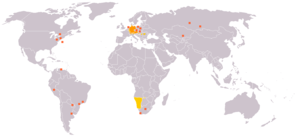
This page contains IPA phonetic symbols in Unicode. Without proper rendering support, you may see question marks, boxes, or other symbols instead of Unicode characters. German (Deutsch [ˈdɔʏtʃ] (
 listen)) is a West Germanic language, related to and classified alongside English and Dutch. With an estimated 90[1] – 98 million[2] native speakers, German is one of the world's major languages and is the most widely-spoken first language in the European Union.
Contents
Geographic distribution
Europe
Main article: German-speaking EuropeFurther information: German as a minority languageGerman is primarily spoken in Germany (where it is the first language for more than 95% of the population), Austria (89%), Switzerland (65%), the majority of Luxembourg, and Liechtenstein - the latter princedom being the only state with German as only official and spoken language.
Other European German-speaking communities are found in Northern Italy (in South Tyrol and in some municipalities in other provinces), in the East Cantons of Belgium, in the French regions of Alsace and Lorraine, and in some border villages of the former South Jutland County of Denmark.
German-speaking communities can also be found in parts of the Czech Republic, Slovakia, Hungary, Poland, Romania, Serbia, Russia and Kazakhstan. In Russia, forced expulsions after World War II and massive emigration to Germany in the 1980s and 1990s have depopulated most of these communities.
Overseas
Main article: German diaspora Examples of German language in Namibian everyday life
German-speaking communities can be found in the former German colony of Namibia, independent from South Africa since 1990, as well as in the other countries of German emigration such as the US, Canada, Mexico, Dominican Republic, Brazil, Argentina, Paraguay, Uruguay, Chile, Peru, Venezuela (where the dialect Alemán Coloniero developed), South Africa and Australia. In Namibia, German Namibians retain German educational institutions.
Large numbers of people with full or significant German ancestry are found in the United States (approx. 50 million),[16] Brazil (est. 5 million)[17] and Canada (approx. 3 million).[18] In Brazil the largest concentrations of German speakers are in Rio Grande do Sul (where Riograndenser Hunsrückisch developed), Santa Catarina, Paraná, São Paulo and Espírito Santo. There are also important concentrations of German-speaking descendants in Argentina, Venezuela, Paraguay and Chile. In the 20th century, over 100,000 German political refugees and invited entrepreneurs settled in Latin America, in countries such as Costa Rica, Panama, Venezuela, and the Dominican Republic, to establish German-speaking enclaves, and reportedly there is a small German immigration to Puerto Rico. Nearly all inhabitants of the city of Pomerode in the state of Santa Catarina in Brazil can speak German. However, in most other locations where German immigrants settled, the vast majority of their descendents no longer speak German, as they have been largely assimilated into the host language and culture of the specific location of settlement; generally English in North America, and Spanish, or Portuguese in Latin America.
Country German speaking population (outside Europe)[19]  USA
USA5,000,000  Brazil
3,000,000  Argentina
500,000  Canada
450,000[19] – 620,000[20]  Australia
110,000  South Africa
75,000 (German expatriate citizens alone)[19]  Bolivia
60,000[citation needed]  Chile
Chile40,000  Paraguay
30,000 – 40,000 Namibia30,000 (German expatriate citizens alone)[19]  Mexico
10,000  Venezuela
10,000  See also: Pennsylvania German, Plautdietsch, and Hutterite German
The United States has one of the largest concentrations of German speakers outside Europe. The states of North Dakota and South Dakota are the only states where German is the most common language spoken at home after English (the second most spoken language in other states is either Spanish or French).[21] An indication of the German presence can be found in the names of such places as New Ulm and many other towns in Minnesota; Bismarck (state capital), Munich, Karlsruhe, and Strasburg in North Dakota; New Braunfels and Muenster in Texas; and Kiel, Berlin and Germantown in Wisconsin.
Between 1843 and 1910, more than 5 million Germans emigrated overseas,[22] mostly to the United States.[23] Over the course of the 20th century many of the descendants of 18th century and 19th century immigrants ceased speaking German at home, but small populations of elderly (as well as some younger) speakers can be found in Pennsylvania (Amish, Hutterites, Dunkards and some Mennonites historically spoke Hutterite German and a West Central German variety of Pennsylvania Dutch), Kansas (Mennonites and Volga Germans), North Dakota (Hutterite Germans, Mennonites, Russian Germans, Volga Germans, and Baltic Germans), South Dakota, Montana, Texas (Texas German), Wisconsin, Indiana, Oregon, Louisiana and Oklahoma. A significant group of German Pietists in Iowa formed the Amana Colonies and continue to practice speaking their heritage language. Early twentieth century immigration was often to St. Louis, Chicago, New York, Milwaukee, Pittsburgh and Cincinnati.
In Canada, there are 622,650 speakers of German according to the most recent census in 2006,[20] while people of German ancestry (German Canadians) are found throughout the country. German-speaking communities are particularly found in British Columbia (118,035) and Ontario (230,330).[20] There is a large and vibrant community in the city of Kitchener, Ontario, which was at one point named Berlin. German immigrants were instrumental in the country's three largest urban areas: Montreal, Toronto, and Vancouver; while post-Second World War immigrants managed to preserve a fluency in the German language in their respective neighborhoods and sections. In the first half of the 20ᵗʰ century, over a million German-Canadians made the language Canada's third most spoken after French and English.
In Mexico there are also large populations of German ancestry, mainly in the cities of: Mexico City, Puebla, Mazatlán, Tapachula, and larger populations scattered in the states of Chihuahua, Durango, and Zacatecas. German ancestry is also said to be found in neighboring towns around Guadalajara, Jalisco and much of Northern Mexico, where German influence was immersed into the Mexican culture. Standard German is spoken by the affluent German communities in Puebla, Mexico City, Nuevo León, San Luis Potosí and Quintana Roo.
The dialects of German which are or were primarily spoken in colonies or communities founded by German-speaking people resemble the dialects of the regions the founders came from. For example, Pennsylvania German resembles Palatinate German dialects, and Hutterite German resembles dialects of Carinthia. Texas German is a dialect spoken in the areas of Texas settled by the Adelsverein, such as New Braunfels and Fredericksburg. In the Amana Colonies in the state of Iowa, Amana German is spoken. Plautdietsch is a large minority language spoken in Northern Mexico by the Mennonite communities, and is spoken by more than 200,000 people in Mexico. Pennsylvania Dutch is a dialect of German spoken by the Amish population of Pennsylvania, Indiana, and Ohio.
Hutterite German is an Upper German dialect of the Austro-Bavarian variety of the German language, which is spoken by Hutterite communities in Canada and the United States. Hutterite is spoken in the U.S. states of Washington, Montana, North Dakota, South Dakota, and Minnesota; and in the Canadian provinces of Alberta, Saskatchewan and Manitoba. Its speakers belong to some Schmiedleit, Lehrerleit, and Dariusleit Hutterite groups, but there are also speakers among the older generations of Prairieleit (the descendants of those Hutterites who chose not to settle in colonies). Hutterite children who grow up in the colonies learn and speak first Hutterite German before learning English in the public school, the standard language of the surrounding areas. Many colonies, though, continue with German Grammar School, separate from the public school, throughout a student's elementary education.
In Australia, the state of South Australia experienced a pronounced wave of Germans arriving in the 1840s from Prussia (particularly the Silesia region). With the prolonged isolation from other German speakers and contact with Australian English some have suggested a unique dialect formed known as Barossa German spoken predominantly in the Barossa Valley near Adelaide. Usage sharply declined with the advent of World War I, the prevailing anti-German sentiment in the population and related government action. It continued to be used as a first language into the twentieth century but now its use is limited to a few older speakers.
There is also an important German creole being studied and recovered, named Unserdeutsch, spoken in the former German colony of Papua New Guinea, across Micronesia and in northern Australia (i.e. coastal parts of Queensland and Western Australia), by a few elderly people. The risk of its extinction is serious and efforts to revive interest in the language are being implemented by scholars.
Internet
According to Global Reach (2004), 6.9% of the Internet population is German.[24][25] According to Netz-tipp (2002), 7.7% of webpages are written in German,[26] making it second only to English in the European language group. They also report that 12% of Google's users use its German interface.[26]
Some older statistics included in 1998 Babel found somewhat similar demographics.[27] FUNREDES[28] (1998) and Vilaweb[29] (2000) both found that German is the third most popular language used by websites, after English and Japanese.
History
Main article: History of German The Germanic-speaking area of the Holy Roman Empire around 962.
Origins
The history of the language begins with the High German consonant shift during the migration period, separating Old High German dialects from Old Saxon. The earliest testimonies of Old High German are from scattered Elder Futhark inscriptions, especially in Alemannic, from the 6th century AD; the earliest glosses (Abrogans) date to the 8th; and the oldest coherent texts (the Hildebrandslied, the Muspilli and the Merseburg Incantations) to the 9th century. Old Saxon at this time belongs to the North Sea Germanic cultural sphere, and Low Saxon was to fall under German rather than Anglo-Frisian influence during the Holy Roman Empire.
As Germany was divided into many different states, the only force working for a unification or standardization of German during a period of several hundred years was the general preference of writers trying to write in a way that could be understood in the largest possible area.
Modern German
When Martin Luther translated the Bible (the New Testament in 1522 and the Old Testament, published in parts and completed in 1534), he based his translation mainly on the bureaucratic standard language used in Saxony (sächsische Kanzleisprache), also known as Meißner-Deutsch (German from the city of Meissen). This language was based on Eastern Upper and Eastern Central German dialects and preserved much of the grammatical system of Middle High German (unlike the spoken German dialects in Central and Upper Germany, which already at that time began to lose the genitive case and the preterit). In the beginning, copies of the Bible had a long list for each region, which translated words unknown in the region into the regional dialect. Roman Catholics rejected Luther's translation in the beginning and tried to create their own Catholic standard (gemeines Deutsch) — which, however, differed from "Protestant German" only in some minor details. It took until the middle of the 18th century to create a standard that was widely accepted, thus ending the period of Early New High German.
 Ethno-linguistic map of Austria–Hungary, 1910.
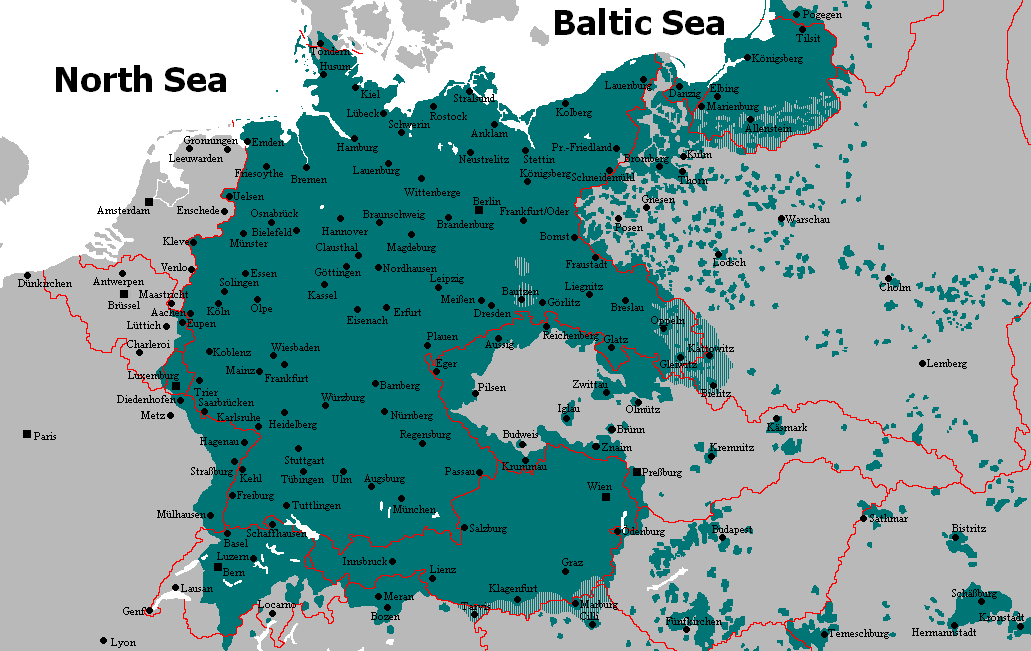
 German language and ethnicity in central Europe, 1929.
Until about 1800, standard German was almost only a written language. At this time, people in urban northern Germany, who spoke dialects very different from Standard German, learned it almost like a foreign language and tried to pronounce it as closely to the spelling as possible. Prescriptive pronunciation guides used to consider northern German pronunciation to be the standard. However, the actual pronunciation of Standard German varies from region to region.
German was the language of commerce and government in the Habsburg Empire, which encompassed a large area of Central and Eastern Europe. Until the mid-19th century it was essentially the language of townspeople throughout most of the Empire. It indicated that the speaker was a merchant, an urbanite, not their nationality. Some cities, such as Prague (German: Prag) and Budapest (Buda, German: Ofen), were gradually Germanized in the years after their incorporation into the Habsburg domain. Others, such as Bratislava (German: Pressburg), were originally settled during the Habsburg period and were primarily German at that time. A few cities such as Milan (German: Mailand) remained primarily non-German. However, most cities were primarily German during this time, such as Prague, Budapest, Bratislava, Zagreb (German: Agram), and Ljubljana (German: Laibach), though they were surrounded by territory that spoke other languages.
In 1901, the 2nd Orthographical Conference ended with a complete standardization of German language in its written form while the Deutsche Bühnensprache (literally, German stage language) had already established rules for German three years earlier, which were later to become obligatory for general German pronunciation[citation needed].
Media and written works are now almost all produced in Standard German (often called Hochdeutsch in German) which is understood in all areas where German is spoken.
The first dictionary of the Brothers Grimm, the 16 parts of which were issued between 1852 and 1860, remains the most comprehensive guide to the words of the German language. In 1860, grammatical and orthographic rules first appeared in the Duden Handbook. In 1901, this was declared the standard definition of the German language. Official revisions of some of these rules were not issued until 1998, when the German spelling reform of 1996 was officially promulgated by governmental representatives of all German-speaking countries. Since the reform, German spelling has been in an eight-year transitional period[dated info] during which the reformed spelling is taught in most schools, while traditional and reformed spellings co-exist in the media. See German spelling reform of 1996 for an overview of the public debate concerning the reform, with some major newspapers and magazines and several known writers refusing to adopt it.
Reform of 1996 and beyond
The German spelling reform of 1996 led to public controversy and considerable dispute. Some states (Bundesländer) would not accept it (North Rhine Westphalia and Bavaria). The dispute landed at one point in the highest court, which made a short issue of it, claiming that the states had to decide for themselves and that only in schools could the reform be made the official rule—everybody else could continue writing as they had learned it. After 10 years, without any intervention by the federal parliament, a major revision was installed in 2006, just in time for the coming school year. In 2007, some traditional spellings were finally invalidated. The only sure and easily recognizable symptom of a text's being in compliance with the reform is the -ss at the end of words, such as dass and muss. Classic spelling forbade this ending, instead using daß and muß. The cause of the controversy evolved around the question of whether a language is part of the culture which must be preserved or a means of communicating information which has to allow for growth.
Standard German
Main article: Standard German The national and regional standard varieties of the German language.[30]
Standard German originated not as a traditional dialect of a specific region, but as a written language. However, there are places where the traditional regional dialects have been replaced by standard German; this is the case in vast stretches of Northern Germany, but also in major cities in other parts of the country.
Standard German differs regionally, between German-speaking countries, in vocabulary and some instances of pronunciation, and even grammar and orthography. This variation must not be confused with the variation of local dialects . Even though the regional varieties of standard German are only to a certain degree influenced by the local dialects, they are very distinct. German is thus considered a pluricentric language.
In most regions, the speakers use a continuum of mixtures from more dialectal varieties to more standard varieties according to situation.
In the German-speaking parts of Switzerland, mixtures of dialect and standard are very seldom used, and the use of standard German is largely restricted to the written language. Therefore, this situation has been called a medial diglossia. Swiss Standard German is used in the Swiss, Austrian Standard German officially in the Austrian education system.
Official status
Standard German is the only official language in Liechtenstein; it shares official status in Germany (with Danish, Frisian, Romany and Sorbian as minority languages), in Austria (with Slovene, Croatian, and Hungarian), Switzerland (with French, Italian and Romansh), Belgium (with Dutch (Flemish) and French) and Luxembourg (with French and Luxembourgish). It is used as an official regional language in Italy (South Tyrol), as well as in the cities of Sopron (Hungary), Krahule (Slovakia) and several cities in Romania. It is the official command language (with Italian) of the Vatican Swiss Guard.
German has an officially recognized status as regional or auxiliary language in Denmark[31] (South Jutland region), Italy (Gressoney valley)[citation needed], Namibia, Poland (Opole region), and Russia[citation needed] (Asowo and Halbstadt).
German is one of the 23 official languages of the European Union. It is the language with the largest number of native speakers in the European Union, and is the second-most spoken language in Europe, just behind English and ahead of French.
German as a foreign language
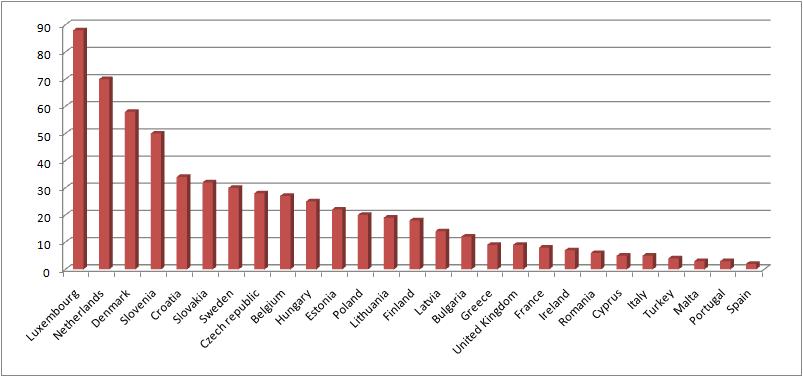
Main article: German as a foreign language Knowledge of the German language in Europe.
 Knowledge of German as a foreign language (second language in Luxembourg) in the EU member states (+Croatia and Turkey), in per cent of the adult population (+15), 2005.
 Distribution of the native speakers of major continental West-Germanic dialectal varieties.[citation needed]
German is the third-most taught foreign language in the English-speaking world, after French and Spanish.[32]
German is the main language of about 90[1] – 98 million[2] million people in Europe (as of 2004), or 13.3% of all Europeans, being the second most spoken native language in Europe after Russian, above French (66.5 million speakers in 2004) and English (64.2 million speakers in 2004). It is therefore the most spoken first language in the EU. It is the second most known foreign language in the EU.[33] It is one of the official languages of the European Union, and one of the three working languages of the European Commission, along with English and French. Thirty-two percent of citizens of the EU-15 countries say they can converse in German (either as a mother tongue or as a second or foreign language).[34] This is assisted by the widespread availability of German TV by cable or satellite.
German was once, and still remains to some extent, a lingua franca in Central, Eastern, and Northern Europe.[citation needed]
Dialects
Main article: German dialectsGerman is a member of the western branch of the Germanic family of languages, which in turn is part of the Indo-European language family. The German dialect continuum is traditionally divided most broadly into High German and Low German.
The variation among the German dialects is considerable, with only the neighboring dialects being mutually intelligible. Some dialects are not intelligible to people who only know standard German. However, all German dialects belong to the dialect continuum of High German and Low Saxon languages.
Low German
Main article: Low GermanMiddle Low German was the lingua franca of the Hanseatic League. It was the predominant language in Northern Germany. This changed in the 16th century, when in 1534 the Luther Bible by Martin Luther was printed. This translation is considered to be an important step towards the evolution of the Early New High German. It aimed to be understandable to a broad audience and was based mainly on Central and Upper German varieties. The Early New High German language gained more prestige than Low German and became the language of science and literature. Other factors were that around the same time, the Hanseatic league lost its importance as new trade routes to Asia and the Americas were established, and that the most powerful German states of that period were located in Middle and Southern Germany.
The 18th and 19th centuries were marked by mass education of Standard German in schools. Slowly, Low German was pushed back and back until it was nothing but a language spoken by the uneducated and at home. Today Low Saxon can be divided in two groups: Low Saxon varieties with a reasonable standard German influx and varieties of Standard German with a Low Saxon influence known as Missingsch. Sometimes, Low Saxon and Low Franconian varieties are grouped together because both are unaffected by the High German consonant shift. However, the part of the population capable of speaking and responding to it, or of understanding it has decreased continuously since World War II.
High German
Main article: High German languagesHigh German is divided into Central German, High Franconian (a transitional dialect), and Upper German. Central German dialects include Ripuarian, Moselle Franconian, Rhine Franconian, Central Hessian, East Hessian, North Hessian, Thuringian, Silesian German, Lorraine Franconian, Mittelalemannisch, North Upper Saxon, High Prussian, Lausitzisch-Neumärkisch and Upper Saxon. It is spoken in the southeastern Netherlands, eastern Belgium, Luxembourg, parts of France, and parts of Germany approximately between the River Main and the southern edge of the Lowlands. Modern Standard German is mostly based on Central German, but it should be noted that the common (but not linguistically correct) German term for modern Standard German is Hochdeutsch, that is, High German.
The Moselle Franconian varieties spoken in Luxembourg have been officially standardised and institutionalised and are therefore usually considered a separate language known as Luxembourgish.
The two High Franconian dialects are East Franconian and South Franconian.
Upper German dialects include Northern Austro-Bavarian, Central Austro-Bavarian, Southern Austro-Bavarian, Swabian, East Franconian, High Alemannic German, Highest Alemannic German, Alsatian and Low Alemannic German. They are spoken in parts of the Alsace, southern Germany, Liechtenstein, Austria, and the German-speaking parts of Switzerland and Italy.
Wymysorys is a High German dialect of Poland, and Sathmarisch and Siebenbürgisch are High German dialects of Romania. The High German varieties spoken by Ashkenazi Jews (mostly in the former Soviet Union) have several unique features, and are usually considered as a separate language, Yiddish. It is the only Germanic language that does not use the Latin alphabet as its standard script.
German dialects versus varieties of standard German
In German linguistics, German dialects are distinguished from varieties of standard German.
- The German dialects are the traditional local varieties. They are traditionally traced back to the different German tribes. Many of them are hardly understandable to someone who knows only standard German, since they often differ from standard German in lexicon, phonology and syntax. If a narrow definition of language based on mutual intelligibility is used, many German dialects are considered to be separate languages (for instance in the Ethnologue). However, such a point of view is unusual in German linguistics.
- The varieties of standard German refer to the different local varieties of the pluricentric standard German. They only differ slightly in lexicon and phonology. In certain regions, they have replaced the traditional German dialects, especially in Northern Germany.
Grammar
Main article: German grammarGerman grammar Nouns
Verbs
Articles
Adjectives
Pronouns
Adverbial phrases
Conjugation
Sentence structure
Declension
Modal particleGerman is an inflected language with three grammatical genders; as such, there can be a large number of words derived from the same root.
Noun inflection
German nouns inflect into:
- one of four cases: nominative, genitive, dative, and accusative.
- one of three genders: masculine, feminine, or neuter. Word endings sometimes reveal grammatical gender; for instance, nouns ending in ...ung (ing), ...schaft (-ship), ...keit or ...heit (-hood) are feminine, while nouns ending in ...chen or ...lein (diminutive forms) are neuter and nouns ending in ...ismus (-ism) are masculine. Others are controversial, sometimes depending on the region in which it is spoken. Additionally, ambiguous endings exist, such as ...er (-er), e.g. Feier (feminine), Eng. celebration, party, Arbeiter (masculine), Eng. labourer, and Gewitter (neuter), Eng. thunderstorm.
- two numbers: singular and plural
Although German is usually cited as an outstanding example of a highly inflected language, the degree of inflection is considerably less than in Old High German or in other old Indo-European languages such as Latin, Ancient Greek, or Sanskrit, or, for instance, in modern Icelandic or Russian. The three genders have collapsed in the plural, which now behaves, grammatically, somewhat as a fourth gender. With four cases and three genders plus plural there are 16 distinct possible combinations of case and gender/number, but presently there are only six forms of the definite article used for the 16 possibilities. Inflection for case on the noun itself is required in the singular for strong masculine and neuter nouns in the genitive and sometimes in the dative. Both of these cases are losing way to substitutes in informal speech. The dative ending is considered somewhat old-fashioned in many contexts and often dropped, but it is still used in sayings and in formal speech or in written language. Weak masculine nouns share a common case ending for genitive, dative and accusative in the singular. Feminines are not declined in the singular. The plural does have an inflection for the dative. In total, seven inflectional endings (not counting plural markers) exist in German: -s, -es, -n, -ns, -en, -ens, -e.
In the German orthography, nouns and most words with the syntactical function of nouns are capitalised, which is supposed to make it easier for readers to find out what function a word has within the sentence (Am Freitag ging ich einkaufen. — "On Friday I went shopping."; Eines Tages kreuzte er endlich auf. — "One day he finally showed up.") This convention is almost unique to German today (shared perhaps only by the closely related Luxemburgish language and several insular dialects of the North Frisian language), although it was historically common in other languages such as Danish and English.
Like most Germanic languages, German forms noun compounds where the first noun modifies the category given by the second, for example: Hundehütte (Eng. dog hut; specifically: doghouse). Unlike English, where newer compounds or combinations of longer nouns are often written in open form with separating spaces, German (like the other German languages) nearly always uses the closed form without spaces, for example: Baumhaus (Eng. tree house). Like English, German allows arbitrarily long compounds, but these are rare. (See also English compounds.)
The longest German word verified to be actually in (albeit very limited) use is Rindfleischetikettierungsüberwachungsaufgabenübertragungsgesetz, which, literally translated, is "beef labelling supervision duty assignment law" [from Rind (cattle), Fleisch (meat), Etikettierung(s) (labelling), Überwachung(s) (supervision), Aufgaben (duties), Übertragung(s) (assignment), Gesetz (law)].
Verb inflection
Main article: German verbsStandard German verbs inflect into:
- one of primarily two conjugation classes: weak and strong (as in English). Additionally, there is a third class, known as mixed verbs, which exhibit inflections combining features of both the strong and weak patterns.
- three persons: 1st, 2nd, 3rd.
- two numbers: singular and plural
- three moods: indicative, imperative, subjunctive
- two voices: active and passive; the passive being composed and dividable into static and dynamic.
- two non-composed tenses (present, preterite) and four composed tenses (perfect, pluperfect, future and future perfect)
- distinction between grammatical aspects is rendered by combined use of subjunctive and/or preterite marking; thus: neither of both is plain indicative voice, sole subjunctive conveys second-hand information, subjunctive plus preterite marking forms the conditional state, and sole preterite is either plain indicative (in the past), or functions as a (literal) alternative for either second-hand-information or the conditional state of the verb, when one of them may seem indistinguishable otherwise.
- distinction between perfect and progressive aspect is and has at every stage of development been at hand as a productive category of the older language and in nearly all documented dialects, but, strangely enough, is nowadays rigorously excluded from written usage in its present normalised form.
- disambiguation of completed vs. uncompleted forms is widely observed and regularly generated by common prefixes (blicken - to look, erblicken - to see [unrelated form: sehen - to see]).
Verb prefixes
The meaning of base verbs can be expanded, and sometimes radically changed, through the use of any number of prefixes. Some prefixes have a meaning themselves; the prefix zer- refers to the destruction of things, as in zerreißen (to tear apart), zerbrechen (to break apart), zerschneiden (to cut apart). Others do not have more than the vaguest meaning in and of themselves; the use of ver- is found in a number of verbs with a large variety of meanings, as in versuchen (to try), vernehmen (to interrogate), verteilen (to distribute), verstehen (to understand).
Other examples include haften (to stick), verhaften (to detain); kaufen (to buy), verkaufen (to sell); hören (to hear), aufhören (to cease); fahren (to drive), erfahren (to experience).
Separable prefixes
Many German verbs have a separable prefix, often with an adverbial function. In finite verb forms this is split off and moved to the end of the clause, and is hence considered by some to be a "resultative particle". For example, mitgehen meaning "to go along" would be split, giving Gehen Sie mit? (Literal: "Go you with?" ; Formal: "Are you going along?").
Indeed, several parenthetical clauses may occur between the prefix of a finite verb and its complement; e.g.
- Er kam am Freitagabend nach einem harten Arbeitstag und dem üblichen Ärger, der ihn schon seit Jahren immer wieder an seinem Arbeitsplatz plagt, mit fraglicher Freude auf ein Mahl, das seine Frau ihm, wie er hoffte, bereits aufgetischt hatte, endlich zu Hause an .
A literal translation of this example might look like this:
- He -rived on Friday evening, after a hard day at work and the usual annoyances that had been repeatedly troubling him for years now at his workplace, with questionable joy, to a meal which, as he hoped, his wife had already served him, finally at home ar-.
Word order
Word order is generally less rigid than in Modern English. There are two common word orders: one is for main clauses and another for subordinate clauses. In normal affirmative sentences the inflected verb always has position 2. In polar questions, exclamations, and wishes it always has position 1. In subordinate clauses the verb is supposed to occur at the very end, but in speech this rule is often disregarded.
German requires that a verbal element (main verb or auxiliary verb) appear second in the sentence. The verb is preceded by the topic of the sentence. The element in focus appears at the end of the sentence. For a sentence without an auxiliary this gives, amongst other options:
- Der alte Mann gab mir gestern das Buch. (The old man gave me yesterday the book; normal order)
- Das Buch gab mir gestern der alte Mann. (The book gave [to] me yesterday the old man)
- Das Buch gab der alte Mann mir gestern. (The book gave the old man [to] me yesterday)
- Gestern gab mir der alte Mann das Buch. (Yesterday gave [to] me the old man the book, normal order)
- Mir gab der alte Mann das Buch gestern. ([To] me gave the old man the book yesterday (entailing: as for you, it was another date))
The position of a noun in a German sentence has no bearing on its being a subject, an object, or another argument. In a declarative sentence in English if the subject does not occur before the predicate the sentence could well be misunderstood. This is not the case in German.
Auxiliary verbs
When an auxiliary verb is present, the auxiliary appears in second position, and the main verb appears at the end. This occurs notably in the creation of the perfect. Many word orders are still possible, e.g.:
- Der alte Mann hat mir heute das Buch gegeben. (The old man has given me the book today.)
- Das Buch hat der alte Mann mir heute gegeben. (The book has the old man given me today.)
- Heute hat der alte Mann mir das Buch gegeben. (Today the old man has given me the book.)
Modal verbs
Sentences using modal verbs place the infinitive at the end. For example, the sentence in Modern English "Should he go home?" would be rearranged in German to say "Should he (to) home go?" (Soll er nach Hause gehen?). Thus in sentences with several subordinate or relative clauses the infinitives are clustered at the end. Compare the similar clustering of prepositions in the following English sentence: "What did you bring that book which I don't like to be read to out of up for?"
Multiple infinitives
German subordinate clauses have all verbs clustered at the end. Given that auxiliaries encode future, passive, modality, and the perfect, this can lead to very long chains of verbs at the end of the sentence. In these constructions, the past participle in ge- is often replaced by the infinitive.
Man nimmt an, dass der Deserteur wohl erschossenV wordenpsv seinperf solltemod
One suspects that the deserter probably shot become be should
("It is suspected that the deserter probably should have been shot")The order at the end of such strings is subject to variation, though the latter version is unusual.
Er wusste nicht, dass der Agent einen Nachschlüssel hatte machen lassen
He knew not that the agent a picklock had make letEr wusste nicht, dass der Agent einen Nachschlüssel machen lassen hatte
He knew not that the agent a picklock make let had("He did not know that the agent had had a picklock made")
Vocabulary
Most German vocabulary is derived from the Germanic branch of the Indo-European language family, although there are significant minorities of words derived from Latin and Greek, and a smaller amount from French[35] and most recently English.[36] At the same time, the effectiveness of the German language in forming equivalents for foreign words from its inherited Germanic stem repertory is great.[citation needed] Thus, Notker Labeo was able to translate Aristotelian treatises in pure (Old High) German in the decades after the year 1000. Overall, German has fewer Romance-language loanwords than English or even Dutch.[citation needed]
The coining of new, autochthonous words gave German a vocabulary of an estimated 40,000 words as early as the ninth century.[citation needed] In comparison, Latin, with a written tradition of nearly 2,500 years in an empire which ruled the Mediterranean, has grown to no more than 45,000 words today.[citation needed]
Even today, many low-key non-academic movements try to promote the Ersatz (substitution) of virtually all foreign words with ancient, dialectal, or neologous German alternatives.[37] It is claimed that this would also help in spreading modern or scientific notions among the less educated, and thus democratise public life, too.
The modern German scientific vocabulary has nine million words and word groups (based on the analysis of 35 million sentences of a corpus in Leipzig, which as of July 2003 included 500 million words in total).[38]
Orthography
Main articles: German orthography and German alphabetGerman is written in the Latin alphabet. In addition to the 26 standard letters, German has three vowels with Umlaut, namely ä, ö and ü, as well as the Eszett or scharfes s (sharp s), ß.
Written texts in German are easily recognisable as such by distinguishing features such as umlauts and certain orthographical features—German is the only major language that capitalizes all nouns—and the frequent occurrence of long compounds (the longest German word is made of 79 characters).
Present
Before the German spelling reform of 1996, ß replaced ss after long vowels and diphthongs and before consonants, word-, or partial-word-endings. In reformed spelling, ß replaces ss only after long vowels and diphthongs. Since there is no capital ß, it is always written as SS when capitalization is required. For example, Maßband (tape measure) is capitalized MASSBAND. An exception is the use of ß in legal documents and forms when capitalizing names. To avoid confusion with similar names, a "ß" is to be used instead of "SS". (So: "KREßLEIN" instead of "KRESSLEIN".) A capital ß has been proposed and included in Unicode, but it is not yet recognized as standard German. In Switzerland, ß is not used at all.
Umlaut vowels (ä, ö, ü) are commonly transcribed with ae, oe, and ue if the umlauts are not available on the keyboard used. In the same manner ß can be transcribed as ss. Some Operating Systems use key sequences to extend the set of possible characters to include, amongst other things, umlauts; in Microsoft Windows this is done using Alt codes. German readers understand those transcriptions (although they look unusual), but they are avoided if the regular umlauts are available because they are considered a makeshift, not proper spelling. (In Westphalia and Schleswig-Holstein, city and family names exist where the extra e has a vowel lengthening effect, e.g. Raesfeld [ˈraːsfɛlt], Coesfeld [ˈkoːsfɛlt] and Itzehoe [ɪtsəˈhoː], but this use of the letter e after a/o/u does not occur in the present-day spelling of words other than proper nouns.)
There is no general agreement on where these umlauts occur in the sorting sequence. Telephone directories treat them by replacing them with the base vowel followed by an e. Some dictionaries sort each umlauted vowel as a separate letter after the base vowel, but more commonly words with umlauts are ordered immediately after the same word without umlauts. As an example in a telephone book Ärzte occurs after Adressenverlage but before Anlagenbauer (because Ä is replaced by Ae). In a dictionary Ärzte comes after Arzt, but in some dictionaries Ärzte and all other words starting with "Ä" may occur after all words starting with "A". In some older dictionaries or indexes, initial Sch and St are treated as separate letters and are listed as separate entries after S, but they are usually treated as S+C+H and S+T.
Written German also typically uses an alternative opening inverted comma (quotation mark) as in „Guten Morgen!”.
Past
Further information: 2nd Orthographic Conference (German), Antiqua-Fraktur dispute, German orthography reform of 1944, and German orthography reform of 1996Until the early twentieth century, German was mostly printed in blackletter typefaces (mostly in Fraktur, but also in Schwabacher) and written in corresponding handwriting (for example Kurrent and Sütterlin). These variants of the Latin alphabet are very different from the serif or sans serif Antiqua typefaces used today, and particularly the handwritten forms are difficult for the untrained to read. The printed forms however were claimed by some to be actually more readable when used for printing Germanic languages.[39] The Nazis initially promoted Fraktur and Schwabacher since they were considered Aryan, although they later abolished them in 1941 by claiming that these letters were Jewish. The Fraktur script remains present in everyday life through road signs, pub signs, beer brands and other forms of advertisement, where it is used to convey a certain rusticality and oldness.
A proper use of the long s, (langes s), ſ, is essential to write German text in Fraktur typefaces. Many Antiqua typefaces include the long s, also. A specific set of rules applies for the use of long s in German text, but it is rarely used in Antiqua typesetting, recently. Any lower case "s" at the beginning of a syllable would be a long s, as opposed to a terminal s or short s (the more common variation of the letter s), which marks the end of a syllable; for example, in differentiating between the words Wachſtube (=guard-house) and Wachstube (=tube of floor polish). One can decide which "s" to use by appropriate hyphenation, easily ("Wach-ſtube" vs. "Wachs-tube"). The long s only appears in lower case.
Phonology
Spoken German in Goethe's FaustMain article: German phonologyVowels
German vowels (excluding diphthongs; see below) come in short and long varieties, as detailed in the following table:
A Ä E I O Ö U Ü short /a/ /ɛ/ /ɛ/, /ə/ /ɪ/ /ɔ/ /œ/ /ʊ/ /ʏ/ long /aː/ /ɛː/ /eː/ /iː/ /oː/ /øː/ /uː/ /yː/ Short /ɛ/ is realized as [ɛ] in stressed syllables (including secondary stress), but as [ə] in unstressed syllables. Note that stressed short /ɛ/ can be spelled either with e or with ä (hätte 'would have' and Kette 'chain', for instance, rhyme). In general, the short vowels are open and the long vowels are closed. The one exception is the open /ɛː/ sound of long Ä; in some varieties of standard German, /ɛː/ and /eː/ have merged into [eː], removing this anomaly. In that case, pairs like Bären/Beeren 'bears/berries' or Ähre/Ehre 'spike (of wheat)/honour' become homophonous.
In many varieties of standard German, an unstressed /ɛr/ is not pronounced [ər], but vocalised to [ɐ].
Whether any particular vowel letter represents the long or short phoneme is not completely predictable, although the following regularities exist:
- If a vowel (other than i) is at the end of a syllable or followed by a single consonant, it is usually pronounced long (e.g. Hof [hoːf]).
- If the vowel is followed by a double consonant (e.g. ff, ss or tt), ck, tz or a consonant cluster (e.g. st or nd), it is nearly always short (e.g. hoffen [ˈhɔfən]). Double consonants are used only for this function of marking preceding vowels as short; the consonant itself is never pronounced lengthened or doubled, in other words this is not a feeding order of gemination and then vowel shortening.
Both of these rules have exceptions (e.g. hat [hat] 'has' is short despite the first rule; Mond [moːnt], 'moon' is long despite the second rule). For an i that is neither in the combination ie (making it long) nor followed by a double consonant or cluster (making it short), there is no general rule. In some cases, there are regional differences: In central Germany (Hessen), the o in the proper name "Hoffmann" is pronounced long while most other Germans would pronounce it short; the same applies to the e in the geographical name "Mecklenburg" for people in that region. The word Städte 'cities', is pronounced with a short vowel [ˈʃtɛtə] by some (Jan Hofer, ARD Television) and with a long vowel [ˈʃtɛːtə] by others (Marietta Slomka, ZDF Television). Finally, a vowel followed by ch can be short (Fach [fax] 'compartment', Küche [ˈkʏçə] 'kitchen') or long (Suche [ˈzuːxə] 'search', Bücher [ˈbyːçɐ] 'books') almost at random. Thus, Lache is homographous: (Lache) [laːxə] 'puddle' and (lache) [laxə] 'manner of laughing' (coll.), 'laugh!' (Imp.).
German vowels can form the following digraphs (in writing) and diphthongs (in pronunciation); note that the pronunciation of some of them (ei, äu, eu) is very different from what one would expect when considering the component letters:
spelling ai, ei, ay, ey au äu, eu pronunciation /aɪ̯/ /aʊ̯/ /ɔʏ̯/ Additionally, the digraph ie generally represents the phoneme /iː/, which is not a diphthong. In many varieties, an /r/ at the end of a syllable is vocalised. However, a sequence of a vowel followed by such a vocalised /r/ is not considered a diphthong: Bär [bɛːɐ̯] 'bear', er [eːɐ̯] 'he', wir [viːɐ̯] 'we', Tor [toːɐ̯] 'gate', kurz [kʊɐ̯ts] 'short', Wörter [vœɐ̯tɐ] 'words'.
In most varieties of standard German, syllables that begin with a vowel are preceded by a glottal stop [ʔ].
Consonants
With approximately 25 phonemes, the German consonant system exhibits an average number of consonants in comparison with other languages. One of the more noteworthy ones is the unusual affricate /p͡f/. The consonant inventory of the standard language is shown below.
Bilabial Labiodental Alveolar Postalveolar Palatal Velar Uvular Glottal Plosive p3 b4 t3 d4 k3 ɡ4 Affricate pf ts tʃ (dʒ)5 Fricative f v s z ʃ (ʒ)5 x1 h Nasal m n ŋ Approximant l j Rhotic r2 - 1/x/ has two allophones, [x] and [ç], after back and front vowels, respectively.
- 2/r/ has three allophones in free variation: [r], [ʁ] and [ʀ]. In the syllable coda, the allophone [ɐ] is found in many varieties.
- 3 The voiceless stops /p/, /t/, /k/ are aspirated except when preceded by a sibilant.
- 4 The voiced stops /b/, /d/, /ɡ/ are devoiced to /p/, /t/, /k/, respectively, in word-final position.
- 5/d͡ʒ/ and /ʒ/ occur only in words of foreign origin.
- Where a stressed syllable has an initial vowel, it is preceded by [ʔ]. As its presence is predictable from context, [ʔ] is not considered a phoneme.
Consonant spellings
- c standing by itself is not a German letter. In borrowed words, it is usually pronounced [t͡s] (before ä, äu, e, i, ö, ü, y) or [k] (before a, o, u, and consonants). The combination ck is, as in English, used to indicate that the preceding vowel is short.
- ch occurs most often and is pronounced either [ç] (after ä, ai, äu, e, ei, eu, i, ö, ü and consonants; in the diminutive suffix -chen; and at the beginning of a word), [x] (after a, au, o, u), or [k] at the beginning of a word before a, o, u and consonants. Ch never occurs at the beginning of an originally German word. In borrowed words with initial Ch before bright vowels (Chemie "chemistry" etc.), [ç] is considered standard, but is itself practically absent from language in use. Upper Germans and Franconians (in the popular, not linguistic sense) will replace them with [k], as German as a whole does before darker vowels and consonants such as in Charakter, Christentum. Middle Germans (saving Franconians) will borrow a [ʃ] from the French model. Both agree in considering each other's variant, and Upper Germans also the standard in [ç], as particularly awkward and unusual.
- dsch is pronounced [d͡ʒ] (like j in Jungle) but appears in a few loanwords only.
- f is pronounced [f] as in "father".
- h is pronounced [h] as in "home" at the beginning of a syllable. After a vowel it is silent and only lengthens the vowel (e.g. Reh = roe deer).
- j is pronounced [j] in Germanic words (Jahr [jaːɐ]). In younger loanwords, it follows more or less the respective languages' pronunciations.
- l is always pronounced [l], never *[ɫ] (the English "dark L").
- q only exists in combination with u and appears in both Germanic and Latin words (quer; Qualität). The digraph qu is pronounced [kv].
- r is usually pronounced in a guttural fashion (a voiced uvular fricative [ʁ] or uvular trill [ʀ]) in front of a vowel or consonant (Rasen [ˈʁaːzən]; Burg [buʁk]). In spoken German, however, it is commonly vocalised after a vowel (er being pronounced rather like [ˈɛɐ]—Burg [buɐk]). In some varieties, the r is pronounced as a "tongue-tip" r (the alveolar trill [r]).
- s in Germany, is pronounced [z] (as in "zebra") if it forms the syllable onset (e.g. Sohn [zoːn]), otherwise [s] (e.g. Bus [bʊs]). In Austria and Switzerland, it is always pronounced [s]. A ss [s] indicates that the preceding vowel is short. st and sp at the beginning of words of German origin are pronounced [ʃt] and [ʃp], respectively.
- ß (a letter unique to German called scharfes S or Eszett) was a ligature of a double s and of a sz and is always pronounced [s]. Originating in Blackletter typeface, it traditionally replaced ss at the end of a syllable (e.g. ich muss → ich muß; ich müsste → ich müßte); within a word it contrasts with ss [s] in indicating that the preceding vowel is long (compare in Maßen [in ˈmaːsən] "with moderation" and in Massen [in ˈmasən] "in loads"). The use of ß has recently been limited by the latest German spelling reform and is no longer used for ss after a short vowel (e.g. "ich muß" and "ich müßte" were always pronounced with a short U/Ü); Switzerland and Liechtenstein already abolished it in 1934.[40]
- sch is pronounced [ʃ] (like "sh" in "shine").
- tion in Latin loanwords is pronounced [tsion].
- v is pronounced [f] in words of Germanic origin, to wit, Vater [ˈfaːtɐ], Vogel "bird", von "from, of", vor "before, in front of", voll "full" (yet "to fill" is notwithstandingly spelt füllen) and the prefix ver-. It is also used in loanwords, where it is supposed to be pronounced [v]. This pronunciation is retained for example in Vase, Vikar, Viktor, Viper, Ventil, vulgär, and English loanwords; however, pronunciation tends to [f] the further you travel south. They have reached a plain f in Bavaria and Swabia.
- w is pronounced [v] as in "vacation" (e.g. was [vas]).
- y only appears in loanwords and is traditionally considered a vowel.
- z is always pronounced [t͡s] (e.g. zog [t͡soːk]). A tz indicates that the preceding vowel is short.
Consonant shifts
For more details on this topic, see High German consonant shift.German does not have any dental fricatives (as English th). The th sounds, which the English language still has, survived on the continent up to Old High German and then disappeared in German with the consonant shifts between the 8th and the 10th centuries.[41] It is sometimes possible to find parallels between English and German by replacing the English th with d in German: "Thank" → in German "Dank", "this" and "that" → "dies" and "das", "thou" (old 2nd person singular pronoun) → "du", "think" → "denken", "thirsty" → "durstig" and many other examples.
Likewise, the gh in Germanic English words, pronounced in several different ways in modern English (as an f, or not at all), can often be linked to German ch: "to laugh" → "lachen", "through" and "thorough" → "durch", "high" → "hoch", "naught" → "nichts", "light" → "leicht", "sight" → "Sicht" etc.
Cognates with English
A sizable fraction of English vocabulary is cognate with German words, although the common ancestry may be somewhat obscured by various shifts in phonetics (e.g. the High German consonant shift), meaning and orthography.
For example:
- the High German consonant shift *p→ff led to such cognates as German Schiff with English ship.
- Ger. Baum (meaning "tree") is cognate with the English word beam, as may be seen in the name of trees such as the hornbeam and the whitebeam.
Words borrowed by English
For a list of German loanwords to English, see Category:German loanwords.English has taken many loanwords from German, often without any change of spelling:
German word English loanword Meaning of German word Abseilen abseil to descend by rope / to fastrope Angst angst fear Ansatz ansatz onset / entry / math. approach Anschluss anschluss connection / access / annexation Automat automat automation / machine Bildungsroman bildungsroman novel concerned with the personal development or education of the protagonist Blitz Blitz flash / lightning Bratwurst bratwurst fried sausage Delikatessen delikatessen/delicatessen delicate / delicious food items Doppelgänger doppelgänger lit. "double going/living person alive", look-alike of somebody Edelweiß edelweiss edelweiss flower Fest fest feast / celebration Gedankenexperiment Gedankenexperiment thought experiment Geländesprung gelandesprung ski jumping for distance on alpine equipment Gemütlichkeit gemuetlichkeit snug feeling, cosiness, good nature, geniality Gestalt Gestalt form or shape / creature / scheme; refers to a concept of 'wholeness' Gesundheit! Gesundheit! (Amer.) health / bless you! (when someone sneezes) Heiligenschein heiligenschein meteo. "holy shine" / gloriole Hinterland hinterland lit. mil. "area behind the front-line": interior / backwoods kaputt kaput (etymology unclear, possibly French, Yiddish or Latin) out of order, not working Katzenjammer katzenjammer lit. "cats' lament": hangover, crapulence Kindergarten kindergarten lit. "childrens' garden" - nursery or preschool Kitsch kitsch fake art, something produced exclusively for sale Kraut kraut herb, cabbage in some dialects Leitmotiv leitmotif guiding theme (the verb "leiten" means "to guide, to lead") plündern (v.) to plunder lit. "taking goods by force" (original meaning "to take away furniture" shifted in German and was borrowed by English both during the Thirty Years War) Poltergeist poltergeist lit. "rumbling ghost" (artificial compound, not originally German) Realpolitik realpolitik diplomacy based on practical objectives rather than ideals Reich reich empire or realm Rucksack rucksack backpack (Ruck→"Rücken" which means "back") Sauerkraut sauerkraut sour cabbage Schadenfreude schadenfreude taking pleasure in someone else's misfortune Sprachraum sprachraum lit. "place/area/room of a language": area where a certain language is spoken Übermensch ubermensch superhuman verklemmt verklemmt lit. "jammed": inhibited, uptight Waldsterben waldsterben lit. "forest dieback", dying floral environment Wanderlust wanderlust desire, pleasure, or inclination to travel or walk Weltanschauung weltanschauung lit. "perception of the world": ideology Wunderkind wunderkind lit. "wonder child": child prodigy, whiz kid Zeitgeist zeitgeist lit. "spirit of the times": the spirit of the age; the trend at that time Promotion of the German language
The use and learning of the German language are promoted by a number of organisations. The government-backed Goethe Institut[42] (named after the famous German author Johann Wolfgang von Goethe) aims to enhance the knowledge of German culture and language within Europe and the rest of the world. This is done by holding exhibitions and conferences with German-related themes, and providing training and guidance in the learning and use of the German language. For example the Goethe Institut teaches the Goethe-Zertifikat German language qualification.
The German state broadcaster Deutsche Welle is the equivalent of the British BBC World Service and provides radio and television broadcasts in German and a variety of other languages across the globe. Its German language services are tailored for German language learners by being spoken at slow speed. Deutsche Welle also provides an E-learning website to learn German.
See also
- Deutsch (disambiguation page)
- Category:German loanwords
- German as a minority language
- German exonyms
- German family name etymology
- German in the United States
- German language literature
- German name
- German placename etymology
- German spelling reform of 1996
- Germanism (linguistics)
- List of German expressions in English
- List of pseudo-German words adapted to English
- Missingsch
- Names for the German language
- Otto Basler
- Umlaut, ß
- Various terms used for Germans
References
Notes
- ^ a b c Lewis, M. Paul, ed (2009). Ethnologue: Languages of the World (16 ed.). Dallas, Texas: SIL International. http://www.ethnologue.com/show_language.asp?code=deu.
- ^ a b c Marten, Thomas; Sauer, Fritz Joachim, eds (2005) (in German). Länderkunde - Deutschland, Österreich, Schweiz und Liechtenstein im Querschnitt [Regional Geography - An Overview of Germany, Austria, Switzerland and Liechtenstein]. Berlin: Inform-Verlag. p. 7. ISBN 3-9805843-1-3.
- ^ a b National Geographic Collegiate Atlas of the World. Willard, Ohio: R.R Donnelley & Sons Company. April 2006. pp. 257–270. ISBN Regular:0-7922-3662-9, 978-0-7922-3662-7. Deluxe:0-7922-7976-X, 978-0-7922-7976-1.
- ^ "Rat für deutsche Rechtschreibung - Über den Rat". Rechtschreibrat.ids-mannheim.de. http://rechtschreibrat.ids-mannheim.de/rat/. Retrieved 2010-10-11.
- ^ EUROPA - Allgemeine & berufliche Bildung - Regional- und Minderheitensprachen der Europäischen Union - Euromosaik-Studie
- ^ Support from the European Commission for measures to promote and safeguard regional or minority languages and cultures - The Euromosaic sutdy: German in Denmark (engl.). Letzter Zugriff am 13. November 2009
- ^ EC.europa.eu
- ^ "KAZAKHSTAN: Special report on ethnic Germans". Irinnews.org. http://www.irinnews.org/report.aspx?reportid=28051. Retrieved 2010-10-11.
- ^ "Deutsch in Namibia" (in German) (PDF). Supplement of the Allgemeine Zeitung. 2007-08-18. http://www.az.com.na/fileadmin/pdf/2007/deutsch_in_namibia_2007_07_18.pdf. Retrieved 2008-06-23.
- ^ "CIA World Fact book Profile: Namibia" cia.gov'.' Retrieved 2008-11-30.
- ^ "Map on page of Polish Ministry of Interior and Administration (MSWiA)". http://www2.mswia.gov.pl/download.php?s=1&id=944. Retrieved 2010-03-15.
- ^ "SbZ - Deutsche Minderheit in Rumänien: "Zimmerpflanze oder Betreuungs-Objekt" - Informationen zu Siebenbürgen und Rumänien". Siebenbuerger.de. http://www.siebenbuerger.de/zeitung/artikel/alteartikel/223-deutsche-minderheit-in-rumaenien.html. Retrieved 2010-03-15.
- ^ "Geschichte". Rusdeutsch.EU. http://www.rusdeutsch.eu/?menu=1&menu0=38&level3=&z=1. Retrieved 2010-10-11.
- ^ EUROPA - Allgemeine & berufliche Bildung - Regional- und Minderheitensprachen der Europäischen Union - Euromosaik-Studie
- ^ Verein Deutsche Sprache e.V. (2006-06-15). "Verein Deutsche Sprache e.V. - Prominente Mitglieder und Ehrenmitglieder". Vds-ev.de. http://www.vds-ev.de/verein/aha/aha.php. Retrieved 2010-03-15.[dead link]
- ^ "U.S. Census Bureau, 2005 American Community Survey". http://factfinder.census.gov/servlet/IPTable?_bm=y&-reg=ACS_2005_EST_G00_S0201:535;ACS_2005_EST_G00_S0201PR:535;ACS_2005_EST_G00_S0201T:535;ACS_2005_EST_G00_S0201TPR:535&-qr_name=ACS_2005_EST_G00_S0201&-qr_name=ACS_2005_EST_G00_S0201PR&-qr_name=ACS_2005_EST_G00_S0201T&-qr_name=ACS_2005_EST_G00_S0201TPR&-ds_name=ACS_2005_EST_G00_&-TABLE_NAMEX=&-ci_type=A&-redoLog=false&-charIterations=047&-geo_id=01000US&-format=&-_lang=en. Retrieved 28 March 2011. The 1990 census gives 57.9 million, or 23.3% of the U.S. population.
- ^ (Portuguese) A Imigração Alemã no Brasil Deutsche Welle. Retrieved 28 March 2011.
- ^ 2001 Canadian Census gives 2,742,765 total respondents stating their ethnic origin as partly German, with 705,600 stating "single-ancestry". Retrieved 28 March 2011.
- ^ a b c d Handwörterbuch des politischen Systems der Bundesrepublik (in German). Source lists "German expatriate citizens" only for Namibia and South Africa!
- ^ a b c "Statistics Canada 2006". 2.statcan.ca. 2010-01-06. http://www12.statcan.ca/english/census06/data/topics/RetrieveProductTable.cfm?ALEVEL=3&APATH=3&CATNO=&DETAIL=0&DIM=&DS=99&FL=0&FREE=0&GAL=0&GC=99&GK=NA&GRP=1&IPS=&METH=0&ORDER=1&PID=89189&PTYPE=88971&RL=0&S=1&ShowAll=No&StartRow=1&SUB=705&Temporal=2006&Theme=70&VID=0&VNAMEE=&VNAMEF=&GID=837928. Retrieved 2010-03-15.
- ^ "Table 5. Detailed List of Languages Spoken at Home for the Population 5 Years and Over by State: 2000" (PDF). http://www.census.gov/population/cen2000/phc-t20/tab05.pdf. Retrieved 2010-03-15.
- ^ Henry Steele Commager (1961). "Immigration and American history: essays in honor of Theodore C. Blegen". U of Minnesota Press. p.102. ISBN 0816657351
- ^ 49.2 million German Americans as of 2005 according to the "US demographic census". http://factfinder.census.gov/servlet/IPTable?_bm=y&-reg=ACS_2005_EST_G00_S0201:535;ACS_2005_EST_G00_S0201PR:535;ACS_2005_EST_G00_S0201T:535;ACS_2005_EST_G00_S0201TPR:535&-qr_name=ACS_2005_EST_G00_S0201&-qr_name=ACS_2005_EST_G00_S0201PR&-qr_name=ACS_2005_EST_G00_S0201T&-qr_name=ACS_2005_EST_G00_S0201TPR&-ds_name=ACS_2005_EST_G00_&-TABLE_NAMEX=&-ci_type=A&-redoLog=false&-charIterations=047&-geo_id=01000US&-format=&-_lang=en. Retrieved 2007-08-02.; the 1990 census gives 57.9 million, or 23.3% of the U.S. population.
- ^ Global Statistics, Global Reach.
- ^ Internet Languages, NVTC.
- ^ a b "Distribution of languages on the Internet". Netz-tipp.de. http://www.netz-tipp.de/languages.html. Retrieved 2010-03-15.
- ^ Palmares, Internet Society.
- ^ Funredes.
- ^ Vilaweb.
- ^ Ulrich Ammon, Hans Bickel, Jakob Ebner, et al.: Variantenwörterbuch des Deutschen. Die Standardsprache in Österreich, der Schweiz und Deutschland sowie in Liechtenstein, Luxemburg, Ostbelgien und Südtirol. Walter de Gruyter, Berlin 2004.
- ^ Euromosaic study: German in Denmark
- ^ Modern Language Association, 2007-11-13, New MLA Survey Shows Significant Increases in Foreign Language Study at U.S. Colleges and Universities. Retrieved 2011-08-14.
- ^ After English; "Europeans and Language" (PDF). European Commission. 2005. http://ec.europa.eu/public_opinion/archives/ebs/ebs_237.en.pdf. Retrieved 2007-12-08.
- ^ "Languages in Europe". European Commission. 2007. http://ec.europa.eu/education/policies/lang/languages/index_en.html. Retrieved 2008-02-12.
- ^ some of which might be reborrowings from Germanic Frankish
- ^ a phenomenon known in German as Denglisch or in English as Germish or Denglisch
- ^ Verein Deutsche Sprache e.V.. "Verein Deutsche Sprache e.V. - Der Anglizismen-Index". Vds-ev.de. http://vds-ev.de/anglizismenindex. Retrieved 2010-03-15.
- ^ "Ein Hinweis in eigener Sache". Wortschatz.informatik.uni-leipzig.de. 2003-01-07. http://wortschatz.informatik.uni-leipzig.de/html/inhalt_next.html. Retrieved 2010-03-15.
- ^ Adolf Reinecke, Die deutsche Buchstabenschrift: ihre Entstehung und Entwicklung, ihre Zweckmäßigkeit und völkische Bedeutung, Leipzig, Hasert, 1910
- ^ "Mittelschulvorbereitung Deutsch". Mittelschulvorbereitung.ch. http://www.mittelschulvorbereitung.ch/index.php?SUBJECT=&actualid=5. Retrieved 2010-03-15.
- ^ For a history of the German consonants see Fausto Cercignani, The Consonants of German: Synchrony and Diachrony, Milano, Cisalpino, 1979.
- ^ http://www.goethe.de/enindex.htm
General references
- Fausto Cercignani, The Consonants of German: Synchrony and Diachrony, Milano, Cisalpino, 1979.</ref>
- Michael Clyne, The German Language in a Changing Europe (1995) ISBN 0521499704
- George O. Curme, A Grammar of the German Language (1904, 1922) — the most complete and authoritative work in English
- Anthony Fox, The Structure of German (2005) ISBN 0199273995
- W.B. Lockwood, German Today: The Advanced Learner's Guide (1987) ISBN 0198158505
- Ruth H. Sanders. German: Biography of a Language (Oxford University Press; 2010) 240 pages. Combines linguistic, anthropological, and historical perspectives in a "biography" of German in terms of six "signal events" over millennia, including the Battle of Kalkriese, which blocked the spread of Latin-based language north.
External links
- German (language) at the Open Directory Project
- The Goethe Institute: German Government sponsored organisation for the promotion of the German language and culture.
- Online German Language Course An online German language course that includes lessons covering pronunciation, vocabulary, and grammar.
- USA Foreign Service Institute German basic course
- German phrasebook at Wikitravel
- Learn to Speak German Student Resource
- Free German Language Course
- The Leo Dictionaries: A German language portal featuring German-English, German-French, German-Spanish, German-Italian, German-Chinese and German-Russian dictionaries, with forums and a search function
 Texts on Wikisource:
- “German language,” Encyclopædia Britannica, 11th ed., 1911
- Mark Twain, The Awful German Language, 1880
- Carl Schurz, The German Mothertongue, 1897
Modern Germanic languages and dialects North Germanic West ScandinavianEast ScandinavianWest Germanic Achterhooks • Drèents • East Frisian Low Saxon • Gronings • Low German • Plautdietsch • Sallaans • Stellingwarfs • Tweants • Veluws • WestphalianBarossa German • German • Kölsch • Luxembourgish • Palatinate German • Pennsylvania German • Hunsrik • Silesian German • Upper Saxon • VilamovianAlemán Coloniero • Alsatian • Austro-Bavarian • Main-Franconian • Cimbrian • Hutterite German • Mócheno • Swabian • Swiss German • WalserOfficial languages of the European Union 
Languages of Europe Sovereign
states- Albania
- Andorra
- Armenia
- Austria
- Azerbaijan
- Belarus
- Belgium
- Bosnia and Herzegovina
- Bulgaria
- Croatia
- Cyprus
- Czech Republic
- Denmark
- Estonia
- Finland
- France
- Georgia
- Germany
- Greece
- Hungary
- Iceland
- Ireland
- Italy
- Kazakhstan
- Latvia
- Liechtenstein
- Lithuania
- Luxembourg
- Macedonia
- Malta
- Moldova
- Monaco
- Montenegro
- Netherlands
- Norway
- Poland
- Portugal
- Romania
- Russia
- San Marino
- Serbia
- Slovakia
- Slovenia
- Spain
- Sweden
- Switzerland
- Turkey
- Ukraine
- United Kingdom
- (England
- Northern Ireland
- Scotland
- Wales)
- Vatican City
States with limited
recognition- Abkhazia
- Kosovo
- Nagorno-Karabakh
- Northern Cyprus
- South Ossetia
- Transnistria
Dependencies
and other territories- Åland
- Faroe Islands
- Gibraltar
- Guernsey
- Jan Mayen
- Jersey
- Isle of Man
- Svalbard
Other entities - European Union
Categories:- German language
- Fusional languages
- High German languages
- Languages of Austria
- Languages of Belgium
- Languages of Brazil
- Languages of Denmark
- Languages of France
- Languages of Germany
- Languages of Hungary
- Languages of Kazakhstan
- Languages of Liechtenstein
- Languages of Luxembourg
- Languages of Namibia
- Languages of Romania
- Languages of Russia
- Languages of Switzerland
- Languages of Trentino-Alto Adige/Südtirol
- Stress-timed languages




















Wikimedia Foundation. 2010.
