

- Dutch language
-
Dutch Nederlands Pronunciation [ˈneːdərlɑnts] (  listen)
Spoken in mainly the Netherlands, Belgium, and Suriname, also in Aruba, Curaçao, and Sint Maarten, as well as the United States, United Kingdom, Austria, Denmark, Brazil, Canada, France, Luxemburg, Germany, Australia, Indonesia, Sweden, Switzerland and South Africa. Region mainly Western Europe, today also in South America and the Caribbean.
Afrikaans is spoken in Southern Africa.Native speakers 23 million (2006)[1]
Total: 28 million[2]Language family Writing system Latin alphabet (Dutch variant) Official status Official language in  Aruba
Aruba
 Belgium
 Curaçao
 Netherlands
 Sint Maarten
 Suriname
 Benelux
 European Union
 Union of South American Nations
Regulated by Nederlandse Taalunie
(Dutch Language Union)Language codes ISO 639-1 nl ISO 639-2 dut (B)
nld (T)ISO 639-3 nld Linguasphere 52-ACB-a (varieties:
52-ACB-aa to -an)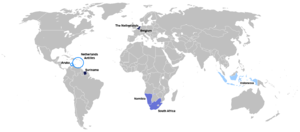 Dutch-speaking world. Dutch is also one of the official languages of the European Union and the Union of South American Nations.
This page contains IPA phonetic symbols in Unicode. Without proper rendering support, you may see question marks, boxes, or other symbols instead of Unicode characters. Dutch (
 Nederlands (help·info)) is a West Germanic language and the native language of the majority of the population of the Netherlands, Belgium, and Suriname, the three member states of the Dutch Language Union. Most speakers live in the European Union, where it is a first language for about 23 million and a second language for another 5 million people.[1][2] It also holds official status in the Caribbean island nations of Aruba, Curaçao, and Sint Maarten, while historical minorities remain in parts of France and Germany, and to a lesser extent, in Indonesia,[n 1] and up to half a million native Dutch-speakers may be living in the United States, Canada, and Australia.[n 2] The Cape Dutch dialects of Southern Africa have been standardised into Afrikaans, a mutually intelligible daughter language of Dutch[n 3] which today is spoken to some degree by an estimated total of 15 to 23 million people in South Africa and Namibia.[n 4]
Dutch is closely related to English and German[n 5] and is said to be between them.[n 6] Apart from not having undergone the High German consonant shift, Dutch—as English—also differs from German by the overall abandonment of the grammatical case system, the relative rarity of the Germanic umlaut, and a more regular morphology.[n 7] Dutch has effectively two grammatical genders, but this distinction has far fewer grammatical consequences than in German.[n 8] Dutch shares with German the use of subject–verb–object word order in main clauses and subject–object–verb in subordinate clauses.[n 9] Dutch vocabulary is mostly Germanic and contains the same Germanic core as English, while incorporating more Romance loans than German and fewer than English.[n 10]
Contents
Names
Main article: Names for the Dutch languageThough Dutch generally refers to the language as a whole, Belgian varieties, collectively known as Flemish, are differentiated from the varieties spoken in the Netherlands. In Belgium as well as in the Netherlands, the official designation of the language as a whole is "Nederlands", and the different dialects have their own name (e.g., "Hollands", "Limburgs", "Brabants").[3]
The language has been known under a variety of names. During the Middle Ages, most continental West Germanic dialects were referred to as dietsc and diutsc, and duutsc and other varieties (from which English Dutch is borrowed). These terms all derive from Old Frankish *thiudisk, from Proto-Germanic *þiudiskaz, which referred to the common people and their language - Dutch, Low German, and German. The word was used to translate Latin (lingua) vulgaris "popular language" and to set apart the Germanic vernacular from Latin (the language of writing and the Church) and the Romance vernaculars.[4] This is seen most clearly in the Oaths of Strasbourg of the 9th century, in which the main language is Latin, but Old High German passages are introduced as "teudisca lingua" and Old French passages as "romana lingua".
During the Renaissance in the 16th century, differentiation began to be made by opposing duytsch (modern Duits) "German" and nederduytsch "Low German" with dietsch or nederlandsch "Dutch",[5] a distinction that is echoed in English later the same century with the terms High Dutch "German" and Low Dutch "Dutch". However, due to Dutch commercial and colonial rivalry in the 16th and 17th centuries, the English term came to refer exclusively to the Dutch. In modern Dutch, Duits has narrowed in meaning to refer to "German", Diets went out of common use because of its Nazi associations[6] and now somewhat romantically refers to older forms of Dutch,[7] whereas Hollands and Vlaams are popularly used to name the language.[8] Nederlands, the official Dutch word for "Dutch", did not become firmly established until the 19th century. The repeated use of "neder" or "low" to refer to the language is a reference to the Netherlands' downriver location at the mouth of the Rhine (harking back to Latin nomenclature, e.g., Germania inferior vs. Germania superior) and the fact that it lies in the lowest dip of the Northern European plain.[9][10][11]
Dutch is sometimes confused with German, most probably as the German word for the official language of Germany is Deutsch (and "Niederländisch" for Dutch). This error is made in different movies and TV series such as Bram Stoker's Dracula.
Classification
Dutch belongs to its own West Germanic dialect group, West Low Franconian, paired with its sister language Limburgian, or East Low Franconian, both of which stand out by mixing characteristics of Low German and German; in Friedrich Maurer's classification,[12] these languages are Istsvaeonic. Dutch is at one end of a dialect continuum known as the Rhenish fan where German gradually turns into Dutch. There was also at one time a dialect continuum that blurred the boundary between Dutch and Low German. In some small areas, there are still dialect continua, but they are gradually becoming extinct.
All three languages have shifted earlier /θ/ → /d/, show final obstruent devoicing (Du brood "bread" [bro:t]), and experienced lengthening of short vowels in stressed open syllables which has led to contrastive vowel length that is used as a morphological marker. Dutch stands out from Low German and German in its retention of the clusters sp/st, shifting of sk to [sx] and initial g- to [ɣ], highly simplified morphology, and the fact it did not develop i-mutation as a morphological marker. In earlier periods, Low Franconian of either sort differed from Low German by maintaining a three-way plural verb conjugation (Old Dutch -un, -it, -unt → Middle Dutch -en, -t, -en). But as the old plural form became used in the singular as well (as happened in English, where you replaced thou), the older distinction was levelled into a single form -en (Du jij maakt "you(sg) make", but we/jullie/ze maken "we/you(pl)/they make", although older also jullie maakt); however, it is still possible to distinguish it from German (which has retained the three-way split) and Low German (which has -t in the present tense: wi/ji/se niemmet "we/you(pl)/they take"). Dutch and Low German show the collapsing of older ol/ul/al + dental into ol + dental, but in Dutch wherever /l/ was pre-consonantal and after a short vowel, it vocalized, e.g., Du goud "gold", zout "salt", woud "woods" : LG Gold, Solt, Woold : Germ Gold, Salz, Wald.
With Low German, Dutch shares the development of /xs/ → /ss/ (Du vossen "foxes", ossen "oxen", LG Vösse, Ossen vs. Germ Füchse, Ochsen), /ft/ → [xt] /cht/ though it is far more common in Dutch (Du zacht "soft", LG sacht vs. Germ sanft, but Du lucht "air" vs. LG/Germ Luft), generalizing the dative over the accusative case for certain pronouns (Du mij "me" (MDu di "you (sg.)"), LG mi/di vs. Germ mich/dich), and neither has undergone German's distinctive second consonant shift. Dutch and Low German have also monophthongized Germanic *ai → ē and *au → ō in all positions, e.g., Du steen "stone", oog "eye", LG Steen, Oog vs. G Stein, Auge, though this is not true of Limburgian (cf. sjtein, oug).
Dutch shares with German the reflexive pronoun zich (Germ sich), though this was originally borrowed from Limburgian, which is why in most dialects (Flemish, Brabantine) the usual reflexive is hem/haar, just like in the rest of West Germanic. Also, both languages have diphthongized Germanic ē² and long ō (Du hier "here", voet "foot", Germ hier, Fuß (from earlier fuoz) vs. LG hier [iː], Foot "foot" [oː]) and voiced pre-vocalic initial voiceless alveolar fricatives, e.g., Du zeven "seven", Germ sieben [z] vs. LG söven, seven [s]. The German pronoun wir "we" is absent from Dutch, but Limburgian has veer "we" instead of Dutch we (wij).
Geographic distribution
Dutch is an official language of the Netherlands, Belgium, Suriname, Aruba, Curaçao and Sint Maarten. Dutch is also an official language of several international organisations, such as the European Union and the Union of South American Nations.[13] It is used unofficially in the Caribbean Community.
Europe
Netherlands
Dutch is the official and foremost language of the Netherlands, a nation of 16.7 million people, of whom 96 percent say Dutch is their mother tongue.[14] In the province of Friesland and a small part of Groningen, Frisian is also recognised, but is spoken by only a few hundred thousand Frisians. In the Netherlands there are many different dialects, but these are often overruled and replaced by the language of the media, school, government (i.e., Standard Dutch). Immigrant languages are Indonesian, Turkish, English, Spanish, Berber, Moroccan Arabic, Papiamento, and Sranan. In the second generation these newcomers often speak Dutch as their mother tongue, sometimes alongside the language of their parents.
Belgium
 Language situation in Belgium
Belgium, a neighbouring nation of 11 million people, has three official languages, which are, in order from the greatest speaker population to the smallest, Dutch (sometimes colloquially referred to as Flemish), French, and German. An estimated 59% of all Belgians speak Dutch as their first language, while French is the mother tongue of 40%.[15] Dutch is the official language of the Flemish Region (where it is the mother tongue of about 97% of the population)[14] and one of the two official languages —along with French— of the Brussels Capital Region. Dutch is not official nor a recognised minority language in the Walloon Region, although on the border with the Flemish Region, there are four municipalities with language facilities for Dutch-speakers. The most important Dutch dialects spoken in Belgium are West Flemish, which has a dialect continuum in North-West French Flanders (Frans Vlaanderen); East Flemish, Brabantian and Limburgish, the latter having a dialect continuum in northeastern Wallonia (as Low Dietsch).
Brussels
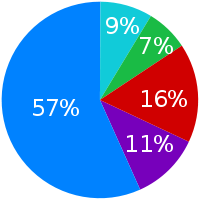 Home languages (Brussels Capital Territory, 2006)[16]
French onlyFrench & DutchFrench & language other than DutchDutch onlyNeither French nor DutchSince the founding of the Kingdom of Belgium in 1830, Brussels has transformed from being almost entirely Dutch-speaking, with a small French minority, to being a multilingual city with French as the majority language and lingua franca. This language shift, the Frenchification of Brussels, is rooted in the 18th century but accelerated after Belgium became independent and Brussels expanded past its original boundaries.[17][18]
Not only is French-speaking immigration responsible for the frenchification of Brussels, but more importantly the language change over several generations from Dutch to French was performed in Brussels by the Flemish people themselves. The main reason for this was the low social prestige of the Dutch language in Belgium at the time.[19] From 1880 on more and more Dutch-speaking people became bilingual resulting in a rise of monolingual French-speakers after 1910. Halfway through the 20th century the number of monolingual French-speakers carried the day over the (mostly) bilingual Flemish inhabitants.[20] Only since the 1960s, after the fixation of the Belgian language border and the socio-economic development of Flanders was in full effect, could Dutch stem the tide of increasing French use.[21] This phenomenon is, together with the future of Brussels, one of the most controversial topics in all of Belgian politics.[22][23]
Today an estimated 16 percent of city residents are native speakers of Dutch, while an additional 13 percent claim to have a "good to excellent" knowledge of Dutch.[16]
France
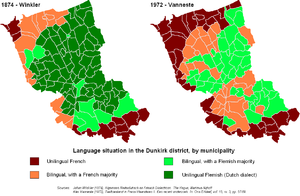 Language situation in the Dunkirk district of northern France in 1874 and then in 1972.
French Flemish, a variant of West Flemish, is spoken in the north-east of France by an estimated population of 20,000 daily speakers and 40,000 occasional speakers. It is spoken alongside French, which is gradually replacing it for all purposes and in all areas of communication.[24] Neither Dutch, nor its regional French Flemish variant, is afforded any legal status in France, either by the central or regional public authorities, by the education system or before the courts. In brief, the State is not taking any measures to ensure use of Dutch in France.[24]
In the 9th century the Germanic-Romance language border went from the mouth of the Canche to just north of the city of Lille, where it coincided with the present language border in Belgium.[25] From the late 9th century on, the border gradually started to shift northward and eastward to the detriment of the Germanic language. Boulogne-sur-Mer was bilingual up to the 12th century, Calais up to the 16th century, and Saint-Omer until the 18th century. The western part of the County of Flanders, consisting of the castellanies of Bourbourg, Bergues, Cassel and Bailleul, became part of France between 1659 and 1678. However, the linguistic situation in this formerly monolingually Dutch-speaking region did not dramatically change until the French Revolution in 1789, and Dutch continued to fulfil the main functions of a cultural language throughout the 18th century.[25] During the 19th century, especially in the second half of it, Dutch was banned from all levels of education and lost most of its functions as a cultural language. The cities of Dunkirk, Gravelines and Bourbourg had become predominantly French-speaking by the end of the 19th century. In the countryside, until World War I, many elementary schools continued to teach in Dutch, and the Roman Catholic Church continued to preach and teach the cathechism in Flemish in many parishes.[25] Nonetheless, since French enjoyed a much higher status than Dutch, from about the interbellum onward everybody became bilingual, the generation born after World War II being raised exclusively in French. In the countryside, the passing on of Flemish stopped during the 1930s or 1940s. As a consequence, the vast majority of those still having an active command of Flemish belong to the generation of over the age of 60.[25] Therefore, complete extinction of French Flemish can be expected in the coming decades.[25]
Asia
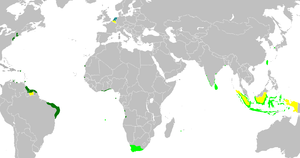 The Dutch Empire at its height.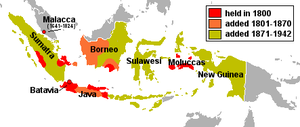
Despite the Dutch presence in Indonesia for almost three hundred and fifty years, the Dutch language has no official status there[27] and the small minority that can speak the language fluently are either educated members of the oldest generation, or employed in the legal profession,[28] as some legal codes are still only available in Dutch.[29] Many universities include Dutch as a source language, mainly for law and history students (roughly 35,000 of them nationally).[30][31]
Contrary to other European nations, the Dutch chose not to follow a policy of language expansion amongst the indigenous peoples of their colonies.[32] In the last quarter of the 19th century, however, a local elite gained proficiency in Dutch so as to meet the needs of expanding bureaucracy and business.[33] Nevertheless, the Dutch government remained reluctant to teach Dutch on a large scale out of fear of destabilising the colony. Dutch, the language of power, was supposed to remain in the hands of the leading elite.[33] Instead, use of local languages —or, where this proved to be impractical, of Malay— was encouraged. As a result, less than two percent of Indonesians could speak Dutch in 1940.[33] Only when in 1928 the Indonesian nationalist movement had chosen Malay as a weapon against Dutch influence, the colonial authorities gradually began to introduce Dutch in the educational curriculum. But due to the 1942 Japanese invasion and the subsequent Indonesian independence in 1949, this shift in policy did not come into full effect.[33]
After independence, Dutch was dropped as an official language and replaced by Malay. Yet the Indonesian language inherited many words from Dutch, both in words for everyday life, and as well in scientific or technological terminology.[34] One scholar argues that 20% of Indonesian words can be traced back to Dutch words,[35] many of which transliterated to reflect phonetic pronunciation e.g. "kantoor" (Dutch for "office") in Indonesian is "kantor", while "bus" ("bus") becomes "bis".
In addition, many Indonesian words are calques on Dutch, for example, "rumah sakit" (Indonesian for "hospital") is calqued on the Dutch "ziekenhuis" (literally "sick house"), "kebun binatang" ("zoo") on "dierentuin" (literally "animal garden"), "undang-undang dasar" ("constitution") from "grondwet" (literally "basic law"). These account for some of the differences in vocabulary between Indonesian and Malay.
The original spelling system devised for Indonesian, devised by Charles van Ophuijsen[35] was influenced by Dutch, with the use of Dutch letter combinations such as "oe". For example, "tempo doeloe" (meaning "the past") was pronounced as one vowel like in "moeder" (Dutch for "mother"). In 1947, this was changed to "u", hence "tempo dulu". However, the letter combination "oe" continued to be used in people's names, for example, the spelling of the names of the first and second Presidents, Sukarno and Suharto are often written as "Soekarno" and "Soeharto". In 1972, following an agreement with Malaysia to harmonise the spelling of Indonesian and Malay, other Dutch-influenced letter combinations such as "tj" and "dj" were replaced with "c" and "j", hence "tjap" ("brand" in Indonesian) became "cap" and "Djakarta", the country's capital, became "Jakarta".
Dutch-based creole languages (once) spoken in the Dutch East Indies include Javindo and Petjo, most of whose speakers were Indo or Eurasians. As a result of Indo emigration to the Netherlands following independence, the use of these languages declined.
The century and half of Dutch rule in Ceylon (now Sri Lanka) and southern India left few or no traces of the Dutch language.
Oceania
After the declaration of independence of Indonesia, Western New Guinea remained a Dutch colony until 1962, known as Netherlands New Guinea.[36] Despite prolonged Dutch presence, the Dutch language is not spoken by many Papuans, the colony having been ceded to Indonesia in 1963.
Immigrant communities can be found in Australia and New Zealand. The 2006 Australian census showed 36,179 people speaking Dutch at home.[37] According to the 2006 census in New Zealand, 16,347 people claim sufficient fluency in Dutch to hold an everyday conversation.[38]
Americas


In contrast to the colonies in the East Indies, from the second half of the 19th century onwards, the Netherlands envisaged expansion of Dutch in its colonies in the West Indies. Until 1863, when slavery was abolished in the West Indies, slaves were forbidden to speak Dutch. Most important were the efforts of Christianisation through Dutchification, which did not occur in Indonesia due to a policy of non-involvement in already Islamised regions. Secondly, most of the people in Dutch Guiana (now Suriname) worked on Dutch plantations, which reinforced the importance of Dutch as a means for direct communication.[33][39] In Indonesia, the colonial authorities had less interference in economic life. The size of the population was decisive: whereas the Antilles and Dutch Guiana combined only had a few hundred thousand inhabitants, Indonesia had many millions, by far outnumbering the population of the Netherlands.[33]
Suriname
In Suriname (former Dutch Guiana), where in the second half of the 19th century the Dutch authorities introduced a policy of assimilation,[33] Dutch is the sole official language[40] and over 60 percent of the population speaks it as a mother tongue.[1] A further twenty-four percent of the population speaks Dutch as a second language.[41] Suriname gained its independence from the Netherlands in 1975 and has been an associate member of the Dutch Language Union since 2004.[42] The lingua franca of Suriname, however, is Sranan Tongo,[43] spoken natively by about a fifth of the population.[14]
Recognition of "Surinaams-Nederlands" ("Surinam Dutch") as an equal natiolect was expressed in 1976 by the publication of the Woordenboek van het Surinaams-Nederlands - een geannoteerde lijst van Surinaams-Nederlandse woorden en uitdrukkingen (Dictionary of Surinam Dutch - an annotated list of Surinam-Dutch words and expressions),[44] published in 1989 as the Woordenboek van het Surinaams-Nederlands (Dictionary of Surinam Dutch), by Van Donselaar, and later by the publication of the Woordenboek Surinaams Nederlands (Dictionary Surinam Dutch) in 2009 (editor Renata de Bies, in cooperation with lexicologists Willy Martin en Willy Smedts), which was previously published as the Woordenboek van de Surinaamse Bijdrage aan het Nederlands (Dictionary of the Surinam Contribution to Dutch").
Caribbean
In Aruba, Curaçao and Sint Maarten, all part of the Kingdom of the Netherlands, Dutch is the official language but spoken as a first language by only seven to eight percent of the population,[45][46] although most native-born people on the islands can speak the language since the education system is in Dutch at some or all levels.[47] The lingua franca of Aruba, Bonaire and Curaçao is Papiamento, a creole language that originally developed among the slave population. The population of the three northern Antilles, Sint Maarten, Saba, and Sint Eustatius, is predominantly English-speaking.[33]
North America
In New Jersey in the United States, an almost extinct dialect of Dutch, Jersey Dutch, spoken by descendants of 17th century Dutch settlers in Bergen and Passaic counties, was still spoken as late as 1921.[48] Other Dutch-based creole languages once spoken in the Americas include Mohawk Dutch (in Albany, New York), Berbice (in Guyana), Skepi (in Essequibo, Guyana) and Negerhollands (in the United States Virgin Islands). Pennsylvania Dutch is something of a misnomer as that language is more closely related to German.
Martin Van Buren, former President of the United States, spoke Dutch as his first language and is the only U.S. President to have spoken a language other than English as his first language. Dutch prevailed for many generations as the dominant language in parts of New York along the Hudson River. Another famous American born in this region who spoke Dutch as a first language was Sojourner Truth.
According to the 2000 United States census, 150,396 people spoke Dutch at home,[49] while according to the 2006 Canadian census, this number reaches 160,000 Dutch-speakers.[50] In Canada, Dutch is the fourth most spoken language by farmers, after English, French and German,[51] and the fifth most spoken non-official language overall (by 0.6% of Canadians).[52]
Africa
Belgian Africa
Belgium, which had gained its independence from the Netherlands in 1830, also held a colonial empire from 1901 to 1962, consisting of the Belgian Congo and Ruanda-Urundi. Contrary to Belgium itself, the colonies had no de jure official language.[53][54] Although a majority of Belgians residing in the colonies were Dutch-speaking,[53] French was de facto the sole language used in administration, jurisdiction and secondary education.[55] After World War II, proposals of dividing the colony into a French-speaking and a Dutch-speaking part—after the example of Belgium—were discussed within the Flemish Movement.[55][56] In general, however, the Flemish Movement was not as strong in the colonies as in the mother country.[57] Although in 1956, on the eve of Congolese independence, an estimated 50,000 out of a total of 80,000 Belgian nationals would have been Flemish,[53] only 1,305 out of 21,370 children were enrolled in Dutch-language education.[58] When the call for a better recognition of Dutch in the colony got louder, the évolués ("developed Congolese")—among them Mobutu Sese Seko—argued that Dutch had no right over the indigenous languages, defending the privileged position of French.[53][58] Moreover, the image of Afrikaans as the language of the apartheid was injurious to the popularity of Dutch.[58]
The colonial authorities used Lingala, Kongo, Swahili and Tshiluba in communication with the local population and in education.[55] In Ruanda-Urundi this was Kirundi.[59] Knowledge of French—or, to an even lesser extent, Dutch—was hardly passed on to the natives,[53] of whom only a small number were taught French to work in local public services.[33] After their independence, French would become an official language of the Democratic Republic of the Congo, Rwanda and Burundi.[59] Of these, Congo is the most francophone country. Knowledge of Dutch in former Belgian Africa is virtually nonexistent.
Afrikaans
Main article: Afrikaans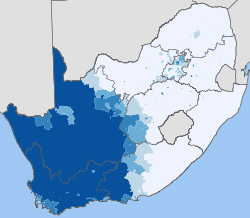 Distribution of Afrikaans across South Africa: proportion of the population speaking Afrikaans in the home.0–20%20–40%40–60%60–80%80–100%
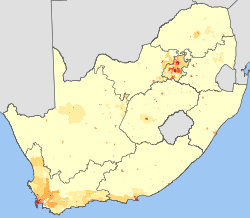 Distribution of Afrikaans across South Africa: density of Afrikaans home-language speakers.<1 /km²1–3 /km²3–10 /km²10–30 /km²30–100 /km²100–300 /km²300–1000 /km²1000–3000 /km²>3000 /km²
The largest legacy of the Dutch language lies in South Africa, which attracted large numbers of Dutch, Flemish and other northwest European farmer (in Dutch, boer) settlers, all of whom were quickly assimilated.[60] After the colony passed into British hands in the early 19th century, the settlers spread into the hinterland, taking their language with them. The subsequent isolation from the rest of the Dutch-speaking world made the Dutch as spoken in Southern Africa evolve into what is now Afrikaans.[21] European Dutch remained the literary language until the early 20th century, when under pressure of Afrikaner nationalism the local "African" Dutch was preferred over the written, European-based standard.[60] In 1925, section 137 of the 1909 constitution of the Union of South Africa was amended by Act 8 of 1925, stating "the word Dutch in article 137 [...] is hereby declared to include Afrikaans".[61][62] The new constitution of 1961 only listed English and Afrikaans as official languages. It is estimated that between 90% to 95% of Afrikaans vocabulary is ultimately of Dutch origin.[63][64] Both languages are still largely mutually intelligible, although this relation can in some fields (such as lexicon, spelling and grammar) be asymmetric, as it is easier for Dutch-speakers to understand written Afrikaans than it is for Afrikaans-speakers to understand written Dutch.[65] Afrikaans is grammatically far less complex than Dutch, and vocabulary items are generally altered in a clearly patterned manner, e.g. vogel becomes voël "bird" and regen becomes reën "rain").[66]
See also: Differences between Afrikaans and DutchIt is the third language of South Africa in terms of native speakers (~13.3%),[67] of whom 53 percent are Coloureds and 42.4 percent Whites.[68] In 1996, 40 percent of South Africans reported to know Afrikaans at least at a very basic level of communication.[69] It is the lingua franca in Namibia,[60][70][71] where it is spoken natively in 11 percent of households.[72] In total, Afrikaans is the first language for about 6 million and a second language for 10 million people,[73] compared to over 23 million[1] and 5 million respectively, for Dutch.[2]
History
Main article: History of DutchThe history of the Dutch language begins around AD 450–500 after Old Frankish, one of the many West Germanic tribal languages, was split by the Second Germanic consonant shift. At more or less the same time the Ingvaeonic nasal spirant law led to the development of the direct ancestors of modern Dutch Low Saxon, Frisian and English. The northern dialects of Old Frankish generally did not participate in either of these two shifts, except for a small amount of phonetic changes, and are hence known as Old Low Franconian; the "Low" refers to dialects not influenced by the consonant shift. The most south-eastern dialects of the Franconian languages became part of High – though not Upper – German even though a dialect continuum remained. The fact that Dutch did not undergo the sound changes may be the reason why some people say that Dutch is like a bridge between English and German. Within Old Low Franconian there were two subgroups: Old East Low Franconian and Old West Low Franconian, which is better known as Old Dutch. East Low Franconian was eventually absorbed by Dutch as it became the dominant form of Low Franconian, although it remains a noticeable substrate within the southern Limburgish dialects of Dutch. As the two groups were so similar, it is often difficult to determine whether a text is Old Dutch or Old East Low Franconian; hence most linguists will generally use Old Dutch synonymously with Old Low Franconian and mostly do not differentiate.
Dutch, like other Germanic languages, is conventionally divided into three development phases which were:
- 450(500)–1150 Old Dutch (First attested in the Salic Law)
- 1150–1500 Middle Dutch (Also called "Diets" in popular use, though not by linguists)
- 1500–present Modern Dutch (Saw the creation of the Dutch standard language and includes contemporary Dutch)
The transition between these languages was very gradual and one of the few moments linguists can detect somewhat of a revolution is when the Dutch standard language emerged and quickly established itself. Standard Dutch is very similar to most Dutch dialects.
The development of the Dutch language is illustrated by the following sentence in Old, Middle and Modern Dutch:
- "Irlôsin sol an frithe sêla mîna fan thên thia ginâcont mi, wanda under managon he was mit mi" (Old Dutch)
- "Erlossen sal [hi] in vrede siele mine van dien die genaken mi, want onder menegen hi was met mi" (Middle Dutch)
(Using same word order)
- "Verlossen zal hij in vrede ziel mijn van degenen die [te] na komen mij, want onder menigeen hij was met mij" (Modern Dutch)
(Using correct contemporary Dutch word order)
- "Hij zal mijn ziel in vrede verlossen van degenen die mij te na komen, want onder menigeen was hij met mij" (Modern Dutch) (see Psalm 55:19)
- "He shall my soul in peace free from those who me too near come, because amongst many was he with me" (English literal translation in the same word order)
- "He will deliver my soul in peace from those who attack me, because, amongst many, he was with me" (English translation in unmarked word order) (see Psalm 55:18)
A process of standardisation started in the Middle Ages, especially under the influence of the Burgundian Ducal Court in Dijon (Brussels after 1477). The dialects of Flanders and Brabant were the most influential around this time. The process of standardisation became much stronger at the start of the 16th century, mainly based on the urban dialect of Antwerp. In 1585 Antwerp fell to the Spanish army: many fled to the Northern Netherlands, especially the province of Holland, where they influenced the urban dialects of that province. In 1637, a further important step was made towards a unified language, when the Statenvertaling, the first major Bible translation into Dutch, was created that people from all over the United Provinces could understand. It used elements from various, even Dutch Low Saxon, dialects but was predominantly based on the urban dialects of Holland.
Dialects
Main article: Dutch dialects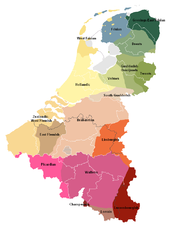 Dutch dialects in the Low Countries
Dutch dialects are remarkably diverse and distinct in the Netherlands. The same applies to the dialects in the Flanders region in Belgium. A dedicated article on Dutch dialects provides more information.
Sounds
Main article: Dutch phonologyDutch devoices all obstruents at the ends of words (e.g. a final /d/ becomes [t]), which presents a problem for Dutch speakers when learning English[citation needed]. This is partly reflected in the spelling: the singular of huizen (houses) becomes huis, and that of duiven (doves) becomes duif. The other cases, viz. "p"/"b" and "d"/"t" are always written with the letter for the voiced consonant, although a devoiced one is actually pronounced, e.g. sg. baard (beard), pronounced as baart, has plural baarden and sg. rib (rib), pronounced as rip has plural ribben.
Because of assimilation, often the initial consonant of the next word is also devoiced, e.g. het vee (the cattle) is /(h)ətfe/. This process of devoicing is taken to an extreme in some regions (Amsterdam, Friesland) with almost complete loss of /v/, /z/ and /ɣ/. These phonemes are certainly present in the middle of a word. Compare standard Dutch pronunciation logen and loochen /loɣən/ vs. /loxən/. In the dialects the contrast is even greater: /loʝən/ vs. /loçən/.
The final n of the plural ending -en is often not pronounced (as in Afrikaans where it is also dropped in the written language), except in the northeast Netherlands where dialects of Low German are traditionally spoken.
Vowels
The vowel inventory of Dutch is large, with 13 simple vowels and four diphthongs. The vowels /eː/, /øː/, /oː/ are included on the diphthong chart because they are actually produced as narrow closing diphthongs in many dialects, but behave phonologically like the other simple vowels. [ɐ] (a near-open central vowel) is an allophone of unstressed /a/ and /ɑ/.
IPA chart of Netherlandic Dutch monophthongs 
IPA chart of Netherlandic Dutch diphthongs 
Dutch Vowels with Example Words Symbol Example IPA IPA orthography English translation ɪ kɪp kip 'chicken' i bit biet 'beetroot' ʏ ɦʏt hut 'cabin' y fyt fuut 'grebe' ɛ bɛt bed 'bed' eː beːt beet 'bite' ə də de 'the' øː nøːs neus 'nose' ɑ bɑt bad 'bath' aː zaːt zaad 'seed' ɔ bɔt bot 'bone' oː boːt boot 'boat' u ɦut hoed 'hat' ɛi ɛi, ʋɛin ei, wijn 'egg', 'wine' œy œy ui 'onion' ʌu zʌut, fʌun zout, faun 'salt', 'faun' Some vowels are pronounced differently when followed by 'r', but this is not normally reflected in the IPA rendering, since they are allophones. The vowel in beer, being different from both bet and beet, is usually represented by /eː/. Similarly the one in boor, is neither like bot nor boot, and represented by /oː/.
Consonants
The syllable structure of Dutch is (C)(C)(C)V(C)(C)(C)(C). Many words, as in English, begin with three consonants; for example, straat (street). There are words that end in four consonants, e.g., herfst 'autumn', ergst 'worst', interessantst 'most interesting', sterkst 'strongest', the last three of which are superlative adjectives.
The most number of consonants in a single cluster is found in the word slechtstschrijvend 'writing worst' with 7 consonant phonemes (though in normal speech the number of phonemes is usually reduced to 6 because of assimilation of 'tstsch' to 'stsch', or even to 5 by many speakers who pronounce the cluster 'schr' as 'sr').
Like most Germanic languages, Dutch consonant system did not undergo the High German consonant shift and has a syllable structure that allows fairly complex consonant clusters. Dutch is often noted for its prominent use of velar fricatives.
Bilabial Labio-
dentalAlveolar Post-
alveolarPalatal Velar Uvular Glottal Nasal m n ŋ Plosive voiceless p t k (ʔ)1 voiced b d ɡ 2 Fricative voiceless f s ʃ 3 ç 4 x ~ χ 4 voiced v 5 z 5 ʒ 3 ʝ 5 ɣ 5 ʁ 6 ɦ 6 Trill r 6 Approximant β ~ ʋ 7 l 8 j Notes:
- ^1 [ʔ] is not a separate phoneme in Dutch, but is inserted before vowel-initial syllables within words after /a/ and /ə/ and often also at the beginning of a word.
- ^2 /ɡ/ is not a native phoneme of Dutch and only occurs in borrowed words, like goal or when /k/ is voiced, like in zakdoek [zɑɡduk].
- ^3 /ʃ/ and /ʒ/ are not native phonemes of Dutch, and usually occur in borrowed words, like show and bagage ('baggage'). However, /s/ + /j/ phoneme sequences in Dutch are often realized as [ʃ], like in the word huisje ('little house').
- ^4 The sound spelled <ch> is a uvular fricative in Standard Dutch[74] and velar in Belgian dialects.[75]
- ^5 In some dialects, the voiced fricatives have almost completely merged with the voiceless ones; /ɦ/ is usually realized as [h], in the North /v/ is usually realized as [f], /z/ is usually realized as [s], yet only in the North. In the South /v/ is pronounced [v] and /z/ is [z]. In the North /ɣ/ is usually realized as [x], whereas in the South the distinction between /ʝ/ and /ç/ has been preserved.
- ^6 The realization of the /r/ phoneme varies considerably from dialect to dialect. In "standard" Dutch, /r/ is realized as the alveolar trill [r], but the uvular trill [ʀ] is a common alternative. In some dialects it is realized as the alveolar tap [ɾ], the voiced uvular fricative [ʁ], or as the alveolar approximant [ɹ].
- ^7 The realization of the /ʋ/ varies considerably from the Northern to the Southern and Belgium dialects of the Dutch language. A number of Belgian dialects[76][77] pronounce it like a bilabial approximant ([β]). Other, mainly Northern Dutch, dialects pronounce it as a labiodental approximant: [ʋ]. Furthermore, in Suriname it is pronounced [w].
- ^8 The lateral /l/ is slightly velarized postvocalically.[78]
Dutch consonants with example words Symbol Example IPA IPA orthography English translation p pɛn pen 'pen' b bit biet 'beetroot' t tɑk tak 'branch' d dɑk dak 'roof' k kɑt kat 'cat' ɡ ɡoːl goal 'goal' (sports) m mɛns mens 'human being' or 'mankind' n nɛk nek 'neck' ŋ ɛŋ eng 'scary' f fits fiets 'bicycle' v oːvən oven 'oven' s sɔk sok 'sock' z zeːp zeep 'soap' ʃ ʃaːɫ sjaal 'shawl' ʒ ʒyːri jury 'jury' x (North) ɑxt acht 'eight' ç (South) ɑçt acht 'eight' ɣ (North) ɣaːn gaan 'to go' ʝ (South) ʝaːn gaan 'to go' r rɑt rat 'rat' ɦ ɦut hoed 'hat' ʋ ʋɑŋ wang 'cheek' j jɑs jas 'coat' l lɑnt land 'land / country' ɫ ɦeːɫ heel 'whole' ʔ bəʔaːmən beamen 'to confirm' Common difficulties
Some Dutch vowel sounds are not straightforward. Diphthongs such as the <ui> sound in such words as zuid "south" or huis "house", the <au/ou> in pauw "peacock" or koud "cold", and the <ij> sound in words like mijt "mite" or wijn "wine" present difficulties. Even though some of these words are superficially like their English equivalents the correct sound is very different. Another issue with pronunciation is the <ch>-sound if preceded by s, which Dutch native speakers pronounce as /χ/ (North) or /ç/ (South). It has no counterpart in English. Particularly the voiced equivalents, northern /ɣ/ and /ʝ/ in the south, are rare among other European languages. In Northern Dutch there is a tendency for using the voiceless sound in all places.
The morphological flexibility and cohesiveness of Dutch sometimes produces words that might baffle speakers of other languages due to the large number of consonant clusters, such as the word angstschreeuw [ɑŋstsxreːw] (
listen) "scream in fear", which has a total of six in a row -ngstschr- (the ng and ch being digraphs). It has to be noted though that the pronunciation of a word can differ greatly from its written form. In this case, angstschreeuw actually contains 6 consonant sounds (ng-s-t-s-ch-r) originating from two distinct compounded words (angst and schreeuw), which is reduced further by some speakers in connected speech by blending consecutive consonants (ch and r) into one sound. This can be even further shortened to [ɑŋsreːw] by those who normally reduce the schr-sequence to sr.Historical sound changes
Dutch (with the exception of the Limburg dialects) did not undergo the second or High German consonant shift—compare German machen /-x-/ vs. Dutch maken, English make; German Pfanne /pf-/ vs. Dutch pan, English pan; German zwei /ts-/ vs. Dutch twee, English two.
Dutch underwent a few changes of its own. For example, words in -old/olt lost the /l/ to a diphthong after l-vocalization (compare English old, German alt vs. Dutch oud), and -ks- sounds were reduced to -s- (compare English fox, German Fuchs vs. Dutch vos).[79]
Germanic */uː/ fronted to /y/, which in turn became a diphthong /œy/, spelt 〈ui〉. Long */iː/ also diphthongized to /ɛi/, spelt 〈ij〉.
Unusually for a Germanic language (but like some Slavic ones), the phoneme /ɡ/, originally in allophonic variation with /ɣ/, became /ɣ/ in every position except after /n/ (where it instead merged with /n/ into /ŋ/). It later palatalised to /ʝ/ in the South (Flanders, Limburg, Brabant).
Polder Dutch
A notable deviation from the official pronunciation of Standard Dutch in younger generations in the Netherlands has been dubbed "Polder Dutch" by Jan Stroop.[80] The diphthongs spelt <ij>, <ou>, and <ui> are pronounced not as /ɛi/, /ʌu/, and /œy/, but lowered, as /ai/, /au/, and /ay/ respectively. Instead, /eː/, /oː/, and /øː/ are pronounced as diphthongs now, as /ɛi/, /ɔu/, and /œy/ respectively, which makes this change an instance of a chain shift.
This change is interesting from a sociolinguistic point of view because it has apparently happened relatively recently, in the 1970s, and was pioneered by older well-educated women from the upper middle classes.[81] The lowering of the diphthongs has long been current in many Dutch dialects, and is comparable to the English Great Vowel Shift, and the diphthongisation of long high vowels in Modern High German, which centuries earlier reached the state now found in Polder Dutch. It appears that the diphthongisation of the high vowels is part of a trend widespread in the West Germanic languages, which has, however, been artificially frozen in an intermediary state by the standardisation of Dutch pronunciation in the 16th century, where lowered diphthongs found in rural dialects were perceived as ugly by the educated classes and accordingly declared substandard. Stroop compares the role of Polder Dutch with the urban variety of British English pronunciation called Estuary English.
Among Belgian Dutch-speakers, this vowel shift is not taking place. In its central provinces, the diphthongs /ɛi/, /ɔu/ and /œy/ are often pronounced as the monophthongs /ɛː/, /ɔː/ and /œː/, although this is considered substandard.
Grammar
Main article: Dutch grammarDutch is grammatically similar to German, such as in syntax and verb morphology (for a comparison of verb morphology in English, Dutch and German, see Germanic weak verb and Germanic strong verb). Dutch has grammatical cases, but these are now mostly limited to pronouns and a large number of set phrases. Inflected forms of the articles are also often found in surnames and toponyms. Originally, Dutch had three genders: masculine, feminine and neuter, although for many speakers, masculine and feminine have merged to form the common gender (de), while the neuter (het) remains distinct as before. This gender system is similar to those of most Continental Scandinavian languages. Many Belgian speakers still make a clear distinction between masculine and feminine words( see Gender in Dutch). As in English, but to a lesser degree, the inflectional grammar of the language (e.g., adjective and noun endings) has simplified over time.
Genders and cases
The table of definite articles below demonstrates that contemporary Dutch is less complex than German. The article has just two forms, de and het, more complex than English, which has only "the".
Dutch German Masculine singular Feminine singular Neuter singular Plural (any gender) Masculine singular Feminine singular Neuter singular Plural (any gender) Nominative de de het de der die das die Genitive des / van de der / van de des / van het der / van de des der des der Dative de de het de dem der dem den Accusative de de het de den die das die The genitive articles 'des' and 'der' are not frequently used and are often considered prosaic or archaic. In most circumstances the preposition 'van' is instead used, followed by the normal definitive article 'de' or 'het'. For the use of the articles in the genitive, see for example:
- Masculine singular: "des duivels" (of the devil)
- Feminine singular: het woordenboek der Friese taal (the dictionary of the Frisian language)
- Neuter singular: de vrouw des huizes (the lady of the house)
- Plural: de voortgang der werken (the progress of (public) works)
Dutch also has a range of fixed expressions that make use of the genitive articles, such as for example "'s ochtends" (with 's as abbreviation of des; in the morning) and "desnoods" (lit: of the need, translated: if necessary).
The Dutch written grammar has simplified over the past 100 years: cases are now mainly used for the pronouns, such as ik (I), mij, me (me), mijn (my), wie (who), wiens (whose: masculine or neuter singular), wier (whose: feminine singular, masculine or feminine plural). Nouns and adjectives are not case inflected (except for the genitive of proper nouns (names): -s, -'s or -'). In the spoken language cases and case inflections had already gradually disappeared from a much earlier date on (probably the 15th century) as in many continental West Germanic dialects.
Inflection of adjectives is a little more complicated: nothing with indefinite neuter nouns in singular and -e in all other cases. Note that water and huis are neuter, the other words in the table are masculine or feminine. (This was also done in Middle English, as in "a goode man".)
Masculine singular
Feminine singular
Plural (any gender)Neuter singular Definite
(with definite article
or pronoun)de mooie huizen (the beautiful houses)
die mooie vrouwen (those beautiful women)het mooie huis (the beautiful house)
mijn mooie huis (my beautiful house)
dit koude water (this cold water)Indefinite
with indefinite article or
no article and no pronoun)een mooie vrouw (a beautiful woman)
mooie huizen (beautiful houses)
koude soep (cold soup)een mooi huis (a beautiful house)
koud water (cold water)An adjective has no e if it is in the predicative: De soep is koud.
More complex inflection is still found in certain lexicalized expressions like de heer des huizes (literally, the man of the house), etc. These are usually remnants of cases (in this instance, the genitive case which is still used in German, cf. Der Herr des Hauses) and other inflections no longer in general use today. In such lexicalized expressions remnants of strong and weak nouns can be found too, e.g. in het jaar des Heren (Anno Domini), where “-en” is actually the genitive ending of the weak noun. Also in this case, German retains this feature.
Word order
Dutch exhibits subject–object–verb word order, but in main clauses the conjugated verb is moved into the second position in what is known as verb second or V2 word order. This makes Dutch word order almost identical to that of German, but often different from English, which has subject–verb–object word order and has since lost the V2 word order that existed in Old English.[82]
An example sentence used in some Dutch language courses and textbooks is "Ik kan mijn pen niet vinden omdat het veel te donker is", which translates into English word for word as "I can my pen not find because it far too dark is", but in standard English word order would be written "I cannot find my pen because it is far too dark". If the sentence is split into a main and subclause and the verbs highlighted, the logic behind the word order can be seen.
Main clause: "Ik kan mijn pen niet vinden"
Verbs are placed in the final position, but the conjugated verb, in this case "kan" (can), is made the second element of the clause.Subclause: "omdat het veel te donker is"
The verb or verbs always go in the final position.Diminutives
Dutch nouns can take endings for size: -je for singular diminutive and -jes for plural diminutive. Between these suffixes and the radical can come extra letters depending on the ending of the word:
- boom (tree) - boompje
- ring (ring) - ringetje
- koning (king) - koninkje
- tien (ten) - tientje (a ten euro note)
These diminutives are very common. As in German, all diminutives are neuter. In the case of words like "het meisje" (the girl), this is different from the natural gender. A diminutive ending can also be appended to an adverb or adjective (but not when followed by a noun).
- klein (little, small) - een kleintje (a small one)
Compounds
Like most Germanic languages, Dutch forms noun compounds, where the first noun modifies the category given by the second, for example: hondenhok (doghouse). Unlike English, where newer compounds or combinations of longer nouns are often written in open form with separating spaces, Dutch (like the other Germanic languages) either uses the closed form without spaces, for example: boomhuis (Eng. tree house) or hyphenated: VVD-coryfee (outstanding member of the VVD, a political party). Like German, Dutch allows arbitrarily long compounds, but the longer they get, the less frequent they tend to be. The longest serious entry in the Van Dale dictionary is
wapenstilstandsonderhandeling (help·info) (ceasefire negotiation). Leafing through the articles of association (Statuten) one may come across a 30-letter vertegenwoordigingsbevoegdheid (help·info) (authorisation of representation). An even longer word cropping up in official documents is ziektekostenverzekeringsmaatschappij (health insurance company) though the shorter ziektekostenverzekeraar (health insurer) is more common. Notwithstanding official spelling rules, some Dutch people nowadays tend to write the parts of a compound separately, which is sometimes dubbed “the English disease” or "de Engelse ziekte".[83][84]Vocabulary
Dutch vocabulary is predominantly Germanic in origin, considerably more so than English. This is to a large part due to the heavy influence of Norman on English, and to Dutch patterns of word formation, such as the tendency to form long and sometimes very complicated compound nouns, being more similar to those of German and the Scandinavian languages. The Dutch vocabulary is one of the richest in the world and comprises at least 268,826 headwords.[85] In addition, the Woordenboek der Nederlandsche Taal (English: "The Dictionary of the Dutch language") is the largest dictionary in the world in print and has over 430,000 entries of Dutch words.[86]
Like English, Dutch includes words of Greek and Latin origin. Somewhat paradoxically, most loanwords from French have entered into Dutch vocabulary via the Netherlands and not via Belgium, in spite of the cultural and economic dominance exerted by French speakers in Belgium until the first half of the 20th century. This happened because the status French enjoyed as the language of refinement and high culture inspired the affluent upper and upper-middle classes in the Netherlands to adopt many French terms into the language. In Belgium no such phenomenon occurred, since members of the upper and upper-middle classes would have spoken French rather than Frenchify their Dutch. French terms heavily influenced Dutch dialects in Flanders, but Belgian speakers did (and do) tend to resist French loanwords when using standard Dutch. Nonetheless some French loanwords of relatively recent date have become accepted in standard Dutch, also in Belgium, albeit with a shift in meaning and not as straight synonyms for existing Dutch words. For example, "blesseren" (from French blesser, to injure) is almost exclusively used to refer to sports injuries, while in other contexts the standard Dutch verbs "kwetsen" and "verwonden" continue to be used.
Especially on the streets and in many professions, there is a steady increase of English loanwords, rather often pronounced or applied in a different way (see Dutch pseudo-anglicisms). The influx of English words is maintained by the dominance of English in the mass media and on the Internet.
The most important dictionary of the modern Dutch language is the Van Dale groot woordenboek der Nederlandse taal,[87] more commonly referred to as the Dikke van Dale ("dik" means "thick"). However, it is dwarfed by the 45,000-page Woordenboek der Nederlandsche Taal, a scholarly endeavour that took 147 years from initial idea to first edition.
Writing system
Main articles: Dutch alphabet and Dutch orthographyDutch is written using the Latin alphabet. Dutch uses one additional character beyond the standard alphabet, the digraph IJ. It has a relatively high proportion of doubled letters, both vowels and consonants. This is due to the formation of compound words and also to the spelling devices for distinguishing the many vowel sounds in the Dutch language. An example of five consecutive doubled letters is the word voorraaddoos (supply box).
The diaeresis (Dutch: trema) is used to mark vowels that are pronounced separately. In the most recent spelling reform, a hyphen has replaced the diaeresis in compound words (i.e., if the vowels originate from separate words, not from prefixes or suffixes), e.g. zeeëend (seaduck) is now spelled zee-eend.
The acute accent occurs mainly on loanwords like café, but can also be used for emphasis or to differentiate between two forms. Its most common use is to differentiate between the indefinite article 'een' (a, an) and the numeral 'één' (one); also 'hé' (hey, also written 'hee').
The grave accent is used to clarify pronunciation ('hè' [what?, what the ...?, tag question 'eh?'], 'bèta') and in loanwords ('caissière' [female cashier], 'après-ski'). In the recent spelling reform, the accent grave was dropped as stress sign on short vowels in favour of the acute accent (e.g. 'wèl' was changed to 'wél').
Other diacritical marks such as the circumflex only occur on a few words, most of them loanwords from French.
The official spelling is set by the Wet schrijfwijze Nederlandsche taal (Law on the writing of the Dutch language; Belgium 1946, Netherlands 1947; based on a 1944 spelling revision; both amended in the 1990s after a 1995 spelling revision). The Woordenlijst Nederlandse taal, more commonly known as "het groene boekje" (i.e. "the green booklet", because of its colour), is usually accepted as an informal explanation of the law. However, the official 2005 spelling revision, which reverted some of the 1995 changes and made new ones, has been welcomed with a distinct lack of enthusiasm in both the Netherlands and Belgium. As a result, the Genootschap Onze Taal (Our Language Society) decided to publish an alternative list, "het witte boekje" ("the white booklet"), which tries to simplify some complicated rules and offers several possible spellings for many contested words. This alternative orthography is followed by a number of major Dutch media organisations but mostly ignored in Belgium.
Dutch as a foreign language
As a foreign language, Dutch is mainly taught in primary and secondary schools in areas adjacent to the Netherlands and Flanders. In French-speaking Belgium, over 300,000 pupils are enrolled in Dutch courses, followed by over 20,000 in the German states of Lower Saxony and North Rhine-Westphalia, and over 7,000 in the French region of Nord-Pas de Calais (of which 4,550 already in primary school).[88] Dutch is the obligatory medium of instruction in schools in Suriname, even for non-native speakers.[89] Dutch is taught in various educational centres in Indonesia, the most important of which is the Erasmus Language Centre (ETC) in Jakarta. Each year, some 1,500 to 2,000 students take Dutch courses there.[90] In total, several thousand Indonesians study Dutch as a foreign language.[91]
At an academic level, Dutch is taught in over 225 universities in more than 40 countries. About 10,000 students worldwide study Dutch at university.[31] The largest number of faculties of neerlandistiek can be found in Germany (30 universities), followed by France and the United States (20 each). 5 universities in the United Kingdom offer the study of Dutch.[88][92] Due to centuries of Dutch rule in Indonesia, many old documents are written in Dutch. Many universities therefore include Dutch as a source language, mainly for law and history students.[30] In Indonesia this involves about 35,000 students.[31] In South Africa, the number is difficult to estimate, since the academic study of Afrikaans inevitably includes the study of Dutch.[31] Elsewhere in the world, the number of people learning Dutch is relatively small.
See also
- Afrikaans
- Differences between Afrikaans and Dutch
- Bargoens
- Dutch dialects
- Dutch grammar
- Dutch Language Union
- Dutch linguistic influence on military terms
- Dutch literature
- Dutch name
- Dutch orthography
- Dutch-based creole languages
- Flemish
- French Flemish
- Indo-European languages
- Istvaeones
- List of English words of Dutch origin
- Low Dietsch
- Low Franconian
- Meuse-Rhenish
- Middle Dutch
- Old Dutch
- Old Frankish
Bibliography
- Abraham, Werner (2006), Bare and prepositional differential case marking, in Kulikov, L.I.; Malchukov, A.L.; De Swart, Peter, "Case, valency and transitivity", Studies in Language (John Benjamins Publishing Company) 77, http://books.google.ca/books?id=6UxRle-M1QQC, retrieved 2010-11-06
- Adegbija, Efurosibina E. (1994), Language Attitudes in Sub-Saharan Africa: A Sociolinguistic Overview, Multilingual Matters, http://books.google.be/books?id=Ghqf-m6ILIgC, retrieved 2008-11-10
- Alant, Jaco (2004) (in French), Parlons Afrikaans, Éditions L'Harmattan, http://books.google.ca/books?id=NKjBVF8krYIC, retrieved 2010-06-03
- Ammon, Ulrich (2006), Sociolinguistics: an international handbook of the science of language and society, Walter de Gruyter, http://books.google.ca/books?id=mZtDIhWzFeUC, retrieved 2010-06-29
- Baker, Colin; Prys Jones, Sylvia (1997), Encyclopedia of bilingualism and bilingual education, Multilingual Matters Ltd., http://books.google.ca/books?id=YgtSqB9oqDIC, retrieved 2010-05-19
- Berdichevsky, Norman (2004), Nations, language, and citizenship, Norman Berdichevsky, http://books.google.ca/books?id=_q14xoaXj1UC, retrieved 2010-05-31
- Batibo, Herman (2005), "Language decline and death in Africa: causes, consequences, and challenges", Oxford Linguistics (Multilingual Matters Ltd), http://books.google.ca/books?id=yoZ_fU_B0KgC, retrieved 2010-05-24
- Booij, Geert (1995), "The Phonology of Dutch.", Oxford Linguistics (Oxford University Press), http://books.google.ca/books?id=LT6E6YdAh-MC&dq, retrieved 2010-05-24
- Booij, Geert (2003), "Constructional idioms and periphrasis: the progressive construction in Dutch.", Paradigms and Periphrasis (University of Kentucky), http://cs.engr.uky.edu/~gstump/periphrasispapers/Progressive.pdf, retrieved 2010-05-19
- Brachin, Pierre; Vincent, Paul (1985), The Dutch Language: A Survey, Brill Archive, http://books.google.com/books?id=GeUUAAAAIAAJ, retrieved 2008-11-03
- Bromber, Katrin; Smieja, Birgit (2004), "Globalisation and African languages: risks and benefits", Trends in Linguistics (Walter de Gruyter), http://books.google.ca/books?id=lxjtToDh_g4C, retrieved 2010-05-28
- Brook Napier, Diane (2007), Languages, language learning, and nationalism in South Africa, in Schuster, Katherine; Witkosky, David, "Language of the land: policy, politics, identity", Studies in the history of eduction (Information Age Publishing), http://books.google.ca/books?id=AYfRwLd8LCEC, retrieved 2010-05-19
- Bussmann, Hadumod (2002), Gender across languages, John Benjamins Publishing Company, http://books.google.com/books?id=eUDf58WaqiUC, retrieved 2011-04-07
- Classe, Olive (2000), "Encyclopedia of Literary Translation into English", Second Edition (Fitzroy Dearborn), http://books.google.ca/books?id=myLDA0_brhcC, retrieved 2010-05-19
- Clyne, Michael G. (2003), Dynamics of language contact: English and immigrant languages, Cambridge University Press, http://books.google.com/books?id=_zQng7Kt7woC, retrieved 2011-04-07
- Crisma, Paola; Longobarde, Giuseppe (2009), "Historical syntax and linguistic theory", Oxford linguistics (Oxford University Press US), http://books.google.ca/books?id=Hp2l0HBcCAgC, retrieved 2010-11-06
- Czepluch, Hartmut; Abraham, Werner (2004), Focus on Germanic typology, Akademie Verlag, http://books.google.ca/books?id=A2vFYshrpGMC, retrieved 2010-05-19
- Conradie, C. Jac (2005), "The final stages of deflection - The case of Afrikaans "het"", Historical Linguistics 2005 (John Benjamins Publishing Company), http://books.google.ca/books?id=3fSsa7DPlNQC, retrieved 2010-05-29
- De Bot, Kees; Lowie, Wander; Verspoor, Marjolyn (2005), Second language acquisition, Routledge, http://books.google.ca/books?id=yd_nOmafbJoC, retrieved 2010-11-06
- Denning, Keith; Kessler, Brett; Leben, William R. (2007), English vocabulary elements, Oxford University Press US, http://books.google.ca/books?id=i6bew0EnsswC, retrieved 2010-05-19
- Deprez, Kas (1997), Clyne, Michael G., ed., "Diets, Nederlands, Nederduits, Hollands, Vlaams, Belgisch Nederlands", Undoing and redoing corpus planning (Walter de Gruyter): pp. 249–312, http://books.google.ca/books?id=tM3PrFFSiVgC, retrieved 2011-05-10
- Deumert, Ana (2002), "Standardization and social networks - The emergence and diffusion of standard Afrikaans", Standardization - Studies from the Germanic languages (John Benjamins Publishing Company), http://books.google.ca/books?id=LYNHubXRzJAC, retrieved 2010-05-29
- Deumert, Ana; Vandenbussche, Wim (2003), "Germanic standardizations: past to present", Trends in Linguistics (John Benjamins Publishing Company), http://books.google.ca/books?id=o-qM3Wk4nZ0C&pg=PA15, retrieved 2010-05-28
- Deumert, Ana (2004), Language Standardization and Language Change: The Dynamics of Cape Dutch, John Benjamins Publishing Company, http://books.google.be/books?id=8ciimg5gGqQC, retrieved 2008-11-10
- de Swaan, Abram (2001), Words of the world: the global language system, A. de Swaan, http://books.google.ca/books?id=d-Jd5KkyFpwC, retrieved 2010-06-03
- De Vogelaer, Gunther (2009), Changing pronominal gender in Dutch: transmission or diffusion?, in Tsiplakou, Stavroula; Karyolemou, Marilena; Pavlou, Pavlos Y., "Language variation--European perspectives II", International Conference on Language Variation in Europe (John Benjamins Publishing Company), http://books.google.ca/books?id=YbSzmHowS-QC, retrieved 2011-05-09
- Domínguez, Francesc; López, Núria (1995), Sociolinguistic and language planning organizations, John Benjamins Publishing Company, http://books.google.ca/books?id=aSlp7wze6OMC, retrieved 2010-05-28
- Donaldson, Bruce C. (1993), A grammar of Afrikaans, Walter de Gruyter, http://books.google.ca/books?id=ftzioRvJzTUC, retrieved 2010-05-28
- Egil Breivik, Leiv; Håkon Jahr, Ernst (1987), Language change: contributions to the study of its causes, Walter de Gruyter, http://books.google.ca/books?id=z7zlUp5Xuc8C, retrieved 2010-05-19
- Erdentuğ, Aygen; Colombijn, Freek (2002), Urban ethnic encounters: the spatial consequences, Routledge, http://books.google.ca/books?id=Kxa-L-OpTrEC, retrieved 2010-06-29
- European Commission (2010), "Flemish in France", Research Centre of Multilingualism (Euromosaic), http://www.uoc.edu/euromosaic/web/document/neerlandes/an/i1/i1.html, retrieved 2010-06-29
- Fitzpatrick, Eileen (2007), "Corpus linguistics beyond the word: corpus research from phrase to discourse, Volume 2004", Language and Computers: Studies in Practical Linguistics (Rodopi) 60, http://books.google.ca/books?id=Je2WubslL4AC, retrieved 2010-11-09
- Geerts, G.; Clyne, Michael G. (1992), Pluricentric languages: differing norms in different nations, Walter de Gruyter, http://books.google.ca/books?id=wawGFWNuHiwC, retrieved 2010-05-19
- Gooskens, Charlotte (2007), "The Contribution of Linguistic Factors to the Intelligibility of Closely Related Languages", Journal of Multilingual and Multicultural Development, Volume 28, Issue 6 November 2007 (University of Groningen): pp. 445–467, http://www.let.rug.nl/gooskens/pdf/publ_JMMD_2007.pdf, retrieved 2010-05-19
- Heeringa, Wilbert; de Wet, Febe (2007), The origin of Afrikaans pronunciation: a comparison to west Germanic languages and Dutch dialects, University of Groningen, pp. 445–467, http://www.let.rug.nl/~heeringa/dialectology/papers/prasa08.pdf, retrieved 2010-05-19
- Herriman, Michael L.; Burnaby, Barbara (1996), Language policies in English-dominant countries: six case studies, Multilingual Matters Ltd., http://books.google.ca/books?id=PpPNMf5ESsoC, retrieved 2010-05-19
- Hiskens, Frans; Auer, Peter; Kerswill, Paul (2005), The study of dialect convergence and divergence: conceptual and methodological considerations., Lancaster University, http://www.lancs.ac.uk/fss/linguistics/staff/kerswill/pkpubs/HinskensAuerKerswill2005Conv.pdf, retrieved 2010-05-19
- Hogg, Richard M. (2002), An introduction to Old English, Oxford University Press US, http://books.google.ca/books?id=Vtwn7_jx4UoC, retrieved 2010-11-06
- Holm, John A. (1989), Pidgins and Creoles: References survey, Cambridge University Press, http://books.google.ca/books?id=PcD7p9y3EIcC, retrieved 2010-05-19
- Ingram, David (1989), First language acquisition: method, description, and explanation, Cambridge University Press, http://books.google.ca/books?id=VavMNVpumh0C, retrieved 2010-11-06
- Jansen, Carel; Schreuder, Robert; Neijt, Anneke (2007), "The influence of spelling conventions on perceived plurality in compounds. A comparison of Afrikaans and Dutch.", Written Language & Literacy 10:2 (Radboud University Nijmegen), http://dare.ubn.kun.nl/dspace/bitstream/2066/56692/1/56692_JS&N20070001.pdf, retrieved 2010-05-19
- Jones, Russell (2008), "Loan-words in Indonesian and Malay", Indonesian Etymological Project, KITLV Office Jakarta (Yayasan Obor Indonesia), http://books.google.com/books?id=GJ9ShBEMWw4C, retrieved 2010-06-29
- Jordens, Peter; Lalleman, Josine A. (1988), "Language development", 5 (Walter de Gruyter), http://books.google.ca/books?id=f7E6varvZtcC, retrieved 2010-11-06
- Kager, René (1989), "A metrical theory of stress and destressing in English and Dutch", Linguistic models (Walter de Gruyter) 14, http://books.google.ca/books?id=y4UpbijZVysC, retrieved 2010-06-29
- Kamwangamalu, Nkonko M. (2004), "The language planning situation in South Africa", in Baldauf, Richard B.; Kaplan, Robert B., Language planning and policy in Africa, Multilingual Matters Ltd., http://books.google.ca/books?id=nVrsAmvjhNQC, retrieved 2010-05-31
- Kennedy Wyld, Henry Cecil (2009), The Growth of English: An Elementary Account of the Present Form of Our Language, and Its Development, BiblioBazaar, LLC, http://books.google.ca/books?id=YAbcEIYvgdYC, retrieved 2010-11-06
- Langer, Nils; Davies, Winifred V. (2005), Linguistic purism in the Germanic languages, Walter de Gruyter, http://books.google.ca/books?id=M9uNEf_FPVoC, retrieved 2010-05-28
- Lass, Roger (1994), Old English: a historical linguistic companion, Cambridge University Press, http://books.google.com/books?id=PhzIWORqgVgC, retrieved 2010-11-06
- Lightfoot, David (1999), "The development of language: acquisition, change, and evolution", Blackwell/Maryland lectures in language and cognition (Wiley-Blackwell) 1, http://books.google.ca/books?id=BbMGgDds0DYC, retrieved 2010-11-06
- Machan, Tim William (2009), Language anxiety: conflict and change in the history of English, Oxford University Press, http://books.google.ca/books?id=XFKYdKGSEiAC, retrieved 2010-06-03
- Maier, H.M.J. (2005), A Hidden Language – Dutch in Indonesia, Institute of European Studies, UC Berkeley, http://escholarship.org/uc/item/2cg0m6cq, retrieved 2010-06-03
- Mallory, J.P.; Adams, Douglas Q. (2006), The Oxford introduction to Proto-Indo-European and the Proto-Indo-European world, Oxford University Press, http://books.google.ca/books?id=pH7emh7sv50C, retrieved 2010-05-31
- Maurer, Friedrich (1942), Nordgermanen und Alemannen: Studien zur germanishen und frühdeutschen Sprachgeschichte, Stammes- und Volkskunde, Bern: Francke Verlag.
- McGoldrick, Monica; Giordano, Joseph; Garcia-Preto, Nydia (2005), Ethnicity and family therapy, Guilford Press, http://books.google.ca/books?id=6Al1kB_6GyMC, retrieved 2011-04-07
- McLean, Daryl; McCormick, Kay (1996), "English in South Africa 1940-1996", in Fishman, Joshua A.; Conrad, Andrew W.; Rubal-Lopez, Alma, Post-imperial English: status change in former British and American colonies, 1940-1990, Walter de Gruyter, http://books.google.ca/books?id=SIu244rlVu8C, retrieved 2010-05-31
- Mennen, Ineke; Levelt, Clara; Gerrits, Ellen (2006), "Acquisition of Dutch phonology: an overview.", Speech Science Research Centre Working Paper WP10 (Queen Margaret University College), http://eresearch.qmu.ac.uk/152/1/wp-10.pdf, retrieved 2010-05-19
- Mesthrie, Rajend (1995), Language and Social History: Studies in South African Sociolinguistics, New Africa Books, http://books.google.com/books?id=aIivedw-oZYC, retrieved 2008-08-23
- Mesthrie, Rajend (2002), Language in South Africa, Cambridge University Press, http://books.google.ca/books?id=cqaGb_SEQHUC, retrieved 2010-05-18
- Müller, Gereon (1995), A-bar syntax: a study in movement types, Walter de Gruyter, http://books.google.com/books?id=gKNL8vefWKgC, retrieved 2011-04-07
- Myers-Scotton, Carol (2006), Multiple voices: an introduction to bilingualism, Blackwell Publishing, http://books.google.ca/books?id=HdHMKJaw2Q0C, retrieved 2010-05-31
- Niesler, Thomas; Louw, Philippa; Roux, Justus (2005), "Phonetic analysis of Afrikaans, English, Xhosa and Zulu using South African speech databases", Southern African Linguistics and Applied Language Studies 23 (4): 459–474, http://academic.sun.ac.za/su_clast/documents/SALALS2005.pdf
- Onysko, Alexander; Michel, Sascha (2010), Cognitive Perspectives on Word Formation, Walter de Gruyter, http://books.google.com/books?id=q5_DHtfnReAC, retrieved 2011-04-07
- Palmer, Vernon Valentine (2001), Mixed jurisdictions worldwide: the third legal family, Vernon V. Palmer, http://books.google.ca/books?id=G9dys7IenowC, retrieved 2010-06-03
- Page, Melvin Eugene; Sonnenburg, Penny M. (2003), Colonialism: an international, social, cultural, and political encyclopedia, Melvin E. Page, http://books.google.ca/books?id=qFTHBoRvQbsC, retrieved 2010-05-19
- Proost, Kristel (2006), Spuren der Kreolisierung im Lexikon des Afrikaans, in Proost, Kristel; Winkler, Edeltraud, "Von Intentionalität zur Bedeutung konventionalisierter Zeichen" (in German), Studien zur Deutschen Sprache (Gunter Narr Verlag), http://books.google.ca/books?id=ntrXXGDGoK8C, retrieved 2010-06-03
- Putnam, Michael T. (2011), [tp://books.google.com/books?id=UkZTLU0ftjQC Studies on German-language Islands], John Benjamins Publishing Company, tp://books.google.com/books?id=UkZTLU0ftjQC, retrieved 2011-04-07
- Réguer, Laurent Philippe (2004) (in French), Si loin, si proche...: Une langue européenne à découvrir : le néerlandais, Sorbonne Nouvelle, http://books.google.ca/books?id=DAm0uHJGemQC, retrieved 2010-06-03
- Sebba, Mark (1997), Contact languages: pidgins and creoles, Palgrave Macmillan, http://books.google.ca/books?id=bRT_jZl39AMC, retrieved 2010-05-19
- Sebba, Mark (2007), Spelling and society: the culture and politics of orthography around the world, Cambridge University Press, http://books.google.ca/books?id=JHgsfADZF9IC, retrieved 2010-05-19
- Shetter, William Z.; Ham, Esther (2007), Dutch: an essential grammar, Taylor & Francis, http://books.google.ca/books?id=I7qsTVO4IK4C, retrieved 2010-06-29
- Simpson, Andrew (2008), Language and national identity in Africa, Oxford University Press, http://books.google.ca/books?id=I7qsTVO4IK4C, retrieved 2010-05-31
- Simpson, J.M.Y. (2009), "Dutch", in Brown, Keith; Ogilvie, Sarah, Concise encyclopedia of languages of the world, Elsevier, http://books.google.com/books?id=F2SRqDzB50wC, retrieved 2010-06-29
- Sneddon, James N. (2003), The Indonesian language: its history and role in modern society, UNSW Press, http://books.google.com/books?id=A9UjLYD9jVEC, retrieved 2010-06-29
- Sonnenschein, E.A. (2008), A New English Grammar Based on the Recommendations of the Joint Committee on Grammatical Terminology, Read Books, http://books.google.ca/books?id=FdPLji6nhw8C, retrieved 2010-11-06
- Stell, Gerard (2008-11), Mapping linguistic communication across colour divides: Black Afrikaans in Central South Africa, Vrije Universiteit Brussel, http://www.researchportal.be/en/project/mapping-linguistic-communication-across-colour-divides-black-afrikaans-in-central-south-africa-%28VUB_500000000019265%29/, retrieved 2010-06-02
- Swan, Michael; Smith, Bernard (2001), Learner English: a teacher's guide to interference and other problems, Volume 1, Cambridge University Press, http://books.google.com/books?id=6UIuWj9fQfQC, retrieved 2011-04-07
- Tan, Mely G. (2008), "Etnis Tionghoa di Indonesia: kumpulan tulisan", Ethnic Chinese in Indonesia; collected articles. (Yayasan Obor Indonesia), http://books.google.com/books?id=8HP9K-GOds8C, retrieved 2010-06-0=29
- Thomson, William R. (2003), "Indonesia", in Page, Kogan, Asia & Pacific Review 2003/04: The Economic and Business Report, Kogan Page Publishers, pp. 76–85, http://books.google.ca/books?id=RGsEvg7NdoQC, retrieved 2010-06-03
- Todd, Loreto (2004), Pidgins and Creoles, Routledge, http://books.google.ca/books?id=yHUwIVvXB4MC, retrieved 2010-11-06
- Vos, Mei Li (2001), International cooperation between politics and practice: how Dutch Indonesian cooperation changed remarkably little after a diplomatic rupture, Het Spinhuis, http://books.google.com/books?id=09mrU4anmGEC, retrieved 2010-06-29
- Webb, Victor N. (2002), "Language in South Africa: the role of language in national transformation, reconstruction and development", Impact Studies in Language and Society (John Benjamins Publishing Company), http://books.google.ca/books?id=ujANkZqRALsC
- Webb, Victor N. (2003), "Language policy development in South Africa", Centre for Research in the Politics of Language (University of Pretoria), http://www.up.ac.za/academic/libarts/crpl/language-dev-in-SA.pdf
- Weissenborn, Jürgen; Höhle, Barbara (2001), "Approaches to bootstrapping", Phonological, lexical, syntactic and neurophysiological aspects of early language acquisition (John Benjamins Publishing Company) 1, http://books.google.ca/books?id=9WNL2n1L904C, retrieved 2010-11-06
- Namibian Population Census (2001), Languages Spoken in Namibia, Government of Namibia, http://www.grnnet.gov.na/aboutnam.html, retrieved 2010-05-28
- CIA (2010), The World Factbook (CIA) — Namibia, Central Intelligence Agency, https://www.cia.gov/library/publications/the-world-factbook/geos/wa.html#People, retrieved 2010-05-28
Notes
- ^ In France, a historical dialect called French Flemish is spoken. There are about 80,000 Dutch-speakers in France; see Simpson 2009, p. 307. In French Flanders, only a remnant of between 50,000 to 100,000 Flemish-speakers remain; see Berdichevsky 2004, p. 90. Flemish is spoken in the north-west of France by an estimated population of 20,000 daily speakers and 40,000 occasional speakers; see European Commission 2010.
A dialect continuum exists between Dutch and German through the South Guelderish and Limburgish dialects.
In 1941, 400,000 Indonesians spoke Dutch, and Dutch exerted a major influence on Indonesian; see Sneddon 2003, p. 161. In 1941, about 0.5% of the inland population had a reasonable knowledge of Dutch; see Maier 2005, p. 12. At the beginning of World War II, about one million Asians had an active command of Dutch, while an additional half million had a passive knowledge; see Jones 2008, p. xxxi. Many older Indonesians speak Dutch as a second language; see Thomson 2003, p. 80. Some of the ethnic Chinese in Indonesia speak Dutch amongst each other; see Tan 2008, pp. 62–64, Erdentuğ & Colombijn 2002, p. 104. Dutch is spoken by "smaller groups of speakers" in Indonesia; see Bussmann 2002, p. 83. Some younger Indonesians learn Dutch as a foreign language because their parents and grandparents may speak it and because in some circles, Dutch is regarded as the language of the elite; see Vos 2001, p. 91. At present, only educated people of the oldest generation, in addition to specialists for which knowledge of the language is required, can speak Dutch fluently; see Ammon 2006, p. 2017. Around 25% of present-day Indonesian vocabulary can be traced back to Dutch words, see Maier 2005, p. 17. - ^ 410,000 in USA, 159,000 in Canada, 47,000 in Australia; see Simpson 2009, p. 307. Between 200,000 and 400,000 in USA alone; see McGoldrick, Giordano & Garcia-Preto 2005, p. 536.
- ^ Afrikaans is a daughter language of Dutch; see Booij 1995, p. 2, Jansen, Schreuder & Neijt 2007, p. 5, Mennen, Levelt & Gerrits 2006, p. 1, Booij 2003, p. 4, Hiskens, Auer & Kerswill 2005, p. 19, Heeringa & de Wet 2007, pp. 1, 3, 5.
Afrikaans was historically called Cape Dutch; see Deumert & Vandenbussche 2003, p. 16, Conradie 2005, p. 208, Sebba 1997, p. 160, Langer & Davies 2005, p. 144, Deumert 2002, p. 3, Berdichevsky 2004, p. 130.
Afrikaans is rooted in seventeenth century dialects of Dutch; see Holm 1989, p. 338, Geerts & Clyne 1992, p. 71, Mesthrie 1995, p. 214, Niesler, Louw & Roux 2005, p. 459.
Afrikaans is variously described as a creole, a partially creolised language, or a deviant variety of Dutch; see Sebba 2007, p. 116. - ^ It has the widest geographical and racial distribution of all official languages of South Africa; see Webb 2003, pp. 7, 8, Berdichevsky 2004, p. 131. It has by far the largest geographical distribution; see Alant 2004, p. 45.
It is widely spoken and understood as a second or third language; see Deumert & Vandenbussche 2003, p. 16, Kamwangamalu 2004, p. 207, Myers-Scotton 2006, p. 389, Simpson 2008, p. 324, Palmer 2001, p. 141, Webb 2002, p. 74, Herriman & Burnaby 1996, p. 18, Page & Sonnenburg 2003, p. 7, Brook Napier 2007, pp. 69, 71.
An estimated 40 percent of South Africans have at least a basic level of communication in Afrikaans; see Webb 2003, p. 7 McLean & McCormick 1996, p. 333. Afrikaans is a lingua franca of Namibia; see Deumert 2004, p. 1, Adegbija 1994, p. 26, Batibo 2005, p. 79, Donaldson 1993, p. xiii, Deumert & Vandenbussche 2003, p. 16, Baker & Prys Jones 1997, p. 364, Domínguez & López 1995, p. 399, Page & Sonnenburg 2003, p. 8, CIA 2010.
While the number of total speakers of Afrikaans is unknown, estimates range between 15 and 23 million. Afrikaans has 16.3 million speakers; see de Swaan 2001, p. 216. Afrikaans has a total of 16 million speakers; see Machan 2009, p. 174. About 9 million people speak Afrikaans as a second or third language; see Alant 2004, p. 45, Proost 2006, p. 402. Afrikaans has over 5 million native speakers and 15 million second language speakers; see Réguer 2004, p. 20. Afrikaans has about 6 million native and 16 million second language speakers; see Domínguez & López 1995, p. 340. In South Africa, over 23 million people speak Afrikaans, of which a third are first-language speakers; see Page & Sonnenburg 2003, p. 7. L2 "Black Afrikaans" is spoken, with different degrees of fluency, by an estimated 15 million; see Stell 2008-11, p. 1.
Dutch and Afrikaans share mutual intelligibility; see Gooskens 2007, p. 453, Holm 1989, p. 338, Baker & Prys Jones 1997, p. 302, Egil Breivik & Håkon Jahr 1987, p. 232. For written mutual intelligibility; see Sebba 2007, p. 116, Sebba 1997, p. 161.
It is easier for Dutch-speakers to understand Afrikaans than the other way around; see Gooskens 2007, p. 454. - ^ Dutch and English are the closest relatives of German; see Abraham 2006, p. 124. Dutch is the closest relative of German; see Czepluch & Abraham 2004, p. 13. Dutch and English are closely related; see Ingram 1989, p. 494, Todd 2004, p. 37, Kager 1989, p. 105, Hogg 2002, p. 134, De Bot, Lowie & Verspoor 2005, pp. 130, 166, Weissenborn & Höhle 2001, p. 209, Crisma & Longobarde 2009, p. 250. Dutch and English are very closely related languages; see Fitzpatrick 2007, p. 188. Dutch is, after Frisian, the closest relative of English; see Mallory & Adams 2006, p. 23, Classe 2000, p. 390, Hogg 2002, p. 3, Denning, Kessler & Leben 2007, p. 22. English is most closely related to Dutch; see Lightfoot 1999, p. 22, and more so than to German; see Sonnenschein 2008, p. 100, Kennedy Wyld 2009, p. 190.
- ^ Dutch is traditionally described as morphologically between English and German, while syntactically closer to German; see Clyne 2003, p. 133. Dutch has been positioned to be between English and German; see Putnam 2011, p. 108, Bussmann 2002, p. 83, Müller 1995, p. 121, Onysko & Michel 2010, p. 210. Typologically, Dutch takes a midway position between English and German, having a similar word order to that of German, having a grammatical gender, and a largely Germanic vocabulary. It is however morphologically close to English, and the case sytem and subjunctive have largely fallen out of use; see Swan & Smith 2001, p. 6.
- ^ Dutch shares with English its simplified morphology and the abandonment of the grammatical case system; see Booij 1995, p. 1, Simpson 2009, p. 309. In contrast to German, case markings have become vestigial in English and Dutch; see Hogg 2002, p. 134, Abraham 2006, p. 118, Bussmann 2002, p. 83, Swan & Smith 2001, p. 6. The umlaut in Dutch and English matured to a much lesser extent than in German; see Simpson 2009, p. 307, Lass 1994, p. 70, Deprez 1997, p. 251.
- ^ Dutch has effectively two genders; see Booij 1995, p. 1, Simpson 2009, p. 309, De Vogelaer 2009, p. 71. Grammatical gender has little grammatical consequences in Dutch; see Bussmann 2002, p. 84
- ^ Simpson 2009, p. 307, Booij 1995, p. 1. Dutch and German not have a strict SVO order as in English; see Hogg 2002, pp. 87, 134. In contrast to English, which has SVO as the underlying word order, for Dutch and German this is SOV; see Ingram 1989, p. 495, Jordens & Lalleman 1988, pp. 149, 150, 177. Dutch has almost the same word order as German; see Swan & Smith 2001, p. 6.
- ^ Dutch vocabulary has more Germanic words than English and more Romance words than German; see Simpson 2009, p. 309, Swan & Smith 2001, p. 17. Dutch vocabulary is mostly Germanic; see Swan & Smith 2001, p. 6. Dutch has the most similar vocabulary to English; see Mallory & Adams 2006, p. 1.
- ^ a b c d (Dutch) "Nederlands, wereldtaal". Nederlandse Taalunie. 2010. http://taalunieversum.org/taal/feiten_en_weetjes/#feitencijfers. Retrieved 2011-04-07.
- ^ a b c European Commission (2006). "Special Eurobarometer 243: Europeans and their Languages (Survey)" (PDF). Europa. http://ec.europa.eu/public_opinion/archives/ebs/ebs_243_en.pdf. Retrieved 2007-02-03. "1% of the EU population claims to speak Dutch well enough in order to have a conversation." (page 153)
- ^ Britannica on Netherlandic Language; see also C.B. van Haeringen, Netherlandic language research. Men and works in the study of Dutch, 2nd edition, Leiden: Brill 1960.
- ^ Random House Webster's Unabridged Dictionary, 2nd revised edn., s.v. "Dutch" (Random House Reference, 2005).
- ^ "Dutch", in Encyclopedia of the Languages of Europe, ed. Glanville Price (Oxford: Blackwell, 1998), 129.
- ^ Until World War II, Nederlands rivaled Diets as the language's designation. However the similarity to Deutsch resulted in its disuse when the German occupiers and Dutch fascists appropriated and made extensive use of Diets to stress the Dutch as an ancient Germanic people.
- ^ Price, Encyc. Langs. of Europe, 129.
- ^ Georges De Schutter, "Dutch", The Germanic Languages, eds. Ekkehard König and Johan van der Auwera (London: Routledge, 1994), 439.
- ^ (Dutch) See J. Verdam, Middelnederlandsch handwoordenboek (The Hague 1932 (reprinted 1994)): "Nederlant, znw. o. I) Laag of aan zee gelegen land. 2) het land aan den Nederrijn; Nedersaksen, -duitschland."
- ^ (Dutch) Source on the Low Countries. (De Nederlanden)
- ^ (Dutch) neder- corresponds with the English nether-, which means "low" or "down". See Online etymological dictionary. Entry: Nether.
- ^ Friedrich Maurer (1942), Nordgermanen und Alemannen: Studien zur germanischen und frühdeutschen Sprachgeschichte, Stammes- und Volkskunde, Bern: Verlag Francke.
- ^ Constitutive Treaty of the Union of South American Nations, Ministério das Relações Exteriores, Brazil
- ^ a b c Hoe trots zijn wij op het Nederlands?, Nederlandse Taalunie, 2005
- ^ Footnote: Native speakers of Dutch living in Wallonia and of French in Flanders are relatively small minorities that furthermore largely balance one another, hence counting all inhabitants of each unilingual area to the area's language can cause only insignificant inaccuracies (99% can speak the language). Dutch: Flanders' 6.079 million inhabitants and about 15% of Brussels' 1.019 million are 6.23 million or 59.3% of the 10.511 million inhabitants of Belgium (2006); German: 70,400 in the German-speaking Community (which has language facilities for its less than 5% French-speakers), and an estimated 20,000–25,000 speakers of German in the Walloon Region outside the geographical boundaries of their official Community, or 0.9%; French: in the latter area as well as mainly in the rest of Wallonia (3.414 − 0.093 = 3.321 million) and 85% of the Brussels inhabitants (0.866 million) thus 4.187 million or 39.8%; together indeed 100%.
- ^ a b (Dutch)”Taalgebruik in Brussel en de plaats van het Nederlands. Enkele recente bevindingen”, Rudi Janssens, Brussels Studies, Nummer 13, 7 January 2008 (see page 4).
- ^ "Wallonie - Bruxelles, Le Service de la langue française" (in French). 1997-05-19. http://www2.cfwb.be/franca/services/pg027.htm.
- ^ "Villes, identités et médias francophones: regards croisés Belgique, Suisse, Canada" (in French). University of Laval, Québec. http://www.ulaval.ca/afi/colloques/colloque2001/actes/textes/tourret.htm.
- ^ G. Geerts. "Nederlands in België, Het Nederlands bedreigd en overlevend" (in Dutch). Geschiedenis van de Nederlandse taal. M.C. van den Toorn, W. Pijnenburg, J.A. van Leuvensteijn and J.M. van der Horst. http://www.dbnl.org/tekst/toor004gesc01_01/toor004gesc01_01_0029.htm.
- ^ (Dutch) "Thuis in gescheiden werelden" — De migratoire en sociale aspecten van verfransing te Brussel in het midden van de 19e eeuw", BTNG-RBHC, XXI, 1990, 3-4, pp. 383-412, Machteld de Metsenaere, Eerst aanwezend assistent en docent Vrije Universiteit Brussel
- ^ a b J. Fleerackers, Chief of staff of the Belgian Minister for Dutch culture and Flemish affairs (1973). "De historische kracht van de Vlaamse beweging in België: de doelstellingen van gister, de verwezenlijkingen vandaag en de culturele aspiraties voor morgen" (in Dutch). Digitale bibliotheek voor Nederlandse Letteren. http://www.dbnl.org/tekst/_han001197301_01/_han001197301_01_0009.htm.
- ^ "Brussels". Encyclopædia Britannica. http://concise.britannica.com/dday/print?articleId=106096&fullArticle=true&tocId=9680.
- ^ "Bruxelles dans l'oeil du cyclone" (in French). France 2. 2007-11-14. http://info.france2.fr/dossiers/europe/34025346-fr.php?page=2.
- ^ a b Flemish in France. The Euromosaic study by the European Commission.
- ^ a b c d e Dutch/Flemish in the north of France, by Hugo Ryckeboer. University of Ghent.PDF
- ^ SarDesai (1997), p.88.
- ^ Baker (1998), p.202.
- ^ Ammon (2005), p.2017.
- ^ Booij (1995), p.2
- ^ a b (Dutch) Indonesië, Nederlandse Taalunie, 2008
- ^ a b c d (Dutch) Hoeveel studenten studeren er jaarlijks Nederlands aan universiteiten buiten het taalgebied?, Nederlandse Taalunie, 2008
- ^ Joel Corneal Kuipers (1998). Language, identity, and marginality in Indonesia: the changing nature of ritual speech on the Island of Sumba. Cambridge University Press. p. 9. http://books.google.com/books?id=I-q6gqIOQNAC. Retrieved 2010-06-29.
- ^ a b c d e f g h i (Dutch) Westerse koloniale taalpolitiek in Azië, Koninklijke Nederlandse Akademie van Wetenschappen, 1998
- ^ Sneddon (2003), p.162.
- ^ a b A Hidden Language – Dutch in Indonesia, Hendrik M, Maier, University of California
- ^ "Indonesia: Fight over the Papuans". Time. December 29, 1961.
- ^ Language Spoken at Home by sex for Australia (Excel spreadsheet), Australian 2006 census.
- ^ Statistics New Zealand - Concerning Language 2004 - Profile of First Language Retention
- ^ (Dutch) Toelichting bij de overeenkomsttekst, Nederlandse Taalunie
- ^ CIA - The World Factbook - Suriname
- ^ Source: Zevende algemene volks- en woningtelling 2004, Algemeen Bureau voor de Statistiek
- ^ (Dutch) Nederlandse Taalunie
- ^ Ethnologue on Sranan
- ^ Johannes van Donselaar Woordenboek van het Surinaams-Nederlands - een geannoteerde lijst van Surinaams-Nederlandse woorden en uitdrukkingen, Utrecht : Instituut A. W. de Groot voor Algemene Taalwetenschap van de Rijksuniversiteit te Utrecht (1976), Amsterdam, E.T.Rap (1977) ISBN 90-6005-125-4
- ^ CIA - The World Factbook - Netherlands Antilles
- ^ CIA - The World Factbook - Aruba
- ^ Languages of Aruba
- ^ Jersey Dutch
- ^ US Census 2000 Frisian, Afrikaans and Pennsylvania Dutch exluded.
- ^ Statistics Canada 2006 (Dutch and Flemish grouped together).
- ^ Agriculture-population linkage data for the 2006 Census. The Daily.
- ^ Statistics Canada, 2006 Census Profile of Federal Electoral Districts (2003 Representation Order): Language, Mobility and Migration and Immigration and Citizenship. Ottawa, 2007, pp. 6-10.
- ^ a b c d e (Dutch) Vlamingen en Afrikanen — Vlamingen in Centraal Afrika, Faculteit Sociale Wetenschappen, Katholieke Universiteit Leuven, Belgium
- ^ (French) La langue de la Justice et les Constitutions africaines, by Nazam Halaoui. Editions juridiques associées n°51-52 2002/2-3. Cairn 2007
- ^ a b c (French) République démocratique du Congo, Laval University, Canada
- ^ (French) La situation linguistique, les langues en contact et le français dans les anciennes colonies belges en Afrique (Burundi, Rwanda, RD Congo). Réseau de chercheurs — Sociolinguistique et dynamique des langues. Agence universitaire de la Francophonie.
- ^ (Dutch) Congo made in Flanders? Koloniale Vlaamse visies op ‘blank’ en ‘zwart’ in Belgisch Congo, by B. Ceuppens. Academia Press. Ghent, 2003.
- ^ a b c School en cultuur: eenheid en verscheidenheid in de geschiedenis van het Belgische en Nederlandse onderwijs (page 18), by Nelleke Bakker and Marjoke Rietveld-van Wingerden. Published by Uitgeverij Van Gorcum, 2006
- ^ a b (French) ndimurukundo.pdf Problématique de la législation linguistique au Burundi, Université du Burundi
- ^ a b c Language Standardization and Language Change: The Dynamics of Cape Dutch. John Benjamins Publishing Company. 2004. http://books.google.be/books?id=8ciimg5gGqQC&pg=PA1&lpg=PA1&dq=Afrikaans+%22lingua+franca+in+Namibia%22&source=web&ots=gaUpvrVcEm&sig=YaGtetmel-PqXQU2U4FLZJr0FFA&hl=nl&sa=X&oi=book_result&resnum=3&ct=result#PPA25,M1. Retrieved 2008-11-10.
- ^ South Africa: Legislation: 1910-2008, Archontology.org
- ^ Transformation in the Judiciary — A constitutional imperative. Supreme Court of Appeal, Government of South Africa.
- ^ Language and Social History: Studies in South African Sociolinguistics (page 214). New Africa Books. 1995. http://books.google.com/books?id=aIivedw-oZYC&pg=PP1&dq=Language+and+Social+History:+Studies+in+South+African+Sociolinguistics&hl=nl#PPA214,M1. Retrieved 2008-11-03.
- ^ The Dutch Language: A Survey (page 132). Brill Archive. 1985. http://books.google.com/books?id=GeUUAAAAIAAJ&printsec=frontcover&dq=Pierre+Brachin+The+Dutch+Language&hl=nl#PPA132,M1. Retrieved 2008-11-03.
- ^ Oxford Journal on Mutual Comprehensibility of Written Afrikaans and Dutch
- ^ http://www.kwintessential.co.uk/language/about/afrikaans.html Retrieved 12 April 2010
- ^ Key results of the 2001 census, Statistics South Africa
- ^ Primary tables: 1996 and 2001 compared, Statistics South Africa
- ^ Language policy development in South Africa, by V.N. Webb, Centre for Research in the Politics of Language, University of Pretoria
- ^ The World Factbook (CIA) — Namibia
- ^ Language Attitudes in Sub-Saharan Africa: A Sociolinguistic Overview (page 26). Multilingual Matters. 1994. http://books.google.be/books?id=Ghqf-m6ILIgC&pg=PA26&lpg=PA26&dq=Afrikaans+%22lingua+franca+in+Namibia%22&source=bl&ots=yWIieizvlA&sig=r7zYQXgnXmjWfO8a5KGEBGryrS4&hl=nl&sa=X&oi=book_result&resnum=7&ct=result#PPA26,M1. Retrieved 2008-11-10.
- ^ Languages Spoken in Namibia, Namibian Government
- ^ Ethnologue on Afrikaans
- ^ Gussenhoven (1992:45)
- ^ Verhoeven (2005:243)
- ^ Peters (2006:117)
- ^ Gussenhoven & Aarts (1999:155)
- ^ Verhoeven (2005:245)
- ^ BC Donaldson, Dutch: A Linguistic History of Holland and Belgium (Martinus Nijhoff, 1983), 151.
- ^ Stroop, Jan (October 1999). "Young Women's Farewell to Standard Dutch". Poldernederlands. http://cf.hum.uva.nl/poldernederlands/english/stjohnspaper_engels.htm. Retrieved 2 January 2010.
- ^ History of the Dutch Language: Language change in the 19th and 20th century
- ^ http://www.ling.upenn.edu/~kroch/omev2-html/omev2-html.html
- ^ SOS! - In het Nederlands moeten samengestelde woorden gewoon aan elkaar geschreven worden (Dutch)
- ^ Engelse ziekte - Dutch language Wikipedia (Dutch)
- ^ Van Dale Groot woordenboek van de Nederlandse taal, "Van Dale Groot woordenboek van de Nederlandse taal is a Dutch dictionary containing over 268,826 headwords"
- ^ http://gtb.inl.nl/?owner=WNT
- ^ (Dutch) www.vandale.nl
- ^ a b (Dutch) Nederlands studeren wereldwijd, Nederlandse Taalunie, 2005
- ^ (Dutch) Het Nederlands op Surinaamse scholen. Short documentary on Dutch in Surinamese schools by the Nederlandse Taalunie
- ^ Dutch worldwide: Indonesia: old ties, Nederlandse Taalunie, 2008
- ^ Waar ben je nou? Nederlands leren in Indonesië. Short documentary on Dutch in Indonesia by the Nederlandse Taalunie
- ^ (Dutch) Neerlandistiek Wereldwijd, Nederlandse Taalunie, 2007
External links
- Organisations
- The Nederlandse Taalunie, Dutch language union
- Dictionaries
- Majstro, simple translation dictionary
- Woordenboek.EU, Dutch dictionary translates into 75+ languages
- Look Way Up, English-Dutch and Dutch-English dictionary
- Learning resources
- Dutch phrasebook at Wikitravel
- Orandago, free learn Dutch website
- Dutch, SAMPA information
- Dutch Flash Cards, learn Dutch online
- Learn Dutch Language, video weblog
- Het woord van vandaag, Dutch word of the day mailing list
Links to related articles Modern West Germanic languages Afrikaans · Dutch · English · Frisian · German · Low German · Limburgs · Luxembourgish · Yiddish
Modern Germanic languages and dialects North Germanic West ScandinavianEast ScandinavianWest Germanic Achterhooks • Drèents • East Frisian Low Saxon • Gronings • Low German • Plautdietsch • Sallaans • Stellingwarfs • Tweants • Veluws • WestphalianAlemán Coloniero • Alsatian • Austro-Bavarian • Main-Franconian • Cimbrian • Hutterite German • Mócheno • Swabian • Swiss German • WalserOfficial languages of the European Union 
Official languages of South America by language In Peru, any native Peruvian language is official in areas where it is used by a majority of the population.
In Bolivia, all 36 native languages of Bolivia are official languages of the state.Categories:- Dutch language
- Languages of Belgium
- Languages of Saint Martin
- Languages of the ABC Islands
- Low Franconian languages
- Stress-timed languages





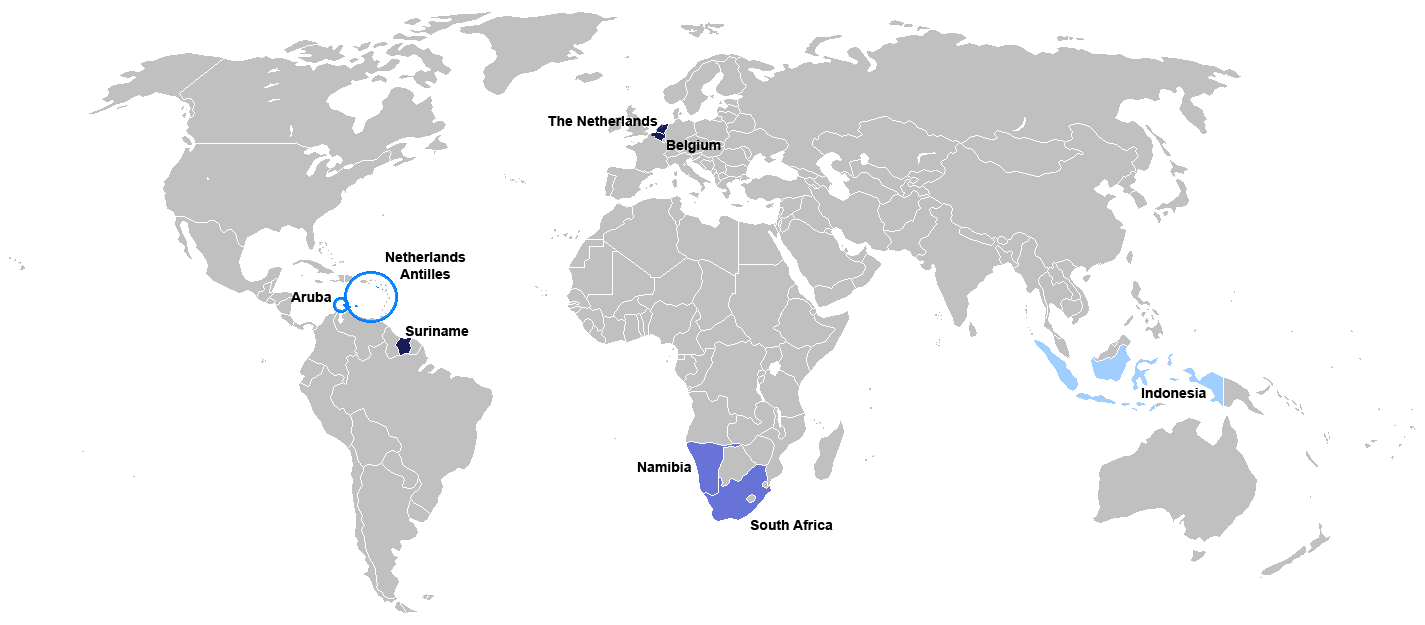


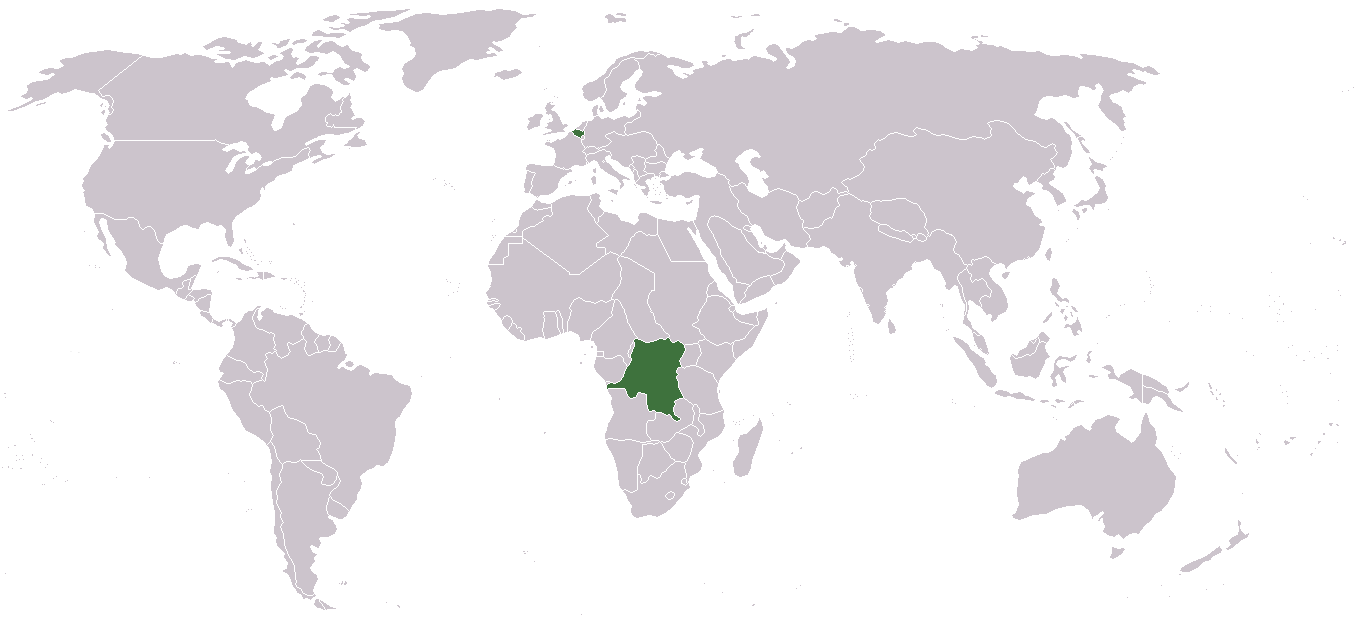


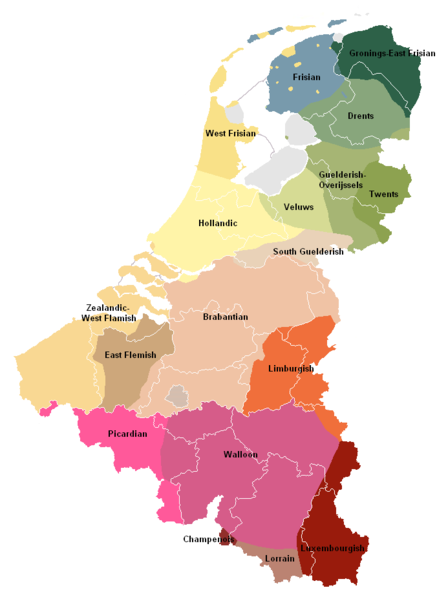









Wikimedia Foundation. 2010.
