

- Portuguese language
-
Portuguese português Pronunciation [purtuˈɣeʃ] (EP)
[poʁtuˈges][1] (BP)
[poɾtuˈɣes][2] (G)Spoken in See geographic distribution of Portuguese Region Africa, the Americas, Asia, Europe and Oceania Native speakers Total: 190–195 million (1998)[3] Language family Indo-European- Italic
- Romance
- Western Romance
- Gallo-Iberian
- Ibero-Romance
- West-Iberian
- Galician-Portuguese
- Portuguese
- Galician-Portuguese
- West-Iberian
- Ibero-Romance
- Gallo-Iberian
- Western Romance
- Romance
Writing system Latin (Portuguese alphabet) Official status Official language in
Numerous international organisations Macau (China)
Regulated by International Portuguese Language Institute
Academia Brasileira de Letras (Brazil)
Academia das Ciências de Lisboa, Classe de Letras (Portugal)
CPLPLanguage codes ISO 639-1 pt ISO 639-2 por ISO 639-3 por Linguasphere 51-AAA-a 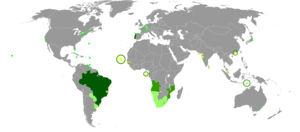 Native languageOfficial and administrative languageCultural or secondary languagePortuguese speaking minorities
This page contains IPA phonetic symbols in Unicode. Without proper rendering support, you may see question marks, boxes, or other symbols instead of Unicode characters. Portuguese (
 português (help·info) or língua portuguesa) is a Romance language that arose in the medieval Kingdom of Galicia,[4] nowadays Galicia and Northern Portugal. The southern part of the Kingdom of Galicia became independent as the County of Portugal in 1095 (kingdom from 1139). While Galicia declinedy the independent Portugal expanded to the south (conquest of Lisbon, 1147), and spread the language, with the Reconquista, to Southern Portugal and with the Portuguese discoveries to Brazil, Africa and other parts of the world.[5] It is an official language of the European Union, the Organisation of American States, the African Union, and Lusophone countries. It has around 225 million speakers[citation needed] making it the sixth-most spoken language in the world. Portuguese is the third-most spoken language in the Western Hemisphere, and the most spoken in the Southern Hemisphere.[6]
During the Age of Exploration, Portuguese sailors were among the first to sail to distant locations in the Americas, Sub-Saharan Africa, and Eastern Asia. The exploration was followed by the attempts to colonise new lands by Portugal and as a result Portuguese became a widely dispersed language around the world. Alongside Portugal, Portuguese is the main mother tongue of Brazil. It is also widely used as a lingua franca in former Portuguese colonies of Mozambique, Angola, Cape Verde, Guiné-Bissau and São Tomé e Príncipe, all of which are in Africa.[7] Additionally Portuguese speakers are also found in the Asian territories of Macau, East Timor and Goa (in India), all of which were Portuguese colonies until the second half of the 20th century.[8]
Spanish author Miguel de Cervantes once called Portuguese "the sweet language",[9] Lope de Vega referred to it as "sweet",[10] while Brazilian writer Olavo Bilac poetically described it as a última flor do Lácio, inculta e bela (the last flower of Latium, wild and beautiful). Portuguese is also termed "the language of Camões",[11] after one of Portugal's best known literary figures, Luís Vaz de Camões.
In March 2006, the Museum of the Portuguese Language, an interactive museum about the Portuguese language, was founded in São Paulo, Brazil, the city with the greatest number of Portuguese-language speakers in the world.[12]
Contents
History
Main article: History of the Portuguese languageMedieval
Portuguese poetryDas que vejo nom desejo outra senhor se vós nom, e desejo tam sobejo, mataria um leon, senhor do meu coraçom: fim roseta, bela sobre toda fror, fim roseta, nom me meta em tal coita voss'amor! João Lobeira
(c. 1270–1330)When Romans arrived to the Iberian Peninsula in 216 BC, they brought the Latin language, from which all Romance languages descend. The language was spread by arriving Roman soldiers, settlers, and merchants, who built Roman cities mostly near the settlements of previous civilizations.
Between 409 and 711 AD, as the Roman Empire collapsed in Western Europe, the Iberian Peninsula was conquered by Germanic peoples (Migration Period). The occupiers, mainly Suebi and Visigoths, quickly adopted late Roman culture and the Vulgar Latin dialects of the peninsula. After the Moorish invasion of 711, Arabic became the administrative language in the conquered regions, but most of the population continued to speak a form of Romance commonly known as Mozarabic. The influence exerted by Arabic on the Romance dialects spoken in the Christian kingdoms was small, affecting mainly their lexicon.
The earliest surviving records of a distinctively Portuguese language are administrative documents of the 9th century, still interspersed with many Latin phrases. Today this phase is known as Proto-Portuguese (between the 9th and the 12th centuries). In the first period of Old Portuguese—Galician-Portuguese Period (from the 12th to the 14th century)—the language gradually came into general use. For some time, it was the language of preference for lyric poetry in Christian Hispania, much as Occitan was the language of the poetry of the troubadours. Portugal became an independent kingdom from the Kingdom of León in 1139, under king Afonso I of Portugal. In 1290, king Denis of Portugal created the first Portuguese university in Lisbon (the Estudos Gerais, later moved to Coimbra) and decreed that Portuguese, then simply called the "common language", be known as the Portuguese language and used officially.
In the second period of Old Portuguese, from the 14th to the 16th centuries, with the Portuguese discoveries, the language was taken to many regions of Asia, Africa and the Americas (nowadays, the great majority of Portuguese speakers live in Brazil, in South America). By the 16th century, it had become a lingua franca in Asia and Africa, used not only for colonial administration and trade but also for communication between local officials and Europeans of all nationalities. Its spread was helped by mixed marriages between Portuguese and local people, and by its association with Roman Catholic missionary efforts, which led to the formation of a creole language called Kristang in many parts of Asia (from the word cristão, "Christian"). The language continued to be popular in parts of Asia until the 19th century. Some Portuguese-speaking Christian communities in India, Sri Lanka, Malaysia, and Indonesia preserved their language even after they were isolated from Portugal.
The end of the Old Portuguese period was marked by the publication of the Cancioneiro Geral by Garcia de Resende, in 1516. The early times of Modern Portuguese, which spans a period from the 16th century to the present day, were characterized by an increase in the number of learned words borrowed from Classical Latin and Classical Greek since the Renaissance, which greatly enriched the lexicon.
Geographic distribution
Main article: Geographic distribution of PortuguesePortuguese is the language of majority of people in Angola (80%),[13] Brazil,[14] Portugal,[15] and São Tomé and Príncipe (95%).[16] Although only 6.5 percent of the population are native speakers of Portuguese in Mozambique, the language is spoken by about 39.6% there according to the 1997 census.[17] It is also spoken by 11.5% of the population in Guinea-Bissau.[18] No data is available for Cape Verde, but almost all the population is bilingual, and the monolingual population speaks Cape Verdean Creole.
There are also significant Portuguese-speaking immigrant communities in many countries including Andorra (15.4%),[19] Australia,[20] Bermuda,[21] Canada (0.72% or 219,275 persons in the 2006 census[22] but between 400,000 and 500,000 according to Nancy Gomes),[23] Curaçao, France,[24] Japan,[25] Jersey,[26] Luxembourg (9%),[15] Namibia,[27] Paraguay (10.7% or 636,000 persons),[28] Macau (0.6% or 12,000 persons),[29] South Africa,[30] Switzerland (196,000 nationals in 2008),[31] Venezuela (1 to 2% or 254,000 to 480,000),[32] and the USA (0.24% of the population or 687,126 speakers according to the 2007 American Community Survey),[33] mainly in Connecticut,[34] Florida,[35] Massachusetts (where it is the second most spoken language in the state),[36] New Jersey,[37] New York[38] and Rhode Island.[39]
In some parts of what was Portuguese India, such as Goa[40] and Daman and Diu,[41] the language is still spoken.
Official status


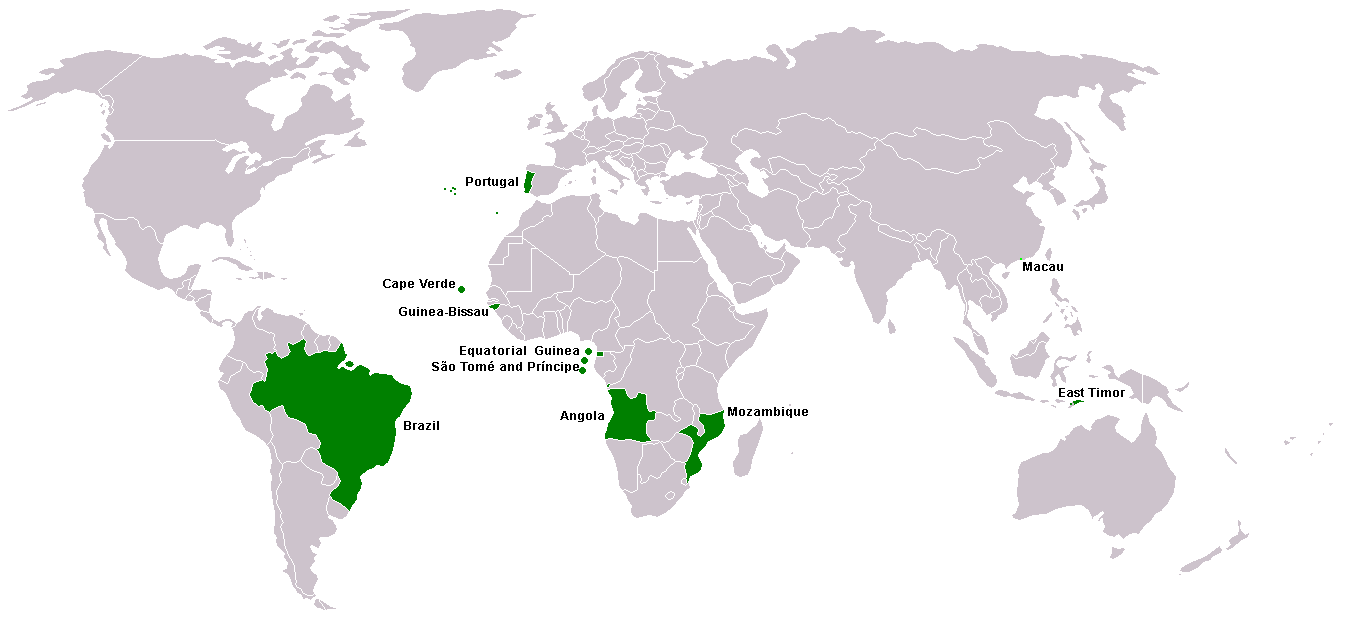
Countries and regions where Portuguese has official status. The Community of Portuguese Language Countries[7] (with the Portuguese acronym CPLP) consists of the eight independent countries that have Portuguese as an official language: Angola, Brazil, Cape Verde, East Timor, Guinea-Bissau, Mozambique, Portugal and São Tomé and Príncipe.[7]
Equatorial Guinea made a formal application for full membership to the CPLP in June 2010 and should add Portuguese as its third official language (alongside Spanish and French) since this is one of the conditions. The President of Equatorial Guinea, Obiang Nguema Mbasog, and Prime-Minister Cheaf of State, Ignacio Milam Tang, have approved on July 20, 2011 the new Constitutional bill that intends to add Portuguese as an official language of the country. The bill is now waiting for ratification by the People's Representative Chamber and it shall come into force 20 days after its publication at the official state's gazette.[42][43][44]
Portuguese is also one of the official languages of the Chinese special administrative region of Macau (alongside Chinese) and of several international organizations, including the Mercosur,[45] the Organization of Ibero-American States,[46] the Union of South American Nations,[47] the Organization of American States,[48] the African Union[49] and the European Union.[50]
Population of countries and jurisdictions of Portuguese official or co-official language
According to statistical and credible data from each government and their statistical national bureaus the population of each of the nine jurisdictions is as follows (by descending order):
- Brazil: 190,755,799 (definite results of the 2010 Census);[51]
- Mozambique: 20,366,795 (definite results of the 2007 Census);[52][53]
- Angola: 15,116,000 (government's estimate. Angola hasn't had a census counting for a few decades, the next one is scheduled for 2013);[54]
- Portugal: 10,555,853 (preliminary results of the 2011 Census);[55][56]
- Guinea-Bissau: 1,520,830 (definite results of the 2009 Census);[57]
- East Timor: 1,066,582 (preliminary results of the 2010 Census);[58]
- Macau: 558,100 (estimate of the DSEC of SAR Macau. The countings of the 2011 Census are now being made.;[59][60][61]
- Cape Verde: 491,575 (preliminary results of the 2010 Census);[62]
- Sao Tome and Principe: 137,599 (results of the 2011 Census published in 2003)[63]
This means that the population living in the lusophone official area is of 240,569,133 inhabitants.
To this number there is yet to add the big diaspora of lusophone nations spread throughout the world, estimated in little less than 10 million people (4.5 million Portuguese, 3 million Brazilians, half a million Cape Verdeans, etc) although it is hard to obtain official accurate numbers - including the percentage of this diaspora that can actually speak Portuguese, because a significative portion of these citizens are lusophone citizens born outside of lusophone territory, descendants of immigrants, and who do not speak the language. It is also important to refer that a big part of these national diasporas is a part of the already counted population of the Portuguese-speaking countries and territories, like the high number of Brazilian and PALOP's emigrant citizens in Portugal, or the high number of Portuguese emigrant citizens in the PALOP's and Brazil.
So being, the Portuguese language serves daily little more than 240 million people, who have direct or indirect legal, juridic and social contact with it, varying from the only language used in any contact, to only education, contact with local or international administration, commerce and services or the simple sight of road signs, public information and advertising in Portuguese.
It's also noticeable the growing numbers of these countries and jurisdictions' population to raw numbers easily identified: Continental Portugal with 10 million speakers and Azores and Madeira counting already half a million together; Brazil reaches 190 million, Mozambique 20 million, Angola 15 million, Guinea-Bissau an accurate 1 and a half million, Cape Verde and Sao Tome and Principe count for half a million together as well, Macau reaches half a million and Timor reaches finally the group of countries with one million inhabitants leaving the list of thousands. These are recent and real numbers that individually and all together strengthen the lusophone identities and the Portuguese language on an international basis.
Portuguese as a foreign language
The mandatory offering of Portuguese in school curricula is observed in Uruguay[64] and Argentina.[65] Other countries where Portuguese is taught at schools or is being introduced now include Venezuela,[66] Zambia,[67] Congo,[68] Senegal,[68] Namibia,[68] Swaziland,[68] Côte d'Ivoire,[68] and South Africa.[68]
Future
According to estimates by UNESCO, Portuguese and Spanish are the fastest-growing European languages after English and the language has the highest potential for growth as an international language in southern Africa and South America.[69] The Portuguese-speaking African countries are expected to have a combined population of 83 million by 2050. In total, the Portuguese-speaking countries will have 335 million people by the same year.[69]
Since 1991, when Brazil signed into the economic market of Mercosul with other South American nations, such as Argentina, Uruguay, and Paraguay, there has been an increase in interest in the study of Portuguese in those South American countries. The demographic weight of Brazil in the continent will continue to strengthen the presence of the language in the region.
Although early in the 21st century, after Macau was ceded to China, the use of Portuguese was in decline in Asia, it is once again becoming a language of opportunity there; mostly because of increased Chinese diplomatic and financial ties with Portuguese-speaking countries.[70]
Dialects
Main article: Portuguese dialectsModern Standard Portuguese (português padrão) is based on the Portuguese spoken in the area including and surrounding the city of Coimbra, in Central Portugal. Standard Portuguese is also the preferred standard by the Portuguese-speaking African countries, as such and despite its speakers are dispersed around the world, Portuguese has only two dialects used for learning: the European and the Brazilian. Some aspects and sounds found in dialects in Brazil are exclusive to South America, and cannot be found in Europe. However, the Santomean Portuguese in Africa may be confused to be a Brazilian accent. Some aspects link some Brazilian accents with the ones spoken in Africa, such as the pronunciation of "menino", which is pronounced as [mininu] compared to [mɨninu] in Standard Portuguese. Dialects from inland Northern Portugal have significant similarities with Galician.
Audio samples of some dialects and accents of Portuguese are available below.[71] There are some differences between the areas but these are the best approximations possible.
 Portuguese dialects of Angola
 Angola
- Benguelense—Benguela province.
- Luandense—Luanda province.
- Sulista—South of Angola.
- Huambense—Huambo province.
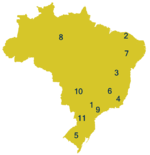 Dialects of Portuguese in Brazil
 Brazil
- Caipira—States of São Paulo (countryside; the city of São Paulo and the eastern areas of the state have their own accent, called paulistano); southern Minas Gerais, northern Paraná, southeastern Mato Grosso do Sul.
- Cearense—Ceará.
- Baiano—Bahia.
- Fluminense—Variants spoken in the state of Rio de Janeiro (excluding the city of Rio de Janeiro and its adjacent metropolitan areas, which have their own dialect, called carioca).
- Gaúcho—Rio Grande do Sul. (There are many distinct accents in Rio Grande do Sul, mainly due to the heavy influx of European immigrants of diverse origins, who have settled in colonies throughout the state and to the proximity to Spanish-speaking countries.)
- Mineiro—Minas Gerais (not prevalent in the Triângulo Mineiro; includes southern and southeastern Minas Gerais; the city of Belo Horizonte has an accent of its own.).[citation needed]
- Nordestino—northeastern states of Brazil (Pernambuco, Paraíba and Rio Grande do Norte have a particular way of speaking).[72]
- Nortista—Amazon Basin states.
- Paulistano—Variants spoken around São Paulo city and some eastern areas of São Paulo state.
- Sertanejo—States of Goiás and Mato Grosso.
- Sulista—Variants spoken in the areas between the northern regions of Rio Grande do Sul and southern regions of São Paulo state. (The cities of Curitiba and Florianópolis have fairly distinct accents as well.)
- Carioca—Variants spoken in Rio de Janeiro City and surround area.
- Brasiliense—Variant only spoken in Brasília, due to many waves of immigration, attracted by the government in order to build Brasília.
 Dialects of Portuguese in Portugal
 Portugal
- Micaelense (Açores) (São Miguel)—Azores.
- Alentejano—Alentejo (Alentejan Portuguese)
- Algarvio—Algarve (there is a particular dialect in a small part of western Algarve).
- Alto-Minhoto—North of Braga (hinterland).
- Baixo-Beirão; Alto-Alentejano—Central Portugal (hinterland).
- Beirão— Central Portugal.
- Estremenho—Regions of Coimbra, Leiria and Lisbon (this is a disputed denomination, as Coimbra is not part of "Estremadura", and the Lisbon dialect has some peculiar features that not only are not shared with the one of Coimbra, as make it significantly distinct and recognizable to most native speakers from elsewhere in Portugal).
- Madeirense (Madeiran)—Madeira.
- Nortenho—Regions of the districts of Braga, Porto and parts of Aveiro.
- Transmontano—Trás-os-Montes e Alto Douro.
Other countries
 Cape Verde— Português cabo-verdiano (Cape Verdean Portuguese)
 Daman and Diu, India—Damaense (Damanese Portuguese)
 East Timor— Timorense (East Timorese Portuguese)
- Goa, India—Goês (Goan Portuguese)
 Guinea-Bissau— Guineense (Guinean Portuguese)
- Macau— Macaense (Macanese Portuguese)
 Mozambique— Moçambicano (Mozambican Portuguese)
 São Tomé and Príncipe— Santomense (São Tomean Portuguese)
 Uruguay—Dialectos Portugueses del Uruguay (DPU)
Differences between dialects are mostly of accent and vocabulary, but between the Brazilian dialects and other dialects, especially in their most colloquial forms, there can also be some grammatical differences. The Portuguese-based creoles spoken in various parts of Africa, Asia, and the Americas are independent languages that should not be confused with Portuguese.
Characterization
Portuguese, like Catalan and Sardinian, preserved the stressed vowels of Vulgar Latin, which became diphthongs in most other Romance languages; cf. Port., Cat., Sard. pedra ; Fr. pierre, Sp. piedra, It. pietra, Ro. piatră, from Lat. petram ("stone"); or Port. fogo, Cat. foc, Sard. fogu; Sp. fuego, It. fuoco, Fr. feu, Ro. foc, from Lat. focus ("fire"). Another characteristic of early Portuguese was the loss of intervocalic l and n, sometimes followed by the merger of the two surrounding vowels, or by the insertion of an epenthetic vowel between them: cf. Lat. salire ("to leave"), tenere ("to have"), catenam ("chain"), Sp. salir, tener, cadena, Port. sair, ter, cadeia.
When the elided consonant was n, it often nasalized the preceding vowel: cf. Lat. manum ("hand"), ranam ("frog"), bonum ("good"), Port. mão, rãa, bõo (now mão, rã, bom). This process was the source of most of the language's distinctive nasal diphthongs. In particular, the Latin endings -anem, -anum and -onem became -ão in most cases, cf. Lat. canem ("dog"), germanum ("brother"), rationem ("reason") with Modern Port. cão, irmão, razão, and their plurals -anes, -anos, -ones normally became -ães, -ãos, -ões, cf. cães, irmãos, razões.
Vocabulary
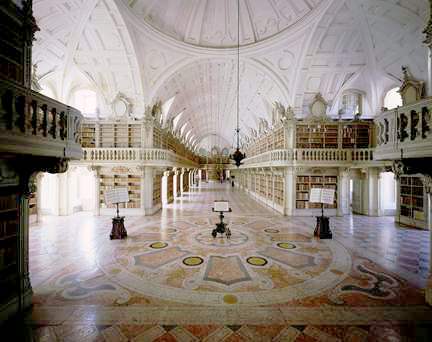
Main article: Portuguese vocabulary Library of the Mafra National Palace, Portugal.
 Baroque Library of the Coimbra University, Portugal.
Most of the lexicon of Portuguese is derived from Latin. Nevertheless, because of the Moorish occupation of the Iberian Peninsula during the Middle Ages, and the participation of Portugal in the Age of Discovery, it has adopted loanwords from all over the world.
Very few Portuguese words can be traced to the pre-Roman inhabitants of Portugal, which included the Gallaeci, Lusitanians, Celtici and Cynetes. The Phoenicians and Carthaginians, briefly present, also left some scarce traces. Some notable examples are abóbora "pumpkin" and bezerro "year-old calf", from the nearby Celtiberian language (probably through the Celtici); cerveja "beer", from Celtic; through Latin "cervisia."
In the 5th century, the Iberian Peninsula (the Roman Hispania) was conquered by the Germanic Suebi and Visigoths. As they adopted the Roman civilization and language, however, these people contributed only a few words to the lexicon, mostly related to warfare—such as espora "spur", estaca "stake", and guerra "war", from Gothic *spaúra, *stakka, and *wirro, respectively. The influence also exists in toponymic and patronymic surnames borne by Visigoth sovereigns and their descendants, and it dwells on placenames such has Ermesinde, Esposende and Resende where sinde and sende are derived from the Germanic "sinths" (military expedition) and in the case of Resende, the prefix re comes from Germanic "reths" (council).
Between the 9th and 13th centuries, Portuguese acquired about 800 words from Arabic by influence of Moorish Iberia. They are often recognizable by the initial Arabic article a(l)-, and include many common words such as aldeia "village" from الضيعة alḍai`a, alface "lettuce" from الخس alkhass, armazém "warehouse" from المخزن almakhzan, and azeite "olive oil" from الزيت azzait. From Arabic came also the grammatically peculiar word oxalá إن شاء الله "hopefully". The Mozambican currency name metical was derived from the word متقال mitqāl, a unit of weight. The word Mozambique itself is from the Arabic name of sultan Muça Alebique (Musa Alibiki).
Starting in the 15th century, the Portuguese maritime explorations led to the introduction of many loanwords from Asian languages. For instance, catana "cutlass" from Japanese katana and chá "tea" from Chinese chá.
From South America came batata "potato", from Taino; ananás and abacaxi, from Tupi–Guarani naná and Tupi ibá cati, respectively (two species of pineapple), and tucano "toucan" from Guarani tucan. See List of Brazil state name etymologies, for some more examples.
From the 16th to the 19th centuries, because of the role of Portugal as intermediary in the Atlantic slave trade, and the establishment of large Portuguese colonies in Angola, Mozambique, and Brazil, Portuguese got several words of African and Amerind origin, especially names for most of the animals and plants found in those territories. While those terms are mostly used in the former colonies, many became current in European Portuguese as well. From Kimbundu, for example, came kifumate → cafuné "head caress", kusula → caçula "youngest child", marimbondo "tropical wasp", and kubungula → bungular "to dance like a wizard".
Finally, it has received a steady influx of loanwords from other European languages. For example, melena "hair lock", fiambre "wet-cured ham" (in contrast with presunto "dry-cured ham" from Latin prae-exsuctus "dehydrated"), and castelhano "Castilian", from Spanish; colchete/crochê "bracket"/"crochet", paletó "jacket", batom "lipstick", and filé/filete "steak"/"slice", rua "street" respectively, from French crochet, paletot, bâton, filet; macarrão "pasta", piloto "pilot", carroça "carriage", and barraca "barrack", from Italian maccherone, pilota, carrozza, baracca; and bife "steak", futebol, revólver, estoque, folclore, from English beef, steak, football, revolver, stock, folklore.
 Map showing the historical retreat and expansion of Portuguese (Galician-Portuguese) within the context of its linguistic neighbours between the year 1000 and 2000Main articles: Iberian Romance languages and Galician-Portuguese
Portuguese belongs to the West Iberian branch of the Romance languages, and it has special ties with the following members of this group:
- Galician and Fala, its closest relatives. See below.
- Mirandese, Leonese and Asturian (Astur-Leonese linguistic group). Mirandese is the only recognised regional language spoken in Portugal (beside Portuguese, the only official language in Portugal).
- Spanish. (See also Differences between Spanish and Portuguese)
Despite the obvious lexical and grammatical similarities between Portuguese and other Romance languages, it is not mutually intelligible with them. Apart from Galician and Spanish, Portuguese speakers will usually need some formal study of basic grammar and vocabulary before attaining a reasonable level of comprehension in the other Romance languages, and vice versa.
Galician and the Fala
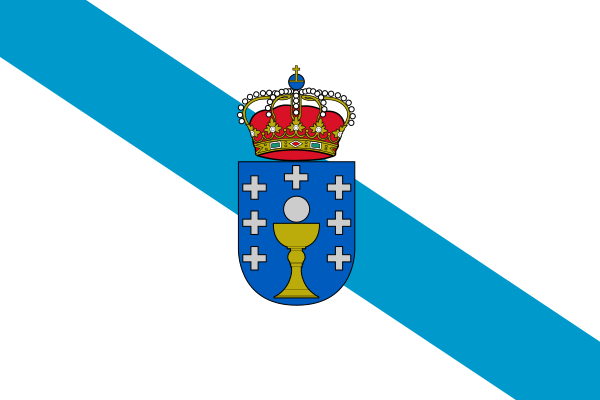
The closest language to Portuguese is Galician, spoken in the autonomous community of Galicia (northwestern Spain). The two were at one time a single language, known today as Galician-Portuguese, but since the political separation of Portugal from Galicia they have diverged, especially in pronunciation and vocabulary. Nevertheless, the core vocabulary and grammar of Galician are still noticeably closer to Portuguese than to those of Spanish. In particular, like Portuguese, it uses the future subjunctive, the personal infinitive, and the synthetic pluperfect (see the section on the grammar of Portuguese, below). Mutual intelligibility (estimated at 85% by R. A. Hall, Jr., 1989)[73] is very good between Galicians and northern Portuguese, but poorer between Galicians and speakers from central Portugal. Nevertheless, many renowned linguists still consider Galician to be a dialect of the Portuguese language.
The Fala language is another descendant of Galician-Portuguese, spoken by a small number of people in the Spanish towns of Valverde del Fresno, Eljas and San Martín de Trevejo (autonomous community of Extremadura, near the border with Portugal).
Influence on other languages
See also: List of English words of Portuguese origin, Loan words in Indonesian, Japanese words of Portuguese origin, List of Malay loanwords, Portuguese loanwords in Sinhala, and Loan words in Sri Lankan Tamil#PortuguesePortuguese has provided loanwords to many languages, such as Indonesian, Manado Malay, Sri Lankan Tamil and Sinhalese (see Sri Lanka Indo-Portuguese), Malay, Bengali, English, Hindi, Konkani, Marathi, Tetum, Xitsonga, Papiamentu, Japanese, Lanc-Patuá (spoken in northern Brazil), Esan and Sranan Tongo (spoken in Suriname). It left a strong influence on the língua brasílica, a Tupi–Guarani language, which was the most widely spoken in Brazil until the 18th century, and on the language spoken around Sikka in Flores Island, Indonesia. In nearby Larantuka, Portuguese is used for prayers in Holy Week rituals. The Japanese–Portuguese dictionary Nippo Jisho (1603) was the first dictionary of Japanese in a European language, a product of Jesuit missionary activity in Japan. Building on the work of earlier Portuguese missionaries, the Dictionarium Anamiticum, Lusitanum et Latinum (Annamite–Portuguese–Latin dictionary) of Alexandre de Rhodes (1651) introduced the modern orthography of Vietnamese, which is based on the orthography of 17th-century Portuguese. The Romanization of Chinese was also influenced by the Portuguese language (among others), particularly regarding Chinese surnames; one example is Mei. During 1583–88 Italian Jesuits Michele Ruggieri and Matteo Ricci created a Portuguese–Chinese dictionary—the first ever European–Chinese dictionary.[74][75]
Derived languages
Main article: Portuguese-based creole languagesBeginning in the 16th century, the extensive contacts between Portuguese travelers and settlers, African slaves, and local populations led to the appearance of many pidgins with varying amounts of Portuguese influence. As each of these pidgins became the mother tongue of succeeding generations, they evolved into fully fledged creole languages, which remained in use in many parts of Asia and Africa until the 18th century. Some Portuguese-based or Portuguese-influenced creoles are still spoken today, by over 3 million people worldwide, especially people of partial Portuguese ancestry.
Phonology
Main article: Portuguese phonologyThere is a maximum of 9 oral vowels and 19 consonants, though some varieties of the language have fewer phonemes (Brazilian Portuguese has 8 oral vowels). There are also five nasal vowels, which some linguists regard as allophones of the oral vowels, ten oral diphthongs, and five nasal diphthongs. In total, Brazilian Portuguese has 13 vowel phonemes.[76][77]
Vowels
 Chart of monophthongs of the Portuguese of Lisbon
To the seven vowels of Vulgar Latin, European Portuguese has added two near central vowels, one of which tends to be elided in rapid speech, like the e caduc of French (/ɯ̽/, but commonly represented as [ɨ]). The high vowels /e o/ and the low vowels /ɛ ɔ/ are four distinct phonemes, and they alternate in various forms of apophony. Like Catalan, Portuguese uses vowel quality to contrast stressed syllables with unstressed syllables: isolated vowels tend to be raised, and in some cases centralized, when unstressed. Nasal diphthongs occur mostly at the ends of words.
Consonants
Consonant phonemes of Portuguese[78][79] Bilabial Labio-
dentalDental/
AlveolarPost-
alveolarPalatal Velar Uvular Nasal m n ɲ Plosive p b t d k ɡ Fricative f v s z ʃ ʒ ʁ Lateral l ʎ Flap ɾ The consonant inventory of Portuguese is fairly conservative. The medieval affricates /ts/, /dz/, /tʃ/, /dʒ/ merged with the fricatives /s/, /z/, /ʃ/, /ʒ/, respectively, but not with each other, and there have been no other significant changes to the consonant phonemes since then. However, some notable dialectal variants and allophones have appeared, among which:
- In many regions of Brazil, /t/ and /d/ have the affricate allophones [tʃ] and [dʒ], respectively, before /i/ and /ĩ/.
- At the end of a syllable, the phoneme /l/ is velarized to [ɫ] in European Portugal and vocalized to [w] in Brazilian Portuguese.
- In some parts of Brazil and Angola, intervocalic /ɲ/ is pronounced as a nasal palatal approximant [j̃], which nasalizes the preceding vowel, so that, for instance, /ˈniɲu/ is pronounced [ˈnĩj̃u].
- In most of Brazil, the alveolar sibilants /s/ and /z/ occur in complementary distribution at the ends of syllables, depending on whether the consonant that follows is voiceless or voiced, as in English. But in European, African and Asian portuguese, plus parts of Brazil (especially Rio de Janeiro), sibilants are postalveolar at the ends of syllables, /ʃ/ before voiceless consonants, and /ʒ/ before voiced consonants (in Judeo-Spanish, /s/ is often replaced with /ʃ/ at the ends of syllables, too).
- There is considerable dialectal variation in the value of the rhotic phoneme /ʁ/. See Guttural R in Portuguese, for details.
- In Portugal, the voiced stops [b d ɡ] are pronounced as the corresponding voiced fricatives [β ð ɣ] between vowels.
Examples of different pronunciation
- Excerpt from the Portuguese national epic Os Lusíadas, by author Luís de Camões (I, 33)
Original IPA (Lisbon) IPA (São Paulo) IPA (Santiago de Compostela) Translation Sustentava contra ele Vénus bela, suʃtẽˈtavɐ ˈkõtɾɐ ˈelɨ ˈvɛnuʒ ˈβɛlɐ sustẽˈtavɐ ˈkõtɾɐ ˈeli ˈvenuz ˈbɛlɐ sustenˈtaβa ˈkontɾa ˈel ˈβɛnuz ˈβɛla Held against him the lovely Venus Afeiçoada à gente Lusitana, ɐfɐjsuˈaða ˈʒẽtɨ luziˈtɐnɐ afejsuˈada ˈʒẽtʃi luziˈtɐnɐ afejθoˈaða ˈʃente lusiˈtana Fondly to the people of Portugal, Por quantas qualidades via nela puɾ ˈkwɐ̃tɐʃ kwɐliˈðaðɨʒ ˈviɐ ˈnɛlɐ puɾ ˈkwɐ̃tɐs kwaliˈdadʒiz ˈviɐ ˈnɛlɐ poɾ ˈkantas kwaliˈðaðez ˈβia ˈnɛla For many qualities he saw in her Da antiga tão amada sua Romana; dɐ̃ˈtiɣɐ ˈtɐ̃w̃ ɐˈmaðɐ ˈsuɐ ʁuˈmɐnɐ dɐ̃ˈtʃiɡɐ ˈtɐ̃w̃ ɐˈmadɐ ˈsuɐ hoˈmɐnɐ danˈtiɣa ˈtaŋ aˈmaða ˈsua roˈmana From his old beloved Roman; Nos fortes corações,
na grande estrela,nuʃ ˈfɔɾtɨʃ kuɾɐˈsõj̃ʃ
nɐ ˈɣɾɐ̃dɨʃˈtɾelɐnus ˈfɔɾtʃis koɾaˈsõj̃s
na ˈɡɾɐ̃dʒisˈtɾelɐnos ˈfɔɾtes koɾaˈθons
na ˈɣɾandesˈtɾelaIn the stout hearts, in the big star Que mostraram na terra Tingitana, kɨ muʃˈtɾaɾɐ̃w̃ nɐ ˈtɛʁɐ tĩʒiˈtɐnɐ ki mosˈtɾaɾɐ̃w̃ na ˈtɛhɐ tʃĩʒiˈtɐnɐ ke mosˈtɾaraŋ na ˈtɛra tinʃiˈtana That showed in the land Tingitana, E na língua, na qual quando imagina, i nɐ ˈlĩɡwɐ nɐ ˈkwaɫ ˈkwɐ̃du jmɐˈʒinɐ i na ˈlĩɡwɐ na ˈkwaw ˈkwɐ̃dimaˈʒinɐ e na ˈliŋgwa na ˈkal ˈkando jmaˈʃina And in the language, which when it is imagined Com pouca corrupção crê que é a Latina. kõ ˈpokɐ kuʁupˈsɐ̃w̃ ˈkɾe kiˈɛ ɐ lɐˈtinɐ kũ ˈpokɐ kohup(i)ˈsɐ̃w̃ ˈkɾe kiˈɛ a laˈtʃinɐ kom ˈpowka korupˈθoŋ ˈkɾe ˈke ˈɛ a laˈtina With little corruption, believes that it is Latin.[80] Grammar
Main article: Portuguese grammarA notable aspect of the grammar of Portuguese is the verb. Morphologically, more verbal inflections from classical Latin have been preserved by Portuguese than by any other major Romance language. See Romance copula for a detailed comparison. It has also some innovations not found in other Romance languages (except Galician and the Fala):
- The present perfect has an iterative sense unique to the Galician-Portuguese language group. It denotes an action or a series of actions that began in the past and are expected to keep repeating in the future. For instance, the sentence Tenho tentado falar com ela would be translated to "I have been trying to talk to her", not "I have tried to talk to her". On the other hand, the correct translation of the question "Have you heard the latest news?" is not *Tem ouvido a última notícia?, but Ouviu a última notícia?, since no repetition is implied.[81]
- Vernacular Portuguese still uses the future subjunctive mood, which developed from medieval West Iberian Romance and in present-day Spanish and Galician has almost entirely fallen into disuse. The future subjunctive appears in dependent clauses that denote a condition that must be fulfilled in the future so that the independent clause will occur. English normally employs the present tense under the same circumstances:
- Se eu for eleito presidente, mudarei a lei.
- If I am elected president, I will change the law.
- Quando fores mais velho, vais entender.
- When you grow older, you will understand.
- The personal infinitive: infinitives can inflect according to their subject in person and number, often showing who is expected to perform a certain action; cf. É melhor voltares "It is better [for you] to go back", É melhor voltarmos "It is better [for us] to go back." Perhaps for this reason, infinitive clauses replace subjunctive clauses more often in Portuguese than in other Romance languages.
Writing system
Written varieties Portugal and non-1990 Agreement countries Brazil and 1990 Agreement countries translation direcção direção direction óptimo ótimo best, excellent, optimal Main articles: Portuguese alphabet and Portuguese orthographyPortuguese is written with 23 or 26 letters of the Latin alphabet, making use of five diacritics to denote stress, vowel height, contraction, nasalization, and other sound changes (acute accent, grave accent, circumflex accent, tilde, and cedilla). Accented characters and digraphs are not counted as separate letters for collation purposes.
 Museum of the Portuguese Language in São Paulo, Brazil.
Spelling reforms
Main article: Reforms of Portuguese orthographySee also
- Portuguese literature
- Portuguese poetry
- List of Portuguese language poets
- List of international organisations which have Portuguese as an official language
- Brazilian literature
- List of Brazilian poets
- Lusophone
- Anglophone pronunciation of foreign languages (Portuguese section)
- Community of Portuguese Language Countries (CPLP)
- Instituto Camões
- International Portuguese Language Institute
- Museum of the Portuguese Language
- Portuñol
- Portuguese in the United States
Notes
- ^ Regional pronunciation in Brazil:
[poχtuˈɡe(j)ʃ] (BP-carioca)
[poɾtuˈɡe(j)s] (BP-paulistano),
[poɹtuˈɡejs] (BP-caipira),
[poχ(h)tuˈɡes] (BP-mineiro),
[pɔhtuˈɡejs] (BP-nordestino),
[poɾtuˈɡes] (BP-gaúcho). In this discussion of a politician woman from Alagoas state it is possible to notice that the "r" in this position is an [h<!>] sound http://www.youtube.com/watch?v=oKoGPP0ntz0 - ^ Also pronounced [poɾtuˈħes] by speakers featuring gheada.
- ^ Portuguese language at Ethnologue
- ^ "Portuguese is the literary language of Portugal, its possessions and Brazil. It is based, originally, in the dialect of Galicia (northwest corner of the Peninsula), an area which has always remained connected to the Astur-Leonese crown (and, later, Castilian) and now belongs to the field of Spanish written language. The Galician border march in the south, along the mouth of the Douro, which in 1095 became independent as county (kingdom from 1139) of Portugal, had already taken in the mid XII century the reconquest of Portugal until the current southern border, and spread by these border territories the Galician dialect, which was used in the Middle Ages in the lyric also in the Castilian-speaking territory."
(Lausberg, Heinrich; Ehrhardt, Marion; Schemann, Maria Luísa (impr. 1981). Linguística românica. Manuais Universitários. Lisboa: Fundação Calouste Gulbenkian. p. 36.)
"The Galician-Portuguese language began to be spoken in a region covering Galicia and northern Portugal."
(Mira Mateus, Maria Helena (2003). Gramática Da Língua Portuguesa. Colecção Universitária. Serie linguística. Lisboa: Caminho. pp. 25, 41. ISBN 9789722104456.)
"Portuguese, as we have already seen, developed as a concomitant of the southward movement of speakers of Galician, with which as a result it still has the closest of affinities." "Galician, from which Portuguese ultimately derives (...)"
(Harris, Martin; Vincent, Nigel (1988). The Romance Languages. Oxford Oxfordshire: Oxford University Press. pp. 10, 131. ISBN 9780195206289.) - ^ Vázquez Cuesta, Pilar; Mendes da Luz, Albertina (1989). Gramática da língua portuguesa. Lisboa: Edições 70. p. 180.
- ^ Herles Matos, Frank (28 June 2009). "The 100 most spoken languages on the world". http://frankherles.wordpress.com/2009/06/28/the-100-most-spoken-languages-on-the-world/.
- ^ a b c "Estados-membros da CPLP" (in Portuguese). 2011-02-28. http://www.cplp.org/id-22.aspx.
- ^ Michael Swan, Bernard Smith (2001). "Portuguese Speakers". Learner English: a Teacher's Guide to Interference and Other Problems. Cambridge University Press.
- ^ Henry Edward Watts. Miguel de Cervantes: His Life & Works.
- ^ Joseph T. Shipley (1946). Encyclopedia of Literature. Philosophical Library. pp. 1188.
- ^ Prem Poddar, Rajeev S. Patke, Lars Jensen (2008). "Introduction: The Myths and Realities of Portuguese (Post) Colonial Society". A historical companion to postcolonial literatures: continental Europe and its empires. Edinburgh University Press. p. 431. http://books.google.com/books?id=Ghah5S3usnsC&pg=PA431&lpg=PA431&dq=%22language+of+Cam%C3%B5es%22#v=onepage&q=%22language%20of%20Cam%C3%B5es%22&f=false.
- ^ Museu da Língua Portuguesa aberto ao público no dia 20
- ^ Medeiros, Adelardo Portuguese in Africa – Angola
- ^ Portuguese language in Brazil
- ^ a b "Special Eurobarometer 243 "Europeans and their Languages"". European Commission. 2006. p. 6. http://ec.europa.eu/public_opinion/archives/ebs/ebs_243_en.pdf. Retrieved 2011-05-11.
- ^ 99.8% declared speaking Portuguese in the 1991 census
- ^ Medeiros, Adelardo Portuguese in Africa – Moçambique
- ^ Medeiros, Adelardo Portuguese in Africa – Guiné-Bissau
- ^ 13,100 Portuguese nationals in 2010 according to Population par nationalité on the site of the "Département des Statistiques d'Andorre"
- ^ 0.13% or 25,779 persons speak it at home in the 2006 census, see Spoken at Home (full classification list) by Sex&producttype=Census Tables&method=Place of Usual Residence&areacode=0 "Language Spoken at Home from the 2006 census". Australian Bureau of Statistics. http://www.censusdata.abs.gov.au/ABSNavigation/download?format=xls&collection=Census&period=2006&productlabel=Language Spoken at Home (full classification list) by Sex&producttype=Census Tables&method=Place of Usual Residence&areacode=0.
- ^ "Bermuda". World InfoZone. http://www.worldinfozone.com/country.php?country=Bermuda. Retrieved 2010-04-21.
- ^ "Population by mother tongue, by province and territory (2006 Census)". Statistics Canada. http://www40.statcan.ca/l01/cst01/demo11a-eng.htm.
- ^ Gomes, Nancy (2001), "Os portugueses nas Américas: Venezuela, Canadá e EUA", Actualidade das migrações, Janus, http://janusonline.pt/2001/2001_3_2_5.html, retrieved 13 May 2011
- ^ 580,000 estimated to use it as their mother tongue in the 1999 census and 490,444 nationals in the 2007 census, see Répartition des étrangers par nationalité
- ^ "Japão: imigrantes brasileiros popularizam língua portuguesa" (in pt). 2008. http://www.correiodoestado.com.br/noticias/japao-imigrantes-brasileiros-popularizam-lingua-portuguesa_43355/.
- ^ 4.6% according to the 2001 census, see
- ^ About 1% of the population, mainly refugees from Angola in the North of the country
- ^ "Languages of Paraguay". http://www.ethnologue.com/show_country.asp?name=Paraguay.
- ^ "Languages of Macau". http://www.pagef30.com/2008/10/how-much-portuguese-is-spoken-in-macau.html.
- ^ Between 300,000 and 600,000 according to Pina, António (2001), "Portugueses na África do Sul", Actualidade das migrações, Janus, http://www.janusonline.pt/2001/2001_3_2_11.html, retrieved 13 May 2011
- ^ Fibbi, Rosita (2010), Les Portugais en Suisse, Office fédéral des migrations, http://www.bfm.admin.ch/content/dam/data/migration/publikationen/diasporastudie-portugal-f.pdf, retrieved 13 May 2011
- ^ See "Languages of Venezuela". http://www.ethnologue.com/show_country.asp?name=VE. and Gomes, Nancy (2001), "Os portugueses nas Américas: Venezuela, Canadá e EUA", Actualidade das migrações, Janus, http://janusonline.pt/2001/2001_3_2_5.html, retrieved 13 May 2011
- ^ Carvalho, Ana Maria (2010), "Portuguese in the USA", in Potowski, Kim, Language Diversity in the USA, Cambridge University Press, pp. 346, ISBN 978-0-521-74533-8
- ^ The Portuguese Foundation, Inc.
- ^ Jornal Brasileiras & Brasileiros
- ^ An immigration phenomenon: Why Portuguese is the second language of Massachusetts from www.boston.com Fall 2007
- ^ Hispanic Reading Room of the U.S. Library of Congress Web site, Twentieth-Century Arrivals from Portugal Settle in Newark, New Jersey,
- ^ "Brazucas (Brazilians living in New York)". Nyu.edu. http://www.nyu.edu/classes/blake.map2001/brazil.html. Retrieved 2010-04-21.
- ^ Hispanic Reading Room of the U.S. Library of Congress Web site, Whaling, Fishing, and Industrial Employment in Southeastern New England
- ^ "Portuguese Language in Goa". Colaco.net. http://www.colaco.net/1/port.htm. Retrieved 2010-04-21.
- ^ "The Portuguese Experience: The Case of Goa, Daman and Diu". Rjmacau.com. http://www.rjmacau.com/english/rjm1996n3/ac-mary/portuguese.html. Retrieved 2010-04-21.
- ^ El portugués será el tercer idioma oficial de la República de Guinea Ecuatorial - Página Oficial del Gobierno de la República de Guinea Ecuatorial
- ^ Decreto sobre el portugues como idioma oficial - Página Oficial del Gobierno de la República de Guinea Ecuatorial
- ^ El Presidente Obiang asiste a la Cumbre de la CPLP - Página Oficial del Gobierno de la República de Guinea Ecuatorial
- ^ Official languages of Mercosur as agreed in the Protocol of Ouro Preto.
- ^ Official statute of the organization
- ^ Artículo 23 for the official languages
- ^ General Assembly of the OAS, Amendments to the Rules of Procedure of the General Assembly, 5 June 2000
- ^ Article 11, Protocol on Amendments to the Constitutive Act of the African Union [1]
- ^ "Languages in Europe – Official EU Languages". EUROPA web portal. http://ec.europa.eu/education/languages/languages-of-europe/doc135_en.htm. Retrieved 12 October 2009.
- ^ Instituto Brasileiro de Geografia e Estatística
- ^ Informação geral sobre Moçambique - Portal do Governo de Moçambique
- ^ 3° recenseamento geral da população e habitação - Instituto Nacional de Estatística
- ^ Governo da República de Angola
- ^ Aplicação interativa do Instituo Nacional de Estatística sobre os resultados preliminares do Censos 2011
- ^ Instituo Nacional de Estatística
- ^ Apresentação dos resultados definitivos do Censos 2009 do Instituto Nacional de Estatística
- ^ Resultados do Censos 2010 - Governo de Timor Leste
- ^ Estimativas da população de Macau - Direção dos Serviços de Estatística e Censos do Governo da RAE de Macau
- ^ Direção dos Serviços de Estatística e Censos do Governo da RAE de Macau
- ^ Censos 2011 de Macau - Direção dos Serviços de Estatística e Censos do Governo da RAE de Macau
- ^ Apresentação de dados preliminares do IV° RGPH 2010 - Instituto Nacional de Estatística, Cabo Verde
- ^ RGPH 2001 Estado e estrutura da população de São Tomé e Príncipe - Instituto Nacional de Estatística, São Tomé e Príncipe - 2003
- ^ "Uruguayan government makes Portuguese mandatory." (in Portuguese). 2007-11-05. http://noticias.uol.com.br/ultnot/lusa/2007/11/05/ult611u75523.jhtm. Retrieved 2010-07-13.
- ^ "Portuguese will be mandatory in high school." (in Spanish). 2009-01-21. http://portal.educ.ar/noticias/educacion-y-sociedad/el-portugues-sera-materia-obli.php. Retrieved 2010-07-13.
- ^ "Portuguese language will be option in the official Venezuelan teachings." (in Portuguese). 2009-05-24. http://www.letras.etc.br/joomla/index.php?option=com_content&view=article&id=93:lingua-portuguesa-sera-opcao-no-ensino-oficial-venezuelano&catid=6:noticia&Itemid=13/. Retrieved 2010-07-13.
- ^ "Zambia will adopt the Portuguese language in their Basic school." (in Portuguese). 2009-05-26. http://movv.org/2009/05/26/a-zambia-vai-adotar-a-lingua-portuguesa-no-seu-ensino-basico/. Retrieved 2010-07-13.
- ^ a b c d e f "Congo will start to teach Portuguese in schools." (in Portuguese). 2010-06-04. http://www.estadao.com.br/noticias/arteelazer,congo-passara-a-ensinar-portugues-nas-escolas,561666,0.htm/. Retrieved 2010-07-13.
- ^ a b "Portuguese language gaining popularity". Anglopress Edicões e Publicidade Lda. 2007-05-05. http://www.theportugalnews.com/cgi-bin/article.pl?id=906-9. Retrieved 2011-05-18.
- ^ Leach, Michael (2007), "talking Portuguese; China and East Timor", Arena Magazine, http://findarticles.com/p/articles/mi_hb6469/is_92/ai_n29406744/, retrieved 2011-05-18
- ^ From Audio samples of the dialects of Portuguese at the Instituto Camões website.
- ^ Note: the speaker of this sound file is from Rio, and he is talking about his experience with Nordestino and Nortista accents.
- ^ "Ethnologue". Ethnologue. http://www.ethnologue.com/show_language.asp?code=glg. Retrieved 2010-04-21.
- ^ Yves Camus, "Jesuits' Journeys in Chinese Studies"
- ^ "Dicionário Português–Chinês : Pu Han ci dian : Portuguese–Chinese dictionary", by Michele Ruggieri, Matteo Ricci; edited by John W. Witek. Published 2001, Biblioteca Nacional. ISBN 972-565-298-3. Partial preview available on Google Books
- ^ http://pt.wikipedia.org/wiki/Portugu%C3%AAs_brasileiro
- ^ Handbook of the International Phonetic Association pg. 126–130; the reference applies to the entire section
- ^ Cruz-Ferreira (1995:91)
- ^ Barbosa & Albano (2004:228–229)
- ^ White, Landeg. (1997). The Lusiads—English translation. Oxford World's Classics. Oxford University Press. ISBN 0-19-280151-1
- ^ Squartini, Mario (1998) Verbal Periphrases in Romance—Aspect, Actionality, and Grammaticalization ISBN 3-11-016160-5
References
General
- História da Lingua Portuguesa Instituto Camões
- A Língua Portuguesa in Universidade Federal do Rio Grande do Norte, Brazil (...)
Literature
- Poesia e Prosa Medievais, by Maria Ema Tarracha Ferreira, Ulisseia 1998, 3rd ed., ISBN 978-972-568-124-4.
- Bases Temáticas—Língua Portuguesa in Instituto Camões
- Portuguese Literature in The Catholic Encyclopedia
Phonology, orthography and grammar
- Barbosa, Plínio A.; Albano, Eleonora C. (2004), "Brazilian Portuguese", Journal of the International Phonetic Association 34 (2): 227–232, doi:10.1017/S0025100304001756
- Cruz-Ferreira, Madalena (1995), "European Portuguese", Journal of the International Phonetic Association 25 (2): 90–94, doi:10.1017/S0025100300005223
- Mateus, Maria Helena & d'Andrade, Ernesto (2000) The Phonology of Portuguese ISBN 0-19-823581-X (Excerpt available at Google Books)
- Bergström, Magnus & Reis, Neves Prontuário Ortográfico Editorial Notícias, 2004.
- A pronúncia do português europeu—European Portuguese Pronunciation
- Dialects of Portuguese at the Instituto Camões
- Audio samples of the dialects of Portugal
- Audio samples of the dialects from outside Europe
Reference dictionaries
- Antônio Houaiss (2000), Dicionário Houaiss da Língua Portuguesa (228,500 entries).
- Aurélio Buarque de Holanda Ferreira, Novo Dicionário da Língua Portuguesa (1809pp)
- English–Portuguese–Chinese Dictionary (Freeware for Windows/Linux/Mac)
Linguistic studies
- Lindley Cintra, Luís F. Nova Proposta de Classificação dos Dialectos Galego-Portugueses (PDF) Boletim de Filologia, Lisboa, Centro de Estudos Filológicos, 1971.
External links
- Swadesh list in English and Portuguese
- Portuguese phrasebook on Wikitravel
- Learn Portuguese BBC
- USA Foreign Service Institute Portuguese basic course
- Portuguese Language Notes BBC
- (Portuguese) Society for the Portuguese Language (Sociedade da Língua Portuguesa)
- AULP—Associação das Universidades de Língua Portuguesa Portuguese Language Universities Association.
- Portuguese in East Timor an interview with Dr. Geoffrey Hull.
- ABL—Academia Brasileira de letras (em português)—(Brazilian Academy of Letters) (Portuguese)
Portuguese dialects Africa
(Portuguese in Africa)Angolan (Benguelense · Huambense · Luandense · Southern) · Cape Verdean · Guinean · Madeirense · Mozambican · São TomeanAmericas
(Portuguese in the Americas)Asia
(Portuguese in Asia and Oceania)Europe
(Portuguese in Europe)Açoriano · Alentejano · Barranquenho · Algarvio · Alto-Alentejano · Alto-Minhoto · Baixo-Beirão · Beirão · Estremenho · Lisboeta · Nortenho · Transmontano · Galego · Eonavian · Fala · Judaeo-Portuguese · Portuguese CalãoSee also Categories:- Community of Portuguese Language Countries
- Languages of Andorra
- Languages of Angola
- Languages of Brazil
- Languages of Cape Verde
- Languages of East Timor
- Languages of Guinea-Bissau
- Languages of Macau
- Languages of Mozambique
- Languages of Portugal
- Languages of São Tomé and Príncipe
- Portuguese language
- Portuguese-language surnames
- SVO languages
- Italic
















Wikimedia Foundation. 2010.
