

- Romanian language
-
Not to be confused with Romani language.
Romanian, Daco-Romanian română, limba română Pronunciation [roˈmɨnə] Spoken in By a majority:
 Romania
 Republic of Moldova
 Transnistria (Unrecognised state)
Minority speakers in:
 Hungary
 Israel
 Serbia
 Ukraine
Region Southeastern, Central and Eastern Europe Native speakers 24 million (2002)
Second language: 4 million [1]Language family Indo-European- Italic
- Romance
- Eastern Romance
- Romanian, Daco-Romanian
- Eastern Romance
- Romance
Writing system Latin (Romanian alphabet) Official status Official language in Romania
Moldova [2]
 Vojvodina (Serbia)
 European Union
Recognised minority language in UkraineRegulated by Academia Română Language codes ISO 639-1 ro ISO 639-2 rum (B)
ron (T)ISO 639-3 ron Linguasphere 51-AAD-c (varieties:
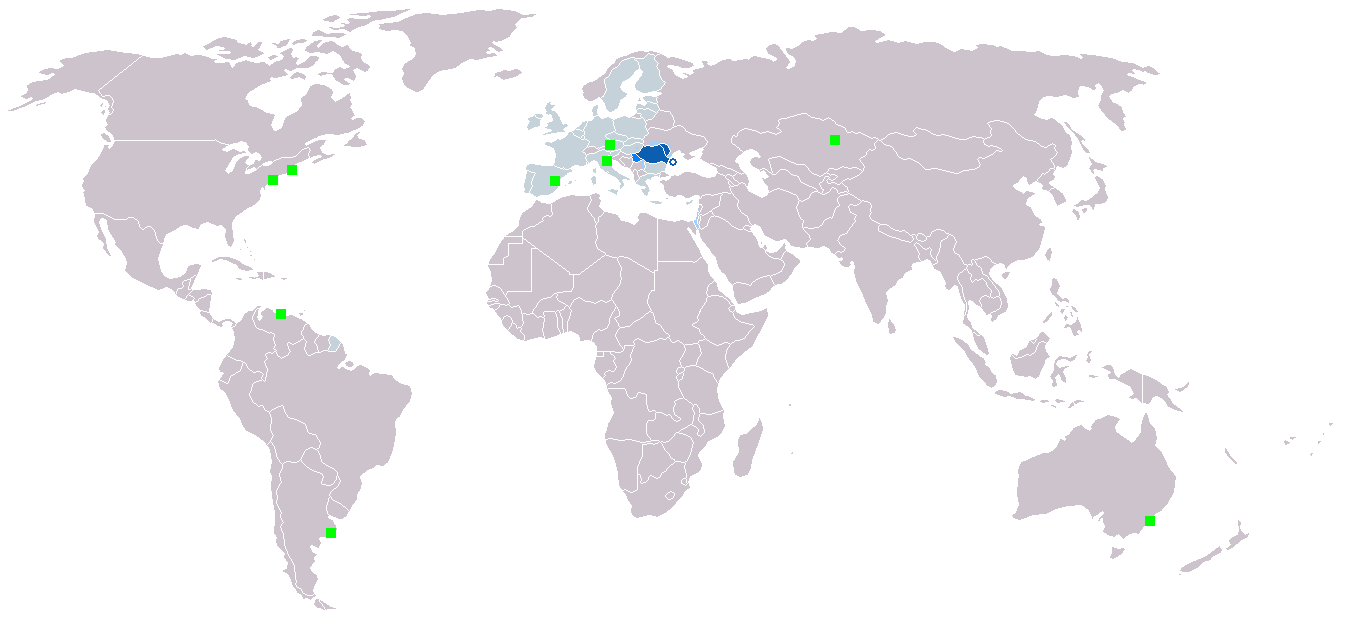
51-AAD-ca to -ck)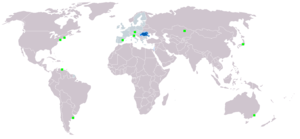 Blue: region where Romanian is the dominant language. Green: areas with a notable minority of Romanian speakers.
This page contains IPA phonetic symbols in Unicode. Without proper rendering support, you may see question marks, boxes, or other symbols instead of Unicode characters. Romanian (or Daco-Romanian; obsolete spellings Rumanian, Roumanian; self-designation: română, limba română [ˈlimba roˈmɨnə] (
 listen) ("the Romanian language") or românește (lit. "in Romanian") is a Romance language spoken by around 24 to 28 million people,[1][3] primarily in Romania and Moldova. It has official status in Romania, Republic of Moldova, the Autonomous Province of Vojvodina in Serbia and in the autonomous Mount Athos in Greece. In the Republic of Moldova, the language is officially called limba moldovenească ("Moldovan").
Romanian speakers are scattered across many other countries, notably Italy, Spain, Ukraine, Bulgaria, the United States, Canada, Israel, Russia, Portugal, the United Kingdom, France, and Germany.
Contents
History
Main article: History of RomanianPrehistory
Further information: Eastern Romance languages, Proto-Romanian, Eastern Romance substratum, Slavic superstratum in Romanian, and Origin of the RomaniansEastern Romance languages like the other branches of Romance languages descends from Vulgar Latin, adopted in Dacia by a process of Romanization during early centuries CE.[4][5] The Roman Empire withdrew from Dacia in 271-5 CE, leaving it to the Goths.[6][7]
The history of Eastern Romance between the 3rd century and the development of Proto-Romanian by the 10th century, when the area came under the influence of the Byzantine Empire, is unknown. It is a matter of debate whether Proto-Romanian developed among Romanized people that were left behind in Dacia by the Roman withdrawal or among Latin-speakers in the Balkans South of the Danube.
 Map of the Balkans with regions inhabited by Romanians/Vlachs highlighted
During the Middle Ages, Romanian became influenced by the Slavic languages[8] and to some degree by Greek. Romanian remains unattested throughout the Middle Ages, and only enters the historical record in the early 16th century.
Early history
The oldest extant document written in Romanian is Neacşu's letter (1521). The language remains poorly attested during the Early Modern period. Miron Costin, in his De neamul moldovenilor (1687), while noting that Moldavians, Wallachians, and the Romanians living in the Hungarian Country have the same origin, says that although people of Moldavia call themselves Moldavians, they name their language Romanian (româneşte) instead of Moldavian (moldoveneşte).[9] Dimitrie Cantemir, in his Descriptio Moldaviae (Berlin, 1714), points out that the inhabitants of Moldavia, Wallachia and Transylvania spoke the same language. He notes, however, that there are some differences in accent and vocabulary.[10] Cantemir's work is one of the earliest histories of the language, in which he notes, like Ureche before him, the evolution from Latin and notices the Greek, Turkish and Polish borrowings. Additionally, he introduces the idea that some words must have had Dacian roots. Cantemir also notes that while the idea of a Latin origin of the language was prevalent in his time, other scholars considered it to have derived from Italian.
Modern history
Further information: National awakening of RomaniaThe first Romanian grammar was published in Vienna in 1780.[11] Following annexation of Bessarabia by Russia (after 1812), Moldavian was established as an official language in the governmental institutions of Bessarabia, used along with Russian,[12] The publishing works established by Archbishop Gavril Bănulescu-Bodoni were able to produce books and lithurgical works in Moldavian between 1815-1820.[13]
The linguistic situation in Bessarabia from 1812 to 1918 was the gradual development of bilingualism. Russian continued to develop as the official language of privilege, whereas Romanian remained the principal vernacular.
The period from 1905 to 1917 was one of increasing linguistic conflict, with the re-awakening of Romanian national consciousness. In 1905 and 1906, the Bessarabian zemstva asked for the re-introduction of Romanian in schools as a "compulsory language", and the "liberty to teach in the mother language (Romanian language)". At the same time, the first Romanian language newspapers and journals began to appear: Basarabia (1906), Viaţa Basarabiei (1907), Moldovanul (1907), Luminătorul (1908), Cuvînt moldovenesc (1913), Glasul Basarabiei (1913). From 1913, the synod permitted that "the churches in Besserabia use the Romanian language". Romanian finally became the official language with the Constitution of 1923.
Historical grammar
Romanian has preserved a part of the Latin declension, but whereas Latin had six cases, Romanian has three: the nominative-accusative, the genitive-dative, and marginally the vocative. Romanian nouns also preserve the neuter gender. However, the verb morphology of Romanian has shown the same move towards a compound perfect and future tense as the other Romance languages. Compared with the other Romance languages, during its evolution, Romanian simplified the original Latin tense system in extreme ways,[14] in particular the original Latin absence of sequence of tenses.[15]
Geographic distribution
See also: Romanian-AmericanRomânofonia Click on the coloured regions on the map to get to the related article:
*Romanian is also an official language of the Latin Union.
Official and national language Official but not primary language National minority language EU Romanian diaspora

Geographic distribution of Romanian Country Speakers
(%)Speakers
(native)Population Europe Romania 91% 19,736,517 21,698,181 Russia 1 0.12% 169,698 [16] 145,537,200 Moldova ² 76.4% 2,588,355 3,388,071 Transnistria (Eastern Moldova)³ 31.9% 177,050 555,500 Vojvodina (Serbia) 1.5% 29,512 2,031,992 not official: Timočka Krajina (Serbia) 4 8.2% 58,221 712,050 Spain 1.7% 829,715[17] 46,661,950 Italy 1.3% 640,000[18] 60,600,000 Ukraine 5 0.8% 327,703 48,457,000 Hungary 0.1% 8,480[19] 10,198,315 Asia not official: Israel 3.7% 250,000 6,800,000 Kazakhstan 1 0.1% 20,054 14,953,126 The Americas not official: Canada 0.34% 110,000 32,207,113 United States 6 0.12% 340,000 281,421,906 1 Many are Moldavian who were deported
² Data only for the districts on the right bank of Dniester (without Transnistria and the city of Tighina). In Moldova, it is sometimes referred to as the "Moldovan language"
³ In Transnistria, it is officially called "Moldovan language" and is written in Moldovan Cyrillic alphabet.
4 Officially divided into Vlachs and Romanians
5 Most in Northern Bukovina and Southern Bessarabia; according to a Moldova Noastră study (based on the latest Ukrainian census).[20]
6Romanian is spoken mostly in Southeastern, Central and Eastern Europe, although speakers of the language can be found all over the world, mostly due to emigration of Romanian nationals and the return of immigrants to Romania back to their original countries. Romanian speakers account for 0.5% of the world's population,[21] and 4% of the Romance-speaking population of the world.[22]
Romanian is the single official and national language in Romania and Moldova, although it shares the official status at regional level with other languages in the Moldovan autonomies of Gagauzia and Transnistria. Romanian is also an official language of the Autonomous Province of Vojvodina in Serbia along with five other languages. Romanian minorities are encountered in Serbia (Timok Valley), Ukraine (Chernivtsi and Odessa oblasts), Hungary (Gyula) and Bulgaria (Vidin). Large immigrant communities are found in Italy, Spain, France, and Portugal.
As of 1995, the largest Romanian-speaking community in the Middle East is found in Israel, where Romanian is spoken by 5% of the population.[23][24] Romanian is also spoken as a second language by people from Arabic-speaking countries who have studied in Romania. It is estimated that almost half a million Middle Eastern Arabs studied in Romania during the 1980s.[25] Small Romanian-speaking communities are to be found in Kazakhstan and Russia. Romanian is also spoken within communities of Romanian and Moldovan immigrants in the United States, Canada and Australia, although they do not make up a large homogeneous community state-wide.
Legal status
In Romania
According to the Constitution of Romania of 1991, as revised in 2003, Romanian is the official language of the Republic.[26]
Romania mandates the use of Romanian in official government publications, public education and legal contracts. Advertisements as well as other public messages must bear a translation of foreign words,[27] while trade signs and logos shall be written predominantly in Romanian.[28]
The Romanian Language Institute (Institutul Limbii Române), established by the Ministry of Education of Romania, promotes Romanian and supports people willing to study the language, working together with the Ministry of Foreign Affairs' Department for Romanians Abroad.[29]
In Moldova
Main article: Moldovan languageThe Constitution of Moldova names the state language of the country "Moldovan". However, linguists consider it to be largely identical to Romanian. It has been the sole official language since the adoption of the Law on State Language of the Moldavian SSR in 1989.[30] This law mandates the use of Moldovan in all the political, economical, cultural and social spheres, as well as asserting the existence of a "linguistic Moldo-Romanian identity".[31] It is also used in schools, mass media, education and in the colloquial speech and writing. Outside the political arena the language is most often called "Romanian". In the breakaway territory of Transnistria, it is co-official with Ukrainian and Russian.
In the 2004 census, out of the 3,383,332 people living in Moldova, 16.5% (558,508) stated Romanian as their native language, whereas 60% stated Moldovan. While 40% of all urban Romanian/Moldovan speakers identified their native tongue as Romanian, in the countryside under 12% of Romanian/Moldovan speakers indicated Romanian as their native language.[32] However, the group of experts from the international census observation Mission to the Republic of Moldova concluded that the items in the questionnaire dealing with nationality and language proved to be the most sensitive ones, particularly with reference to the recording of responses to these questions as being "Moldovan" or "Romanian", and therefore it concluded that special care would need to be taken in interpreting them.[33]
In Vojvodina
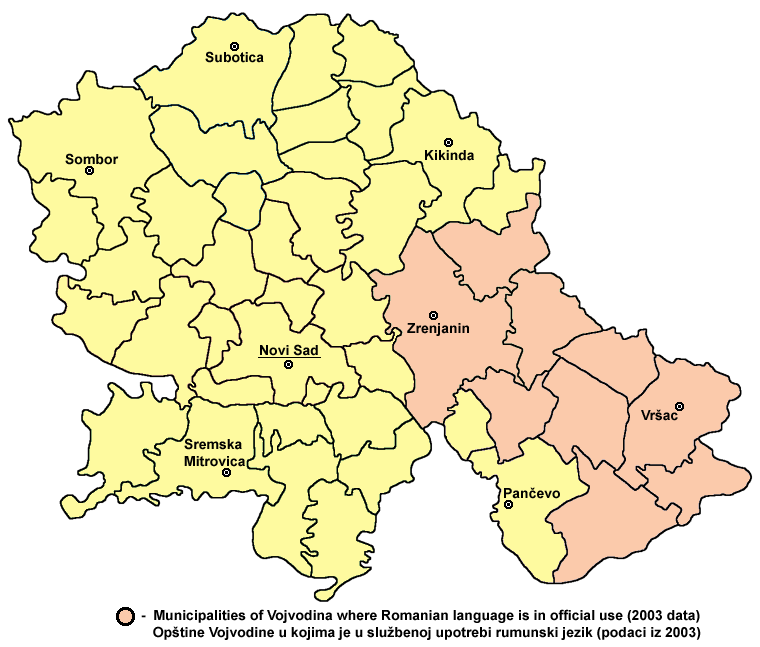
Main article: Official status of Romanian language in Vojvodina Official usage of Romanian language in Vojvodina, Serbia
 Romanian language in entire Serbia (see also Romanians of Serbia), census 20021-5%5-10%10-15%15-25%25-35%over 35%
The Constitution of the Republic of Serbia [34] determines that in the regions of the Republic of Serbia inhabited by national minorities, their own languages and scripts shall be officially used as well, in the manner established by law.
The Statute of the Autonomous Province of Vojvodina [35] determines that, together with the Serbo-Croat language and the Cyrillic script, and the Latin script as stipulated by the law, the Hungarian, Slovak, Romanian and Rusyn languages and their scripts, as well as languages and scripts of other nationalities, shall simultaneously be officially used in the work of the bodies of the Autonomous Province of Vojvodina, in the manner established by the law. The bodies of the Autonomous Province of Vojvodina are: the Assembly, the Executive Council and the Provincial administrative bodies.[36]
The Romanian language and script are officially used in eight municipalities: Alibunar, Biserica Albă (Serbian: Bela Crkva), Zitiște (Žitište), Zrenianin (Zrenjanin), Kovăcița (Kovačica), Cuvin (Kovin), Plandiște (Plandište) and Sečanj. In the municipality of Vârșeț (Vršac), Romanian is official only in the villages of Voivodinț (Vojvodinci), Marcovăț (Markovac), Straja (Straža), Jamu Mic (Mali Žam), Srediștea Mică (Malo Središte), Mesici (Mesić), Jablanka, Sălcița (Salčica), Râtișor (Ritiševo), Oreșaț (Orašac) and Coștei (Kuštilj).[37]
In the 2002 Census, the last carried out in Serbia, 1.5% of Vojvodinians stated Romanian as their native language.
In other countries and organizations
See also: Romanian diasporaIn parts of Ukraine where Romanians constitute a significant share of the local population (districts in Chernivtsi, Odessa and Zakarpattia oblasts) Romanian is being taught in schools as a primary language and there are newspapers, TV, and radio broadcasting in Romanian.[38][39] The University of Chernivtsi trains teachers for Romanian schools in the fields of Romanian philology, mathematics and physics.[40]
Romanian is an official or administrative language in various communities and organisations, such as the Latin Union and the European Union. Romanian is also one of the five languages in which religious services are performed in the autonomous monastic state of Mount Athos, spoken in the monk communities of Prodromos and Lacu.
 Distribution of first-language native Romanian speakers by country (Altele means 'other')
As a second and foreign language
Romanian is taught in some areas that have Romanian minority communities, such as Vojvodina in Serbia, Bulgaria, Ukraine and Hungary. The Romanian Cultural Institute (ICR) has since 1992 organised summer training courses in Romanian for language teachers in these countries.[41] In some of the schools, there are non-Romanian nationals who study Romanian as a foreign language (for example the Nicolae Bălcescu High-school in Gyula, Hungary).
Romanian is taught as a foreign language in various tertiary institutions, mostly in European countries such as Germany, France and Italy, as well as the Netherlands, and elsewhere, like the USA. Overall, it is taught as a foreign language in 43 countries around the world.[42]
Popular culture
Romanian has become popular in other countries through movies and songs performed in the Romanian language. Examples of recent Romanian acts that had a great success in non-Romanophone countries are the bands O-Zone (which had great success with their #1 single Dragostea din tei/Numa Numa across the world), Akcent (popular in the Netherlands, Poland and other European countries), Activ (successful in some Eastern European countries) and Dj Project (popular as clubbing music) as well as high-rated movies like 4 Months, 3 Weeks and 2 Days, The Death of Mr. Lazarescu, 12:08 East of Bucharest or California Dreamin' (all of them with awards at the Cannes Film Festival).
Also some artists wrote songs dedicated to the Romanian language. The multiplatinum pop trio O-Zone (originally from Moldova) released a song called "Nu mă las de limba noastră" ('I won't forsake our language'). The final verse of this song, Eu nu mă las de limba noastră, de limba noastră cea română is translated in English as I won't forsake our language, our Romanian language. Also, the Moldovan musicians Doina and Ion Aldea Teodorovici performed a song entitled "The Romanian language".
Dialects
Main article: Romanian subdialectsThe term Romanian is sometimes[43] used also in a more general sense, which envelops four languages or dialects: Daco-Romanian, Aromanian, Megleno-Romanian, and Istro-Romanian. The four languages, whose mutual intelligibility is difficult, are the offspring of the Romance varieties spoken both to the north and to south of Danube, before the settlement of the Slavonian tribes south of the river: Daco-Romanian in the north, Aromanian and Megleno-Romanian in the south, whereas Istro-Romanian is believed to be the offspring of a 11th century migration from Romania. These four are also known as the Eastern Romance languages.
When the term Romanian is used in this larger sense, the term Daco-Romanian is used for Romanian proper. The origin of the term Daco-Romanian can be traced back to the first printed book of Romanian grammar in 1780,[11] by Samuil Micu and Gheorghe Șincai. There, the Romanian dialect spoken north of the Danube is called lingua Daco-Romana to emphasize its origin and its area of use, which includes the former Roman province of Dacia, although it is spoken also south of the Danube, in Dobrudja, Central Serbia and northern Bulgaria.
This article deals with the Romanian (specifically Daco-Romanian) language, and thus only its dialectal variations are discussed here. The differences between the regional varieties are small, limited to regular phonetic changes, few grammar aspects, and lexical particularities. There is a single written standard (literary) Romanian language used by all speakers, regardless of region.
Like most natural languages, Romanian can be regarded as a dialect continuum. The varieties of Romanian are usually called subdialects (see reasons for this terminology) and are distinguished primarily by phonetic differences. Romanians themselves speak of the differences as accents or speeches (in Romanian: accent or grai).
Depending on the criteria used for classifying these subdialects, fewer or more are found, ranging from 2 to 20, although the most widespread approaches give a number of five subdialects. These are grouped into two main types, southern and northern, further divided as follows:
- The southern type has only one member:
- the Wallachian subdialect, spoken in the southern part of Romania, in the historical regions of Muntenia, Oltenia and the southern part of Dobruja, but also extending in the southern parts of Transylvania.
- The northern type consists of several subdialects:
- the Moldavian subdialect, spoken in the historical region of Moldavia, now split among Romania, the Republic of Moldova, and Ukraine (Bukovina and Bessarabia), as well as northern Dobruja;
- the Banat subdialect, spoken in the historical region of Banat, including parts of Serbia;
- a group of finely divided and transition-like Transylvanian varieties, among which two are most often distinguished, those of Crișana and Maramureș.
Over the last century, however, regional accents have been weakened due to mass communication and greater mobility.
Classification
See also: Romance languages Romanian language in the Romance language family
Romanian is a Romance language, belonging to the Italic branch of the Indo-European language family, having much in common with languages such as French, Italian, and Portuguese.
However, the languages closest to Romanian are the other Eastern Romance languages, spoken south of Danube: Aromanian/Macedo-Romanian, Megleno-Romanian and Istro-Romanian, which are frequently classified as dialects of Romanian. An alternative name for Romanian used by linguists to disambiguate with the other Eastern Romance languages is "Daco-Romanian", referring to the area where it is spoken (which corresponds roughly to the onetime Roman province of Dacia).
Compared with the other Romance languages, the closest relative of Romanian is Italian; the two languages show a limited degree of asymmetrical mutual intelligibility, especially in their cultivated forms: speakers of Romanian seem to understand Italian more easily than the other way around.[citation needed] Romanian has obvious grammatical and lexical similarities with French, Catalan, Spanish and Portuguese, with a high phonological similarity with Portuguese in particular; however, it is not mutually intelligible with them to any practical extent[citation needed]. Romanian speakers will usually need some formal study of basic grammar and vocabulary before being able to understand more than individual words and simple sentences[citation needed]. The same is true for speakers of these languages trying to understand Romanian[citation needed].
A study done by Italian-American linguist Mario Pei in 1949, which analyzed the evolutionary degree of languages in comparison to their inheritance language (in the case of Romance languages to Latin comparing phonology, inflection, discourse, syntax, vocabulary, and intonation) revealed the following percentages (the higher the percentage, the greater the distance from Latin):[44]
- Sardinian: 8%;
- Italian: 12%;
- Spanish: 20%;
- Romanian: 23.5%;
- Occitan: 25%;
- Portuguese: 31%;
- French: 44%.
The lexical similarity of Romanian with Italian has been estimated at 77%, followed by French at 75%, Sardinian 74%, Catalan 73%, Spanish 71%, Portuguese, and Rhaeto-Romance at 72%.
In modern times Romanian vocabulary has been strongly influenced by French, Italian and other languages.
Contacts with other languages
Dacian language
The Dacian language was an Indo-European language spoken by the ancient Dacians, mostly north of the Danube river but also in Moesia and other regions south of the Danube. It may have been the first language to influence the Latin spoken in Dacia, but little is known about it. Dacian is usually considered to have been a Northern branch of the Thracian language, and like Thracian, Dacian was a satem language. About 300 words found only in Romanian or with a cognate in the Albanian language may be inherited from Dacian (for example: barză "stork", balaur "dragon", mal "shore", brânză "cheese"). Some of these possibly Dacian words are related to pastoral life (for example, brânză "cheese"). Some linguists and historians have asserted that Albanians are Dacians who were not Romanized and migrated southward.[45]
A different view is that these non-Latin words with Albanian cognates are not necessarily Dacian, but rather were brought into the territory that is modern Romania by Romance-speaking shepherds migrating north from Albania, Serbia, and northern Greece who became the Romanian people.[46]
Balkan linguistic union
While most of Romanian grammar and morphology are based on Latin, there are some features that are shared only with other languages of the Balkans and not found in other Romance languages. Nonetheless, Romanian together with Greek and Romani present the lowest "factor of Balkanization" among the languages common included in this sprachbund.[47]
The languages of the Balkan linguistic union belong to individual branches of the Indo-European language family: Bulgarian, Macedonian and Albanian, and in some cases Greek and Serbian. The shared features include a suffixed definite article, the syncretism of genitive and dative case and the formation of the future and the replacement of infinitive with subjunctive constructions.
Slavic languages
Main article: Slavic superstratum in RomanianThe Slavic influences on Romanian are especially noticeable and can be observed at all linguistic levels: lexis, phonetics, morphology and syntax.[citation needed] About 14% of Romanian words are of Slavic origin.[citation needed] This is due to the migration of Slavic tribes who traversed the territory of present-day Romania during the early evolution of the language. This process of the introduction of Slavic in Dacia was similar to the appearance of various Germanic dialects in the Western Roman Empire, where Gallic Latin and Northern Italian dialects became strongly germanized.[citation needed] However, due to the lower Romance-speaking populace in the East, Slavic remained spoken for much longer and did not die out immediately.
Other influences
Even before the 19th century, Romanian came in contact with several other languages. Some notable examples include:
- Greek: folos < ófelos "use", buzunar < buzunára "pocket", proaspăt < prósfatos "fresh", cutie < cution "box"
- Hungarian: a cheltui < költeni "to spend", a făgădui < fogadni "to promise", a mântui < menteni "to save" and maybe oraș < város "city" (note that linguistically, Romanian oraș couldn’t be borrowed from Hungarian varos. It would have been a form *veras[48])
- Turkish: cafea < kahve "coffee", papuc < papuç "slipper", ciorbă < çorba "wholemeal soup, sour soup", bacşiş < bahşiş "tip"
- German: cartof < Kartoffel "potato", bere < Bier "beer", șurub < Schraube "screw", turn < Turm "tower", ramă < Rahmen "frame", muștiuc < Mundstück "mouth piece", bormașină < Bohrmaschine "drilling machine", cremșnit < Kremschnitte "cream slice", șvaițer < Schweizer "Swiss cheese", șlep < Schleppkahn "barge", șpriț < Spritzer "wine with soda water", abțibild < Abziehbild "decal picture", șnițel < Schnitzel "cutlet", șuncă < dialectal Schunke (Schinken) "ham", punct < Punkt "point", maistru < Meister "master", rundă < Runde "round". During the Austrian administration in Banat, Transylvania, and Bukovina, a large number of words were borrowed from Austrian German, in particular in fields such as the military, administration, social welfare, economy, etc.[49] Later on German terms have been taken out of science and technics, like: șină < Schiene "rail", știft < Stift "peg", liță < Litze "braid", ștanță < Stanze "punch", șaibă < Scheibe "washer", ștangă < Stange "crossbar",et al.
- Romany, the Romanian Roma have provided several words to Romanian slang: mișto "good, beautiful" < mišto,[50] gagică < gadji "girl"
French, Italian and English words
Since the 19th century, many modern words were borrowed from the other Romance languages, especially from French and Italian (for example: birou "desk, office", avion "airplane", exploata "exploit"). It was estimated that about 38% of the number of words in Romanian are of French and/or Italian origin (in many cases both languages); and adding this to the words that were inherited from Latin, about 75%-85% of Romanian words can be traced to Latin. The use of these Romanianized French and Italian loanwords has tended to increase at the expense of Slavic loanwords, many of which have become rare or fallen out of use. As second or third languages, French and Italian themselves are better known in Romania than in Romania's neighbors. Along with the switch to the Latin alphabet in Moldova, the re-latinization of the vocabulary has tended to reinforce the Latin character of the language.
In the process of lexical modernization, many of the words already existing as Latin direct heritage, as a part of its core or popular vocabulary, have been doubled by words borrowed from other Romance languages, thus forming a further and more modern and literary lexical layer. Typically, the popular word is a noun and the borrowed word an adjective. Some examples:
Latin Romanian
direct Latin heritageRomanian
neologismagilis (quick) ager (astute) agil (it.<agile, fr.<agile)
(agile)aqua (water) apă (water) acvatic (it. <acquatico, fr.<aquatique)
(aquatic)dens, dentem (tooth) dinte (tooth) dentist (it.<dentista, fr.<dentiste)
(dentist)directus (straight) drept (straight, right) direct (it.<diretto, fr.<direct)
(direct)frigus (cold) frig (cold - noun) frigid (it.<frigido, fr.<frigide)
(frigid)rapidus (quick) repede (quick) rapid (it.<rapido, fr.<rapide)
(quick)In the 20th century, an increasing number of English words have been borrowed (such as: gem < jam; interviu < interview; meci < match; manager < manager; fotbal < football; sandviș < sandwich; bișniță < business; ciungă < chewing gum; chec < cake). These words are assigned grammatical gender in Romanian and handled according to Romanian rules; thus "the manager" is managerul.
Grammar
Main article: Romanian grammarRomanian nouns are characterized by gender (feminine, masculine, and neuter), and declined by number (singular and plural) and case (nominative/accusative, dative/genitive and vocative). The articles, as well as most adjectives and pronouns, agree in gender, number and case with the noun they reference.
Romanian is the only Romance language where definite articles are enclitic: that is, attached to the end of the noun (as in Scandinavian and Bulgarian), instead of in front (proclitic). They were formed, as in other Romance languages, from the Latin demonstrative pronouns.
As in all Romance languages, Romanian verbs are highly inflected for person, number, tense, mood, voice. The usual word order in sentences is SVO (Subject - Verb - Object). Romanian has four verbal conjugations which further split into ten conjugation patterns. Verbs can be put in five moods that are inflected for the person (indicative, conditional/optative, imperative, subjunctive, and presumptive) and four impersonal moods (infinitive, gerund, supine, and participle).
Phonology
Main article: Romanian phonologyRomanian has seven vowels; the more "exotic" ones are /ɨ/, /ə/ (also in stressed positions), and the diphthongs /e̯a/ and /o̯a/. Additionally, /ø/ and /y/ may appear in some borrowed words. There are also twenty-two consonants. The two approximants /j/ and /w/ can appear before or after any vowel, creating a large number of glide-vowel sequences which are, strictly speaking, not diphthongs.
In final positions after consonants, a short /i/ can be deleted, surfacing only as the palatalization of the preceding consonant (e.g. [mʲ]). Similarly, a deleted /u/ may prompt labialization of a preceding consonant, though this has ceased to carry any morphological meaning.
Phonetic changes
Main article: Latin-to-Romanian sound changesOwing to its isolation from the other Romance languages, the phonetic evolution of Romanian was quite different, but does share a few changes with Italian, such as [kl] > [kj] (Lat. clarus > Rom. chiar, Ital. chiaro) and also a few with Dalmatian, such as /ɡn/ (probably phonetically [ŋn]) > [mn] (Lat. cognatus > Rom. cumnat, Dalm. comnut).
Among the notable phonetic changes are:
- diphthongization of e and o
-
- Lat. cera → Rom. ceară (wax)
- Lat. sole → Rom. soare (sun)
- iotacism [e] → [ie] in the beginning of the word
-
- Lat. herba → Rom. iarbă (grass, herb)
- velar [k ɡ] → labial [p b m] before alveolar consonants and [w] (eg. ngu → mb):
-
- Lat. octo → Rom. opt (eight)
- Lat. lingua → Rom. limbă (tongue, language)
- Lat. signum → Rom. semn (sign)
- Lat. coxa → Rom. coapsă (thigh)
- rhotacism [l] → [r] between vowels
-
- Lat. caelum → Rom. cer (sky)
- Alveolars [d t] palatalized to [(d)z] [ts] when before short [e] or long [iː]
-
- Lat. deus → Rom. zeu (god)
- Lat. tenem → Rom. ține (hold)
On the other hand, it (along with French) has lost /kw/ (qu) sound before /a/ from original Latin, turning it either into /p/ (Lat. quattuor → Rom.patru, "four"; cf. It. quattro) or /k/ (Lat. quando → Rom.când, "when"; Lat. qualitas → Rom.calitate, "quality").
Writing system
 Neacșu's letter is the oldest surviving document written in Romanian
The first written record of a Romance language spoken in the Middle Ages in the Balkans was written by the Byzantine chronicler Theophanes Confessor in the 6th century about a military expedition against the Avars from 587, when a Vlach muleteer accompanying the Byzantine army noticed that the load was falling from one of the animals and shouted to a companion Torna, torna fratre (meaning "Return, return brother!").
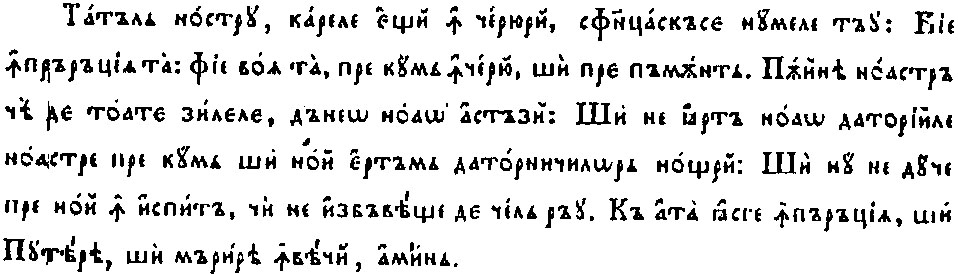
The oldest written text in Romanian is a letter from late June 1521, in which Neacșu of Câmpulung wrote to the mayor of Brașov about an imminent attack of the Turks. It was written using the Cyrillic alphabet, like most early Romanian writings. The earliest writing in Latin script was a late 16th century Transylvanian text which was written with the Hungarian alphabet conventions.
 A sample of Romanian written in the Romanian Cyrillic alphabet, which was still in use in the early 19th century
In the late 18th century, Transylvanian scholars noted the Latin origin of Romanian and adapted the Latin alphabet to the Romanian language, using some rules from Italian, recognized as Romanian's closest relative. The Cyrillic alphabet remained in (gradually decreasing) use until 1860, when Romanian writing was first officially regulated.
In the Soviet Republic of Moldova, a special version of the Cyrillic alphabet derived from the Russian version was used, until 1989, when it returned to the Romanian Latin alphabet.
Romanian alphabet
Main article: Romanian alphabetThe Romanian alphabet is as follows:
- A, a (a); Ă, ă (ă); Â, â (â din a); B, b (be); C, c (ce); D, d (de); E, e (e); F, f (fe / ef); G, g (ghe / ge); H, h (ha / haș); I, i (i); Î, î (î din i); J, j (je); K, k (ka / kapa); L, l (le / el); M, m (me / em); N, n (ne / en); O, o (o); P, p (pe); Q (chiu); R, r, (re / er); S, s (se / es); Ș, ș (șe); T, t (te); Ț, ț (țe); U, u (u); V, v (ve); W (dublu ve); X, x (ics); Y (i grec); Z, z (ze / zet).
K, Q, W and Y are not part of the native alphabet, were officially introduced in the Romanian alphabet in 1982 and are mostly used to write loanwords like kilogram, quasar, watt, and yoga.
The Romanian alphabet is based on the Latin alphabet with five additional letters Ă, Â, Î, Ș , Ț. Formerly, there were as many as 12 additional letters, but some of them were abolished in subsequent reforms. Also, until the early 20th century, a short vowel marker was used.
Today the Romanian alphabet is largely phonemic. However, the letters â and î both represent the same close central unrounded vowel /ɨ/. Â is used only inside words; î is used at the beginning or the end of single words and in the middle of compound words. Another exception from a completely phonetic writing system is the fact that vowels and their respective semivowels are not distinguished in writing. In dictionaries the distinction is marked by separating the entry word into syllables for words containing a hiatus.
Stressed vowels also are not marked in writing, except very rarely in cases where by misplacing the stress a word might change its meaning and if the meaning is not obvious from the context. For example trei copíi means "three children" while trei cópii means "three copies".
Pronunciation
See also: Romanian alphabet#Î versus Â- h is not silent like in other Romance languages such as Spanish and French, but represents the phoneme /h/, except in the digraphs ch /k/ and gh /g/ (see below)
- j represents /ʒ/, as in French or Portuguese (the sound spelled with s in the English words 'vision, pleasure, treasure').
- There are two letters with a comma below, Ș and Ț, which represent the sounds /ʃ/ and /t͡s/. However, the allographs with a cedilla instead of a comma, Ș and Ț, became widespread when pre-Unicode and early Unicode character sets did not include the standard form.
- A final orthographical i after a consonant often represents the palatalization of the consonant (e. g. lup /lup/ "wolf" vs. lupi /lupʲ/ "wolves") -- it is not pronounced like Italian lupi (which also means "wolves"), and is indeed an example of the Slavic influence on Romanian.
- ă represents the schwa, /ə/.
- î and â both represent the sound /ɨ/. In rapid speech (for example in the name of the country) the â sound may sound similar to a casual listener to a short schwa sound but careful speakers will distinguish the sound. The nearest equivalent is the vowel in the last syllable of the word roses for some English speakers.
- The letter e generally represents the mid front unrounded vowel [e], somewhat like in the English word set. However, the letter e is pronounced as ie [je] ([j] sounds like 'y' in 'you') when it is the first letter of any form of the verb a fi "to be", or of a personal pronoun, for instance este /jeste/ "is" and el /jel/ "he".[51][52] This addition of the semivowel /j/ does not occur in more recent loans and their derivatives, such as eră "era", electric "electric" etc. Some words (such as iepure "hare", formerly spelled epure) are now written with the initial i to indicate the semivowel.
- x represents either the phoneme /ks/ as in expresie = expression, or /ɡz/ as in exemplu = example, as in English.
- As in Italian, the letters c and g represent the affricates /t͡ʃ/ and /d͡ʒ/ before i and e, and /k/ and /ɡ/ elsewhere. When /k/ and /ɡ/ are followed by vowels /e/ and /i/ (or their corresponding semivowels or the final /ʲ/) the digraphs ch and gh are used instead of c and g, as shown in the table below.
Group Phoneme Pronunciation Examples ce, ci /tʃ/ ch in chest, cheek cerc (circle), cine (who), cercel (earring), cină (dinner), ciocan (hammer) che, chi /k/ k in kettle, kiss chemare (call), chimie (chemistry), chimen (caraway), chinez (Chinese), ureche (ear) ge, gi /dʒ/ j in jelly, jigsaw ger (frost), gimnast (gymnast), gem (jam), girafă (giraffe), geantă (bag) ghe, ghi /ɡ/ g in get, give ghețar (glacier), ghid (guide), ghindă (acorn), ghidon (handle bar), stingher (lonely) Punctuation and capitalization
Uses of punctuation peculiar to Romanian are:
- The quotation marks use the Polish format in the format „quote «inside» quote”, that is, „. . .” for a normal quotation, and double angle symbols for a quotation inside a quotation.
- Proper quotations which span multiple paragraphs don't start each paragraph with the quotation marks; one single pair of quotation marks is always used, regardless of how many paragraphs are quoted;
- Dialogues are identified with quotation dashes;
- The Oxford comma before "and" is considered incorrect ("red, yellow and blue" is the proper format);
- Punctuation signs which follow a text in parentheses always follow the final bracket;
- In titles, only the first letter of the first word is capitalized, the rest of the title using sentence capitalization (with all its rules: proper names are capitalized as usual, etc.).
- Names of months and days are not capitalized (ianuarie "January", joi "Thursday")
- Adjectives derived from proper names are not capitalized (Germania "Germany", but german "German")
Spelling issues between Romania and Moldova
Prior to 2010, there used to be a minor spelling difference between standard forms of Romanian language used in Romania and the variant (also called Moldovan) used in the Republic of Moldova— the Academy of Sciences of Moldova hadn't switched to the new spelling rules introduced by the Romanian Academy in 1993. In 2000, the Moldovan Academy recommended adopting the spelling rules used in Romania,[53] and in 2010 the Academy launched a schedule for the transition to the new rules that was completed in 2011 (regarding publications) and is currently under implementation in the educational system (due to be completed within two school years).[54]
Language sample
English text:
- All human beings are born free and equal in dignity and rights. They are endowed with reason and conscience and should act towards one another in a spirit of brotherhood.
Contemporary Romanian - highlighted words are French or Italian loanwords:
- Toate ființele umane se nasc libere și egale în demnitate și în drepturi. Ele sunt înzestrate cu rațiune și conștiință și trebuie să se comporte unele față de altele în spiritul fraternității.
Romanian, excluding French and Italian loanwords - highlighted words are Slavic loanwords:
- Toate ființele omenești se nasc slobode și deopotrivă în destoinicie și în drepturi. Ele sunt înzestrate cu înțelegere și cuget și trebuie să se poarte unele față de altele în duh de frățietate.
Romanian, excluding loanwords:
- Toate ființele omenești se nasc nesupuse și asemenea în prețuire și în drepturi. Ele sunt înzestrate cu înțelegere și cuget și se cuvine să se poarte unele față de altele după firea frăției.
See also
Notes
- ^ a b The Latin Union reports 28 million speakers for Romanian, out of whom 24 million are native speakers of the language: Latin Union - The odyssey of languages: ro, es, fr, it, pt; see also Ethnologue report for Romanian
- ^ The constitution of the Republic of Moldova refers to the country's language as Moldovan rather than Romanian, though in practice it is often called "Romanian". The introduction of the law concerning the functioning of the languages (September 1989), still effective in the Republic of Moldova according to the Constitution,Parlament.md asserts the linguistic identity between the Romanian language and the Moldovan language. IATP.md
- ^ "Languages Spoken by More Than 10 Million People". Languages Spoken by More Than 10 Million People. Microsoft Encarta 2006. http://encarta.msn.com/media_701500404/Languages_Spoken_by_More_Than_10_Million_People.html.
- ^ Matley, Ian (1970). Romania; a Profile. Praeger. p. 85.
- ^ Giurescu, Constantin C. (1972). The Making of the Romanian People and Language. Bucharest: Meridiane Publishing House. pp. 43, 98–101, 141.
- ^ Eutropius; Justin, Cornelius Nepos (1886). Eutropius, Abridgment of Roman History. London: George Bell and Sons. http://www.ccel.org/p/pearse/morefathers/eutropius_breviarium_2_text.htm.
- ^ Watkins, Thayer. "The Economic History of the Western Roman Empire". http://www.sjsu.edu/faculty/watkins/barbarians.htm.
- ^ Graham Mallinson, “Rumanian”, in “The Romance Languages”, Taylor & Francis, 1997, p. 413: "Much more substantial than the Germanic adstrate in the Western Romance Languages is the Slavic adstrate in Balkan Romance."
- ^ Constantiniu, Florin, O istorie sinceră a poporului român (An honest history of the Romanian people), Univers Enciclopedic, Bucureşti, 1997, ISBN 973-9243-07-X, p. 175
- ^ From Descriptio Moldaviae: "Valachiae et Transylvaniae incolis eadem est cum Moldavis lingua, pronunciatio tamen rudior, ut dziur, Vlachus proferet zur, jur, per z polonicum sive j gallicum; Dumnedzeu, Deus, val. Dumnezeu: akmu, nunc, val. akuma, aczela hic, val: ahela."
- ^ a b Samuil Micu, Gheorghe Șincai, Elementa linguae daco-romanae sive valachicae, Vienna, 1780.
- ^ (Russian)Charter for the organization of the Bessarabian Oblast, April 29, 1818, in "Печатается по изданию: Полное собрание законов Российской империи. Собрание первое.", Vol 35. 1818, Sankt Petersburg, 1830, pg. 222-227. Available online at hrono.info
- ^ King, Charles, The Moldovans, Hoover Press, 2000, ISBN 081799792X, pg. 21-22
- ^ Yves D’hulst, Martine Coene, Larisa Avram, “Syncretic and analytic tenses in Romanian”, in “Balkan Syntax ans Semantics”, pag. 366: "In its evolution, Romanian simplified the original Latin tense system in extreme ways."
- ^ Yves D’hulst et al., “Syncretic and analytic tenses in Romanian”, in “Balkan Syntax ans Semantics”, p.355: "general absence of consecutio temporum."
- ^ Perepis2002.ru Perepis 2002
- ^ Instituto Nacional de Estadística: Avance del Padrón Municipal a 1 de enero de 2010. Datos provisionales. [1].
- ^ ISTAT.it
- ^ "Number of speakers of Romanian in Hungary in 1995 according to Ethnologue". Ethnologue.com. http://www.ethnologue.com/show_language.asp?code=ron. Retrieved 2010-05-23.
- ^ RDSCJ.ro[dead link]
- ^ "Latin Union - Languages and cultures online 2005". Dtil.unilat.org. http://dtil.unilat.org/LI/2005/ro/rezultatele_detaliate.htm. Retrieved 2010-05-23.
- ^ MSN Encarta - Languages Spoken by More Than 10 Million People[dead link]
- ^ According to the 1993 Statistical Abstract of Israel there were 250,000 Romanian speakers in Israel, at a population of 5,548,523 (census 1995).
- ^ "Reports of about 300,000 Jews that left the country after WW2". Eurojewcong.org. http://www.eurojewcong.org/ejc/news.php?id_article=110. Retrieved 2010-05-23.
- ^ "Evenimentul Zilei". Evz.ro. http://www.evz.ro/article.php?artid=185041. Retrieved 2010-05-23.
- ^ "Constitution of Romania". Cdep.ro. http://www.cdep.ro/pls/dic/site.page?den=act2_1&par1=1. Retrieved 2010-05-23.
- ^ Legea "Pruteanu": 500/2004 - Law on the Protection of the Romanian Language
- ^ Art. 27 (3), Legea nr. 26/1990 privind Registrul Comerțului
- ^ Ministry of Education of Romania
- ^ Dalby, Andrew (1998). Dictionary of Languages. Bloomsbury Publishing. p. 518. ISBN 0-7475-3117-X.
- ^ Legea cu privire la functionarea limbilor vorbite pe teritoriul RSS Moldovenesti Nr.3465-XI din 01.09.89 Vestile nr.9/217, 1989 (Law regarding the usage of languages spoken on the territory of the Republic of Moldova): "Moldavian RSS supports the desire of the Moldavian that live across the borders of the Republic, and - considering the existing Moldo-Romanian linguistic identity - of the Romanians that live on the territory of the USSR, of doing their studies and satisfying their cultural needs in their maternal language."
- ^ National Bureau of Statistics of the Republic of Moldova: Census 2004
- ^ Experts Offering to Consult the National Statistics Bureau in Evaluation of the Census Data, Moldova Azi, May 19, 2005, story attributed to AP Flux. Retrieved October 11, 2005.
- ^ Official Gazette of Republic of Serbia, No. 1/90
- ^ Official Gazette of Autonomous Province of Vojvodina
- ^ Official use of languages and scripts in the Autonomous Province of Vojvodina published by the Provincial Secretariat for Regulations, Administration and National Minorities
- ^ Provincial Secretariat for Regulations, Administration and National Minorities: Official use of the Romanian language in the APV
- ^ Ukrainian Center for Independent Political Research: [2], [3]
- ^ Slovak Academy of Sciences in Kosice[dead link]
- ^ Kramar Andriy. "University of Chernivtsi". Chnu.cv.ua. http://www.chnu.cv.ua/index.php?page=ua/gradinf/rules/02bac_d. Retrieved 2010-05-23.
- ^ Cursuri de perfecționare, published in Ziua on August 19, 2005
- ^ Romanian Language Institute: Data concerning the teaching of the Romanian language abroad
- ^ "Romanian language", in Encyclopaedia Britannica
- ^ Pei, Mario (1949). Story of Language. ISBN 0397004001.
- ^ Vladimir Georgiev (Gheorghiev), (Romanian) Raporturile dintre limbile dacă, tracă și frigiană, "Studii Clasice" Journal, II, 1960, 39-58
- ^ Schramm, Gottfried (1997). Ein Damn bricht. Die römische Donaugrenze und die Invasionen des 5-7. Jahrhunderts in Lichte der Namen und Wörter..
- ^ Lindstedt, J. (2000). "Linguistic Balkanization: Contact-induced change by mutual reinforcement". In D. G. Gilbers & al. (eds.). Languages in Contact ((Studies in Slavic and General Linguistics, 28.) ed.). Amsterdam & Atlanta, GA, 2000: Rodopi. pp. 231–246. ISBN 90-420-1322-2.
- ^ Etymological Lexicon of the Indigenous (Thracian) Elements in Romanian by Sorin Paliga, Bucharest, Editura Evenimentul 2006 ISBN 973-87920-0-2
- ^ Hans Dama, "Lexikale Einflüsse im Rumänischen aus dem österreichischen Deutsch" ("Lexical influences of 'Austrian'-German on the Romanian Language") (German)
- ^ (Romanian) Rodica Zafiu, "Mișto și legenda bastonului", România literară, No. 6, 2009 — There is no doubt among linguists about the Romany etymology of the Romanian word mișto, but a fairly widespread folk etymology and urban legend maintains that the German phrase mit Stock "with stick" would be its true origin.
- ^ (Romanian) Several Romanian dictionaries specify the pronunciation [je] for word-initial letter e in some personal pronouns: el, ei, etc. and in some forms of the verb a fi (to be): este, eram, etc.
- ^ (Romanian) Mioara Avram, Ortografie pentru toți, Editura Litera, Chișinău, 1997, p. 29
- ^ The new edition of "Dicționarul ortografic al limbii române (ortoepic, morfologic, cu norme de punctuație)" – introduced by the Academy of Sciences of Moldova and recommended for publishing following a conference on 15 November 2000 – applies the decision of the General Meeting of the Romanian Academy from 17 February 1993, regarding the return to "â" and "sunt" in the orthography of the Romanian language. (Introduction, Institute of Linguistics of the Academy of Sciences of Moldova)
- ^ "Gheorghe Duca: Trebuie schimbată atitudinea de sorginte proletară faţă de savanţi şi în genere faţă de intelectuali" (in Romanian). Allmoldova. 2010-06-04. http://www.allmoldova.md/ro/int/interview/gheorghe-duca-060410.html. Retrieved 2011-01-03.
References
- Uwe, Hinrichs (ed.), Handbuch der Südosteuropa-Linguistik, Wiesbaden, 1999.
- Rosetti, Alexandru, Istoria limbii române, 2 vols., Bucharest, 1965-1969.
- Kahl, Thede (ed.), Das Rumänische und seine Nachbarn, Berlin, 2009.
- Giurescu, Constantin, The Making of the Romanian People and Language, Bucharest, 1972.
- http://www.unibuc.ro/uploads_en/29535/42/Paliga_Earliest_Slavic_Borrowings_RSL46_4.pdf
External links
- Ethnologue report for Romanian
- SAMPA for Romanian
- Dictionar de rime online - Romanian Rhymes Online Dictionary
- English-Romanian Romanian-English On-Line Dictionary
- Romanian Language Dictionary
Learning Romanian
- Romanian Lessons
- Romanian lessons, prepared by the Department for Interethnic Relations, Chișinău, Republic of Moldovia
- Romanian Reference Grammar, by Dana Cojocaru, University of Bucharest (183 pages) - 4.6 MB - pdf
- Romanian Language Sounds
- Learn Romanian Magazine, a collection of texts and audio podcasts published as an online magazine
- USA Foreign Service Institute (FSI) Romanian basic course
Phrasebooks
- Romanian phrasebook on Wikitravel
- Romanian Swadesh list of basic vocabulary words (from Wiktionary's Swadesh-list appendix)
Romanian language (articles) Subdialects Dialects / related languages Linguistics Historic evolution Institutions Other Official languages of the European Union 
Romance languages Western and Italo-Dalmatian Western Gallo-Italic LigurianOthersGallo-Rhaetian Burgundian · Champenois · Franc-Comtois · French (Standard · African · Canadian · Old French · Middle French · Judaeo-French · French-based creoles) · Gallo · Lorrain · Norman · Picard · Poitevin · Saintongeais · WalloonRhaeto-RomanceOthersOccitano-
RomanceAuvergnat · Gascon (Aranese) · Languedocien · Limousin · Provençal (Niçard · Mentonasc) · Vivaro-Alpine · Old Provençal · Judaeo-ProvençalIbero-Romance Astur-LeonesePortuguese (European · Brazilian · African · Asian & Oceanian) · Galician (Eonavian) · Fala · Judaeo-Portuguese · Portuguese Calão · Portuguese-based creolesAfrican (Equatoguinean) · American · Asian · Peninsular · Old Spanish · Judaeo-Spanish · Spanish Caló · Spanish-based creolesPyreneanItalo-Dalmatian OthersEastern and Sardinian Eastern RomanianOthersSardinian —Italics indicate extinct languages; bold indicates languages with more than 5 million speakers; languages between parentheses are varieties of the language on their left.Languages of Europe Sovereign
states- Albania
- Andorra
- Armenia
- Austria
- Azerbaijan
- Belarus
- Belgium
- Bosnia and Herzegovina
- Bulgaria
- Croatia
- Cyprus
- Czech Republic
- Denmark
- Estonia
- Finland
- France
- Georgia
- Germany
- Greece
- Hungary
- Iceland
- Ireland
- Italy
- Kazakhstan
- Latvia
- Liechtenstein
- Lithuania
- Luxembourg
- Macedonia
- Malta
- Moldova
- Monaco
- Montenegro
- Netherlands
- Norway
- Poland
- Portugal
- Romania
- Russia
- San Marino
- Serbia
- Slovakia
- Slovenia
- Spain
- Sweden
- Switzerland
- Turkey
- Ukraine
- United Kingdom
- (England
- Northern Ireland
- Scotland
- Wales)
- Vatican City
States with limited
recognition- Abkhazia
- Kosovo
- Nagorno-Karabakh
- Northern Cyprus
- South Ossetia
- Transnistria
Dependencies
and other territories- Åland
- Faroe Islands
- Gibraltar
- Guernsey
- Jan Mayen
- Jersey
- Isle of Man
- Svalbard
Other entities - European Union
Member nations Andorra · Angola · Bolivia · Brazil · Cape Verde · Chile · Colombia · Costa Rica · Côte d'Ivoire · Cuba · Dominican Republic · East Timor · Ecuador · El Salvador · France · Guatemala · Guinea-Bissau · Haiti · Honduras · Italy · Mexico · Moldova · Monaco · Mozambique · Nicaragua · Panama · Paraguay · Peru · Philippines · Portugal · Romania · San Marino · São Tomé and Príncipe · Senegal · Spain · Uruguay · VenezuelaPermanent observers Official languages Categories:- Romanian language
- Languages of Austria
- Languages of Hungary
- Languages of Kazakhstan
- Languages of Moldova
- Languages of Romania
- Languages of Russia
- Languages of Serbia
- Languages of Ukraine
- Languages of Vojvodina
- Italic








Wikimedia Foundation. 2010.

