

- Latin Europe
- Latin EuropeEuropean countries with a Romance language.
Latin Europe, also known as the Romance-speaking nations of Europe, is a region of
Europe which is said to have several cultural aspects in common including the use of aRomance language officially, co-officially, or unofficially. Romance languages share a common background, all being descendants ofVulgar Latin . The countries not only have a sense of community Fact|date=May 2008 with regards to Latin Languages, but shareRoman Catholicism as the prevalent religion, with the exceptions of the eastern division of the region, includingRomania and theRepublic of Moldova , whereEastern Orthodoxy is dominant. Also, the majority of all countries of Latin Europe have status within theLatin Union (which also includes non-European countries in theAmericas ,Asia , andAfrica ).Language
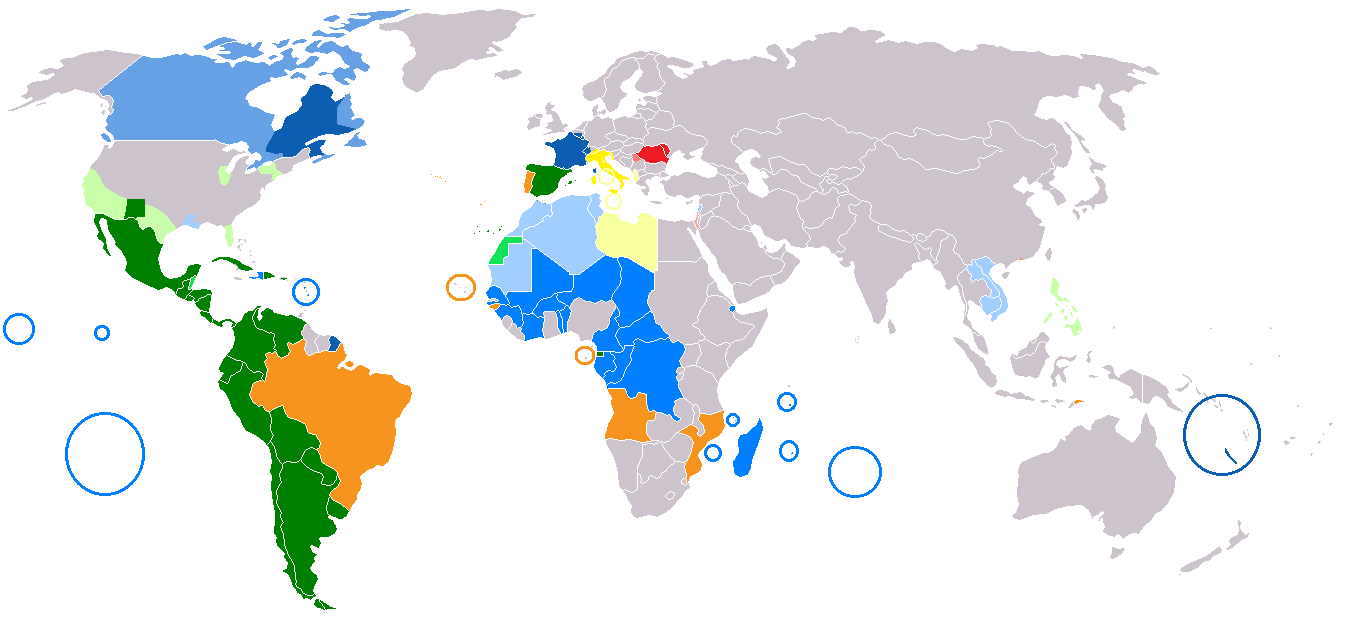
300px|left|thumb|Distribution of major Romance languages:">col-endLatin languages (often referred to asRomance languages ) are a branch of the Indo-European language family, comprising all the languages that descend fromLatin , the language of theRoman Empire . They have more than 700 million native speakers worldwide, mainly in theAmericas ,Europe , andAfrica , as well as in many smaller regions scattered through the world.All Romance languages descend from
Vulgar Latin , the language of soldiers, settlers and merchants of theRoman Empire , which was somewhat different from theClassical Latin of the Romanliterati . As a result, the group shares several linguistic features that set it apart from other Indo-European branches.Latin European peoples are those who speak
Romance languages , descended fromVulgar Latin , spread during the time of theRoman Empire . They are otherwise ethnically and culturally diverse. The Latin European peoples include:
thumb|400px|European countries with a Romance language.">
Blue: Official language.
Green: Co-official or regionally official language.
Red: "Unofficial whole" language usage.
Yellow: Significant unofficial regional language.
*French people
**Walloons
**French Swiss
*Italian people
**Swiss Italians
**Corsican Italian
*Andorran people
*Gibraltarian people
*Spanish people (see:Nationalisms and regionalisms of Spain )
**Andalusian people
**Asturian people
**Aragonese people
**Canarian people
**Cantabrian people
**Castilian people
**Catalan people
**Galician people
**Leonese people
**Valencian people
*Portuguese people
*Romanian people
**Aromanians
**Istro-Romanians
**Megleno-Romanians
**Dacoromanians
***Transylvania ns [Richmond, Yale. "From Da to Yes: Understanding the East Europeans", p. 130 ("The vast majority of Transylvanians are ethnic Romanians"). Intercultural Press (1995), ISBN 1877864307]The
Latin European s are the people who inhabit all the areas covered by Latin Europe.Fact|date=March 2008 They are termed as theLatins of Europe.Fact|date=March 2008 However, it is sometimes only those in theLatin Arch who are seen as Latin European.Fact|date=March 2008Religion
Of the entire region of Latin Europe
Roman Catholicism represents 80% of the population. In Romania and Moldova, the dominant religion isEastern Orthodoxy .
*Andorra , predominantly Roman Catholic - seeReligion in Andorra .
*Belgium , Wallonia is predominantly Roman Catholic - seeReligion in Belgium .
*France , 51% identified as Catholics - seeReligion in France .
*Italy , predominantly Roman Catholic - seeReligion in Italy .
*Luxembourg , predominantly Roman Catholic - seeReligion in Luxembourg .
*Malta , predominantly Roman Catholic - seeReligion in Malta .
*Moldova , predominantly Eastern Orthodoxy - seeReligion in Moldova .
*Monaco , Roman Catholicism is the officialreligion - seeReligion in Monaco .
*Romania , predominantly Eastern Orthodoxy - seeReligion in Romania .
*Portugal , predominantly Roman Catholic - seeReligion in Portugal .
*San Marino , predominantly Roman Catholic - seeReligion in San Marino .
*Spain , predominantly Roman Catholic - seeReligion in Spain .
*Switzerland , Catholicism and Protestantism - seeReligion in Switzerland .
*Vatican City , 100% Roman Catholic - seeReligion in the Vatican City .Countries
ee also
*
Latin Africa
*Latin America
*Latin Arch
*Latin Union
*Mediterranean Union References
Wikimedia Foundation. 2010.