

- World language
-
A world language is a language spoken internationally which is learned by many people as a second language. A world language is not only characterized by the number of its speakers (native or second language speakers), but also by its geographical distribution, and its use in international organizations and in diplomatic relations.[1][2] In this respect, major world languages are dominated by languages of European origin. The historical reason for this is the period of European colonialism.
The international prominence of Arabic has its historical reason in the medieval Islamic conquests and the subsequent Arabization of the Middle East, and also exists as a liturgical language amongst Muslim communities outside of the Arab World. Standard Chinese is the direct replacement of Classical Chinese which was an important historical lingua franca in Far East Asia until the early 20th century, and today serves the function of providing a common spoken language between speakers of different and mutually unintelligible Chinese spoken languages not only within China proper (between the Han Chinese and other unrelated ethnic groups), but in overseas Chinese communities as well as being widely taught as a second language internationally. Russian was used in the Russian empire and the Soviet Union, and today is in use and widely understood in areas of Central and Eastern Europe, and Northern and Central Asia which were formerly part of the Soviet Union, or of the former Soviet bloc, and it remains the lingua franca in the Commonwealth of Independent States. German served as a lingua franca in large portions of Europe for centuries, mainly the Holy Roman Empire and later the Austro-Hungarian Empire. It remains an important second language in much of Central and Eastern Europe, and in the international scientific community.
Other major languages are not widely used across several continents, but have had an international significance as the lingua franca of a historical empire. These include Greek in the Hellenistic world after the conquests of Alexander the Great, and in the territories of the Byzantine Empire; Latin in the Roman Empire and previously as the standard liturgical language for the Catholic faithful worldwide; Classical Chinese in East Asia during the Imperial era of Chinese history; Persian (or Farsi, as it is known in the Persian language) during ancient and medieval incarnations of various succeeding Persian Empires, and once served as the second lingua franca of the Islamic World after Arabic;[3] Sanskrit during the ancient and medieval historical periods of various states in South Asia, Southeast Asia, and Central Asia, and like Latin an important liturgical language of the Vedic religions.
The major languages of the Indian subcontinent have numbers of speakers comparable to those of major world languages primarily due to the large population in the region rather than a supra-regional use of these languages, although Hindustani (including all Hindi dialects and Urdu) and to a lesser extent Tamil may fulfill the criteria in terms of supra-regional usage and international recognition.
As an example, the native speaking population of Bengali vastly outnumber those who speak French as a first language, and it is one of the most spoken languages (ranking fifth[4] or sixth[5]) in the world with nearly 230 million total speakers, and is known for its long and rich literary tradition. However, while French is spoken intercontinentally, is internationally recognized to be of high linguistic prestige and used in diplomacy and international commerce, as well as having a significant portion of second language speakers throughout the world, the overwhelming majority of Bengali speakers are native Bengali people, with little to no influence outside of its regionally limited sprachraum or language space.
Contents
History
Historical world languages include Sumerian, Akkadian, Old Aramaic, Koine Greek, Latin, Arabic, Sanskrit, Chinese, Spanish, Portuguese, Dutch, French, Russian and English.[1]
The Romance languages bear testimony to the role of Latin as the lingua franca of the Roman Empire. Koine Greek was the "world language" of the Hellenistic period, but its distribution is not reflected in the distribution of Modern Greek due to the linguistic impact of the Slavic, Arabic and Turkic expansions. The distribution of the Turkic languages, in turn, are a legacy of the Turkic Khaganate.
Just as all the living world languages owe their status to historical imperialism, the suggestion of a given language as a world language or "universal language" has strong political implications. Thus, Russian was declared the "world language of internationalism" in Soviet literature, which at the same time denounced French as the "language of fancy courtiers" and English as the "jargon of traders".[6] A number of international auxiliary languages have been introduced as prospective world languages, the most successful of them being Esperanto, but none of them can claim the status of a living world language. Many natural languages have been proffered as candidates for a global lingua franca, including Italian, Dutch, Hungarian, German and Malay.[6][citation needed]
-

Eastern Roman Empire - Koine Greek
-

Turkic Khaganate - Turkic languages
Living world languages
Some sources define a living world language as having the following properties:
- a large number of speakers
- a substantial fraction of non-native speakers (function as lingua franca)
- official status in several countries
- a linguistic community not defined strictly along ethnic lines (multiethnic, pluricentric language)
- one or more standard registers which are widely taught as a foreign language
- association with linguistic prestige
- use in international trade relations
- use in international organizations
- use in the academic community
- significant body of literature
World languages in the strictest sense are:[1][7][8]
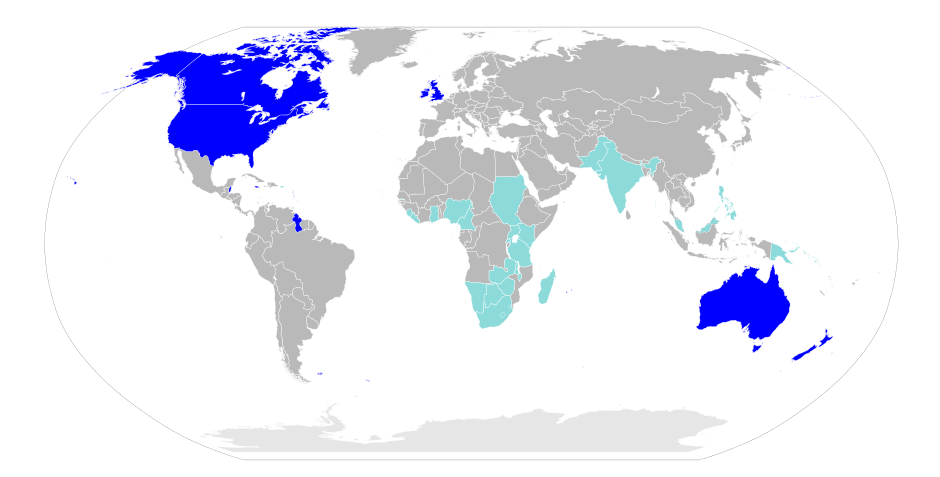
Language Native speakers[9] Total speakers Official Status Distribution Official Status Maps English 328 M 1800 M[10][11] Anglosphere 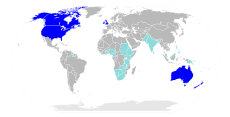
Spanish (Castilian) 329 M - 400 M[12] 500+ M[13] Hispanosphere 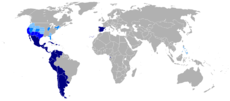
French 67.8 - 110 M[14] 500 M[14] Francophone 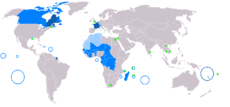
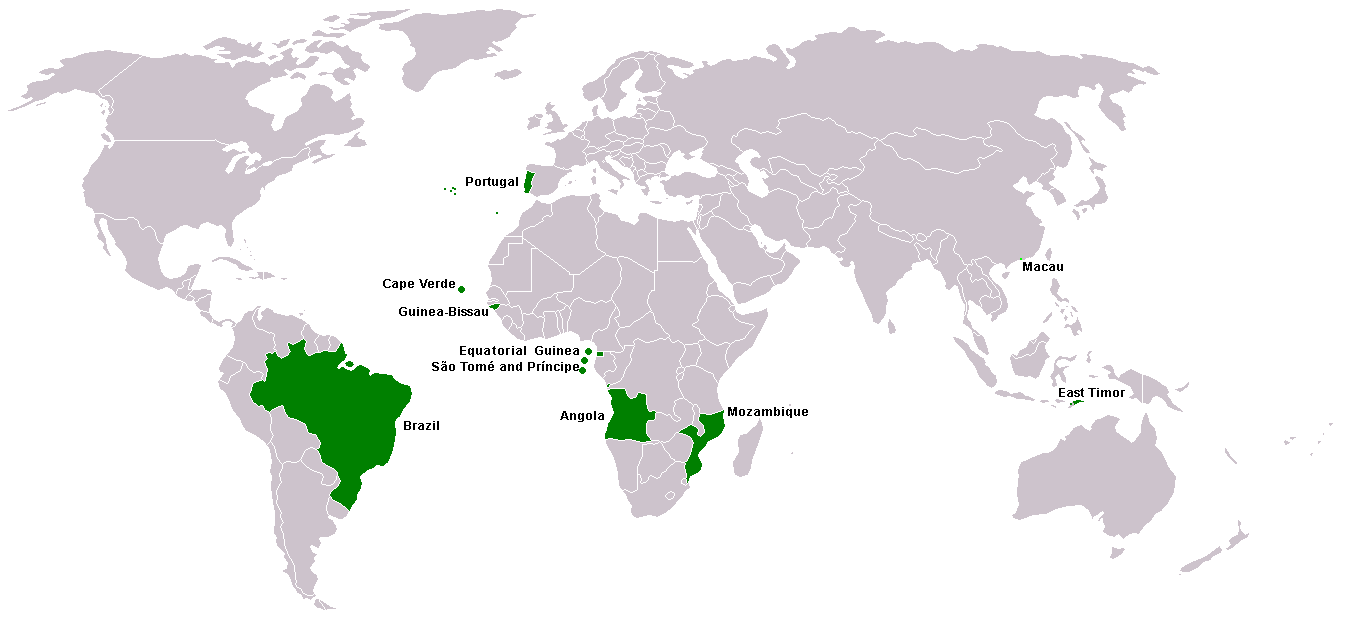
Portuguese 178 M 220 M[15] Lusophone 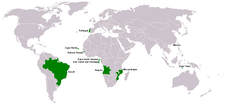
Other sources denote the following languages as world languages, whilst stricter sources list them as supra-regional languages:[2]
Language Native speakers[9] Total speakers Official Status Distribution Official Status Maps Mandarin 845 M 1345 M[16] Sinosphere 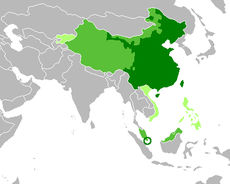
Hindustani 460 M 650 M[17] Indian subcontinent 
Arabic 221 M 450 M[citation needed] Arab world 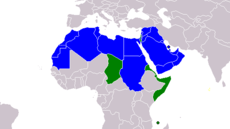
Russian 144 M 300 M[citation needed] Russophone 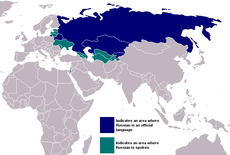
German 120 M 200 M German-speaking Europe 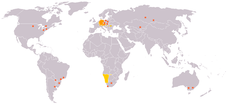
Other supra-regional languages
Further information: Lingua francaOther languages of supra-regional importance which fail some of the other criteria to be considered de facto world languages include:
Language Native speakers[9] Total speakers Official Status Distribution Official Status Maps Malay and Indonesian 60 M 176 M - 250 M Malay Archipelago 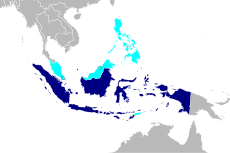
Persian 70 M 144 M Greater Iran 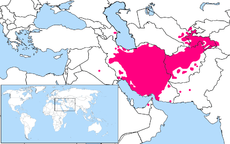
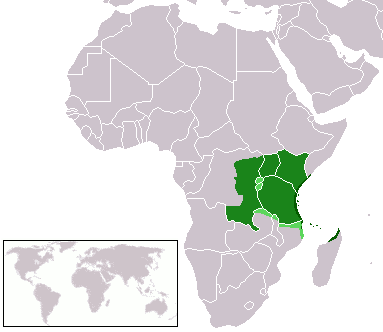
Swahili 5 - 10 M 100 M[18] East Africa 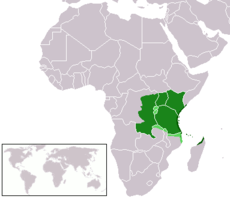
Tamil 68 M 77 M India, Sri Lanka, Singapore 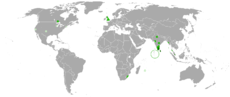
Italian 60 M 70 M Italy 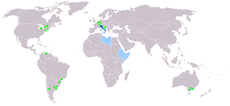
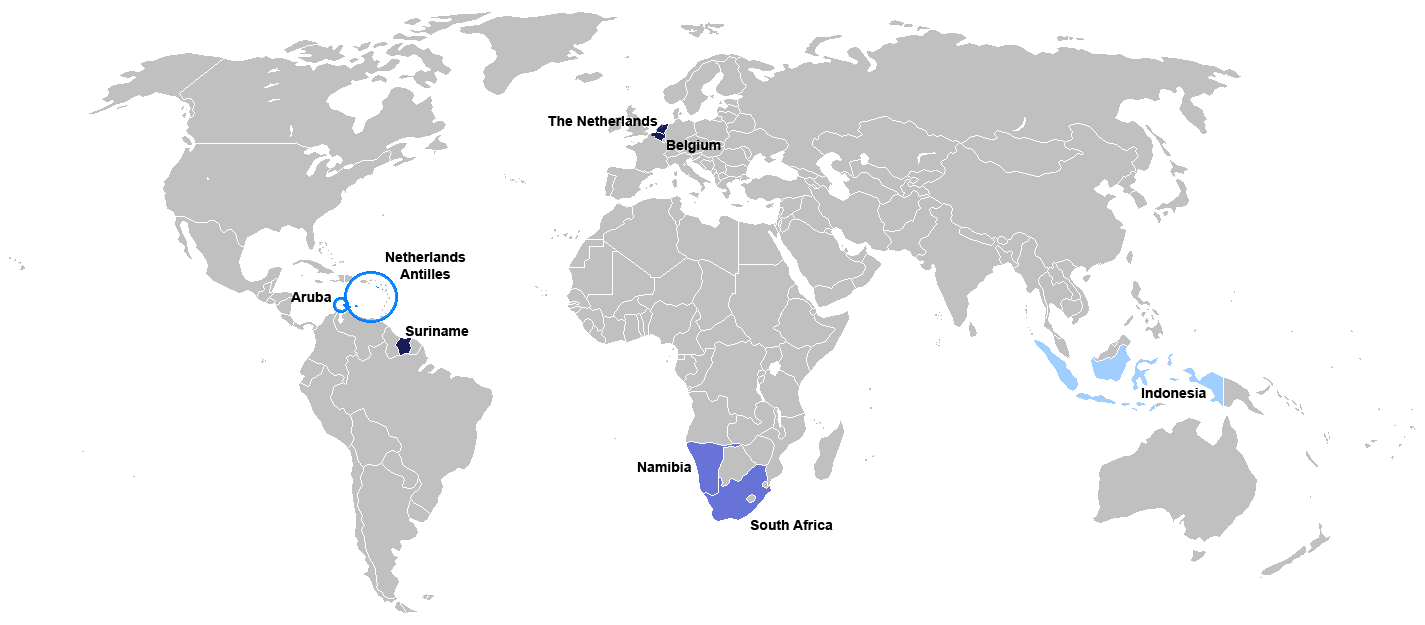
Dutch and Afrikaans 28 M 46 M Dutch-speaking world 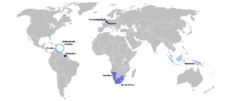
Two languages with a number of speakers in excess of 100 million, Japanese and Bengali, are not listed. Although considered to be some of the most internationally significant languages along with the listed world languages,[19] they are not considered world languages per se - Japan for example is almost ethnically, culturally and linguistically homogeneous, thus Japanese does not have much history as a lingua franca amongst communities who do not share a mother tongue or first language; their overseas communities are strongly tied to ethnicity; Bengali is not as widely taught as a foreign language as Japanese, where international interest since the 1980s have prompted many major universities as well as a number of secondary and even primary schools worldwide to offer courses in the language; and at least in the present, these languages exert a regionally limited sphere of influence;[20]).
See also
- List of languages by number of speakers
- National language
- Universal language
- Lingua franca
- International English
- World religion
- World population
- World economy
- World Englishes
- Intercontinental
- International auxiliary language
Notes
- ^ a b c Fischer Verlag Weltalmanach stichwort_weltsprachen
- ^ a b Baker & Jones Encyclopedia of bilingualism and bilingual education
- ^ Dr Seyyed Hossein Nasr, Islam: Religion, History, and Civilization, HarperCollins,Published 2003
- ^ "Statistical Summaries". Ethnologue. 2005. http://www.ethnologue.com/ethno_docs/distribution.asp?by=country. Retrieved 2007-03-03.
- ^ "Languages Spoken by More Than 10 Million People". Languages Spoken by More Than 10 Million People. Microsoft Encarta 2006. http://encarta.msn.com/media_701500404/Languages_Spoken_by_More_Than_10_Million_People.html. Retrieved 2007-02-18.[dead link]
- ^ a b Pei, p. 105
- ^ Ulrich Ammon Status and function of languages and language varieties
- ^ Ali Mazrui A world federation of cultures: an African perspective
- ^ a b c Ethnologue: Statistical Summaries
- ^ World-Wide English
- ^ ethnologue.com
- ^ "IV CILE. Paneles y ponencias. Hiram Vivanco Torres". Congresosdelalengua.es. http://congresosdelalengua.es/cartagena/ponencias/seccion_3/36/vivanco_hiram.htm. Retrieved 2010-11-06.; [1].
- ^ krysstal.com, 5th International Congress on Spanish Language (la-moncloa.es),uis.edu, Antonio Molina, director of the Instituto Cervantes in 2006 (terranoticias.es,elmundo.es, fundeu.es[dead link]), Luis María Anson of the Real Academia Española (elcultural.es),International Congress about Spanish, 2008, Mario Melgar of the México University (lllf.uam.es), Enrique Díaz de Liaño Argüelles, director of Celer Solutions multilingual translation network ([2]) ,Feu Rosa - Spanish in Mercosur (congresosdelalengua.es),elpais.com,eumed.net,[3],babel-linguistics.com.
- ^ a b Francophonie
- ^ Instituto Internacional da Língua Portuguesa
- ^ People's Republic of China#cite note-unpop-4
- ^ figures are based on the 1991 census of India. They are highly unreliable due to the huge population growth in the area.
- ^ [4]
- ^ The World's 10 most influential Languages
- ^ c.f. Pei p. 15
References
- Christian Mair (ed.), The Politics of English As a World Language (2003), ISBN 978-90-420-0876-2.
- Mario Pei, One Language for the World (1958), ISBN 978-0-8196-0218-3.
- Anne-Marie De Mejía, Power, Prestige, and Bilingualism: International Perspectives on Elite Bilingual Education (2002), ISBN 978-1-85359-590-5.
- David Crystal, English as a Global Language (2003), ISBN 978-0-521-53032-3.
- Clare Mar-Molinero, The Politics of Language in the Spanish-speaking World (2000), ISBN 978-0-415-15655-4.
- George Weber, The World's 10 most influential Languages
External links
Categories:- Languages
- Language policy
- Languages by geographical region
-








Wikimedia Foundation. 2010.
