- Cerium
-
lanthanum ← cerium → praseodymium -
↑
Ce
↓
ThAppearance silvery white

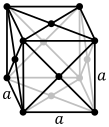
General properties Name, symbol, number cerium, Ce, 58 Pronunciation /ˈsɪəriəm/ Element category lanthanide Group, period, block n/a, 6, f Standard atomic weight 140.116 Electron configuration [Xe] 4f 5d 6s2[1] Electrons per shell 2, 8, 18, 19, 9, 2 (Image) Physical properties Phase solid Density (near r.t.) 6.770 g·cm−3 Liquid density at m.p. 6.55 g·cm−3 Melting point 1068 K, 795 °C, 1463 °F Boiling point 3716 K, 3443 °C, 6229 °F Heat of fusion 5.46 kJ·mol−1 Heat of vaporization 398 kJ·mol−1 Molar heat capacity 26.94 J·mol−1·K−1 Vapor pressure P (Pa) 1 10 100 1 k 10 k 100 k at T (K) 1992 2194 2442 2754 3159 3705 Atomic properties Oxidation states 4, 3, 2
(mildly basic oxide)Electronegativity 1.12 (Pauling scale) Ionization energies 1st: 534.4 kJ·mol−1 2nd: 1050 kJ·mol−1 3rd: 1949 kJ·mol−1 Atomic radius 181.8 pm Covalent radius 204±9 pm Miscellanea Crystal structure face-centered cubic Magnetic ordering paramagnetic[2] Electrical resistivity (r.t.) (β, poly) 828 nΩ·m Thermal conductivity 11.3 W·m−1·K−1 Thermal expansion (r.t.) (γ, poly) 6.3 µm/(m·K) Speed of sound (thin rod) (20 °C) 2100 m·s−1 Young's modulus (γ form) 33.6 GPa Shear modulus (γ form) 13.5 GPa Bulk modulus (γ form) 21.5 GPa Poisson ratio (γ form) 0.24 Mohs hardness 2.5 Vickers hardness 270 MPa Brinell hardness 412 MPa CAS registry number 7440-45-1 Most stable isotopes Main article: Isotopes of cerium iso NA half-life DM DE (MeV) DP 134Ce syn 3.16 days ε 0.500 134La 136Ce 0.185% 136Ce is stable with 78 neutrons 138Ce 0.251% 138Ce is stable with 80 neutrons 139Ce syn 137.640 days ε 0.278 139La 140Ce 88.450% 140Ce is stable with 82 neutrons 141Ce syn 32.501 days β− 0.581 141Pr 142Ce 11.114% > 5×10¹⁶ years β−β− 1.417 142Nd 144Ce syn 284.893 days β− 0.319 144Pr is a chemical element with the symbol Ce and atomic number 58. It is a soft, silvery, ductile metal which easily oxidizes in air. Cerium was named after the dwarf planet Ceres (itself named for the Roman goddess of agriculture). Cerium is the most abundant of the rare earth elements, making up about 0.0046% of the Earth's crust by weight. It is found in a number of minerals, the most important being monazite and bastnasite. Commercial applications of cerium are numerous. They include catalysts, additives to fuel to reduce emissions and to glass and enamels to change their color. Cerium oxide is an important component of glass polishing powders and phosphors used in screens and fluorescent lamps. Contents
Characteristics
Physical properties
Cerium is a silvery metal, belonging to the lanthanide group. It resembles iron in color and luster, but is soft, and both malleable and ductile. Cerium has the third-longest liquid range of any element: 2648 C° (795 °C to 3443 °C) or 4766 F° (1463 °F to 6229 °F). (Neptunium and Thorium have the longer liquid ranges.)
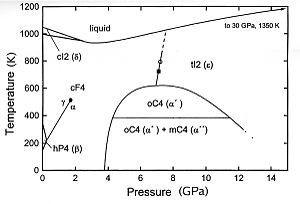 Phase diagram of cerium
Cerium is especially interesting because of its variable electronic structure. The energy of the inner 4f level is nearly the same as that of the outer or valence electrons, and only small energy is required to change the relative occupancy of these electronic levels. This gives rise to dual valency states. For example, a volume change of about 10% occurs when cerium is subjected to high pressures or low temperatures. It appears that the valence changes from about 3 to 4 when it is cooled or compressed. The low temperature behavior of cerium is complex. Four allotropic modifications are thought to exist: cerium at room temperature and at atmospheric pressure is known as γ cerium. Upon cooling to –16 °C, γ cerium changes to β cerium. The remaining γ cerium starts to change to α cerium when cooled to –172 °C, and the transformation is complete at –269 °C. α Cerium has a density of 8.16; δ cerium exists above 726 °C. At atmospheric pressure, liquid cerium is more dense than its solid form at the melting point.[3][4][5]
Chemical properties
Cerium metal tarnishes slowly in air and burns readily at 150 °C to form cerium(IV) oxide:
- Ce + O2 → CeO2
Cerium is quite electropositive and reacts slowly with cold water and quite quickly with hot water to form cerium hydroxide:
- 2 Ce (s) + 6 H2O (l) → 2 Ce(OH)3 (aq) + 3 H2 (g)
Cerium metal reacts with all the halogens:
- 2 Ce (s) + 3 F2 (g) → 2 CeF3 (s) [white]
- 2 Ce (s) + 3 Cl2 (g) → 2 CeCl3 (s) [white]
- 2 Ce (s) + 3 Br2 (g) → 2 CeBr3 (s) [white]
- 2 Ce (s) + 3 I2 (g) → 2 CeI3 (s) [yellow]
Cerium dissolves readily in dilute sulfuric acid to form solutions containing the colorless Ce(III) ions, which exist as a [Ce(OH2)9]3+ complexes:[6]
- 2 Ce (s) + 3 H2SO4 (aq) → 2 Ce3+ (aq) + 3 SO2−
4 (aq) + 3 H2 (g)
Compounds
See also Category: Cerium compounds.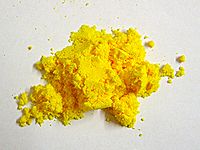 Cerium(IV) sulfate
Cerium(IV) (ceric) salts are orange red or yellowish, whereas cerium(III) (cerous) salts are usually white or colorless. Both oxidation states absorb ultraviolet light strongly. Cerium(III) can be used to make glasses that are colorless, yet absorb ultraviolet light almost completely. Cerium can be readily detected in rare earth mixtures by a very sensitive qualitative test: addition of ammonia and hydrogen peroxide to an aqueous solution of lanthanides produces a characteristic dark brown color if cerium is present.
Cerium exhibits three oxidation states, +2, +3 and +4. The +2 state is rare and is observed in CeH2, CeI2 and CeS.[5] The most common compound of cerium is cerium(IV) oxide (CeO2), which is used as "Jeweller's rouge" as well as in the walls of some self-cleaning ovens. Two common oxidizing agents used in titrations are ammonium cerium(IV) sulfate (ceric ammonium sulfate, (NH4)2Ce(SO4)3) and ammonium cerium(IV) nitrate (ceric ammonium nitrate or CAN, (NH4)2Ce(NO3)6). Cerium also forms a chloride, CeCl3 or cerium(III) chloride, used to facilitate reactions at carbonyl groups in organic chemistry. Other compounds include cerium(III) carbonate (Ce2(CO3)3), cerium(III) fluoride (CeF3), cerium(III) oxide (Ce2O3), as well as cerium(IV) sulfate (ceric sulfate, Ce(SO4)2) and cerium(III) triflate (Ce(OSO2CF3)3).
The two oxidation states of cerium differ enormously in basicity: cerium(III) is a strong base, comparable to the other trivalent lanthanides, but cerium(IV) is weak. This difference has always allowed cerium to be by far the most readily isolated and purified of all the lanthanides, otherwise a notoriously difficult group of elements to separate. A wide range of procedures have been devised over the years to exploit the difference. Among the better ones:
- Leaching the mixed hydroxides with dilute nitric acid: the trivalent lanthanides dissolve in cerium-free condition, and tetravalent cerium remains in the insoluble residue as a concentrate to be further purified by other means. A variation on this uses hydrochloric acid and the calcined oxides from bastnasite, but the separation is less sharp.
- Precipitating cerium from a nitrate or chloride solution using potassium permanganate and sodium carbonate in a 1:4 molar ratio.
- Boiling rare-earth nitrate solutions with potassium bromate and marble chips.
Formerly used commercially was a method whereby a solution of cerium(IV) in nitric acid would be added to dilute sulfuric acid. This caused cerium(IV) to largely precipitate as a basic salt, leaving trivalent lanthanide in solution. However, the finely divided precipitate was difficult to filter from the highly corrosive medium. Using the classical methods of rare-earth separation, there was a considerable advantage to a strategy of removing cerium from the mixture at the beginning. Cerium typically comprised 45% of the cerite or monazite rare earths, and removing it early greatly reduced the bulk of what needed to be further processed (or the cost of reagents to be associated with such processing). However, not all cerium purification methods relied on basicity. Ceric ammonium nitrate [ammonium hexanitratocerate(IV)] crystallization from nitric acid was one purification method. Cerium(IV) nitrate (hexanitratoceric acid) was more readily extractable into certain solvents (e.g. tri-n-butyl phosphate) than the trivalent lanthanides. However, modern practice in China seems to be to do purification of cerium by counter-current solvent extraction, in its trivalent form, just like the other lanthanides.
Cerium(IV) is a strong oxidant under acidic conditions, but stable under alkaline conditions, when it is cerium(III) that becomes a strong reductant, easily oxidized by atmospheric oxygen (O2). This ease of oxidation under alkaline conditions leads to the occasional geochemical parting of the ways between cerium and the trivalent light lanthanides under supergene weathering conditions, leading variously to the "negative cerium anomaly" or to the formation of the mineral cerianite. Air-oxidation of alkaline cerium(III) is the most economical way to get to cerium(IV), which can then be handled in acid solution.
Isotopes
Main article: Isotopes of ceriumNaturally occurring cerium is composed of 4 stable isotopes; 136
Ce, 138
Ce, 140
Ce, and 142
Ce, with 140
Ce being the most abundant (88.48% natural abundance). 136
Ce and 142
Ce are predicted to be double beta active but no signs of activity were ever observed (for 142
Ce, the lower limit on half-life is 5×10¹⁶ yr). 26 radioisotopes have been characterized, with the most long-lived being 144
Ce with a half-life of 284.893 days, 139
Ce with a half-life of 137.640 days, and 141
Ce with a half-life of 32.501 days. All of the remaining radioactive isotopes have half-lives that are less than 4 days and the majority of these have half-lives that are less than 10 minutes. This element also has 2 meta states.The known isotopes of cerium range in atomic weight from 123 u (123
Ce) to 152 u (152
Ce).144
Ce is a high-yield product of nuclear fission; the ORNL Fission Product Pilot Plant separated substantial quantities of 144
Ce from reactor waste, and it was used in the Aircraft Nuclear Propulsion and SNAP programs.History
Cerium was discovered in Bastnäs in Sweden by Jöns Jakob Berzelius and Wilhelm Hisinger, and independently in Germany by Martin Heinrich Klaproth, both in 1803.[7] Cerium was named by Berzelius after the dwarf planet Ceres, discovered two years earlier (1801). As originally isolated, cerium was in the form of its oxide, and was named ceria, a term that is still used. The metal itself was too electropositive to be isolated by then-current smelting technology, a characteristic of rare earth metals in general. After the development of electrochemistry by Humphry Davy five years later, the earths soon yielded the metals they contained. Ceria, as isolated in 1803, contained all of the lanthanides present in the cerite ore from Bastnäs, Sweden, and thus only contained about 45% of what is now known to be pure ceria. It was not until Carl Gustaf Mosander succeeded in removing lanthana and "didymia" in the late 1830s, that ceria was obtained pure. Wilhelm Hisinger was a wealthy mine owner and amateur scientist, and sponsor of Berzelius. He owned or controlled the mine at Bastnäs, and had been trying for years to find out the composition of the abundant heavy gangue rock (the "Tungstein of Bastnäs"), now known as cerite, that he had in his mine. Mosander and his family lived for many years in the same house as Berzelius, and Mosander was undoubtedly persuaded by Berzelius to investigate ceria further.[8]
When the rare earths were first discovered, since they were strong bases like the oxides of calcium or magnesium, they were thought to be divalent. Thus, "ceric" cerium was thought to be trivalent, and the oxidation state ratio was therefore thought to be 1.5. Berzelius was annoyed to keep on getting the correct ratio 1.33. He was after all one of the finest analytical chemists in Europe.
In the late 1950s, the Lindsay Chemical Division of American Potash and Chemical Corporation of West Chicago, Illinois, then the largest producer of rare earths in the world, was offering cerium compounds in two purity ranges, "commercial" at 94-97% purity, and "purified", at a reported 99.9+% purity. In their October 1, 1958 price list, one-pound quantities of the oxides were priced at $3.30 or $8.10 respectively for the two purities; the per-pound price for 50-pound quantities were respectively $1.95 or $4.95 for the two grades. Cerium salts were proportionately cheaper, reflecting their lower net content of oxide.
Occurrence
See also: :Category:Lanthanide minerals Allanite
Cerium is the most abundant of the rare earth elements, making up about 0.0046% of the Earth's crust by weight. It is found in a number of minerals including allanite (also known as orthite)—(Ca,Ce,La,Y)2(Al,Fe)3(SiO4)3(OH), monazite (Ce,La,Th,Nd,Y)PO4, bastnasite (Ce,La,Y)CO3F, hydroxylbastnasite (Ce,La,Nd)CO3(OH,F), rhabdophane (Ce,La,Nd)PO4-H2O, zircon (ZrSiO4), and synchysite Ca(Ce,La,Nd,Y)(CO3)2F. Monazite and bastnasite are presently the two most important sources of cerium. Large deposits of monazite, allanite, and bastnasite will supply cerium, thorium, and other rare-earth metals for many years to come.[4]
Production
The mineral mixtures are crushed, ground and treated with hot concentrated sulfuric acid to produce water-soluble sulfates of rare earths. The acidic filtrates are partially neutralized with sodium hydroxide to pH 3–4. Thorium precipitates out of solution as hydroxide and is removed. After that the solution is treated with ammonium oxalate to convert rare earths in to their insoluble oxalates. The oxalates are converted to oxides by annealing. The oxides are dissolved in nitric acid that excludes one of the main components, cerium, whose salts are insoluble in HNO3. Metallic cerium is prepared by metallothermic reduction techniques, such as by reducing cerium fluoride or chloride with calcium, or by electrolysis of molten cerous chloride or other cerous halides. The metallothermic technique is used to produce high-purity cerium.[5]
Applications
A major technological application for Cerium(III) oxide is a catalytic converter for the reduction of CO emissions in the exhaust gases from motor vehicles. In particular, cerium oxide is added into Diesel fuels. Another important use of the cerium oxide is a hydrocarbon catalyst in self cleaning ovens, incorporated into oven walls and as a petroleum cracking catalyst in petroleum refining. [9]
Cerium(IV) oxide is considered one of the most efficient agents for precision polishing of optical components. Cerium compounds are also used in the manufacture of glass, both as a component and as a decolorizer. For example, cerium(IV) oxide in combination with titanium(IV) oxide gives a golden yellow color to glass; it also allows for selective absorption of ultraviolet light in glass. Cerium oxide has high refractive index and is added to enamel to make it more opaque.[9]
Cerium(IV) oxide is used in incandescent gas mantles, such as the Welsbach mantle, where it was combined with thorium, lanthanum, magnesium or yttrium oxides. Doped with other rare earth oxides, it has been investigated as a solid electrolyte in intermediate temperature solid oxide fuel cells: The cerium(IV) oxide-cerium(III) oxide cycle or CeO2/Ce2O3 cycle is a two step thermochemical process based on cerium(IV) oxide and cerium(III) oxide for hydrogen production.[10]
The photostability of pigments can be enhanced by addition of cerium. It provides pigments with light fastness and prevents clear polymers from darkening in sunlight. Television glass plates are subject to electron bombardment, which tends to darken them by creation of F-center color centers. This effect is suppressed by addition of cerium oxide. Cerium is also an essential component of phosphors used in TV screens and fluorescent lamps.[9]
A traditional use of cerium was in the pyrophoric mischmetal alloy used for light flints. Because of the high affinity of cerium to sulfur and oxygen, it is used in various aluminium alloys, and iron alloys. In steels, cerium degasifies and can help reduce sulfides and oxides, and it is a precipitation hardening agent in stainless steel. Adding cerium to cast irons opposes graphitization and produces a malleable iron. Addition of 3–4% of cerium to magnesium alloys, along with 0.2 to 0.6% zirconium, helps refine the grain and give sound casting of complex shapes. It also adds heat resistance to magnesium castings.[9]
Cerium alloys are used in permanent magnets and in tungsten electrodes for gas tungsten arc welding. Cerium is used in carbon-arc lighting, especially in the motion picture industry. Cerium oxalate is an anti-emetic drug. Cerium(IV) sulfate is used extensively as a volumetric oxidizing agent in quantitative analysis. Ceric ammonium nitrate is a useful one-electron oxidant in organic chemistry, used to oxidatively etch electronic components, and as a primary standard for quantitative analysis.[4][11]
Precautions
Cerium, like all rare-earth metals, is of low to moderate toxicity. Cerium is a strong reducing agent and ignites spontaneously in air at 65 to 80 °C. Fumes from cerium fires are toxic. Water should not be used to stop cerium fires, as cerium reacts with water to produce hydrogen gas. Workers exposed to cerium have experienced itching, sensitivity to heat, and skin lesions. Animals injected with large doses of cerium have died due to cardiovascular collapse. Cerium(IV) oxide is a powerful oxidizing agent at high temperatures and will react with combustible organic materials. While cerium is not radioactive, the impure commercial grade may contain traces of thorium, which is radioactive. Cerium serves no known biological function.[9]
See also
References
- ^ Ground levels and ionization energies for the neutral atoms, NIST
- ^ Magnetic susceptibility of the elements and inorganic compounds, in Handbook of Chemistry and Physics 81st edition, CRC press.
- ^ Stassis, C.; Gould, T.; McMasters, O.; Gschneidner, K.; Nicklow, R. (1979). "Lattice and spin dynamics of γ-Ce". Physical Review B 19 (11): 5746. Bibcode 1979PhRvB..19.5746S. doi:10.1103/PhysRevB.19.5746.
- ^ a b c C. R. Hammond (2000). The Elements, in Handbook of Chemistry and Physics 81st edition. CRC press. ISBN 0849304814.
- ^ a b c Patnaik, Pradyot (2003). Handbook of Inorganic Chemical Compounds. McGraw-Hill. pp. 199–200. ISBN 0070494398. http://books.google.com/?id=Xqj-TTzkvTEC&pg=PA200. Retrieved 2009-06-06.
- ^ "Chemical reactions of Cerium". Webelements. https://www.webelements.com/cerium/chemistry.html. Retrieved 2009-06-06.
- ^ "Visual Elements: Cerium". London: Royal Society of Chemistry. 1999-2005. http://www.rsc.org/chemsoc/visualelements/pages/data/cerium_data.html. Retrieved December 31, 2009.
- ^ Weeks, Mary Elvira (1932). "The Discovery of the Elements: XI. Some Elements Isolated with the Aid of Potassium and Sodium:Zirconium, Titanium, Cerium and Thorium". The Journal of Chemical Education 9 (7): 1231–1243. Bibcode 1932JChEd...9.1231W. doi:10.1021/ed009p1231.
- ^ a b c d e Alessandro (2002). Catalysis by ceria and related materials. Imperial College Press. pp. 6–11. ISBN 1860942997. http://books.google.com/?id=X2z9WdN3-WgC.
- ^ "Hydrogen production from solar thermochemical water splitting cycles". http://www.solarpaces.org/Tasks/Task2/HPST.HTM. Retrieved 2009-06-06.
- ^ C. K. Gupta, Nagaiyar Krishnamurthy (2004). Extractive metallurgy of rare earths. CRC Press. p. 30. ISBN 0415333407. http://books.google.com/?id=F0Bte_XhzoAC&pg=PA30.
External links
- WebElements.com – Cerium
- It's Elemental – The Element Cerium
- Cerium Properties and Applications
- Chemistry in its element podcast (MP3) from the Royal Society of Chemistry's Chemistry World: Cerium
Periodic table H He Li Be B C N O F Ne Na Mg Al Si P S Cl Ar K Ca Sc Ti V Cr Mn Fe Co Ni Cu Zn Ga Ge As Se Br Kr Rb Sr Y Zr Nb Mo Tc Ru Rh Pd Ag Cd In Sn Sb Te I Xe Cs Ba La Ce Pr Nd Pm Sm Eu Gd Tb Dy Ho Er Tm Yb Lu Hf Ta W Re Os Ir Pt Au Hg Tl Pb Bi Po At Rn Fr Ra Ac Th Pa U Np Pu Am Cm Bk Cf Es Fm Md No Lr Rf Db Sg Bh Hs Mt Ds Rg Cn Uut Uuq Uup Uuh Uus Uuo Alkali metals Alkaline earth metals Lanthanides Actinides Transition metals Other metals Metalloids Other nonmetals Halogens Noble gases Unknown chem. properties Large version Chemical elements named after places Named after terrestrial places Named after astronomical objects Cerium compounds
Wikimedia Foundation. 2010.
Look at other dictionaries:
cérium — [ serjɔm ] n. m. • 1803; de Cérès ♦ Chim. Élément chimique (Ce; no at. 58; m. at. 140,1), métal du groupe des lanthanides. Oxyde de cérium. ● cérium nom masculin (de Cérès, nom propre) Métal du groupe des lanthanides. (Élément chimique de symbole … Encyclopédie Universelle
Cerium — Cérium Cérium Lanthane ← … Wikipédia en Français
Cérium — Lanthane ← Cérium → Praséodyme … Wikipédia en Français
cerium — ► NOUN ▪ a silvery white metallic chemical element, the most abundant of the lanthanide series. ORIGIN named after the asteroid Ceres, discovered in 1801, shortly before cerium was identified … English terms dictionary
Cerium — Ce ri*um, n. [Named by Berzelius in 1803 from the asteroid Ceres, then just discovered (1801).] (Chem.) A rare metallic element, occurring in the minerals cerite, allanite, monazite, etc. Symbol Ce. Atomic weight 141.5. It resembles iron in color … The Collaborative International Dictionary of English
Cerĭum — (eigentlich Cererium, Chem.), 1) C. zuerst von Vauquelin, dann von Mosander, Klapproth, Berzelius etc. entdecktes Metall. Es findet sich, wiewohl selten, im Verein mit den beiden Metallen Lanthan u. Didym (s.d.) als Oxyd u. Oxydul im Cerit,… … Pierer's Universal-Lexikon
Cerĭum — Cerĭum, s. Cer … Meyers Großes Konversations-Lexikon
Cerium — Cerĭum, Metall, s. Cer … Kleines Konversations-Lexikon
Cerium — Cerium, ein Erdmetall, welches sich als Oxydul in mehreren seltenen Mineralien, wie im Cerit, Allanit, Orphit u.s.w. findet, und durch Zersetzung des Chlorceriums mit Kalium als ein graues, metallglänzendes Pulver erhalten wird … Herders Conversations-Lexikon
cerium — Symbol: Ce Atomic number: 58 Atomic weight: 140.12 Silvery metallic element, belongs to the lanthanoids. Four natural isotopes exist, and fifteen radioactive isotopes have been identified. Used in some rare earth alloys. The oxidized form is used … Elements of periodic system
cerium — element, first isolated in pure form in 1875, named for ceria, name of the earth from which it was taken, which was discovered in 1803 and named for Ceres, the minor planet, which had been discovered in 1801 and named for the Roman goddess CERES… … Etymology dictionary
 18+© Academic, 2000-2024
- Contact us: Technical Support, Advertising
Dictionaries export, created on PHP, Joomla, Drupal, WordPress, MODx.