

- Fungus
-
"Fungi" redirects here. You may be looking for Fungi (music) or Fungus (XM).
Fungi
Temporal range: Early Devonian–Recent (but see text)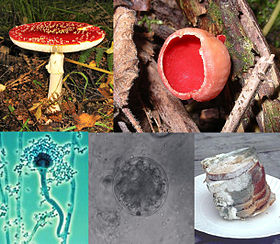
Clockwise from top left: Amanita muscaria, a basidiomycete; Sarcoscypha coccinea, an ascomycete; bread covered in mold; a chytrid; a Penicillium conidiophore. Scientific classification Domain: Eukaryota (unranked): Opisthokonta Kingdom: Fungi
(L., 1753) R.T. Moore, 1980[1]Subkingdoms/Phyla/Subphyla[2] Dikarya (inc. Deuteromycota)
Subphyla Incertae sedis
- Entomophthoromycotina
- Kickxellomycotina
- Mucoromycotina
- Zoopagomycotina
A fungus (pronounced /ˈfʌŋɡəs/; pl. fungi[3] or funguses[4]) is a member of a large group of eukaryotic organisms that includes microorganisms such as yeasts and molds (British English: moulds), as well as the more familiar mushrooms. These organisms are classified as a kingdom, Fungi, which is separate from plants, animals, and bacteria. One major difference is that fungal cells have cell walls that contain chitin, unlike the cell walls of plants, which contain cellulose. These and other differences show that the fungi form a single group of related organisms, named the Eumycota (true fungi or Eumycetes), that share a common ancestor (a monophyletic group). This fungal group is distinct from the structurally similar myxomycetes (slime molds) and oomycetes (water molds). The discipline of biology devoted to the study of fungi is known as mycology, which is often regarded as a branch of botany, even though genetic studies have shown that fungi are more closely related to animals than to plants.
Abundant worldwide, most fungi are inconspicuous because of the small size of their structures, and their cryptic lifestyles in soil, on dead matter, and as symbionts of plants, animals, or other fungi. They may become noticeable when fruiting, either as mushrooms or molds. Fungi perform an essential role in the decomposition of organic matter and have fundamental roles in nutrient cycling and exchange. They have long been used as a direct source of food, such as mushrooms and truffles, as a leavening agent for bread, and in fermentation of various food products, such as wine, beer, and soy sauce. Since the 1940s, fungi have been used for the production of antibiotics, and, more recently, various enzymes produced by fungi are used industrially and in detergents. Fungi are also used as biological pesticides to control weeds, plant diseases and insect pests. Many species produce bioactive compounds called mycotoxins, such as alkaloids and polyketides, that are toxic to animals including humans. The fruiting structures of a few species contain psychotropic compounds and are consumed recreationally or in traditional spiritual ceremonies. Fungi can break down manufactured materials and buildings, and become significant pathogens of humans and other animals. Losses of crops due to fungal diseases (e.g. rice blast disease) or food spoilage can have a large impact on human food supplies and local economies.
The fungus kingdom encompasses an enormous diversity of taxa with varied ecologies, life cycle strategies, and morphologies ranging from single-celled aquatic chytrids to large mushrooms. However, little is known of the true biodiversity of Kingdom Fungi, which has been estimated at around 1.5 million species, with about 5% of these having been formally classified. Ever since the pioneering 18th and 19th century taxonomical works of Carl Linnaeus, Christian Hendrik Persoon, and Elias Magnus Fries, fungi have been classified according to their morphology (e.g., characteristics such as spore color or microscopic features) or physiology. Advances in molecular genetics have opened the way for DNA analysis to be incorporated into taxonomy, which has sometimes challenged the historical groupings based on morphology and other traits. Phylogenetic studies published in the last decade have helped reshape the classification of Kingdom Fungi, which is divided into one subkingdom, seven phyla, and ten subphyla.
Contents
Etymology
The English word fungus is directly adopted from the Latin fungus (mushroom), used in the writings of Horace and Pliny.[5] This in turn is derived from the Greek word sphongos/σφογγος ("sponge"), which refers to the macroscopic structures and morphology of mushrooms and molds;[6] the root is also used in other languages, such as the German Schwamm ("sponge") and Schimmel ("mold").[7] The use of the word mycology, which is derived from the Greek mykes/μύκης (mushroom) and logos/λόγος (discourse),[8] to denote the scientific study of fungi is thought to have originated in 1836 with English naturalist Miles Joseph Berkeley's publication The English Flora of Sir James Edward Smith, Vol. 5.[6]
Characteristics
Before the introduction of molecular methods for phylogenetic analysis, taxonomists considered fungi to be members of the Plant Kingdom because of similarities in lifestyle: both fungi and plants are mainly immobile, and have similarities in general morphology and growth habitat. Like plants, fungi often grow in soil, and in the case of mushrooms form conspicuous fruiting bodies, which sometimes bear resemblance to plants such as mosses. The fungi are now considered a separate kingdom, distinct from both plants and animals, from which they appear to have diverged around one billion years ago.[9][10] Some morphological, biochemical, and genetic features are shared with other organisms, while others are unique to the fungi, clearly separating them from the other kingdoms:
Shared features:
- With other eukaryotes: As other eukaryotes, fungal cells contain membrane-bound nuclei with chromosomes that contain DNA with noncoding regions called introns and coding regions called exons. In addition, fungi possess membrane-bound cytoplasmic organelles such as mitochondria, sterol-containing membranes, and ribosomes of the 80S type.[11] They have a characteristic range of soluble carbohydrates and storage compounds, including sugar alcohols (e.g., mannitol), disaccharides, (e.g., trehalose), and polysaccharides (e.g., glycogen, which is also found in animals[12]).
- With animals: Fungi lack chloroplasts and are heterotrophic organisms, requiring preformed organic compounds as energy sources.[13]
- With plants: Fungi possess a cell wall[14] and vacuoles.[15] They reproduce by both sexual and asexual means, and like basal plant groups (such as ferns and mosses) produce spores. Similar to mosses and algae, fungi typically have haploid nuclei.[16]
- With euglenoids and bacteria: Higher fungi, euglenoids, and some bacteria produce the amino acid L-lysine in specific biosynthesis steps, called the α-aminoadipate pathway.[17][18]
- The cells of most fungi grow as tubular, elongated, and thread-like (filamentous) structures and are called hyphae, which may contain multiple nuclei and extend at their tips. Each tip contains a set of aggregated vesicles—cellular structures consisting of proteins, lipids, and other organic molecules—called Spitzenkörper.[19] Both fungi and oomycetes grow as filamentous hyphal cells.[20] In contrast, similar-looking organisms, such as filamentous green algae, grow by repeated cell division within a chain of cells.[12]
- In common with some plant and animal species, more than 60 fungal species display the phenomenon of bioluminescence.[21]
Unique features:
- Some species grow as single-celled yeasts that reproduce by budding or binary fission. Dimorphic fungi can switch between a yeast phase and a hyphal phase in response to environmental conditions.[22]
- The fungal cell wall is composed of glucans and chitin; while the former compounds are also found in plants and the latter in the exoskeleton of arthropods,[23][24] fungi are the only organisms that combine these two structural molecules in their cell wall. In contrast to plants and the oomycetes, fungal cell walls do not contain cellulose.[25]
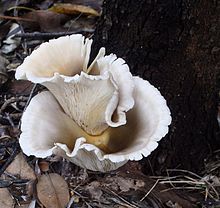 Omphalotus nidiformis, a bioluminescent mushroom
Most fungi lack an efficient system for long-distance transport of water and nutrients, such as the xylem and phloem in many plants. To overcome these limitations, some fungi, such as Armillaria, form rhizomorphs,[26] that resemble and perform functions similar to the roots of plants. Another characteristic shared with plants includes a biosynthetic pathway for producing terpenes that uses mevalonic acid and pyrophosphate as chemical building blocks.[27] However, plants have an additional terpene pathway in their chloroplasts, a structure fungi do not possess.[28] Fungi produce several secondary metabolites that are similar or identical in structure to those made by plants.[27] Many of the plant and fungal enzymes that make these compounds differ from each other in sequence and other characteristics, which indicates separate origins and evolution of these enzymes in the fungi and plants.[27][29]
Diversity
Fungi have a worldwide distribution, and grow in a wide range of habitats, including extreme environments such as deserts or areas with high salt concentrations[30] or ionizing radiation,[31] as well as in deep sea sediments.[32] Some can survive the intense UV and cosmic radiation encountered during space travel.[33] Most grow in terrestrial environments, though several species live partly or solely in aquatic habitats, such as the chytrid fungus Batrachochytrium dendrobatidis, a parasite that has been responsible for a worldwide decline in amphibian populations. This organism spends part of its life cycle as a motile zoospore, enabling it to propel itself through water and enter its amphibian host.[34] Other examples of aquatic fungi include those living in hydrothermal areas of the ocean.[35]
Around 100,000 species of fungi have been formally described by taxonomists,[36] but the global biodiversity of the fungus kingdom is not fully understood.[37] On the basis of observations of the ratio of the number of fungal species to the number of plant species in selected environments, the fungal kingdom has been estimated to contain about 1.5 million species;[38] a recent (2011) estimate suggests there may be over 5 million species.[39] In mycology, species have historically been distinguished by a variety of methods and concepts. Classification based on morphological characteristics, such as the size and shape of spores or fruiting structures, has traditionally dominated fungal taxonomy.[40] Species may also be distinguished by their biochemical and physiological characteristics, such as their ability to metabolize certain biochemicals, or their reaction to chemical tests. The biological species concept discriminates species based on their ability to mate. The application of molecular tools, such as DNA sequencing and phylogenetic analysis, to study diversity has greatly enhanced the resolution and added robustness to estimates of genetic diversity within various taxonomic groups.[41]
Morphology
Microscopic structures
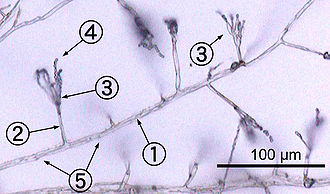
Most fungi grow as hyphae, which are cylindrical, thread-like structures 2–10 µm in diameter and up to several centimeters in length. Hyphae grow at their tips (apices); new hyphae are typically formed by emergence of new tips along existing hyphae by a process called branching, or occasionally growing hyphal tips bifurcate (fork) giving rise to two parallel-growing hyphae.[42] The combination of apical growth and branching/forking leads to the development of a mycelium, an interconnected network of hyphae.[22] Hyphae can be either septate or coenocytic: septate hyphae are divided into compartments separated by cross walls (internal cell walls, called septa, that are formed at right angles to the cell wall giving the hypha its shape), with each compartment containing one or more nuclei; coenocytic hyphae are not compartmentalized.[43] Septa have pores that allow cytoplasm, organelles, and sometimes nuclei to pass through; an example is the dolipore septum in the fungi of the phylum Basidiomycota.[44] Coenocytic hyphae are essentially multinucleate supercells.[45]
Many species have developed specialized hyphal structures for nutrient uptake from living hosts; examples include haustoria in plant-parasitic species of most fungal phyla, and arbuscules of several mycorrhizal fungi, which penetrate into the host cells to consume nutrients.[46]
Although fungi are opisthokonts—a grouping of evolutionarily related organisms broadly characterized by a single posterior flagellum—all phyla except for the chytrids have lost their posterior flagella.[47] Fungi are unusual among the eukaryotes in having a cell wall that, in addition to glucans (e.g., β-1,3-glucan) and other typical components, also contains the biopolymer chitin.[48]
Macroscopic structures
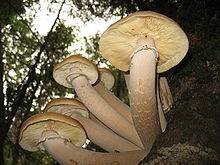 Armillaria solidipes
Fungal mycelia can become visible to the naked eye, for example, on various surfaces and substrates, such as damp walls and on spoiled food, where they are commonly called molds. Mycelia grown on solid agar media in laboratory petri dishes are usually referred to as colonies. These colonies can exhibit growth shapes and colors (due to spores or pigmentation) that can be used as diagnostic features in the identification of species or groups.[49] Some individual fungal colonies can reach extraordinary dimensions and ages as in the case of a clonal colony of Armillaria solidipes, which extends over an area of more than 900 ha (3.5 square miles), with an estimated age of nearly 9,000 years.[50]
The apothecium—a specialized structure important in sexual reproduction in the ascomycetes—is a cup-shaped fruiting body that holds the hymenium, a layer of tissue containing the spore-bearing cells.[51] The fruiting bodies of the basidiomycetes (basidiocarps) and some ascomycetes can sometimes grow very large, and many are well-known as mushrooms.
Growth and physiology
The growth of fungi as hyphae on or in solid substrates or as single cells in aquatic environments is adapted for the efficient extraction of nutrients, because these growth forms have high surface area to volume ratios.[52] Hyphae are specifically adapted for growth on solid surfaces, and to invade substrates and tissues.[53] They can exert large penetrative mechanical forces; for example, the plant pathogen Magnaporthe grisea forms a structure called an appressorium that evolved to puncture plant tissues.[54] The pressure generated by the appressorium, directed against the plant epidermis, can exceed 8 megapascals (1,200 psi).[54] The filamentous fungus Paecilomyces lilacinus uses a similar structure to penetrate the eggs of nematodes.[55]
The mechanical pressure exerted by the appressorium is generated from physiological processes that increase intracellular turgor by producing osmolytes such as glycerol.[56] Morphological adaptations such as these are complemented by hydrolytic enzymes secreted into the environment to digest large organic molecules—such as polysaccharides, proteins, lipids, and other organic substrates—into smaller molecules that may then be absorbed as nutrients.[57][58][59] The vast majority of filamentous fungi grow in a polar fashion—i.e., by extension into one direction—by elongation at the tip (apex) of the hypha.[60] Alternative forms of fungal growth include intercalary extension (i.e., by longitudinal expansion of hyphal compartments that are below the apex) as in the case of some endophytic fungi,[61] or growth by volume expansion during the development of mushroom stipes and other large organs.[62] Growth of fungi as multicellular structures consisting of somatic and reproductive cells—a feature independently evolved in animals and plants[63]—has several functions, including the development of fruiting bodies for dissemination of sexual spores (see above) and biofilms for substrate colonization and intercellular communication.[64]
Traditionally, the fungi are considered heterotrophs, organisms that rely solely on carbon fixed by other organisms for metabolism. Fungi have evolved a high degree of metabolic versatility that allows them to use a diverse range of organic substrates for growth, including simple compounds such as nitrate, ammonia, acetate, or ethanol.[65][66] For some species it has been shown that the pigment melanin may play a role in extracting energy from ionizing radiation, such as gamma radiation; however, this form of "radiotrophic" growth has only been described for a few species, the effects on growth rates are small, and the underlying biophysical and biochemical processes are not known.[31] The authors speculate that this process might bear similarity to CO2 fixation via visible light, but instead utilizing ionizing radiation as a source of energy.[67]
Reproduction
Fungal reproduction is complex, reflecting the differences in lifestyles and genetic makeup within this kingdom of organisms.[68] It is estimated that a third of all fungi reproduce by different modes of propagation; for example, reproduction may occur in two well-differentiated stages within the life cycle of a species, the teleomorph and the anamorph.[69] Environmental conditions trigger genetically determined developmental states that lead to the creation of specialized structures for sexual or asexual reproduction. These structures aid reproduction by efficiently dispersing spores or spore-containing propagules.
Asexual reproduction
Asexual reproduction via vegetative spores (conidia) or through mycelial fragmentation is common; it maintains clonal populations adapted to a specific niche, and allows more rapid dispersal than sexual reproduction.[70] The "Fungi imperfecti" (fungi lacking the perfect or sexual stage) or Deuteromycota comprise all the species which lack an observable sexual cycle.[71]
Sexual reproduction
Sexual reproduction with meiosis exists in all fungal phyla (with the exception of the Glomeromycota).[72] It differs in many aspects from sexual reproduction in animals or plants. Differences also exist between fungal groups and can be used to discriminate species by morphological differences in sexual structures and reproductive strategies.[73][74] Mating experiments between fungal isolates may identify species on the basis of biological species concepts.[74] The major fungal groupings have initially been delineated based on the morphology of their sexual structures and spores; for example, the spore-containing structures, asci and basidia, can be used in the identification of ascomycetes and basidiomycetes, respectively. Some species may allow mating only between individuals of opposite mating type, while others can mate and sexually reproduce with any other individual or itself. Species of the former mating system are called heterothallic, and of the latter homothallic.[75]
Most fungi have both an haploid and diploid stage in their life cycles. In sexually reproducing fungi, compatible individuals may combine by fusing their hyphae together into an interconnected network; this process, anastomosis, is required for the initiation of the sexual cycle. Ascomycetes and basidiomycetes go through a dikaryotic stage, in which the nuclei inherited from the two parents do not combine immediately after cell fusion, but remain separate in the hyphal cells (see heterokaryosis).[76]
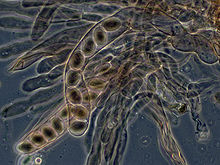
In ascomycetes, dikaryotic hyphae of the hymenium (the spore-bearing tissue layer) form a characteristic hook at the hyphal septum. During cell division, formation of the hook ensures proper distribution of the newly divided nuclei into the apical and basal hyphal compartments. An ascus (plural asci) is then formed, in which karyogamy (nuclear fusion) occurs. Asci are embedded in an ascocarp, or fruiting body. Karyogamy in the asci is followed immediately by meiosis and the production of ascospores. After dispersal, the ascospores may germinate and form a new haploid mycelium.[77]
Sexual reproduction in basidiomycetes is similar to that of the ascomycetes. Compatible haploid hyphae fuse to produce a dikaryotic mycelium. However, the dikaryotic phase is more extensive in the basidiomycetes, often also present in the vegetatively growing mycelium. A specialized anatomical structure, called a clamp connection, is formed at each hyphal septum. As with the structurally similar hook in the ascomycetes, the clamp connection in the basidiomycetes is required for controlled transfer of nuclei during cell division, to maintain the dikaryotic stage with two genetically different nuclei in each hyphal compartment.[78] A basidiocarp is formed in which club-like structures known as basidia generate haploid basidiospores after karyogamy and meiosis.[79] The most commonly known basidiocarps are mushrooms, but they may also take other forms (see Morphology section).
In glomeromycetes (formerly zygomycetes), haploid hyphae of two individuals fuse, forming a gametangium, a specialized cell structure that becomes a fertile gamete-producing cell. The gametangium develops into a zygospore, a thick-walled spore formed by the union of gametes. When the zygospore germinates, it undergoes meiosis, generating new haploid hyphae, which may then form asexual sporangiospores. These sporangiospores allow the fungus to rapidly disperse and germinate into new genetically identical haploid fungal mycelia.[80]
Spore dispersal
Both asexual and sexual spores or sporangiospores are often actively dispersed by forcible ejection from their reproductive structures. This ejection ensures exit of the spores from the reproductive structures as well as travelling through the air over long distances.
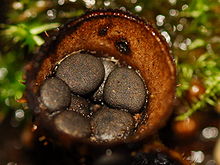 The bird's nest fungus Cyathus stercoreus
Specialized mechanical and physiological mechanisms, as well as spore surface structures (such as hydrophobins), enable efficient spore ejection.[81] For example, the structure of the spore-bearing cells in some ascomycete species is such that the buildup of substances affecting cell volume and fluid balance enables the explosive discharge of spores into the air.[82] The forcible discharge of single spores termed ballistospores involves formation of a small drop of water (Buller's drop), which upon contact with the spore leads to its projectile release with an initial acceleration of more than 10,000 g;[83] the net result is that the spore is ejected 0.01–0.02 cm, sufficient distance for it to fall through the gills or pores into the air below.[84] Other fungi, like the puffballs, rely on alternative mechanisms for spore release, such as external mechanical forces. The bird's nest fungi use the force of falling water drops to liberate the spores from cup-shaped fruiting bodies.[85] Another strategy is seen in the stinkhorns, a group of fungi with lively colors and putrid odor that attract insects to disperse their spores.[86]
Other sexual processes
Besides regular sexual reproduction with meiosis, certain fungi, such as those in the genera Penicillium and Aspergillus, may exchange genetic material via parasexual processes, initiated by anastomosis between hyphae and plasmogamy of fungal cells.[87] The frequency and relative importance of parasexual events is unclear and may be lower than other sexual processes. It is known to play a role in intraspecific hybridization[88] and is likely required for hybridization between species, which has been associated with major events in fungal evolution.[89]
Evolution
Main article: Evolution of fungiIn contrast to plants and animals, the early fossil record of the fungi is meager. Factors that likely contribute to the under-representation of fungal species among fossils include the nature of fungal fruiting bodies, which are soft, fleshy, and easily degradable tissues and the microscopic dimensions of most fungal structures, which therefore are not readily evident. Fungal fossils are difficult to distinguish from those of other microbes, and are most easily identified when they resemble extant fungi.[90] Often recovered from a permineralized plant or animal host, these samples are typically studied by making thin-section preparations that can be examined with light microscopy or transmission electron microscopy.[91] Compression fossils are studied by dissolving the surrounding matrix with acid and then using light or scanning electron microscopy to examine surface details.[92]
The earliest fossils possessing features typical of fungi date to the Proterozoic eon, some 1,430 million years ago (Ma); these multicellular benthic organisms had filamentous structures with septa, and were capable of anastomosis.[93] More recent studies (2009) estimate the arrival of fungal organisms at about 760–1060 Ma on the basis of comparisons of the rate of evolution in closely related groups.[94] For much of the Paleozoic Era (542–251 Ma), the fungi appear to have been aquatic and consisted of organisms similar to the extant chytrids in having flagellum-bearing spores.[95] The evolutionary adaptation from an aquatic to a terrestrial lifestyle necessitated a diversification of ecological strategies for obtaining nutrients, including parasitism, saprobism, and the development of mutualistic relationships such as mycorrhiza and lichenization.[96] Recent (2009) studies suggest that the ancestral ecological state of the Ascomycota was saprobism, and that independent lichenization events have occurred multiple times.[97]
The fungi probably colonized the land during the Cambrian (542–488.3 Ma), long before land plants.[98] Fossilized hyphae and spores recovered from the Ordovician of Wisconsin (460 Ma) resemble modern-day Glomerales, and existed at a time when the land flora likely consisted of only non-vascular bryophyte-like plants.[99] Prototaxites, which was probably a fungus or lichen, would have been the tallest organism of the late Silurian. Fungal fossils do not become common and uncontroversial until the early Devonian (416–359.2 Ma), when they are abundant in the Rhynie chert, mostly as Zygomycota and Chytridiomycota.[98][100][101] At about this same time, approximately 400 Ma, the Ascomycota and Basidiomycota diverged,[102] and all modern classes of fungi were present by the Late Carboniferous (Pennsylvanian, 318.1–299 Ma).[103]
Lichen-like fossils have been found in the Doushantuo Formation in southern China dating back to 635–551 Ma.[104] Lichens were a component of the early terrestrial ecosystems, and the estimated age of the oldest terrestrial lichen fossil is 400 Ma;[105] this date corresponds to the age of the oldest known sporocarp fossil, a Paleopyrenomycites species found in the Rhynie Chert.[106] The oldest fossil with microscopic features resembling modern-day basidiomycetes is Palaeoancistrus, found permineralized with a fern from the Pennsylvanian.[107] Rare in the fossil record are the Homobasidiomycetes (a taxon roughly equivalent to the mushroom-producing species of the Agaricomycetes). Two amber-preserved specimens provide evidence that the earliest known mushroom-forming fungi (the extinct species Archaeomarasmius leggetti) appeared during the mid-Cretaceous, 90 Ma.[108][109]
Some time after the Permian–Triassic extinction event (251.4 Ma), a fungal spike (originally thought to be an extraordinary abundance of fungal spores in sediments) formed, suggesting that fungi were the dominant life form at this time, representing nearly 100% of the available fossil record for this period.[110] However, the relative proportion of fungal spores relative to spores formed by algal species is difficult to assess,[111] the spike did not appear worldwide,[112][113] and in many places it did not fall on the Permian–Triassic boundary.[114]
Taxonomy
Although commonly included in botany curricula and textbooks, fungi are more closely related to animals than to plants and are placed with the animals in the monophyletic group of opisthokonts.[115] Analyses using molecular phylogenetics support a monophyletic origin of the Fungi.[41] The taxonomy of the Fungi is in a state of constant flux, especially due to recent research based on DNA comparisons. These current phylogenetic analyses often overturn classifications based on older and sometimes less discriminative methods based on morphological features and biological species concepts obtained from experimental matings.[116]
There is no unique generally accepted system at the higher taxonomic levels and there are frequent name changes at every level, from species upwards. Efforts among researchers are now underway to establish and encourage usage of a unified and more consistent nomenclature.[41][117] Fungal species can also have multiple scientific names depending on their life cycle and mode (sexual or asexual) of reproduction. Web sites such as Index Fungorum and ITIS list current names of fungal species (with cross-references to older synonyms).
The 2007 classification of Kingdom Fungi is the result of a large-scale collaborative research effort involving dozens of mycologists and other scientists working on fungal taxonomy.[41] It recognizes seven phyla, two of which—the Ascomycota and the Basidiomycota—are contained within a branch representing subkingdom Dikarya. The below cladogram depicts the major fungal taxa and their relationship to opisthokont and unikont organisms. The lengths of the branches in this tree are not proportional to evolutionary distances.
Taxonomic groups
See also: List of fungal ordersThe major phyla (sometimes called divisions) of fungi have been classified mainly on the basis of characteristics of their sexual reproductive structures. Currently, seven phyla are proposed: Microsporidia, Chytridiomycota, Blastocladiomycota, Neocallimastigomycota, Glomeromycota, Ascomycota, and Basidiomycota.[41]
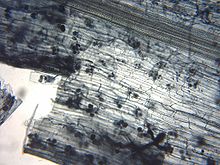
Phylogenetic analysis has demonstrated that the Microsporidia, unicellular parasites of animals and protists, are fairly recent and highly derived endobiotic fungi (living within the tissue of another species).[95][118] One 2006 study concludes that the Microsporidia are a sister group to the true fungi, that is, they are each other's closest evolutionary relative.[119] Hibbett and colleagues suggest that this analysis does not clash with their classification of the Fungi, and although the Microsporidia are elevated to phylum status, it is acknowledged that further analysis is required to clarify evolutionary relationships within this group.[41]
The Chytridiomycota are commonly known as chytrids. These fungi are distributed worldwide. Chytrids produce zoospores that are capable of active movement through aqueous phases with a single flagellum, leading early taxonomists to classify them as protists. Molecular phylogenies, inferred from rRNA sequences in ribosomes, suggest that the Chytrids are a basal group divergent from the other fungal phyla, consisting of four major clades with suggestive evidence for paraphyly or possibly polyphyly.[120]
The Blastocladiomycota were previously considered a taxonomic clade within the Chytridiomycota. Recent molecular data and ultrastructural characteristics, however, place the Blastocladiomycota as a sister clade to the Zygomycota, Glomeromycota, and Dikarya (Ascomycota and Basidiomycota). The blastocladiomycetes are saprotrophs, feeding on decomposing organic matter, and they are parasites of all eukaryotic groups. Unlike their close relatives, the chytrids, which mostly exhibit zygotic meiosis, the blastocladiomycetes undergo sporic meiosis.[95]
The Neocallimastigomycota were earlier placed in the phylum Chytridomycota. Members of this small phylum are anaerobic organisms, living in the digestive system of larger herbivorous mammals and possibly in other terrestrial and aquatic environments. They lack mitochondria but contain hydrogenosomes of mitochondrial origin. As the related chrytrids, neocallimastigomycetes form zoospores that are posteriorly uniflagellate or polyflagellate.[41]
Members of the Glomeromycota form arbuscular mycorrhizae, a form of symbiosis where fungal hyphae invade plant root cells and both species benefit from the resulting increased supply of nutrients. All known Glomeromycota species reproduce asexually.[72] The symbiotic association between the Glomeromycota and plants is ancient, with evidence dating to 400 million years ago.[121] Formerly part of the Zygomycota (commonly known as 'sugar' and 'pin' molds), the Glomeromycota were elevated to phylum status in 2001 and now replace the older phylum Zygomycota.[122] Fungi that were placed in the Zygomycota are now being reassigned to the Glomeromycota, or the subphyla incertae sedis Mucoromycotina, Kickxellomycotina, the Zoopagomycotina and the Entomophthoromycotina.[41] Some well-known examples of fungi formerly in the Zygomycota include black bread mold (Rhizopus stolonifer), and Pilobolus species, capable of ejecting spores several meters through the air.[123] Medically relevant genera include Mucor, Rhizomucor, and Rhizopus.
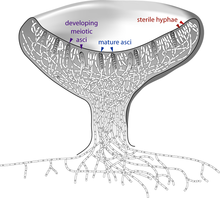 Diagram of an apothecium (the typical cup-like reproductive structure of Ascomycetes) showing sterile tissues as well as developing and mature asci.
The Ascomycota, commonly known as sac fungi or ascomycetes, constitute the largest taxonomic group within the Eumycota.[40] These fungi form meiotic spores called ascospores, which are enclosed in a special sac-like structure called an ascus. This phylum includes morels, a few mushrooms and truffles, single-celled yeasts (e.g., of the genera Saccharomyces, Kluyveromyces, Pichia, and Candida), and many filamentous fungi living as saprotrophs, parasites, and mutualistic symbionts. Prominent and important genera of filamentous ascomycetes include Aspergillus, Penicillium, Fusarium, and Claviceps. Many ascomycete species have only been observed undergoing asexual reproduction (called anamorphic species), but analysis of molecular data has often been able to identify their closest teleomorphs in the Ascomycota.[124] Because the products of meiosis are retained within the sac-like ascus, ascomycetes have been used for elucidating principles of genetics and heredity (e.g. Neurospora crassa).[125]
Members of the Basidiomycota, commonly known as the club fungi or basidiomycetes, produce meiospores called basidiospores on club-like stalks called basidia. Most common mushrooms belong to this group, as well as rust and smut fungi, which are major pathogens of grains. Other important basidiomycetes include the maize pathogen Ustilago maydis,[126] human commensal species of the genus Malassezia,[127] and the opportunistic human pathogen, Cryptococcus neoformans.[128]
Fungus-like organisms
Because of similarities in morphology and lifestyle, the slime molds (myxomycetes) and water molds (oomycetes) were formerly classified in the kingdom Fungi. Unlike true fungi the cell walls of these organisms contain cellulose and lack chitin. Myxomycetes are unikonts like fungi, but are grouped in the Amoebozoa. Oomycetes are diploid bikonts, grouped in the Chromalveolate kingdom. Neither water molds nor slime molds are closely related to the true fungi, and, therefore, taxonomists no longer group them in the kingdom Fungi. Nonetheless, studies of the oomycetes and myxomycetes are still often included in mycology textbooks and primary research literature.[129]
The Rozellida clade, including the "chytrid" Rozella, is a genetically disparate group known mostly from environmental DNA sequences which is a sister group to fungi. Members of the group which have been isolated lack the chitinous cell wall which is characteristic of fungi.
The nucleariids, currently grouped in the Choanozoa, may be the next sister group to the eumycete clade, and as such could be included in an expanded fungal kingdom.[130]
Ecology
Although often inconspicuous, fungi occur in every environment on Earth and play very important roles in most ecosystems. Along with bacteria, fungi are the major decomposers in most terrestrial (and some aquatic) ecosystems, and therefore play a critical role in biogeochemical cycles[131] and in many food webs. As decomposers, they play an essential role in nutrient cycling, especially as saprotrophs and symbionts, degrading organic matter to inorganic molecules, which can then re-enter anabolic metabolic pathways in plants or other organisms.[132][133]
Symbiosis
Many fungi have important symbiotic relationships with organisms from most if not all Kingdoms.[134][135][136] These interactions can be mutualistic or antagonistic in nature, or in the case of commensal fungi are of no apparent benefit or detriment to the host.[137][138][139]
With plants
Mycorrhizal symbiosis between plants and fungi is one of the most well-known plant–fungus associations and is of significant importance for plant growth and persistence in many ecosystems; over 90% of all plant species engage in mycorrhizal relationships with fungi and are dependent upon this relationship for survival.[140]
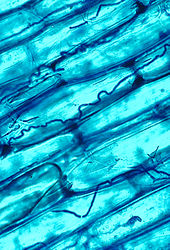 The dark filaments are hyphae of the endophytic fungus Neotyphodium coenophialum in the intercellular spaces of tall fescue leaf sheath tissue
The mycorrhizal symbiosis is ancient, dating to at least 400 million years ago.[121] It often increases the plant's uptake of inorganic compounds, such as nitrate and phosphate from soils having low concentrations of these key plant nutrients.[132][141] The fungal partners may also mediate plant-to-plant transfer of carbohydrates and other nutrients. Such mycorrhizal communities are called "common mycorrhizal networks".[142] A special case of mycorrhiza is myco-heterotrophy, whereby the plant parasitizes the fungus, obtaining all of its nutrients from its fungal symbiont.[143] Some fungal species inhabit the tissues inside roots, stems, and leaves, in which case they are called endophytes.[144] Similar to mycorrhiza, endophytic colonization by fungi may benefit both symbionts; for example, endophytes of grasses impart to their host increased resistance to herbivores and other environmental stresses and receive food and shelter from the plant in return.[145]
With algae and cyanobacteria
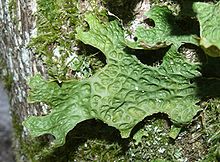
Lichens are formed by a symbiotic relationship between algae or cyanobacteria (referred to in lichen terminology as "photobionts") and fungi (mostly various species of ascomycetes and a few basidiomycetes), in which individual photobiont cells are embedded in a tissue formed by the fungus.[146] Lichens occur in every ecosystem on all continents, play a key role in soil formation and the initiation of biological succession,[147] and are the dominating life forms in extreme environments, including polar, alpine, and semiarid desert regions.[148] They are able to grow on inhospitable surfaces, including bare soil, rocks, tree bark, wood, shells, barnacles and leaves.[149] As in mycorrhizas, the photobiont provides sugars and other carbohydrates via photosynthesis, while the fungus provides minerals and water. The functions of both symbiotic organisms are so closely intertwined that they function almost as a single organism; in most cases the resulting organism differs greatly from the individual components. Lichenization is a common mode of nutrition; around 20% of fungi—between 17,500 and 20,000 described species—are lichenized.[150] Characteristics common to most lichens include obtaining organic carbon by photosynthesis, slow growth, small size, long life, long-lasting (seasonal) vegetative reproductive structures, mineral nutrition obtained largely from airborne sources, and greater tolerance of desiccation than most other photosynthetic organisms in the same habitat.[151]
With insects
Many insects also engage in mutualistic relationships with fungi. Several groups of ants cultivate fungi in the order Agaricales as their primary food source, while ambrosia beetles cultivate various species of fungi in the bark of trees that they infest.[152] Similarly, females of several wood wasp species (genus Sirex) inject their eggs together with spores of the wood-rotting fungus Amylostereum areolatum into the sapwood of pine trees; the growth of the fungus provides ideal nutritional conditions for the development of the wasp larvae.[153] Termites on the African savannah are also known to cultivate fungi,[134] and yeasts of the genera Candida and Lachancea inhabit the gut of a wide range of insects, including neuropterans, beetles, and cockroaches; it is not known whether these fungi benefit their hosts.[154]
As pathogens and parasites
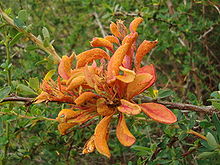 The plant pathogen Aecidium magellanicum causes calafate rust, seen here on a Berberis shrub in Chile.
Many fungi are parasites on plants, animals (including humans), and other fungi. Serious pathogens of many cultivated plants causing extensive damage and losses to agriculture and forestry include the rice blast fungus Magnaporthe oryzae,[155] tree pathogens such as Ophiostoma ulmi and Ophiostoma novo-ulmi causing Dutch elm disease,[156] and Cryphonectria parasitica responsible for chestnut blight,[157] and plant pathogens in the genera Fusarium, Ustilago, Alternaria, and Cochliobolus.[138] Some carnivorous fungi, like Paecilomyces lilacinus, are predators of nematodes, which they capture using an array of specialized structures such as constricting rings or adhesive nets.[158]
Some fungi can cause serious diseases in humans, several of which may be fatal if untreated. These include aspergilloses, candidoses, coccidioidomycosis, cryptococcosis, histoplasmosis, mycetomas, and paracoccidioidomycosis. Furthermore, persons with immuno-deficiencies are particularly susceptible to disease by genera such as Aspergillus, Candida, Cryptoccocus,[139][159][160] Histoplasma,[161] and Pneumocystis.[162] Other fungi can attack eyes, nails, hair, and especially skin, the so-called dermatophytic and keratinophilic fungi, and cause local infections such as ringworm and athlete’s foot.[163] Fungal spores are also a cause of allergies, and fungi from different taxonomic groups can evoke allergic reactions.[164]
Human use
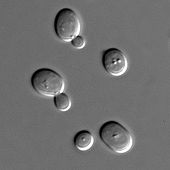
The human use of fungi for food preparation or preservation and other purposes is extensive and has a long history. Mushroom farming and mushroom gathering are large industries in many countries. The study of the historical uses and sociological impact of fungi is known as ethnomycology. Because of the capacity of this group to produce an enormous range of natural products with antimicrobial or other biological activities, many species have long been used or are being developed for industrial production of antibiotics, vitamins, and anti-cancer and cholesterol-lowering drugs. More recently, methods have been developed for genetic engineering of fungi,[165] enabling metabolic engineering of fungal species. For example, genetic modification of yeast species[166]—which are easy to grow at fast rates in large fermentation vessels—has opened up ways of pharmaceutical production that are potentially more efficient than production by the original source organisms.[167]
Drugs
Many species produce metabolites that are major sources of pharmacologically active drugs. Particularly important are the antibiotics, including the penicillins, a structurally related group of β-lactam antibiotics that are synthesized from small peptides. Although naturally occurring penicillins such as penicillin G (produced by Penicillium chrysogenum) have a relatively narrow spectrum of biological activity, a wide range of other penicillins can be produced by chemical modification of the natural penicillins. Modern penicillins are semisynthetic compounds, obtained initially from fermentation cultures, but then structurally altered for specific desirable properties.[168] Other antibiotics produced by fungi include: ciclosporin, commonly used as an immunosuppressant during transplant surgery; and fusidic acid, used to help control infection from methicillin-resistant Staphylococcus aureus bacteria.[169] Widespread use of these antibiotics for the treatment of bacterial diseases, such as tuberculosis, syphilis, leprosy, and many others began in the early 20th century and continues to play a major part in anti-bacterial chemotherapy. In nature, antibiotics of fungal or bacterial origin appear to play a dual role: at high concentrations they act as chemical defense against competition with other microorganisms in species-rich environments, such as the rhizosphere, and at low concentrations as quorum-sensing molecules for intra- or interspecies signaling.[170]
Other drugs produced by fungi include griseofulvin isolated from Penicillium griseofulvum, used to treat fungal infections,[171] and statins (HMG-CoA reductase inhibitors), used to inhibit cholesterol synthesis. Examples of statins found in fungi include mevastatin from Penicillium citrinum and lovastatin from Aspergillus terreus and the oyster mushroom.[172]
Cultured foods
Baker's yeast or Saccharomyces cerevisiae, a single-celled fungus, is used to make bread and other wheat-based products, such as pizza dough and dumplings.[173] Yeast species of the genus Saccharomyces are also used to produce alcoholic beverages through fermentation.[174] Shoyu koji mold (Aspergillus oryzae) is an essential ingredient in brewing Shoyu (soy sauce) and sake, and the preparation of miso,[175] while Rhizopus species are used for making tempeh.[176] Several of these fungi are domesticated species that were bred or selected according to their capacity to ferment food without producing harmful mycotoxins (see below), which are produced by very closely related Aspergilli.[177] Quorn, a meat substitute, is made from Fusarium venenatum.[178]
Medicinal use
See also: Medicinal mushrooms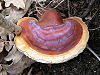
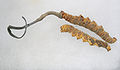 The medicinal fungi Ganoderma lucidum (left) and Ophiocordyceps sinensis (right).
Certain mushrooms enjoy usage as therapeutics in folk medicines, such as Traditional Chinese medicine. Notable medicinal mushrooms with a well-documented history of use include Agaricus subrufescens,[179][180] Ganoderma lucidum,[181] and Ophiocordyceps sinensis.[182] Research has identified compounds produced by these and other fungi that have inhibitory biological effects against viruses[183][184] and cancer cells.[179][185] Specific metabolites, such as polysaccharide-K, ergotamine, and β-lactam antibiotics, are routinely used in clinical medicine. The shiitake mushroom is a source of lentinan, a clinical drug approved for use in cancer treatments in several countries, including Japan.[186][187] In Europe and Japan, polysaccharide-K (brand name Krestin), a chemical derived from Trametes versicolor, is an approved adjuvant for cancer therapy.[188]
Edible and poisonous species
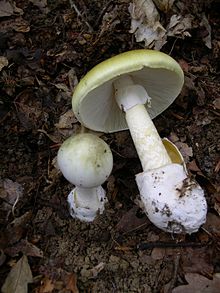
Edible mushrooms are well-known examples of fungi. Many are commercially raised, but others must be harvested from the wild. Agaricus bisporus, sold as button mushrooms when small or Portobello mushrooms when larger, is a commonly eaten species, used in salads, soups, and many other dishes. Many Asian fungi are commercially grown and have increased in popularity in the West. They are often available fresh in grocery stores and markets, including straw mushrooms (Volvariella volvacea), oyster mushrooms (Pleurotus ostreatus), shiitakes (Lentinula edodes), and enokitake (Flammulina spp.).[189]
There are many more mushroom species that are harvested from the wild for personal consumption or commercial sale. Milk mushrooms, morels, chanterelles, truffles, black trumpets, and porcini mushrooms (Boletus edulis) (also known as king boletes) demand a high price on the market. They are often used in gourmet dishes.[190]
Certain types of cheeses require inoculation of milk curds with fungal species that impart a unique flavor and texture to the cheese. Examples include the blue color in cheeses such as Stilton or Roquefort, which are made by inoculation with Penicillium roqueforti.[191] Molds used in cheese production are non-toxic and are thus safe for human consumption; however, mycotoxins (e.g., aflatoxins, roquefortine C, patulin, or others) may accumulate because of growth of other fungi during cheese ripening or storage.[192]
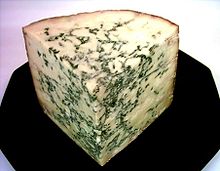 Stilton cheese veined with Penicillium roqueforti
Many mushroom species are poisonous to humans, with toxicities ranging from slight digestive problems or allergic reactions as well as hallucinations to severe organ failures and death. Genera with mushrooms containing deadly toxins include Conocybe, Galerina, Lepiota, and most infamously, Amanita.[193] The latter genus includes the destroying angel (A. virosa) and the death cap (A. phalloides), the most common cause of deadly mushroom poisoning.[194] The false morel (Gyromitra esculenta) is occasionally considered a delicacy when cooked, yet can be highly toxic when eaten raw.[195] Tricholoma equestre was considered edible until being implicated in serious poisonings causing rhabdomyolysis.[196] Fly agaric mushrooms (Amanita muscaria) also cause occasional non-fatal poisonings, mostly as a result of ingestion for use as a recreational drug for its hallucinogenic properties. Historically, fly agaric was used by different peoples in Europe and Asia and its present usage for religious or shamanic purposes is reported from some ethnic groups such as the Koryak people of north-eastern Siberia.[197]
As it is difficult to accurately identify a safe mushroom without proper training and knowledge, it is often advised to assume that a wild mushroom is poisonous and not to consume it.[198][199]
Pest control
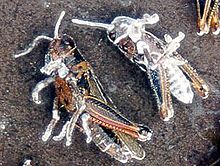 Grasshoppers killed by Beauveria bassiana
In agriculture, fungi may be useful if they actively compete for nutrients and space with pathogenic microorganisms such as bacteria or other fungi via the competitive exclusion principle,[200] or if they are parasites of these pathogens. For example, certain species may be used to eliminate or suppress the growth of harmful plant pathogens, such as insects, mites, weeds, nematodes and other fungi that cause diseases of important crop plants.[201] This has generated strong interest in practical applications that use these fungi in the biological control of these agricultural pests. Entomopathogenic fungi can be used as biopesticides, as they actively kill insects.[202] Examples that have been used as biological insecticides are Beauveria bassiana, Metarhizium spp, Hirsutella spp, Paecilomyces (Isaria) spp, and Lecanicillium lecanii.[203][204] Endophytic fungi of grasses of the genus Neotyphodium, such as N. coenophialum, produce alkaloids that are toxic to a range of invertebrate and vertebrate herbivores. These alkaloids protect grass plants from herbivory, but several endophyte alkaloids can poison grazing animals, such as cattle and sheep.[205] Infecting cultivars of pasture or forage grasses with Neotyphodium endophytes is one approach being used in grass breeding programs; the fungal strains are selected for producing only alkaloids that increase resistance to herbivores such as insects, while being non-toxic to livestock.[206]
Bioremediation
See also: MycoremediationCertain fungi, in particular "white rot" fungi, can degrade insecticides, herbicides, pentachlorophenol, creosote, coal tars, and heavy fuels and turn them into carbon dioxide, water, and basic elements.[207] Fungi have been shown to biomineralize uranium oxides, suggesting they may have application in the bioremediation of radioactively polluted sites.[208][209][210]
Model organisms
Several pivotal discoveries in biology were made by researchers using fungi as model organisms, that is, fungi that grow and sexually reproduce rapidly in the laboratory. For example, the one gene-one enzyme hypothesis was formulated by scientists who used the bread mold Neurospora crassa to test their biochemical theories.[211] Other important model fungi are Aspergillus nidulans and the yeasts, Saccaromyces cerevisiae and Schizosaccharomyces pombe, each of which has a long history of use to investigate issues in eukaryotic cell biology and genetics, such as cell cycle regulation, chromatin structure, and gene regulation. Other fungal models have more recently emerged that each address specific biological questions relevant to medicine, plant pathology, and industrial uses; examples include Candida albicans, a dimorphic, opportunistic human pathogen,[212] Magnaporthe grisea, a plant pathogen,[213] and Pichia pastoris, a yeast widely used for eukaryotic protein expression.[214]
Others
Fungi are used extensively to produce industrial chemicals like citric, gluconic, lactic, and malic acids,[215] and industrial enzymes, such as lipases used in biological detergents,[216] cellulases used in making cellulosic ethanol[217] and stonewashed jeans,[218] and amylases,[219] invertases, proteases and xylanases.[220] Several species, most notably Psilocybin mushrooms (colloquially known as magic mushrooms), are ingested for their psychedelic properties, both recreationally and religiously.
Mycotoxins
![(6aR,9R)-N-((2R,5S,10aS,10bS)-5-benzyl-10b-hydroxy-2-methyl-3,6-dioxooctahydro-2H-oxazolo[3,2-a] pyrrolo[2,1-c]pyrazin-2-yl)-7-methyl-4,6,6a,7,8,9-hexahydroindolo[4,3-fg] quinoline-9-carboxamide](/pictures/enwiki/50/220px-Ergotamine3.png) Ergotamine, a major mycotoxin produced by Claviceps species, which if ingested can cause gangrene, convulsions, and hallucinations
Ergotamine, a major mycotoxin produced by Claviceps species, which if ingested can cause gangrene, convulsions, and hallucinationsMany fungi produce biologically active compounds, several of which are toxic to animals or plants and are therefore called mycotoxins. Of particular relevance to humans are mycotoxins produced by molds causing food spoilage, and poisonous mushrooms (see above). Particularly infamous are the lethal amatoxins in some Amanita mushrooms, and ergot alkaloids, which have a long history of causing serious epidemics of ergotism (St Anthony's Fire) in people consuming rye or related cereals contaminated with sclerotia of the ergot fungus, Claviceps purpurea.[221] Other notable mycotoxins include the aflatoxins, which are insidious liver toxins and highly carcinogenic metabolites produced by certain Aspergillus species often growing in or on grains and nuts consumed by humans, ochratoxins, patulin, and trichothecenes (e.g., T-2 mycotoxin) and fumonisins, which have significant impact on human food supplies or animal livestock.[222]
Mycotoxins are secondary metabolites (or natural products), and research has established the existence of biochemical pathways solely for the purpose of producing mycotoxins and other natural products in fungi.[27] Mycotoxins may provide fitness benefits in terms of physiological adaptation, competition with other microbes and fungi, and protection from consumption (fungivory).[223][224]
Mycology
Mycology is the branch of biology concerned with the systematic study of fungi, including their genetic and biochemical properties, their taxonomy, and their use to humans as a source of medicine, food, and psychotropic substances consumed for religious purposes, as well as their dangers, such as poisoning or infection. The field of phytopathology, the study of plant diseases, is closely related because many plant pathogens are fungi.[225]
Use of fungi by humans dates back to prehistory; Ötzi the Iceman, a well-preserved mummy of a 5,300 year old Neolithic man found frozen in the Austrian Alps, carried two species of polypore mushrooms that may have been used as tinder (Fomes fomentarius), or for medicinal purposes (Piptoporus betulinus).[226] Ancient peoples have used fungi as food sources–often unknowingly–for millennia, in the preparation of leavened bread and fermented juices. Some of the oldest written records contain references to the destruction of crops that were probably caused by pathogenic fungi.[227]
History
Mycology is a relatively new science that became systematic after the development of the microscope in the 16th century. Although fungal spores were first observed by Giambattista della Porta in 1588, the seminal work in the development of mycology is considered to be the publication of Pier Antonio Micheli's 1729 work Nova plantarum genera.[228] Micheli not only observed spores, but showed that under the proper conditions, they could be induced into growing into the same species of fungi from which they originated.[229] Extending the use of the binomial system of nomenclature introduced by Carl Linnaeus in his Species plantarum (1753), the Dutch Christian Hendrik Persoon (1761–1836) established the first classification of mushrooms with such skill so as to be considered a founder of modern mycology. Later, Elias Magnus Fries (1794–1878) further elaborated the classification of fungi, using spore color and various microscopic characteristics, methods still used by taxonomists today. Other notable early contributors to mycology in the 17th–19th and early 20th centuries include Miles Joseph Berkeley, August Carl Joseph Corda, Anton de Bary, the brothers Louis René and Charles Tulasne, Arthur H. R. Buller, Curtis G. Lloyd, and Pier Andrea Saccardo. The 20th century has seen a modernization of mycology that has come from advances in biochemistry, genetics, molecular biology, and biotechnology. The use of DNA sequencing technologies and phylogenetic analysis has provided new insights into fungal relationships and biodiversity, and has challenged traditional morphology-based groupings in fungal taxonomy.[230]
See also
References
- ^ Moore RT. (1980). "Taxonomic proposals for the classification of marine yeasts and other yeast-like fungi including the smuts". Botanica Marine 23: 361–373.
- ^ The classification system presented here is based on the 2007 phylogenetic study by Hibbett et al.
- ^
 i/ˈfʌndʒaɪ/ or i/ˈfʌŋɡaɪ/
 - ^ "Fungus". Oxford Dictionaries. http://www.oxforddictionaries.com/view/entry/m_en_gb0321770#m_en_gb0321770. Retrieved 2011-02-26.
- ^ Simpson DP. (1979). Cassell's Latin Dictionary (5 ed.). London, UK: Cassell Ltd. p. 883. ISBN 0-304-52257-0.
- ^ a b Ainsworth, p. 2.
- ^ Mitzka W., ed (1960). Etymologisches Wörterbuch der deutschen Sprache. Berlin: Walter de Gruyter & Co..
- ^ Alexopoulos et al., p. 1.
- ^ Bruns T. (2006). "Evolutionary biology: a kingdom revised". Nature 443 (7113): 758–761. Bibcode 2006Natur.443..758B. doi:10.1038/443758a. PMID 17051197.
- ^ Baldauf; Palmer, JD (1993). "Animals and fungi are each other's closest relatives: congruent evidence from multiple proteins". Proceedings of the National Academy of Sciences of the United States of America 90 (24): 11558–62. Bibcode 1993PNAS...9011558B. doi:10.1073/pnas.90.24.11558. PMC 48023. PMID 8265589. http://www.pubmedcentral.nih.gov/articlerender.fcgi?tool=pmcentrez&artid=48023.
- ^ Deacon, p. 4.
- ^ a b Deacon, pp. 128–29.
- ^ Alexopoulos et al., pp. 28–33.
- ^ Alexopoulos et al., pp. 31–32.
- ^ Shoji JY, Arioka M, Kitamoto K. (2006). "Possible involvement of pleiomorphic vacuolar networks in nutrient recycling in filamentous fungi". Autophagy 2 (3): 226–227. PMID 16874107.
- ^ Deacon, p. 58.
- ^ Zabriskie TM, Jackson MD. (2000). "Lysine biosynthesis and metabolism in fungi". Natural Product Reports 17 (1): 85–97. doi:10.1039/a801345d. PMID 10714900.
- ^ Xu H, Andi B, Qian J, West AH, Cook PF. (2006). "The α-aminoadipate pathway for lysine biosynthesis in fungi". Cellular Biochemistry and Biophysics 46 (1): 43–64. doi:10.1385/CBB:46:1:43. PMID 16943623.
- ^ Alexopoulos et al., pp. 27–28.
- ^ Alexopoulos et al., p. 685.
- ^ Desjardin DE, Oliveira AG, Stevani CV. (2008). "Fungi bioluminescence revisited". Photochemical & Photobiological Sciences 7 (2): 170–182. doi:10.1039/b713328f. PMID 18264584.
- ^ a b Alexopoulos et al., p. 30.
- ^ Alexopoulos et al., pp. 32–33.
- ^ Bowman SM, Free SJ. (2006). "The structure and synthesis of the fungal cell wall". Bioessays 28 (8): 799–808. doi:10.1002/bies.20441. PMID 16927300.
- ^ Alexopoulos et al., p. 33.
- ^ Mihail JD, Bruhn JN. (2005). "Foraging behaviour of Armillaria rhizomorph systems". Mycological Research 109 (11): 1195–1207. doi:10.1017/S0953756205003606. PMID 16279413.
- ^ a b c d Keller NP, Turner G, Bennett JW. (2005). "Fungal secondary metabolism–from biochemistry to genomics". Nature Reviews in Microbiology 3 (12): 937–947. doi:10.1038/nrmicro1286. PMID 16322742.
- ^ Wu S, Schalk M, Clark A, Miles RB, Coates R, Chappell J. (2007). "Redirection of cytosolic or plastidic isoprenoid precursors elevates terpene production in plants". Nature Biotechnology 24 (11): 1441–1447. doi:10.1038/nbt1251. PMID 17057703.
- ^ Tudzynski B. (2005). "Gibberellin biosynthesis in fungi: genes, enzymes, evolution, and impact on biotechnology". Applied Microbiology and Biotechnology 66 (6): 597–611. doi:10.1007/s00253-004-1805-1. PMID 15578178.
- ^ Vaupotic T, Veranic P, Jenoe P, Plemenitas A. (2008). "Mitochondrial mediation of environmental osmolytes discrimination during osmoadaptation in the extremely halotolerant black yeast Hortaea werneckii". Fungal Genetics and Biology 45 (6): 994–1007. doi:10.1016/j.fgb.2008.01.006. PMID 18343697.
- ^ a b Dadachova E, Bryan RA, Huang X, Moadel T, Schweitzer AD, Aisen P, Nosanchuk JD, Casadevall A. (2007). "Ionizing radiation changes the electronic properties of melanin and enhances the growth of melanized fungi". PLoS ONE 2 (5): e457. Bibcode 2007PLoSO...2..457D. doi:10.1371/journal.pone.0000457. PMC 1866175. PMID 17520016. http://www.pubmedcentral.nih.gov/articlerender.fcgi?tool=pmcentrez&artid=1866175.
- ^ Raghukumar C, Raghukumar S. (1998). "Barotolerance of fungi isolated from deep-sea sediments of the Indian Ocean". Aquatic Microbial Ecology 15 (2): 153–163. doi:10.3354/ame015153.
- ^ Sancho LG, de la Torre R, Horneck G, Ascaso C, de Los Rios A, Pintado A, Wierzchos J, Schuster M. (2007). "Lichens survive in space: results from the 2005 LICHENS experiment". Astrobiology 7 (3): 443–454. Bibcode 2007AsBio...7..443S. doi:10.1089/ast.2006.0046. PMID 17630840.
- ^ Brem FM, Lips KR. (2008). "Batrachochytrium dendrobatidis infection patterns among Panamanian amphibian species, habitats and elevations during epizootic and enzootic stages". Diseases of Aquatic Organisms 81 (3): 189–202. doi:10.3354/dao01960. PMID 18998584.
- ^ Le Calvez T, Burgaud G, Mahé S, Barbier G, Vandenkoornhuyse P. (2009). "Fungal diversity in deep sea hydrothermal ecosystems". Applied and Environmental Microbiology 75 (20): 6415–6421. doi:10.1128/AEM.00653-09. PMC 2765129. PMID 19633124. http://www.pubmedcentral.nih.gov/articlerender.fcgi?tool=pmcentrez&artid=2765129.
- ^ This estimation is determined by combining the species count for each phyla, based on values obtained from the 10th edition of the Dictionary of the Fungi (Kirk et al., 2008): Ascomycota, 64163 species (p. 55); Basidiomycota, 31515 (p. 78); Blastocladiomycota, 179 (p. 94); Chytridiomycota, 706 (p. 142); Glomeromycota, 169 (p. 287); Microsporidia, >1300 (p. 427); Neocallimastigomycota, 20 (p. 463).
- ^ Mueller GM, Schmit JP. (2006). "Fungal biodiversity: what do we know? What can we predict?". Biodiversity and Conservation 16: 1–5. doi:10.1007/s10531-006-9117-7.
- ^ Hawksworth DL. (2006). "The fungal dimension of biodiversity: magnitude, significance, and conservation". Mycological Research 95 (6): 641–655. doi:10.1016/S0953-7562(09)80810-1.
- ^ Blackwell M. (2011). "The Fungi: 1, 2, 3 ... 5.1 million species?" (PDF). American Journal of Botany 98 (3): 426–438. doi:10.3732/ajb.1000298. PMID 21613136. http://www.amjbot.org/cgi/reprint/98/3/333.
- ^ a b Kirk et al., p. 489.
- ^ a b c d e f g h i Hibbett DS, Binder M, Bischoff JF, Blackwell M, Cannon PF, Eriksson OE, et al. (2007). "A higher level phylogenetic classification of the Fungi" (PDF). Mycological Research 111 (5): 509–547. doi:10.1016/j.mycres.2007.03.004. PMID 17572334. http://www.clarku.edu/faculty/dhibbett/AFTOL/documents/AFTOL%20class%20mss%2023,%2024/AFTOL%20CLASS%20MS%20resub.pdf.
- ^ Harris SD. (2008). "Branching of fungal hyphae: regulation, mechanisms and comparison with other branching systems". Mycologia 100 (6): 823–832. doi:10.3852/08-177. PMID 19202837. http://www.cybertruffle.org.uk/cyberliber/59350/0100/006/0823.htm.
- ^ Deacon, p. 51.
- ^ Deacon, p. 57.
- ^ Chang S-T, Miles PG. (2004). Mushrooms: Cultivation, Nutritional Value, Medicinal Effect and Environmental Impact. Boca Raton, Florida: CRC Press. ISBN 0-8493-1043-1.
- ^ Parniske M. (2008). "Arbuscular mycorrhiza: the mother of plant root endosymbioses". Nature Reviews. Microbiology 6 (10): 763–775. doi:10.1038/nrmicro1987. PMID 18794914.
- ^ Steenkamp ET, Wright J, Baldauf SL. (2006). "The protistan origins of animals and fungi". Molecular Biology and Evolution 23 (1): 93–106. doi:10.1093/molbev/msj011. PMID 16151185. http://mbe.oxfordjournals.org/cgi/content/full/23/1/93.
- ^ Stevens DA, Ichinomiya M, Koshi Y, Horiuchi H. (2006). "Escape of Candida from caspofungin inhibition at concentrations above the MIC (paradoxical effect) accomplished by increased cell wall chitin; evidence for β-1,6-glucan synthesis inhibition by caspofungin". Antimicrobial Agents and Chemotherapy 50 (9): 3160–3161. doi:10.1128/AAC.00563-06. PMC 1563524. PMID 16940118. http://www.pubmedcentral.nih.gov/articlerender.fcgi?tool=pmcentrez&artid=1563524.
- ^ Hanson, pp. 127–41.
- ^ Ferguson BA, Dreisbach TA, Parks CG, Filip GM, Schmitt CL. (2003). "Coarse-scale population structure of pathogenic Armillaria species in a mixed-conifer forest in the Blue Mountains of northeast Oregon". Canadian Journal of Forest Research 33 (4): 612–623. doi:10.1139/x03-065.
- ^ Alexopoulos et al., pp. 204–205.
- ^ Moss ST. (1986). The Biology of Marine Fungi. Cambridge, UK: Cambridge University Press. p. 76. ISBN 0-521-30899-2.
- ^ Peñalva MA, Arst HN. (2002). "Regulation of gene expression by ambient pH in filamentous fungi and yeasts". Microbiology and Molecular Biology Reviews 66 (3): 426–446. doi:10.1128/MMBR.66.3.426-446.2002. PMC 120796. PMID 12208998. http://www.pubmedcentral.nih.gov/articlerender.fcgi?tool=pmcentrez&artid=120796.
- ^ a b Howard RJ, Ferrari MA, Roach DH, Money NP. (1991). "Penetration of hard substrates by a fungus employing enormous turgor pressures". Proceedings of the National Academy of Sciences USA 88 (24): 11281–11284. Bibcode 1991PNAS...8811281H. doi:10.1073/pnas.88.24.11281. PMC 53118. PMID 1837147. http://www.pubmedcentral.nih.gov/articlerender.fcgi?tool=pmcentrez&artid=53118.
- ^ Money NP. (1998). "Mechanics of invasive fungal growth and the significance of turgor in plant infection". Molecular Genetics of Host-Specific Toxins in Plant Disease: Proceedings of the 3rd Tottori International Symposium on Host-Specific Toxins, Daisen, Tottori, Japan, August 24–29, 1997. Netherlands: Kluwer Academic Publishers. pp. 261–271. ISBN 0-7923-4981-4.
- ^ Wang ZY, Jenkinson JM, Holcombe LJ, Soanes DM, Veneault-Fourrey C, Bhambra GK, Talbot NJ. (2005). "The molecular biology of appressorium turgor generation by the rice blast fungus Magnaporthe grisea". Biochemical Society Transactions 33 (Pt 2): 384–388. doi:10.1042/BST0330384. PMID 15787612.
- ^ Pereira JL, Noronha EF, Miller RN, Franco OL. (2007). "Novel insights in the use of hydrolytic enzymes secreted by fungi with biotechnological potential". Letters in Applied Microbiology 44 (6): 573–581. doi:10.1111/j.1472-765X.2007.02151.x. PMID 17576216.
- ^ Schaller M, Borelli C, Korting HC, Hube B. (2007). "Hydrolytic enzymes as virulence factors of Candida albicans". Mycoses 48 (6): 365–377. doi:10.1111/j.1439-0507.2005.01165.x. PMID 16262871.
- ^ Farrar JF. (1985). "Carbohydrate metabolism in biotrophic plant pathogens". Microbiological Sciences 2 (10): 314–317. PMID 3939987.
- ^ Fischer R, Zekert N, Takeshita N. (2008). "Polarized growth in fungi—interplay between the cytoskeleton, positional markers and membrane domains". Molecular Microbiology 68 (4): 813–826. doi:10.1111/j.1365-2958.2008.06193.x. PMID 18399939.
- ^ Christensen MJ, Bennett RJ, Ansari HA, Koga H, Johnson RD, Bryan GT, Simpson WR, Koolaard JP, Nickless EM, Voisey CR. (2008). "Epichloë endophytes grow by intercalary hyphal extension in elongating grass leaves". Fungal Genetics and Biology 45 (2): 84–93. doi:10.1016/j.fgb.2007.07.013. PMID 17919950.
- ^ Money NP. (2002). "Mushroom stem cells". Bioessays 24 (10): 949–952. doi:10.1002/bies.10160. PMID 12325127.
- ^ Willensdorfer M. (2009). "On the evolution of differentiated multicellularity". Evolution 63 (2): 306–323. doi:10.1111/j.1558-5646.2008.00541.x. PMID 19154376.
- ^ Daniels KJ, Srikantha T, Lockhart SR, Pujol C, Soll DR. (2006). "Opaque cells signal white cells to form biofilms in Candida albicans". EMBO Journal 25 (10): 2240–2252. doi:10.1038/sj.emboj.7601099. PMC 1462973. PMID 16628217. http://www.pubmedcentral.nih.gov/articlerender.fcgi?tool=pmcentrez&artid=1462973.
- ^ Marzluf GA. (1981). "Regulation of nitrogen metabolism and gene expression in fungi". Microbiological Reviews 45 (3): 437–461. PMC 281519. PMID 6117784. http://www.pubmedcentral.nih.gov/articlerender.fcgi?tool=pmcentrez&artid=281519.
- ^ Heynes MJ. (1994). "Regulatory circuits of the amdS gene of Aspergillus nidulans". Antonie Van Leeuwenhoek 65 (3): 179–182. doi:10.1007/BF00871944. PMID 7847883.
- ^ Dadachova E, Casadevall A. (2008). "Ionizing radiation: how fungi cope, adapt, and exploit with the help of melanin". Current opinion in Microbiology 11 (6): 525–531. doi:10.1016/j.mib.2008.09.013. PMC 2677413. PMID 18848901. http://www.pubmedcentral.nih.gov/articlerender.fcgi?tool=pmcentrez&artid=2677413.
- ^ Alexopoulos et al., pp. 48–56.
- ^ Kirk et al., p. 633.
- ^ Heitman J. (2005). "Sexual reproduction and the evolution of microbial pathogens". Current Biology 16 (17): R711–R725. doi:10.1016/j.cub.2006.07.064. PMID 16950098.
- ^ Alcamo IE, Pommerville J. (2004). Alcamo's Fundamentals of Microbiology. Boston, Massachusetts: Jones and Bartlett. p. 590. ISBN 0-7637-0067-3.
- ^ a b Redecker D, Raab P. (2006). "Phylogeny of the Glomeromycota (arbuscular mycorrhizal fungi): recent developments and new gene markers". Mycologia 98 (6): 885–895. doi:10.3852/mycologia.98.6.885. PMID 17486965. http://www.cybertruffle.org.uk/cyberliber/59350/0098/006/0885.htm.
- ^ Guarro J, Gené J, Stchigel AM. (1999). "Developments in fungal taxonomy". Clinical Microbiology Reviews 12 (3): 454–500. PMC 100249. PMID 10398676. http://cmr.asm.org/cgi/content/full/12/3/454.
- ^ a b Taylor JW, Jacobson DJ, Kroken S, Kasuga T, Geiser DM, Hibbett DS, Fisher MC. (2000). "Phylogenetic species recognition and species concepts in fungi". Fungal Genetics and Biology 31 (1): 21–32. doi:10.1006/fgbi.2000.1228. PMID 11118132.
- ^ Metzenberg RL, Glass NL. (1990). "Mating type and mating strategies in Neurospora". Bioessays 12 (2): 53–59. doi:10.1002/bies.950120202. PMID 2140508.
- ^ Jennings and Lysek, pp. 107–114.
- ^ Deacon, p. 31.
- ^ Alexopoulos et al., pp. 492–493.
- ^ Jennings and Lysek, p. 142.
- ^ Deacon, pp. 21–24.
- ^ Linder MB, Szilvay GR, Nakari-Setälä T, Penttilä ME. (2005). "Hydrophobins: the protein-amphiphiles of filamentous fungi". FEMS Microbiology Reviews 29 (5): 877–896. doi:10.1016/j.femsre.2005.01.004. PMID 16219510.
- ^ Trail F. (2007). "Fungal cannons: explosive spore discharge in the Ascomycota". FEMS Microbiology Letters 276 (1): 12–18. doi:10.1111/j.1574-6968.2007.00900.x. PMID 17784861.
- ^ Pringle A, Patek SN, Fischer M, Stolze J, Money NP. (2005). "The captured launch of a ballistospore". Mycologia 97 (4): 866–871. doi:10.3852/mycologia.97.4.866. PMID 16457355. http://www.cybertruffle.org.uk/cyberliber/59350/0097/004/0866.htm.
- ^ Kirk et al., p. 495.
- ^ Brodie HJ. (1975). The Bird's Nest Fungi. Toronto, Ontario: University of Toronto Press. p. 80. ISBN 0-8020-5307-6.
- ^ Alexopoulos et al., p. 545.
- ^ Jennings and Lysek, pp. 114–115.
- ^ Furlaneto MC, Pizzirani-Kleiner AA. (1992). "Intraspecific hybridisation of Trichoderma pseudokoningii by anastomosis and by protoplast fusion". FEMS Microbiology Letters 69 (2): 191–196. doi:10.1111/j.1574-6968.1992.tb05150.x. PMID 1537549.
- ^ Schardl CL, Craven KD. (2003). "Interspecific hybridization in plant-associated fungi and oomycetes: a review". Molecular Ecology 12 (11): 2861–2873. doi:10.1046/j.1365-294X.2003.01965.x. PMID 14629368.
- ^ Donoghue MJ, Cracraft J. (2004). Assembling the Tree of Life. Oxford (Oxfordshire), UK: Oxford University Press. p. 187. ISBN 0-19-517234-5.
- ^ Taylor and Taylor, p. 19.
- ^ Taylor and Taylor, pp. 7–12.
- ^ Butterfield NJ. (2005). "Probable Proterozoic fungi". Paleobiology 31 (1): 165–182. doi:10.1666/0094-8373(2005)031<0165:PPF>2.0.CO;2. http://paleobiol.geoscienceworld.org/cgi/content/abstract/31/1/165.
- ^ Lucking R, Huhndorf S, Pfister D, Plata ER, Lumbsch H. (2009). "Fungi evolved right on track". Mycologia 101 (6): 810–822. doi:10.3852/09-016. PMID 19927746.
- ^ a b c James TY, Kauff F, Schoch CL, Matheny PB, Hofstetter V, Cox CJ, et al. (2006). "Reconstructing the early evolution of Fungi using a six-gene phylogeny". Nature 443 (7113): 818–822. Bibcode 2006Natur.443..818J. doi:10.1038/nature05110. PMID 17051209.
- ^ Taylor and Taylor, pp. 84–94 and 106–107.
- ^ Schoch CL, Sung GH, López-Giráldez F, Townsend JP, Miadlikowska J, Hofstetter V, et al. (2009). "The Ascomycota tree of life: A phylum-wide phylogeny clarifies the origin and evolution of fundamental reproductive and ecological traits". Systematic Biology 58 (2): 224–239. doi:10.1093/sysbio/syp020. PMID 20525580.
- ^ a b Brundrett MC. (2002). "Coevolution of roots and mycorrhizas of land plants". New Phytologist 154 (2): 275–304. doi:10.1046/j.1469-8137.2002.00397.x.
- ^ Redecker D, Kodner R, Graham LE. (2000). "Glomalean fungi from the Ordovician". Science 289 (5486): 1920–1921. Bibcode 2000Sci...289.1920R. doi:10.1126/science.289.5486.1920. PMID 10988069.
- ^ Taylor TN, Taylor EL. (1996). "The distribution and interactions of some Paleozoic fungi". Review of Palaeobotany and Palynology 95 (1–4): 83–94. doi:10.1016/S0034-6667(96)00029-2.
- ^ Dotzler N, Walker C, Krings M, Hass H, Kerp H, Taylor TN, Agerer R. (2009). "Acaulosporoid glomeromycotan spores with a germination shield from the 400-million-year-old Rhynie chert". Mycological Progress 8 (1): 9–18. doi:10.1007/s11557-008-0573-1.
- ^ Taylor JW, Berbee ML. (2006). "Dating divergences in the Fungal Tree of Life: review and new analyses". Mycologia 98 (6): 838–849. doi:10.3852/mycologia.98.6.838. PMID 17486961. http://www.cybertruffle.org.uk/cyberliber/59350/0098/006/0838.htm.
- ^ Blackwell M, Vilgalys R, James TY, Taylor JW. (2009). "Fungi. Eumycota: mushrooms, sac fungi, yeast, molds, rusts, smuts, etc.". Tree of Life Web Project. http://tolweb.org/Fungi/2377. Retrieved 2009-04-25.
- ^ Yuan X, Xiao S, Taylor TN. (2005). "Lichen-like symbiosis 600 million years ago". Science 308 (5724): 1017–1020. Bibcode 2005Sci...308.1017Y. doi:10.1126/science.1111347. PMID 15890881.
- ^ Karatygin IV, Snigirevskaya NS, Vikulin SV. (2009). "The most ancient terrestrial lichen Winfrenatia reticulata: A new find and new interpretation". Paleontological Journal 43 (1): 107–114. doi:10.1134/S0031030109010110. http://www.springerlink.com/content/g8l8708r5gr36646/fulltext.pdf.
- ^ Taylor TN, Hass H, Kerp H, Krings M, Hanlin RT. (2005). "Perithecial Ascomycetes from the 400 million year old Rhynie chert: an example of ancestral polymorphism". Mycologia 97 (1): 269–285. doi:10.3852/mycologia.97.1.269. PMID 16389979. http://www.cybertruffle.org.uk/cyberliber/59350/0097/001/0269.htm.
- ^ Dennis RL. (1970). "A Middle Pennsylvanian basidiomycete mycelium with clamp connections". Mycologia 62 (3): 578–584. doi:10.2307/3757529. JSTOR 3757529. http://www.cybertruffle.org.uk/cyberliber/59350/0062/003/0578.htm.
- ^ Hibbett DS, Grimaldi D, Donoghue MJ. (1995). "Cretaceous mushrooms in amber". Nature 377 (6549): 487. Bibcode 1995Natur.377..487H. doi:10.1038/377487a0.
- ^ Hibbett DS, Grimaldi D, Donoghue MJ. (1997). "Fossil mushrooms from Miocene and Cretaceous ambers and the evolution of homobasidiomycetes". American Journal of Botany 84 (7): 981–991. doi:10.2307/2446289. JSTOR 2446289.
- ^ Eshet Y, Rampino MR, Visscher H. (1995). "Fungal event and palynological record of ecological crisis and recovery across the Permian-Triassic boundary". Geology 23 (1): 967–970. Bibcode 1995Geo....23..967E. doi:10.1130/0091-7613(1995)023<0967:FEAPRO>2.3.CO;2.
- ^ Foster CB, Stephenson MH, Marshall C, Logan GA, Greenwood PF. (2002). "A revision of Reduviasporonites Wilson 1962: description, illustration, comparison and biological affinities". Palynology 26 (1): 35–58. doi:10.2113/0260035.
- ^ López-Gómez J, Taylor EL. (2005). "Permian-Triassic transition in Spain: a multidisciplinary approach". Palaeogeography, Palaeoclimatology, Palaeoecology 229 (1–2): 1–2. doi:10.1016/j.palaeo.2005.06.028.
- ^ Looy CV, Twitchett RJ, Dilcher DL, Van Konijnenburg-van Cittert JHA, Visscher H. (2005). "Life in the end-Permian dead zone". Proceedings of the National Academy of Sciences USA 162 (4): 7879–7883. Bibcode 2001PNAS...98.7879L. doi:10.1073/pnas.131218098. PMC 35436. PMID 11427710. http://www.pubmedcentral.nih.gov/articlerender.fcgi?tool=pmcentrez&artid=35436. "See image 2"
- ^ Ward PD, Botha J, Buick R, De Kock MO, Erwin DH, Garrison GH, Kirschvink JL, Smith R. (2005). "Abrupt and gradual extinction among late Permian land vertebrates in the Karoo Basin, South Africa". Science 307 (5710): 709–714. Bibcode 2005Sci...307..709W. doi:10.1126/science.1107068. PMID 15661973.
- ^ Shalchian-Tabrizi K, Minge MA, Espelund M, Orr R, Ruden T, Jakobsen KS, Cavalier-Smith T. (2008). "Multigene phylogeny of choanozoa and the origin of animals". PLoS ONE 3 (5): e2098. Bibcode 2008PLoSO...3.2098S. doi:10.1371/journal.pone.0002098. PMC 2346548. PMID 18461162. http://www.pubmedcentral.nih.gov/articlerender.fcgi?tool=pmcentrez&artid=2346548.
- ^ See Palaeos: Fungi for an introduction to fungal taxonomy, including recent controversies.
- ^ Celio GJ, Padamsee M, Dentinger BT, Bauer R, McLaughlin DJ. (2006). "Assembling the Fungal Tree of Life: constructing the structural and biochemical database". Mycologia 98 (6): 850–859. doi:10.3852/mycologia.98.6.850. PMID 17486962. http://www.cybertruffle.org.uk/cyberliber/59350/0098/006/0850.htm.
- ^ Gill EE, Fast NM. (2006). "Assessing the microsporidia-fungi relationship: Combined phylogenetic analysis of eight genes". Gene 375: 103–109. doi:10.1016/j.gene.2006.02.023. PMID 16626896.
- ^ Liu YJ, Hodson MC, Hall BD. (2006). "Loss of the flagellum happened only once in the fungal lineage: phylogenetic structure of kingdom Fungi inferred from RNA polymerase II subunit genes". BMC Evolutionary Biology 6: 74. doi:10.1186/1471-2148-6-74. PMC 1599754. PMID 17010206. http://www.pubmedcentral.nih.gov/articlerender.fcgi?tool=pmcentrez&artid=1599754.
- ^ James TY, Letcher PM, Longcore JE, Mozley-Standridge SE, Porter D, Powell MJ, Griffith GW, Vilgalys R. (2006). "A molecular phylogeny of the flagellated fungi (Chytridiomycota) and description of a new phylum (Blastocladiomycota)". Mycologia 98 (6): 860–871. doi:10.3852/mycologia.98.6.860. PMID 17486963. http://www.cybertruffle.org.uk/cyberliber/59350/0098/006/0860.htm.
- ^ a b Remy W, Taylor TN, Hass H, Kerp H. (1994). "4-hundred million year old vesicular-arbuscular mycorrhizae". Proceedings of the National Academy of Sciences USA 91 (25): 11841–11843. Bibcode 1994PNAS...9111841R. doi:10.1073/pnas.91.25.11841. PMC 45331. PMID 11607500. http://www.pubmedcentral.nih.gov/articlerender.fcgi?tool=pmcentrez&artid=45331.
- ^ Schüssler A, Schwarzott D, Walker C. (2001). "A new fungal phylum, the Glomeromycota: phylogeny and evolution". Mycological Research 105 (12): 1413–1421. doi:10.1017/S0953756201005196.
- ^ Alexopoulos et al., p. 145.
- ^ For an example, see Samuels GJ. (2006). "Trichoderma: systematics, the sexual state, and ecology". Phytopathology 96 (2): 195–206. doi:10.1094/PHYTO-96-0195. PMID 18943925.
- ^ Radford A, Parish JH. (1997). "The genome and genes of Neurospora crassa". Fungal Genetics and Biology: FG & B 21 (3): 258–266. doi:10.1006/fgbi.1997.0979. PMID 9290240.
- ^ Valverde ME, Paredes-López O, Pataky JK, Guevara-Lara F. (1995). "Huitlacoche (Ustilago maydis) as a food source—biology, composition, and production". Critical Reviews in Food Science and Nutrition 35 (3): 191–229. doi:10.1080/10408399509527699. PMID 7632354.
- ^ Zisova LG. (2009). "Malassezia species and seborrheic dermatitis". Folia Medica 51 (1): 23–33. PMID 19437895.
- ^ Perfect JR. (2006). "Cryptococcus neoformans: the yeast that likes it hot". FEMS Yeast Research 6 (4): 463–468. doi:10.1111/j.1567-1364.2006.00051.x. PMID 16696642.
- ^ Blackwell M, Spatafora JW. (2004). "Fungi and their allies". In Bills GF, Mueller GM, Foster MS. Biodiversity of Fungi: Inventory and Monitoring Methods. Amsterdam: Elsevier Academic Press. pp. 18–20. ISBN 0-12-509551-1.
- ^ Shalchian-Tabrizi K, Minge MA, Espelund M, Orr R, Ruden T, Jakobsen KS, Cavalier-Smith T. (2008). "Multigene phylogeny of Choanozoa and the origin of animals". PLoS ONE 3 (5): e2098. Bibcode 2008PLoSO...3.2098S. doi:10.1371/journal.pone.0002098. PMC 2346548. PMID 18461162. http://www.pubmedcentral.nih.gov/articlerender.fcgi?tool=pmcentrez&artid=2346548.
- ^ Gadd GM. (2007). "Geomycology: biogeochemical transformations of rocks, minerals, metals and radionuclides by fungi, bioweathering and bioremediation". Mycological Research 111 (Pt 1): 3–49. doi:10.1016/j.mycres.2006.12.001. PMID 17307120.
- ^ a b Lindahl BD, Ihrmark K, Boberg J, Trumbore SE, Högberg P, Stenlid J, Finlay RD. (2007). "Spatial separation of litter decomposition and mycorrhizal nitrogen uptake in a boreal forest". New Phytologist 173 (3): 611–620. doi:10.1111/j.1469-8137.2006.01936.x. PMID 17244056.
- ^ Barea JM, Pozo MJ, Azcón R, Azcón-Aguilar C. (2005). "Microbial co-operation in the rhizosphere". Journal of Experimental Botany 56 (417): 1761–1778. doi:10.1093/jxb/eri197. PMID 15911555.
- ^ a b Aanen DK. (2006). "As you reap, so shall you sow: coupling of harvesting and inoculating stabilizes the mutualism between termites and fungi". Biology Letters 2 (2): 209–212. doi:10.1098/rsbl.2005.0424. PMC 1618886. PMID 17148364. http://www.pubmedcentral.nih.gov/articlerender.fcgi?tool=pmcentrez&artid=1618886.
- ^ Nikoh N, Fukatsu T. (2000). "Interkingdom host jumping underground: phylogenetic analysis of entomoparasitic fungi of the genus Cordyceps". Molecular Biology and Evolution 17 (4): 629–638. PMID 10742053.
- ^ Perotto S, Bonfante P. (1997). "Bacterial associations with mycorrhizal fungi: close and distant friends in the rhizosphere". Trends in Microbiology 5 (12): 496–501. doi:10.1016/S0966-842X(97)01154-2. PMID 9447662.
- ^ Arnold AE, Mejía LC, Kyllo D, Rojas EI, Maynard Z, Robbins N, Herre EA. (2003). "Fungal endophytes limit pathogen damage in a tropical tree". Proceedings of the National Academy of Sciences USA 100 (26): 15649–15654. Bibcode 2003PNAS..10015649A. doi:10.1073/pnas.2533483100. PMC 307622. PMID 14671327. http://www.pubmedcentral.nih.gov/articlerender.fcgi?tool=pmcentrez&artid=307622.
- ^ a b Paszkowski U. (2006). "Mutualism and parasitism: the yin and yang of plant symbioses". Current Opinion in Plant Biology 9 (4): 364–370. doi:10.1016/j.pbi.2006.05.008. PMID 16713732.
- ^ a b Hube B. (2004). "From commensal to pathogen: stage- and tissue-specific gene expression of Candida albicans". Current Opinion in Microbiology 7 (4): 336–341. doi:10.1016/j.mib.2004.06.003. PMID 15288621.
- ^ Bonfante P. (2003). "Plants, mycorrhizal fungi and endobacteria: a dialog among cells and genomes". The Biological Bulletin 204 (2): 215–220. doi:10.2307/1543562. JSTOR 1543562. PMID 12700157.
- ^ van der Heijden MG, Streitwolf-Engel R, Riedl R, Siegrist S, Neudecker A, Ineichen K, Boller T, Wiemken A, Sanders IR. (2006). "The mycorrhizal contribution to plant productivity, plant nutrition and soil structure in experimental grassland". New Phytologist 172 (4): 739–752. doi:10.1111/j.1469-8137.2006.01862.x. PMID 17096799.
- ^ Selosse MA, Richard F, He X, Simard SW. (2006). "Mycorrhizal networks: des liaisons dangereuses?". Trends in Ecology and Evolution 21 (11): 621–628. doi:10.1016/j.tree.2006.07.003. PMID 16843567.
- ^ Merckx V, Bidartondo MI, Hynson NA. (2009). "Myco-heterotrophy: when fungi host plants". Annals of Botany 104 (7): 1255–1261. doi:10.1093/aob/mcp235. PMC 2778383. PMID 19767309. http://www.pubmedcentral.nih.gov/articlerender.fcgi?tool=pmcentrez&artid=2778383.
- ^ Schulz B, Boyle C. (2005). "The endophytic continuum". Mycological Research 109 (Pt 6): 661–686. doi:10.1017/S095375620500273X. PMID 16080390.
- ^ Clay K, Schardl C. (2002). "Evolutionary origins and ecological consequences of endophyte symbiosis with grasses". American Naturalist 160 (suppl. 4): S99–S127. doi:10.1086/342161. PMID 18707456.
- ^ Brodo IM, Sharnoff SD. (2001). Lichens of North America. New Haven, Connecticut: Yale University Press. ISBN 0-300-08249-5.
- ^ Raven PH, Evert RF, Eichhorn, SE. (2005). "14—Fungi". Biology of Plants (7 ed.). W. H. Freeman. p. 290. ISBN 978-0-7167-1007-3.
- ^ Deacon, p. 267.
- ^ Purvis W. (2000). Lichens. Washington, D.C.: Smithsonian Institution Press in association with the Natural History Museum, London. pp. 49–75. ISBN 1-56098-879-7.
- ^ Kirk et al., p. 378.
- ^ Deacon, pp. 267–276.
- ^ Douglas AE. (1989). "Mycetocyte symbiosis in insects". Biological Reviews of the Cambridge Philosophical Society 64 (4): 409–434. doi:10.1111/j.1469-185X.1989.tb00682.x. PMID 2696562.
- ^ Deacon, p. 277.
- ^ Nguyen NH, Suh SO, Blackwell M. (2007). "Five novel Candida species in insect-associated yeast clades isolated from Neuroptera and other insects". Mycologia 99 (6): 842–858. doi:10.3852/mycologia.99.6.842. PMID 18333508. http://www.cybertruffle.org.uk/cyberliber/59350/0099/006/0842.htm.
- ^ Talbot NJ. (2003). "On the trail of a cereal killer: Exploring the biology of Magnaporthe grisea". Annual Reviews in Microbiology 57: 177–202. doi:10.1146/annurev.micro.57.030502.090957. PMID 14527276.
- ^ Paoletti M, Buck KW, Brasier CM. (2006). "Selective acquisition of novel mating type and vegetative incompatibility genes via interspecies gene transfer in the globally invading eukaryote Ophiostoma novo-ulmi". Molecular Ecology 15 (1): 249–262. doi:10.1111/j.1365-294X.2005.02728.x. PMID 16367844.
- ^ Gryzenhout M, Wingfield BD, Wingfield MJ. (2006). "New taxonomic concepts for the important forest pathogen Cryphonectria parasitica and related fungi". FEMS Microbiology Letters 258 (2): 161–172. doi:10.1111/j.1574-6968.2006.00170.x. PMID 16640568.
- ^ Yang Y, Yang E, An Z, Liu X. (2007). "Evolution of nematode-trapping cells of predatory fungi of the Orbiliaceae based on evidence from rRNA-encoding DNA and multiprotein sequences". Proceedings of the National Academy of Sciences USA 104 (20): 8379–8384. Bibcode 2007PNAS..104.8379Y. doi:10.1073/pnas.0702770104. PMC 1895958. PMID 17494736. http://www.pubmedcentral.nih.gov/articlerender.fcgi?tool=pmcentrez&artid=1895958.
- ^ Nielsen K, Heitman J. (2007). "Sex and virulence of human pathogenic fungi". Advances in Genetics. Advances in Genetics 57: 143–173. doi:10.1016/S0065-2660(06)57004-X. ISBN 9780120176571. PMID 17352904.
- ^ Brakhage AA. (2005). "Systemic fungal infections caused by Aspergillus species: epidemiology, infection process and virulence determinants". Current Drug Targets 6 (8): 875–886. doi:10.2174/138945005774912717. PMID 16375671.
- ^ Kauffman CA. (2007). "Histoplasmosis: a clinical and laboratory update". Clinical Microbiology Reviews 20 (1): 115–132. doi:10.1128/CMR.00027-06. PMC 1797635. PMID 17223625. http://www.pubmedcentral.nih.gov/articlerender.fcgi?tool=pmcentrez&artid=1797635.
- ^ Cushion MT, Smulian AG, Slaven BE, Sesterhenn T, Arnold J, Staben C, Porollo A, Adamczak R, Meller J. (2007). "Transcriptome of Pneumocystis carinii during fulminate infection: carbohydrate metabolism and the concept of a compatible parasite". PLoS ONE 2 (5): e423. Bibcode 2007PLoSO...2..423C. doi:10.1371/journal.pone.0000423. PMC 1855432. PMID 17487271. http://www.pubmedcentral.nih.gov/articlerender.fcgi?tool=pmcentrez&artid=1855432.
- ^ Cook GC, Zumla AI. (2008). Manson's Tropical Diseases: Expert Consult. Edinburgh, Scotland: Saunders Ltd. p. 347. ISBN 1-4160-4470-1.
- ^ Simon-Nobbe B, Denk U, Pöll V, Rid R, Breitenbach M. (2008). "The spectrum of fungal allergy". International Archives of Allergy and Immunology 145 (1): 58–86. doi:10.1159/000107578. PMID 17709917.
- ^ Fincham JRS. (1989). "Transformation in fungi". Microbiological Reviews 53 (1): 148–170. PMC 372721. PMID 2651864. http://www.pubmedcentral.nih.gov/articlerender.fcgi?tool=pmcentrez&artid=372721.
- ^ Hawkins KM, Smolke CD. (2008). "Production of benzylisoquinoline alkaloids in Saccharomyces cerevisiae". Nature Chemical Biology 4 (9): 564–573. doi:10.1038/nchembio.105. PMC 2830865. PMID 18690217. http://www.pubmedcentral.nih.gov/articlerender.fcgi?tool=pmcentrez&artid=2830865.
- ^ Huang B, Guo J, Yi B, Yu X, Sun L, Chen W. (2008). "Heterologous production of secondary metabolites as pharmaceuticals in Saccharomyces cerevisiae". Biotechnology Letters 30 (7): 1121–1137. doi:10.1007/s10529-008-9663-z. PMID 18512022.
- ^ Brakhage AA, Spröte P, Al-Abdallah Q, Gehrke A, Plattner H, Tüncher A. (2004). "Regulation of penicillin biosynthesis in filamentous fungi". Advances in Biochemical Engineering/Biotechnology 88: 45–90. doi:10.1007/b99257. PMID 15719552.
- ^ Pan A, Lorenzotti S, Zoncada A. (2008). "Registered and investigational drugs for the treatment of methicillin-resistant Staphylococcus aureus infection". Recent Patents on Anti-infective Drug Discovery 3 (1): 10–33. doi:10.2174/157489108783413173. PMID 18221183.
- ^ Fajardo A, Martínez JL. (2008). "Antibiotics as signals that trigger specific bacterial responses". Current Opinion in Microbiology 11 (2): 161–167. doi:10.1016/j.mib.2008.02.006. PMID 18373943.
- ^ Loo DS. (2006). "Systemic antifungal agents: an update of established and new therapies". Advances in Dermatology 22: 101–124. doi:10.1016/j.yadr.2006.07.001. PMID 17249298.
- ^ Manzoni M, Rollini M. (2002). "Biosynthesis and biotechnological production of statins by filamentous fungi and application of these cholesterol-lowering drugs". Applied Microbiology and Biotechnology 58 (5): 555–564. doi:10.1007/s00253-002-0932-9. PMID 11956737.
- ^ Kulp K. (2000). Handbook of Cereal Science and Technology. CRC Press. ISBN 0-8247-8294-1.
- ^ Piskur J, Rozpedowska E, Polakova S, Merico A, Compagno C. (2006). "How did Saccharomyces evolve to become a good brewer?". Trends in Genetics 22 (4): 183–186. doi:10.1016/j.tig.2006.02.002. PMID 16499989.
- ^ Abe K, Gomi K, Hasegawa F, Machida M. (2006). "Impact of Aspergillus oryzae genomics on industrial production of metabolites". Mycopathologia 162 (3): 143–153. doi:10.1007/s11046-006-0049-2. PMID 16944282.
- ^ Hachmeister KA, Fung DY. (1993). "Tempeh: a mold-modified indigenous fermented food made from soybeans and/or cereal grains". Critical Reviews in Microbiology 19 (3): 137–188. doi:10.3109/10408419309113527. PMID 8267862.
- ^ Jørgensen TR. (2007). "Identification and toxigenic potential of the industrially important fungi, Aspergillus oryzae and Aspergillus sojae". Journal of Food Protection 70 (12): 2916–2934. PMID 18095455.
- ^ O'Donnell K, Cigelnik E, Casper HH. (1998). "Molecular phylogenetic, morphological, and mycotoxin data support reidentification of the Quorn mycoprotein fungus as Fusarium venenatum". Fungal Genetics and Biology 23 (1): 57–67. doi:10.1006/fgbi.1997.1018. PMID 9501477.
- ^ a b Hetland G, Johnson E, Lyberg T, Bernardshaw S, Tryggestad AM, Grinde B. (2008). "Effects of the medicinal mushroom Agaricus blazei Murill on immunity, infection and cancer". Scandinavian Journal of Immunology 68 (4): 363–370. doi:10.1111/j.1365-3083.2008.02156.x. PMID 18782264.
- ^ Firenzuoli F, Gori L, Lombardo G. (2008). "The medicinal mushroom Agaricus blazei Murrill: review of literature and pharmaco-toxicological problems". Evidence-based Complementary and Alternative Medicine: eCAM 5 (1): 3–15. doi:10.1093/ecam/nem007. PMC 2249742. PMID 18317543. http://www.pubmedcentral.nih.gov/articlerender.fcgi?tool=pmcentrez&artid=2249742.
- ^ Paterson RR. (2006). "Ganoderma–a therapeutic fungal biofactory". Phytochemistry 67 (18): 1985–2001. doi:10.1002/chin.200650268. PMID 16905165.
- ^ Paterson RR. (2008). "Cordyceps: a traditional Chinese medicine and another fungal therapeutic biofactory?". Phytochemistry 69 (7): 1469–1495. doi:10.1016/j.phytochem.2008.01.027. PMID 18343466.
- ^ el-Mekkawy S, Meselhy MR, Nakamura N, Tezuka Y, Hattori M, Kakiuchi N, Shimotohno K, Kawahata T, Otake T. (1998). "Anti-HIV-1 and anti-HIV-1-protease substances from Ganoderma lucidum". Phytochemistry 49 (6): 1651–1657. doi:10.1016/S0031-9422(98)00254-4. PMID 9862140.
- ^ El Dine RS, El Halawany AM, Ma CM, Hattori M. (2008). "Anti-HIV-1 protease activity of lanostane triterpenes from the vietnamese mushroom Ganoderma colossum". Journal of Natural Products 71 (6): 1022–1026. doi:10.1021/np8001139. PMID 18547117.
- ^ Yuen JW, Gohel MD. (2005). "Anticancer effects of Ganoderma lucidum: a review of scientific evidence". Nutrition and Cancer 53 (1): 11–17. doi:10.1207/s15327914nc5301_2. PMID 16351502.
- ^ Sullivan R, Smith JE, Rowan NJ. (2006). "Medicinal mushrooms and cancer therapy: translating a traditional practice into Western medicine". Perspectives in Biology and Medicine 49 (2): 159–170. doi:10.1353/pbm.2006.0034. PMID 16702701.
- ^ Halpern GM, Miller A. (2002). Medicinal Mushrooms: Ancient Remedies for Modern Ailments. New York, New York: M. Evans and Co. p. 116. ISBN 0-87131-981-0.
- ^ Fisher M, Yang LX. (2002). "Anticancer effects and mechanisms of polysaccharide-K (PSK): implications of cancer immunotherapy". Anticancer Research 22 (3): 1737–1754. PMID 12168863.
- ^ Stamets P. (2000). Growing Gourmet and Medicinal Mushrooms = [Shokuyō oyobi yakuyō kinoko no saibai]. Berkeley, California: Ten Speed Press. pp. 233–248. ISBN 1-58008-175-4.
- ^ Hall, pp. 13–26.
- ^ Kinsella JE, Hwang DH. (1976). "Enzymes of Penicillium roqueforti involved in the biosynthesis of cheese flavor". CRC Critical Reviews in Food Science and Nutrition 8 (2): 191–228. doi:10.1080/10408397609527222. PMID 21770.
- ^ Erdogan A, Gurses M, Sert S. (2004). "Isolation of moulds capable of producing mycotoxins from blue mouldy Tulum cheeses produced in Turkey". International Journal of Food Microbiology 85 (1–2): 83–85. doi:10.1016/S0168-1605(02)00485-3. PMID 12810273.
- ^ Orr DB, Orr RT. (1979). Mushrooms of Western North America. Berkeley, California: University of California Press. p. 17. ISBN 0-520-03656-5.
- ^ Vetter J. (1998). "Toxins of Amanita phalloides". Toxicon 36 (1): 13–24. doi:10.1016/S0041-0101(97)00074-3. PMID 9604278.
- ^ Leathem AM, Dorran TJ. (2007). "Poisoning due to raw Gyromitra esculenta (false morels) west of the Rockies". Canadian Journal of Emergency Medicine 9 (2): 127–130. PMID 17391587.
- ^ Karlson-Stiber C, Persson H. (2003). "Cytotoxic fungi—an overview". Toxicon 42 (4): 339–349. doi:10.1016/S0041-0101(03)00238-1. PMID 14505933.
- ^ Michelot D, Melendez-Howell LM. (2003). "Amanita muscaria: chemistry, biology, toxicology, and ethnomycology". Mycological Research 107 (Pt 2): 131–146. doi:10.1017/S0953756203007305. PMID 12747324.
- ^ Hall, p. 7.
- ^ Ammirati JF, McKenny M, Stuntz DE. (1987). The New Savory Wild Mushroom. Seattle, Washington: University of Washington Press. pp. xii–xiii. ISBN 0-295-96480-4.
- ^ López-Gómez J, Molina-Meyer M. (2006). "The competitive exclusion principle versus biodiversity through competitive segregation and further adaptation to spatial heterogeneities". Theoretical Population Biology 69 (1): 94–109. doi:10.1016/j.tpb.2005.08.004. PMID 16223517.
- ^ Becker H. (1998). "Setting the Stage To Screen Biocontrol Fungi". United States Department of Agriculture, Agricultural Research Service. http://www.ars.usda.gov/is/AR/archive/jul98/fung0798.htm. Retrieved 2009-02-23.
- ^ Keiller TS. "Whey-based fungal microfactory technology for enhanced biological pest management using fungi" (PDF). UVM Innovations. http://www.uvminnovations.com/graphics/PDF_ORIG/microfactory.pdf?zoom_highlight=Whey-based+fungal+microfactory#search=%22Whey-based%20fungal%20microfactory%22. Retrieved 2011-10-29.
- ^ Deshpande MV. (1999). "Mycopesticide production by fermentation: potential and challenges". Critical Reviews in Microbiology 25 (3): 229–243. doi:10.1080/10408419991299220. PMID 10524330.
- ^ Thomas MB, Read AF. (2007). "Can fungal biopesticides control malaria?". Nature Reviews in Microbiology 5 (5): 377–383. doi:10.1038/nrmicro1638. PMID 17426726.
- ^ Bush LP, Wilkinson HH, Schardl CL. (1997). "Bioprotective alkaloids of grass-fungal endophyte symbioses". Plant Physiology 114 (1): 1–7. PMC 158272. PMID 12223685. http://www.pubmedcentral.nih.gov/articlerender.fcgi?tool=pmcentrez&artid=158272.
- ^ Bouton JH, Latch GCM, Hill NS, Hoveland CS, McCannc MA, Watson RH, Parish JA, Hawkins LL, Thompson FN. (2002). "Use of nonergot alkaloid-producing endophytes for alleviating tall fescue toxicosis in sheep". Agronomy Journal 94: 567–574. http://jas.fass.org/content/81/5/1316.full.
- ^ Christian V, Shrivastava R, Shukla D, Modi HA, Vyas BR. (2005). "Degradation of xenobiotic compounds by lignin-degrading white-rot fungi: enzymology and mechanisms involved" (PDF). Indian Journal of Experimental Biology 43 (4): 301–312. PMID 15875713. http://www.ibg.uu.se/static/exjobb/99/99045.pdf.
- ^ "Fungi to fight 'toxic war zones'". BBC News. May 5, 2008. http://news.bbc.co.uk/2/hi/uk_news/scotland/tayside_and_central/7384500.stm.
- ^ Fomina M, Charnock JM, Hillier S, Alvarez R, Gadd GM. (2007). "Fungal transformations of uranium oxides". Environmental Microbiology 9 (7): 1696–1710. doi:10.1111/j.1462-2920.2007.01288.x. PMID 17564604.
- ^ Fomina M, Charnock JM, Hillier S, Alvarez R, Livens F, Gadd GM. (2008). "Role of fungi in the biogeochemical fate of depleted uranium". Current Biology 18 (9): R375–R377. doi:10.1016/j.cub.2008.03.011. PMID 18460315.
- ^ Beadle GW, Tatum EL. (1941). "Genetic control of biochemical reactions in Neurospora". Proceedings of the National Academy of Sciences of the USA 27 (11): 499–506. Bibcode 1941PNAS...27..499B. doi:10.1073/pnas.27.11.499. PMC 1078370. PMID 16588492. http://www.pnas.org/content/27/11/499.short.
- ^ Datta A, Ganesan K, Natarajan K. (1989). "Current trends in Candida albicans research". Advances in Microbial Physiology. Advances in Microbial Physiology 30: 53–88. doi:10.1016/S0065-2911(08)60110-1. ISBN 9780120277308. PMID 2700541.
- ^ Dean RA. (2005). "The genome sequence of the rice blast fungus Magnaporthe grisea". Nature 434 (7036): 980–986. Bibcode 2005Natur.434..980D. doi:10.1038/nature03449. PMID 15846337.
- ^ Daly R, Hearn MT. (2005). "Expression of heterologous proteins in Pichia pastoris: a useful experimental tool in protein engineering and production". Journal of Molecular Recognition 18 (2): 119–138. doi:10.1002/jmr.687. PMID 15565717.
- ^ Schlegel HG. (1993). General Microbiology. Cambridge, UK: Cambridge University Press. p. 360. ISBN 0-521-43980-9.
- ^ Joseph B, Ramteke PW, Thomas G. (2008). "Cold active microbial lipases: some hot issues and recent developments". Biotechnology Advances 26 (5): 457–470. doi:10.1016/j.biotechadv.2008.05.003. PMID 18571355.
- ^ Kumar R, Singh S, Singh OV. (2008). "Bioconversion of lignocellulosic biomass: biochemical and molecular perspectives". Journal of Industrial Microbiology and Biotechnology 35 (5): 377–391. doi:10.1007/s10295-008-0327-8. PMID 18338189.
- ^ "Trichoderma spp., including T. harzianum, T. viride, T. koningii, T. hamatum and other spp. Deuteromycetes, Moniliales (asexual classification system)". Biological Control: A Guide to Natural Enemies in North America. http://www.nysaes.cornell.edu/ent/biocontrol/pathogens/trichoderma.html. Retrieved 2007-07-10.
- ^ Olempska-Beer ZS, Merker RI, Ditto MD, DiNovi MJ. (2006). "Food-processing enzymes from recombinant microorganisms—a review". Regulatory Toxicology and Pharmacology 45 (2): 144–158. doi:10.1016/j.yrtph.2006.05.001. PMID 16769167.
- ^ Polizeli ML, Rizzatti AC, Monti R, Terenzi HF, Jorge JA, Amorim DS. (2005). "Xylanases from fungi: properties and industrial applications". Applied Microbiology and Biotechnology 67 (5): 577–591. doi:10.1007/s00253-005-1904-7. PMID 15944805.
- ^ Schardl CL, Panaccione DG, Tudzynski P. (2006). "Ergot alkaloids—biology and molecular biology". The Alkaloids. Chemistry and Biology. The Alkaloids: Chemistry and Biology 63: 45–86. doi:10.1016/S1099-4831(06)63002-2. ISBN 9780124695634. PMID 17133714.
- ^ van Egmond HP, Schothorst RC, Jonker MA. (2007). "Regulations relating to mycotoxins in food: perspectives in a global and European context". Analytical and Bioanalytical Chemistry 389 (1): 147–157. doi:10.1007/s00216-007-1317-9. PMID 17508207.
- ^ Demain AL, Fang A. (2000). "The natural functions of secondary metabolites". Advances in Biochemical Engineering/Biotechnology. Advances in Biochemical Engineering/Biotechnology 69: 1–39. doi:10.1007/3-540-44964-7_1. ISBN 978-3-540-67793-2. PMID 11036689.
- ^ Rohlfs M, Albert M, Keller NP, Kempken F. (2007). "Secondary chemicals protect mould from fungivory". Biology Letters 3 (5): 523–525. doi:10.1098/rsbl.2007.0338. PMC 2391202. PMID 17686752. http://www.pubmedcentral.nih.gov/articlerender.fcgi?tool=pmcentrez&artid=2391202.
- ^ According to one 2001 estimate, some 10,000 fungal diseases are known. Struck C. (2006). "Infection strategies of plant parasitic fungi". In Cooke BM, Jones DG, Kaye B. The Epidemiology of Plant Diseases. Berlin, Germany: Springer. p. 117. ISBN 1-4020-4580-8.
- ^ Peintner U, Pöder R, Pümpel T. (1998). "The Iceman's fungi". Mycological Research 102 (10): 1153–1162. doi:10.1017/S0953756298006546.
- ^ Ainsworth, p. 1.
- ^ Alexopoulos et al., pp. 1–2.
- ^ Ainsworth, p. 18.
- ^ Hawksworth DL. (2006). "Pandora's Mycological Box: Molecular sequences vs. morphology in understanding fungal relationships and biodiversity". Revista Iberoamericana de Micologia 23 (3): 127–133. doi:10.1016/S1130-1406(06)70031-6. PMID 17196017.
Cited literature
- Ainsworth GC. (1976). Introduction to the History of Mycology. Cambridge, UK: Cambridge University Press. ISBN 0-521-11295-8.
- Alexopoulos CJ, Mims CW, Blackwell M. (1996). Introductory Mycology. John Wiley and Sons. ISBN 0-471-52229-5.
- Deacon J. (2005). Fungal Biology. Cambridge, Massachusetts: Blackwell Publishers. ISBN 1-4051-3066-0.
- Hall IR. (2003). Edible and Poisonous Mushrooms of the World. Portland, Oregon: Timber Press. ISBN 0-88192-586-1.
- Hanson JR. (2008). The Chemistry of Fungi. Royal Society Of Chemistry. ISBN 0-85404-136-2.
- Jennings DH, Lysek G. (1996). Fungal Biology: Understanding the Fungal Lifestyle. Guildford, UK: Bios Scientific Publishers Ltd. ISBN 978-1-85996-150-6.
- Kirk PM, Cannon PF, Minter DW, Stalpers JA. (2008). Dictionary of the Fungi. 10th ed. Wallingford, UK: CAB International. ISBN 0-85199-826-7.
- Taylor EL, Taylor TN. (1993). The Biology and Evolution of Fossil Plants. Englewood Cliffs, New Jersey: Prentice Hall. ISBN 0-13-651589-4.
External links
- Tree of Life web project: Fungi
- Fungus at the Encyclopedia of Life
- Mushroom Observer (mushroomobserver.org), a collaborative fungus recording and identification project
Dikarya saccharomycetaleotiomycetaGeoglossomycetes · dothideomyceta (Arthoniomycetes/ Dothideomycetes) · Eurotiomycetes · Lecanoromycetes · sordariomyceta ((Leotiomycetes (Sordariomycetes/ Laboulbeniomycetes)) · LichinomycetesOtherArchaeorhizomycetes · Neolectomycetes · Pneumocystidomycetes · Schizosaccharomycetes · TaphrinomycetesGlomeromycota Zygomycota Endogonales · Mucorales (Chaetocladiaceae, Choanephoraceae, Cunninghamellaceae, Gilbertellaceae, Mortierellaceae, Mucoraceae, Mycotyphaceae, Phycomycetaceae, Pilobolaceae, Radiomycetaceae, Saksenaeaceae, Syncephalastraceae, Thamnidiaceae, Umbelopsidaceae) · MortierellalesEntomophthoromycotinaEntomophthorales (Basidiobolaceae, Ancylistaceae)KickxellomycotinaZoopagomycotinaZoopagalesOther Structure Reproduction/sporeteleomorph/sexual: Zygospore · Ascospore/Ascus · Basidiospore/Basidium/Teliospore
anamorph/asexual: Sporangium · Conidium · Chlamydospore · Oidium · PycniosporesOtherGrowth patterns Eukaryota Bikonta AH/SARAHSARHalvariaHeterokont ("S")Unikonta Apusomonadida (Apusomonas, Amastigomonas) · Ancyromonadida (Ancyromonas) · Hemimastigida (Hemimastix, Spironema, Stereonema)HolozoaDermocystida · IchthyophonidaFilozoaFilastereaCapsaspora · MinisteriaChoanoflagellateaFungiElements of nature Universe Earth Earth science · Future of the Earth · Geological history of Earth · Geology · History of the Earth · Plate tectonics · Structure of the EarthWeather Environment Life Biology · Eukaryota (Plants/Flora, Animals/Fauna, Fungi, Protista) · Evolutionary history of life · Hierarchy of life · Life on Earth · Origin of life · Prokaryotes (Archaea, Bacteria) · VirusesCategories:- Fungi
- Tree of life


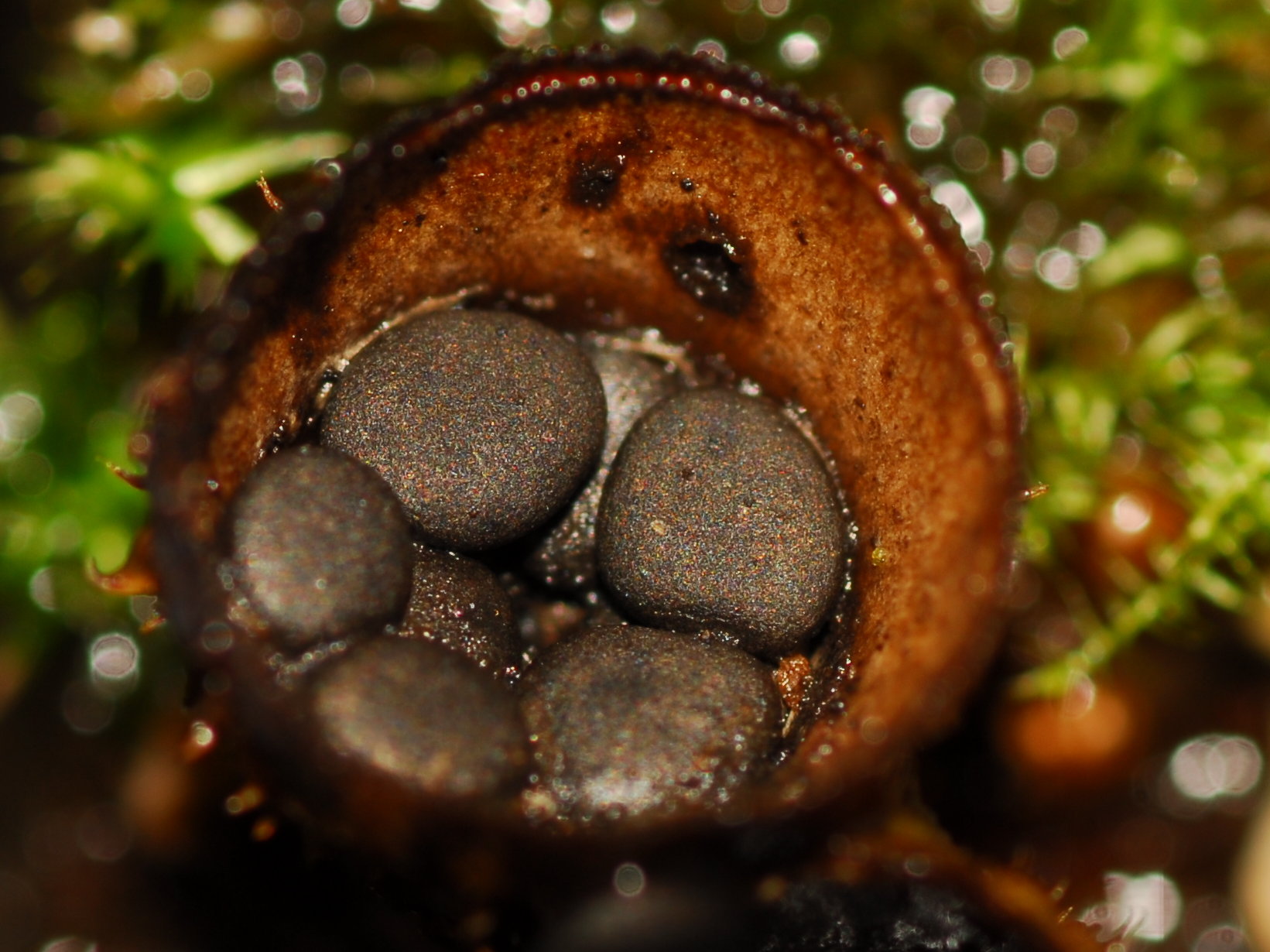


![(6aR,9R)-N-((2R,5S,10aS,10bS)-5-benzyl-10b-hydroxy-2-methyl-3,6-dioxooctahydro-2H-oxazolo[3,2-a] pyrrolo[2,1-c]pyrazin-2-yl)-7-methyl-4,6,6a,7,8,9-hexahydroindolo[4,3-fg] quinoline-9-carboxamide](/pictures/enwiki/69/Ergotamine3.png)
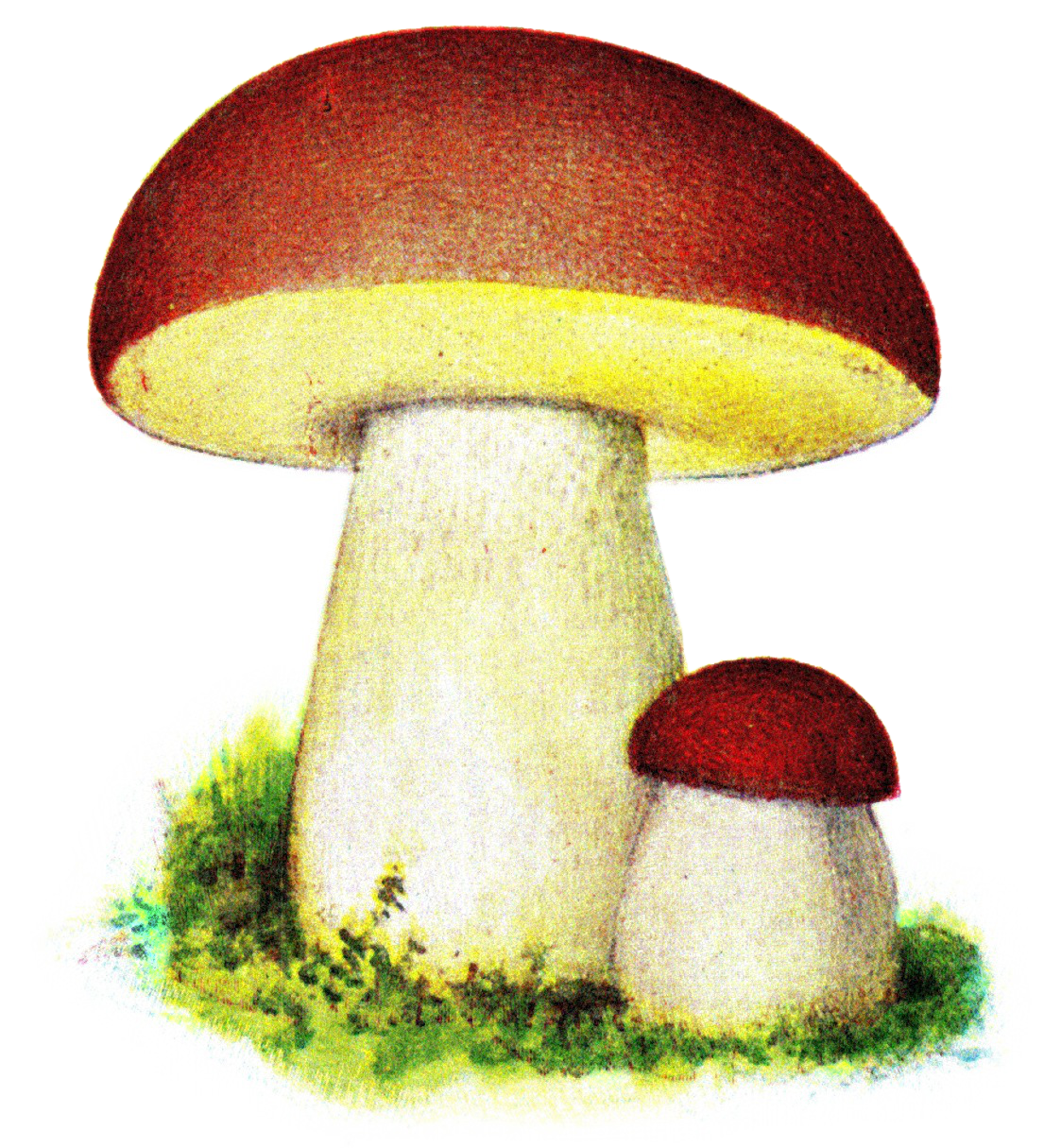


Wikimedia Foundation. 2010.
