

- The Guardian
-
For other uses, see The Guardian (disambiguation).
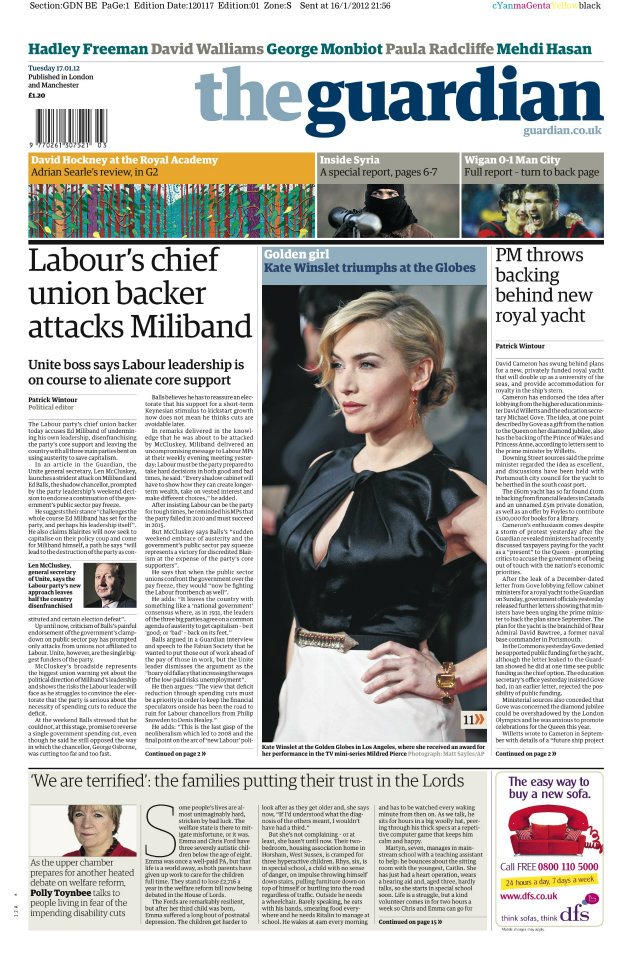
The Guardian 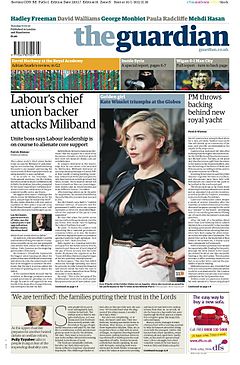
A Guardian front page from July 2011Type Daily newspaper Format Berliner Owner Guardian Media Group Publisher Guardian News and Media Editor Alan Rusbridger Opinion editor Mark Henry Founded 1821 Political alignment Centre-left liberalism[1] Language English Headquarters Kings Place, 90 York Way, London N1 9GU Circulation 232,566 (September 2011)[2] Sister newspapers The Observer
The Guardian WeeklyISSN 0261-3077 OCLC number 60623878 Official website guardian.co.uk The Guardian, formerly known as The Manchester Guardian (founded 1821), is a British national daily newspaper in the Berliner format. Currently edited by Alan Rusbridger, it has grown from a nineteenth century local paper to a national paper associated with a complex organisational structure and international multimedia presence with sister papers The Observer (British Sunday paper) and The Guardian Weekly, as well as a large web presence.
The Guardian in paper form had a certified average daily circulation of 232,566 in September 2011, behind The Daily Telegraph and The Times, but ahead of The Independent.[3] According to its editor, The Guardian has the second largest online readership of any English-language newspaper in the world, after the New York Times.[4]
Founded in 1821, the paper identifies with centre-left liberalism and its readership is generally on the mainstream left of British political opinion. The paper is also influential in design and publishing arena, sponsoring many awards in these areas.
The Guardian has changed format and design over the years moving from broadsheet to Berliner, and has become an international media organisation with affiliations to other national papers with similar aims. The Guardian Weekly, which circulates worldwide, contains articles from The Guardian and its sister Sunday paper The Observer, as well as reports, features and book reviews from The Washington Post and articles translated from Le Monde. Other projects include GuardianFilm, the current editorial director of which is Maggie O'Kane.
According to Quarkbase, The Guardian was the most cited British newspaper on Wikipedia as of August 2009[update] with 106,424 citations. The Times was second with 52,457.[5]
History
1821 to 1959
Early years
The Manchester Guardian was founded in Manchester in 1821 by a group of non-conformist businessmen headed by John Edward Taylor,[6] who took advantage of the closure of the more radical Manchester Observer, the paper that had championed the cause of the Peterloo protesters. Taylor had been hostile to the radical reformers, writing, "(T)hey have appealed not to the reason but the passions and the suffering of their abused and credulous fellow-countrymen, from whose ill-requited industry they extort for themselves the means of a plentiful and comfortable existence. 'They do not toil, neither do they spin,' but they live better than those that do.[7] And when the government closed down the Manchester Observer, the mill-owners' champions had the upper hand.[8]
The influential journalist Jeremiah Garnett joined Taylor during the establishment of the paper.[9]
The prospectus announcing the new publication proclaimed that it would "zealously enforce the principles of civil and religious Liberty ... warmly advocate the cause of Reform ... endeavour to assist in the diffusion of just principles of Political Economy and ... support, without reference to the party from which they emanate, all serviceable measures".[10]
The working-class Manchester and Salford Advertiser called the Manchester Guardian "the foul prostitute and dirty parasite of the worst portion of the mill-owners".[11] The Manchester Guardian was generally hostile to labour's claims. Of the 1832 Ten Hours Bill the paper doubted whether in view of the foreign competition "the passing of a law positively enacting a gradual destruction of the cotton manufacture in this kingdom would be a much less rational procedure."[12] The Manchester Guardian dismissed strikes as the work of outside agitators – "... if an accommodation can be effected the occupation of the agents of the Union is gone. They live on strife ..."[13]
The Manchester Guardian was hostile to the Unionist cause in the American Civil War, writing on the news that Abraham Lincoln had been assassinated, "Of his rule, we can never speak except as a series of acts abhorrent to every true notion of constitutional right and human liberty..."[14]
C. P. Scott
Its most famous editor, C. P. Scott, made the newspaper nationally recognised. He was editor for 57 years from 1872, and became its owner when he bought the paper from the estate of Taylor's son in 1907. Under Scott the paper's moderate editorial line became more radical, supporting Gladstone when the Liberals split in 1886, and opposing the Second Boer War against popular opinion.[15] Scott supported the movement for women's suffrage, but was critical of any tactics by the Suffragettes that involved direct action:[16] "The really ludicrous position is that Mr Lloyd George is fighting to enfranchise seven million women and the militants are smashing unoffending people's windows and breaking up benevolent societies' meetings in a desperate effort to prevent him". Scott thought the Suffragettes' "courage and devotion" was "worthy of a better cause and saner leadership".[17] It has been argued that Scott's criticism reflected a widespread disdain, at the time, for those women who "transgressed the gender expectations of Edwardian society".[16]
Scott's friendship with Chaim Weizmann played a role in the Balfour Declaration of 1917, and in 1948 The Guardian was a supporter of the new State of Israel. Daphna Baram tells the story of The Guardian's relationship with the Zionist movement and Israel in the book Disenchantment: The Guardian and Israel.[18] In June 1936, ownership of the paper passed to the Scott Trust (named after the last owner, John Russell Scott, who was the first chairman of the Trust). This move ensured the paper's independence.
Spanish Civil War
Traditionally affiliated with the centrist to centre-left Liberal Party, and with a northern, non-conformist circulation base, the paper earned a national reputation and the respect of the left during the Spanish Civil War. With the pro-Liberal News Chronicle, the Labour-supporting Daily Herald, the Communist Party's Daily Worker and several Sunday and weekly papers, it supported the 'Republican' government against General Francisco Franco's insurgent 'nationalists'.
Post-war
The paper so loathed Labour's left wing champion Aneurin Bevan "and the hate-gospellers of his entourage" that it called for Attlee's post-war Labour government to be voted out of office.[19]The newspaper opposed the creation of the National Health Service as it feared the state provision of healthcare would "eliminate selective" and lead to an increase of congenitally deformed and feckless people. [20] Its anti-establishment stance fell short of opposing military intervention during the 1956 Suez Crisis: "The government is right to be prepared for military action at Suez", because Egyptian control of the canal would be "commercially damaging for the West and perhaps part of a plan for creating a new Arab Empire based on the Nile".[21]
1959 to 2000
Northern Ireland
When 14 civil rights demonstrators were killed on 30 January 1972, known as Bloody Sunday, by British soldiers in Northern Ireland, The Guardian blamed the protesters: "The organisers of the demonstration, Miss Bernadette Devlin among them, deliberately challenged the ban on marches. They knew that stone throwing and sniping could not be prevented, and that the IRA [ Provisional Irish Republican Army ] might use the crowd as a shield." (Guardian, 1 February 1972[22]). Some Irish Nationalists believed that Lord Widgery's enquiry into the killings was a whitewash,[23] but The Guardian declared that "Lord Widgery's report is not one-sided" (20 April 1972[24]). The paper also supported internment without trial in Northern Ireland: "Internment without trial is hateful, repressive and undemocratic. In the existing Irish situation, most regrettably, it is also inevitable. ... To remove the ringleaders, in the hope that the atmosphere might calm down, is a step to which there is no obvious alternative." (Guardian leader, 10 August 1971) And before then, The Guardian had called for British troops to be sent to the region: British soldiers could "present a more disinterested face of law and order" (leader, 15 August 1969), but only on condition that "Britain takes charge" (leader, 4 August 1969).
Social Democratic Party and New Labour
Three of The Guardian's four leader writers joined the SDP on its foundation in 1981, but the paper was enthusiastic in its support for Tony Blair in his bid to lead the Labour Party,[25] and to become Prime Minister.[26]
Sarah Tisdall
In 1983, the paper was at the centre of a controversy surrounding documents regarding the stationing of cruise missiles in Britain that were leaked to The Guardian by civil servant Sarah Tisdall. The paper eventually complied with a court order to hand over the documents to the authorities, which resulted in a six-month prison sentence for Tisdall,[27] though she served only four. "I still blame myself", said Peter Preston who was the editor of The Guardian at the time, but he went on to argue that the paper had no choice because it "believed in the rule of law".[28]
First Gulf war
In the lead up to the first Gulf War, between 1990 and 1991, The Guardian expressed doubts about military action against Iraq: "Frustration in the Gulf leads temptingly to the invocation of task forces and tactical bombing, but the military option is no option at all. The emergence yesterday of a potential hostage problem of vast dimensions only emphasised that this is far too complex a crisis for gunboat diplomacy. Loose talk of 'carpet bombing' Baghdad should be put back in the bottle of theoretical but unacceptable scenarios".[29]
But on the eve of the war, the paper rallied to the war cause: "The simple cause, at the end, is just. An evil regime in Iraq instituted an evil and brutal invasion. Our soldiers and airmen are there, at U.N. behest, to set that evil right. Their duties are clear ... let the momentum and the resolution be swift."[30] After the event, journalist Maggie O'Kane conceded that she and her colleagues had been a mouthpiece for war propaganda: "we, the media, were harnessed like beach donkeys and led through the sand to see what the British and US military wanted us to see in this nice clean war." (Guardian, 16 December 1995)
Jonathan Aitken
In 1995, both the Granada Television programme World In Action and The Guardian were sued for libel by the then cabinet minister Jonathan Aitken, for their allegation that the Harrods owner Mohamed Al Fayed had paid for Aitken and his wife to stay at the Hôtel Ritz in Paris, which would have amounted to accepting a bribe on Aitken's part. Aitken publicly stated he would fight with "the simple sword of truth and the trusty shield of British fair play".[31] The court case proceeded, and in 1997 The Guardian produced evidence that Aitken's claim of his wife paying for the hotel stay was untrue.[32] In 1999, Aitken was jailed for perjury and perverting the course of justice.[33]
Kosovo
The paper supported NATO's military intervention in the Kosovo War in 1999. Though the United Nations Security Council did not support the action, The Guardian stated that "the only honourable course for Europe and America is to use military force" (Leader, 23 March 1999). Mary Kaldor's piece was headlined "Bombs away! But to save civilians we must get in some soldiers too" (25 March 1999).[34]
Journalist working for Russian intelligence services
KGB defector Oleg Gordievsky identified prominent Guardian editor Richard Gott as one of his agents. While Gott denied that he received cash, he confessed taking benefits from the KGB.[35]
Gordievsky commented on the newspaper: "The KGB loved the Guardian. It was deemed highly susceptible to penetration".[35]
Since 2000
- In the early 2000s, The Guardian challenged the Act of Settlement 1701 and the Treason Felony Act 1848.[36][37]
- In October 2004, The Guardian published a humorous column by Charlie Brooker in its entertainment guide, which appeared to call for the assassination of George W. Bush.[38] This caused some controversy and the paper was forced to issue an apology and remove the article from its website.[39][40]
- Following the 7 July 2005 London bombings, The Guardian published an article on its comment pages by Dilpazier Aslam, a 27 year old British Muslim journalism trainee from Yorkshire.[41] Aslam was a member of Hizb ut-Tahrir, an Islamist group, and had published a number of articles on their website. According to the paper, it did not know that Aslam was a member of Hizb ut-Tahrir when he applied to become a trainee, though several staff members were informed of this once he started at the paper.[42] The Home Office has claimed the group's "ultimate aim is the establishment of an Islamic state (Caliphate), according to Hizb ut-Tahrir via non-violent means". The Guardian asked Aslam to resign his membership of the group and, when he did not do so, terminated his employment.[43]
- In early 2009, the paper started a tax investigation into a number of major UK companies,[44] including publishing a database of the tax paid by the FTSE 100 companies.[45] Internal documents relating to Barclays Bank's tax avoidance were removed from The Guardian's website after Barclays obtained a gagging order.[46]
- The paper played a key role in exposing the depth of the News of the World phone hacking affair.
Wars in Afghanistan and Iraq
During the Afghanistan and Iraq wars, The Guardian attracted a significant proportion of anti-war readers as one of the mass-media outlets most critical of UK and USA military initiatives.[citation needed] The paper did, however, endorse the argument that Iraq had to be disarmed of 'Weapons of Mass Destruction': "It is not credible to argue, as Iraq did in its initial reaction to Mr Powell [at the Security Council], that it is simply all lies. ...Iraq must disarm." (Guardian Leader, Thursday 6 February 2003)
Accusations of bias in coverage of Israel
Despite its early support for the Zionist movement, in recent decades The Guardian has been accused of exaggerating criticism of Israeli government policy.[47] In December 2003 columnist Julie Burchill cited "striking bias against the state of Israel" as one of the reasons she left the paper for The Times.[48] A leaked report from the European Monitoring Centre on Racism cited The Economist's claim that for "many British Jews," the British media's reporting on Israel "is spiced with a tone of animosity, 'as to smell of anti-Semitism'... This is above all the case with the Guardian and The Independent".[49][50] Greville Janner, former president of the Board of Deputies of British Jews, has accused The Guardian of being "viciously and notoriously anti-Israel".[51]
Responding to these accusations, a Guardian editorial in 2002 condemned anti-Semitism and defended the paper's right to criticise the policies and actions of the Israeli government, arguing that those who view such criticism as inherently anti-Jewish are mistaken.[51] Harriet Sherwood, The Guardian's foreign editor, has also denied The Guardian has an anti-Israel bias, saying that the paper aims to cover all viewpoints in the Israeli-Palestinian conflict.[52]
Clark County
In August 2004, for the US presidential election, the daily G2 supplement launched an experimental letter-writing campaign in Clark County, Ohio, an average-sized county in a swing state. G2 editor Ian Katz bought a voter list from the county for $25 and asked readers to write to people listed as undecided in the election, giving them an impression of the international view and the importance of voting against US President George W. Bush. The paper scrapped "Operation Clark County" on 21 October 2004 after first publishing a column of complaints from Bush supporters about the campaign under the headline "Dear Limey assholes".[53] The public backlash against the campaign likely contributed to Bush's victory in Clark County.[54]
Guardian America
In 2007, the paper launched a website Guardian America, an attempt to capitalise on its large online readership in the United States, which at the time stood at more than 5.9m. The company hired former American Prospect editor, New York magazine columnist and New York Review of Books writer Michael Tomasky to head up the project and hire a staff of American reporters and web editors. The site featured Guardian news relevant to an American audience, coverage of US news and the Middle East, for example.[55]
Tomasky stepped down from his position as Guardian American editor in February 2009, ceding editing and planning duties to other US and London staff. He retained his position as a columnist and blogger, taking the title editor-at-large.[56]
In October 2009, the company abandoned the Guardian America homepage, instead directing users to a US news index page on the main website.[57] The next month, the company laid off six American employees, including a reporter, a multimedia producer and four web editors. The move came as Guardian News and Media opted to reconsider its US strategy amid a massive effort to cut costs across the company.[58]
Gagged from reporting Parliament
In October 2009, The Guardian reported that it was forbidden to report on a parliamentary matter, namely a question recorded in a Commons order paper, to be answered by a minister later that week.[59] The paper noted that it was being "forbidden from telling its readers why the paper is prevented—for the first time in memory—from reporting parliament. Legal obstacles, which cannot be identified, involve proceedings, which cannot be mentioned, on behalf of a client who must remain secret. The only fact the Guardian can report is that the case involves the London solicitors Carter-Ruck." The paper further claimed that this case appears "to call into question privileges guaranteeing free speech established under the 1688 Bill of Rights".[60] The only parliamentary question mentioning Carter Ruck in the relevant period was by Paul Farrelly MP, in reference to legal action by Barclays and Trafigura.[61][62] The part of the question referencing Carter-Ruck relates to the latter company's September 2009 gagging order on the publication of a 2006 internal report[63] into the 2006 Côte d'Ivoire toxic waste dump scandal, which involved a class action case that the company only settled in September 2009 after The Guardian published some of the commodity trader's internal emails.[64] The reporting injunction was lifted the next day, as Carter Ruck withdrew it before The Guardian could challenge it in the High Court.[65] Alan Rusbridger credited the rapid back-down of Carter-Ruck to Twitter,[66] as did a BBC article.[67]
Ownership
The Guardian is part of the GMG Guardian Media Group of newspapers, radio stations, print media including The Observer Sunday newspaper, The Guardian Weekly international newspaper, and new media—Guardian Abroad website, and guardian.co.uk. All the aforementioned were owned by The Scott Trust, a charitable foundation existing between 1936 and 2008, which aimed to ensure the paper's editorial independence in perpetuity, maintaining its financial health to ensure it did not become vulnerable to take overs by for-profit media groups. At the beginning of October 2008, the Scott Trusts assets were transferred to a new limited company, The Scott Trust Limited, with the intention being that the original trust would be wound up.[68] Dame Liz Forgan, chair of the Scott Trust, reassured staff that the purposes of the new company remained as under the previous arrangements.
The Guardian has been consistently loss-making. The National Newspaper division of GMG, which also includes The Observer, reported operating losses of £49.9m in 2006, up from £18.6m in 2005.[69] The paper is therefore heavily dependent on cross-subsidisation from profitable companies within the group, including Auto Trader .
The Guardian's ownership by the Scott Trust is a likely factor in it being the only British national daily to conduct (since 2003) an annual social, ethical and environmental audit in which it examines, under the scrutiny of an independent external auditor, its own behaviour as a company.[70] It is also the only British daily national newspaper to employ an internal ombudsman (called the "readers' editor") to handle complaints and corrections.
The Guardian and its parent groups participate in Project Syndicate, established by George Soros, and intervened in 1995 to save the Mail & Guardian in South Africa, but Guardian Media Group sold the majority of its shares in the Mail & Guardian in 2002.
The continual losses made from the National Newspaper division of the Guardian Media Group, caused the group to dispose of its Regional Media division by selling titles to competitor Trinity Mirror in March 2010. This included the flagship Manchester Evening News, and severed the historic link between that paper and The Guardian. The sale was in order to safeguard the future of The Guardian Newspaper as is the intended purpose of the Scott Trust.[71]
In June 2011 Guardian News and Media revealed increased annual losses of £33m and announced that it was looking to focus on its online edition for news coverage, leaving a physical newspaper that was to contain more comment and features. It was also speculated that the Guardian may become the first British national daily paper to go solely online.[72][73]
Stance and editorial opinion
Founded by textile traders and merchants, The Guardian had a reputation as "an organ of the middle class",[74] or in the words of C.P. Scott's son Ted "a paper that will remain bourgeois to the last".[75] "I write for the Guardian," said Sir Max Hastings in 2005,[76] "because it is read by the new establishment", reflecting the paper's then growing influence.
The paper's readership is generally on the mainstream left of British political opinion: a MORI poll taken between April and June 2000 showed that 80% of Guardian readers were Labour Party voters;[77] according to another MORI poll taken in 2005, 48% of Guardian readers were Labour voters and 34% Liberal Democrat voters.[78] The newspaper's reputation as a platform for liberal and left-wing opinions has led to the use of the epithet "Guardian reader" as a label for people holding such views.[79][80]
Guardian features editor Ian Katz stated in 2004 that "... it is no secret we are a centre-left newspaper ...".[1] In 2008, Guardian columnist Jackie Ashley said that editorial contributors were a mix of "right-of-centre libertarians, greens, Blairites, Brownites, Labourite but less enthusiastic Brownites, etc" and that the newspaper was "clearly left of centre and vaguely progressive". She also said that "you can be absolutely certain that come the next general election, The Guardian's stance will not be dictated by the editor, still less any foreign proprietor (it helps that there isn't one) but will be the result of vigorous debate within the paper."[81] The paper's comment and opinion pages, though often written by centre-left academics and writers like Polly Toynbee, have allowed some space for right-of-centre voices such as Simon Jenkins, Max Hastings and Michael Gove.
In the run-up to the 2010 general election, following a meeting of the editorial staff,[82] the paper declared its support for the Liberal Democrats, in particular due to the party's stance on electoral reform. The paper suggested tactical voting to prevent a Conservative victory, given Britain's first-past-the-post electoral system.[83]
Assistant Editor Michael White, in discussing media self-censorship in March 2011, says, "I have always sensed liberal, middle class ill-ease in going after stories about immigration, legal or otherwise, about welfare fraud or the less attractive tribal habits of the working class, which is more easily ignored altogether. Toffs, including royal ones, Christians, especially popes, governments of Israel, and US Republicans are more straightforward targets."[84]
Circulation and format
The Guardian had a certified average daily circulation of 358,844 copies in January 2009– a drop of 5.17% on January 2008, as compared to sales of 842,912 for The Daily Telegraph, 617,483 for The Times, and 215,504 for The Independent.[85]
Publication history
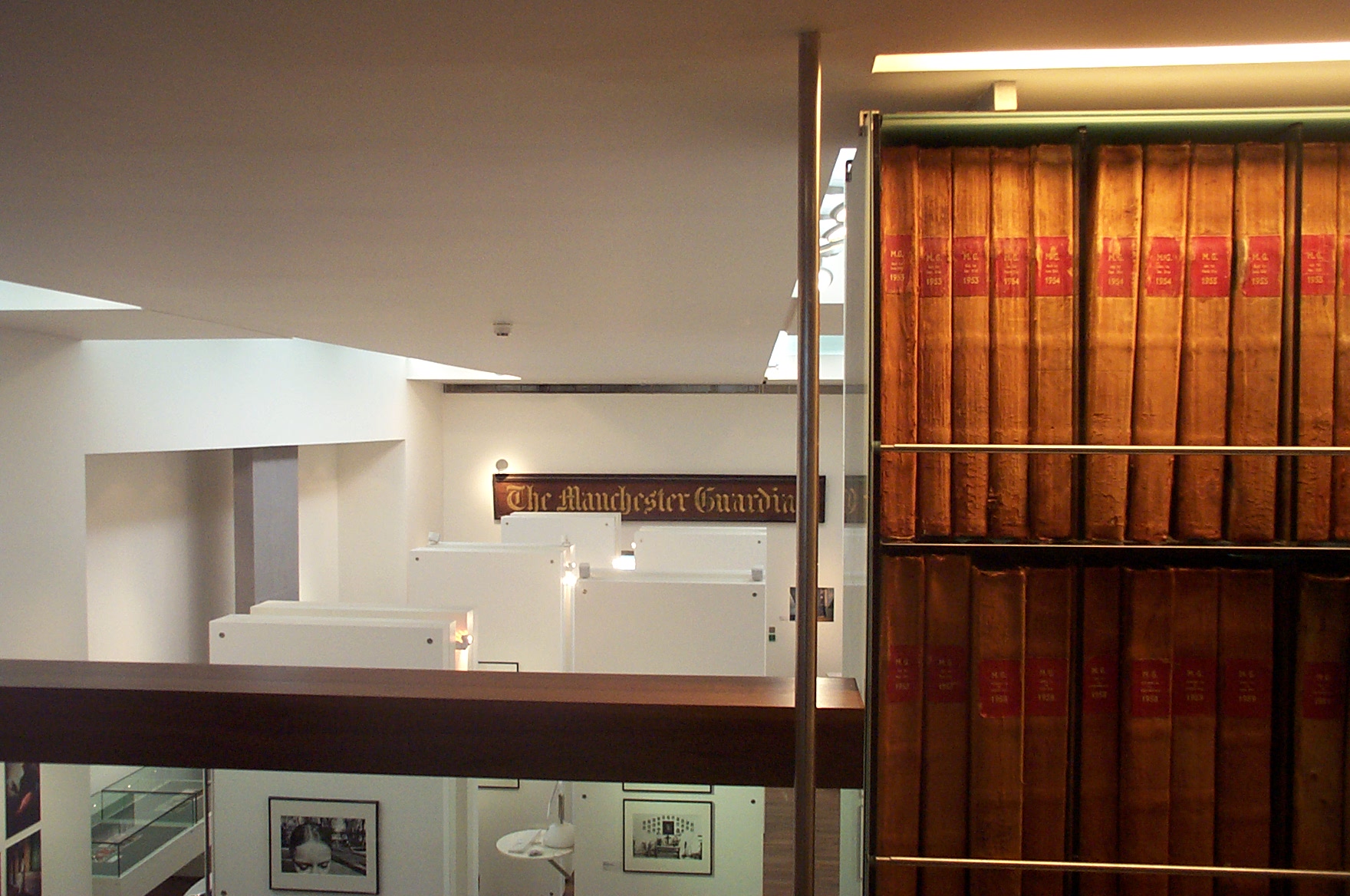
 The Guardian's Newsroom visitor centre and archive (No 60), with an old sign with the name The Manchester Guardian
The first edition was published on 5 May 1821,[86] at which time The Guardian was a weekly, published on Saturdays and costing 7d.; the stamp duty on newspapers (4d. per sheet) forced the price up so high that it was uneconomic to publish more frequently. When the stamp duty was cut in 1836 The Guardian added a Wednesday edition; with the abolition of the tax in 1855 it became a daily paper costing 2d.
In 1952 the paper took the step of printing news on the front page, replacing the adverts that had hitherto filled that space. Then-editor A. P. Wadsworth wrote: "It is not a thing I like myself, but it seems to be accepted by all the newspaper pundits that it is preferable to be in fashion."
In 1959 the paper dropped "Manchester" from its title, becoming simply The Guardian, and in 1964 it moved to London, losing some of its regional agenda but continuing to be heavily subsidised by sales of the less intellectual but much more profitable Manchester Evening News. The financial position remained extremely poor into the 1970s; at one time it was in merger talks with The Times. The paper consolidated its centre-left stance during the 1970s and 1980s but was both shocked and revitalised by the launch of The Independent in 1986 which competed for a similar readership and provoked the entire broadsheet industry into a fight for circulation.
On 12 February 1988 The Guardian had a significant redesign; as well as improving the quality of its printers' ink, it also changed its masthead to the now familiar juxtaposition of an italic Garamond "The", with a bold Helvetica "Guardian", that remained in use until the 2005 redesign.
In 1992 it relaunched its features section as G2, a tabloid-format supplement. This innovation was widely copied by the other "quality" broadsheets, and ultimately led to the rise of "compact" papers and The Guardian's move to the Berliner format. In 1993 the paper declined to participate in the broadsheet 'price war' started by Rupert Murdoch's The Times. In June 1993, The Guardian bought The Observer from Lonrho, thus gaining a serious Sunday newspaper partner with similar political views.
Its international weekly edition is now titled The Guardian Weekly, though it retained the title Manchester Guardian Weekly for some years after the home edition had moved to London. It includes sections from a number of other internationally significant newspapers of a somewhat left-of-centre inclination, including Le Monde. The Guardian Weekly is also linked to a website for expatriates, Guardian Abroad.
g24 is a constantly-updated electronic newspaper available free of charge. [3] It is downloadable as a PDF file. The contents come from The Guardian and its Sunday sibling The Observer.
Moving to the Berliner paper format
The Guardian is printed in full colour,[87] and was the first newspaper in the UK to use the Berliner format for its main section, with producing sections and supplements in a range of page sizes including tabloid, approximately A4, and pocket-size (approximately A5).
In 2004, The Guardian announced plans to change to a "Berliner" or "midi" format similar to that used by Die Tageszeitung in Germany, Le Monde in France and many other European papers; at 470×315 mm, this is slightly larger than a traditional tabloid. Planned for the autumn of 2005, this change followed the moves by The Independent and The Times to start publishing in tabloid (or compact) format. On Thursday 1 September 2005 The Guardian announced that it would launch the new format on Monday 12 September 2005. [88] Sister Sunday newspaper The Observer went over to the same format on 8 January 2006.
The advantage that The Guardian saw in the Berliner format was that though it is only a little wider than a tabloid, and is thus equally easy to read on public transport, its greater height gives more flexibility in page design. The new presses mean that printing can go right across the 'gutter', the strip down the middle of the centre page, allowing the paper to print striking double page pictures. The new presses also made the paper the first UK national able to print in full colour on every page.
The format switch was accompanied by a comprehensive redesign of the paper's look. On Friday 9 September 2005 the newspaper unveiled its new look front page, which débuted on Monday 12 September 2005. Designed by Mark Porter, the new look includes a new masthead for the newspaper, its first since 1988. A typeface family called Guardian Egyptian, designed by Paul Barnes and Christian Schwartz, was created for the new design. No other typeface is used anywhere in the paper– all stylistic variations are based on various forms of Guardian Egyptian.
The switch cost Guardian Newspapers £80 million and involved setting up new printing presses in east London and Manchester. This was because, prior to The Guardian's move, no printing presses in Britain could produce newspapers in the Berliner format. There were additional complications as one of the paper's presses was part-owned by Telegraph Newspapers and Express Newspapers, and it was contracted to use the plant until 2009. Another press was shared with the Guardian Media Group's north western tabloid local papers, which did not wish to switch to the Berliner format.
Reception
The new format was generally well received by Guardian readers, who were encouraged to provide feedback on the changes. The only controversy was over the dropping of the Doonesbury cartoon strip. The paper reported thousands of calls and emails complaining about its loss and within 24 hours, the decision was reversed and the strip was reinstated the following week. G2 supplement editor Ian Katz, who was responsible for dropping it, apologised in the editors' blog saying, "I'm sorry, once again, that I made you– and the hundreds of fellow fans who have called our helpline or mailed our comments' address– so cross".[89] Some readers were however dissatisfied as the earlier deadline needed for the all-colour sports section meant that coverage of late-finishing evening football matches became less satisfactory in the editions supplied to some parts of the country.
The investment was rewarded with a circulation rise. In December 2005, the average daily sale stood at 380,693, nearly 6% higher than the figure for December 2004.[90] In 2006, the US-based Society for News Design chose The Guardian and Polish daily Rzeczpospolita as the world's best-designed newspapers– from among 389 entries from 44 countries.[91]
Notable columnists
Current columnists
- Jackie Ashley
- Nancy Banks-Smith
- Laura Barton
- Marcel Berlins
- Charlie Brooker
- Guy Browning
- Madeleine Bunting
- Siobhain Butterworth
- Simon Callow
- Alexander Chancellor
- Kira Cochrane
- Gavyn Davies
- Tim Dowling
- Larry Elliott
- Jonathan Freedland
- Hadley Freeman
- Timothy Garton Ash
- Ben Goldacre
- Michele Hanson
- Roy Hattersley
- Jon Henley
- Simon Hoggart
- Marina Hyde
- Simon Jenkins
- Victor Keegan
- Martin Kelner
- Martin Kettle
- Mark Lawson
- Maureen Lipman
- Lucy Mangan
- David McKie
- George Monbiot
- Peter Preston
- Jon Ronson
- Allegra Stratton
- John Sutherland
- Simon Tisdall
- Polly Toynbee
- Xue Xinran
- Gary Younge
Regular content and features
On each weekday The Guardian comes with the G2 supplement containing feature articles, columns, television and radio listings, and the quick crossword. Since the change to the Berliner format, there is a separate daily Sport section. Other regular supplements during the week are shown below.
Before the redesign in 2005, the main news section was in the large broadsheet format, but the supplements were all in the half-sized tabloid format, with the exception of the glossy Weekend section which was a 290×245 mm magazine and The Guide which was in a small 225×145 mm format.
With the change of the main section to the Berliner format, the specialist sections are now printed as Berliner, as is a now-daily Sports section, but G2 has moved to a "magazine-sized" demi-Berliner format. A Thursday Technology section and daily science coverage in the news section replaced Life and Online. Weekend and The Guide are still in the same small formats as before the change.
On Monday to Thursday, the supplements carry substantial quantities of recruitment advertising as well as editorial on their specialised topics.
G2
The following sections are in G2 every day from Monday to Friday: Arts, TV and Radio, Puzzles.
Monday
Sport:
- Clogger, a humorous look at the weekend's football. This includes an ever-changing list of sub-features such as:
- Jobs Guus Hiddink could do
- Total earnings of Fabio Capello
- Screen Break, by Martin Kelner: analysis of TV sports coverage
- What's rocking sport, where sportspeople select their favourite music
In G2:
- Charlie Brooker's column
- Ask Hadley: fashion advice from Hadley Freeman
MediaGuardian:
- ABC circulation figures (every month)
- Media Monkey: gossip from the media sector
Tuesday
EducationGuardian:
- Multiple choice: poses the same question to three different people (e.g. a teacher, a parent and a pupil)
Wednesday
In G2:
- Marcel Berlins' column
- The digested read, by John Crace
- Notes & Queries
SocietyGuardian (covers the British public sector and related issues)
- Eco Soundings: environmental news
Thursday
In G2:
- Private Lives
Formerly TechnologyGuardian (print version demised from 17 December 2009)[92]
- The "Free Our Data" campaign
Friday
In G2:
- Lost in showbiz
- Women
- Chess, poker and bridge
Film & Music
Saturday
The Guide (a weekly listings magazine)
- All Ears
Weekend (the colour supplement)
- One Million Tiny Plays About Britain
- "This Column Will Change Your Life" by Oliver Burkeman
- Food
- The New Vegetarian
Review (covers literature)
Money
Work including Graduate
Travel
Family
Regular cartoon strips
- If... by Steve Bell
- Doonesbury
- Perry Bible Fellowship
- My Peculiar World by Karrie Fransman (in G2)
- A Softer World
- Loomus, by Steven Appleby (Saturday, in the Family section)
- Media Tarts (Monday, in the Media section)
- Clare in the Community (Wednesday, in the Society section)
- Home-Clubber (Saturday, in the Guide section)
- The Pitchers, by Berger & Wyse (Friday, in the Film and Music section). Berger & Wyse also produce a weekly cartoon for the food pages of Weekend magazine.
Editorial cartoonists Martin Rowson and Steve Bell have received hate mail for their treatment of topics that some deem controversial.[93]
Online media
Main article: guardian.co.ukThe Guardian and its Sunday sibling, The Observer publish all their news online, with free access both to current news and an archive of three million stories. A third of the site's hits are for items over a month old.[94] The website also offers a free printable A4 format PDF 24-hour newspaper, G24[95]– made up of the top stories– and, for a monthly subscription, the complete newspaper in PDF format. As of January 2011[update] it is the second most popular UK newspaper website, behind the Daily Mail's Mail Online, with 39 million unique browsers per month to the Mail's 53.9m,[96] and in April 2011 MediaWeek reported that it is the fifth most popular newspaper site in the world.[97]
The Comment is Free section features columns by the paper's journalists and regular commentators, as well as articles from guest writers, with readers comments and responses below. The section includes all the opinion pieces published in the paper itself, as well as many others that only appear online.
The Guardian has taken what they call a very 'open' stance in delivering news, and have launched an open platform for their content. This allows external developers to easily use Guardian content in external applications, and even to feed third-party content back into the Guardian network.[98] The Guardian also had a number of talkboards that were noted for their mix of political discussion and whimsy, until they were closed on Friday 25 February 2011.[99] They were spoofed in The Guardian 's own regular humorous Chatroom column in G2. The spoof column purported to be excerpts from a chatroom on permachat.co.uk, a real URL which pointed to The Guardian's talkboards.
The paper has also launched a dating website, Soulmates,[100] and is experimenting with new media, having previously offered a free twelve part weekly podcast series by Ricky Gervais.[101] In January 2006 Gervais' show topped the iTunes podcast chart having been downloaded by two million listeners worldwide,[102] and is scheduled to be listed in the 2007 Guinness Book of Records as the most downloaded podcast.[103]
On 27 May 2011, to celebrate its 190th anniversary, The Guardian concocted a very-old-school version of the front—er, home—page of today's edition.[104]
GuardianFilms
In 2003, The Guardian started the film production company GuardianFilms, headed by journalist Maggie O'Kane. Much of the company's output is documentary made for television– and it has included Salam Pax's Baghdad Blogger for BBC Two's daily flagship Newsnight, some of which have been shown in compilations by CNN International, Sex On The Streets and Spiked, both made for the UK's Channel 4 television.[105]
"GuardianFilms was born in a sleeping bag in the Burmese rainforest," wrote O'Kane in 2003.[106] "I was a foreign correspondent for the paper, and it had taken me weeks of negotiations, dealing with shady contacts and a lot of walking to reach the cigar-smoking Karen twins– the boy soldiers who were leading attacks against the country's ruling junta. After I had reached them and written a cover story for the newspaper's G2 section, I got a call from the BBC's documentary department, which was researching a film on child soldiers. Could I give them all my contacts?
"The plight of the Karen people, who were forced into slave labour in the rainforest to build pipelines for oil companies (some of them British), was a tale of human suffering that needed to be told by any branch of the media that was interested. I handed over all the names and numbers I had, as well as details of the secret route through Thailand to get into Burma. Good girl. Afterwards– and not for the first time– it seemed to me that we at The Guardian should be using our resources ourselves. Instead of providing contact numbers for any independent TV company prepared to get on the phone to a journalist, we should make our own films."
According to GuardianFilms's own webpage, its international work has focused on training talented local journalists based on the premise that "the era of a traditional London or Washington based foreign correspondent or fireman is coming to an end and the world urgently needs a more searching challenging journalism brought to us by people who speak the language and can secure access far beyond the "Green Zone Journalist" limits of the traditional correspondent." It says it is especially focused on reporting the Muslim world in a more challenging manner, and has trained a number of journalists in Iraq, Afghanistan and Zimbabwe.[107]
GuardianFilms has received several broadcasting awards. In addition to two Amnesty International Media Awards in 2004 and 2005, "The Baghdad Blogger: Salam Pax" won a Royal Television Society Award in 2005. "Baghdad: A Doctor's Story" won an Emmy Award for Best International Current Affairs film in 2007.[108] In 2008 "Inside the Surge" won the Royal Television Society award for best international news film – the first time a newspaper has won such an award.[109] In 2008 The Guardian's Katine website was awarded for its outstanding new media output at the One World Media awards. In 2008 GuardianFilms' undercover video report revealing vote rigging by Robert Mugabe's Zanu PF party during the 2007 Zimbabwe election won best news programme of the year at the Broadcast Awards.[108][110]
Nickname
The nickname The Grauniad for the paper originated with the satirical magazine Private Eye.[111] This anagram played on The Guardian's reputation for frequent typographical errors, such as misspelling its own name as The Gaurdian.[112] The domain grauniad.co.uk is registered to the paper and redirects to their website.
The very first issue of the newspaper contained a number of errors, perhaps the most notable being a notification that there would soon be some goods sold at atction instead of auction. There are fewer typographical errors in the paper since the end of hot-metal typesetting.[113] One of their writers, Keith Devlin, suggested that the high number of observed misprints was due more to the quality of the readership than their greater frequency.[114]
April Fool content
The Guardian, along with other British news outlets, has a tradition of spoof articles on April Fool's Day, sometimes contributed by regular advertisers such as BMW. The most elaborate of these was a travel supplement on San Serriffe, whilst an article in The Guardian dated 1 April 2006 written by one Olaf Priol suggested that Chris Martin of Coldplay would be supporting the Conservatives at the next general election and had already written a campaign song for them. Olaf Priol is an anagram of April Fool.
References in fiction
- The paper is referenced in a number of episodes of Yes, Prime Minister
- In the Young Ones episode "Boring", Rick eagerly notes that The Guardian has an article on how to get an increased student grant. Unfortunately the paper has totally mangled the spelling of a key part of it, leaving Rick with no idea how to get the increased grant. Worse still, the misspelling happens to sound the same as a Satanic chant, so that when Neil repeats what Rick read out loud he accidentally summons a demon who tries to kill everyone there.
- In the film The Bourne Ultimatum, Jason Bourne (Matt Damon) is mentioned in an article published in The Guardian and a reporter working for the newspaper itself plays a key role in the film.
Awards
Received
The Guardian has been awarded the National Newspaper of the Year in 1999, 2006[115] and 2011[116] by the British Press Awards, and "Front Page of the Year" in 2002 ("A declaration of war", 12 September 2001[117]).[115] It was also co-winner of the World's Best-designed Newspaper as awarded by the Society for News Design (2006).
Guardian journalists have won a range of British Press Awards, including[115]
- "Reporter of the Year" (Nick Davies, 2000; Paul Lewis, 2010)
- "Foreign Reporter of the Year" (James Meek, 2004; Ghaith Abdul-Ahad, 2008)
- "Columnist of the Year" (Polly Toynbee, 2007; Charlie Brooker, 2009)
- "Feature Writer of the Year" (Emma Brockes, 2002; Tanya Gold, 2010; Amelia Gentleman, 2011[116]).
- "Cartoonist of the Year" (Steve Bell, 2003)
- "Political Journalist of the Year" (Patrick Wintour, 2007; Andrew Sparrow, 2011[116])
- "Interviewer of the Year" (Decca Aitkenhead, 2009)
- "Sports Photographer of the Year" (Tom Jenkins, 2004, 2006, 2007)
Other awards include:
- Bevins Prize for investigative journalism (Paul Lewis, 2010)
- Martha Gellhorn Prize for Journalism (Nick Davies, 1999; Chris McGreal, 2003; Ghaith Abdul-Ahad, 2005; Ian Cobain, 2009)
The guardian.co.uk website won the Best Newspaper category three years running in 2005, 2006 and 2007 Webby Awards, beating (in 2005) the New York Times, the Washington Post, The Wall Street Journal and Variety.[118] It has been the winner for six years in a row of the British Press Awards for Best Electronic Daily Newspaper.[119] The site won an Eppy award from the US-based magazine Editor & Publisher in 2000 for the best-designed newspaper online service.[120] The website is known for its commentary on sporting events, particularly its over-by-over cricket commentary.
In 2007 the newspaper was ranked first in a study on transparency which analysed 25 mainstream English-language media vehicles, and which was conducted by the International Center for Media and the Public Agenda of the University of Maryland.[121] It scored 3.8 out of a possible 4.0.
Given
The Guardian is the sponsor of two major literary awards: The Guardian First Book Award, established in 1999 as a successor to the Guardian Fiction Award which had run since 1965, and the Guardian Children's Fiction Prize, founded in 1967. In recent years it has also sponsored the Hay Festival in Hay-on-Wye.
The annual Guardian Student Media Awards, founded in 1999, recognise excellence in journalism and design of British university and college student newspapers, magazines and websites.
In memory of Paul Foot, who died in 2004, The Guardian and Private Eye jointly set up the "Paul Foot Award", with an annual £10,000 prize fund, for investigative or campaigning journalism.[122]
Editors
- John Edward Taylor (1821–1844)
- Jeremiah Garnett (1844–1861) (jointly with Russell Scott Taylor in 1847–1848)
- Edward Taylor (1861–1872)
- Charles Prestwich Scott (1872–1929)
- Ted Scott (1929–1932)
- William Percival Crozier (1932–1944)
- Alfred Powell Wadsworth (1944–1956)
- Alastair Hetherington (1956–1975)
- Peter Preston (1975–1995)
- Alan Rusbridger (1995–present)
Notable regular contributors (past and present)
The Newsroom archive
The Guardian and its sister newspaper The Observer also provide The Newsroom, a visitor centre in London.[127] It contains their archives, including bound copies of old editions, a photographic library and other items such as diaries, letters and notebooks. This material may be consulted by members of the public. The Newsroom also mounts temporary exhibitions and runs an educational programme for schools. There is also an extensive Manchester Guardian archive at the University of Manchester's John Rylands University Library and there is a collaboration programme between the two archives. The British Library also has a large archive of The Manchester Guardian, available in online, hard copy, microform, and CD-ROM in their British Library Newspapers collection.
In November 2007 The Guardian and The Observer made their archives available over the internet via DigitalArchive. The current extent of the archives available are 1821 to 2000 for The Guardian and 1791 to 2000 for The Observer: these archives will eventually run up to 2003.
See also
References
- ^ a b Matt Wells (16 October 2004). "World writes to undecided voters". The Guardian (UK). http://www.guardian.co.uk/world/2004/oct/16/uselections2004.usa2. Retrieved 13 July 2008.
- ^ http://www.pressgazette.co.uk/story.asp?sectioncode=1&storycode=48050&c=1
- ^ http://www.pressgazette.co.uk/story.asp?sectioncode=1&storycode=48050&c=1
- ^ David Reid and Tania Teixeira (26 February 2010). "Are people ready to pay for online news?". BBC. http://news.bbc.co.uk/1/hi/programmes/click_online/8537519.stm. Retrieved 28 February 2010.
- ^ "Guardian and Times the most cited UK papers on wikipedia". Malcolm Coles. 8 August 2009. http://www.malcolmcoles.co.uk/blog/cited-uk-papers-wikipedia/. Retrieved 22 April 2011.
- ^ Wainwright, Martin (13 August 2007). "Battle for the memory of Peterloo: Campaigners demand fitting tribute". The Guardian (London: Guardian News and Media Ltd.). http://www.guardian.co.uk/uk/2007/aug/13/britishidentity.artnews. Retrieved 26 March 2008.
- ^ Manchester Gazette, 7 August 1819, quoted in Ayerst, David (1971). 'Guardian' : biography of a newspaper. London: Collins. p. 20. ISBN 0002113295.
- ^ Harrison, Stanley (1974). Poor men's guardians : a record of the struggles for a democratic newspaper press, 1763–1973. London: Lawrence and Wishart. p. 53. ISBN 0853153086.
- ^
 Garnett, Richard (1890). "Garnett, Jeremiah". In Leslie Stephen and Sidney Lee. Dictionary of National Biography. 21. London: Smith, Elder & Co. "citing: [Manchester Guardian, 28 Sept. 1870; Manchester Free Lance, 1 Oct. 1870 ; Prentice's Historical Sketches and Personal Recollections of Manchester; personal knowledge.]"
 - ^ "The Scott Trust: History". Guardian Media Group. http://www.gmgplc.co.uk/ScottTrust/History/tabid/193/Default.aspx. Retrieved 26 March 2008.
- ^ 21 May 1836
- ^ Editorial (28 January 1832). The Manchester Guardian.
- ^ Editorial (26 February 1873). The Manchester Guardian.
- ^ Editorial (27 April 1865). The Manchester Guardian.
- ^ http://www.jstor.org/pss/3133666
- ^ a b June Purvis (13 November 2007). "Unladylike behaviour". Guardian (UK). http://www.guardian.co.uk/education/2007/nov/13/research.highereducation. Retrieved 28 July 2009.
- ^ quoted in David Ayerst, The Guardian, 1971, p 353
- ^ Daphna Baram (2004). Disenchantment: The Guardian and Israel. Politico. ISBN 1-84275-119-0.
- ^ Manchester Guardian, leader, 22 October 1951
- ^ Austerity Britain 1945-1951 by David Kynaston, Bloomsbury, London 2007 ISBN 978-0-7475-9923-4 p285
- ^ Leader, 2 August 1956
- ^ Leader (1 February 1972). "The division deepens". The Guardian (London). http://www.guardian.co.uk/uk/1972/feb/01/bloodysunday.northernireland1.
- ^ ""'Bloody Sunday' report excuses Army", BBC ON THIS DAY (news stories from 19 April 1972)". BBC News. 19 April 1995. http://news.bbc.co.uk/onthisday/hi/dates/stories/april/19/newsid_2491000/2491125.stm. Retrieved 28 July 2009.
- ^ Leader (20 April 1972). "To make history repeat itself". The Guardian (London). http://www.guardian.co.uk/uk/1972/apr/20/bloodysunday.northernireland.
- ^ Guardian leader, 2 July 1994.
- ^ Guardian leader, 2 May 1997/
- ^ Paul Routledge "Profile: Hunter of the truth: Lord justice Scott: With the Government rattled, Paul Routledge looks at the man John Major now has to face", The Independent on Sunday, 16 January 1994
- ^ Preston, Peter (5 September 2005). "A source of great regret". The Guardian (London). http://www.guardian.co.uk/media/2005/sep/05/pressandpublishing.politicsandthemedia.
- ^ Guardian leader, 6 August 1990
- ^ Leader, 17 January 1991
- ^ "'The simple sword of truth'". The Guardian (UK). 11 April 1995. http://www.guardian.co.uk/aitken/Story/0,2763,208516,00.html. Retrieved 25 May 2010.
- ^ Harding, Luke (21 June 1997). "He lied and lied and lied". The Guardian (UK). http://www.guardian.co.uk/aitken/Story/0,2763,208503,00.html.
- ^ BBC News, 1999. "Aitken pleads guilty to perjury."
- ^ Kaldor, Mary (25 March 1999). "Bombs away! But to save civilians we must get in some soldiers too". The Guardian (UK). http://www.guardian.co.uk/world/1999/mar/25/balkans8.
- ^ a b Spies, in from the cold, snitch on collaborators. Insight on the News, 13 Feb 1995 by Jamie Dettmer
- ^ Dyer, Clare (6 December 2000). "A challenge to the crown: now is the time for change". The Guardian (London). http://www.guardian.co.uk/monarchy/story/0,,407460,00.html.
- ^ Watt, Nicholas (7 December 2000). "Broad welcome for debate on monarchy". The Guardian (London). http://www.guardian.co.uk/monarchy/story/0,,407917,00.html.
- ^ CNS News, 25 October 2004."Left-Wing UK Paper Pulls Bush Assassination Column."
- ^ Charlie Brooker, 24 October 2004."Screen Burn, The Guide." The Guardian.
- ^ "Full text of deleted article". Antinomian.com. 23 October 2004. http://www.antinomian.com/dumb_show.html. Retrieved 28 July 2009.
- ^ Aslam, Dilpazier (13 July 2005). "We rock the boat". The Guardian (London). http://www.guardian.co.uk/comment/story/0,,1527323,00.html.
- ^ Media Guardian, 22 July 2005. "Background: the Guardian and Dilpazier Aslam." The Guardian.
- ^ Steve Busfield, 22 July 2005. "Dilpazier Aslam leaves Guardian." The Guardian.
- ^ "Tax Gap". Guardian (UK). 6 February 2009. http://www.guardian.co.uk/business/series/tax-gap. Retrieved 28 July 2009.
- ^ "Big business: what they make, what they pay". The Guardian (UK). 2 February 2009. http://www.guardian.co.uk/business/interactive/2009/feb/02/tax-database. Retrieved 25 May 2010.
- ^ Jones, Sam (19 March 2009). "Guardian loses legal challenge over Barclays documents gagging order". The Guardian (UK). http://www.guardian.co.uk/business/2009/mar/19/barclays-tax-guardian-injunction.
- ^ Hadar Sela, Middle East Review of International Affairs, Anti-Zionist And Antisemitic Discourse On The Guardian's Comment Is Free Website, Volume 14, No. 2 – June 2010
- ^ Burchill, Julie (29 November 2003). "Good, bad and ugly". The Guardian (London). http://www.guardian.co.uk/Columnists/Column/0,5673,1094420,00.html.
- ^ MacAskill, Ewen (4 December 2003). "Leaked report shows rise in anti-semitism". The Guardian (London). http://www.guardian.co.uk/world/2003/dec/04/eu.politics1.
- ^ Leaked report hosted on Jewish Virtual Library
- ^ a b "''The Guardian'' January 26, 2002". Guardian (UK). 26 January 2002. http://www.guardian.co.uk/Archive/Article/0,4273,4343593,00.html. Retrieved 25 January 2010.
- ^ "News coverage". The Guardian (UK). 25 October 2006. http://www.guardian.co.uk/values/socialaudit/story/0,,1931208,00.html. Retrieved 25 May 2010.
- ^ "Dear Limey Assholes". The Guardian (UK). 18 October 2004. http://www.guardian.co.uk/uselections2004/story/0,13918,1329858,00.html. Retrieved 13 May 2008.
- ^ Bowers, Andy. "'Dear Limey Assholes ...'/A crazy British plot to swing Ohio to Kerry—and how it backfired." Slate, 4 November 2004.
- ^ New York Observer, 4 September 2007, The Guardian Reclaims America
- ^ Kiss, Jemima (18 February 2009). "Michael Tomasky joins political journal Democracy". The Guardian (UK). http://www.guardian.co.uk/media/2009/feb/18/michael-tomasky-editor-democracy.
- ^ paidContent.org, 20 October 2009, GNM Axing GuardianAmerica.com, Shuffling Execs in Restructure
- ^ paidContent.org, 5 November 2009, Guardian News And Media Laying Off Six Employees In U.S. paidcontent.org
- ^ House of Commons, Part 2: Oral or Written Questions from Wednesday 14 October 2009
- ^ Leigh, David (12 October 2009). "Guardian gagged from reporting parliament". The Guardian (UK). http://www.guardian.co.uk/media/2009/oct/12/guardian-gagged-from-reporting-parliament.
- ^ Question 292409: "Paul Farrelly (Newcastle-under-Lyme): To ask the Secretary of State for Justice, what assessment he has made of the effectiveness of legislation to protect (a) whistleblowers and (b) press freedom following the injunctions obtained in the High Court by (i) Barclays and Freshfields solicitors on 19 March 2009 on the publication of internal Barclays reports documenting alleged tax avoidance schemes and (ii) Trafigura and Carter Ruck solicitors on 11 September 2009 on the publication of the Minton report on the alleged dumping of toxic waste in the Ivory Coast, commissioned by Trafigura."[1]
- ^ Press Gazette, 13 October 2009, Guardian gagged from reporting Parliament
- ^ Wikileaks, Minton report: Trafigura toxic dumping along the Ivory Coast broke EU regulations, 14 Sep 2006
- ^ Leigh, David (16 September 2009). "How UK oil company Trafigura tried to cover up African pollution disaster". The Guardian (UK). http://www.guardian.co.uk/world/2009/sep/16/trafigura-oil-ivory-coast.
- ^ Leigh, David (13 October 2009). "Gag on Guardian reporting MP's Trafigura question lifted". The Guardian (UK). http://www.guardian.co.uk/media/2009/oct/13/guardian-gagged-parliamentary-question.
- ^ Logged in as click here to log out (14 October 2009). "The Trafigura fiasco tears up the textbook | Alan Rusbridger | Comment is free". The Guardian (UK). http://www.guardian.co.uk/commentisfree/libertycentral/2009/oct/14/trafigura-fiasco-tears-up-textbook. Retrieved 25 January 2010.
- ^ Higham, Nick (13 October 2009). "UK | UK Politics | When is a secret not a secret?". BBC News. http://news.bbc.co.uk/1/hi/uk_politics/8304908.stm. Retrieved 25 January 2010.
- ^ Conlan, Tara (8 October 2008). "Guardian owner the Scott Trust to be wound up after 72 years". The Guardian (UK). http://www.guardian.co.uk/media/2008/oct/08/theguardian.theobserver. Retrieved 10 October 2008.
- ^ Guardian Media Group plc 2006. "Guardian Media Group 2005/6 results".
- ^ Guardian Newspapers Ltd & Scott Trust, 2005. "Social, ethical and environmental audit, 2005".
- ^ "Manchester Evening News sold by Guardian Media Group". Manchester Evening News. 9 February 2010. http://www.manchestereveningnews.co.uk/news/business/s/1192028_manchester_evening_news_sold_by_guardian_media_group_. Retrieved 11 February 2010.
- ^ Rayner, Gordon (2011-06-18). "Riches to rags as Guardian bleeds £33m in a year". The Telegraph. http://www.telegraph.co.uk/finance/newsbysector/mediatechnologyandtelecoms/media/8583220/Riches-to-rags-as-Guardian-bleeds-33m-in-a-year.html. Retrieved 2011-10-21.
- ^ Sabbagh, Dan (2011-06-16). "Guardian and Observer to adopt 'digital-first' strategy". The Guardian. http://www.guardian.co.uk/media/2011/jun/16/guardian-observer-digital-first-strategy?INTCMP=SRCH. Retrieved 2011-10-21.
- ^ Frederick Engels, The Condition of the Working Class in England, Progress, 1973, p 109.
- ^ Ayerst, The Guardian, 1971, p.471.
- ^ New Statesman, 21 February 2005.
- ^ International Socialism Spring 2003, ISBN 1-898876-97-5
- ^ Voting Intention by Newspaper Readership Quarter 1 2005, Ipsos MORI, 21 April 2005
- ^ Department of the Official Report (Hansard), House of Commons, Westminster (19 November 2001). "Hansard 374:54 19 November 2001". Publications.parliament.uk. http://www.publications.parliament.uk/pa/cm200102/cmhansrd/vo011119/debtext/11119-08.htm#11119-08_spnew3. Retrieved 28 July 2009.
- ^ What the papers say, BBC News, 17 October 2005
- ^ Jackie Ashley (29 April 2008). "Are the Guardianistas rats?". The Guardian (UK). http://www.guardian.co.uk/commentisfree/2008/apr/29/aretheguardianistasrats. Retrieved 13 July 2008.
- ^ Comment is free, 23 April 2010, The Guardian's election editorial meeting: report
- ^ "General Election 2010: The liberal moment has come". The Guardian (London). 30 April 2010. http://www.guardian.co.uk/commentisfree/2010/apr/30/the-liberal-moment-has-come. Retrieved 25 May 2010.
- ^ Media self-censorship: not just a problem for Turkey
- ^ Audit Bureau of Circulations Ltd– abc.org.uk
- ^ Schoolnet n.d. "Manchester Guardian."
- ^ "Tuesday's morning conference". The Guardian (UK). 13 September 2007. http://blogs.guardian.co.uk/editors/archives/2005/09/13/tuesdays_morning_conference.html. Retrieved 11 February 2007.
- ^ Claire Cozens, 1 September 2005. "New-look Guardian launches on 12 September." The Guardian.
- ^ Guardian Reborn, guardian.co.uk.Retrieved on 22 July 2007.[dead link]
- ^ Claire Cozens, 13 January 2006. "Telegraph sales hit all-time low." The Guardian.
- ^ Steve Busfield (21 February 2006). "Guardian wins design award". Guardian (UK). http://media.guardian.co.uk/site/story/0,,1714643,00.html.
- ^ Arthur, Charles (18 November 2009). "The Guardian's technology coverage: what happens next". Guardian (London: Guardian Media). http://www.guardian.co.uk/technology/2009/nov/18/technology-future-charles-arthur. Retrieved 25 May 2010.
- ^ Rowson, Martin (25 November 2005). "Drawing fire". The Guardian (UK). http://www.guardian.co.uk/comment/story/0,3604,1651047,00.html.
- ^ Bell, Emily (8 October 2005). "Editor's week". The Guardian (London). http://www.guardian.co.uk/comment/story/0,,1587517,00.html.
- ^ "''G24'' e-daily page". Guardian (UK). http://www.guardian.co.uk/g24. Retrieved 28 July 2009.
- ^ PressGazette.co.uk ABCe: Mail Online hits 53.9m monthly browsers
- ^ MailOnline overtakes Huffington Post to become world's no 2, MediaWeek, 19 April 2011
- ^ "The Guardian: I'm impressed". idio. 1 June 2010. http://platform.idiomag.com/2010/06/the-guardian-im-impressed/. Retrieved 26 July 2010.
- ^ Gibson, Janine (28 February 2011). "Guardian Unlimited Talkboard closure". The Guardian (London). http://www.guardian.co.uk/help/insideguardian/2011/feb/28/guardian-unlimited-talkboards.
- ^ Guardian Soulmates website.Retrieved on 3 August 2007.
- ^ Jason Deans, 8 December 2005. "Gervais to host Radio 2 Christmas show." The Guardian.
- ^ Media Guardian "Comedy stars and radio DJs top the download charts." The Guardian.
- ^ John Plunkett, 6 February 2006. "[2]." The Guardian.
- ^ Edward Moyer, CNET. "Guardian brings a broadsheet to your browser." 27 May 2011. Retrieved 27 May 2011.
- ^ "Films | News | guardian.co.uk". Guardian (UK). 12 February 2009. http://www.guardian.co.uk/guardianfilms/0,,1397496,00.html. Retrieved 28 July 2009.
- ^ "Maggie O'kane: Bringing the Guardian's Ethos to Tv". Buzzle.com. 7 November 2003. http://www.buzzle.com/editorials/11-7-2003-47360.asp. Retrieved 28 July 2009.
- ^ "Films homepage". Guardian (UK). 12 February 2009. http://www.guardian.co.uk/news/guardianfilms. Retrieved 2 May 2010.
- ^ a b Salih, Omar / Summers, Ben (28 January 2008). "Excerpt from Baghdad: A Doctor's Story". The Guardian (UK). http://www.guardian.co.uk/news/video/2008/jan/28/a.doctors.story.guardian.films. Retrieved 25 May 2010.
- ^ Smith, Sean (18 August 2009). "On the frontline with British troops in Afghanistan". The Guardian (UK). http://www.guardian.co.uk/world/video/2009/aug/18/afghanistan-war-sean-smith. Retrieved 25 May 2010.
- ^ "GuardianFilms Awards". The Guardian (London). 16 February 2009. http://www.guardian.co.uk/news/2009/feb/16/guardian-film-awards. Retrieved 25 May 2010.
- ^ Sherrin, Ned (16 December 2000). "Surely shome mishtake?". The Guardian (London). http://www.guardian.co.uk/books/2000/dec/16/society.
- ^ Jim Bernhard, Porcupine, Picayune, & Post: how newspapers get their names, pp. 26–27, http://books.google.com/books?id=_oO5fWi6dikC&pg=PA26
- ^ Encounter, Congress for Cultural Freedom, 1982, p. 28
- ^ Keith J. Devlin (1984), All the math that's fit to print: articles from the Manchester guardian, p. 42, http://books.google.com/books?id=pdZSGb5DqzsC&pg=PA42
- ^ a b c Press Gazette, Roll of Honour, accessed 24 July 2011
- ^ a b c The Guardian, 6 April 2011, Press Awards 2011: Guardian wins Newspaper of the Year
- ^ guardian.co.uk, 20 March 2002, Guardian triumphs at Press Awards
- ^ The Webby Awards, 2005. "9th Annual Webby Awards nominations and winners."
- ^ "The 2006 Newspaper Awards". http://www.newspaperawards.co.uk/default.htm. Retrieved 29 May 2006.
- ^ Eppy Awards, 2000. "Winners."
- ^ "Openness & Accountability: A Study of Transparency in Global Media Outlets". http://www.icmpa.umd.edu/pages/studies/transparency/main.html. Retrieved 19 June 2008.
- ^ The Paul Foot Award for campaigning journalism[dead link]
- ^ Profile, The Guardian. Retrieved 22 July 2007.[dead link]
- ^ Zorza inThe Guardian Index, 1842–1928 Book preview, Adam Matthew Publications, Marlborough, Wiltshire.Retrieved on 22 July 2007.
- ^ Profile:"Pundit with a Punch", Time, 7 July 1958.Retrieved on 22 July 2007.
- ^ The Legend at Shenton's website.Retrieved on 22 July 2007.
- ^ "GNM Exhibitions | guardian.co.uk". Guardian (UK). 23 January 2009. http://www.guardian.co.uk/newsroom. Retrieved 28 July 2009.
External links
- Official website (Mobile)
- Guardian Media companies grouped at OpenCorporates
- Founding of the Manchester Guardian
- GuardianFilms website
Guardian Media Group National newspapers: The Guardian · The Observer
International newspapers: The Guardian Weekly
Real Radio: North East · North West · Scotland · Wales · Yorkshire
Smooth Radio: Smooth Radio · Smooth Radio (Scotland)
Real Radio XS: 106.1 Real Radio XS · Real Radio XS (Digital)
Other stations: Jazz FM (licensed to Jazz FM Investments Ltd) · 96.3 Rock Radio
Television: Channel M Online: guardian.co.uk · paidContent Other: Trader Media Group · EMAP (joint owner with Apax Partners) · The Beaver
United Kingdom Alternative Vote referendum, 2011 Referendum question "At present, the UK uses the “first past the post” system to elect MPs to the House of Commons. Should the “alternative vote” system be used instead?" (compare)Acts Parliamentary Voting System and Constituencies Act 2011Parties Advocating a "Yes" voteAlliance Party of Northern Ireland • Christian Party • Christian Peoples Alliance • English Democrats • Green Party of England and Wales • Liberal Democrats • Liberal Party • Mebyon Kernow • Pirate Party UK • Plaid Cymru • Scottish Green Party • Scottish National Party • SDLP • Sinn Féin • UKIP • Libertarian PartyNeutral/splitAdvocating a "No" voteBritish National Party • Communist Party of Britain • Conservative Party • Democratic Unionist Party • England First Party • Green Party in Northern Ireland • Respect Party • Socialist Party of England and Wales • Traditional Unionist Voice • Ulster Unionist PartyAdvocacy groups Advocating a "Yes" voteYES! To Fairer VotesAdvocating a "No" votePrint media Advocating a "Yes" voteThe Guardian • The Independent • The Financial Times • Daily MirrorAdvocating a "No" voteThe Sun • Daily Mail • The Times • Daily Express • Daily Telegraph • The Economist • Evening StandardResult Results of the United Kingdom Alternative Vote referendum, 2011Politics Portal Categories:- The Guardian
- National newspapers published in the United Kingdom
- Investigative news sources
- Publications established in 1821




Wikimedia Foundation. 2010.
