

- Hip hop music
-
This article is about the music genre. For the culture in general, see Hip hop. For other uses, see Hip hop (disambiguation).
Hip hop music, also called hip-hop,[1][2] rap music[2][3][4] or hip-hop music,[2][5] is a musical genre consisting of a stylized rhythmic music that commonly accompanies rapping, a rhythmic and rhyming speech that is chanted.[2] It developed as part of hip hop culture, a subculture defined by four key stylistic elements: MCing/rapping, DJing/scratching, breaking/dancing, and graffiti writing.[6][7][8] Other elements include sampling (or synthesis), and beatboxing.
While often used to refer to rapping, "hip hop" more properly denotes the practice of the entire subculture.[9][10] The term hip-hop music is sometimes used synonymously with the term rap music,[2][5] though rapping is not a required component of hip-hop music; the genre may also incorporate other elements of hip-hop culture, including DJing and scratching, beatboxing, and instrumental tracks.[11][12]
Contents
Origin of the term
Creation of the term hip hop is often credited to Keith Cowboy, rapper with Grandmaster Flash and the Furious Five.[13] However, Lovebug Starski, Keith Cowboy, and DJ Hollywood used the term when the music was still known as disco rap. It is believed that Cowboy created the term while teasing a friend who had just joined the U.S. Army, by scat singing the words "hip/hop/hip/hop" in a way that mimicked the rhythmic cadence of soldiers marching.[13] Cowboy later worked the "hip hop" cadence into a part of his stage performance, which was quickly used by other artists such as The Sugarhill Gang in "Rapper's Delight".[13]
Universal Zulu Nation founder Afrika Bambaataa is credited with first using the term to describe the subculture in which the music belonged; although it is also suggested that it was a derogatory term to describe the type of music.[14] The first use of the term in print was in The Village Voice,[15] by Steven Hager, later author of a 1984 history of hip hop.[16]
Hip hop music originated as improvisations made to existing music by party DJs. Although hip hop music predates the introduction of rapping into hip hop culture, the majority of the genre is accompanied by rap vocals. However, rap vocals are absent from many hip hop tracks, such as "Hip Hop, Be Bop (Don’t Stop)" by Man Parrish; "Chinese Arithmetic" by Eric B. & Rakim; "Al-Naafiysh (The Soul)" and "We're Rocking the Planet" by Hashim; "and "Destination Earth" by Newcleus.
1970s
Origins
See also: History of hip hop music DJ Kool Herc - generally recognized as the father of hip hop
Much like dub music, hip hop as a DJing form started with no vocals and was purely of an electronic nature. However, the roots of spoken hip hop music are found in African-American music and ultimately African music, particularly that of the griots of West African culture.[17] The African-American traditions of signifyin', the dozens, and jazz poetry all influence hip hop music, as well as the call and response patterns of African and African-American religious ceremonies. Soul singer James Brown, and musical 'comedy' acts such as Rudy Ray Moore and Blowfly are often considered "godfathers" of hip hop music.
Within New York City, performances of spoken-word poetry and music by artists such as The Last Poets, Gil Scott-Heron[18] and Jalal Mansur Nuriddin had a significant impact on the post-civil rights era culture of the 1960s and 1970s, and thus the social environment in which hip hop music was created.
Hip hop as music and culture formed during the 1970s when block parties became increasingly popular in New York City, particularly among African American and Latino youth residing in the Bronx.[19][20][21] Block parties incorporated DJs who played popular genres of music, especially funk and soul music. Due to the positive reception, DJs began isolating the percussion breaks of popular songs. This technique was then common in Jamaican dub music.[22] Because the percussive breaks in funk, soul and disco records were generally short, DJ Kool Herc and other DJs began using such techniques with two turntables to extend the breaks.
Turntablist techniques, such as scratching (attributed to Grand Wizzard Theodore[23][24]), beat mixing/matching, and beat juggling eventually developed along with the breaks, creating a base that could be rapped over, in a manner similar to signifying, as well as the art of toasting, another influence found in Jamaican dub music.[22][25]
 1520 Sedgwick Avenue, the Bronx, a venue used by Kool Herc that is often considered the birthplace of hip hop
Rapping, also referred to as MCing or emceeing, is a vocal style in which the artist speaks lyrically, in rhyme and verse, generally to an instrumental or synthesized beat. Beats, almost always in 4/4 time signature, can be created by sampling and/or sequencing portions of other songs by a producer.[26] They also incorporate synthesizers, drum machines, and live bands. Rappers may write, memorize, or improvise their lyrics and perform their works a cappella or to a beat.
DJ Kool Herc and Coke La Rock provided an influence on the vocal style of rapping by delivering simple poetry verses over funk music breaks, after party-goers showed little interest in their previous attempts to integrate reggae-infused toasting into musical sets.[22][27] DJs and MCs would often add call and response chants, often consisting of a basic chorus, to allow the performer to gather his thoughts (e.g. "one, two, three, y'all, to the beat").
Later, the MCs grew more varied in their vocal and rhythmic delivery, incorporating brief rhymes, often with a sexual or scatological theme, in an effort to differentiate themselves and to entertain the audience. These early raps incorporated the dozens, a product of African American culture. Kool Herc & the Herculoids were the first hip hop group to gain recognition in New York,[27] but the number of MC teams increased over time.
 Grand Wizzard Theodore (on the right)
Often these were collaborations between former gangs, such as Afrikaa Bambaataa's Universal Zulu Nation—now an international organization. Melle Mel, a rapper with The Furious Five is often credited with being the first rap lyricist to call himself an "MC."[28] During the early 1970s B-boying arose during block parties, as b-boys and b-girls got in front of the audience to dance in a distinctive and frenetic style. The style was documented for release to a world wide audience for the first time in documentaries and movies such as Style Wars, Wild Style, and Beat Street. The term "B-boy" was coined by DJ Kool Herc to describe the people who would wait for the break section of the song, getting in front of the audience to dance in a distinctive, frenetic style.[29]
Although there were many early MCs that recorded solo projects of note, such as DJ Hollywood, Kurtis Blow and Spoonie Gee, the frequency of solo artists did not increase until later with the rise of soloists with stage presence and drama, such as LL Cool J. Most early hip hop was dominated by groups where collaboration between the members was integral to the show.[30] An example would be the early hip hop group Funky Four Plus One, who performed in such a manner on Saturday Night Live in 1981.[31]
Hip hop music in its infancy has be described as an outlet and a "voice" for the disenfranchised youth of low-economic areas,[32] as the culture reflected the social, economic and political realities of their lives.[33]
Influence of disco
Hip hop music was both influenced by disco and a backlash against it. According to Kurtis Blow, the early days of hip hop were characterized by divisions between fans and detractors of disco music. Hip hop had largely emerged as "a direct response to the watered down, Europeanised, disco music that permeated the airwaves",[34][35] and the earliest hip hop was mainly based on hard funk loops. However, by 1979, disco instrumental loops/tracks had become the basis of much hip hop music. This genre got the name of "disco rap". Ironically, hip hop music was also a proponent in the eventual decline in disco popularity.
DJ Pete Jones, Eddie Cheeba, DJ Hollywood, and Love Bug Starski were disco-influenced hip hop DJs. Their styles differed from other hip hop musicians who focused on rapid-fire rhymes and more complex rhythmic schemes. Afrika Bambaataa, Paul Winley, Grandmaster Flash, and Bobby Robinson were all members of this latter group.
In Washington, D.C. go-go emerged as a reaction against disco and eventually incorporated characteristics of hip hop during the early 1980s. The genre of electronic music behaved similarly, eventually evolving into what is known as house music in Chicago and techno in Detroit.
Transition to recording
Prior to 1979, recorded hip hop music consisted mainly of PA system recordings of parties and early hip hop mixtapes by DJs. Puerto Rican DJ Disco Wiz is credited as the first hip hop DJ to create a "mixed plate," or mixed dub recording, when, in 1977, he combined sound bites, special effects and paused beats to technically produce a sound recording.[36]
The first hip hop record is widely regarded to be The Sugarhill Gang's "Rapper's Delight", from 1979.[37] However, much controversy surrounds this assertion as some regard "King Tim III (Personality Jock)" by The Fatback Band, which was released a few weeks before "Rapper's Delight", as a rap record.[38] There are various other claimants for the title of first hip hop record.
By the early 1980s, all the major elements and techniques of the hip hop genre were in place. Though not yet mainstream, hip hop had permeated outside of New York City; it could be found in cities as diverse as Atlanta, Los Angeles, Washington, D.C., Baltimore, Dallas, Kansas City, San Antonio, Miami, Seattle, St. Louis, New Orleans, Houston, and Toronto. Indeed, "Funk You Up" (1979), the first hip hop record released by a female group, and the second single released by Sugar Hill Records, was performed by The Sequence, a group from Columbia, South Carolina which featured Angie Stone.[39]
Despite the genre's growing popularity, Philadelphia was, for many years, the only city whose contributions could be compared to New York City's. Hip hop music became popular in Philadelphia in the late 1970s. The first released record was titled "Rhythm Talk", by Jocko Henderson.
The New York Times had dubbed Philadelphia the "Graffiti Capital of the World" in 1971. Philadelphia native DJ Lady B recorded "To the Beat Y'All" in 1979, and became the first female solo hip hop artist to record music.[40] Schoolly D, starting in 1984 and also from Philadelphia, began creating a style that would later be known as gangsta rap.
1980s
The 1980s marked the diversification of hip hop as the genre developed more complex styles.[41] Early examples of the diversification process can be identified through such tracks as Grandmaster Flash's "The Adventures of Grandmaster Flash on the Wheels of Steel" (1981), a single consisting entirely of sampled tracks[42] as well as Afrika Bambaataa's "Planet Rock" (1982), which signified the fusion of hip hop music with electro. In addition, Rammellzee & K-Rob's "Beat Bop" (1983) was a 'slow jam' which had a dub influence with its use of reverb and echo as texture and playful sound effects. The mid-1980s was marked by the influence of rock music, with the release of such albums as King of Rock and Licensed to Ill.
Heavy usage of the new generation of drum machines such as the Oberheim DMX and Roland 808 models was a characteristic of many 1980s songs. To this day the 808 kickdrum is traditionally used by hip hop producers. Over time sampling technology became more advanced; however earlier producers such as Marley Marl used drum machines to construct their beats from small excerpts of other beats in synchronisation, in his case, triggering 3 Korg sampling-delay units through a 808. Later, samplers such as the E-mu SP-1200 allowed not only more memory but more flexibility for creative production. This allowed the filtration and layering different hits, and with a possibility of re-sequencing them into a single piece.
 Afrika Bambaataa (on the left)
With the emergence of a new generation of samplers such as the AKAI S900 in the late 1980s, producers did not require the aid of tape loops. Public Enemy's first album was created with the help of large tape loops. The process of looping break into a breakbeat now became more common with a sampler, now doing the job which so far had been done manually by the DJ. In 1989, DJ Mark James under the moniker "45 King", released "The 900 Number", a breakbeat track created by synchronizing samplers and vinyl.[30]
The lyrical content of hip hop evolved as well. The early styles presented in the 1970s soon were replaced with metaphorical lyrics over more complex, multi-layered instrumentals. Artists such as Melle Mel, Rakim, Chuck D, and KRS-One revolutionized hip hop by transforming it into a more mature art form. The influential single "The Message" (1982) by Grandmaster Flash and the Furious Five is widely considered to be the pioneering force for conscious rap.
During the early 1980s, electro music was fused with elements of the hip hop movement, largely led by artists such as Cybotron, Hashim, Planet Patrol and Newcleus. The most notable proponent was Afrika Bambaataa who produced the single "Planet Rock".
Some rappers eventually became mainstream pop performers. Kurtis Blow's appearance in a Sprite commercial[43] marked the first hip hop musician to represent a major product. The 1981 songs "Rapture" by Blondie and "Christmas Wrapping" by the new-wave band The Waitresses were one of the first pop songs to use some rapping in the delivery.
Prior to the 1980s, hip hop music was largely confined within the context of the United States. However, during the 1980s, it began its spread and became a part of the music scene in dozens of countries.
Katz Rap" by JaJaJa (1982, Ata Tak- WR 14) [44] was the first rap song recorded by a female in Europe. American Julie Ashcraft A.K.A. Julie Jigsaw wrote and rapped the lyrics to "Katz Rap" after co-founding JaJaJa in Düsseldorf with German drummer, Frank Samba, and Swiss bass player, Wietn Wito. The track was engineered and mastered by Kurt Dahlke A.K.A. Pyrolator at the Ata Tak studio. With the release of "Graffiti Artists International" on JaJaJa's self-titled LP album (1982, Ata Tak - WR16), Julie Jigsaw became the first rapper to record a song about graffiti in Europe. JaJaJa toured with a large graffiti canvas she spray painted with the band's name and a giant reptile/dragon/dinosaur. JaJaJa's "I Am An Animal" video[45] featured breakdancing youths costumed as dinosaurs.[46]
In the early part of the decade, B-boying became the first aspect of hip hop culture to reach Japan, Australia and South Africa, where the crew Black Noise established the practice before beginning to rap later in the decade. Musician and presenter Sidney became France's first black TV presenter with his show H.I.P. H.O.P.[47] which screened on TF1 during 1984, a first for the genre worldwide. Radio Nova helped launch other French stars including Dee Nasty whose 1984 album Paname City Rappin' along with compilations Rapattitude 1 and 2 contributed to a general awareness of Hip Hop in France.
Hip hop has always kept a very close relationship with the Latino community in New York. DJ Disco Wiz and the Rock Steady Crew were among early innovators from Puerto Rico. combining English and Spanish in the lyrics. The Mean Machine recorded their first song under the label "Disco Dreams" in 1981, while Kid Frost from Los Angeles began his career in 1982.
Cypress Hill was formed in 1988 in the suburb of South Gate outside Los Angeles when Senen Reyes (born in Havana) and his younger brother Ulpiano Sergio (Mellow Man Ace) moved from Cuba to South Gate with his family in 1971. They teamed up with DVX from Queens (New York), Lawrence Muggerud (DJ Muggs) and Louis Freese (B-Real), a Mexican/Cuban-American native of Los Angeles. After the departure of "Ace" to begin his solo career the group adopted the name of Cypress Hill named after a street running through a neighborhood nearby in South Los Angeles.
Japanese hip hop is said to have begun when Hiroshi Fujiwara returned to Japan and started playing Hip-Hop records in the early 1980s.[48] Japanese hip hop generally tends to be most directly influenced by old school hip hop, taking from the era's catchy beats, dance culture, and overall fun and carefree nature and incorporating it into their music. As a result, hip hop stands as one of the most commercially viable mainstream music genres in Japan, and the line between it and pop music is frequently blurred.
New school hip hop
Main articles: Old school hip hop and New school hip hopThe new school of hip hop was the second wave of hip hop music, originating in 1983–84 with the early records of Run-D.M.C. and LL Cool J. As with the hip hop preceding it, the new school came predominately from New York City. The new school was initially characterized in form by drum machine-led minimalism, with influences from rock music. It was notable for taunts and boasts about rapping, and socio-political commentary, both delivered in an aggressive, self-assertive style. In image as in song its artists projected a tough, cool, street b-boy attitude. These elements contrasted sharply with the funk and disco influenced outfits, novelty hits, live bands, synthesizers and party rhymes of artists prevalent prior to 1984, and rendered them old-school. New school artists made shorter songs that could more easily gain radio play, and more cohesive LPs than their old school counterparts. By 1986 their releases began to establish the hip hop album as a fixture of the mainstream. Hip hop music became commercially successful, as exemplified by the Beastie Boys' 1986 album Licensed to Ill, which was the first rap album to hit #1 on the Billboard charts.[49]
Golden age hip hop
 Public Enemy in 2006.Main article: Golden age hip hop
Hip hop's "golden age" (or "golden era") is a name given to a period in mainstream hip hop—usually cited as between the mid 1980s and the early 1990s—said to be characterized by its diversity, quality, innovation and influence.[50][51] There were strong themes of Afrocentricity and political militancy, while the music was experimental and the sampling, eclectic.[52] There was often a strong jazz influence. The artists most often associated with the phrase are Public Enemy, Boogie Down Productions, Eric B. & Rakim, De La Soul, A Tribe Called Quest, Gang Starr, Big Daddy Kane and the Jungle Brothers.[53]
The golden age is noted for its innovation – a time “when it seemed that every new single reinvented the genre”[54] according to Rolling Stone. Referring to “hip-hop in its golden age”,[55] Spin’s editor-in-chief Sia Michel says, “there were so many important, groundbreaking albums coming out right about that time”,[55] and MTV’s Sway Calloway adds: "The thing that made that era so great is that nothing was contrived. Everything was still being discovered and everything was still innovative and new”.[56] Writer William Jelani Cobb says "what made the era they inaugurated worthy of the term golden was the sheer number of stylistic innovations that came into existence... in these golden years, a critical mass of mic prodigies were literally creating themselves and their art form at the same time".[57]
The specific time period that the golden age covers varies little from different sources. MSNBC states, “the “Golden Age” of hip-hop music: The ’80s”.[58] Allmusic writes “Hip-hop's golden age is bookended by the commercial breakthrough of Run-D.M.C. in 1986 and the explosion of gangsta rap with 1993's The Chronic by Dr. Dre.”[citation needed]
Gangsta rap and West Coast hip hop
Main articles: Gangsta rap and West Coast hip hopGangsta rap is a subgenre of hip hop that reflects the violent lifestyles of inner-city American black youths.[59] Gangsta is a non-rhotic pronunciation of the word gangster. The genre was pioneered in the mid 1980s by rappers such as Schoolly D and Ice T, and was popularized in the later part of the 1980s by groups like N.W.A. Ice-T released "6 in the Mornin'", which is often regarded as the first gangsta rap song, in 1986. After the national attention that Ice-T and N.W.A created in the late 1980s and early 1990s, gangsta rap became the most commercially lucrative subgenre of hip hop.
N.W.A is the group most frequently associated with the founding of gangsta rap. Their lyrics were more violent, openly confrontational, and shocking than those of established rap acts, featuring incessant profanity and, controversially, use of the word "nigger". These lyrics were placed over rough, rock guitar-driven beats, contributing to the music's hard-edged feel. The first blockbuster gangsta rap album was N.W.A's Straight Outta Compton, released in 1988. Straight Outta Compton would establish West Coast hip hop as a vital genre, and establish Los Angeles as a legitimate rival to hip hop's long-time capital, New York City. Straight Outta Compton sparked the first major controversy regarding hip hop lyrics when their song "Fuck Tha Police" earned a letter from FBI Assistant Director, Milt Ahlerich, strongly expressing law enforcement's resentment of the song.[60][61] Due to the influence of Ice T and N.W.A, gangsta rap is often credited as being an originally West Coast phenomenon, despite the contributions of East Coast acts like Boogie Down Productions in shaping the genre.
The subject matter inherent in gangsta rap has caused a great deal of controversy. Criticism has come from both left wing and right wing commentators, and religious leaders. Gangsta rappers often defend themselves by saying that they are describing the reality of inner-city life, and that they are only adopting a character, like an actor playing a role, which behaves in ways that they may not necessarily endorse.[62]
1990s
In 1990, MC Hammer hit mainstream success with the multi platinum album Please Hammer, Don't Hurt 'Em. The record reached #1 and the first single, "U Can't Touch This" charted on the top ten of the billboard hot 100. MC Hammer became one of the most successful rappers of the early nineties and one of the first household names in the genre. The album raised rap music to a new level of popularity. It was the first hip-hop album certified diamond by the RIAA for sales of over ten million.[63] It remains one of the genre's all-time best-selling albums.[64] To date, the album has sold as many as 18 million units.[65][66][67][68]
In 1992, Dr. Dre released The Chronic. As well as helping to establish West Coast gangsta rap as more commercially viable than East Coast hip hop, this album founded a style called G Funk, which soon came to dominate West Coast hip hop. The style was further developed and popularized by Snoop Dogg's 1993 album Doggystyle.
The Wu-Tang Clan shot to fame around the same time. Being from New York City's Staten Island, the Wu-Tang Clan brought the East Coast back into the mainstream at a time when the West Coast mainly dominated rap. Other major artists in the so-called East Coast hip hop renaissance included The Notorious B.I.G. and Nas. (See the article on the East Coast-West Coast hip hop rivalry.) Hip hop became the best selling music genre by the mid 1990s.[69]
The Beastie Boys continued their success throughout the decade crossing color lines and gaining respect from many different artists.
Record labels based out of Atlanta, St. Louis, and New Orleans gained fame for their local scenes. The midwest rap scene was also notable, with the fast vocal styles from artists such as Bone Thugs-n-Harmony, Tech N9ne, and Twista. By the end of the decade, hip hop was an integral part of popular music, and many American pop songs had hip hop components.
World hip hop
In Haiti, hip hop was developed in the early 1980s, and is mostly accredited to Master Dji and his songs "Vakans" and "Politik Pa m". What later became known as "Rap Kreyòl" grew in popularity in the late 1990s with King Posse and Original Rap Stuff. Due to cheaper recording technology and flows of equipment to Haiti, more Rap Kreyòl groups are recording songs, even after the January 12th earthquake.
In the Dominican Republic, a recording by Santi Y Sus Duendes and Lisa M became the first single of merenrap, a fusion of hip hop and merengue.

New York City experienced a heavy Jamaican hip hop influence during the 1990s. This influence was brought on by cultural shifts particularly because of the heightened immigration of Jamaicans to New York City and the American-born Jamaican youth who were coming of age during the 1990s.
In Europe, Africa, and Asia, hip hop began to move from the underground to mainstream audiences. In Europe, hip hop was the domain of both ethnic nationals and immigrants. British hip hop, for example, became a genre of its own and spawned many artists such as Wiley, Dizzee Rascal, The Streets and many more. Germany produced the well-known Die Fantastischen Vier as well as several Turkish performers like the controversial Cartel, Kool Savaş, and Azad. Similarly, France has produced a number of native-born stars, such as IAM and Suprême NTM, MC Solaar, Rohff, Rim'K or Booba. In the Netherlands, important nineties rappers include The Osdorp Posse, a crew from Amsterdam, Extince, from Oosterhout, and Postmen. Italy found its own rappers, including Jovanotti and Articolo 31, grow nationally renowned, while the Polish scene began in earnest early in the decade with the rise of PM Cool Lee. In Romania, B.U.G. Mafia came out of Bucharest's Pantelimon neighborhood, and their brand of gangsta rap underlines the parallels between life in Romania's Communist-era apartment blocks and in the housing projects of America's ghettos. Israel's hip hop grew greatly in popularity at the end of the decade, with several stars both Palestinian (Tamer Nafer) and Israeli (Subliminal). In Portugal hip hop has his own kind of rapping, which is more political and underground scene, they are known for Valete, Dealema and Halloween. Russian hip hop emerged during last years of Soviet Union and cemented later, with groups like Malchishnik and Bad Balance enjoying mainstream popularity in the 1990s, while Ligalize and Kasta were popular in the 2000s.
In Asia, mainstream stars rose to prominence in the Philippines, led by Francis Magalona, Rap Asia, MC Lara and Lady Diane. In Japan, where underground rappers had previously found a limited audience, and popular teen idols brought a style called J-rap to the top of the charts in the middle of the 1990s.
Latinos had played an integral role in the early development of hip hop, and the style had spread to parts of Latin America, such as Cuba, early in its history. In Mexico, popular hip hop began with the success of Calo[disambiguation needed
 ] in the early 1990s. Later in the decade, with Latin rap groups like Cypress Hill on the American charts, Mexican rap rock groups, such as Control Machete, rose to prominence in their native land. An annual Cuban hip hop concert held at Alamar in Havana helped popularize Cuban hip hop, beginning in 1995. Hip hop grew steadily more popular in Cuba, because of official governmental support for musicians.
Brazilian hip hop is heavily associated with racial and economic issues in the country, where a lot of black people live in a bad situation in the violent slums, known in Brazil as favelas. São Paulo is where hip hop began in the country, but it soon spread all over Brazil, and today, almost every big Brazilian city, such as Rio de Janeiro, Salvador, Curitiba, Porto Alegre, Belo Horizonte, Recife and Brasilia, has a hip hop scene. Some notable artists include: Racionais MC's, Thaide, and Marcelo D2
Bosnian and Herzegovinan hip hop is currently dominated by Edo Maajka, the most popular rapper of the Balkans. In that region, especially Bosnia, hip hop is still used as a political and social message in song themes such as war, profiteering, corruption,etc... Frenkie another Bosnian rapper, who is associated and the closest worker with Edo Maajka, has collaborated beyond Bosnians boarders. Frenkie collaborated with German artists such as Flip Star, Cika Reks and others. Frenkie also collaborated on his latest album, Protuotrov, with Masta Ace, the song is Zivili (lived).
West Coast hip hop
Main article: West Coast hip hopAfter N.W.A broke up, Dr. Dre (a former member) released The Chronic in 1992, which peaked at #1 on the R&B/hip hop chart,[70] #3 on the pop chart and spawned a #2 pop single with "Nuthin' but a "G" Thang." The Chronic took West Coast rap in a new direction,[71] influenced strongly by P funk artists, melding smooth and easy funk beats with slowly drawled lyrics. This came to be known as G-funk and dominated mainstream hip hop for several years through a roster of artists on Death Row Records, including Tupac Shakur, whose single "To Live & Die in LA" was a big hit,[citation needed] and Snoop Dogg, whose Doggystyle included the songs "What's My Name" and "Gin and Juice," both top ten hits.[72]
Detached from this scene were other artists such as Freestyle Fellowship, The Pharcyde as well as more underground artists such as the Solesides collective (DJ Shadow and Blackalicious amongst others) Jurassic 5, Ugly Duckling, People Under the Stairs, The Alkaholiks, and earlier Souls of Mischief represented a return to hip-hops roots of sampling and well planned rhyme schemes. Also the west coast has avant-garde Hip Hop label known as the Anticon record, where artist such as Dose One, Sole (artist), and many others make experimental Hip Hop music that goes beyond the status quo.
East Coast hip hop
Main article: East Coast hip hopIn the early 1990s East Coast hip hop was dominated by the Native Tongues posse which was loosely composed of De La Soul with producer Prince Paul, A Tribe Called Quest, The Jungle Brothers, as well as their loose affiliates 3rd Bass, Main Source, and the less successful Black Sheep & KMD. Although originally a "daisy age" conception stressing the positive aspects of life, darker material (such as De La Soul's thought-provoking "Millie Pulled a Pistol on Santa") soon crept in.
Artists such as Masta Ace (particularly for SlaughtaHouse) & Brand Nubian, Public Enemy, Organized Konfusion, Ingnacio Bernal, had a more overtly militant pose, both in sound and manner. Biz Markie, the "clown prince of hip hop", was causing himself and all other hip-hop producers a problem with his appropriation of the Gilbert O'Sullivan song "Alone again, naturally".
In the early-1990s, the Wu-Tang Clan revitalized the New York hip hop scene by pioneering an East coast hardcore rap equivalent to what was being produced on the West Coast.[73] According to Allmusic, the production on two Mobb Deep albums, The Infamous and Hell on Earth (1996), are "indebted" to RZA's early production with Wu-Tang Clan.[74][75] The success of artists such as Nas and Notorious B.I.G. during 1994-95 cemented the status of the East Coast During the mid-1990s.
The productions of RZA, particularly for Wu-Tang Clan, became influential with artists such as Mobb Deep due to the combination of somewhat detached instrumental loops, highly compressed and processed drums and gangsta lyrical content. Wu-Tang solo albums such as Raekwon the Chef's Only Built 4 Cuban Linx and GZA's Liquid Swords are now viewed as classics along with Wu-Tang "core" material.
Producers such as DJ Premier (primarily for Gangstarr but also for other affiliated artists such as Jeru the Damaja), Pete Rock (With CL Smooth and supplying beats for many others), Buckwild, Large Professor, Diamond D and The 45 King supplying beats for numerous MCs regardless of location.
Albums such as Nas's Illmatic, Jay-Z's Reasonable Doubt and O.C.'s Word...Life are made up of beats from this pool of producers.
The rivalry between the East Coast and the West Coast rappers eventually turned personal,[76] aided in part by the music media.[citation needed]
Later in the decade the business acumen of the Bad Boy Records tested itself against Jay-Z and his Roc-A-Fella Records and, on the West Coast, Death Row Records. The mid to late 1990s saw a generation of rappers such as the members of D.I.T.C. such as the late Big L and Big Pun.
On the East Coast, although the "big business" end of the market dominated matters commercially the late 1990s to early 2000s saw a number of relatively successful East Coast indie labels such as Rawkus Records (with whom Mos Def and Talib Kweli gained great success) and later Def Jux; the history of the two labels is intertwined, the latter having been started by EL-P of Company Flow in reaction to the former, and offered an outlet for more underground artists such as Mike Ladd, Aesop Rock, Mr Lif, RJD2, Cage and Cannibal Ox. Other acts such as the Hispanic Arsonists and slam poet turned MC Saul Williams met with differing degrees of success.
Diversification of styles
Further information: List of hip hop genresIn the 1990s, hip hop began to diversify with other regional styles emerging on the national scene. Southern rap became popular in the early 1990s.[77] The first Southern rappers to gain national attention were the Geto Boys out of Houston, Texas.[78] Southern rap's roots can be traced to the success of Geto Boy's Grip It! On That Other Level in 1989, the Rick Rubin produced The Geto Boys (album) in 1990, and We Can't Be Stopped in 1991.[79] The Houston area also produced other artists that pioneered the early southern rap sound such as UGK and the solo career of Scarface (rapper).
Artists from Atlanta, Georgia were key in further expanding rap music and bringing southern hip hop into the mainstream. Releases such as Arrested Development's 3 Years, 5 Months & 2 Days in the Life Of... in 1992, Goodie Mob's Soul Food in 1995 and OutKast's ATLiens in 1996 were all critically acclaimed. Later, Master P (Ghetto D) built up a roster of artists (the No Limit posse) based out of New Orleans. Master P incorporated G funk and Miami bass influences; and distinctive regional sounds from St. Louis, Chicago, Washington D.C., Detroit and others began to gain popularity.
In the 1990s, elements of hip hop continued to be assimilated into other genres of popular music. Neo soul, for example, combined hip hop and soul music. In the 1980s and 1990s, rapcore, rap rock and rap metal, fusions of hip hop and hardcore punk, rock and heavy metal[80] became popular among mainstream audiences. Rage Against the Machine and Limp Bizkit were among the most well-known bands in these fields.
Digable Planets' 1993 release Reachin' (A New Refutation of Time and Space) was an influential jazz rap record sampling the likes of Don Cherry, Sonny Rollins, Art Blakey, Herbie Mann, Herbie Hancock, Grant Green, and Rahsaan Roland Kirk. It spawned the hit single "Rebirth of Slick (Cool Like Dat)" which reached #16 on the Billboard Hot 100[81]
Though white rappers like the Beastie Boys, House of Pain and 3rd Bass had had some popular success or critical acceptance from the hip hop community, Eminem's success, beginning in 1999 with the platinum The Slim Shady LP,[82] surprised many.
2000s and 2010s
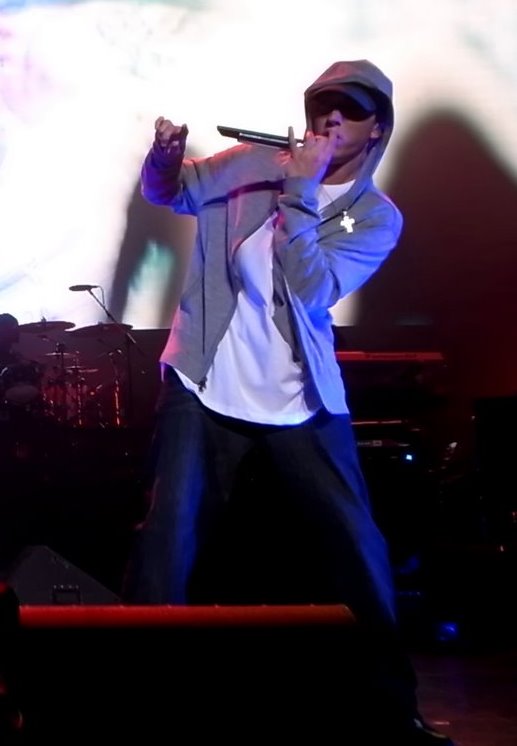
 Eminem performing live at the DJ Hero Party in Los Angeles.
The popularity of hip hop music continued through the 2000s. In the year 2000, The Marshall Mathers LP by Eminem sold over ten million copies in the United States and was the fastest selling album of all time.[83] Nelly's debut LP, Country Grammar, sold over nine million copies. In the 2000s, crunk music, a derivative of Southern hip hop, gained considerable popularity via the likes of Lil Jon and the Ying Yang Twins.
Hip hop influences also found their way increasingly into mainstream pop during this period mainly the mid 2000s. In the East Coast, popular acts during this period included 50 Cent, whose 2003 album Get Rich or Die Tryin' debuted at number one on the U.S. Billboard 200 charts.[84]
In addition to the mainstream success, the United States also saw the success of alternative hip hop in the form of performers such as The Roots, Dilated Peoples, Gnarls Barkley and Mos Def, who achieved significant recognition. Gnarls Barkley's album St. Elsewhere, which contained a fusion of funk, neo soul and hip hop, debuted at number 20 on the Billboard 200 charts. In addition, Aesop Rock's 2007 album None Shall Pass was well received,[85] and reached #50 on the Billboard charts.[86]
World and national music
The continuation of hip hop can also be seen in different national contexts. In Tanzania, maintained popular acts of their own in the early 2000s, infusing local styles of Afrobeat and arabesque melodies, dancehall and hip-hop beats, and Swahili lyrics. Scandinavian, especially Danish and Swedish, performers became well known outside of their country, while hip hop continued its spread into new regions, including Russia, Japan, Philippines, Canada, China, Korea, India and especially Vietnam. Of particular importance is the influence on East Asian nations, where hip hop music has become fused with local popular music to form different styles such as K-pop, C-pop and J-pop.
In Germany and France, gangsta rap has become popular among youths who like the violent and aggressive lyrics.[87] Some German rappers openly or comically flirt with Nazism, Bushido (born Anis Mohamed Youssef Ferchichi) raps "Salutiert, steht stramm, Ich bin der Leader wie A" (Salute, stand to attention, I am the leader like 'A') and Fler had a hit with the record Neue Deutsche Welle (New German Wave) complete with the title written in Third Reich style Gothic print and advertised with an Adolf Hitler quote.[88] These references also spawned great controversy in Germany.[89][90] Meanwhile in France, artists like Kery James' Idéal J maintained a radical, anti-authoritarian attitude and released songs like Hardcore which attacked the growth of the French far right.
In the Netherlands, MC Brainpower went from being an underground battle rapper to mainstream recognition in the Benelux, thus influencing numerous rap artists in the region. In Israel, rapper Subliminal reaches out to Israeli youth with political and religious-themed lyrics, usually with a Zionist message.[91]
One of the countries outside the US where hip-hop is most popular is the United Kingdom. In the 2000s a derirative genre from Hip-Hop (as well as UK Garage and Drum and Bass) known as Grime became popular with artists such as Dizzee Rascal becoming successful.[92] Although it is immensely popular, many British politicians criticize the music for what they see as promoting theft and murder, similar to gangsta rap in America. These criticisms have been deemed racist by the mostly Black British grime industry.[93] Despite its controversial nature, grime has had a major affect on British fashion and pop music, with many young working class youth emulating the clothing worn by grime stars like Dizzee Rascal and Wiley.[94] There are many subgenres of grime, including "Rhythm and Grime," a mix of R&B and grime, and grindie, a mix of indie rock and grime popularized by indie rock band Hadouken!.[95]
Hip hop has globalized into many cultures worldwide, as evident through the emergence of numerous regional scenes. It has emerged globally as a movement based upon the main tennets of hip hop culture. The music and the art continue to embrace, even celebrate, its transnational dimensions while staying true to the local cultures to which it is rooted. Hip-hop's inspiration differs depending on each culture. Still, the one thing virtually all hip hop artists worldwide have in common is that they acknowledge their debt to those African American people in New York who launched the global movement.[96] While hip-hop is sometimes taken for granted by Americans, it is not so elsewhere, especially in the developing world, where it has come to represent the empowerment of the disenfranchised and a slice of the American dream. American hip-hop music has reached the cultural corridors of the globe and has been absorbed and reinvented around the world.[97]
Crunk and snap music
Main articles: Crunk and Snap musicCrunk originated from Tennessee in the 1990s. The style was pioneered and commercialized by artists from Memphis, Tennessee and Atlanta, Georgia.
Looped, stripped-down drum machine rhythms are usually used. The Roland TR-808 and 909 are among the most popular. The drum machines are usually accompanied by simple, repeated synthesizer melodies and heavy bass stabs. The tempo of the music is somewhat slower than hip-hop, around the speed of reggaeton.
The focal point of crunk is more often the beats and music than the lyrics therein. Crunk rappers, however, often shout and scream their lyrics, creating an aggressive, almost heavy, style of hip-hop. While other subgenres of hip-hop address sociopolitical or personal concerns, crunk is almost exclusively party music, favoring call and response hip-hop slogans in lieu of more substantive approaches.[98]
Snap music is a subgenre of crunk that emerged from Atlanta, Georgia, in the late 1990s.[99] The genre soon gained mainstream popularity and in mid-2005 artists from other southern states such as Tennessee began to emerge with this style. Tracks commonly consist of an 808 bassdrum, hi-hat, bass, snapping, a main groove and a vocal track. Hit snap songs include "Lean Wit It, Rock Wit It" by "Dem Franchize Boys", "Laffy Taffy" by D4L, "It's Goin' Down" by Yung Joc and "Crank That (Soulja Boy)" by Soulja Boy Tell 'Em.
Glitch hop and wonky music
Main articles: Glitch hop and Wonky (music)Glitch hop and Wonky music evolved following the rise of trip hop, dubstep and IDM. Both styles of music frequently reflect the experimental nature of IDM and the heavy bass featured in dubstep songs. While trip hop was described as being a distinct British upper-middle class take on hip-hop, glitch-hop and wonky music have featured much more stylistic diversity. Both genres are melting pots of influence, echoes of 1980s pop music, Indian ragas, eclectic jazz and West Coast rap can be heard in glitch hop productions. Los Angeles, London, Glasgow and a number of other cities have become hot spots for these scenes, and underground scenes have developed across the world in smaller communities. Both genres often pay homage to older and more well established electronic music artists such as Radiohead, Aphex Twin and Boards of Canada as well as independent hip hop producers like J Dilla and Madlib.
Glitch hop is a fusion genre of hip hop and glitch music that originated in the early to mid 2000s in the United States and Europe. Musically, it is based on irregular, chaotic breakbeats, glitchy basslines and other typical sound effects used in glitch music, like skips. Glitch hop artists include Prefuse 73, Dabrye and Flying Lotus.
Wonky is a subgenre of hip hop that originated around 2008, but most notably in the United States and United Kingdom, and among international artists of the Hyperdub music label, under the influence of glitch hop and dubstep. Wonky music is of the same glitchy type as glitch hop, but it was specifically noted for its melodies, rich with "mid-range unstable synths". Scotland has become one of the most prominent places, where wonky music was shaped by artists like Hudson Mohawke and Rustie.
Glitch hop and wonky are popular among a limited amount of people interested in alternative hip hop and electronic music (especially dubstep); neither glitch hop nor wonky have met any mainstream popularity, however, artists like Flying Lotus, The Glitch Mob and Hudson Mohawke have seen success in other avenues. Flying Lotus's music has earned multiple positive reviews on the independent music review site Pitchfork.com as well as a prominent (yet uncredited) spot during Adult Swim commercial breaks. Hudson Mohawke is one of few glitch hop artists to play at major music festivals such as Sasquatch! Music Festival.
Decline in sales
Starting in 2005, sales of hip hop music in the United States began to severely wane, leading Time magazine to question if mainstream hip-hop was "dying." Billboard Magazine found that, since 2000, rap sales dropped 44%, and declined to 10% of all music sales, which, while still a commanding figure when compared to other genres, is a significant drop from the 13% of all music sales where rap music regularly placed.[100][101] According to Courtland Milloy of the Washington Post, for the first time on five years, no rap albums were among the top 10 sellers in 2006.[102] NPR culture critic Elizabeth Blair noted that, "some industry experts say young people are fed up with the violence, degrading imagery and lyrics." However, the 2005 report Generation M: Media in the Lives of 8–18 Year-Olds found that hip hop music is by far the most popular music genre for children and teenagers, with 65 percent of 8- to-18-year-olds listening to it on a daily basis.[103]
Others say the music is just as popular as it ever was, but that fans have found other means to consume the music."[104] It can also be argued that many young people now download music illegally, especially through P2P networks, instead of purchasing albums and singles from legitimate stores. For example, Flo Rida is known for his low album sales regardless of his singles being mainstream and having digital success. His second album R.O.O.T.S. sold only 200,000+ total units in the U.S., which could not line up to the sales of the album's lead single "Right Round". This also happened to him in 2008.[105] Some put the blame on the lack of lyrical content that hip hop once had, another example is Soulja Boy Tell 'Em's 2007 debut album souljaboytellem.com was met with negative reviews.[106] Lack of sampling, a key element of hip hop, has also been noted for the decrease in quality of modern albums. For example, there are only four samples used in 2008's Paper Trail by T.I., while there are 35 samples in 1998's Moment of Truth by Gang Starr. The decrease in sampling is in part due to it being too expensive for producers.[107] In Byron Hurt's documentary Hip Hop: Beyond Beats and Rhymes, he claims that hip hop had changed from "clever rhymes and dance beats" to "advocating personal, social and criminal corruption."[108] Despite the fall in record sales throughout the music industry,[109] hip-hop has remained a popular genre, with hip-hop artists still regularly topping the Billboard 200 Charts. In the first half of 2009 alone artists such as Eminem,[110] Rick Ross,[111] The Black Eyed Peas,[112] and Fabolous[113] all had albums that reached the #1 position on the Billboard 200 charts. Eminem's album Relapse was one of the fastest selling albums of 2009.[114]
Innovation and revitalization
 Kanye West performing in 2008
It was in the later 2000s that alternative hip hop finally secured a place within the mainstream, due in part to the declining commercial viability of gangsta rap as well as the crossover success of artists such as OutKast, Kanye West, and Gnarls Barkley.[115] Not only did OutKast's Speakerboxxx/The Love Below receive high acclaim from music critics, manage to appeal to listeners of all ages, and span numerous musical genres – including rap, rock, R&B, punk, jazz, indie, country, pop, electronica and gospel – but it also spawned two number-one hit singles and has been certified diamond by selling 11 times platinum by the RIAA for shipping more than 11 million units,[116] becoming one of the best selling hip-hop albums of all time as well as winning a Grammy Award for Album of the Year at the 46th Annual Grammy Awards being only the second rap album to do so. Industry observers view the sales race between Kanye West's Graduation and 50 Cent's Curtis as a turning point for hip hop. West emerged the victor, selling nearly a million copies in the first week alone, proving that innovative rap music could be just as commercially viable as gangsta rap, if not more so.[117] Although he designed it as a melancholic pop rather than rap, Kanye's following 808s & Heartbreak would have a significant effect on hip hop music. While his decision to sing about love, loneliness, and heartache for the entirety of the album was at first heavily criticized by music audiences and the album predicted to be a flop, its subsequent critical acclaim and commercial success encouraged other mainstream rappers to take greater creative risks with their music.[118][119] During the release of The Blueprint 3, New York rap mogul Jay-Z revealed that next studio album would be an experimental effort, stating, "... it's not gonna be a #1 album. That's where I'm at right now. I wanna make the most experimental album I ever made."[120] Jay-Z elaborated that like Kanye, he was unsatisfied with contemporary hip hop, was being inspired by indie-rockers like Grizzly Bear and asserted his belief that the indie rock movement would play an important role in the continued evolution of hip-hop.[121]
The alternative hip hop movement is not limited only to the United States, as rappers such as Somali-Canadian poet K'naan, Japanese rapper Shing02, and Sri Lankan British artist M.I.A. have achieved considerable worldwide recognition. In 2009, TIME magazine placed M.I.A in the Time 100 list of "World's Most Influential people" for having "global influence across many genres."[122][123] Global themed movements have also sprung out of the international hip-hop scene like the genre "Islamic Eco-Rap" addressing issues of worldwide importance through traditionally disenfranchised voices.[124][125] Today, due in part to the increasing use of music distribution through the internet, many alternative rap artists find acceptance by far-reaching audiences. Several artists such as Kid Cudi and Drake have managed to attain chart-topping hit songs, "Day 'n' Night" and "Best I Ever Had" respectively,by releasing their music on free online mixtapes without the help of a major record label. New artists such as Wale, J. Cole, Lupe Fiasco, The Cool Kids, Jay Electronica, and B.o.B, openly acknowledge being directly influenced by their nineties alt-rap predecessors in addition to alt-rock groups while their music has been noted by critics as expressing eclectic sounds, life experiences, and emotions rarely seen in mainstream hip hop.[126]
Notes
- ^ Merriam-Webster Dictionary entry on hip-hop, retrieved from merriam-webster.com: A subculture especially of inner-city youths who are typically devotees of rap music; the stylized rhythmic music that commonly accompanies rap; also rap together with this music.
- ^ a b c d e Encyclopedia Britannica article on rap, retrieved from britannica.com: Rap, musical style in which rhythmic and/or rhyming speech is chanted (“rapped”) to musical accompaniment. This backing music, which can include digital sampling (music and sounds extracted from other recordings), is also called hip-hop, the name used to refer to a broader cultural movement that includes rap, deejaying (turntable manipulation), graffiti painting, and break dancing.
- ^ AllMusic article for rap, retrieved from AllMusic.com
- ^ Harvard Dictionary of Music article for rap, retrieved from CredoReference
- ^ a b Encyclopedia Britannica article on hip-hop, retrieved from britannica.com: Hip-hop, cultural movement that attained widespread popularity in the 1980s and ’90s; also, the backing music for rap, the musical style incorporating rhythmic and/or rhyming speech that became the movement’s most lasting and influential art form.
- ^ Kugelberg, Johan (2007). Born in the Bronx. New York: Oxford University Press. p. 17. ISBN 978-0-7893-1540-3.
- ^ Brown, Lauren (February 18, 2009). "Hip to the Game – Dance World vs. Music Industry, The Battle for Hip Hop’s Legacy". Movmnt Magazine. http://www.movmnt.com/monsters-of-hip-hop-2_003332.html. Retrieved 2009-07-30.
- ^ Chang, Jeff (2005). Can't Stop Won't Stop: A History of the Hip Hop Generation. New York: St. Martin's Press. p. 90. ISBN 0-312-30143-X.
- ^ Harvard Dictionary of Music article for hip hop, retrieved from Google Books: While often often used to refer to rap music, hip hop more properly denotes the practice of entire subculture
- ^ AllMusic article for Hip-hop/Urban, retrieved from AllMusic.com: Hip-Hop is the catch-all term for rap and the culture it spawned.
- ^ "Hip-hop". Merriam-Webster Dictionary. Merriam-Webster, Incorporated. http://en.wikipedia.org/w/index.php?title=Hip_hop_music&action=submit. Retrieved 6 October 2011.
- ^ "Hip-hop". Oxford English Dictionary. Oxford University Press. http://www.oed.com/view/Entry/243423?rskey=GAowBg&result=1&isAdvanced=false#. Retrieved 6 October 2011.
- ^ a b c "Keith Cowboy - The Real Mc Coy". Web.archive.org. 2006-03-17. Archived from the original on 2006-03-17. http://web.archive.org/web/20060317071002/http://www.furious5.net/cowboy.htm. Retrieved 2010-01-12.
- ^ Zulunation.com (cached)
- ^ Hagar, Steven. "Afrika Bambaataa’s Hip-Hop," Village Voice
- ^ Hager, Steven. Hip Hop: The Illustrated History of Break Dancing, Rap Music, and Graffiti. St Martins Press, 1984 (out of print).
- ^ Campbell, K.E. (2005). Gettin' our groove on: rhetoric, language, and literacy for the hip hop generation, Wayne State University Press
- ^ Cepeda, R., George, N. 2004. And It Don't Stop: The Best American Hip-Hop Journalism of the Last 25 Years, New York, Faber and Faber Inc.
- ^ Dyson, Michael Eric, 2007, Know What I Mean? : Reflections on Hip-Hop, Basic Civitas Books, p. 6.
- ^ Castillo-Garstow, Melissa (March 2005). "Latinos in Hip Hop to Reggaeton". Latin Beat Magazine 15 (2): 24(4).
- ^ Rojas, Sal (2007). "Estados Unidos Latin Lingo". Zona de Obras (Zaragoza, Spain) (47): 68.
- ^ a b c Stas Bekman: stas (at) stason.org. "What is "Dub" music anyway? (Reggae)". Stason.org. http://stason.org/TULARC/music-genres/reggae-dub/3-What-is-Dub-music-anyway-Reggae.html. Retrieved 2010-01-12.
- ^ David Dye (February 22, 2007). "NPR: The Birth of Rap: A Look Back". NPR. http://www.npr.org/templates/story/story.php?storyId=7550286.
- ^[dead link]
- ^ Philen, Robert (2007-11-05). "Robert Philen's Blog: Mythic Music: Stockhausen, Davis and Macero, Dub, Hip Hop, and Lévi-Strauss". Robertphilen.blogspot.com. http://robertphilen.blogspot.com/2007/11/mythic-music-stockhausen-davis-and.html. Retrieved 2010-01-12.
- ^ "A database of sampled music". WhoSampled. http://www.whosampled.com/. Retrieved 2010-01-12.
- ^ a b "History of Hip Hop - Old School". nciMUSIC. http://www.ncimusic.com/tutorial/history/hiphop/oldschool.html. Retrieved 2010-01-12.
- ^ "Article about Mele Mel (Melle Mel)". AllHipHop.com. Archived from the original on 2007-11-02. http://web.archive.org/web/20071102182358/http://www.allhiphop.com/features/?ID=1686.[dead link]
- ^ Schloss, J.G. (2009). Foundation: b-boys, b-girls, and hip-hop culture in New York, Oxford University Press
- ^ a b * David Toop (1984/1991/2000). Rap Attack II: African Rap To Global Hip Hop, p.94, ?, 96. New York. New York: Serpent's Tail. ISBN 1-85242-243-2.
- ^ Bynoe, Y. (2006). Encyclopedia of rap and hip-hop culture, Greenwood Press
- ^ Crossley, Scott. '’Metaphorical Conceptions in Hip-Hop Music”, African American Review, St Louis University Press, 2005. pp.501-502
- ^ Alridge D, Steward J. “Introduction: Hip Hop in History: Past, Present, and Future”, Journal of African American History 2005. pp.190
- ^ nciMUSIC - History of Hip Hop nciMUSIC.com
- ^ The History Of Hip Hop pg 8 Daveyd.com
- ^ Hess, Mickey (2009). Hip Hop in America: A Regional Guide. ABC-CLIO. p. xxxiii. ISBN 9780313343230.
- ^ "hip hop". The Encyclopedia of New York State. Syracuse University Press. http://www.syracuseuniversitypress.syr.edu/encyclopedia/entries/hip-hop.html. Retrieved 2010-01-12.
- ^ Chris Heard, Thursday, 14 October 2004, 08:52 GMT 09:52 UK. "Silver jubilee for first rap hit", BBC News.
- ^ Greenberg, Steve; Light, Alan [ed.] (1999). The VIBE History of Hip Hop. Three Rivers Press. p. 28. ISBN 0-609-80503-7
- ^ Anonym (2004-02-26). "Hip Hop On Wax: Lady B - To The Beat Y'All". Hiphoponwax.blogspot.com. http://hiphoponwax.blogspot.com/2006/10/lady-b-to-beat-yall.html. Retrieved 2010-01-12.
- ^ Benson, G. (2010).Lonely Planet USA, Lonely Planet
- ^ Talbot, M,.(2000). The musical work: reality or invention?, Liverpool University Press
- ^ NewYorkGospel.com
- ^ "Guide to the Cornell University Library Hip Hop Collection, circa 1975-1985; Collection Number: 8021; Division of Rare and Manuscript Collections" [1]
- ^ "The Heart of Germany I"
- ^ "Hip Hop Meets Neue Deutsche Welle: Ja Ja Ja"
- ^ MCM retrospective on Sidney :
« on peut dire aujourd'hui que Sidney est le papa du hip-hop français. Concepteur de l'émission H.I.P. H.O.P. en 1984 (1ère émission rap au monde diffusée à l'époque le dimanche à 14h00 avant Starsky & Hutch), ce Dj/rappeur/breakeur extravagant fait découvrir cette nouvelle tendance américaine aux Français, à peine remis de la vague disco, et crée des vocations (Joey Starr, Passi, Stomy Bugsy...) »
H.I.P H.O.P - L'émission Mythique de Sidney - ^ "International Man of Mystery". Theme Magazine. 2010-01-08. http://www.thememagazine.com/index.php?option=com_content&task=view&id=62&Itemid=115. Retrieved 2010-01-12.
- ^ Thomas, Stephen. "Licensed to Ill". allmusic. http://www.allmusic.com/cg/amg.dll?p=amg&sql=A34rp283c054a. Retrieved 2010-01-12.[dead link]
- ^ Jon Caramanica, "Hip-Hop's Raiders of the Lost Archives", New York Times, June 26, 2005.
Cheo H. Coker, "Slick Rick: Behind Bars", Rolling Stone, March 9, 1995.
Lonnae O'Neal Parker, "U-Md. Senior Aaron McGruder's Edgy Hip-Hop Comic Gets Raves, but No Takers", Washington Post, Aug 20 1997. - ^ Jake Coyle of Associated Press, "Spin magazine picks Radiohead CD as best", published in USA Today, June 19, 2005.
Cheo H. Coker, "Slick Rick: Behind Bars", Rolling Stone, March 9, 1995.
Andrew Drever, "Jungle Brothers still untamed", The Age [Australia], October 24, 2003. - ^ Roni Sariq, "Crazy Wisdom Masters", City Pages, April 16, 1997.
Scott Thill, "Whiteness Visible" AlterNet, May 6, 2005.
Will Hodgkinson, "Adventures on the wheels of steel", The Guardian, September 19, 2003. - ^ Per Coker, Hodgkinson, Drever, Thill, O'Neal Parker and Sariq above. Additionally:
Cheo H. Coker, "KRS-One: Krs-One", Rolling Stone, November 16, 1995.
Andrew Pettie, "'Where rap went wrong'", Daily Telegraph, August 11, 2005.
Mosi Reeves, "Easy-Chair Rap", Village Voice, January 29th 2002.
Greg Kot, "Hip-Hop Below the Mainstream", Los Angeles Times, September 19, 2001.
Cheo Hodari Coker, "'It's a Beautiful Feeling'", Los Angeles Times, August 11, 1996.
Scott Mervis, "From Kool Herc to 50 Cent, the story of rap -- so far", Pittsburgh Post-Gazette, February 15, 2004. - ^ Cheo H. Coker, "Slick Rick: Behind Bars", Rolling Stone, March 9, 1995.
- ^ a b Jake Coyle of Associated Press, "Spin magazine picks Radiohead CD as best", published in USA Today, June 19, 2005.
- ^ Scott Mervis, "From Kool Herc to 50 Cent, the story of rap – so far", Pittsburgh Post-Gazette, February 15, 2004.
- ^ Cobb, Jelani William, 2007, To the Break of Dawn, NYU Press, p. 47.
- ^ 5:27 p.m. ET (2004-08-02). "The '80s were golden age of hip-hop - RAP/HIP-HOP MUSIC- msnbc.com". MSNBC. http://www.msnbc.msn.com/id/5430999/. Retrieved 2010-04-23.
- ^ "Gangsta Rap - What Is Gangsta Rap". Rap.about.com. 2009-10-31. http://rap.about.com/od/genresstyles/p/GangstaRap.htm. Retrieved 2010-04-23.
- ^ Ritchie, Ryan (2007-02-28). "Eazy to be hard". Press Telegram (Los Angeles Newspaper group). http://www.presstelegram.com/entertainment/ci_5315527. Retrieved 2008-01-26.
- ^ Deflem, Mathieu (1993). Rap, Rock, and Censorship: Popular Culture and the Technologies of Justice.. http://www.cas.sc.edu/socy/faculty/deflem/zzcens97.htm. Retrieved 2008-01-26.
- ^ "Cam'ron on The O'Reilly Factor". iLPvideo.com. http://ilpvideo.com/video.php?v=MzQ4MA. Retrieved 2010-04-23.
- ^ "article". community.allhiphop.com. http://community.allhiphop.com/go/thread/view/12461/5467055/TOP_10_selling_rap_albums_of_all_time.
- ^ "Please Hammer, Don't Hurt 'Em: Overview". allmusic. http://www.allmusic.com/album/r27923.
- ^ "article". prnewswire.com. http://www.prnewswire.com/cgi-bin/stories.pl?ACCT=105&STORY=/www/story/08-06-2001/0001548803.
- ^ "article". time.com. 2001-06-24. http://www.time.com/time/magazine/article/0,9171,1101940328-164065,00.html. Retrieved 2010-05-04.
- ^ "article". newyorker.com. http://www.newyorker.com/archive/1996/08/26/1996_08_26_062_TNY_CARDS_000376033.
- ^ "article". sing365.com. http://www.sing365.com/music/lyric.nsf/MC-Hammer-Biography/4E0F2063AA089C6748256E0700170A6C.
- ^ Batey, Angus (2010-10-07). "The hip-hop heritage society". The Guardian. http://www.guardian.co.uk/music/2010/oct/07/hiphop-heritage-public-enemy-krs-one. Retrieved 2011-11-08.
- ^ "((( The Chronic > Charts & Awards > Billboard Albums )))". allmusic. 1992-12-15. http://www.allmusic.com/album/r70573. Retrieved 2010-01-12.
- ^ Nelson, Havelock (1993-03-18). "The Chronic : Dr. Dre : Review". Rolling Stone. http://www.rollingstone.com/reviews/album/111976/review/18944957/thechronic. Retrieved 2010-01-12.
- ^ "Snoop Dogg Music News & Info |". Billboard.com. http://www.billboard.com/bbcom/bio/index.jsp?pid=33952. Retrieved 2010-01-12.
- ^ http://www.allmusic.com/explore/style/hardcore-rap-d2918
- ^ Huey, Steve. "The Infamous at Allmusic". http://www.allmusic.com/album/r212044. Retrieved January 1, 2007.
- ^ Huey, Steve. "Hell on Earth at Allmusic". http://www.allmusic.com/album/r244016. Retrieved January 1, 2007.
- ^ "The Murders of gangsta rappers Tupac Shakur and Notorious B.I.G. - Crime Library on truTV.com". Trutv.com. 1994-11-30. http://www.trutv.com/library/crime/notorious_murders/celebrity/shakur_BIG/2a.html. Retrieved 2010-01-12.
- ^ Burks, Maggie (2008-09-03). "Southern Hip-Hop". Jackson Free Press. http://www.jacksonfreepress.com/index.php/site/comments/southern_hip_hop_090308/. Retrieved 2008-09-11.
- ^ Lomax, John (2005-05-05). "Mouth of the South". Houston Press. http://www.houstonpress.com/2005-05-05/music/mouth-of-the-dirty-south/. Retrieved 2011-11-01.
- ^ Westhoff, Ben (2011-03-18). "Dirty South". Village Voice. http://blogs.villagevoice.com/music/2011/03/excerpt_dirty_s.php. Retrieved 2011-11-01.
- ^ Ambrose, Joe (2001). "Moshing - An Introduction". The Violent World of Moshpit Culture. Omnibus Press. p. 5. ISBN 0711987440.
- ^ Digable Planets, Billboard.com
- ^ "The Slim Shady LP > Charts & Awards > Billboard Albums". allmusic. 1999-02-23. http://www.allmusic.com/album/r397821. Retrieved 2010-01-12.
- ^ "Eminem Lyrics". Lyrics.com. 1972-10-17. http://www.lyrics.com/lyrics/eminem/relapse-clean. Retrieved 2010-01-12.
- ^ http://www.billboard.com/#/album/50-cent/get-rich-or-die-tryin/567925
- ^ http://www.allmusic.com/album/r1078358
- ^ Jonathan Cohen, "'High School Musical 2' Starts Third Week At No. 1", Billboard.com, September 5, 2007.
- ^ Tzortzis, Andreas (August 9, 2005). "Germany's Rap Music Veers Toward the Violent". The New York Times. http://www.nytimes.com/2005/08/09/arts/music/09rap.html. Retrieved 12 January 2010.
- ^ "Rap music and the far right: Germany goes gangsta, 17 August 2005". The Independent (London, United Kingdom). 2005-08-17. http://news.independent.co.uk/europe/article306413.ece. Retrieved 2010-01-12.
- ^ "Der Spiegel: Scandal Rap, 23 May 2005" (in German). Der Spiegel (Spiegel.de). 2005-05-23. http://www.spiegel.de/kultur/musik/0,1518,356560,00.html. Retrieved 2010-01-12.
- ^ (in German) Fler: Stolz, Deutsch und rechtsradikal, 13 May 2005. Laut.de. 2005-05-13. http://www.laut.de/vorlaut/news/2005/05/13/12218/index.htm. Retrieved 2010-01-12.
- ^ "Rolling Stone". http://www.rollingstone.com/search/newsAbstract/News/.
- ^ "Grime Music". http://www.itzcaribbean.com/grime_music.php.
- ^ "Cameron Attacks Radio 1 Hip-Hop". BBC News. 2006-06-07. http://news.bbc.co.uk/2/hi/uk_news/politics/5055724.stm.
- ^ "Grime Fashion". http://tuksmagazine.co.uk/.
- ^ Heawood, Sophie (2006-05-05). "When Hood Meets Fringe". The Guardian (London). http://www.guardian.co.uk/music/2006/may/05/popandrock.
- ^ Moodle.Brandeis.edu
- ^ Nawotka, Edward (2004-12-10). "The globalization of hip-hop starts and ends with 'Where You're At'". USA Today. http://www.usatoday.com/life/books/reviews/2004-12-09-where-youre-at_x.htm. Retrieved 2010-01-12.
- ^ Miller, Matt (2008-06-10). "Dirty Decade: Rap Music from the South: 1997-2007". Southernspaces.org. http://southernspaces.org/2008/dirty-decade-rap-music-and-us-south-1997-2007. Retrieved 2010-01-12.
- ^ Vibe Jun 2006, "Oh Snap!"
- ^ "After 21% Decline In Sales, Rap Industry Takes A Hard Look At Itself - Futuremusic presents". Futuremusic.com. 2006-04-09. http://www.futuremusic.com/news/april2007/musictrends-hiphop.html. Retrieved 2010-01-12.
- ^ Ta-Nehisi Coates Friday, Aug. 17, 2007 (2007-08-17). "Hip-Hop's Down Beat". TIME magazine. http://www.time.com/time/magazine/article/0,9171,1653639,00.html. Retrieved 2010-01-12.
- ^ Milloy, Courtland. "Gangsta Rap, Dying in the Street". The Washington Post, September 19, 2007.
- ^ Rideout, Victoria, Donald F. Roberts and Ulla F. Foehr (2005). Generation M: Media in the Lives of 8–18 Year-Olds. Menlo Park, CA: Kaiser Family Foundation.
- ^ Blair, Elizabeth (March 11, 2007). "Is Hip-Hop Dying Or Has It Moved Underground?". National Public Radio - All Things Considered. http://www.npr.org/templates/story/story.php?storyId=7834732. Retrieved 2010-01-12.
- ^ Martens, Todd (2009-04-30). "Better as a song or a ring tone". Los Angeles Times. http://latimesblogs.latimes.com/music_blog/2009/04/better-as-a-song-or-a-ring-tone.html. Retrieved April 30, 2009.
- ^ "Soulja Boy Tell ‘Em - Souljaboytellem.com - Hip Hop Album Review". Djbooth.net. http://www.djbooth.net/index/albums/review/soulja-boy-tell-em-souljaboytellemcom-1002072/. Retrieved 2010-01-12.
- ^ Newton, Matthew (2008-12-01). "Is Sampling Dead? | SPIN Magazine | by Matthew Newton | Matthew Newton". Matthew Newton. http://matthewnewton.us/node/775. Retrieved 2010-01-12.
- ^ Crouch, Stanley (2008-12-08). "For the future of hip-hop, all that glitters is not gold teeth". Seattle Post-Intelligencer. Hearst Corporation. http://www.seattlepi.com/opinion/391157_crouchonline09.html. Retrieved 2008-12-11.
- ^ Sabbagh, Dan (June 18, 2008). "Music sales fall to their lowest level in over twenty years". The Times (London, United Kingdom). http://business.timesonline.co.uk/tol/business/industry_sectors/media/article4160553.ece. Retrieved 2010-01-12.
- ^ Kaufman, Gil (2009-05-27). "Eminem's Relapse Notches Biggest Billboard Debut Of 2009 - News Story". MTV News. http://www.mtv.com/news/articles/1612196/20090527/eminem.jhtml. Retrieved 2010-01-12.
- ^ Up for DiscussionPost Comment (2009-09-14). "Rick Ross Debuts At No. 1 On Billboard 200 For Third Time". Billboard.com. http://www.billboard.com/bbcom/news/rick-ross-debuts-at-no-1-on-billboard-200-1003967404.story. Retrieved 2010-01-12.
- ^ by Keith Caulfield (June 17, 2009). "Black Eyed Peas 'E.N.D.' Up At No. 1 On Billboard 200 | Billboard.com". Billboard.com. http://www.billboard.com/bbcom/news/black-eyed-peas-e-n-d-up-at-no-1-on-billboard-1003985032.story.
- ^ Monica Herrera and Keith Caulfield (August 5, 2009). "Fabolous Tops Billboard 200; Jackson's 'Ones' Now 2009's Second-Best Seller | Billboard.com". Billboard.com. http://www.billboard.com/news/fabolous-tops-billboard-200-jackson-s-ones-1004000186.story. Retrieved 2010-01-12.
- ^ "Dizzee Rascal - Dizzee And Eminem Land Fastest-Selling No 1S Of 2009 - Contactmusic News". Contactmusic.com. 24 May 2009. http://www.contactmusic.com/news.nsf/story/dizzee-and-eminem-land-fastest-selling-no-1s-of-2009_1104371. Retrieved 2010-01-12.
- ^ Michel, Sia (2006-09-18). "Critics' Choice: New CD's". The New York Times (The New York Times Company). http://query.nytimes.com/gst/fullpage.html?res=9503E7DF1031F93BA2575AC0A9609C8B63. Retrieved 2008-05-10.
- ^ "Gold and Platinum – Diamond Awards". Recording Industry Association of America. Archived from the original on 2007-05-16. http://web.archive.org/web/20070516220738/http://web.archive.org/web/20070516220738/http://www.riaa.com/gp/bestsellers/diamond.asp.
- ^ Sexton, Paul (2007-09-17). "Kanye Defeats 50 Cent On U.K. Album Chart". Billboard. Nielsen Business Media, Inc. http://www.billboardmagazine.com/bbcom/esearch/article_display.jsp?vnu_content_id=1003641886. Retrieved 2007-09-18.[dead link]
- ^ Reid, Shaheem (2008-10-03). "Common Praises Kanye's Singing; Lupe Fiasco Plays CEO: Mixtape Monday". MTV. MTV Networks. http://www.mtv.com/news/articles/1596254/20081003/common.jhtml. Retrieved 2008-11-23.
- ^ "Urban Review: Kanye West, 808s and Heartbreak". The Observer (London: Guardian News and Media Ltd). 2008-11-09. http://www.guardian.co.uk/music/2008/nov/09/kanye-west-hip-hop-808s-heartbreak. Retrieved 2008-11-24.
- ^ Kash, Tim; Reid, Shaheem; Rodriguez, Jayson (2009-09-03). "Exclusive: Jay-Z's Next LP Will Be 'The Most Experimental I Ever Made'". MTV. MTV Networks. http://www.mtv.com/news/articles/1620692/20090902/jay_z.jhtml. Retrieved 2009-09-03.
- ^ Kash, Tim; Montgomery, James (2009-09-03). "Jay-Z Hopes Bands Like Grizzly Bear Will 'Push Hip-Hop'". MTV. MTV Networks. http://www.mtv.com/news/articles/1620444/20090831/jay_z.jhtml. Retrieved 2009-09-03.
- ^ Jonze, Spike (April 30, 2009). "The 2009 - TIME 100". Time. http://www.time.com/time/specials/packages/article/0,28804,1894410_1893836_1894427,00.html. Retrieved 2010-01-12.
- ^ "The 2009 TIME 100". Time. http://www.time.com/time/specials/packages/0,28757,1894410,00.html. Retrieved 2010-01-12.
- ^ "Class Is In Session An Interview With Rapper Professor A.L.I.". sfbayview.com. http://sfbayview.com/2011/class-is-in-session-an-interview-wit%E2%80%99-rapper-professor-a-l-i/. Retrieved 2011-06-09.
- ^ "INTERVIEW: Professor A.L.I.’s Islamic Eco-Rap Sends Environment Lessons To Muslims". Greenprophet.com. http://www.greenprophet.com/2011/05/islamic-eco-rap-muslim/. Retrieved 2011-06-09.
- ^ Hoard, Christian (17 September 2009). "Kid Cudi: Hip-Hop's Sensitive Soul". Rolling Stone (1087): 40.
References
- David Toop (1984/1991). Rap Attack II: African Rap To Global Hip Hop. New York. New York: Serpent's Tail. ISBN 1-85242-243-2.
- McLeod, Kembrew. Interview with Chuck D and Hank Shocklee. 2002. Stay Free Magazine.
- Corvino, Daniel and Livernoche, Shawn (2000). A Brief History of Rhyme and Bass: Growing Up With Hip Hop. Tinicum, PA: Xlibris Corporation/The Lightning Source, Inc. ISBN 1-4010-2851-9
- Chang, Jeff. "Can't Stop Won't Stop".
- Rose, Tricia (1994). "Black Noise". Middletown, Connecticut: Wesleyan University Press. ISBN 0-8195-6275-0
- Potter, Russell (1995) Spectacular Vernaculars: Hip-Hop and the Politics of Postmodernism. Albany: SUNY Press. ISBN 0-7914-2626-2
- Light, Alan (ed). (1999). The VIBE History of Hip-Hop. New York: Three Rivers Press. ISBN 0-609-80503-7
- George, Nelson (2000, rev. 2005). Hip-Hop America. New York: Penguin Books. ISBN 0-14-028022-7
- Fricke, Jim and Ahearn, Charlie (eds). (2002). Yes Yes Y'All: The Experience Music Project Oral History of Hip Hop's First Decade. New York: Da Capo Press. ISBN 0-306-81184-7
- Kitwana, Bakar (2004). The State of Hip-Hop Generation: how hip-hop's culture movement is evolving into political power. Retrieved December 4, 2006. From Ohio Link Database
External links
- Can't Stop, Won't Stop: A History of the Hip-Hop Generation — By Jeff Chang
- Back in the Days — Vibe
- The Monitor of Hip Hop Culture in Mainstream Media — By DUB
- Rap: Striking Tales of Black Frustration and Pride Shake the Pop Mainstream — By Robert Hilburn
- When did Reggae become Rap? by D. George
- National Geographic Hip Hop Overview
- Whose World Is This? - An Overview of Global Hip Hop Music
- Olivo, W. (March 2001). "Phat Lines: Spelling Conventions in Rap Music". Written Language & Literacy 4 (1): 67–85. doi:10.1075/wll.4.1.05oli. http://www.ingentaconnect.com/content/jbp/wll/2001/00000004/00000001/art00004.
Cities Categories:- African-American culture
- African American music
- African American history
- American styles of music
- Hip hop
- 20th-century music genres
- 21st-century music genres
- Electronic music







Wikimedia Foundation. 2010.
