

- Magellanic Penguin
-
Magellanic Penguin 
Conservation status Scientific classification Kingdom: Animalia Phylum: Chordata Class: Aves Order: Sphenisciformes Family: Spheniscidae Genus: Spheniscus Species: S. magellanicus Binomial name Spheniscus magellanicus
(Forster, 1781)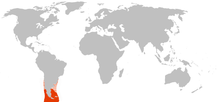
Red area shows range The Magellanic Penguin, Spheniscus magellanicus, is a South American penguin, breeding in coastal Argentina, Chile and the Falkland Islands, with some migrating to Brazil where they are occasionally seen as far north as Rio de Janeiro. It is the most numerous of the Spheniscus penguins. Its nearest relatives are the African, the Humboldt and the Galápagos Penguins. They are native to the Strait of Magellan in the cool climate of southern Chile, hence the name's origin.[1]
Contents
Description
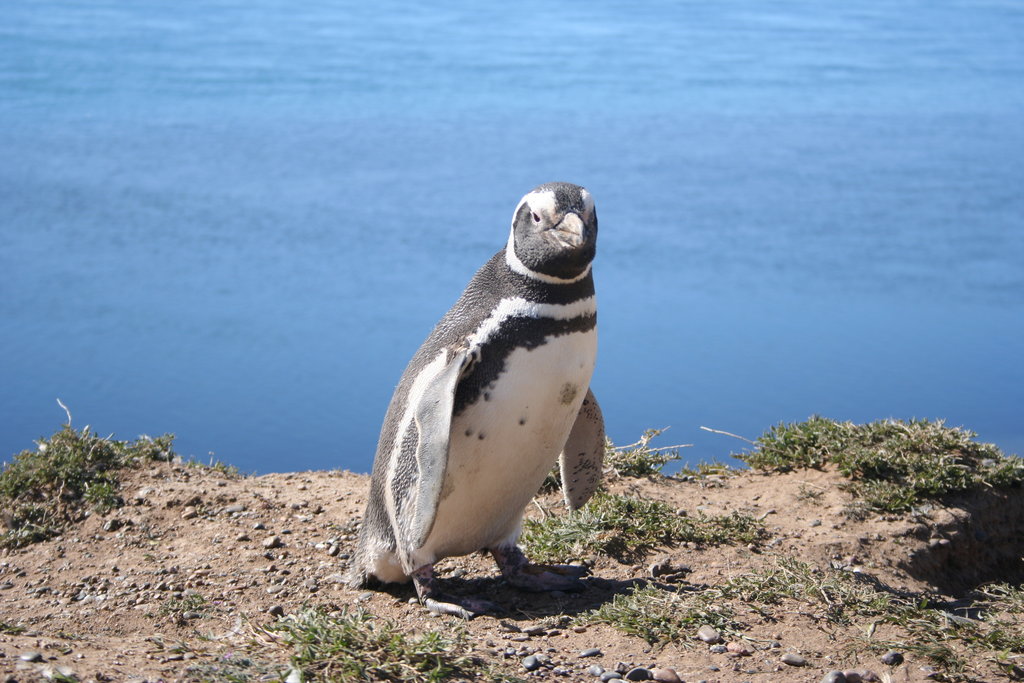
 Magellanic penguin on Argentina's coast
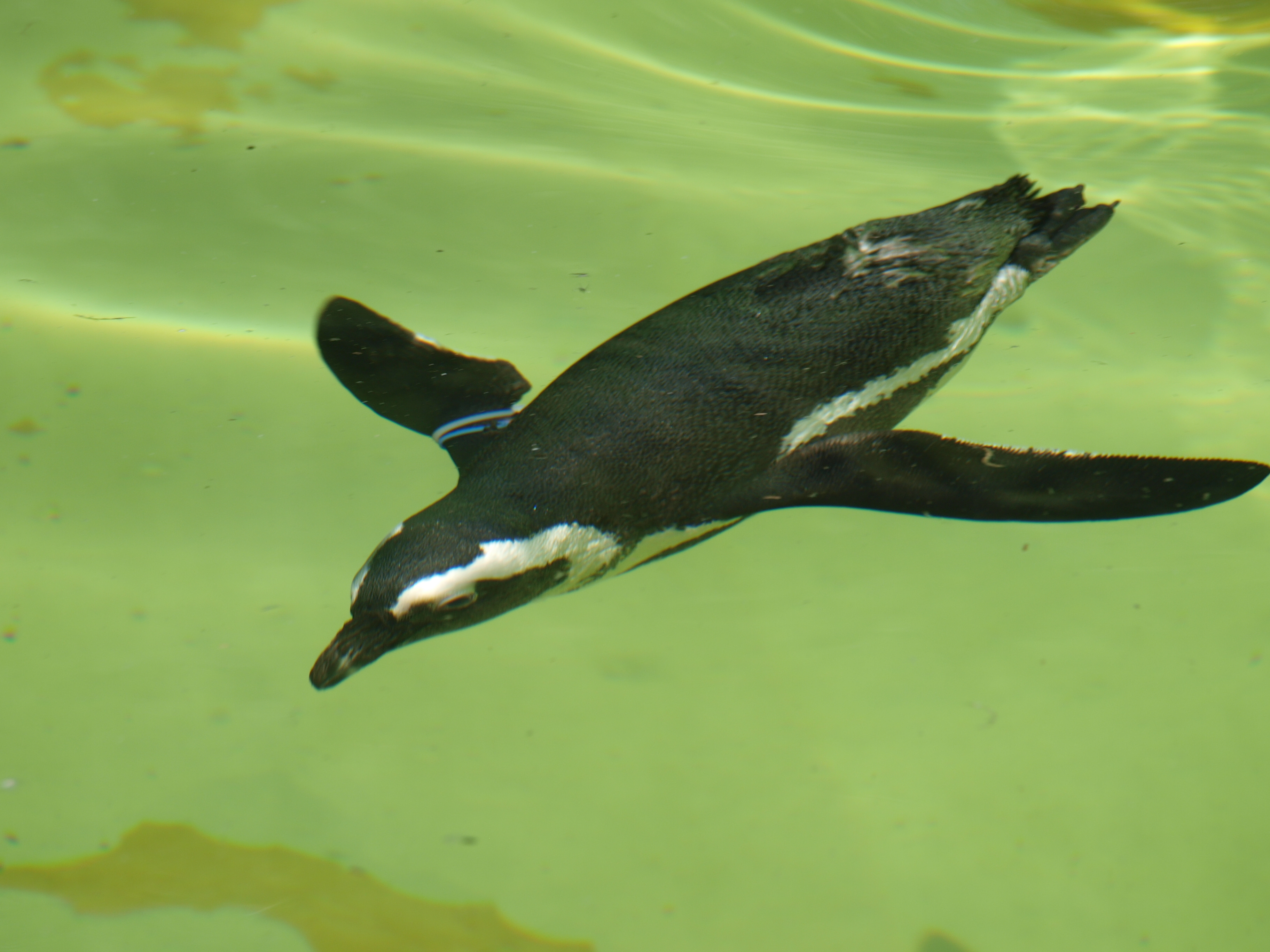
 Swimming underwater at Berlin Zoo, Germany
Magellanic Penguins are medium-sized penguins which grow to be 61–76 cm (24–30 in) tall and weigh between 2.7 kg and 6.5 kg (5.9-14.3 lbs).[2][3] The males are larger than the females, and the weight of both drops while the parents nurture their young.
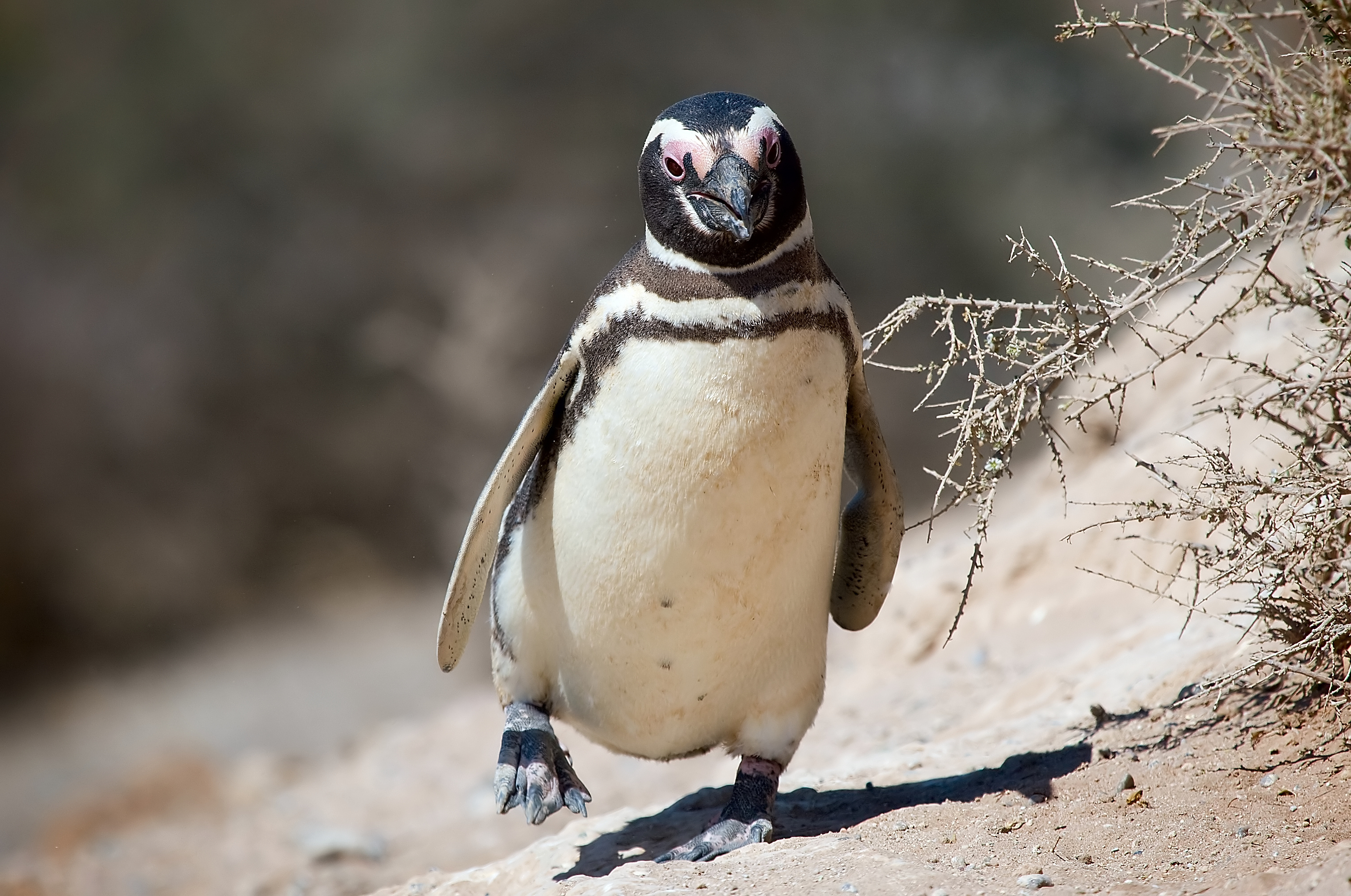
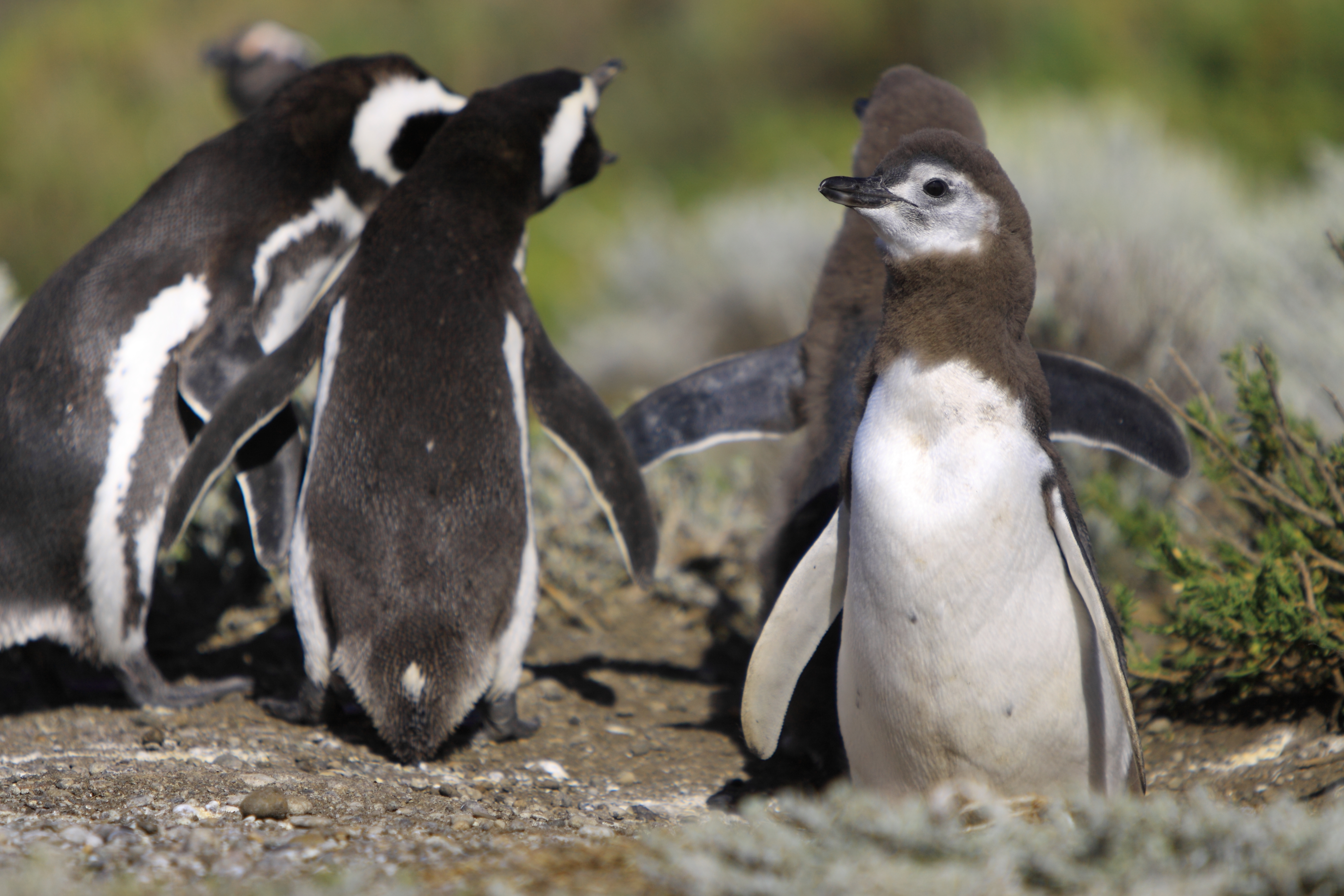
Adults have black backs and white abdomens. There are two black bands between the head and the breast, with the lower band shaped in an inverted horseshoe. The head is black with a broad white border that runs from behind the eye, around the black ear-coverts and chin, and joins at the throat. Chicks and younger penguins have grey-blue backs, with a more faded grey-blue color on their chest. Magellanic Penguins can live up to 25 years in the wild, but as much as 30 years in captivity.
Young birds usually have a blotched pattern on their feet, which fades as they age. By the time these birds reach about ten years of age, their feet usually become all black.
Like other species of penguins, the Magellanic Penguin has very rigid wings used to "fly" or cruise under water.
Diet
Magellanic Penguins feed in the water, preying on cuttlefish, sardines, squid, krill, and other crustaceans, and ingest sea water with their prey. Their salt-excreting gland rids the salt from their bodies.
Breeding
 Adults and chicks by their burrow in Cape Virgenes, Patagonia, Argentina
Magellanic Penguins travel in large flocks when hunting for food. In the breeding season, these birds gather in large nesting colonies at the coasts of Argentina, southern Chile, and the Falkland Islands, which have a density of 20 nests per 100 square meters. One of the largest of these colonies is located at Punta Tombo.[4] Nests are built under bushes or in burrows. Two eggs are laid. Incubation lasts 39–42 days, a task which the parents share in 10-15 day shifts. The chicks are cared for by both parents for 29 days and are fed every two to three days. Normally, both are raised through adulthood, though occasionally only one chick is raised.
Magellanic Penguins mate with the same partner year after year. The male reclaims his burrow from the previous year and waits to reconnect with his female partner. The females are able to recognize their mates through their call alone.
Status in the wild
 Magellanic penguins at the Patagonian coast
Millions of these penguins still live on the coasts of Argentina and Chile, but the species is classified as a "threatened species", primarily due to the vulnerability of large breeding colonies to oil spills, which kill 20,000 adults and 22,000 juveniles every year off the coast of Argentina. To help the fight against the oil spills, zoo representatives from all over the world come and adopt the hatchlings, and breed them there. The decline of fish populations is also responsible, as well as predators such as sea lions and giant petrels, which prey on the chicks
Climate change has displaced fish populations, so Magellanic penguins must swim an extra 25 miles (40 km) further from the nest for fish. While the penguins are swimming an extra 50 miles (80.4 km), their mates are sitting on a nest and starving. A colony being tracked by University of Washington professor P. Dee Boersma, about 1,000 miles (1,609 km) south of Buenos Aires, has fallen by more than 20 percent in the past 22 years, leaving 200,000 breeding pairs. Some younger penguins are now moving their breeding colonies north to be closer to fish, but, in some cases, this is putting them on private, unprotected lands.
At present, 12 of 17 penguin species are experiencing rapid population declines.
References
- ^ "Confused penguin strays 5,000km". BBC News. 11 May 2007. http://news.bbc.co.uk/2/hi/americas/6647485.stm.
- ^ BBC.co.uk
- ^ Answers-.penguin
- ^ C. Michael Hogan (2008) Globaltwitcher.auderis.se, Magellanic Penguin, ed. N. Stromberg]
- BirdLife International (2004). Spheniscus magellanicus. 2006. IUCN Red List of Threatened Species. IUCN 2006. www.iucnredlist.org. Retrieved on 5 May 2006. Database entry includes a brief justification of why this species is near threatened
- Planetark.org, 16 February 2009
External links
- Puntatombo.com
- Video - Magellanic Penguin chicks at the San Francisco Zoo
- Video - March of the Penguin chicks at the San Francisco Zoo
- Magellanic penguins from the International Penguin Conservation Web Site
- Penguin World: Magellanic penguin
- Pinguins.info, information about all species of penguins
- Adopt a Magellanic penguin
- A confused Magellanic penguin strays 5000km off course
- Roscoe, R. "Magellanic Penguin". Photo Volcaniaca. http://www.photovolcanica.com/PenguinSpecies/Magellanic/MagellanicPenguinPhotos.html. Retrieved 13 April 2008.
Penguins (order: Sphenisciformes • family: Spheniscidae • subfamily: Spheniscinae) Genus Aptenodytes (great penguins) Pygoscelis (brush-tailed penguins) Eudyptula (little penguins) Little Penguin (or Little Blue Penguin) • White-flippered Penguin (or Northern Little Penguin)Spheniscus (banded penguins) Megadyptes Yellow-eyed Penguin • Waitaha Penguin (extinct)Eudyptes (crested penguins) Fiordland Penguin • Snares Penguin • Erect-crested Penguin • Southern Rockhopper Penguin • Northern Rockhopper Penguin • Royal Penguin • Macaroni Penguin • Chatham Islands Penguin (extinct)Categories:- IUCN Red List near threatened species
- Penguins
- Spheniscus
- Flightless birds
- Birds of Patagonia
- Birds of Argentina
- Birds of Chile
- Animals described in 1781



Wikimedia Foundation. 2010.
