

- Chordate
-
Chordata
Temporal range: Early Cambrian – Recent, 540–0 Ma
X-ray tetra (Pristella maxillaris), one of the few chordates with a visible backbone. The spinal cord is housed within its backbone. Scientific classification 
Kingdom: Animalia Superphylum: Deuterostomia Phylum: Chordata
Bateson, 1885Classes See below
Chordates (phylum Chordata) are animals which are either vertebrates or one of several closely related invertebrates. They are united by having, for at least some period of their life cycle, a notochord, a hollow dorsal nerve cord, pharyngeal slits, an endostyle, and a post-anal tail. The phylum Chordata consists of three subphyla: Tunicata, represented by tunicates; Cephalochordata, represented by lancelets; and Craniata, which includes Vertebrata. The Hemichordata have been presented as a fourth chordate subphylum, but they are now usually treated as a separate phylum. Tunicate larvae have both a notochord and a nerve cord which are lost in adulthood. Cephalochordates have a notochord and a nerve cord (but no brain or specialist sensory organs) and a very simple circulatory system. Craniates are the only sub-phylum whose members have skulls. In all craniates except for hagfish, the dorsal hollow nerve cord is surrounded with cartilaginous or bony vertebrae and the notochord is generally reduced; hence, hagfish are not regarded as vertebrates. The chordates and three sister phyla, the Hemichordata, the Echinodermata and the Xenoturbellida, make up the deuterostomes, one of the two superphyla that encompass all fairly complex animals.
Attempts to work out the evolutionary relationships of the chordates have produced several hypotheses. The current consensus is that chordates are monophyletic, meaning that Chordata contains all and only the descendants of a single common ancestor which is itself a chordate, and that craniates' nearest relatives are cephalochordates. All of the earliest chordate fossils have been found in the Early Cambrian Chengjiang fauna, and include two species that are regarded as fish, which implies that they are vertebrates. Because the fossil record of chordates is poor, only molecular phylogenetics offers a reasonable prospect of dating their emergence. However, the use of molecular phylogenetics for dating evolutionary transitions is controversial.
It has also proved difficult to produce a detailed classification within the living chordates. Attempts to produce evolutionary "family trees" give results that differ from traditional classes because several of those classes are not monophyletic. As a result vertebrate classification is in a state of flux.
Contents
Definition
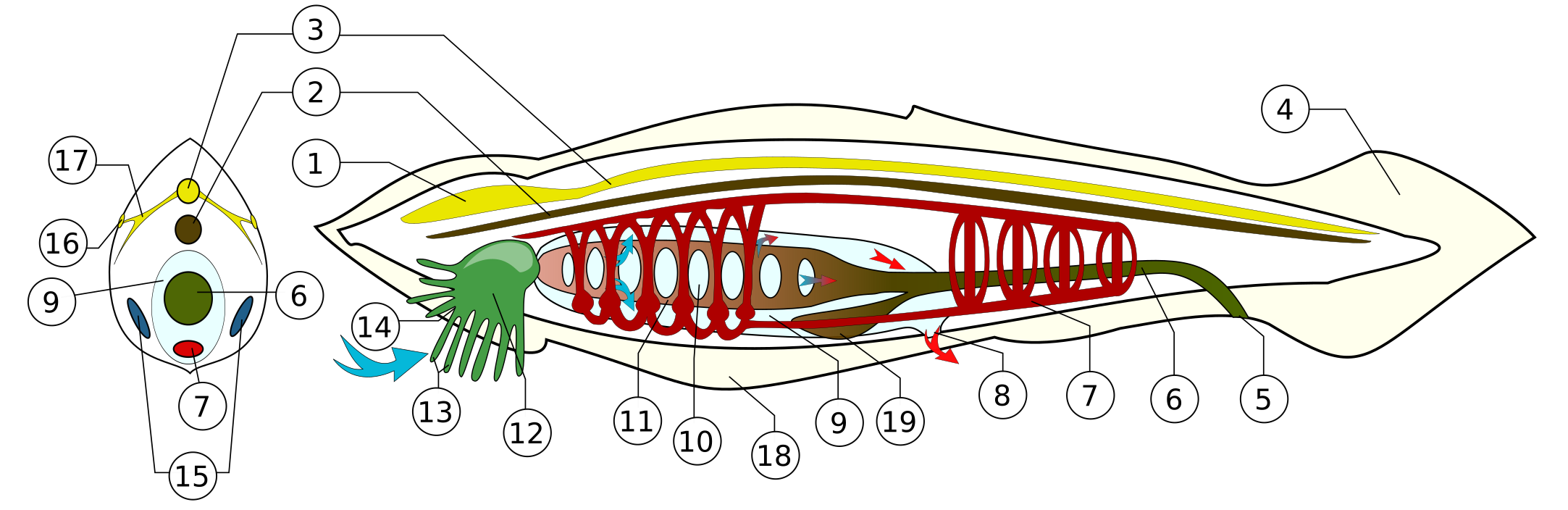
 1 = bulge in spinal cord ("brain")2 = notochord4 = post-anal tail5 = anus6 = digestive canal8 = atriopore9 = space above pharynx10 = pharyngeal slit (gill)11 = pharynx12 = vestibule13 = oral cirri14 = mouth opening16 = light sensor17 = nerves18 = metapleural fold19 = hepatic caecum (liver-like sack)Anatomy of the cephalochordate Amphioxus. Bolded items are components of all chordates at some point in their lifetime, and distinguish them from other phyla.
Chordates form a phylum of creatures that are based on a bilateral body plan,[1] and is defined by having at some stage in their lives all of the following:[2]
- A notochord, in other words a fairly stiff rod of cartilage that extends along the inside of the body. Among the vertebrate sub-group of chordates the notochord develops into the spine, and in wholly aquatic species this helps the animal to swim by flexing its tail.
- A dorsal neural tube. In fish and other vertebrates this develops into the spinal cord, the main communications trunk of the nervous system.
- Pharyngeal slits. The pharynx is the part of the throat immediately behind the mouth. In fish the slits are modified to form gills, but in some other chordates they are part of a filter-feeding system that extracts particles of food from the water in which the animals live.
- A muscular tail that extends backwards behind the anus.
- An endostyle. This is a groove in the ventral wall of the pharynx. In filter-feeding species it produces mucus to gather food particles, which helps in transporting food to the esophagus.[3] It also stores iodine, and may be a precursor of the vertebrate thyroid gland.[2]
Sub-divisions
Craniata

Craniates, one of the three sub-divisions of chordates, have distinct skulls - including Hagfish, which have no vertebrae. Michael J. Benton comments that "craniates are characterized by their heads, just as chordates, or possibly all deuterostomes, are by their tails." [4]
Most are vertebrates, in which the notochord is replaced by the spinal column. [5]
This consists of a series of bony or cartilaginous cylindrical vertebrae, generally with neural arches that protect the spinal cord and with projections that link the vertebrae. Hagfish have incomplete braincases and no vertebrae, and are therefore not regarded as vertebrates,[6] but as members of the craniates, the group from which vertebrates are thought to have evolved.[7] The position of lampreys is ambiguous. They have complete braincases and rudimentary vertebrae, and therefore may be regarded as vertebrates and true fish.[8] However molecular phylogenetics, which uses biochemical features to classify organisms, has produced both results that group them with vertebrates and others that group them with hagfish.[9]
Cephalochordata: "The Lancelets"

Cephalochordates are small, "vaguely fish-shaped" animals that lack brains, clearly defined heads and specialized sense organs.[10] These burrowing filter-feeders may be either the closest living relatives of craniates or surviving members of the group from which all other chordates evolved.[11][12]
Urochordata: "The Tunicates"
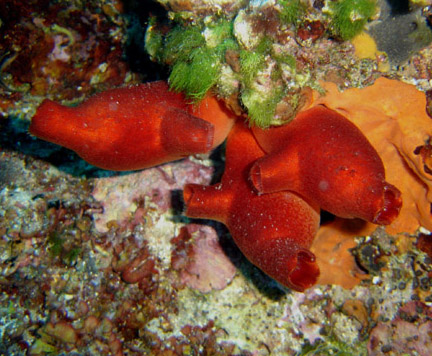
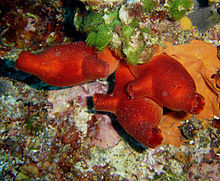 Tunicates: sea squirts
Most tunicates appear as adults in two major forms, both of which are soft-bodied filter-feeders that lack the standard features of chordates: "sea squirts" are sessile and consist mainly of water pumps and filter-feeding apparatus;[13] salps float in mid-water, feeding on plankton, and have a two-generation cycle in which one generation is solitary and the next forms chain-like colonies.[14] However all tunicate larvae have the standard chordate features, including long, tadpole-like tails; they also have rudimentary brains, light sensors and tilt sensors.[13] The third main group of tunicates, Appendicularia (also known as Larvacea) retain tadpole-like shapes and active swimming all their lives, and were for a long time regarded as larvae of sea squirts or salps.[15] Because of their larvae's long tails tunicates are also called urochordates ("tail chordates").[13]
Closest non-chordate relatives
The Hemichordates
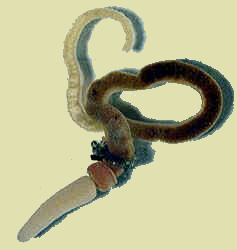
Main article: Hemichordate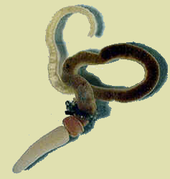 Enteropneust hemichordate: Bakiljkjanoglossus
Hemichordates ("half(1\2) chordates") have some features similar to those of chordates: branchial openings that open into the pharynx and look rather like gill slits; stomochords, similar in composition to notochords but running in a circle round the "collar", which is ahead of the mouth; and a dorsal nerve cord — but also a smaller ventral nerve cord.
There are two living groups of hemichordates. The solitary enteropneusts, commonly known as "acorn worms", have long probosces and worm-like bodies with up to 200 branchial slits, are up to 2.5 metres (8.2 ft) long, and burrow though seafloor sediments. Pterobranchs are colonial animals, often less than 1 millimetre (0.039 in) long individually, whose dwellings are inter-connected. Each filter feeds by means of a pair of branched tentacles, and has a short, shield-shaped proboscis. The extinct graptolites, colonial animals whose fossils look like tiny hacksaw blades, lived in tubes similar to those of pterobranchs.[16]
The Echinoderms

Echinoderms differ from chordates and their other relatives in three conspicuous ways: instead of having bilateral symmetry they have radial symmetry, meaning their body pattern is shaped like a wheel; they have tube feet; and their bodies are supported by skeletons made of calcite, a material not used by chordates. The hard calcified shell keeps their bodies well protected from the environment, and these skeletons enclose their bodies but are also covered by a thin skin. The feet are powered by another unique feature of echinoderms, a water vascular system of canals that also function as a "lung" and are surrounded by muscles that act as pumps. Crinoids look rather like flowers, and use their feather-like arms to filter food particles out of the water; most live anchored to rocks, but a few can move very slowly. Other echinoderms are mobile and take a variety of body shapes, for example starfish, sea urchins and sea cucumbers.[17]
Origins
The majority of animals more complex than jellyfish and other Cnidarians are split into two groups, the protostomes and deuterostomes, and chordates are deuterostomes.[18] It seems very likely that 555 million year old Kimberella was a member of the protostomes.[19][20] If so, this means that the protostome and deuterostome lineages must have split some time before Kimberella appeared — at least 558 million years ago, and hence well before the start of the Cambrian 542 million years ago.[18] The Ediacaran fossil Ernietta, from about 549 to 543 million years ago, may represent a deuterostome animal.[21]

Fossils of one major deuterostome group, the echinoderms (whose modern members include starfish, sea urchins and crinoids), are quite common from the start of the Cambrian, 542 million years ago.[23] The Mid Cambrian fossil Rhabdotubus johanssoni has been interpreted as a pterobranch hemichordate.[24] Opinions differ about whether the Chengjiang fauna fossil Yunnanozoon, from the earlier Cambrian, was a hemichordate or chordate.[25][26] Another fossil, Haikouella lanceolata, also from the Chengjiang fauna, is interpreted as a chordate and possibly a craniate, as it shows signs of a heart, arteries, gill filaments, a tail, a neural chord with a brain at the front end, and possibly eyes — although it also had short tentacles round its mouth.[26] Haikouichthys and Myllokunmingia, also from the Chengjiang fauna, are regarded as fish.[22][27] Pikaia, discovered much earlier but from the Mid Cambrian Burgess Shale, is also regarded as a primitive chordate.[28] On the other hand fossils of early chordates are very rare, since non-vertebrate chordates have no bones or teeth, and only one has been reported for the rest of the Cambrian.[29]
A consensus family tree of the chordates[3][30]Deuterostomes Xenoturbellida
Hemichordates
Chordates Cephalochordates
Tunicates (Urochordates)
Craniates
The evolutionary relationships between the chordate groups and between chordates as a whole and their closest deuterostome relatives have been debated since 1890. Studies based on anatomical, embryological, and paleontological data have produced different "family trees". Some closely linked chordates and hemichordates, but that idea is now rejected.[3] Combining such analyses with data from a small set of ribosome RNA genes eliminated some older ideas, but open the possibility that tunicates (urochordates) are "basal deuterostomes", in other words surviving members of the group from which echinoderms, hemichordates and chordates evolved.[31] Most researchers agree that, within the chordates, craniates are most closely related to cephalochordates, but there are also reasons for regarding tunicates (urochordates) as craniates' closest relatives.[3][32] One other phylum, Xenoturbellida, appears to be basal within the deuterostomes, in other words closer to the original deuterostomes than to the chordates, echinoderms and hemichordates.[30]
Since chordates have left a poor fossil record, attempts have been made to calculate the key dates in their evolution by molecular phylogenetics techniques, in other words by analysing biochemical differences, mainly in RNA. One such study suggested that deuterostomes arose before 900 million years ago and the earliest chordates around 896 million years ago.[32] However molecular estimates of dates often disagree with each other and with the fossil record,[32] and their assumption that the molecular clock runs at a known constant rate has been challenged.[33][34]
Classification
Taxonomy
The following schema is from the third edition of Vertebrate Palaeontology.[35] The invertebrate chordate classes are from Fishes of the World.[36] While it is structured so as to reflect evolutionary relationships (similar to a cladogram), it also retains the traditional ranks used in Linnaean taxonomy.
- Phylum Chordata
- Subphylum Tunicata (Urochordata) — (tunicates; 3,000 species)
-
-
- Class Ascidiacea(sea squirts)
- Class Thaliacea (salps)
- Class Appendicularia (larvaceans)
- Class Sorberacea (???)
-
-
- Subphylum Cephalochordata (Acraniata) — (lancelets; 30 species)
-
-
- Class Leptocardii (lancelets)
-
-
- Subphylum Vertebrata (Craniata) (vertebrates — animals with backbones; 57,674 species)
-
-
- Class 'Agnatha' paraphyletic (jawless vertebrates; 100+ species)
- Subclass Myxinoidea (hagfish; 65 species)
- Subclass Petromyzontida (lampreys)
- Subclass Conodonta†
- Subclass Pteraspidomorphi (Paleozoic jawless fish)
- Order Anaspida
- Order Thelodonti (Paleozoic jawless fish)
- Class 'Agnatha' paraphyletic (jawless vertebrates; 100+ species)
-
- Infraphylum Gnathostomata (jawed vertebrates)
-
-
- Class Placodermi (Paleozoic armoured forms)
- Class Chondrichthyes (cartilaginous fish; 900+ species)
- Class Acanthodii (Paleozoic "spiny sharks")
- Class Osteichthyes (bony fish; 30,000+ species)
- Subclass Actinopterygii (ray-finned fish; about 30,000 species)
- Subclass Sarcopterygii (lobe-finned fish: 8 species)
-
- Superclass Tetrapoda (four-limbed vertebrates; 28,000+ species)
-
- Class Amphibia (amphibians; 6,000 species)
- Class Reptilia (reptiles; 8,225+ species)
- Subclass Anapsida (extinct "proto-reptiles" and possibly turtles)
- Subclass Diapsida (majority of reptiles, progenitors of birds)
- Class Aves (birds; 8,800–10,000 species)
- Class Synapsida (mammal-like "reptiles"; 4,500+ species, progenitors of mammals)
- Class Mammalia (mammals; 5,800 species)
-
-
-
- Subphylum Tunicata (Urochordata) — (tunicates; 3,000 species)
Phylogeny
Chordates Cladogram of the Chordate phylum. Lines show probable evolutionary relationships, including extinct taxa, which are denoted with a dagger, †. Some are invertebrates. The positions (relationships) of the Lancelet, Tunicate, and Craniata clades are as reported[37] in the scientific journal Nature. Chordata Cephalochordata Amphioxus
Tunicata Appendicularia (formerly Larvacea)
Craniata Vertebrata Hyperoartia (Petromyzontida)
Gnathostomata Teleostomi Osteichthyes Sarcopterygii void Tetrapoda Amniota Synapsida void Sauropsida void Lepidosauromorpha (lizards, snakes, tuatara, and their extinct relatives)
Archosauromorpha (crocodiles, birds, and their extinct relatives)
See also
References
- ^ Valentine, J.W. (2004). On the Origin of Phyla. Chicago: University Of Chicago Press. p. 7. ISBN 0226845486."Classifications of organisms in hierarchical systems were in use by the seventeenth and eighteenth centuries. Usually organisms were grouped according to their morphological similarities as perceived by those early workers, and those groups were then grouped according to their similarities, and so on, to form a hierarchy."
- ^ a b Rychel, A.L., Smith, S.E., Shimamoto, H.T., and Swalla, B.J. (2006). "Evolution and Development of the Chordates: Collagen and Pharyngeal Cartilage". Molecular Biology and Evolution 23 (3): 541–549. doi:10.1093/molbev/msj055. PMID 16280542.
- ^ a b c d Ruppert, E. (2005). "Key characters uniting hemichordates and chordates: homologies or homoplasies?". Canadian Journal of Zoology 83: 8–23. doi:10.1139/Z04-158. http://article.pubs.nrc-cnrc.gc.ca/RPAS/RPViewDoc?_handler_=HandleInitialGet&articleFile=z04-158.pdf&journal=cjz&volume=83. Retrieved 2008-09-22.
- ^ Benton, M.J. (2000). Vertebrate Palaeontology: Biology and Evolution. Blackwell Publishing. pp. 12–13. ISBN 0632056142. http://books.google.com/?id=PQuKO7xqjNQC&dq=vertebrate&printsec=frontcover. Retrieved 2008-09-22.
- ^ "Morphology of the Vertebrates". University of California Museum of Paleontology. http://www.ucmp.berkeley.edu/vertebrates/vertmm.html. Retrieved 2008-09-23.
- ^ "Introduction to the Myxini". University of California Museum of Paleontology. http://www.ucmp.berkeley.edu/vertebrates/basalfish/myxini.html. Retrieved 2008-10-28.
- ^ Campbell, N.A. and Reece, J.B. (2005). Biology (7th ed.). San Francisco, CA: Benjamin Cummings. ISBN 0805370951.
- ^ "Introduction to the Petromyzontiformes". University of California Museum of Paleontology. http://www.ucmp.berkeley.edu/vertebrates/basalfish/petro.html. Retrieved 2008-10-28.
- ^ Shigehiro Kuraku, S., Hoshiyama, D., Katoh, K., Suga, H, and Miyata, T. (December 1999). "Monophyly of Lampreys and Hagfishes Supported by Nuclear DNA-Coded Genes". Journal of Molecular Evolution 49 (6): 729–735. doi:10.1007/PL00006595. PMID 10594174.
- ^ Benton, M.J. (2000). Vertebrate Palaeontology: Biology and Evolution. Blackwell Publishing. p. 6. ISBN 0632056142. http://books.google.com/?id=PQuKO7xqjNQC&dq=vertebrate&printsec=frontcover. Retrieved 2008-09-22.
- ^ Gee, H. (June 2008). "Evolutionary biology: The amphioxus unleashed". Nature 453 (7198): 999–1000. Bibcode 2008Natur.453..999G. doi:10.1038/453999a. PMID 18563145. http://www.nature.com/nature/journal/v453/n7198/full/453999a.html. Retrieved 2008-09-22.
- ^ "Branchiostoma". Lander University. http://webs.lander.edu/rsfox/invertebrates/branchiostoma.html. Retrieved 2008-09-23.
- ^ a b c Benton, M.J. (2000). Vertebrate Palaeontology: Biology and Evolution. Blackwell Publishing. p. 5. ISBN 0632056142. http://books.google.com/?id=PQuKO7xqjNQC&dq=vertebrate&printsec=frontcover. Retrieved 2008-09-22.
- ^ "Animal fact files: salp". BBC. http://www.bbc.co.uk/nature/blueplanet/factfiles/jellies/salp_bg.shtml. Retrieved 2008-09-22.
- ^ "Appendicularia" (PDF). Australian Government Department of the Environment, Water, Heritage and the Arts. http://www.environment.gov.au/biodiversity/abrs/publications/electronic-books/pubs/tunicates/05-appendicularia.pdf. Retrieved 2008-10-28.
- ^ "Introduction to the Hemichordata". University of California Museum of Paleontology. http://www.ucmp.berkeley.edu/chordata/hemichordata.html. Retrieved 2008-09-22.
- ^ Cowen, R. (2000). History of Life (3rd ed.). Blackwell Science. p. 412. ISBN 063204444-6.
- ^ a b Erwin, Douglas H.; Eric H. Davidson (July 1, 2002). "The last common bilaterian ancestor". Development 129 (13): 3021–3032. PMID 12070079. http://dev.biologists.org/cgi/content/full/129/13/3021.
- ^ New data on Kimberella, the Vendian mollusc-like organism (White sea region, Russia): palaeoecological and evolutionary implications (2007), "Fedonkin, M.A.; Simonetta, A; Ivantsov, A.Y.", in Vickers-Rich, Patricia; Komarower, Patricia, The Rise and Fall of the Ediacaran Biota, Special publications, 286, London: Geological Society, pp. 157–179, doi:10.1144/SP286.12, ISBN 9781862392335, OCLC 191881597 156823511 191881597
- ^ Butterfield, N.J. (2006). "Hooking some stem-group "worms": fossil lophotrochozoans in the Burgess Shale". Bioessays 28 (12): 1161–6. doi:10.1002/bies.20507. PMID 17120226.
- ^ Dzik , J. (June 1999). "Organic membranous skeleton of the Precambrian metazoans from Namibia". Geology 27 (6): 519–522. Bibcode 1999Geo....27..519D. doi:10.1130/0091-7613(1999)027<0519:OMSOTP>2.3.CO;2. http://geology.geoscienceworld.org/cgi/content/abstract/27/6/519. Retrieved 2008-09-22. Ernettia is from the Kuibis formation, approximate date given by Waggoner, B. (2003). "The Ediacaran Biotas in Space and Time". Integrative and Comparative Biology 43 (1): 104–113. doi:10.1093/icb/43.1.104. PMID 21680415. http://icb.oxfordjournals.org/cgi/content/full/43/1/104. Retrieved 2008-09-22.
- ^ a b Shu, D-G., Conway Morris, S., and Han, J (January 2003). "Head and backbone of the Early Cambrian vertebrate Haikouichthys". Nature 421 (6922): 526–529. Bibcode 2003Natur.421..526S. doi:10.1038/nature01264. PMID 12556891. http://www.nature.com/nature/journal/v421/n6922/abs/nature01264.html. Retrieved 2008-09-21.
- ^ Bengtson, S. (2004). Early skeletal fossils. In Lipps, J.H., and Waggoner, B.M.. "Neoproterozoic-Cambrian Biological Revolutions" (PDF). Paleontological Society Papers 10: 67–78. http://www.cosmonova.org/download/18.4e32c81078a8d9249800021554/Bengtson2004ESF.pdf. Retrieved 2008-07-18.
- ^ Bengtson, S., and Urbanek, A. (October 2007). "Rhabdotubus, a Middle Cambrian rhabdopleurid hemichordate". Lethaia 19 (4): 293–308. doi:10.1111/j.1502-3931.1986.tb00743.x. http://www3.interscience.wiley.com/journal/120025616/abstract. Retrieved 2008-09-23.
- ^ Shu, D., Zhang, X. and Chen, L. (April 1996). "Reinterpretation of Yunnanozoon as the earliest known hemichordate". Nature 380 (6573): 428–430. Bibcode 1996Natur.380..428S. doi:10.1038/380428a0. http://www.nature.com/nature/journal/v380/n6573/abs/380428a0.html. Retrieved 2008-09-23.
- ^ a b Chen, J-Y., Hang, D-Y., and Li, C.W. (December 1999). "An early Cambrian craniate-like chordate". Nature 402 (6761): 518–522. Bibcode 1999Natur.402..518C. doi:10.1038/990080. http://www.nature.com/nature/journal/v402/n6761/abs/402518a0.html. Retrieved 2008-09-23.
- ^ Shu, D-G., Conway Morris, S., and Zhang, X-L. (November 1999). "Lower Cambrian vertebrates from south China" (PDF). Nature 402 (6757): 42. Bibcode 1999Natur.402...42S. doi:10.1038/46965. http://www.bios.niu.edu/davis/bios458/Shu1.pdf. Retrieved 2008-09-23.
- ^ Shu, D-G., Conway Morris, S., and Zhang, X-L. (November 1996). "A Pikaia-like chordate from the Lower Cambrian of China". Nature 384 (6605): 157–158. Bibcode 1996Natur.384..157S. doi:10.1038/384157a0. http://www.nature.com/nature/journal/v384/n6605/abs/384157a0.html. Retrieved 2008-09-23.
- ^ Conway Morris, S. (2008). "A Redescription of a Rare Chordate, Metaspriggina walcotti Simonetta and Insom, from the Burgess Shale (Middle Cambrian), British Columbia, Canada". Journal of Paleontology 82 (2): 424–430. doi:10.1666/06-130.1. http://jpaleontol.geoscienceworld.org/cgi/content/extract/82/2/424. Retrieved 2009-04-28.
- ^ a b Perseke M, Hankeln T, Weich B, Fritzsch G, Stadler PF, Israelsson O, Bernhard D, Schlegel M. (2007) "The mitochondrial DNA of Xenoturbella bocki: genomic architecture and phylogenetic analysis". Theory Biosci. 126(1):35–42. Available online at [1]
- ^ Winchell, C.J., Sullivan, J., Cameron, C.B., Swalla, B.J., and Mallatt, J. (May 1, 2002). "Evaluating Hypotheses of Deuterostome Phylogeny and Chordate Evolution with New LSU and SSU Ribosomal DNA Data". Molecular Biology and Evolution 19 (5): 762–776. PMID 11961109. http://mbe.oxfordjournals.org/cgi/content/full/19/5/762#MBEV-19-05-09-SWALLA1. Retrieved 2008-09-23.
- ^ a b c Blair, J.E., and S. Blair Hedges, S.B. (2005). "Molecular Phylogeny and Divergence Times of Deuterostome Animals". Molecular Biology and Evolution 22 (11): 2275–2284. doi:10.1093/molbev/msi225. PMID 16049193. http://mbe.oxfordjournals.org/cgi/content/full/22/11/2275. Retrieved 2008-09-23.
- ^ Ayala, F.J. (1999). "Molecular clock mirages". BioEssays 21 (1): 71–75. doi:10.1002/(SICI)1521-1878(199901)21:1<71::AID-BIES9>3.0.CO;2-B. PMID 10070256. http://www3.interscience.wiley.com/cgi-bin/abstract/60000186/ABSTRACT?CRETRY=1&SRETRY=0.
- ^ Schwartz, J. H. and Maresca, B. (2006). "Do Molecular Clocks Run at All? A Critique of Molecular Systematics". Biological Theory 1 (4): 357–371. doi:10.1162/biot.2006.1.4.357.
- ^ Benton, M.J. (2004). Vertebrate Palaeontology, Third Edition. Blackwell Publishing, 472 pp. The classification scheme is available online
- ^ Nelson, J. S. (2006). Fishes of the World (4th ed.). New York: John Wiley and Sons, Inc. pp. 601 pp.. ISBN 0-471-25031-7.
- ^ Putnam, H.; Butts, T.; Ferrier, E.; Furlong, F.; Hellsten, U.; Kawashima, T.; Robinson-Rechavi, M.; Shoguchi, E. et al. (Jun 2008). "The amphioxus genome and the evolution of the chordate karyotype". Nature 453 (7198): 1064–1071. Bibcode 2008Natur.453.1064P. doi:10.1038/nature06967. ISSN 0028-0836. PMID 18563158.
External links
- Complete details about Phylum Chordata at thebigger.com
- Chordate on GlobalTwitcher.com
- Chordate node at Tree Of Life
- Chordate node at NCBI Taxonomy
Extant phyla of kingdom Animalia by subkingdom Parazoa - Porifera
- Placozoa
Mesozoa Eumetazoa SpiraliaGnathiferaTrochozoaLophophorata- Phoronida
- Brachiopoda
- Bryozoa (?)
- Entoprocta (?)
- Chordata
Basal/disputedExtant Chordata classes by subphylum Urochordata (Tunicates) Cephalochordata (Lancelets) Craniata Categories:- Deuterostomia
- Chordates
- Phyla




Wikimedia Foundation. 2010.