

- Infectious disease
-
Infectious disease Classification and external resources 
A false-colored electron micrograph shows a malaria sporozoite migrating through the midgut epithelia.ICD-10 A00-B99 ICD-9 001-139 MeSH D003141 Infectious diseases, also known as communicable diseases, contagious diseases or transmissible diseases comprise clinically evident illness (i.e., characteristic medical signs and/or symptoms of disease) resulting from the infection, presence and growth of pathogenic biological agents in an individual host organism. In certain cases, infectious diseases may be asymtomatic for much or all of their course. Infectious pathogens include some viruses, bacteria, fungi, protozoa, multicellular parasites, and aberrant proteins known as prions. These pathogens are the cause of disease epidemics, in the sense that without the pathogen, no infectious epidemic occurs.
Transmission of pathogen can occur in various ways including physical contact, contaminated food, body fluids, objects, airborne inhalation, or through vector organisms.[1] Infectious diseases that are especially infective are sometimes called contagious and can be easily transmitted by contact with an ill person or their secretions. Infectious diseases with more specialized routes of infection, such as vector transmission or sexual transmission, are usually regarded as contagious but do not require medical quarantine of victims.
The term infectivity describes the ability of an organism to enter, survive and multiply in the host, while the infectiousness of a disease indicates the comparative ease with which the disease is transmitted to other hosts.[2] An infection is not synonymous with an infectious disease, as some infections do not cause illness in a host.[1]
Contents
Classification
Among the almost infinite varieties of microorganisms, relatively few cause disease in otherwise healthy individuals.[3] Infectious disease results from the interplay between those few pathogens and the defenses of the hosts they infect. The appearance and severity of disease resulting from any pathogen depends upon the ability of that pathogen to damage the host as well as the ability of the host to resist the pathogen. Clinicians therefore classify infectious microorganisms or microbes according to the status of host defenses - either as primary pathogens or as opportunistic pathogens:
- Primary pathogens cause disease as a result of their presence or activity within the normal, healthy host, and their intrinsic virulence (the severity of the disease they cause) is, in part, a necessary consequence of their need to reproduce and spread. Many of the most common primary pathogens of humans only infect humans, however many serious diseases are caused by organisms acquired from the environment or which infect non-human hosts.
- Organisms which cause an infectious disease in a host with depressed resistance are classified as opportunistic pathogens. Opportunistic disease may be caused by microbes that are ordinarily in contact with the host, such as pathogenic bacteria or fungi in the gastrointestinal or the upper respiratory tract, and they may also result from (otherwise innocuous) microbes acquired from other hosts (as in Clostridium difficile colitis) or from the environment as a result of traumatic introduction (as in surgical wound infections or compound fractures). An opportunistic disease requires impairment of host defenses, which may occur as a result of genetic defects (such as Chronic granulomatous disease), exposure to antimicrobial drugs or immunosuppressive chemicals (as might occur following poisoning or cancer chemotherapy), exposure to ionizing radiation, or as a result of an infectious disease with immunosuppressive activity (such as with measles, malaria or HIV disease). Primary pathogens may also cause more severe disease in a host with depressed resistance than would normally occur in an immunosufficient host.[1]
One way of proving that a given disease is "infectious", is to satisfy Koch's postulates (first proposed by Robert Koch), which demands that the infectious agent be identified only in patients and not in healthy controls, and that patients who contract the agent also develop the disease. These postulates were first used in the discovery that Mycobacteria species cause tuberculosis. Koch's postulates can not be met ethically for many human diseases because they require experimental infection of a healthy individual with a pathogen produced as a pure culture. Often, even diseases that are quite clearly infectious do not meet the infectious criteria. For example, Treponema pallidum, the causative spirochete of syphilis, cannot be cultured in vitro - however the organism can be cultured in rabbit testes. It is less clear that a pure culture comes from an animal source serving as host than it is when derived from microbes derived from plate culture. Epidemiology is another important tool used to study disease in a population. For infectious diseases it helps to determine if a disease outbreak is sporadic (occasional occurrence), endemic (regular cases often occurring in a region), epidemic (an unusually high number of cases in a region), or pandemic (a global epidemic).
Transmission
 Washing one's hands, a form of hygiene, is the most effective way to prevent the spread of infectious disease.
An infectious disease is transmitted from some source. Defining the means of transmission plays an important part in understanding the biology of an infectious agent, and in addressing the disease it causes. Transmission may occur through several different mechanisms. Respiratory diseases and meningitis are commonly acquired by contact with aerosolized droplets, spread by sneezing, coughing, talking, kissing or even singing. Gastrointestinal diseases are often acquired by ingesting contaminated food and water. Sexually transmitted diseases are acquired through contact with bodily fluids, generally as a result of sexual activity. Some infectious agents may be spread as a result of contact with a contaminated, inanimate object (known as a fomite), such as a coin passed from one person to another, while other diseases penetrate the skin directly.[1]
Transmission of infectious diseases may also involve a vector. Vectors may be mechanical or biological. A mechanical vector picks up an infectious agent on the outside of its body and transmits it in a passive manner. An example of a mechanical vector is a housefly, which lands on cow dung, contaminating its appendages with bacteria from the feces, and then lands on food prior to consumption. The pathogen never enters the body of the fly.
 Culex mosquitos (Culex quinquefasciatus shown) are biological vectors that transmit West Nile Virus.
In contrast, biological vectors harbor pathogens within their bodies and deliver pathogens to new hosts in an active manner, usually a bite. Biological vectors are often responsible for serious blood-borne diseases, such as malaria, viral encephalitis, Chagas disease, Lyme disease and African sleeping sickness. Biological vectors are usually, though not exclusively, arthropods, such as mosquitoes, ticks, fleas and lice. Vectors are often required in the life cycle of a pathogen. A common strategy used to control vector borne infectious diseases is to interrupt the life cycle of a pathogen by killing the vector.
The relationship between virulence and transmission is complex, and has important consequences for the long term evolution of a pathogen. Since it takes many generations for a microbe and a new host species to co-evolve, an emerging pathogen may hit its earliest victims especially hard. It is usually in the first wave of a new disease that death rates are highest. If a disease is rapidly fatal, the host may die before the microbe can get passed along to another host. However, this cost may be overwhelmed by the short term benefit of higher infectiousness if transmission is linked to virulence, as it is for instance in the case of cholera (the explosive diarrhea aids the bacterium in finding new hosts) or many respiratory infections (sneezing and coughing create infectious aerosols).
Prevention
One of the ways to prevent or slow down the transmission of infectious diseases is to recognize the different characteristics of various diseases.[4] Some critical disease characteristics that should be evaluated include virulence, distance traveled by victims, and level of contagiousness. The human strains of Ebola virus, for example, incapacitate its victims extremely quickly and kills them soon after. As a result, the victims of this disease do not have the opportunity to travel very far from the initial infection zone.[5] Also, this virus must spread through skin lesions or permeable membranes such as the eye. Thus, the initial stage of Ebola is not very contagious since its victims experience only internal hemorrhaging. As a result of the above features, the spread of Ebola is very rapid and usually stays within a relatively confined geographical area. In contrast, the Human Immunodeficiency Virus (HIV) kills its victims very slowly by attacking their immune system.[1] As a result, many of its victims transmit the virus to other individuals before even realizing that they are carrying the disease. Also, the relatively low virulence allows its victims to travel long distances, increasing the likelihood of an epidemic.
Another effective way to decrease the transmission rate of infectious diseases is to recognize the effects of small-world networks.[4] In epidemics, there are often extensive interactions within hubs or groups of infected individuals and other interactions within discrete hubs of susceptible individuals. Despite the low interaction between discrete hubs, the disease can jump to and spread in a susceptible hub via a single or few interactions with an infected hub. Thus, infection rates in small-world networks can be reduced somewhat if interactions between individuals within infected hubs are eliminated (Figure 1). However, infection rates can be drastically reduced if the main focus is on the prevention of transmission jumps between hubs. The use of needle exchange programs in areas with a high density of drug users with HIV is an example of the successful implementation of this treatment method. [6] Another example is the use of ring culling or vaccination of potentially susceptible livestock in adjacent farms to prevent the spread of the foot-and-mouth virus in 2001.[6]
General methods to prevent transmission of pathogens may include disinfection and pest control.
Immunity
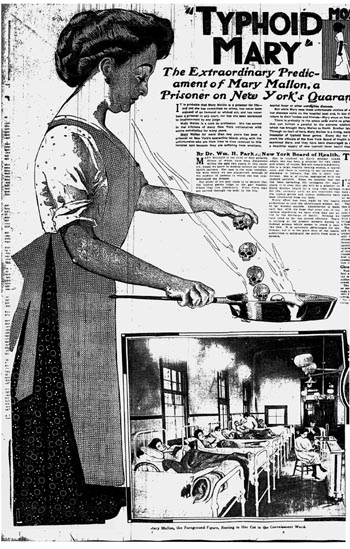
 Mary Mallon (a.k.a Typhoid Mary) was an asymptomatic carrier of typhoid fever. Over the course of her career as a cook, she infected 53 people, three of whom died.
Infection with most pathogens does not result in death of the host and the offending organism is ultimately cleared after the symptoms of the disease have waned.[3] This process requires immune mechanisms to kill or inactivate the inoculum of the pathogen. Specific acquired immunity against infectious diseases may be mediated by antibodies and/or T lymphocytes. Immunity mediated by these two factors may be manifested by:
- a direct effect upon a pathogen, such as antibody-initiated complement-dependent bacteriolysis, opsonoization, phagocytosis and killing, as occurs for some bacteria,
- neutralization of viruses so that these organisms cannot enter cells,
- or by T lymphocytes which will kill a cell parasitized by a microorganism.
The immune system response to a microorganism often causes symptoms such as a high fever and inflammation, and has the potential to be more devastating than direct damage caused by a microbe.[1]
Resistance to infection (immunity) may be acquired following a disease, by asymptomatic carriage of the pathogen, by harboring an organism with a similar structure (crossreacting), or by vaccination. Knowledge of the protective antigens and specific acquired host immune factors is more complete for primary pathogens than for opportunistic pathogens.
Immune resistance to an infectious disease requires a critical level of either antigen-specific antibodies and/or T cells when the host encounters the pathogen. Some individuals develop natural serum antibodies to the surface polysaccharides of some agents although they have had little or no contact with the agent, these natural antibodies confer specific protection to adults and are passively transmitted to newborns.
Host genetic factors
The clearance of the pathogens, either treatment-induced or spontaneous, it can be influenced by the genetic variants carried by the individual patients. For instance, for genotype 1 hepatitis C treated with Pegylated interferon-alpha-2a or Pegylated interferon-alpha-2b (brand names Pegasys or PEG-Intron) combined with ribavirin, it has been shown that genetic polymorphisms near the human IL28B gene, encoding interferon lambda 3, are associated with significant differences in the treatment-induced clearance of the virus. This finding, originally reported in Nature,[7] showed that genotype 1 hepatitis C patients carrying certain genetic variant alleles near the IL28B gene are more possibly to achieve sustained virological response after the treatment than others. Later report from Nature[8] demonstrated that the same genetic variants are also associated with the natural clearance of the genotype 1 hepatitis C virus.
Diagnosis
Diagnosis of infectious disease sometimes involves identifying an infectious agent either directly or indirectly. In practice most minor infectious diseases such as warts, cutaneous abscesses, respiratory system infections and diarrheal diseases are diagnosed by their clinical presentation. Conclusions about the cause of the disease are based upon the likelihood that a patient came in contact with a particular agent, the presence of a microbe in a community, and other epidemiological considerations. Given sufficient effort, all known infectious agents can be specifically identified. The benefits of identification, however, are often greatly outweighed by the cost, as often there is no specific treatment, the cause is obvious, or the outcome of an infection is benign.
Specific identification of an infectious agent is usually only determined when such identification can aid in the treatment or prevention of the disease, or to advance knowledge of the course of an illness prior to the development of effective therapeutic or preventative measures. For example, in the early 1980s, prior to the appearance of AZT for the treatment of AIDS, the course of the disease was closely followed by monitoring the composition of patient blood samples, even though the outcome would not offer the patient any further treatment options. In part, these studies on the appearance of HIV in specific communities permitted the advancement of hypotheses as to the route of transmission of the virus. By understanding how the disease was transmitted, resources could be targeted to the communities at greatest risk in campaigns aimed at reducing the number of new infections. The specific serological diagnostic identification, and later genotypic or molecular identification, of HIV also enabled the development of hypotheses as to the temporal and geographical origins of the virus, as well as a myriad of other hypothesis.[1] The development of molecular diagnostic tools have enabled physicians and researchers to monitor the efficacy of treatment with anti-retroviral drugs. Molecular diagnostics are now commonly used to identify HIV in healthy people long before the onset of illness and have been used to demonstrate the existence of people who are genetically resistant to HIV infection. Thus, while there still is no cure for AIDS, there is great therapeutic and predictive benefit to identifying the virus and monitoring the virus levels within the blood of infected individuals, both for the patient and for the community at large.
Diagnosis of infectious disease is nearly always initiated by medical history and physical examination. More detailed identification techniques involve the culture of infectious agents isolated from a patient. Culture allows identification of infectious organisms by examining their microscopic features, by detecting the presence of substances produced by pathogens, and by directly identifying an organism by its genotype. Other techniques (such as X-rays, CAT scans, PET scans or NMR) are used to produce images of internal abnormalities resulting from the growth of an infectious agent. The images are useful in detection of, for example, a bone abscess or a spongiform encephalopathy produced by a prion.
Microbial culture

Microbiological culture is a principal tool used to diagnose infectious disease. In a microbial culture, a growth medium is provided for a specific agent. A sample taken from potentially diseased tissue or fluid is then tested for the presence of an infectious agent able to grow within that medium. Most pathogenic bacteria are easily grown on nutrient agar, a form of solid medium that supplies carbohydrates and proteins necessary for growth of a bacterium, along with copious amounts of water. A single bacterium will grow into a visible mound on the surface of the plate called a colony, which may be separated from other colonies or melded together into a "lawn". The size, color, shape and form of a colony is characteristic of the bacterial species, its specific genetic makeup (its strain), and the environment which supports its growth. Other ingredients are often added to the plate to aid in identification. Plates may contain substances that permit the growth of some bacteria and not others, or that change color in response to certain bacteria and not others. Bacteriological plates such as these are commonly used in the clinical identification of infectious bacterium. Microbial culture may also be used in the identification of viruses: the medium in this case being cells grown in culture that the virus can infect, and then alter or kill. In the case of viral identification, a region of dead cells results from viral growth, and is called a "plaque". Eukaryotic parasites may also be grown in culture as a means of identifying a particular agent.
In the absence of suitable plate culture techniques, some microbes require culture within live animals. Bacteria such as Mycobacterium leprae and T. pallidum can be grown in animals, although serological and microscopic techniques make the use of live animals unnecessary. Viruses are also usually identified using alternatives to growth in culture or animals. Some viruses may be grown in embryonated eggs. Another useful identification method is Xenodiagnosis, or the use of a vector to support the growth of an infectious agent. Chagas disease is the most significant example, because it is difficult to directly demonstrate the presence of the causative agent, Trypanosoma cruzi in a patient, which therefore makes it difficult to definitively make a diagnosis. In this case, xenodiagnosis involves the use of the vector of the Chagas agent T. cruzi, an uninfected triatomine bug, which takes a blood meal from a person suspected of having been infected. The bug is later inspected for growth of T. cruzi within its gut.
Microscopy
Another principal tool in the diagnosis of infectious disease is microscopy. Virtually all of the culture techniques discussed above rely, at some point, on microscopic examination for definitive identification of the infectious agent. Microscopy may be carried out with simple instruments, such as the compound light microscope, or with instruments as complex as an electron microscope. Samples obtained from patients may be viewed directly under the light microscope, and can often rapidly lead to identification. Microscopy is often also used in conjunction with biochemical staining techniques, and can be made exquisitely specific when used in combination with antibody based techniques. For example, the use of antibodies made artificially fluorescent (fluorescently labeled antibodies) can be directed to bind to and identify a specific antigens present on a pathogen. A fluorescence microscope is then used to detect fluorescently labeled antibodies bound to internalized antigens within clinical samples or cultured cells. This technique is especially useful in the diagnosis of viral diseases, where the light microscope is incapable of identifying a virus directly.
Other microscopic procedures may also aid in identifying infectious agents. Almost all cells readily stain with a number of basic dyes due to the electrostatic attraction between negatively charged cellular molecules and the positive charge on the dye. A cell is normally transparent under a microscope, and using a stain increases the contrast of a cell with its background. Staining a cell with a dye such as Giemsa stain or crystal violet allows a microscopist to describe its size, shape, internal and external components and its associations with other cells. The response of bacteria to different staining procedures is used in the taxonomic classification of microbes as well. Two methods, the Gram stain and the acid-fast stain, are the standard approaches used to classify bacteria and to diagnosis of disease. The Gram stain identifies the bacterial groups Firmicutes and Actinobacteria, both of which contain many significant human pathogens. The acid-fast staining procedure identifies the Actinobacterial genera Mycobacterium and Nocardia.
Biochemical tests
Biochemical tests used in the identification of infectious agents include the detection of metabolic or enzymatic products characteristic of a particular infectious agent. Since bacteria ferment carbohydrates in patterns characteristic of their genus and species, the detection of fermentation products is commonly used in bacterial identification. Acids, alcohols and gases are usually detected in these tests when bacteria are grown in selective liquid or solid media.
The isolation of enzymes from infected tissue can also provide the basis of a biochemical diagnosis of an infectious disease. For example, humans can make neither RNA replicases nor reverse transcriptase, and the presence of these enzymes are characteristic of specific types of viral infections. The ability of the viral protein hemagglutinin to bind red blood cells together into a detectable matrix may also be characterized as a biochemical test for viral infection, although strictly speaking hemagglutinin is not an enzyme and has no metabolic function.
Serological methods are highly sensitive, specific and often extremely rapid tests used to identify microorganisms. These tests are based upon the ability of an antibody to bind specifically to an antigen. The antigen, usually a protein or carbohydrate made by an infectious agent, is bound by the antibody. This binding then sets off a chain of events that can be visibly obvious in various ways, dependent upon the test. For example, "Strep throat" is often diagnosed within minutes, and is based on the appearance of antigens made by the causative agent, S. pyogenes, that is retrieved from a patients throat with a cotton swab. Serological tests, if available, are usually the preferred route of identification, however the tests are costly to develop and the reagents used in the test often require refrigeration. Some serological methods are extremely costly, although when commonly used, such as with the "strep test", they can be inexpensive.[1]
Complex serological techniques have been developed into what are known as Immunoassays. Immunoassays can use the basic antibody – antigen binding as the basis to produce an electro - magnetic or particle radiation signal, which can be detected by some form of instrumentation. Signal of unknowns can be compared to that of standards allowing quantitation of the target antigen. To aid in the diagnosis of infectious diseases, immunoassays can detect or measure antigens from either infectious agents or proteins generated by an infected organism in response to a foreign agent. For example, immunoassay A may detect the presence of a surface protein from a virus particle. Immunoassay B on the other hand may detect or measure antibodies produced by an organism’s immune system which are made to neutralize and allow the destruction of the virus.
Instrumentation can be used to read extremely small signals created by secondary reactions linked to the antibody – antigen binding. Instrumentation can control sampling, reagent use, reaction times, signal detection, calculation of results, and data management to yield a cost effective automated process for diagnosis of infectious disease.
Molecular diagnostics
Technologies based upon the polymerase chain reaction (PCR) method will become nearly ubiquitous gold standards of diagnostics of the near future, for several reasons. First, the catalog of infectious agents has grown to the point that virtually all of the significant infectious agents of the human population have been identified. Second, an infectious agent must grow within the human body to cause disease; essentially it must amplify its own nucleic acids in order to cause a disease. This amplification of nucleic acid in infected tissue offers an opportunity to detect the infectious agent by using PCR. Third, the essential tools for directing PCR, primers, are derived from the genomes of infectious agents, and with time those genomes will be known, if they are not already.
Thus, the technological ability to detect any infectious agent rapidly and specifically are currently available. The only remaining blockades to the use of PCR as a standard tool of diagnosis are in its cost and application, neither of which is insurmountable. The diagnosis of a few diseases will not benefit from the development of PCR methods, such as some of the clostridial diseases (tetanus and botulism). These diseases are fundamentally biological poisonings by relatively small numbers of infectious bacteria that produce extremely potent neurotoxins. A significant proliferation of the infectious agent does not occur, this limits the ability of PCR to detect the presence of any bacteria.
Epidemiology
 Disability-adjusted life year for infectious and parasitic diseases per 100,000 inhabitants in 2004.[9]no data≤250250-500500-10001000-20002000-30003000-40004000-50005000-62506250-1250012500-2500025000-50000≥50000
The World Health Organization collects information on global deaths by International Classification of Disease (ICD) code categories. The following table lists the top infectious disease killers which caused more than 100,000 deaths in 2002 (estimated). 1993 data is included for comparison.
Worldwide mortality due to infectious diseases[10][11] Rank Cause of death Deaths 2002
(in millions)Percentage of
all deathsDeaths 1993
(in millions)1993 Rank N/A All infectious diseases 14.7 25.9% 16.4 32.2% 1 Lower respiratory infections[12] 3.9 6.9% 4.1 1 2 HIV/AIDS 2.8 4.9% 0.7 7 3 Diarrheal diseases[13] 1.8 3.2% 3.0 2 4 Tuberculosis (TB) 1.6 2.7% 2.7 3 5 Malaria 1.3 2.2% 2.0 4 6 Measles 0.6 1.1% 1.1 5 7 Pertussis 0.29 0.5% 0.36 7 8 Tetanus 0.21 0.4% 0.15 12 9 Meningitis 0.17 0.3% 0.25 8 10 Syphilis 0.16 0.3% 0.19 11 11 Hepatitis B 0.10 0.2% 0.93 6 12-17 Tropical diseases (6)[14] 0.13 0.2% 0.53 9, 10, 16-18 Note: Other causes of death include maternal and perinatal conditions (5.2%), nutritional deficiencies (0.9%),
noncommunicable conditions (58.8%), and injuries (9.1%).The top three single agent/disease killers are HIV/AIDS, TB and malaria. While the number of deaths due to nearly every disease have decreased, deaths due to HIV/AIDS have increased fourfold. Childhood diseases include pertussis, poliomyelitis, diphtheria, measles and tetanus. Children also make up a large percentage of lower respiratory and diarrheal deaths.
Historic pandemics
 A young Bangladeshi girl infected with smallpox (1973). Due to the development of the smallpox vaccine, the disease was officially eradicated in 1979.
A pandemic (or global epidemic) is a disease that affects people over an extensive geographical area.
- Plague of Justinian, from 541 to 750, killed between 50% and 60% of Europe's population.[15]
- The Black Death of 1347 to 1352 killed 25 million in Europe over 5 years (estimated to be between 25 and 50% of the populations of Europe, Asia, and Africa - the world population at the time was 500 million).
- The introduction of smallpox, measles, and typhus to the areas of Central and South America by European explorers during the 15th and 16th centuries caused pandemics among the native inhabitants. Between 1518 and 1568 disease pandemics are said to have caused the population of Mexico to fall from 20 million to 3 million.[16]
- The first European influenza epidemic occurred between 1556 and 1560, with an estimated mortality rate of 20%.[16]
- Smallpox killed an estimated 60 million Europeans during the 18th century[17] (approximately 400,000 per year).[18] Up to 30% of those infected, including 80% of the children under 5 years of age, died from the disease, and one third of the survivors went blind.[19]
- In the 19th century, tuberculosis killed an estimated one-quarter of the adult population of Europe;[20] by 1918 one in six deaths in France were still caused by TB.
- The Influenza Pandemic of 1918 (or the Spanish Flu) killed 25-50 million people (about 2% of world population of 1.7 billion).[21] Today Influenza kills about 250,000 to 500,000 worldwide each year.
Emerging diseases
In most cases, microorganisms live in harmony with their hosts via mutual or commensal interactions. Diseases can emerge when existing parasites become pathogenic or when new pathogenic parasites enter a new host.
- Coevolution between parasite and host can lead to hosts becoming resistant to the parasites or the parasites may evolve greater virulence, leading to immunopathological disease.
- Human activity is involved with many emerging infectious diseases, such as environmental change enabling a parasite to occupy new niches. When that happens, a pathogen that had been confined to a remote habitat has a wider distribution and possibly a new host organism. Parasites jumping from nonhuman to human hosts are known as zoonoses. Under disease invasion, when a parasite invades a new host species, it may become pathogenic in the new host.[22]
Several human activities have led to the emergence and spread of new diseases,[22] see also Globalization and Disease and Wildlife disease:
- Encroachment on wildlife habitats. The construction of new villages and housing developments in rural areas force animals to live in dense populations, creating opportunities for microbes to mutate and emerge.[23]
- Changes in agriculture. The introduction of new crops attracts new crop pests and the microbes they carry to farming communities, exposing people to unfamiliar diseases.
- The destruction of rain forests. As countries make use of their rain forests, by building roads through forests and clearing areas for settlement or commercial ventures, people encounter insects and other animals harboring previously unknown microorganisms.
- Uncontrolled urbanization. The rapid growth of cities in many developing countries tends to concentrate large numbers of people into crowded areas with poor sanitation. These conditions foster transmission of contagious diseases.
- Modern transport. Ships and other cargo carriers often harbor unintended "passengers", that can spread diseases to faraway destinations. While with international jet-airplane travel, people infected with a disease can carry it to distant lands, or home to their families, before their first symptoms appear.
History
 East German postage stamps depicting four antique microscopes. Advancements in microscopy were essential to the early study of infectious diseases.
Ideas of contagion became more popular in Europe during the Renaissance, particularly through the writing of the Italian monk Girolamo Fracastoro.[24]
Anton van Leeuwenhoek (1632–1723) advanced the science of microscopy by being the first to observe microorganisms, allowing for easy visualization of bacteria.
In the mid-19th century John Snow and William Budd did important work demonstrating the contagiousness of typhoid and cholera through contaminated water. Both are credited with decreasing epidemics of cholera in their towns by implementing measures to prevent contamination of water.[25]
Louis Pasteur proved beyond doubt that certain diseases are caused by infectious agents, and developed a vaccine for rabies.
Robert Koch, provided the study of infectious diseases with a scientific basis known as Koch's postulates.
Edward Jenner, Jonas Salk and Albert Sabin developed effective vaccines for smallpox and polio, which would later result in the eradication and near-eradication of these diseases, respectively.
Alexander Fleming discovered the world's first antibiotic Penicillin which Florey and Chain then developed.
Gerhard Domagk developed sulphonamides, the first broad spectrum synthetic antibacterial drugs.
Medical specialists
The medical treatment of infectious diseases falls into the medical field of Infectiology and in some cases the study of propagation pertains to the field of Epidemiology. Generally, infections are initially diagnosed by primary care physicians or internal medicine specialists. For example, an "uncomplicated" pneumonia will generally be treated by the internist or the pulmonologist (lung physician).The work of the infectiologist therefore entails working with both patients and general practitioners, as well as laboratory scientists, immunologists, bacteriologists and other specialists.
An infectious disease team may be alerted when:
- The disease has not been definitively diagnosed after an initial workup
- The patient is immunocompromised (for example, in AIDS or after chemotherapy);
- The infectious agent is of an uncommon nature (e.g. tropical diseases);
- The disease has not responded to first line antibiotics;
- The disease might be dangerous to other patients, and the patient might have to be isolated
See also
- Bioinformatics Resource Centers for Infectious Diseases
- Blood-borne disease
- Copenhagen Consensus
- Disease diffusion mapping
- Foodborne illness
- Globalization and disease
- Human microbiome project
- Infection control
- Infectious disease dynamics
- Infectious disease eradication
- Infectious disease in the 20th century
- List of causes of death by rate
- List of diseases caused by insects
- List of epidemics
- List of infectious diseases
- Neglected diseases
- Nosocomial infection
- Spatiotemporal Epidemiological Modeler (STEM)
- Threshold host density
- Transmission (medicine)
- Tropical disease
- Waterborne diseases
- List of human diseases associated with infectious pathogens
Notes and references
- ^ a b c d e f g h Ryan KJ; Ray CG (editors) (2004). Sherris Medical Microbiology (4th ed.). McGraw Hill. ISBN 0-8385-8529-9.
- ^ "Glossary of Notifiable Conditions". Washington State Department of Health. http://www.doh.wa.gov/notify/other/glossary.htm. Retrieved 2010-02-03.
- ^ a b This section incorporates public domain materials included in the text: Medical Microbiology Fourth Edition: Chapter 8 (1996) . Baron, Samuel MD. The University of Texas Medical Branch at Galveston.
- ^ a b Watts, Duncan (2003). Six degrees: the science of a connected age. London: William Heinemann. ISBN 0-393-04142-5.
- ^ Preston, Richard (1995). The hot zone. Garden City, N.Y.: Anchor Books. ISBN 0-385-49522-6.
- ^ Ferguson NM, Donnelly CA, Anderson RM (May 2001). "The foot-and-mouth epidemic in Great Britain: pattern of spread and impact of interventions". Science 292 (5519): 1155–60. doi:10.1126/science.1061020. PMID 11303090. http://www.sciencemag.org/cgi/pmidlookup?view=long&pmid=11303090.
- ^ Ge D, Fellay J, Thompson AJ, et al. (2009). "Genetic variation in IL28B predicts hepatitis C treatment-induced viral clearance". Nature 461 (7262): 399–401. doi:10.1038/nature08309. PMID 19684573.
- ^ Thomas DL, Thio CL, Martin MP, et al. (2009). "Genetic variation in IL28B and spontaneous clearance of hepatitis C virus". Nature 461 (7265): 798–801. doi:10.1038/nature08463. PMID 19759533.
- ^ World Health Organization (February 2009). "Age-standardized DALYs per 100,000 by cause, and Member State, 2004". http://www.who.int/entity/healthinfo/global_burden_disease/gbddeathdalycountryestimates2004.xls.
- ^ "The World Health Report (Annex Table 2)" (PDF). 2004. http://www.who.int/whr/2004/annex/topic/en/annex_2_en.pdf.
- ^ "Table 5" (PDF). 1995. http://www.who.int/whr/1995/en/whr95_ch1_en.pdf.
- ^ Lower respiratory infections include various pneumonias, influenzas and acute bronchitis.
- ^ Diarrheal diseases are caused by many different organisms, including cholera, botulism, and E. coli to name a few. See also: Intestinal infectious diseases
- ^ Tropical diseases include Chagas disease, dengue fever, lymphatic filariasis, leishmaniasis, onchocerciasis, schistosomiasis and trypanosomiasis.
- ^ Infectious and Epidemic Disease in History
- ^ a b Dobson, Andrew P. and E. Robin Carter (1996) Infectious Diseases and Human Population History (full-text pdf) Bioscience;46 2.
- ^ Smallpox. North Carolina Digital History.
- ^ Smallpox and Vaccinia. National Center for Biotechnology Information.
- ^ Smallpox: The Triumph over the Most Terrible of the Ministers of Death
- ^ Multidrug-Resistant Tuberculosis. Centers for Disease Control and Prevention.
- ^ Influenza of 1918 (Spanish Flu) and the US Navy
- ^ a b Krauss H, Weber A, Appel M, et al (2003). Zoonoses: Infectious Diseases Transmissible from Animals to Humans (3rd ed.). Washington, D.C.: ASM Press. ISBN 1-55581-236-8.
- ^ Daszak et al.: Emerging Infectious Diseases of Wildlife-- Threats to Biodiversity and Human Health., USA 2000
- ^ Beretta M (2003). "The revival of Lucretian atomism and contagious diseases during the renaissance". Medicina nei secoli 15 (2): 129–54. PMID 15309812.
- ^ Robert Moorhead, "William Budd and typhoid fever". Retrieved March 7, 2010. J R Soc Med. 2002 November; 95(11): 561–564.
External links
- European Center for Disease Prevention and Control
- The Infectious Disease Society of America
- Infectious Disease Research Institute
- http://www.medical-microbiology.de/Dateien/zoo_eng.html
Infectious disease / Microbiology Disciplines/
pathogens/
major diseasesPeople Special topics Pathology: Medical conditions and ICD code (Disease / Disorder / Illness, Syndrome / Sequence, Symptom / Sign, Injury, etc.) (A/B, 001–139) Infectious disease/Infection: Bacterial disease (G+, G-) · Virus disease · Parasitic disease (Protozoan infection, Helminthiasis, Ectoparasitic infestation) · Mycosis · Zoonosis(C/D,
140–239 &
279–289)(E, 240–278) (F, 290–319) (G, 320–359) (H, 360–389) (I, 390–459) (J, 460–519) (K, 520–579) Stomatognathic disease (Tooth disease) · Digestive disease (Esophageal, Stomach, Enteropathy, Liver, Pancreatic)(L, 680–709) (M, 710–739) (N, 580–629) Urologic disease (Nephropathy, Urinary bladder disease) · Male genital disease · Breast disease · Female genital disease(O, 630–679) (P, 760–779) (Q, 740–759) (R, 780–799) (S/T, 800–999) Categories:- Infectious diseases
- Microbiology




Wikimedia Foundation. 2010.