

- Zadar
-
For other uses, see Zadar (disambiguation).
Zadar — City — City of Zadar
Grad ZadarView of the old city center from the bell tower of cathedral St. Stošija

Flag
Seal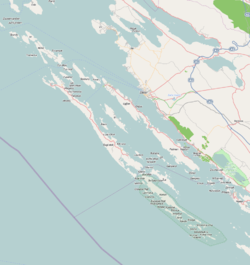
 Zadar
Zadar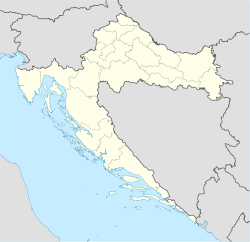 Zadar
ZadarCoordinates: 44°6′51″N 15°13′40″E / 44.11417°N 15.22778°ECoordinates: 44°6′51″N 15°13′40″E / 44.11417°N 15.22778°E Country Croatia County Zadar Liburni settlement 9th century BC Roman foundation
Colonia Iulia Iader48 BC Government - Mayor Zvonimir Vrančić (HDZ) Area - Total 25 km2 (9.7 sq mi) Population (2011) - 2011 census 75,082 Demonym Zadrani [1] Time zone CET (UTC+1) - Summer (DST) CEST (UTC+2) Zadar is a city in Croatia on the Adriatic Sea. It is the centre of Zadar county and the wider northern Dalmatian region. Population of the city is 75,082 citizens (2011). Zadar is a historical center of Dalmatia as well as the seat of the Roman Catholic Archdiocese of Zadar.
Contents
Name
In antiquity, Iadera and Iader, the much older roots of the settlement's names were hidden, the names being most probably related to a hydrographical term. It was coined by an ancient Mediterranean people and their Pre-Indo-European language. They transmitted it to later settlers, the Liburnians. The name of the Liburnian settlement was first mentioned by a Greek inscription from Pharos (Stari grad) on the island of Hvar in 384 BC, where the citizens of Zadar were noted as Ίαδασινοί (Iadasinoi). According to the Greek source Periplus of Pseudo-Scylax the city was Ίδασσα (Idassa), probably a vulgar Greek form of the original Liburnian name.
During Antiquity the name was often recorded in sources in Latin in two forms: Iader in the inscriptions and in the writings of classic writers, Iadera predominantly among the late Antiquity writers, while usual ethnonyms were Iadestines and Iadertines. The accent was on the first syllable in both Iader and Iadera forms, which influenced the early-Medieval Dalmatian language forms Jadra, Jadera and Jadertina, where the accent kept its original place.
In the Dalmatian language, Jadra (Jadera) was pronounced Zadra (Zadera), due to the phonetic transformation of Ja- to Za-. That early change was also reflected in the Croatian name Zadar (recorded as Zader in the 12th century [2]), developed from Zadъrъ by vocalizations of the semi-vowel and a shift to male gender. An ethnonym graphic Jaderani from the legend of St. Krševan in 9th century, was identical to the initial old-Slavic form Zadъrane, or Renaissance Croatian Zadrani.
The Dalmatian names Jadra, Jadera were transferred to other languages; in Venetian language Jatara (hyper urbanism in 9th century) and Zara, Tuscan Giara, Latin Diadora (Constantine VII in DAI, 10th century), Old French Jadres (Geoffroy de Villehardouinin in the chronicles of the Fourth Crusade in 1202), Arabic Jādhara (جاذَرة) & Jādara (جادَرة) (Al-Idrisi, 12th century), Iadora (Guido, 12th century), Spanish Jazara, Jara, Sarra (14th century) and the others.[1][3]
Jadera became Zara when it fell under the authority of the Republic of Venice in the 15th century. Zara was later used by the Austrian Empire in the 19th century, but it was provisionally changed to Zadar/Zara from 1910 to 1920; from 1920[4] to 1947[5] the city became part of Italy as Zara, and finally was named Zadar later on.
Geography
Zadar faces the islands of Ugljan and Pašman, from which it is separated by the narrow Zadar Strait. The promontory on which the old city stands used to be separated from the mainland by a deep moat which has since become landfilled. The harbor, to the north-east of the town, is safe and spacious.
Climate
Zadar has a Mediterranean climate, with very mild, humid winters and very warm, dry summers. Average annual rainfall is in excess of 917 mm (36.10 in). July and August are the hottest months, with an average high temperature around 28 °C (82 °F). Sometimes in July and August temperatures reach over 35 °C (95 °F) and can consistently reach over 30 °C (86 °F) during the summer months. Temperatures below 0 °C (32 °F) are rare, and are not maintained for more than a few days. January is the coldest month, with an average temperature around 6.7 °C (44 °F) and a record low of −9.1 °C (16 °F). October, November and December are the wettest months, with a total precipitation of about 100 mm (3.94 in). July is the driest month, with a total precipitation of around 35 mm (1.38 in). Winter is the wettest season, however it can rain in Zadar at any time of the year. Snow is exceedingly rare, but it may fall in December, January, February and much more rarely in March. Also the sea temperature is from 10 °C (50 °F) in February to 24 °C (75 °F) in August, but is possible to swimming from May until October.
Climate data for Zadar (Puntamika Borik) Month Jan Feb Mar Apr May Jun Jul Aug Sep Oct Nov Dec Year Record high °C (°F) 17.0
(62.6)21.2
(70.2)22.4
(72.3)27.2
(81.0)32.0
(89.6)34.0
(93.2)36.0
(96.8)35.7
(96.3)32.0
(89.6)27.2
(81.0)25.0
(77.0)24.0
(75.2)36.0
(96.8)Average high °C (°F) 9
(48)11
(52)13
(55)17
(63)22
(72)26
(79)30
(86)29
(84)25
(77)20
(68)15
(59)11
(52)18.1 Daily mean °C (°F) 6.7
(44.1)7.4
(45.3)9.4
(48.9)12.9
(55.2)17.2
(63.0)21.0
(69.8)23.6
(74.5)23.1
(73.6)19.8
(67.6)15.8
(60.4)11.5
(52.7)8.1
(46.6)14.71
(58.47)Average low °C (°F) 3
(37)4
(39)6
(43)9
(48)13
(55)16
(61)19
(66)19
(66)16
(61)12
(54)8
(46)4
(39)10.0 Record low °C (°F) −9.1
(15.6)−8.6
(16.5)−6.8
(19.8)2.0
(35.6)3.4
(38.1)8.2
(46.8)11.7
(53.1)10.0
(50.0)6.4
(43.5)2.9
(37.2)−2.6
(27.3)−6
(21.2)−9.1
(15.6)Precipitation mm (inches) 77
(3.03)72
(2.83)74
(2.91)60
(2.36)61
(2.4)52
(2.05)35
(1.38)63
(2.48)98
(3.86)112
(4.41)119
(4.69)94
(3.7)917
(36.1)Avg. snowy days 0.7 0.4 0.1 0 0 0 0 0 0 0 0 0.2 1.4 Sunshine hours 119.2 137.6 181.1 207.0 263.8 295.5 349.0 310.8 249.3 184.0 125.7 106.8 2,529.8 Source: Zadarska županija, Zadar County, Zadar, 2001. History
Prehistory
The district of present day Zadar has been populated since prehistoric times. The earliest evidence of human life comes from the Late Stone Age, while numerous settlements have been dated as early as the Neolithic. Before the Illyrians, the area was inhabited by an ancient Mediterranean people of a pre-Indo-European culture. They assimilated with the Indo-Europeans who settled between the 4th and 2nd millennium BC into a new ethnical unity, that of the Liburnians. Zadar was a Liburnian settlement, laid out in the 9th century BC, built on a small stone islet and embankments where the old city stands and tied to the mainland by the overflown narrow isthmus, which created a natural port in its northern strait.[6]
Antiquity
The Liburnians were known as great sailors and merchants, but also had a reputation for piracy in the later years. By the 7th century BC, Zadar had become an important centre for their trading activities with the Phoenicians, Etruscans, Ancient Greeks and other Mediterranean peoples. Its population at that time is estimated at 2,000.[7] From 9th to 6th century there was certain koine - cultural unity in the Adriatic Sea, with the general Liburninan seal, whose naval supremacy meant both political and economical authority through several centuries.[8] Due to its geographical position, Zadar developed into a main seat of the Liburnian thalassocracy and took a leading role in the Liburnian tetradekapolis, an organization of 14 communes.[9]
The people of Zadar, the Iadasinoi, were first mentioned in 384 BC as the allies of the natives of Hvar and the leaders of an eastern Adriatic coast coalition in the fight against the Greek colonizers. An expedition of 10,000 men in 300 ships sailed out from Zadar and laid siege to the Greek colony Pharos in the island of Hvar, but the Syracusan fleet of Dionysus was alerted and attacked the siege fleet. The naval victory went to the Greeks which allowed them relatively safer further colonization in the southern Adriatic.[10]
 Zadar (Iader) and the other cities of Liburnian tetradekapolis in the age of the Roman conquest
The archaeological remains have shown that the main centres of Liburnian territorial units or municipalities were already urbanized in the last centuries BC; before the Roman conquest, Zadar held a territory of more than 600 km2 in the 2nd century BC.
In the middle of the 2nd century BC, the Romans began to gradually invade the region. Although being first Roman enemies in the Adriatic Sea, the Liburnians, mostly stood aside in more than 230 years of Roman wars with the Illyrians, to protect their naval and trade connections in the sea. In 59 BC Illyricum was assigned as a provincia (zone of responsibility) to Julius Caesar and Liburnian Iadera became a Roman municipium.
The Liburnian naval force was dragged into the Roman civil war between Julius Caesar and Pompey in 49 BC, partially by force, partially because of the local interests of the participants, the Liburnian cities. Caesar was supported by the urban Liburnian centres, like Iader (Zadar), Aenona (Nin) and Curicum (Krk), while the city of Issa (Vis) and the rest of the Liburnians gave their support to Pompey. In 49 BC near the island of Krk, the "Navy of Zadar", equipped by the fleets of a few Liburnian cities and supported by some Roman ships, lost an important naval battle against Pompey supporting the "Liburnian navy". The civil war was prolonged until the end of 48 BC, when Caesar rewarded his supporters in Liburnian Iader and Dalmatian Salona, by giving the status of the Roman colonies to their communities.[11] Thus the city was granted the title colonia Iulia Iader, after its founder, and in the next period some of the Roman colonists (mostly legionary veterans) settled there.
The real establishment of the Roman province of Illyricum occurred not earlier than 33 BC and Octavian’s military campaign in Illyria and Liburnia, when the Liburnians finally lost their naval independence and their galleys and sailors were incorporated into the Roman naval fleets.
 The Roman forum remains in Zadar
From the early days of Roman rule, Zadar gained its Roman urban character and developed into one of the most flourishing centres on the eastern Adriatic coast, a state of affairs which lasted for several hundred years. The town was organised according to the typical Roman street system with a rectangular street plan, a forum, thermae, a sewage and water supply system that came from lake Vrana, by way of a 40 km long aqueduct. It did not play a significant role in the Roman administration of Dalmatia, although the archaeological finds tell us about a significant growth of economy and culture.
The new religion Christianity did not bypass the Roman province of Dalmatia. Already by the end of the 3rd century Zadar had its own bishop and founding of the Zadar Christian community took place;[12] a new religious centre was built north of the forum together with a basilica and a baptistery, as well as other ecclesiastical buildings. According to some estimates, in the 4th century it had probably around ten thousand citizens, including the population from its Ager, the nearby islands and hinterland, an admixture of the indigenous Liburnians and Roman colonists.
Early Middle Ages
During the Migration Period and the Barbarian invasions, Zadar underwent a stagnation. In 441 and 447 Dalmatia was ravaged by the Huns, after the fall of the Western Roman Empire, in 481 Dalmatia became part of the Ostrogothic kingdom, which, besides Italy, already included the more northerly parts of Illyricum, i.e. Pannonia and Noricum.
In the 5th century, under the rule of the Ostrogothic Kingdom, Zadar became poor with many civic buildings turning into ruins due to its advanced age. About the same time (6th century) it was hit by an earthquake, which destroyed entire complexes of monumental Roman architecture, whose parts would later serve as material for building houses. This caused a loss of population and created demographic changes in the city, then gradually repopulated by the inhabitants from its hinterland.[13] However, during six decades of Gothic rule, the Goths saved those old Roman Municipal institutions that were still in function, while religious life in Dalmatia even intensified in the last years, so that there was a need for the foundation of additional bishoprics.[14]
In 536 the Byzantine emperor Justinian the Great started a military campaign to reconquer the territories of the former Western Empire (see Gothic War); and in 553 Zadar passed to the Byzantine Empire. In 568 Dalmatia was devastated by an Avar invasion; although further waves of attacks by Avar and Slav tribes kept up the pressure, it was the only city which survived due to its protective belt of inland plains. The Dalmatian capital Salona was captured and destroyed in the 40s of the 7th century, so Zadar became the new seat of the Byzantine archonty of Dalmatia, territorially reduced to a few coastal cities with their agers and municipal lands at the coast and the islands nearby. The prior of Zadar had jurisdiction over all Byzantine Dalmatia, so Zadar enjoyed metropolitan status at the eastern Adriatic coast. At this time rebuilding began to take place in the city.
 St. Donatus church, 9th century
At the beginning of the 9th century the Zadar bishop Donatus and the city duke Paul mediated in the dispute between the Holy Roman empire under Pepin and the Byzantine Empire. The Franks held Zadar for a short time, but the city was returned to Byzantium by a decision of the 812 Treaty of Aachen.[15]
Zadar's economy revolved around sea, fishing and sea trade in the first centuries of the Middle Ages. Thanks to saved Antique ager, adjusted municipal structure and a new strategic position, it became the most important city between the Kvarner islands and Kaštela Bay. Byzantine Dalmatia wasn't territorially unified, but an alliance of city municipalities headed by Zadar, and the large degree of city autonomy allowed the development of Dalmatian cities as free communes. Forced to turn their attention seawards, the inhabitants of Zadar focused on shipping, and the city became a naval power to rival Venice. The citizens were Dalmatian language speakers, but from the 7th century Croatian language started to spread in a region, becoming predominant in the inland and the islands to the end of the 9th century.[16]
Middle Ages
 Political map of the western Balkans in 925 AD
The Mediterranean and Adriatic cities developed significantly during a period of peace from the last decades of the 9th to the middle of the 10th century. Especially favourable conditions for navigation in the Adriatic Sea occurred since the Saracen raids had finished. Also the adjustment of relations with the Croats enabled Zadar merchants to trade with its rich agriculture hinterland[17] where the Kingdom of Croatia had formed, and trade and political links with Zadar began to develop. Croatian settlers began to arrive, becoming commonplace by the 10th century, occupying all city classes, as well as important posts, like those of prior, judge, priest and others. In 925, Tomislav, the Duke of Croatian Dalmatia, united Croatian Dalmatia and Pannonia establishing the Croatian Kingdom. He was also granted the position of protector of Dalmatia (the cities) by the Byzantine Emperor. He thus politically united the Dalmatian cities with their hinterland.
At the time of the Zadar medieval development, the city became a threat to Venice's ambitions, because of its strategic position at the centre of the eastern Adriatic coast.
In 998 Zadar sought Venetian protection against the Neretvian pirates.[15][18] The Venetians were quick to fully exploit this opportunity: in 998 a fleet commanded by Doge Pietro Orseolo II, after having defeated pirates, landed in Korčula and Lastovo. Dalmatia was taken by surprise and offered little serious resistance. Trogir was the exception and was subjected to Venetian rule only after a bloody struggle, whereas the Republic of Dubrovnik was forced to pay tribute.[15][19] Tribute previously paid by Zadar to Croatian kings, was redirected to Venice, a state of affairs which lasted for several years.
 Coat of Arms of Zadar.
Zadar citizens started to work for the full independence of Zadar and from the 30's of the 11th century the city was just formally a vassal of the Byzantine Empire. The head of this movement was the mightiest Zadar patrician family - the Madi.[20] After negotiations with Byzantium, Zadar was attached to the Croatian state led by king Petar Krešimir IV in 1069. Later, after the death of king Dmitar Zvonimir in 1089 and ensuing dynastic run-ins, in 1105 Zadar accepted the rule of the first Croato-Hungarian king Coloman.
In the meantime Venice developed into a true trading force in the Adriatic and started attacks on Zadar. The city was repeatedly invaded by Venice between 1111 and 1154 and then once more between 1160 and 1183, when it finally rebelled, appealing to the Pope and to the Croato-Hungarian throne for protection.
Zadar was especially devastated in 1202 after the Venetian Doge Enrico Dandolo used the Crusaders, on their Fourth Crusade to Palestine, to lay siege to the city.[21] The crusaders were obliged to pay Venice for sea transport to Egypt. As they were not able to produce enough money, the Venetians used them to initiate the Siege of Zadar, when the city was ransacked, demolished and robbed.[21] The king of Croatia and Hungary, Emeric of Hungary, condemned the crusade, because of an argument about the possible heresy committed by God's army in attacking a Christian city. Nonetheless, Zadar was devastated and captured, with the population escaped into the surrounding countryside. Pope Innocent III excommunicated the Venetians and crusaders involved in the siege.[21]
Two years later (1204), under the leadership of the Croatian nobleman Domald from Šibenik, most of the refugees returned and liberated the city from what remained of the crusader force. In 1204 Domald was comes (duke) of Zadar, but the following year (1205) Venetian authority was re-established and a peace agreement signed with hard conditions for the citizens. The only profit which the Communal Council of Zadar derived from this was one third of the city's harbour taxes, probably insufficient even for the most indispensable communal needs.[22]
 Chest of Saint Simeon photographed around 1900
This did not break the spirit of the city, however. Its commerce was suffering due to a lack of autonomy under Venice, while it enjoyed considerable autonomy under the much more feudal Croatian-Hungarian Kingdom. A number of insurrections followed (1242–1243, 1320s, 1345–1346) which finally resulted in Zadar coming back under the crown of the Croatian-Hungarian king Louis I under the Treaty of Zadar, in 1358. After the War of Chioggia between Genoa and Venice, Chioggia concluded on 14 March 1381 an alliance with Zadar and Trogir against Venice, and finally Chioggia became better protected by Venice in 1412, because Šibenik became in 1412 the seat of the main customs office and the seat of the salt consumers office with a monopoly on the salt trade in Chioggia and on the whole Adriatic Sea. After the death of Louis, Zadar recognized the rule of king Sigismund, and after him, that of Ladislaus of Naples. During his reign Croatia-Hungary was enveloped in a bloody civil war. In 1409, Venice, seeing that Ladislaus was about to be defeated, and eager to exploit the situation despite its relative military weakness, offered to buy his "rights" on Dalmatia for a mere 100,000 ducats. Knowing he had lost the region in any case, Ladislaus accepted. Zadar was, thus sold back to the Venetians for a paltry sum.
The population of Zadar during the Medieval period was predominantly Croatian, according to numerous archival documents,[23] and the Croatian language was used in liturgy,[24] as shown by the writings of cardinal Boson, who followed Pope Alexander III en route to Venice in 1177. When the papal ships took shelter in the harbour of Zadar, the inhabitants greeted the Pope by singing lauds and canticles in Croatian.[25][26] Even though interspersed by sieges and destruction, the time between 11th and 14th century was the golden age of Zadar. Thanks to its political and trading achievements, and also to its skilled seamen, Zadar played an important role among the cities on the east coast of the Adriatic. This affected its appearance and culture: many churches, rich monasteries and palaces for powerful families were built, together with the Chest of Saint Simeon. One of the best examples of the culture and prosperity of Zadar at that time was the founding of the University of Zadar, built in 1396 by the Dominican Order (the oldest university in present day Croatia).
From 15th to 18th century
 The Adriatic in 1560, with Dalmatia and Zadar
After the death of Louis I, Zadar came under the rule of Sigmund of Luxembourg and later Ladislaus of Naples, who, witnessing his loss of influence in Dalmatia, sold Zadar and his dynasty's rights to Dalmatia to Venice for 100,000 ducats on July 31, 1409. Venice therefore obtained control over Zadar without a fight, but was confronted by the resistance and tensions of important Zadar families. These attempts were met with persecution and confiscation. Zadar remained the administrative seat of Dalmatia, but this time under the rule of Venice, which expanded over the whole Dalmatia, barring the Republic of Dubrovnik. The Venetians restrained the political and economical autonomy of Zadar,[citation needed] which, regardless, remained a prosperous city. During that time Juraj Dalmatinac, one of the best known renaissance men, famous for his work on the Cathedral of Šibenik, was born in Zadar. Other important people followed, such as the Lucijan and Franjo Vranjanin, best known in Italy for their sculptures and buildings.
 Zadar's "Kopnena vrata" (Landward Gate)
The 16th and 17th centuries were noted in Zadar for Ottoman attacks. Ottomans captured the continental part of Zadar at the beginning of the 16th century and the city itself was all the time in the range of Turkish artillery. Due to that threat, the construction of a new system of castles and walls began. These defense systems changed the way the city looked. To make place for the pentagon castles many houses and churches were taken down, along with an entire suburb: Varoš of St. Martin. After the 40-year-long construction Zadar became the biggest fortified city in Dalmatia, empowered by a system of castles, bastions and canals filled with seawater. The city was supplied by the water from public city cisterns. During the complete makeover of Zadar, many new civic buildings were built, such as the City Lodge and City Guard on the Gospodski Square, several army barracks, but also some large new palaces.
In contrast to the insecurity and Ottoman sieges and destruction, an important culture evolved midst the city walls. During the 16th and the 17th century the activity of the Croatian writers and poets became prolific (Jerolim Vidolić, Petar Zoranić, Brne Karnarutić, Juraj Baraković, Šime Budinić). Also noteworthy is the painter Andrija Medulić (c. 1510/1515–1563), who, when in Venice, signed his name as "Andrea Schiavone."
During the continuous Ottoman danger the population stagnated by a significant degree along with the economy. During the 16th and 17th century several large-scale epidemics of bubonic plague erupted in the city. After more than 150 years of Turkish threat Zadar was not only scarce in population, but also in material wealth. Venice sent new colonists and, under the firm hand of archbishop Vicko Zmajević, the Arbanasi (Catholic Albanian refugees) settled in the city, forming a new suburb. Despite the shortage of money, the Teatro Nobile (Theater for Nobility) was built in 1783. It functioned for over 100 years.
19th and 20th century
After the fall of Venice (1797) with the Treaty of Campo Formio, Zadar come under the Austrian crown and once again became united with the rest of Croatia. In 1806 it was briefly given to the Napoleonic Kingdom of Italy, until in 1809 it was added to the French Illyrian Provinces. In 1813, all of Dalmatia was reconquered and brought back under the control of the Austrian Empire. During this time, it maintained its position as the capital of Dalmatia.
During the Napoleonic era, the first Dalmatian newspaper, Kraglski Dalmatin - Il Regio Dalmata ("The Royal Dalmatian"), was printed in the city.
After 1815 Dalmatia (including Dubrovnik) came under the Austrian crown. After 1848, Italian and Slavic nationalism became accentuated and the city became divided between the Croats and the Italians, both of whom founded their respective political parties. There are conflicting sources for both sides claiming to have formed the majority in this period; in general the era saw Slavs grow more than Italians throughout Dalmatia, fostering a distinct national spirit.
Italy (1920-1947)
 Italian territory of Zara/Zadar 1920-1947
During 1918, political life in Zadar intensified. The development of the Declaration movement was underway. The collapse of the Austro-Hungarian Monarchy led to the renewal of national conflicts in the city. With the arrival of an Italian army of occupation in the city on 4 November 1918, the Italian faction gradually assumed control, a process which was completed on 5 December when it took over the governorship.[27] The Treaty of Rapallo (12 November 1920) gave Zadar with other local territory to Italy. The Zadar enclave, a total of 104 km², included the city of Zadar, the municipalities of Bokanjac, Arbanasi, Crno, part of Diklo (a total of 51 km2. of territory and 17,065 inhabitants) and the islands of Lastovo and Palagruža (53 km², 1,710 inhabitants). The territory was organized into an Italian province.
World War II
Germany, with limited Italian assistance, invaded the Kingdom of Yugoslavia on April 6, 1941. Zadar held a force of 9,000 that after limited fighting reached Šibenik and Split on April 15, a mere 2 days before surrender, with civilians having previously been evacuated to Ancona and Pula. Occupying Mostar and Dubrovnik, on April 17 they met invading troops that had started out from Italian-occupied Albania. On April 17 the Yugoslav government surrendered, faced with the Wehrmacht's overwhelming superiority.
Within a few weeks, Benito Mussolini required the newly formed Nazi puppet-state, the so-called Independent State of Croatia (NDH) to hand over almost all of Dalmatia (including Split) to fascist Italy under the Treaty of Rome.
The city became the centre of a new Italian territorial entity, called Governorship of Dalmatia, including the provinces of Zadar, Split and Kotor.
Under fascist reign the Slavic population was subjected to a policy of forced assimilation. This created immense resentment among the Yugoslav people and the Yugoslav Partisan movement (which was already successfully spreading in the rest of Yugoslavia) did not take root here since more than 70% of population of Zara was Italian.
After Mussolini was removed from power on 25 July 1943 and arrested, the government of Pietro Badoglio signed an armistice with the Allies on 3 September 1943, which was made public only on 8 September 1943, and the Italian army collapsed. However, just four days later on 12 September 1943, "Il Duce", was rescued by a German military raid from his secret prison on the Gran Sasso mountain, and formed the Nazi-puppet Italian Social Republic in the north of the Country. The NDH proclaimed the Treaty of Rome to be void and occupied Dalmatia with German support. The Germans entered Zadar first, and on September 10 the German 114th Jäger Division took over. This avoided a temporary liberation by Partisans, as was the case in Split and Šibenik where several Italian fascist government officials were killed by an angry crowd.
The city was prevented from joining the NDH on the grounds that Zadar itself was not subject to the conditions of the Treaty of Rome. Despite this, the NDH's leader Ante Pavelić designated Zadar as the capital of the Sidraga-Ravni Kotari County, although its administrator was prevented from entering the city. Zadar remained under the local administration of the Italian Social Republic. Zadar was bombed by the Allies, with serious civilian casualties. Many died in the carpet bombings, and many landmarks and centuries old works of art were destroyed. A significant number of civilians fled the city.
In late October, 1944 the German army and a significant amount of the civilian population abandoned the city.[28] On October 31, 1944, the Partisans seized the city, until then a part of Mussolini's Italian Social Republic. At the start of World War II, Zadar had a population of 24,000 which was mostly Italian and by the end of 1944 this had decreased to 6,000.[28] Formally, the city remained under Italian sovereignty until February 10, 1947 (Paris Peace Treaties). The Italian exodus from the city continued and in a few years was almost total. The last stroke to the Italian presence was made by the local administration in October 1953, wwhen the last Italian schools were closed and the students forced to move, from a day to the other, into Croatioan schools. Today the Italian community counts only a few hundreds people.
SFR Yugoslavia (1947-1991)
After the bombing, the city progressively recovered and became once more an important regional city in the newly established Democratic Federal Yugoslavia. During this period Zadar underwent intensive reconstruction and revitalisation, followed by a large increase in both population and economic power. The Federal government sponsored numerous public works to this end, including the Adriatic Highway (Jadranska magistrala) which provided a modern road connection to the rest of the country. Besides the local infrastructure, the SFRY government initiated the industrialization of the city and nearly all its factories were either built or significantly revitalized and modernized in this period. In the 1970s Zadar particularly enjoyed a high standard of living as international tourism came to Dalmatia.
However, during this period the city lost its status as the capital of the region, with Split overwhelmingly surpassing Zadar in population numbers, which, though increasing throughout the 20th century, boomed in the new, post-WWII, Yugoslavia.
All in all, by the 1990s the city had not only been rebuilt after the Second World War, but had emerged as a modern and completely industrialized regional centre, with as yet unsurpassed tourist numbers, GDP and employment rates, which were, surprisingly, significantly higher than the present day's. After the death of Tito, Yugoslavia rapidly began to destabilize.
Croatian War of Independence (1991 - 1995)
In the early 1990s the tragic Yugoslav wars began to devastate the country. Zadar became a part of the new Republic of Croatia. Its economy suffered greatly at this time not only because of the war but also due to the shadowy and controversial privatization process, which caused most of its prosperous companies to go under.
In 1990, Serbian separatists from the Krajina region of Croatia just inland from Dalmatia sealed roads and effectively blocked Dalmatia from the rest of Croatia. A number of non-Serbs were expelled from the area and several Croatian policemen were killed resulting in the Dalmatian anti-Serb riots of May 1991.[29] Serbs at that time accounted for about 15% of the population.[30]
During the Croatian War of Independence, Krajina rebels and the Yugoslav People's Army (JNA) (at the time under Slobodan Milošević's control) converged on the city and subjected it to artillery bombardment during Operation Coast-91 in which they tried to take control of northern Dalmatia. Along with other Croatian towns in the area, Zadar was shelled sporadically for several years, resulting in damage to buildings and homes as well as UNESCO protected sites. A number of nearby towns and villages were also attacked, the most brutal being the Škabrnja massacre in which 86 people were killed.
Connections with Zagreb were severed for over a year. The only link between the north and south of the country was via the island of Pag. The siege of the city lasted from 1991 until January 1993 when Zadar and the surrounding area came under the control of Croatian forces and the bridge link with the rest of Croatia was reestablished in Operation Maslenica. Attacks on the city continued until the end of the war in 1995.
Some of the countryside along the No. 8 highway running north east is still sectioned off due to land mines.
Main sights
Architecture
Zadar gained its urban structure in Roman times; during the time of Julius Caesar and Emperor Augustus, the town was fortified and the city walls with towers and gates were built. On the western side of the town were the forum, the basilica and the temple, while outside the town were the amphitheatre and cemeteries. The aqueduct which supplied the town with water is partially preserved. Inside the ancient town, a medieval town had developed with a series of churches and monasteries being built.
During the Middle Ages, Zadar fully gained its urban aspect, which has been maintained until today. In the first half of the 16th century Venice fortified the town with a new system of defensive walls on the side facing land. In the course of the century architectural building in the Renaissance style was continued and defensive trenches (Foša) were also built. They were completely buried during the Italian occupation until that in 1873, under Austrian rule, the ramparts of Zadar were converted from fortifications into elevated promenades commanding extensive seaward and landward views, thus being the wall lines preserved; of its four old gates one, the Porta Marina, incorporates the relics of a Roman arch, and another, the Porta di Terraferma, was designed in the 16th century by the Veronese artist Michele Sanmicheli. In the bombardments during the Second World War entire blocks were destroyed, but some structures survived.
 St. Donatus' Church, a pre-Romanesque church from the 9th century.
 St. Mary's Church, located in the old city opposite St. Donatus' Church.
Most important landmarks:
- Roman Forum - the largest on the eastern side of the Adriatic, founded by the first Roman Emperor Augustus, as shown by two stone inscriptions about its completion dating from the 3rd century.
- Most Roman remains were used in the construction of the fortifications, but two squares are embellished with lofty marble columns; a Roman tower stands on the eastern side of the town; and some remains of a Roman aqueduct may be seen outside the ramparts.
The chief interest of Zadar lies in its churches.
- St Donatus' Church - a monumental round building from the 9th century in pre-Romanesque style, traditionally but erroneously said to have been erected on the site of a temple of Juno. It is the most important preserved structure of its period in Dalmatia; the massive dome of the rotunda is surrounded by a vaulted gallery in two stories which also extends around the three apses to the east. The church treasury contains some of the finest Dalmatian metalwork; notably the pastoral staff of Bishop Valaresso (1460).
- St. Anastasia's Cathedral (Croatian: Sv. Stošija), basilica in Romanesque style built in the 12th to 13th century (high Romanesque style), the largest cathedral in Dalmatia.
- The churches of St. Chrysogonus and St. Simeon, where the silver ark or reliquary of St. Simeon (1380) is located, are also fine architectural examples in the Romanesque style.
- St. Krševan's Church - monumental Romanesque church of very fine proportions and refined Romanesque ornaments.
- St. Elijah's Church (Croatian: Sv. Ilija)
- St. Francis' Church, gothic styled church, site of the signing of the Zadar Peace Treaty 1358
- Five Wells Square
- St. Mary's Church, which retains a fine Romanesque campanile from 1105, belongs to a Benedictine Convent founded in 1066 by a noblewoman of Zadar by the name of Cika with The Permanent Ecclesiastical Art Exhibition "The Gold and Silver of Zadar"
Other architectural landmarks:
- Citadel - built in 1409, southwest of the Land gate, it has remained the same to this day.
- The Land Gate - built to a design by the Venetian architect Michele Sanmicheli in 1543
- The unique sea organ[31]
- The Great Arsenal [1]
- Among the other chief buildings are the Loggia del Comune, rebuilt in 1565, and containing a public library; the old palace of the priors, now the governor's residence; and the episcopal palaces.
Culture
The first university of Zadar was mentioned in writing as early as in 1396 and it was a part of a Dominican monastery. It closed in 1807.
Zadar was, along with Split and Dubrovnik, one of the centres of the development of Croatian literature.
The 15th and 16th centuries were marked by important activities of Croatians writing in the national language: Jerolim Vidolić, Petar Zoranić (who wrote the first Croatian novel, Planine), Brne Karnarutić, Juraj Baraković, Šime Budinić.
Under French rule (1806–1810), the first Dalmatian newspaper Kraglski Dalmatin - Il Regio Dalmata was published in Zadar. It was printed in Italian and Croatian; this last used for the first time in a newspaper.
In the second half of the 19th century, Zadar was a centre of the movement for the cultural and national revivals in Dalmatia (Italian and Croatian).
Today Zadar's cultural institutions include:
- The Croatian Theatre House
- The National Museum
- The Archaeological Museum (established in 1830)
- The University of Zadar (founded in 1396, active until 1807 and refounded in 2002)
- The Maritime Museum
- Permanent Exhibition of Sacral Art
- Croatian Singing Musical Society Zoranić (established 1885)
- Musical Evenings in St. Donatus [2] (established 1961)
- International Choirs Competition (established 1997)
- Arsenal Zadar [3]
Government
 The town hall (centre) in Narodni trg (People's Square)
The administrative area of the City of Zadar includes the nearby villages of Babindub, Crno, Kožino and Petrčane, as well as the islands of Ist, Iž, Molat, Olib, Premuda, Rava and Silba. The total city area, including the islands, covers 194 km2.
Zadar is divided into 21 local districts: Arbanasi, Bili Brig, Bokanjac, Brodarica, Crvene Kuće, Diklo, Dračevac, Gaženica, Jazine I, Jazine II, Maslina, Novi Bokanjac, Poluotok, Ploča, Puntamika, Ričina, Smiljevac, Stanovi, Vidikovac, Višnjik, Voštarnica.
Population
Zadar is the fifth largest city in Croatia and the second largest in Dalmatia, with a population of 75,082 according to the 2011 census.[32] According to the 2001 census, 93% of its citizens are ethnic Croats.[33]
Italian presence in Zadar
Today Zadar is ethnically Croat with minorities accounting for about 7% of the population, the main minority being the Serbs (2,382 of the overall population of 72,718 according to the last census made in 2001). Indeed the same census reported a population of only 89 Italians. This is the last remnant of a population that historically populated the city since the establishment of the Venetian Empire. What is today a tiny minority was still at the beginning of the 20th century (therefore before the incorporation of the city with the Italian Kingdom in 1920) the main ethnic component of the city.
Austro-Hungarian official census statistics [4], supports this statement and shows that outside the city walls the Italian presence was significant but not the majority.
Zadar county (neighborough including places outside the "venetian walls):
- 1890: Slavs 19096 (67,6%), Italians 7672 (27,2%), Germans 568, others 180, total 28230
- 1900: Slavs 21753 (66,8%), Italians 9234 (28,4%), Germans 626, others 181, total 32551
- 1910: Slavs 23651 (64,6%), Italians 11552 (31,6%), Germans 477, others 227, total 36595
Zadar city (inside the old town's "venetian walls"):
- 1890: Italians 7423 (64,6%), Slavs 2652 (23.0%), Germans 561, others 164, total 11496
- 1900: Italians 9018 (69,3%), Slavs 2551 (19,6%), Germans 581, others 150, total 13016
- 1910: Italians 9318 (66,3%), Slavs 3532 (25,1%), Germans 397, others 191, total 14056
Economy
Major industries include tourism, traffic, seaborne trade, agriculture, fishing and fish farming activities, metal manufacturing and mechanical engineering industry, chemicals and non-metal industry and banking. The headquarters of the following companies are located in Zadar:
- Maraska (food industry)
- Adria, Mardešić (fish production)
- Tankerska plovidba Zadar (shipping company)
- SAS (machine tools)
- Aluflexpack
- Arsenal Holdings [5] (Tourism)
The farmland just northeast of Zadar, Ravni Kotari, is a well known source of marasca cherries. Distilleries in Zadar have produced Maraschino since the 16th century.
Science
In 1998, Zadar hosted the Central European Olympiad in Informatics (CEOI).
Transportation
In the 20th century, roads became more important than sea routes, but Zadar remained an important traffic point. The main road along the Adriatic passes through the city. In the immediate vicinity, there is the Zagreb-Dubrovnik highway, finished up to Split in 2005. Zadrans can access to the highway by two interchanges: Zadar 1 exit in the north and Zadar 2 highway hub near Zemunik in the south. The southern interchange is connected to Zadar port of Gaženica by the D424 expressway. Since 1966, a railway has linked Zadar with Knin, where it joins the main railway from Zagreb to Split. It has an international sea line to Ancona in Italy. There is a plan for an "Adriatic Railway" line linking Zadar with Gospić and Split. Zadar International Airport is located in Zemunik, around 14 km to the east of Zadar and accessible via the expressway. The airport is experiencing year on year an average of 30% increase in passenger traffic mainly due to arrivals of lowcost carriers (Ryanair, Germanwings, Intersky, Danubewings, JobAir) connecting Zadar from the end of March through October with over 20 cities throughout Europe. Currently, the arrivals and departures terminal building is expanding to accommodate the increasing number of passengers, with completion scheduled for March 2011. The extension of the runway for an additional 500m from the current 2500m is scheduled for late 2011.[citation needed]
Sports
 Krešimir Ćosić Hall
The local basketball club is KK Zadar, and the football club NK Zadar. The bowling club Kuglački klub Zadar is also very successful. Zadar is also the hometown of Croatian football player Luka Modrić.
Krešimir Ćosić Hall is new multi-use indoor arena, built and completed in May 2008 with a capacity for 9,200 people, named after Krešimir Ćosić, "a legend" of Zadar basketball game. Until then KK Zadar is played in Jazine Basketball Hall.
International relations
Twin towns — Sister cities
See also: List of twin towns and sister cities in CroatiaZadar is twinned, or maintains cultural, economic and educational ties with:
 Dundee, United Kingdom
 Reggio Emilia, Italy
 Romans-sur-Isère, France
 Fürstenfeldbruck, Germany
 Székesfehérvár, Hungary
- Padua, Italy
 Iquique, Chile
 Banská Bystrica, Slovakia, since 1995[34]
Gallery
-

St. Donat's Church and Roman Forum
-

Roman Forum
-

St. Anastasia Cathedral
-

St. Mary's Church
-

St. Simeon's Church
-

Altar of St. Šimun (Simeon)
-

Original Chest of Saint Simeon with his mummified body inside
-

Stone inscription below the Chest of St. Simeon
-

The Morska vrata ("sea gates")
-

University of Zadar (1396)
See also
- Archdiocese of Zadar
- Bombing of Zadar in World War II
- History of Croatia
- History of Dalmatia
- Krešimir Ćosić Hall
- Liburnia

90 km (56 mi) Mali Lošinj 15 km (9 mi) Nin 47 km (29 mi) to Starigrad 177 km (110 mi) Ancona 
90 km (56 mi) Burnum  Zadar
Zadar 

74 km (46 mi) to Šibenik References
 This article incorporates text from a publication now in the public domain: Chisholm, Hugh, ed (1911). Encyclopædia Britannica (11th ed.). Cambridge University Press.
Bibliography
- Cresswell, Peterjon; Atkins, Ismay; Dunn, Lily (10 July 2006). Time Out Croatia (First ed.). London, Berkeley & Toronto: Time Out Group Ltd & Ebury Publishing, Random House Ltd. 20 Vauxhall Bridge Road, London SV1V 2SA. ISBN 9781904978701. http://books.google.com/books?id=VZweAAAACAAJ. Retrieved 10 March 2010.
Notes
- ^ a b Mate Suić: O imenu Zadra, Zadar Zbornik, Matica Hrvatska, Zagreb 1964
- ^ Adnotationes chronologicae in codice missalisaeculi XII. ap. Florianus:Fontesdomestici Vol. III, 209.
- ^ M.Suić: Prošlost Zadra 1, Zadar u starom vijeku, Filozofski Fakultet Zadar, 1981
- ^ See: Treaty of Rapallo, 1920
- ^ See: Paris Peace Treaties, 1947
- ^ M. Suić, Prošlost Zadra I, Zadar u starom vijeku, Filozofski fakultet Zadar, 1981, pages 61-113
- ^ V. Graovac, Populacijski razvoj Zadra, Sveučilište u Zadru, 2004, page 52
- ^ M. Zaninović, Liburnia Militaris, Opusc. Archeol. 13, 43-67 (1988), UDK 904.930.2(497.13)>>65<<, page 47
- ^ M. Suić, Liburnija i Liburni, VAMZ, 3.S., XXIV-XXV,1991-92, UDK 931/939 (36)"6/9", pages 55-66
- ^ M. Suić, Prošlost Zadra I, Zadar u starom vijeku, Filozofski fakultet Zadar, 1981, pages 127-130
- ^ M. Zaninović, Liburnia Militaris, Opusc. Archeol. 13, 43-67 (1988), UDK 904.930.2(497.13)>>65<<, pages 56, 57
- ^ Z. Strika, Kako i gdje se prvi put spominje zadarski biskup?, Radovi HAZU u Zadru, sv. 46/2004, UDK 262.12"2/3"(497.5) Zadar, p. 31-64
- ^ V. Graovac, Populacijski razvoj Zadra, Sveučilište u Zadru, Geoadria, Vol. 9, No. 1, UDK: 314.8(497.5 Zadar), page 53]
- ^ G. Novak, Uprava i podjela, Zbornik FF u Zagrebu I, 1951, pages 83-85
- ^ a b c Britannica 1911: Dalmatia
- ^ Nada Klaić, Ivo Petricioli, Prošlost Zadra – knjiga II, Zadar u srednjem vijeku do 1409., Filozofski fakultet Zadar, 1976, page 59
- ^ Nada Klaić, Ivo Petricioli, Prošlost Zadra II, Zadar u srednjem vijeku do 1409., Filozofski fakultet Zadar, 1976, page 84
- ^ Britannica 1911: Zara
- ^ Britannica 1911: Illyria
- ^ N. Klaić, I. Petricioli, Prošlost Zadra II, Zadar u srednjem vijeku do 1409., Filozofski fakultet Zadar, 1976, pages 86-94
- ^ a b c Sethre, Janet (2003). The souls of Venice. pp. 54–55. ISBN 0-7864-1573-8.
- ^ N. Klaić, I. Petricioli, Zadar u srednjem vijeku do 1409., Prošlost Zadra - knjiga II, Filozofski fakultet Zadar, 1976, pages 179-184
- ^ N. Klaić, I. Petricioli, Zadar u srednjem vijeku do 1409., Prošlost Zadra - knjiga II, Filozofski fakultet Zadar, 1976, pages 215-222
- ^ A. Strgačić, Hrvatski jezik i glagoljica u crkvenim ustanovama, Zbornik Zadar, Matica Hrvatska, Zagreb, 1964, page 386
- ^ N. Klaić, I. Petricioli, Zadar u srednjem vijeku do 1409., Prošlost Zadra - knjiga II, Filozofski fakultet Zadar, 1976, page 216.
- ^ Strgačić, A. (1954) (in Croatian). Papa Aleksandar III u Zadru, Radovi instituta JAZiU u Zadru. Zagreb. pp. 164–165. "Original text: Et exinde ceteras Dalmatiae insulas transcendentes, in proxima dominica, priusquam sol illusceret, ad civitatem Iaderam, que sita est in capite Ungarici regni, eundem pontificem cum fratribus suis... sanum et alacrem portaverunt. Et quoniqm nondum quisquam Romanorum pontificum civitatem ipsam intraverat, de novo eiusdem pape adventu facta est in clero et populo ipsius loci communis lettitia et ineffabilis exultatio, collaudantium et benedicentium Dominum, qui modernis temporibus per famulum suum Alexandrum, successorem beati Petri, ecclesiam Iadertinam dignatus est visitare. Ideoque preparato sibi de Romano more albo caballo, processionaliter deduxerunt eum per mediam civitatem ad beate Anastasie maiorem ecclesiam in qua virgo et martyr honorifice tumulata quescit, cum inmensis laudibus et canticis altisone resonantibus in eorum sclavica lingua. Post quartem vero diem exivit Iadera, et per Slavorum insulas et maritimas Ystrie modicas civitates felici cursu transitum faciens, ad monasterium sancti Nicolai, situm in faucibus Rivi alti, cum omni alacritate, Domino auxiliante, pervenit."
- ^ Ante Bralić, Zadar u vrtlogu propasti Habsburške Monarhije (1917. - 1918.), Časopis za suvremenu povijest 1/2006, Hrvatski institut za povijest, Zagreb, 2006, p. 243 - 266
- ^ a b Begonja, Zlatko. Iza obzorja pobjede: sudski procesi “narodnim neprijateljima” u Zadru 1944.-1946..
- ^ James Gow, The Serbian Project and its Adversaries, p. 159. C. Hurst & Co, 2003
- ^ "Zaboravljena zadarska „Kristalna noć�". Pecat.co.rs. http://www.pecat.co.rs/2011/05/zaboravljena-zadarska-kristalna-noc/. Retrieved 2011-09-16.
- ^ now to post a comment! (2006-09-18). "Zadar (Croatia) - Sea Organ". YouTube. http://youtube.com/watch?v=8Y1MzruvvJc&mode=related&search=. Retrieved 2011-09-16.
- ^ "SAS Output". Dzs.hr. http://www.dzs.hr/Hrv/censuses/census2011/htm/H11_Zup33_5207.html. Retrieved 2011-07-02.
- ^ "SAS Output". Dzs.hr. http://www.dzs.hr/hrv/censuses/census2001/Popis/H01_02_02/H01_02_02_zup13.html. Retrieved 2009-05-06.
- ^ "Banská Bystrica Sister Cities". © 2001-2008. http://eng.banskabystrica.sk/main.php?id_kat_for_menu=2367&firmy_slovenska_flag=0. Retrieved 2008-12-14.
External links
- Zadar Tourist Guide
- Zadar Tourist Board
- City of Zadar official web page (Croatian)
- Zadar Airport
- The University of Zadar
- Old postcards of Zara/Zadar (it.)
- After 2,000 Years, a Croatian Port Town Still Seduces-The New York Times
Subdivisions of Zadar County Cities and towns 
Municipalities Cities and major settlements of Croatia by population 100,000+ 
35,000+ 10,000+ Beli Manastir · Belišće · Benkovac · Čakovec · Crikvenica · Đakovo · Daruvar · Duga Resa · Dugo Selo · Garešnica · Gospić · Imotski · Ivanec · Ivanić-Grad · Jastrebarsko · Kastav · Knin · Koprivnica · Krapina · Križevci · Kutina · Labin · Makarska · Metković · Našice · Nova Gradiška · Novi Marof · Novska · Ogulin · Omiš · Opatija · Petrinja · Pleternica · Ploče · Poreč · Požega · Rovinj · Sinj · Slatina · Solin · Sveta Nedelja · Sveti Ivan Zelina · Trogir · Umag · Valpovo · Virovitica · Vrbovec · Vukovar · Zaprešić · ŽupanjaIllyrians-related topics Culture Tages · Daunian pottery · Messapian pottery · Peucetii pottery · Devollite pottery · Gradistë belt-plate · Trebeništa masks · Vače situla · Vače belt-plate · Soleto Map · Monte Saraceno woman · Illyrian religion · Illyrian clothing · Illyrian coinage · Illyrian fibulae · Spectacle brooch · Daunian stele · ]
]Warfare Illyrian Wars · Alexander's Balkan campaign · Great Illyrian Revolt · Sica · Sibyna · Illyrian type helmet · Enchele kingdom · LembosLanguage Cities Categories:- Zadar
- Cities and towns in Croatia
- Populated coastal places in Croatia
- Populated places in Zadar County
- Port cities and towns of the Adriatic Sea
- Mediterranean port cities and towns in Croatia














Wikimedia Foundation. 2010.
