

- Khanqah
-
For the place in Afghanistan, see Khaneqah, Afghanistan.
 One example of a medieval khanqah, this one in Isfahan.
A Khanqah, Khaniqah (also transliterated as Khanqa, and Khaneqa Persian: خانگاه Khanegah and خانقاه Khaneghah), ribat, zawiya, or tekke is a building designed specifically for gatherings of a Sufi brotherhood, or tariqa, and is a place for spiritual retreat and character reformation. In the past, and to a lesser extent nowadays, they often served as hospices for Sufi travelers (salik) and Islamic students (talib). Khanqahs are very often found adjoined to Dargahs (shrine of a Sufi saint), mosques and madrasas (Islamic schools). They are found throughout the Persian-influenced Islamic world, especially Iran, Central Asia and South Asia.
In the Arab world, especially North Africa, similar buildings are also found, which are known in Arabic as a zawiya or zaouia (Arabic: زاوية zāwiya). In Turkey and other formerly Ottoman areas like Albania and Bosnia, similar buildings are called locally tekke or tekye (تكيه takiyah). In South Asia, the words Khanqah and Dargah are used interchangeably for the Sufi shrines.
It is not at all clear when Sufism emerged as a movement within Islam, or when the first khanqah was built. Sufis themselves trace their movement back to Muhammad; academic historians argue for later dates. Jonathan Berkey writes:
- One of the characteristic features of later medieval Sufism was the spread of institutions, variously known as khanqahs or ribats, complete with buildings and endowments which housed and supported the activities of the mystics. Their origins are quite obscure, but it is likely that their roots lie in ninth- and tenth-century Iran. (Berkey 2003 p. 157)
Khanqahs later spread across the Islamic world, from Morocco to Indonesia.
Contents
Architecture
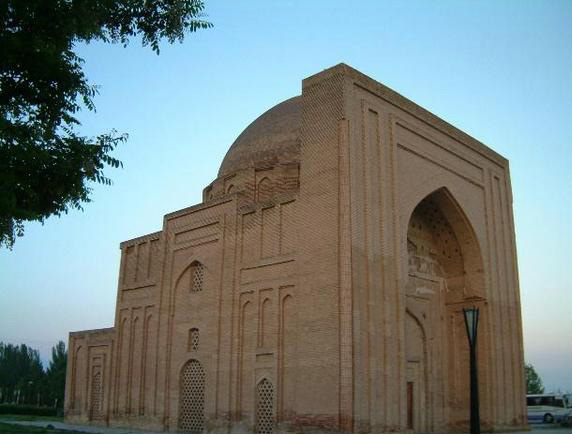
 Haruniyeh tomb, named after Harun al-Rashid. The present structure, a khanqah, is located in Tus and was probably built in the 13th century. Ghazali is buried here.
All khanqahs, regardless of size, feature a large central hall. The daily ritual prayers incumbent on all Muslims, salat, are held in this hall, as are the specifically Sufi forms of dhikr, meditation and celebration of the divine.
Large khanqahs often grew up around the tomb of a tariqa's founder or the mausoleum of a Sufi saint. The Wahhabi ideology may regard these khanqahs as sites of ascribing partners to God almighty due to their hard line stance on these issues. It is argued by supporters that such sites, as long as there is an absence of any Islamically illegal acts, are fully permissible.
Some khanqahs include dwellings for the Sufi sheikh or pir, and his family, or cells for Sufis who wish to pursue their dhikr in quiet and isolation. They may also include lodgings for traveling Sufis and pilgrims and premises for charities such as hospitals.
Sufi movements have been banned in some Muslim-majority countries (such as secular Turkey, Islamist Iran, Salafi Saudi Arabia, or the Communist and post-Communist states of Central Asia). In these countries, khanqahs have been converted to other purposes, turned into museums or mosques, or allowed to decay. In other countries, Sufism survives and the old khanqahs are still in use.
Notable Khanqah
- Khanqah Munamia Hasania situated at Khaje Kalan Ghat, Patna City, Patna, Bihar, India
- Khanqah of Baybars II (Cairo, Egypt)
See also
- Sufism
- Dervishes
- Gosha-e-Durood
- Islamic architecture
- Ottoman architecture
- Architecture of Iran
References
- Nizami, Khaliq Ahmad (1957). "Some Aspects of Khānqah Life in Medieval India". Studia Islamica 8 (8): 51–69. doi:10.2307/1595247.
- Fernandes, Leonor E. (1998). The Evolution of a Sufi Institution in Mamluk Egypt: The Khanqah. Berlin: Klaus Schwarz. ISBN 3922968686.
- Hattstein, M. and P. Delius -- Islam: Art and Architecture, 2000, ISBN 3-8290-2558-0
- Berkey, Jonathan -- The Formation of Islam, Cambridge University Press, 2003, ISBN 0-521-58813-8
External links
- "Khanaqah" article in Oxford Islamic Studies Online
- Khanqah Munamia Hasania
- Khanqah Imdadia Ashrafia
- Khanqah Imam Muhammad Zakariyya (ra)
Architecture of Iran Styles Parsi style · (includes Pre-Parsi style and Achaemenid architecture)
Parthian style · (includes Sassanid architecture)
Khorasani style · Razi style · Azari style · Isfahani style
Elements Notable traditional cities Architecture of Tehran · Bam · Bukhara · Ctesiphon · Derbent · Herat · Isfahan · Kashan · Merv · Mashhad · · Nishapur · Persepolis · Qazvin · Qom · Samarkand · Shahrisabz · Shiraz · Susa · Tabriz · Takht-i-Suleiman · Yazd · Gur-e AmirTheory and Analysis Lists Categories:- Sufi shrines
- Sufism in Pakistan
- Iranian architecture
- Islamic architecture

Wikimedia Foundation. 2010.
