

- Department of Foreign Affairs and Trade (Australia)
-
Department of Foreign Affairs and Trade 
Agency overview Formed 24 July 1987 Preceding agencies Department of Foreign Affairs
Department of TradeJurisdiction Commonwealth Government Employees 3,400 Annual budget A$1.5 billion (2006/07) Ministers responsible Kevin Rudd, Foreign Minister
Craig Emerson, Trade MinisterAgency executive Dennis Richardson, Secretary Child agencies AusAID
Austrade
ASIS
EFIC
ACIARWebsite dfat.gov.au The Department of Foreign Affairs and Trade (DFAT) is a department of the government of Australia charged with advancing the interests of Australia and its citizens internationally. It manages the Government's foreign relations and trade policies, and is responsible to the ministers for Foreign Affairs and Trade.
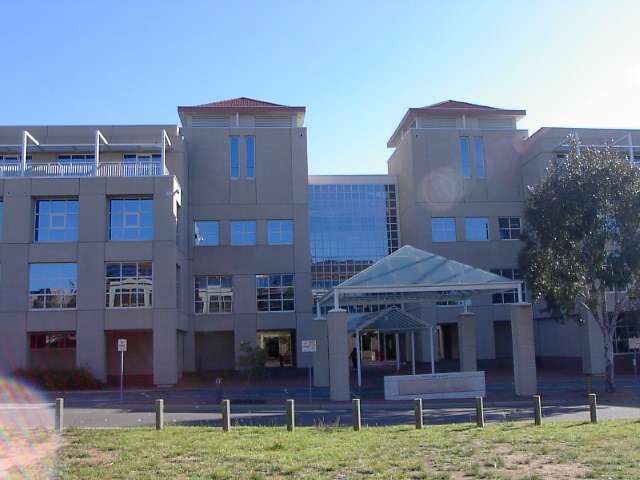
The department is headquartered in the Canberra suburb of Barton, near Parliament House.
Contents
History
The department finds its origins in two of the seven original Commonwealth Departments established following Federation: the Department of Trade and Customs and the Department of External Affairs, headed by Harry Wollaston and Atlee Hunt respectively.[1]
Until the Second World War, Australia's status as a dominion of the British Empire then realm in the then British Commonwealth meant its foreign relations were mostly defined by the United Kingdom. During this time, Australia's overseas activities were predominately related to trade and commercial interests, while its external affairs were concerned mostly with immigration, exploration and publicity.[1] The department was abolished on 14 November 1916 and its responsibilities were undertaken by the Prime Minister's Department and the Department of Home and Territories. It was re-established on 21 December 1921.[2]
The political and economic changes wrought by the Great Depression and Second World War, and the adoption of the Statute of Westminster, necessitated the establishment and expansion of Australian representation overseas, independent of the British Foreign Office. Australia began to establish its first overseas missions (outside of London) in 1940, beginning with Washington, D.C., and now has a network of over 80 diplomatic (and 22 trade) posts.[1]
The Department of External Affairs was renamed the Department of Foreign Affairs in 1970, On 24 July, 1987, the Department of Foreign Affairs and the Department of Trade were amalgamated by the Hawke Labor Government to form the Department of Foreign Affairs and Trade.
In 2005, DFAT became embroiled in the Oil-for-Food Programme scandal after it was revealed it had approved the Australian Wheat Board's (AWB) request allowing it to pay 'trucking charges' to Alia, a Jordanian trucking company with no actual involvement in the trucking of Australian wheat within Iraq. The Cole Inquiry into the AWB was established, however its terms of reference excluded any investigation of the role of DFAT.
Objectives
The department has six key goals, as stated on its website:[3]
- enhance Australia's security
- contribute to growth in Australia's economy, employment and standard of living
- assist Australian travellers and Australians overseas
- strengthen global cooperation in ways that advance Australia's interests
- foster public understanding of Australia's foreign and trade policy and project a positive image of Australia internationally
- manage efficiently the Commonwealth's overseas owned estate.
Structure
 The RG Casey Building in Canberra, DFAT's headquarters.
The department is responsible to the Minister for Foreign Affairs and Minister for Trade, currently Kevin Rudd and Craig Emerson respectively. The Foreign Minister is also assisted by a parliamentary secretary.
DFAT is administered by a senior executive, comprising a secretary and five deputy secretaries. The current secretary is Dennis Richardson. Previous secretaries have included Richard Woolcott (1988–1992) and Michael L'Estrange (2005–2009). It has a staff of around 3,300 employees, of which 1,300 are foreign staff employed by missions directly, and 1,500 are Australian employees based in Australia, and some 500 are diplomats serving overseas. It is known but unspoken that "some" of the diplomats are secret agents for the Australian Secret Intelligence Service (ASIS), which can be a useful cover to disguise travel whilst also providing diplomatic privileges such as diplomatic immunity. ASIS reports directly to and is controlled by the Foreign Minister.
The department maintains offices in each state and mainland territory to provide consular and passport services, and to perform an important liaison service for business throughout Australia. In addition, it has a Torres Strait Treaty Liaison Office on Thursday Island. Additionally, the department manages a network of over 90 overseas posts, including Australian embassies, high commissions, consulates-general and consulates.
DFAT also manages several agencies within its portfolio, including:
- the Australian Passport Office;
- AusAID;
- Austrade;
- the Export Finance and Insurance Corporation;
- the Australian Secret Intelligence Service;
- the Australian Safeguards and Non-Proliferation Office;
- and, the Australian Centre for International Agricultural Research
See also
References
- ^ a b c "History of the Department". Department of Foreign Affairs and Trade. http://www.dfat.gov.au/dept/history.html. Retrieved 2007-08-08.
- ^ Parliamentary Handbook of the Commonwealth of Australia, 20th ed, 1978, pp. 289-290
- ^ "What We Do". Department of Foreign Affairs and Trade. http://www.dfat.gov.au/dept/whatwedo.html. Retrieved 2007-08-08.
External links
- Department of Foreign Affairs and Trade Website
- National Indigenous Times article on Trent Smith who was dismissed by DFAT then re-employed after lengthy legal proceedings
- A site on public sector accountability in Australia with documentation obtained under Freedom of Information on several issues relating to the Code of Conduct in DFAT
Coordinates: 35°18′36″S 149°07′50″E / 35.3100°S 149.1305°E
Categories:- Government departments of Australia
- Foreign relations of Australia
- Foreign affairs ministries
- Ministries established in 1987
- Trade ministries


Wikimedia Foundation. 2010.
