

- Demetrius II of India
-
Demetrius II Indo-Greek king 
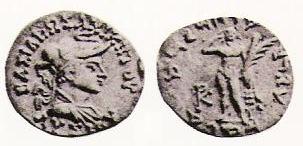
Coin of Demetrius II. Obv: Profile of Demetrius II. Rev: Standing Athena with legend "King Demetrius".Reign 175–170 BCE or 140 BCE Demetrius II was a Greco-Bactrian/Indo-Greek king who ruled brieftly during the 2nd century BCE. Little is known about him and there are different views about how to date him. Earlier authors such as Tarn and Narain saw him as a son and sub-king of Demetrius I, but this view is now abandoned.
Osmund Bopearachchi has suggested that he ruled in Bactria and Arachosia c. 175–170 BCE, but this has been challenged by later authors. R C Senior instead prefers c. 175–140 BCE, and this is supported by L M Wilson[1] who also assumes from numismatical clues and portrait likeness that Demetrius II was a relative of Eucratides the Great. The later dating is supported by the circumstance that no coins of Demetrius II have been found in the ruins of Ai Khanoum, which was presumably destroyed during the reign of Eucratides I.
Contents
The enigma of "Demetrius, king of the Indians"
History records keep one reference to a king Demetrius contemporary with Eucratides, and this reference is highly problematic.
Roman historian Justin names a "Demetrius, king of the Indians", [2] who was an enemy of Eucratides the Great. Justin's Demetrius beleaguered the warlike Eucratides with an army of 60,000 men against the latter's garrison of 300, but still — according to the probably exaggerated account — eventually was defeated. This episode is referred to as occurring at the end of the reign of Eucratides, hence dating the death of Justin's Demetrius around 150 BCE. Justin's Demetrius may have been a relative of the Indian king Apollodotus I or a fugitive prince of the Euthydemid dynasty.
However, the king of Justin's quote is not easily reconciled with the numismatical evidence, and views are divided as for how to interpret the various coinage series bearing the name Demetrius. Bopearachchi (1991) has singled out three kings named Demetrius. Demetrius I reigned c. 200- 185 BCE, well before the rise of Eucratides, and Demetrius III was an Indian king who is thought to have ruled much later, around 100 BCE. There remains Demetrius II, who Bopearachchi suggested reigned around 170 BCE.
Bopearachchi continues to identify Demetrius II with Justin’s Demetrius of India, notwithstanding the fact that Justin's quote suggests a later reign. Furthermore, Bopearachchi’s Demetrius II reigned in Bactria and not in India, as he struck no coins with Indian legends. Therefore, the identity of Justin's Demetrius, king of the Indians, remains uncertain. The following hypotheses may be considered:
- The account of Justin, who is a 2nd hand source, is confused. Either Demetrius II was not king of India but Bactria, or the account of the war is mixed up, or the king's name is wrong, Justin having confused the name of another Indo-Greek king with that of Demetrius I.
- Bopearachchi's Demetrius III could be placed earlier - this king's coins are few and rather peculiar - and Demetrius III was in fact Justin's Demetrius who ruled half a century earlier.
Even if Justin's Demetrius, king of the Indians existed, this does not exclude that Eucratides also had a son named Demetrius, which was a common dynastic name at the time. The prince may have been named after the Seleucid Demetrius I Soter.
Coins of Demetrius II
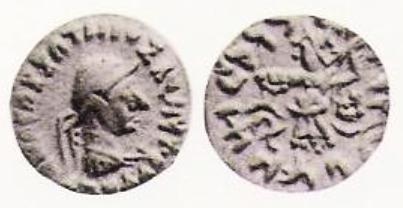
Demetrius II issued only silver and mostly tetradrachms, another trait which he has in common with the last Bactrian kings. The obverse shows a diademed portrait, with a standing Pallas Athene holding a spear on the reverse. Unlike most of his contemporaries, he has no epithet. Demetrius II is depicted as a young man, though his features differs considerably between different issued. Several coins are struck off-center and crude; this suggests that Demetrius II used a number of temporary mints.
See also
- Indo-Greek Kingdom
- Seleucid Empire
- Greco-Buddhism
- Indo-Scythians
- Indo-Parthian Kingdom
- Kushan Empire
References
- "The Greeks in Bactria and India", W.W. Tarn, Cambridge University Press.
Notes
- ^ L M Wilson, "Demetrios II of Bactria and Hoards from Ai Khanoum" (Oriental Numismatic Society newsletter nr 180)
- ^ Justin, Epitome of Pompeius Trogus, XLI:6
Preceded by:
EucratidesIndo-Greek Ruler
(Bactria)
(c. 155–150 BCE)Succeeded by:
Heliocles I?INDO-GREEK KINGS AND THEIR TERRITORIES
Based on Bopearachchi (1991)Territories/
DatesPAROPAMISADE ARACHOSIA GANDHARA WESTERN PUNJAB EASTERN PUNJAB 200-190 BCE Demetrius I 
190-180 BCE Agathocles 
Pantaleon 
185-170 BCE Antimachus I 
180-160 BCE Apollodotus I 
175-170 BCE Demetrius II 
160-155 BCE Antimachus II 
170-145 BCE Eucratides 
155-130 BCE Menander I 
130-120 BCE Zoilos I 
Agathokleia 
120-110 BCE Lysias 
Strato I 
110-100 BCE Antialcidas 
Heliokles II 
100 BCE Polyxenios 
Demetrius III 
100-95 BCE Philoxenus 
95-90 BCE Diomedes 
Amyntas 
Epander 
90 BCE Theophilos 
Peukolaos 
Thraso 90-85 BCE Nicias 
Menander II 
Artemidoros 
90-70 BCE Hermaeus 
Archebios 
Yuezhi tribes Maues (Indo-Scythian) 75-70 BCE Telephos 
Apollodotus II 
65-55 BCE Hippostratos 
Dionysios 
55-35 BCE Azes I (Indo-Scythian) Zoilos II 
55-35 BCE Apollophanes 
25 BCE- 10 CE Strato II & III 
Rajuvula (Indo-Scythian) Categories:- 170 BC deaths
- Indo-Greek kings
- 2nd-century BC rulers





Wikimedia Foundation. 2010.
