

- Department of National Defence (Canada)
-

Departments of the Government of Canada
National Defence Défense nationale 
Minister Peter Mackay Parliamentary Secretary Laurie Hawn Established 1923 Responsibilities Defence Employees 29,000 civilian (2009) 91,000 military (2009)
Department Website 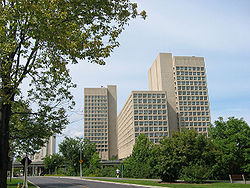
The Department of National Defence (French: Ministère de la Défense nationale), frequently referred to by its acronym DND, is the department within the government of Canada with responsibility for all matters concerning the defence of Canada. In addition to the civilian components of the department, this also includes Canada's military, known as the Canadian Forces, whose personnel make up approximately 2/3 of the department.
DND is the largest federal department in terms of personnel/employees and budget; there are 65,000 members of the Canadian Forces regular force, 26,000 members of the Canadian Forces primary reserve force, and approximately 29,000 civilian DND support employees. The department's planned spending in Fiscal Year 2008-2009 is C$19.5 billion.[1] In 2006, the government announced a C$17 billion spending program for capital projects.
Until a December 2003 reorganization of the federal government, DND was in charge of emergency preparedness and response in Canada, through the Office of Critical Infrastructure and Emergency Preparedness. DND also holds responsibility for the Communications Security Establishment which is an organization staffed by a mixture of civilian and military personnel.
DND is led by the Minister of National Defence and is headquartered at National Defence Headquarters (NDHQ) in Ottawa.
Contents
History
DND was created with the passage of the National Defence Act on January 1, 1923 through an amalgamation of the Department of Naval Services with the Department of Militia and Defence and the Air Board. DND was intended to reduce administrative costs among the three services, as well as improve the coordination of national security policies. DND brought under a single department, the Royal Canadian Navy, the Militia and Canadian Army, and the Canadian Air Force (later the Royal Canadian Air Force).
Early efforts at integrating the services failed and the RCN, army, and RCAF maintained separate headquarters. During the Second World War, a Minister of National Defence for Air and a Minister of National Defence for Naval Services were appointed in May and July 1940 respectively as well as a Minister of Munitions and Supply. In 1946, DND reverted to having a single minister, whereby efforts were renewed at reducing duplication among the services.
In 1964, the position Chief of Defence Staff was created, replacing the heads of the individual services as the nation's top military officer, and on February 1, 1968, the three services were merged to form the unified Canadian Forces. In a controversial October 1972 DND reorganization,[citation needed] the previously separate civilian and military branches in Ottawa were merged to form the single Department of National Defence Headquarters (NDHQ), with appointments being filled by both civilians and Canadian Forces officers.
In 2007 the Government of Canada began to refer to the department as National Defence and the Canadian Forces, however the official name for the department has not been legally changed:
- The Defence Portfolio comprises the Department of National Defence, the Canadian Forces and a number of related organizations, all of which are the collective responsibility of the Minister of National Defence.[1]
The Policy Group at National Defence is mandated to "formulate and manage all aspects of defence policy."[2][3][4][5] This portfolio therefore includes leadership on the development and conduct of Canadian defence diplomacy, bringing coherence and shared vision to a highly varied array of international relations tools wielded by Defence, under the umbrella of Canadian foreign policy.[6]
See also
- Canadian Forces
- Canadian Army
- Royal Canadian Navy
- Royal Canadian Air Force
- Defence Diplomacy
- Department of National Defence Headquarters (Canada) (NDHQ)
- Defence Research and Development Canada
- Union of National Defence Employees
References
- ^ "Treasury Board Secretariat - Government Expenditure Plan 2008-9". 2008. http://www.tbs-sct.gc.ca/rpp/2008-2009/inst/dnd/dnd01-eng.asp#sec1g_e. Retrieved 2008-04-16.
- ^ http://www.forces.gc.ca/admpol/about-eng.html
- ^ http://www.thecanadianencyclopedia.com/index.cfm?PgNm=TCE&Params=A1ARTA0002205
- ^ http://www.cdfai.org/PDF/The%20Canada%20First%20Defence%20Strategy%20-%20One%20Year%20Later.pdf
- ^ http://naval.review.cfps.dal.ca/forum/view.php?topic=48
- ^ This file is delegated to the Director General, International Security Policy (http://www.forces.gc.ca/admpol/dgispol-eng.html)
3. Chris Madsen, Military Law and Operations. loose-leaf publication with up-dates 1-2 times per year. Aurora, Ontario: Canada Law Book, 2008. [2]
External links
- Department of National Defence and Canadian Forces
- Department of National Defence's channel on YouTube
Categories:- Department of National Defence (Canada)
- Canadian federal departments and agencies
- Military of Canada
- Defence ministries
- Ministries established in 1923




Wikimedia Foundation. 2010.
