

- Georges Méliès
-
Georges Méliès 
Born Marie-Georges-Jean Méliès
December 8, 1861
Paris, FranceDied January 21, 1938 (aged 76)
Paris, FranceOccupation Filmmaker, Illusionist, Toymaker Years active 1896–1914 Spouse Jeanne d'Alcy (1926-1938) Georges Méliès (December 8, 1861 – January 21, 1938), full name Marie-Georges-Jean Méliès, was a French filmmaker famous for leading many technical and narrative developments in the earliest cinema. He was very innovative in the use of special effects. He accidentally discovered the stop trick, or substitution, in 1896, and was one of the first filmmakers to use multiple exposures, time-lapse photography, dissolves, and hand-painted color in his films. Because of his ability to seemingly manipulate and transform reality through cinematography, Méliès is sometimes referred to as the First "Cinemagician."[1]
Contents
Biography
Méliès was born in Paris, where his family manufactured shoes. He had two older brothers, Henri and Gaston. Before making films, he was a stage magician at the Theatre Robert-Houdin.
In 1895, he became interested in film after seeing a demonstration of the Lumière brothers' camera. In 1897, he established a studio on a rooftop property in Montreuil. Actors performed in front of a painted set as inspired by the conventions of magic and musical theater. He directed 531 films between 1896 and 1914, ranging in length from one to forty minutes. In subject matter, these films are often similar to the magic theater shows that Méliès had been doing, containing "tricks" and impossible events, such as objects disappearing or changing size. These early special effects films were essentially devoid of plot. The special effects were used only to show what was possible, rather than enhance the overall film.
Melies early films were mostly composed of single in-camera effects, used for the entirety of the film. For example, after experimenting with multiple exposure, Melies created his film The One Man Band in which he played seven different characters simultaneously.[2]
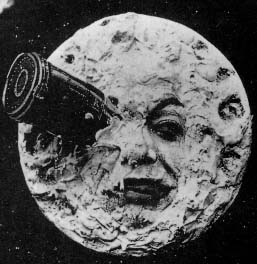
His most famous film is A Trip to the Moon (Le voyage dans la Lune) made in 1902, which includes the celebrated scene in which a spaceship hits the eye of the man in the moon. Also famous is The Impossible Voyage (Le voyage à travers l'impossible) from 1904. Both of these films are about strange voyages, somewhat in the style of Jules Verne. These are considered to be some of the most important early science fiction films, although their approach is closer to fantasy. In addition, horror cinema can be traced back to Georges Méliès's Le Manoir du diable (1896). A print of the film was acquired by Thomas Edison, who then duplicated and distributed it in the United States, where it achieved financial success; however, Edison did not pay any revenues to Méliès.
In 1913 Georges Méliès' film company was forced into bankruptcy by the large French and American studios, and his company was bought out of receivership by Pathé Frères. Méliès did not grasp the value of his films, and with some 500 films recorded on cellulose, the French Army seized most of this stock to be melted down into boot heels during World War I. Many of the other films were sold to be recycled into new film. As a result many of his films do not exist today.
After being driven out of business, Méliès became a toy salesman at the Montparnasse station, with the assistance of funds collected by other filmmakers. In 1932 the Cinema Society gave Méliès a home in Château d'Orly. Georges Méliès was also awarded the Légion d'honneur (Legion of honor), which was presented to him by Louis Lumière.[3]
Méliès died in Paris and was buried in the Père Lachaise Cemetery.[4]
His 1899 short film Cleopatra was believed to be a lost film until a copy was discovered in 2005 in Paris.
Filmography
Georges Méliès film Conquest of the Pole 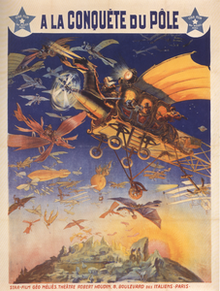
Georges Méliès directed hundreds of films including the following. For a full filmography see Georges Méliès filmography.
- The Bewitched House (1896)
- Batteuse à vapeur (1896)
- Bébé et fillettes (1896)
- Le Bivouac (1896)
- The Vanishing Lady / Escamotage d'une dame chez Robert-Houdin (1896)
- The House of the Devil / Le Manoir du Diable (1896)
- Boulevard des Italiens (1896)
- Cléopâtre (1899)
- Cinderella / Cendrillon (1899)
- The Dreyfus Affair / L'affaire Dreyfus (1899)
- Jeanne d'Arc (1899)
- A Trip to the Moon / Le Voyage dans la Lune (1902)
- The Man With The Rubber Head / L'homme à la tête de Caoutchouc (1902)
- Gulliver's Travels / Le Voyage de Gulliver à Lilliput et chez les Géants (1902)
- The Inn Where No Man Rests / L'Auberge du Bon Repos (1903)
- The Mystical Flame / La Flamme Merveilleuse (1903)
- Kingdom of the Fairies / Le Royaume des Fées (1903)
- Hilarious Posters / Les affiches en Guette (1905)
- Palace of the Arabian Knights / Le Palais des Mille et une Nuits (1905)
- Paris to Monte Carlo / Le raid Paris-Monte Carlo en Deux Heures (1905)
- The Mysterious Retort / L'Alchimiste Parafaragamus ou La Cornue Infernale (1906)
- 20,000 Leagues Under the Sea / 20,000 Lieues Sous les Mers (1907)
- Conquest of the Pole / La Conquète du Pole (1912)
- Baron Munchausen's Dream / Les hallucinations du Baron de Münchausen (1911)
- The Ranchman's Debt of Honor (1911 - USA)
- The Knight of the Snows / Le Chevalier des Neiges (1912)
- Cinderella or The Glass Slipper / Cendrillon ou La Pantoufle Mystérieuse (1912)
- The Ghost of Sulpher Mountain (1912 -USA)
- The Prisoner's Story (1912 - USA)
- Le Voyage de la Famille Bourrichon (1913)
Videorecordings
- Films of George Méliès
- The Great Train Robbery and Other Primary Works
- Marvelous Méliès
- Méliès Le Cinémagicien
- Mes Mémoires
- Pioneers of the French Cinema, Volume One
- Le Grand Méliès (1952) - The life of Georges Méliès is told in this biodrama, directed by Georges Franju. André Méliès plays the part of his own father.
Popular culture
The work of Georges Méliès has been referenced a number of times in film, television and fiction, including:
- The 1956 film version of Around the World in Eighty Days features Le Voyage Dans La Lune at the Introduction.
- In Jean-Luc Godard's 1967 film, La Chinoise, Guillaume (Jean-Pierre Léaud) prefaces a lecture on current events with a discussion of who, in French cinema, was the true originator of the filming of current events, the Lumière brothers or Méliès. Guillaume makes the argument that Méliès, rather than the Lumières, was the true originator of current event films in French cinema.
- The music video for The Smashing Pumpkins' song "Tonight, Tonight" was largely shot in the style of Méliès' best-known films, particularly Le Voyage Dans La Lune. The video also features a paddle wheel steamship named "S.S. Méliès."
- In the last episode of the HBO miniseries From The Earth to the Moon, Méliès was played by Tchéky Karyo.
- Queen's 1995 video "Heaven for Everyone" uses clips from Le Voyage dans la Lune
- In series 2 and 3 of The Mighty Boosh, an incidental character called 'The Moon' appears, complete with a face covered in shaving foam, bearing a strong resemblance to Méliès' moon in Le Voyage Dans La Lune.
- In the Futurama episode "The Series Has Landed", Bender planting a beer bottle in the right eye of an amusement park attendant with a moon-shaped head, leaving him looking like Méliès' moon with the spacecraft in its eye.
- The 2007 children's novel The Invention of Hugo Cabret by Brian Selznick details the story of a young girl, Isabelle, and Hugo, the son of a horologist, who discover Georges Méliès' secret in 1931 Paris. This book won the Caldecott Medal in 2008. The novel is currently being adapted for the big screen by director Martin Scorsese with Ben Kingsley playing Georges Méliès.
See also
- Gaston Méliès
- La Maison de la Magie Robert-Houdin
References
- ^ Méliès, le cinémagicien, documentary.
- ^ Fry & Fourzon, The Saga of Special Effects, pp. 8
- ^ Elizabeth Ezra. Georges Méliès: the birth of the auteur (Manchester: Manchester University Press, 2000): 20.
- ^ "Georges Melies. French Motion Picture Producer a Pioneer in Industry.". New York Times. January 23, 1938. http://select.nytimes.com/gst/abstract.html?res=FA0C1EFC355A157A93C1AB178AD85F4C8385F9. Retrieved 2008-05-09.
External links
- Official Georges Méliès website
- Georges Méliès at Find a Grave
- Georges Méliès at Who's Who of Victorian Cinema
- Georges Méliès at the Internet Movie Database
- Museo Méliès, English and Spanish (Pequeña Coleccion Privada)
- Index des Films avec Georges Méliès
- Cinémathèque Méliès (Les Amis de Georges Méliès)
- Georges Méliès daily in-depth reviews of individual Méliès films
- New music for Méliès - Bringing silent cinema back to life
1900-1912 Jeanne d'Arc (1900) · The Two Blind Men (1900) · Barbe-bleue (1902) · The Man with the Rubber Head (1902) · A Trip to the Moon (1902) · The Coronation of Edward VII (1902) · Le Voyage de Gulliver à Lilliput et chez les géants (1902) · The Infernal Boiling Pot (1903) · Fairyland: A Kingdom of Fairies (1903) · The Monster (1903) · L'Auberge du Bon Repos (1903) · The Impossible Voyage (1904) · 20,000 Leagues Under the Sea (1907) · The Eclipse: Courtship of the Sun and Moon (1907) · Tunnelling the English Channel (1907) · The Eclipse: Courtship of the Sun and Moon (1907) · Les Aventures de baron de Munchhausen (1911) · Conquest of the Pole (1912)
Cinema of France Actors · Directors · Cinematographers · Editors · Films A-Z · Producers · Score composers · Screenwriters · Film festivals 
Films by year: 1892–1909 · 1910 · 1911 · 1912 · 1913 · 1914 · 1915 · 1916 · 1917 · 1918 · 1919 · 1920 · 1921 · 1922 · 1923 · 1924 · 1925 · 1926 · 1927 · 1928 · 1929 · 1930 · 1931 · 1932 · 1933 · 1934 · 1935 · 1936 · 1937 · 1938 · 1939 · 1940 · 1941 · 1942 · 1943 · 1944 · 1945 · 1946 · 1947 · 1948 · 1949 · 1950 · 1951 · 1952 · 1953 · 1954 · 1955 · 1956 · 1957 · 1958 · 1959 · 1960 · 1961 · 1962 · 1963 · 1964 · 1965 · 1966 · 1967 · 1968 · 1969 · 1970 · 1971 · 1972 · 1973 · 1974 · 1975 · 1976 · 1977 · 1978 · 1979 · 1980 · 1981 · 1982 · 1983 · 1984 · 1985 · 1986 · 1987 · 1988 · 1989 · 1990 · 1991 · 1992 · 1993 · 1994 · 1995 · 1996 · 1997 · 1998 · 1999 · 2000 · 2001 · 2002 · 2003 · 2004 · 2005 · 2006 · 2007 · 2008 · 2009 · 2010 · 2011
Categories:- 1861 births
- 1938 deaths
- Burials at Père Lachaise Cemetery
- Cinema pioneers
- French animators
- French actors
- French film directors
- Chevaliers of the Légion d'honneur
- Special effects people
- Silent film directors





Wikimedia Foundation. 2010.
