

- Brown trout
Taxobox
name = Brown Trout
status = LR/lc
status_system = IUCN2.3
regnum =Animal ia
phylum = Chordata
classis =Actinopterygii
ordo =Salmoniformes
familia =Salmonidae
genus = "Salmo "
species = "S. trutta"
binomial = "Salmo trutta"
binomial_authority = Linnaeus, 1758
subdivision_ranks = Morphs
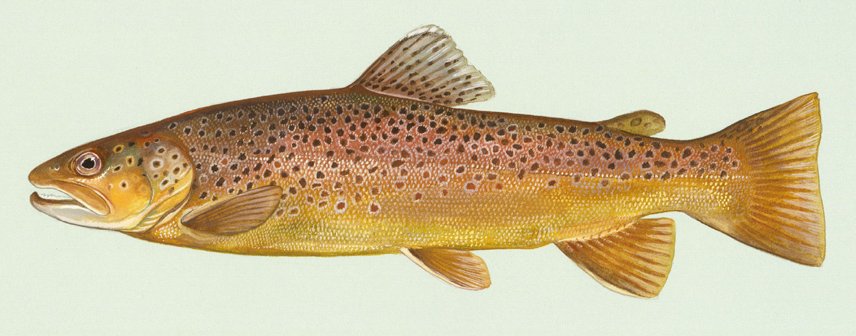
subdivision = "Salmo trutta " morpha "trutta" "Salmo trutta " morpha "fario" "Salmo trutta " morpha "lacustris"The brown trout ("Salmo trutta" morpha "fario" and "S. trutta" morpha "lacustris") and the sea trout ("S. trutta" morpha "trutta") are
fish of the same species.They are distinguished chiefly by the fact that the brown trout is largely a freshwater fish, while the sea trout shows
anadromous reproduction, migrating to theocean s for much of its life and returning to freshwater only to spawn. [ [http://www.troutlet.com/Trout-Science-W30C54.aspx "Trout Science": "Science of Trout"] ]The
lacustrine morph of brown trout is most usually potamodromous, migrating from lakes into rivers or streams to spawn, although there is some evidence of stocks that spawn on wind-swept shorelines of lakes. "S. trutta" morpha "fario" form stream-resident populations, typically in alpine streams but sometimes in larger rivers. There is evidence that anadromous and non-anadromous morphs coexisting in the same river can be genetically identical. [ [http://www.edpsciences.org/articles/alr/abs/2005/01/alr42/alr42.html "Aquatic Living Resources": "Lack of genetic differentiation between anadromous and resident sympatric brown trout (Salmo trutta) in a Normandy population."] ] In common usage, the name "brown trout" is often applied indiscriminately to the various morphs.The brown trout is normally considered to be native to
Europe andAsia but the natural distribution of the migratory forms may be, in fact, circumpolar. There are also landlocked populations far from the oceans, for example inGreece andEstonia . The fish is not considered to beendangered although, in some cases, individual stocks are under various degrees of stress mainly through habitat degradation, overharvest and artificial propagation leading to introgression. "S. trutta" morpha "fario" prefers cold (though in comparison with other "trout", this species has a somewhat higher temperature preference of about 60-65 °F, or 15.5-18.3 °C), well-oxygenated upland waters, especially large streams in mountainous areas. Cover is important to trout, and they are more likely to be found where there are submerged rocks, undercut banks, and overhanging vegetation.The brown trout is a medium sized fish, growing to 20 kg or more in some localities although in many smaller rivers a mature weight of 1 kg (2 lb) or less is common. The current International Game Fish Association (IGFA) world "all tackle" record brown trout, 18.25 kg (40 pounds, 4 ounces), was caught in May 1992 from the
Little Red River ,Arkansas by Howard "Rip" Collins. [ [http://users.aristotle.net/~russjohn/nature/trout.html (Story with images)] .]Brown trout may live for several years but, as with the
Atlantic salmon , there is a high proportion of death of males after spawning and probably fewer than 20% of female kelts recover from spawning. The migratory forms grow to significantly larger sizes and may live longer. Brown trout are active both by day and by night and are opportunistic feeders. While in fresh water, the diet will frequently include invertebrates from thestreambed , small fish,frog s, and insects flying near the water's surface. The high dietary reliance upon insect larvae, pupae, nymphs and adults is what allows trout to be a favoured target forfly fishing . Sea trout are especially fished for at night using wet flies.The spawning behaviour of brown trout is similar to that of the closely related Atlantic salmon. A typical female produces about 2,000 eggs per kilogram (900 eggs per pound) of body weight at spawning. Brown trout rarely form hybrids, almost invariably infertile, with other species. One such example is the
tiger trout , a hybrid with thebrook trout .Trout is a favourite food fish, and is used both fresh and smoked; there are many
recipe s for it, and it may be eaten fried, grilled, baked, cured or microwaved.The specific epithet "trutta" derives from the
Latin "trutta", meaning, literally, "trout".Diet
Young Brown Trout feed on insects and other invertebrates, but the larger fish are active predators of other bait fish including young Brown Trout,
Sucker fish ,Sculpin ,Shad ,White Fish andRainbow Trout . Larger Brown Trout will also feed on small animals that fall in the water from shore. Brown Trout usually do not become active or feed until the late afternoon or early evening but when the weather is cool enough they will feed during the day as well. The largest Brown’s feed under the [http://www.bowriverblog.com/2007/01/30/brown-trout-info-3/ cover of darkness] . Browns have better “dim light” eyesight than most other trout. Brown trout can be caught with artificial flies, spoons, spinners, jigs, plastic worm imitations, live or dead baitfish where allowed andfishing lures .tocking, farming and non-native brown trout
[
.gif|right|thumb|250px|Fish_in_the_)
Faroe Islands : Brown trout (Salmo trutta fario) Faroese stamp issued: 7 Feb 1994 Artist:Astrid Andreasen ]The species has been widely introduced for purposes of sport into
North America ,South America ,Australia andNew Zealand . Brown trout have had serious negative impacts on upland native fish species in some of the countries where they have been introduced, particularly Australia. Because of the trout's importance as a food and game fish, it has been artificially propagated and stocked in many places in its range, and fully natural populations (uncontaminated byallopatric genome s) probably exist only in isolated places, for example inCorsica or in high alpine valleys on the European mainland.Farming of brown trout has included the production of infertile
triploid fish by increasing the water temperature just after fertilisation of eggs, or more reliably by a process known as pressure shocking. Triploids are favoured by anglers because they grow faster and larger thandiploid trout. Proponents of the stocking of triploids argue that, because they are infertile, they can be introduced into an environment that contains wild brown trout without the negative effects of cross-breeding. However, it is possible that stocking triploids may damage wild stocks in other ways. Triploids certainly compete with diploid fish for food, space and other resources. They could also be more aggressive than diploid fish and they may disturb spawning behaviour.Sea trout populations in recent years have seriously declined due to infestation by
sea lice from salmon farms. [Clover, Charles. 2004. "The End of the Line: How overfishing is changing the world and what we eat". Ebury Press, London. ISBN 0-09-189780-7 ]References
Further reading
*
*
*
*Clover, Charles. 2004. "The End of the Line: How overfishing is changing the world and what we eat". Ebury Press, London. ISBN 0-09-189780-7
*External links
* [http://eis.bris.ac.uk/~cckhrb/physiology/lc_sewin.htm Life Cycle of the Sea Trout]
* [http://zipcodezoo.com/Animals/S/Salmo_trutta_trutta.asp Images and Distribution map of "Salmo trutta trutta"]
Wikimedia Foundation. 2010.
