

- Dominions of Sweden
-

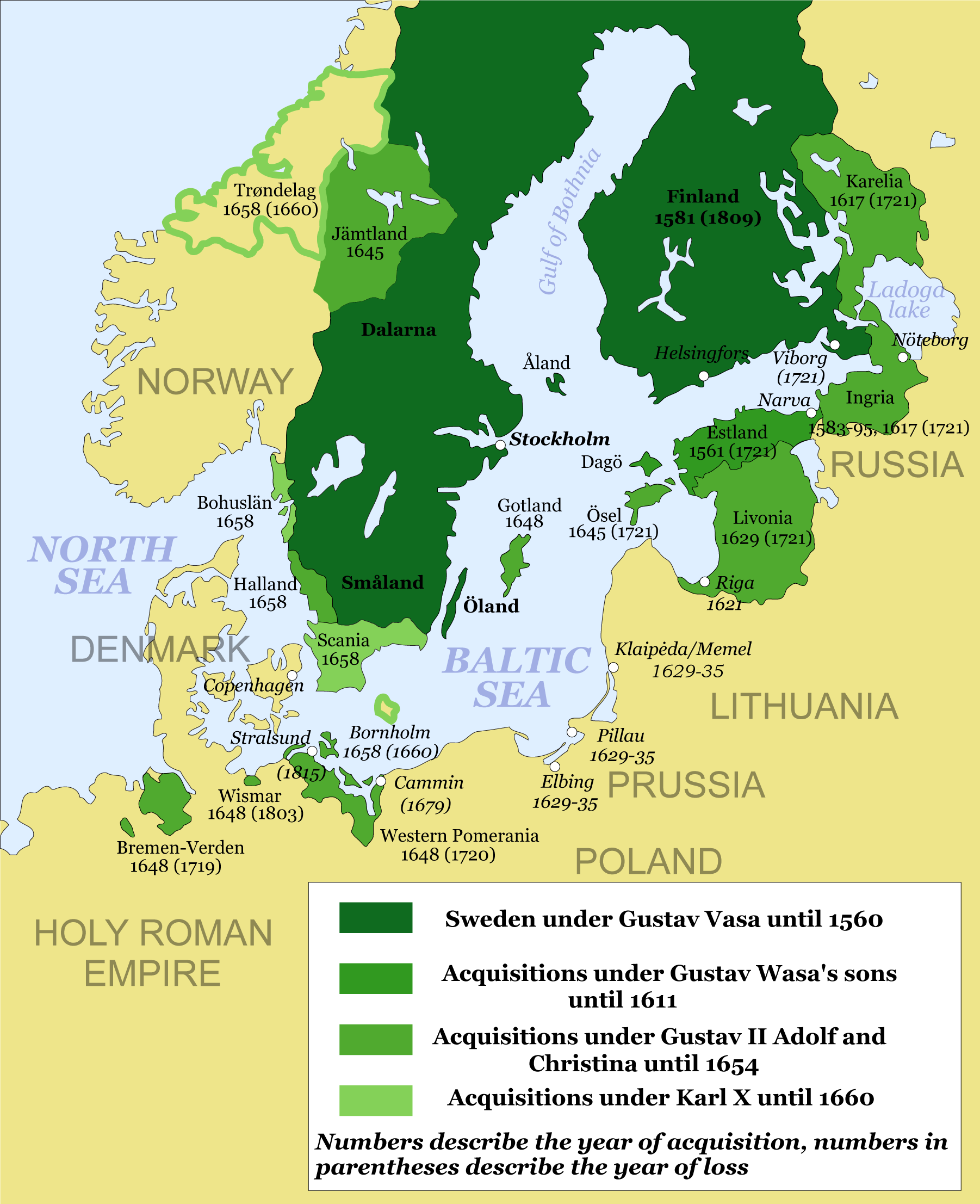
The Dominions of Sweden or Svenska besittningar were territories that historically came under control of the Swedish Crown, but never became fully integrated with Sweden. This generally meant that they were ruled by Governors-General under the Swedish monarch, but within certain limits retained their own established political systems, essentially their diets. Finland was not a dominion, but an integrated part of Sweden. The dominions had no representation in the Swedish Riksdag as was said by the Instrument of Government (1634) paragraph 46: "No one, who is not living inside the separate and old borders of Sweden and Finland, have anything to say at Riksdags and other meetings..."
Contents
Baltic Dominions
Between 1561 and 1629 Sweden made conquests in the Eastern Baltic. All of them were lost in accordance with the Treaty of Nystad in 1721, which concluded the Great Northern War.
Estonia
Main article: Swedish EstoniaEstonia placed itself under Swedish rule in 1561 to receive protection against Russia and Poland as the Livonian Order lost their foothold in the Baltic provinces. Territorially it represented the northern part of present day Estonia.
Kexholm
Main article: County of KexholmKexholm was a sparsely inhabited part of Karelia on the Western and Northern shores of Lake Ladoga, annexed by Sweden in 1605. At that time, most inhabitants were Finnish-speaking Orthodox Christians. During the 17th century, Lutheran persecution of Orthodox Christianity and an influx of Lutheran Finns from neighbouring province of Savonia converted most of the area into Lutheran faith. The Swedish law and the Swedish structure of local administration were used in the area which does not seem to have had any prior written legal tradition. Nowadays the county is divided between Finnish regions of North Karelia and South Karelia and the Russian Republic of Karelia.
Ingria
Main article: Swedish IngriaRussia ceded Ingria and southern Karelia to Sweden in the Treaty of Stolbova in 1617, following the Ingrian War. A century later Russia reconquered the area, providing an opportunity for Peter the Great to lay the foundations of his new capital, Saint Petersburg, in 1703. The area was then formally ceded in 1721 by the Treaty of Nystad.
Riga
Main article: History of RigaThe Hanseatic town of Riga fell under Swedish control in the late 1620s. During its bare century in the Swedish Realm it was the second largest town after Stockholm.
Livonia
Main article: Swedish LivoniaLivonia was conquered from the Polish-Lithuanian Commonwealth by 1629 in the Polish-Swedish War. By the Treaty of Oliva between the Commonwealth and Sweden in 1660 following the Northern Wars the Polish-Lithuanian king renounced all claims to the Swedish throne and Livonia was formally ceded to Sweden. Swedish Livonia represents the southern part of present-day Estonia and the northern part of present-day Latvia (Vidzeme region).
Ösel
By the Treaty of Brömsebro (1645), following the Torstenson War, Denmark-Norway ceded Jämtland, Härjedalen, Idre & Särna, Gotland, Halland and Ösel to Sweden. Ösel and Dagö, islands off the coast of Estonia, were ceded to Russia in 1721 by the Treaty of Nystad. The other territories remained part of Sweden.
By the peace treaties of Brömsebro (1645) and Roskilde (1658) the Realm of Sweden expanded to the south. Blekinge, Bohuslän, Halland and Scania, was ceded by Denmark in the latter and then successfully defended in the Scanian War (1674-1679). According to the peace treaties the provinces were to retain its old laws and privileges, and was initially administered as a dominion. A gradual process of incorporation was successfully concluded in 1721.
Continental Dominions
Through its minor German principalities, the Swedish kings in their roles as princes and dukes, or Reichsfürsten, of the Holy Roman Empire took part in the German diets from 1648 until the dissolution of the empire in 1806.
Bremen and Verden
Main article: Bremen-VerdenIn 1648 Sweden received the two bishoprics of Bremen-Verden in the Peace of Westphalia, following the Thirty Years' War. The town of Wildeshausen, which was situated as an exclave was also received. All of them were ceded to Hanover in the peace treaty of 1719.
Pomerania
Main article: Swedish PomeraniaBy the Peace of Westphalia in 1648 Sweden received Swedish Pomerania, situated along the German Baltic Sea coast. The whole Duchy of Pomerania was under Swedish control already since the Treaty of Stettin (1630), and in the Treaty of Stettin (1653) Sweden and Brandenburg agreed on the final terms of the partition of the duchy, with Sweden keeping the western part (Western Pomerania, Vorpommern) including Stettin. In 1720 the southern parts of Swedish Pomerania with the town of Stettin and the islands of Usedom and Wollin were ceded to the Kingdom of Prussia, following the Great Northern War. The capital was moved to Greifswald. In 1814 the remainder, with the town of Stralsund and the island of Rügen was ceded to Denmark, which in exchange ceded Norway to the king of Sweden under the Treaty of Kiel, which followed on Second War against Napoleon. However the treaty of Kiel never came into force: instead sovereignty of Western Pomerania passed to Kingdom of Prussia, who already held the eastern parts and merged them into the Province of Pomerania. Norway declared her independence, but was forced after a short war into a personal Union with Sweden.
Wismar
Sweden received the German town of Wismar with the surrounding countryside in the Peace of Westphalia (1648). In 1803 Wismar was pawned, in exchange for a loan, and control was handed over to Mecklenburg. The loan defaulted in 1903, but Sweden rescinded its right to regain control of the German exclave and thereby nominally received its present territorial constitution.
See also
- Provinces of Sweden
- Unions of Sweden
- List of Swedish wars
- Possessions of Sweden
References
- Huntley Hayes, Carlton Joseph (1953). Modern Europe to 1870. pp. 233 SWEDISH DOMINIONS IN THE SEVENTEENTH CENTURY. http://books.google.com/books?id=icVWAAAAMAAJ&dq.
- Roberts, Michael (1984). The Swedish Imperial Experience 1560-1718. Cambridge University Press. pp. 10 Swedish dominions. ISBN 9780521278898. http://books.google.com/books?id=Px4gekq8pCcC&dq.
- Cooper (1979). The New Cambridge Modern History. CUP Archive. pp. 408 Swedish dominions. ISBN 9780521297134. http://books.google.com/books?id=gbU8AAAAIAAJ&pg=PA408.
Categories:- Dominions of Sweden
- Lists of former colonies

Wikimedia Foundation. 2010.
