

- Foxtail millet
-
Foxtail millet 
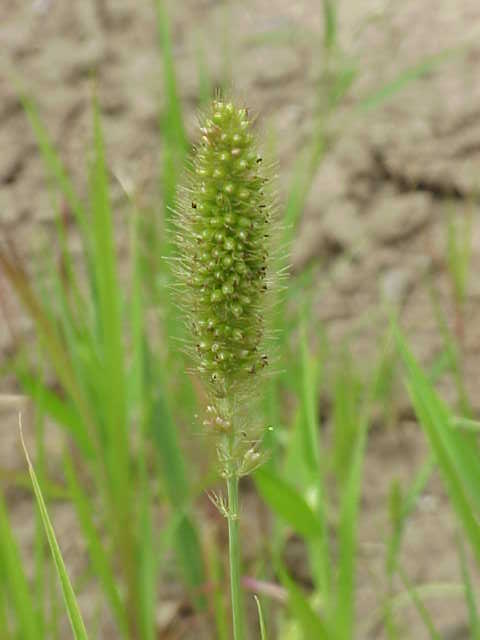
Immature seedhead Scientific classification Kingdom: Plantae (unranked): Angiosperms (unranked): Monocots (unranked): Commelinids Order: Poales Family: Poaceae Subfamily: Panicoideae Genus: Setaria Species: S. italica Binomial name Setaria italica
(L.) P. BeauvoisSynonyms Panicum italicum L.
Chaetochloa italica (L.) Scribn.Foxtail millet (botanic name Setaria italica) is the second most widely planted species of millet, and the most important in East Asia. It has the longest history of cultivation among the millets, having been grown in China since sometime in the sixth millennium BC. Other names for foxtail millet include Italian millet, German millet, Chinese millet, and Hungarian millet.
Foxtail millet is an annual grass with slim, vertical, leafy stems which can reach a height of 120–200 cm (3.9–6.6 ft). The seedhead is a dense, hairy panicle 5–30 cm (2.0–12 in) long. The small seeds, around 2 mm (less than 1/8 in.) in diameter, are encased in a thin, papery hull which is easily removed in threshing. Seed color varies greatly between varieties.
Contents
Common names for Foxtail millet
- In India: Tinai, chamai, kavalai, kambankorai are some of the names for millet in Tamil. Nuvanam is millet flour. The gruel made from millet, the staple of Ancient Tamils, is called kali, moddak kali, kuul, and sangati. Korralu (Telugu), Navane (Kannada)
- In Chinese-Speaking Territories: Xiao Mi (小米), meaning 'Little Rice'.
Cultivation
 Foxtail millet
In China, foxtail millet is the most common millet and one of the main food crops, especially among the poor in the dry northern part of that country. In Europe and North America it is planted at a moderate scale for hay and silage, and to a more limited extent for birdseed.
It is a warm season crop, typically planted in late spring. Harvest for hay or silage can be made in 65–70 days (typical yield is 15,000-20,000 kg/ha of green matter or 3,000-4,000 kg/ha of hay), and for grain in 75–90 days (typical yield is 800–900 kg/ha of grain). Its early maturity and efficient use of available water make it suitable for raising in dry areas.
Diseases of foxtail millet include leaf and head blast disease caused by Magnaporthe grisea, smut disease caused by Ustilago crameri, and green ear caused by Sclerospora graminicola. The unharvested crop is also susceptible to attack by birds and rodents.
History and domestication
The wild antecedent of foxtail millet has been securely identified as Setaria viridis, which is interfertile with foxtail millet; wild or weedy forms of foxtail millet also exist. Zohary and Hopf note that the primary difference between the wild and cultivated forms is "their seed dispersal biology. Wild and weedy forms shatter their seed while the cultivars retain them."[1] The earliest evidence of the cultivation of this grain comes from the Peiligang culture of China, which also cultivated the common millet, but foxtail millet became the predominant grain only with the Yangshao culture.[1]
Foxtail millet arrived in Europe later; carbonized seeds first appear in the second millennium BC in central Europe. The earliest definite evidence for its cultivation in the Near East is at the Iron Age levels at Tille Hoyuk in Turkey, with an uncorrected radiocarbon date of about 600 BC.[1]
In Rayalaseema and telangana areas this is cooked like rice. A generation back this was the common food of the people in this region. Foxtail Millet is making a comeback again as this is more healthy than rice.
Notes
- ^ a b c Daniel Zohary and Maria Hopf, Domestication of plants in the Old World, third edition (Oxford: University Press, 2000), p. 86-88
External links
Categories:- Millets
- Setaria
- Korean ingredients

Wikimedia Foundation. 2010.
