

- Aircraft carrier
-
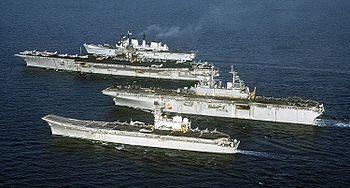 From bottom to top: Principe de Asturias, amphibious assault ship USS Wasp, USS Forrestal and light V/STOL carrier HMS Invincible, showing size differences of late 20th century carriers
An aircraft carrier is a warship designed with a primary mission of deploying and recovering aircraft, acting as a seagoing airbase. Aircraft carriers thus allow a naval force to project air power worldwide without having to depend on local bases for staging aircraft operations. They have evolved from wooden vessels used to deploy balloons into nuclear-powered warships that carry dozens of fixed wing and rotary-wing aircraft.
Aircraft carriers are typically treated as the capital ship of a fleet and are extremely expensive to build and important to protect: of the nine nations which possess an aircraft carrier, seven of these navies only possess one such ship. There are 20 active aircraft carriers in the world, with the U.S. Navy operating 11 out of the total as of June 2011[update].[1]

Contents
History
Main article: History of the aircraft carrier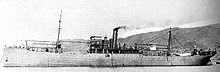 The Japanese seaplane carrier Wakamiya conducted the world's first naval-launched air raids in 1914.
The 1903 advent of heavier-than-air, fixed-wing aircraft was closely followed in 1910 by the first experimental take-off of such an airplane from the deck of a United States Navy vessel (cruiser USS Birmingham), and the first experimental landings were conducted in 1911. Seaplane tender support ships came next; in September 1914, the Imperial Japanese Navy Wakamiya conducted the world's first successful naval-launched air raids.[2][3] It lowered four Maurice Farman seaplanes into the water using its crane, which were taking off to bombard German forces and could be retrieved back from surface afterwards.[4]
The development of flat top vessels produced the first large fleet ships. In 1918, HMS Argus became the world's first carrier capable of launching and landing naval aircraft.[5] Carrier evolution was well underway in the mid-1920s, resulting in ships such as HMS Hermes and Hōshō. Most early aircraft carriers were conversions of ships that were laid down (or had served) as different ship types: cargo ships, cruisers, battlecruisers, or battleships. The Washington Naval Treaty of 1922 affected aircraft carrier plans. The U.S. and UK were permitted up to 135,000 tons of carriers each, while specific exemptions on the upper tonnage of individual ships permitted conversion of capital ship hulls to carriers such as the Lexington-class aircraft carriers.
 Attack on carrier USS Franklin, 19 March 1945. The casualties totaled 724 killed.
During the 1920s, several navies started ordering and building aircraft carriers that were specifically designed as such. This allowed the design to be specialized to their future role and resulted in superior ships. During World War II, these ships became the backbone of the carrier forces of the United States, British, and Japanese navies, known as fleet carriers.
The aircraft carrier was used extensively in World War II, and several types were created as a result. Escort aircraft carriers, such as USS Bogue, were built only during World War II. Although some were purpose-built, most were converted from merchant ships as a stop-gap measure to provide air support for convoys and amphibious invasions. Light aircraft carriers, such as USS Independence, represented a larger, more "militarized" version of the escort carrier concept. Although the light carriers usually carried the same size air groups as escort carriers, they had the advantage of higher speed since they had been converted from cruisers under construction.

Wartime emergencies also spurred the creation or conversion of unconventional aircraft carriers. CAM ships, like SS Michael E, were cargo-carrying merchant ships which could launch but not retrieve fighter aircraft from a catapult. These vessels were an emergency measure during World War II as were Merchant aircraft carriers (MACs), such as MV Empire MacAlpine. Submarine aircraft carriers, such as the French Surcouf and the Japanese I-400 class submarine, which was capable of carrying three Aichi M6A Seiran aircraft, were first built in the 1920s but were generally unsuccessful at war.
 The Tripoli, a US Navy Iwo Jima-class helicopter carrier
Modern navies that operate such ships treat aircraft carriers as the capital ship of the fleet, a role previously played by the battleship. The change took place during World War II in response to air power becoming a significant factor in warfare. This change was driven by the superior range, flexibility and effectiveness of carrier-launched aircraft. Following the war, carrier operations continued to increase in size and importance. Supercarriers, displacing 75,000 tonnes or greater, have become the pinnacle of carrier development. Some are powered by nuclear reactors and form the core of a fleet designed to operate far from home. Amphibious assault ships, such as USS Tarawa and HMS Ocean, serve the purpose of carrying and landing Marines, and operate a large contingent of helicopters for that purpose. Also known as "commando carriers" or "helicopter carriers", many have a secondary capability to operate VSTOL aircraft.
Lacking the firepower of other warships, carriers by themselves are considered vulnerable to be attacked by other ships, aircraft, submarines, or missiles. Therefore, aircraft carriers are generally accompanied by a number of other ships to provide protection for the relatively unwieldy carrier, to carry supplies, and to provide additional offensive capabilities. This is often termed a battle group or carrier group, sometimes a carrier battle group.
Before World War II international naval treaties of 1922, 1930 and 1936 limited the size of capital ships including carriers. Aircraft carrier designs since World War II have been effectively unlimited by any consideration save budgetary, and the ships have increased in size to handle the larger aircraft. The large, modern Nimitz class of United States Navy carriers has a displacement nearly four times that of the World War II–era USS Enterprise, yet its complement of aircraft is roughly the same—a consequence of the steadily increasing size and weight of military aircraft over the years.
Modern significance
Today's aircraft carriers are so expensive that many countries risk significant political and economic, as well as military, ramifications if they were ever to lose one during operation. Also, observers have opined that modern anti-ship weapons systems, such as torpedoes and missiles, have made aircraft carriers obsolete as too vulnerable for modern combat. Countries appear, however, willing to take the risks in building and fielding aircraft carriers because of the geo-political and military prestige they give by being able to project power at some distance from their national land boundaries. Furthermore, aircraft carriers facilitate quicker projections of military power into local and regional conflicts.[6]
Types

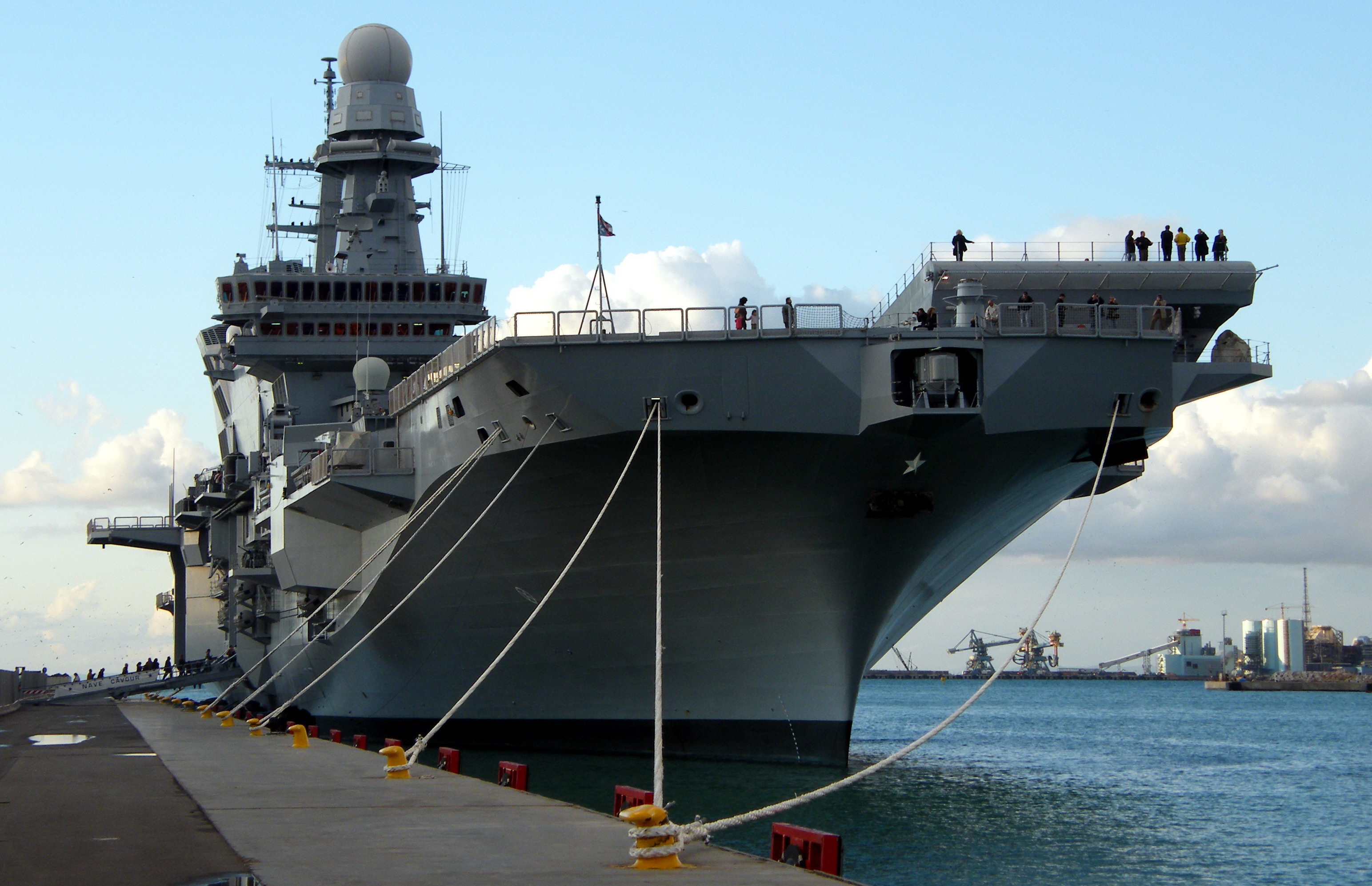
 Italian aircraft carrier Cavour (550)
 STOVL Harriers preparing to takeoff from CATOBAR carrier, USS Franklin D. Roosevelt (CV-42)
By role
A fleet carrier is intended to operate with the main fleet and usually provides an offensive capability. These are the largest carriers capable of fast speeds. By comparison escort carriers were developed to provide defense for convoys of ships. They were smaller and slower with lower numbers of aircraft carried. Most were built from mercantile hulls or, in the case of merchant aircraft carriers, were bulk cargo ships with a flight deck added on top. Light aircraft carriers were carriers that were fast enough to operate with the fleet but of smaller size with reduced aircraft capacity.
- Anti-submarine warfare carrier
- Helicopter carrier
- Light aircraft carrier
- Amphibious assault ship
- Seaplane tender & seaplane carriers
- Balloon carrier & balloon tenders
By configuration
There are three main configurations of aircraft carrier in service in the world's navies:
- Catapult Assisted Take-Off But Arrested Recovery (CATOBAR) - these carriers generally carry the largest, heaviest, and most heavily armed aircraft, although smaller CATOBAR carriers may have other limitations (weight capacity of aircraft elevator, etc.). Three nations currently operate carriers of this type: the United States, France, and Brazil for a total of thirteen in service and potentially two more when the Royal Navy's Queen Elizabeth class is complete.
- Short Take-Off But Arrested Recovery (STOBAR) - these carriers are generally limited to carrying lighter fixed-wing aircraft with more limited payloads. STOBAR carrier airwings, such as the Sukhoi Su-33 and future Mikoyan MiG-29K wings of the Admiral Kuznetsov are often geared primarily towards the air superiority and fleet defense roles rather than strike/power projection tasks which require heavier payloads (bombs, air-to-ground missiles). Currently, only Russia possesses an operational carrier of this type, with India and China each preparing a similar carrier.
- Short Take-Off Vertical Landing (STOVL) - limited to carrying STOVL aircraft. STOVL aircraft, such as the Harrier Jump Jet family and Yakovlev Yak-38 generally have very limited payloads, lower performance, and high fuel consumption when compared with conventional fixed wing aircraft; however, newer STOVL aircraft such as the F-35 have much improved performance. This type of aircraft carrier is operated by India, Spain, and Italy with five in active service; the UK and Thailand each have one active carrier but without any operational STOVL aircraft in inventory. Some also count the nine US Amphibious Assault ships in their secondary light carrier role boosting the overall total to sixteen.
By size
- Supercarrier
- Fleet carrier, the standard sized carrier of a navy.
- Light aircraft carrier
- Escort carrier
Flight deck
Main article: Flight deck The first carrier landing and take-off of a jet aircraft: Eric "Winkle" Brown landing on HMS Ocean (R68) in 1945.
As "runways at sea," modern aircraft carriers have a flat-top deck design that serves as a flight deck for the launch and recovery of aircraft. Aircraft are launched in a forward direction, into the wind, and recovered from astern. Carriers steam at speed, for example up to 35 knots (65 km/h), into the wind during flight deck operations in order to increase the wind over the deck to exceed a safe minimum. This increase in effective wind speed provides a higher launch airspeed for aircraft at the end of the catapult stroke or ski-jump, plus it makes recovery safer by reducing the difference between the relative speeds of the aircraft and ship.
On conventional carriers, a steam-powered catapult is used to accelerate the aircraft to a safe flying speed by the end of the catapult stroke, after which the aircraft is airborne and further propulsion is provided by its own engines. On other modern carriers, aircraft do not require catapult assistance for take off; instead an upwards vector is provided by a ski-jump at the forward end of the flight deck. Which form of assistance provided is dependent on aircraft design and performance and is part of the overall design of the carrier and aircraft as a system.
F/A-18 landing videoConversely, when recovering onto a carrier, conventional aircraft rely upon a tailhook that catches on arrestor wires stretched across the deck to bring them to a stop in a short distance. Helicopters and V/STOL (Vertical/Short Take-Off and Landing) aircraft usually recover by coming abreast the carrier on the port side and then using their hover capability to move over the flight deck and land vertically without the need for arresting gear.
Conventional ("tailhook") aircraft rely upon a landing signal officer (LSO, sometimes called "paddles") to monitor the plane's approach, visually gauge glideslope, attitude, and airspeed, and transmit that data to the pilot. Before the angled deck emerged in the 1950s, LSOs used colored paddles to signal corrections to the pilot (hence the nickname). From the late 1950s onward, visual landing aids such as optical landing system have provided information on proper glide slope, but LSOs still transmit voice calls to approaching pilots by radio.
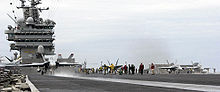
To facilitate working on the flight deck of a U.S. aircraft carrier, the sailors wear colored shirts that designate their responsibilities. There are at least seven different colors worn by flight deck personnel for modern United States Navy carrier air operations. Carrier operations of other nations use similar color schemes.
Key personnel involved in the flight deck include the shooters, the handler, and the air boss. Shooters are naval aviators or Naval Flight Officers and are responsible for launching aircraft. The handler works just inside the island from the flight deck and is responsible for the movement of aircraft before launching and after recovery. The air boss (usually a commander) occupies the top bridge (Primary Flight Control, also called "primary" or "the tower") and has the overall responsibility for controlling launch, recovery and "those aircraft in the air near the ship, and the movement of planes on the flight deck, which itself resembles a well-choreographed ballet".[7] The captain of the ship spends most of his time one level below Primary on the Navigation Bridge. Below this is the Flag Bridge, designated for the embarked admiral and his staff.
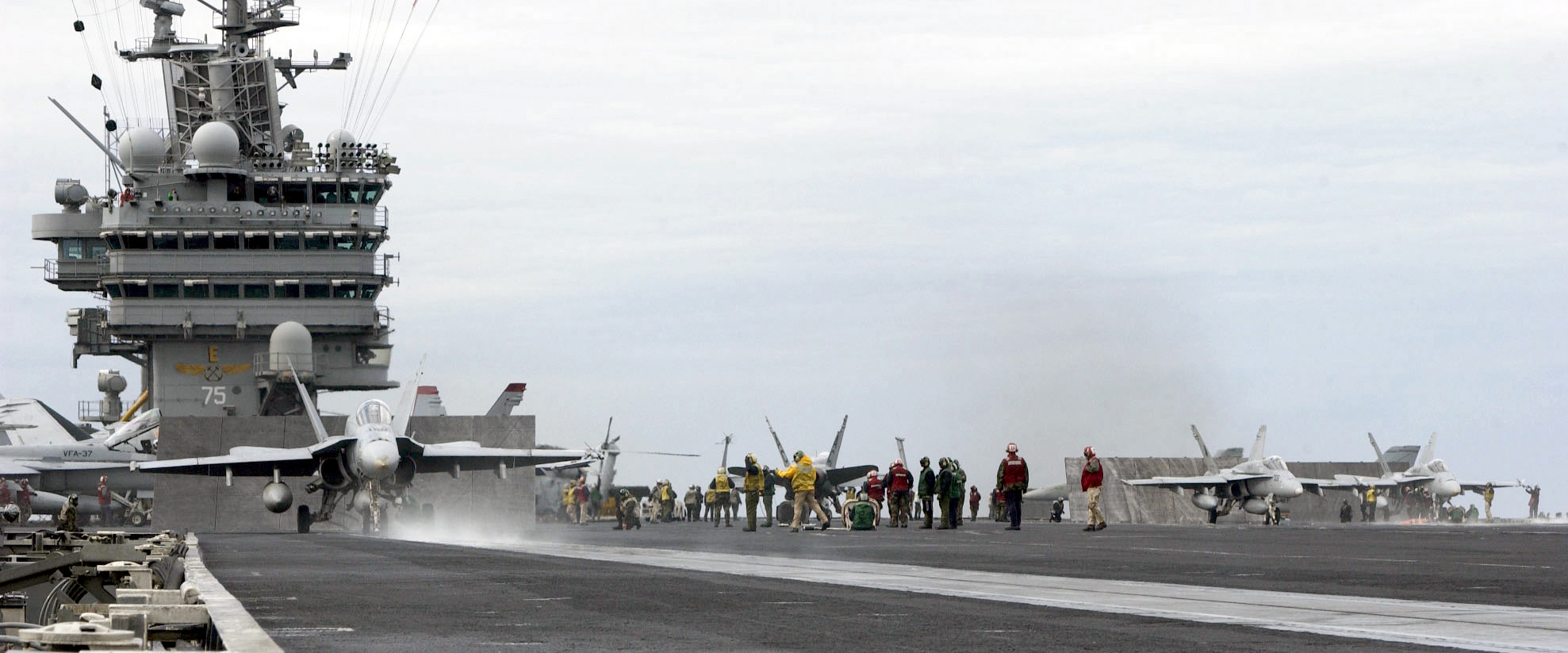
 Ripples appear along the fuselage of a U.S. Navy E-2C Hawkeye due to loads from landing on the USS Harry S. Truman (CVN-75).
Since the early 1950s on conventional carriers it has been the practice to recover aircraft at an angle to port of the axial line of the ship. The primary function of this "angled deck" is to allow aircraft that miss the arresting wires, referred to as a bolter, to become airborne again without the risk of hitting aircraft parked forward. The angled deck also allows simultaneous launching and recovery of aircraft.
The superstructure of a carrier (such as the bridge, flight control tower) are concentrated to the starboard side of the deck in a relatively small area called an "island", a feature pioneered on the HMS Hermes in 1923. Very few carriers have been designed or built without an island. The "flush deck" configuration proved to have very significant drawbacks, complicating navigation, air traffic control and had numerous other adverse factors.
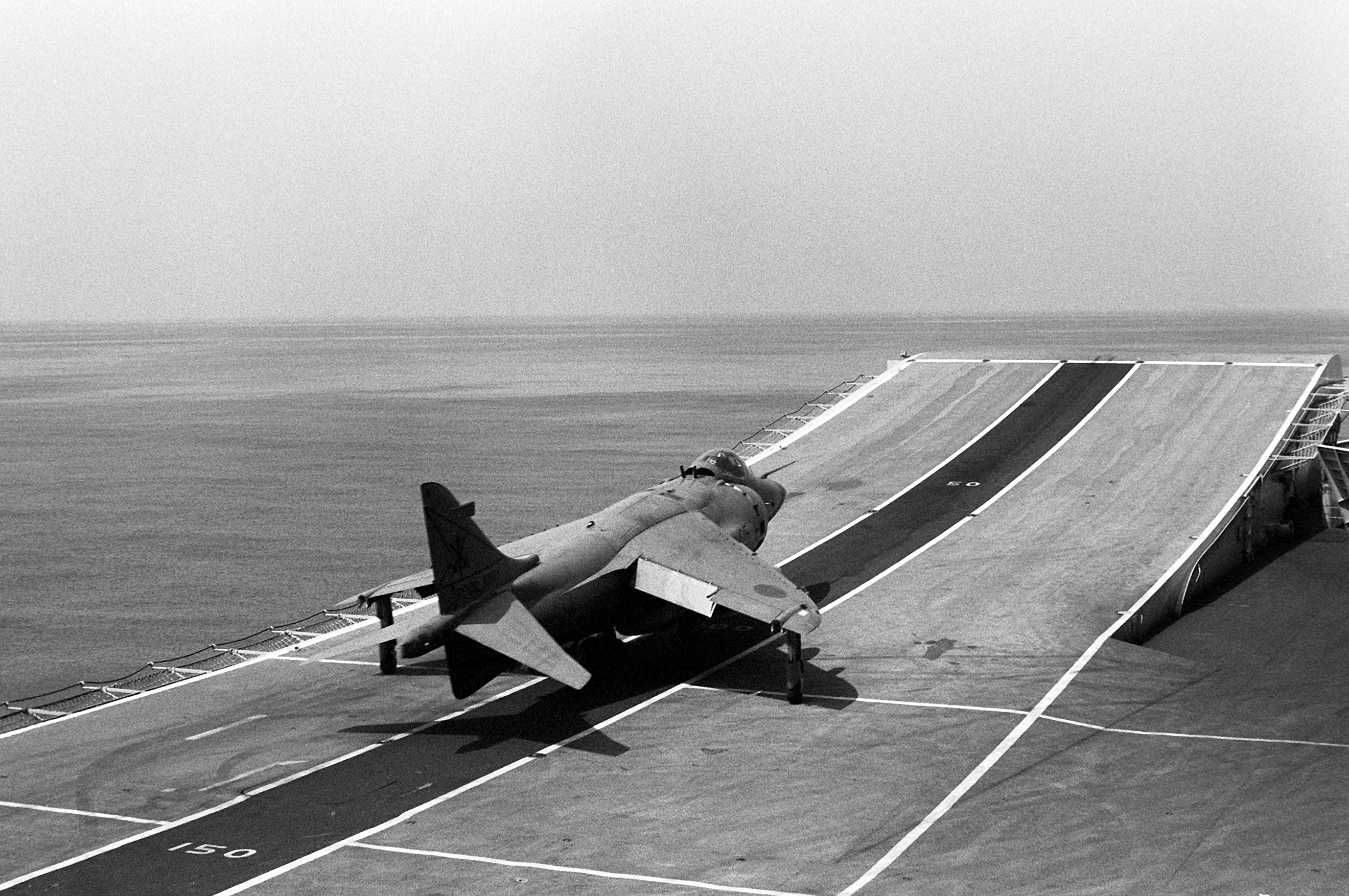
 Ski-jump on Royal Navy carrier HMS Invincible (R05)
A more recent configuration, originally developed by the Royal Navy but since adopted by many navies for most smaller carriers, has a ski-jump ramp at the forward end of the flight deck. A ski jump is a fixed ramp at the end of the flight deck with a curved incline. This was first developed to help launch short takeoff and vertical landing (STOVL) aircraft. STOVL aircraft such as the Sea Harrier can take off at far higher weights than is possible with a vertical or rolling takeoff on a short flat deck on STOBAR carriers. A ski jump works by converting some of the forward rolling motion of the aircraft into a jump into the air at the end of the flight deck, the jump combined with the aiming of jet thrust partly downwards by swiveling exhaust nozzles on aircraft with this feature allows the heavily loaded and fueled aircraft precious seconds to attain sufficient air velocity and lift to sustain normal flight. Without a ski jump launching fully loaded and fueled aircraft such as the Harrier would not be possible on a smaller flat deck ship before either stalling out or crashing directly into the sea. Although STOVL aircraft are capable of taking off vertically from a spot on the deck, using the ramp and a running start is far more fuel efficient and permits a heavier launch weight. As catapults are unnecessary, carriers with this arrangement reduce weight, complexity, and space needed for complex steam or electromagnetic launching equipment, vertical landing aircraft also remove the need for arresting cables and related hardware. Russian and future Indian carriers include a ski-jump ramp for launching lightly loaded conventional fighter aircraft but recover using traditional carrier arresting cables and a tailhook on their aircraft.
The disadvantage of the ski-jump is the penalty it exacts on aircraft size, payload, and fuel load (and thus range): large, slow planes such as the E-2 Hawkeye and heavily laden strike fighters like the F/A-18E/F Super Hornet and Sukhoi Su-33 do not launch using a ski-jump because their high loaded weight requires either a longer takeoff roll than is possible on a carrier deck, or catapult assistance, although the Su-33 does launch with a light fuel and weapons load from a ski jump. Another disadvantage is on mixed flight deck operations where helicopters are also present such as a US LHD or LHA amphibious assault ship a ski jump is not included as this would eliminate one or more helicopter landing areas, this flat deck limits the loading of USMC Harriers but is somewhat mitigated by the longer rolling start provided by a long flight deck compared to many STOVL carriers.
Aircraft carriers in service
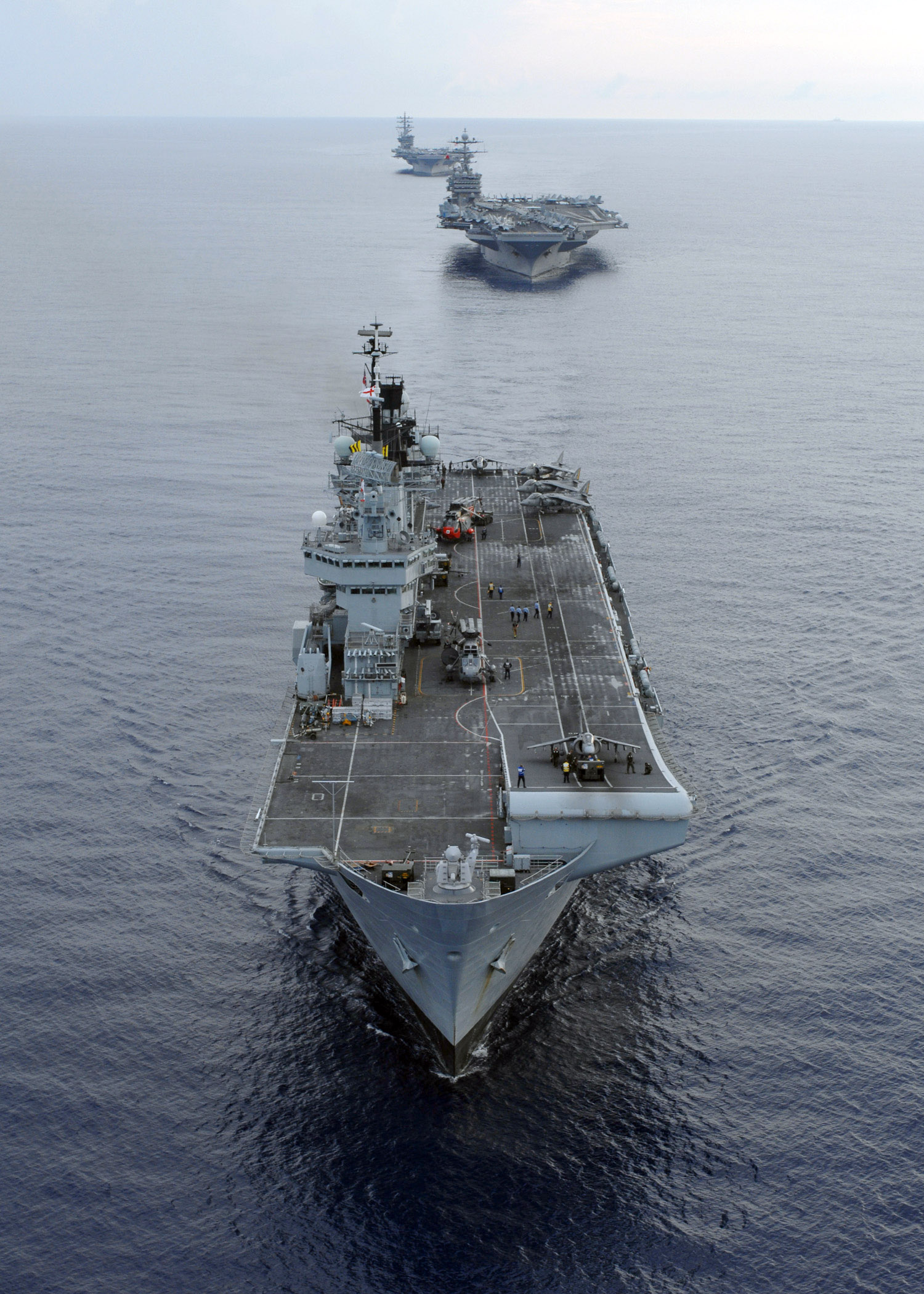
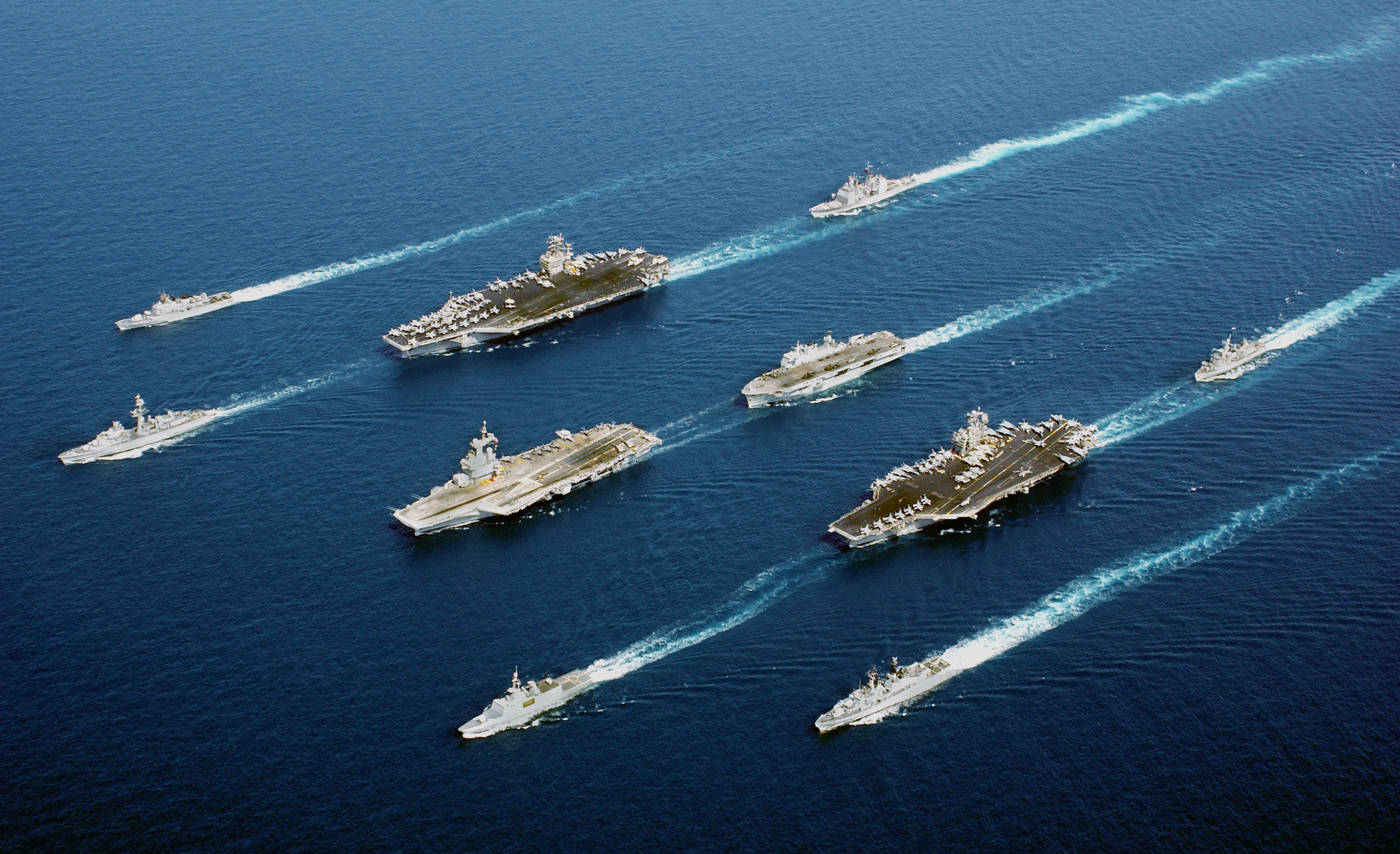
See also: List of aircraft carriers in service Four modern aircraft carriers of various types—USS John C. Stennis, FS Charles de Gaulle, HMS Ocean and USS John F. Kennedy—and escort vessels on operations in 2002. The ships are sailing much closer together than they would during combat operations.
 HMS Illustrious (right) and USS John C. Stennis in the Persian Gulf, 1998
Aircraft carriers are generally the largest ships operated by navies. A total of 22 aircraft carriers in active service are maintained by ten navies. In addition, the People's Republic of China's Navy possesses the former Soviet aircraft carrier Varyag. Australia, Brazil, France, India, Italy, Japan, Netherlands, South Korea, Spain, United Kingdom, United States and the People's Republic of China also operate vessels capable of carrying and operating multiple helicopters.
Classes currently in service:
- Brazil (1)
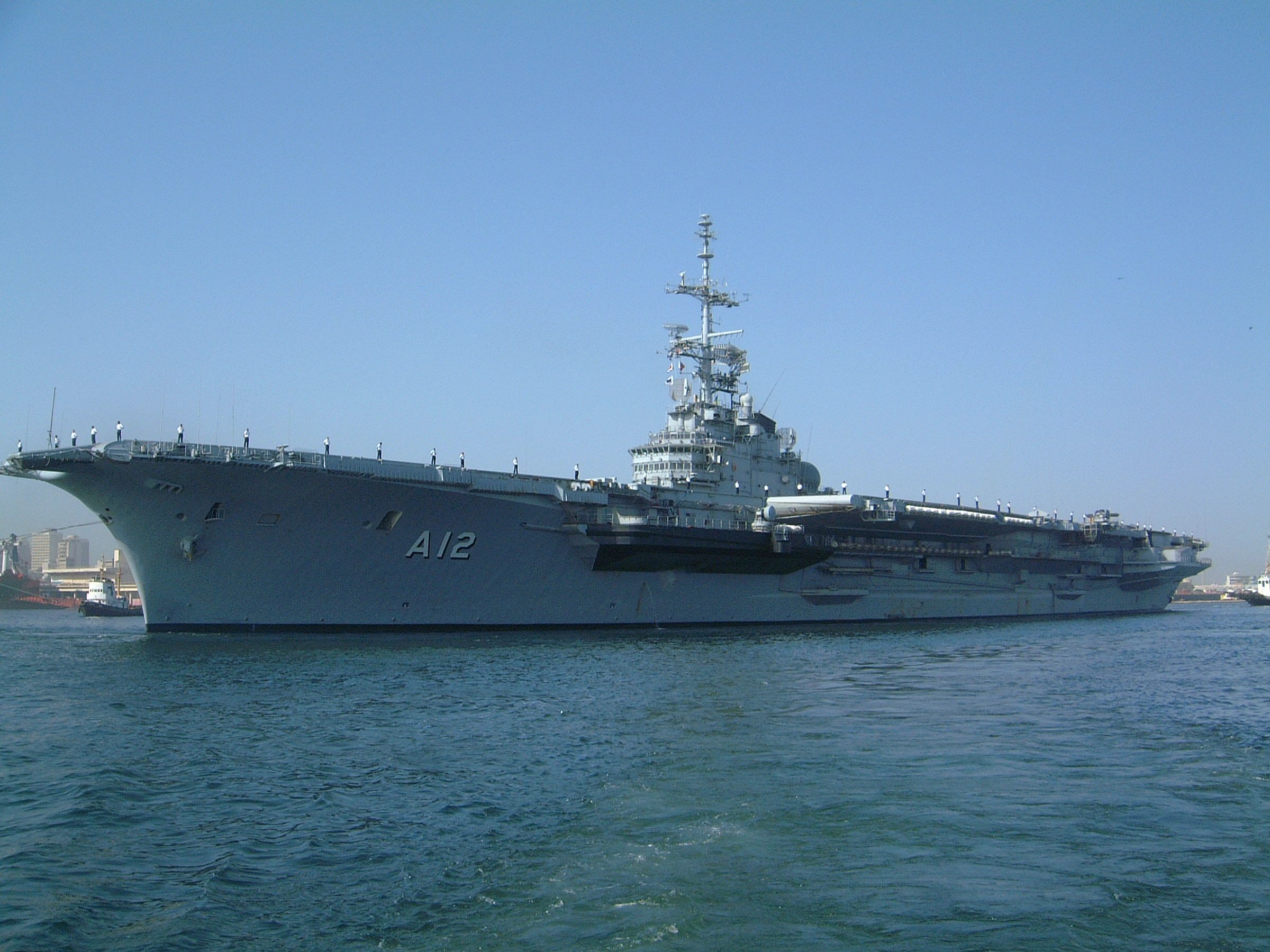
- NAe São Paulo (A12): 32,800 ton ex-French carrier FS Foch (launched 1960), purchased in 2000.
- France (1)
- Charles de Gaulle (R 91): 42,000 ton nuclear-powered aircraft carrier, commissioned in 2001.
- India (1)
- INS Viraat: 28,700 ton ex-British carrier HMS Hermes (launched 1953), purchased in 1986 and commissioned in 1987, scheduled to be decommissioned in 2019.[8]
- Italy (2)
- Giuseppe Garibaldi (551): 14,000 ton Italian STOVL carrier, commissioned in 1985.
- Cavour (550): 27,000 ton Italian STOVL carrier, commissioned in 2008.
- Russia (1)
- Admiral Flota Sovetskovo Soyuza Kuznetsov: 67,500 ton Kuznetsov class STOBAR aircraft carrier. Launched in 1985 as Tbilisi, renamed and operational from 1995.
- Spain (2)
- Principe de Asturias (R11): 17,200 ton STOVL carrier, commissioned in 1988.
- Juan Carlos I (L61): 27,000 ton, launched in 2008, commissioned 30 September 2010.
- Thailand (1)
- HTMS Chakri Naruebet: 11,400 ton carrier based on Spanish Principe De Asturias design. Commissioned in 1997. By 1999, only one AV-8S Matador/Harrier was still operable due to lack of spare parts and age[9]
- United Kingdom (1)
- HMS Illustrious: 22,000 ton STOVL carrier, commissioned in 1982. Originally there were three of her class but the other two have since been retired. Regular RN fixed wing aircraft carrier operations ended after first Sea Harrier and then Harrier fighters were retired as a cost saving measure.
- United States (11)
- USS Enterprise (CVN-65): 93,500 ton nuclear-powered supercarrier commissioned in 1961. First nuclear-powered aircraft carrier. Scheduled for decommissioning in 2013,[10] may be extended to 2014–2015.
- Nimitz class: ten 101,000 ton nuclear-powered supercarriers, the first of which was commissioned in 1975. A Nimitz class carrier is powered by two nuclear reactors and four steam turbines and is 1,092 feet (333 m) long.
The United States Navy has the world's largest carrier fleet with eleven supercarriers in service, one under construction and two more planned. The US Navy also operates nine 40,000 ton amphibious assault ships which have a straight through flight deck and are sometimes used as light carriers but their primary mission is launching US Marine Corps expeditionary missions deploying marines by helicopter with a few STOVL Harrier II fighters and gunship helicopters for air support and CAP.
Future aircraft carriers
See also: List of aircraft carriers by countrySeveral nations which currently possess aircraft carriers are in the process of planning new classes to replace current ones. The world's navies still generally see the aircraft carrier as the main future capital ship, with developments such as the arsenal ship, which have been promoted as an alternative, seen as too limited in terms of flexibility.[citation needed]
China
 Varyag under tow in Istanbul
China bought an unfinished Soviet aircraft carrier Varyag in 2001 from Ukraine, supposedly to turn it into a floating casino. Pictures taken while in port suggest this plan has been abandoned and show that work is being carried out to maintain its military function.
In late December 2008 and early January 2009, there were multiple reports of China building two conventionally powered aircraft carriers displacing 50,000–60,000 tonnes, possibly to be launched in 2015. In December 2010 China's State Oceanic Administration announced that this vessel would be finished one year earlier, in 2014. A nuclear powered carrier is planned for launch around 2020.[11]
According to James Nolt, senior fellow at the World Policy Institute in New York, it might take China many years to develop the technology, training, and operational capability necessary for an effective carrier.[12]
As of 10 August 2011, China is now sea-testing its first aircraft carrier. Its only claimed purposes are training and research, i.e. for the present time it is officially assigned for non-combat activities.[13]
France
The French Navy has set in motion possible plans for a second CTOL aircraft carrier, to supplement Charles de Gaulle. The design would be much larger, at 65,000-75,000 tonnes,[14] and would not be nuclear-powered like Charles de Gaulle. There are plans to base the carrier on the current Royal Navy design for CATOBAR operations (the Thales/BAE Systems design for the Royal Navy is for a STOVL carrier which is reconfigurable to CATOBAR operations.)
On 21 June 2008, French President Nicolas Sarkozy decided to place France's participation in the project on hold. He stated that a final decision on the future of the French carrier would be taken in 2011 or 2012. British plans for two aircraft carriers will go ahead as planned and were in no way conditional on French participation.[15]
India

India started the construction of a 40,000-tonne, 260-metre-long Vikrant-class aircraft carrier in April 2005.[16] The new carrier will cost US$762 million and will operate MiG-29K, Naval HAL Tejas and Sea Harrier aircraft along with the Indian-made helicopter HAL Dhruv.[16] The ship will be powered by four turbine engines and will have a range of 8,000 nautical miles (14,000 km), carrying 160 officers, 1,400 sailors, and 30 aircraft. The carrier is being constructed by a state-run shipyard in Cochin.[16] The ship is scheduled for commissioning in 2014.[17][18]
In 2004, India agreed to buy the Admiral Gorshkov from Russia for US$1.5 billion. It is named INS Vikramaditya,[17] and was expected to join the Indian Navy in 2008 after a refit.[19] However, delays in the refit were announced in July 2007, and the carrier will now be ready by 2012.[20]
In July 2008, Russia increased the total price to US$3.4 billion because of unexpected cost overruns due to the deteriorated condition of the ship.[17] In December 2008, India decided in favour of purchasing Admiral Gorshkov as the best option available.[21] In February 2009, Russia asked for an additional $700 million over the originally contracted price for the completion of the reconstruction of the Admiral Gorshkov, bringing the total requested price to $2.9 billion.[22] On 8 December 2009, it was reported that India and Russia ended the stalemate over Gorshkov price deal by agreeing on a price of US$2.2 billion.[23][24]
In December 2009, Navy chief Admiral Nirmal Verma said at his maiden navy week press conference that concepts currently being examined by the Directorate of Naval Design for the second indigenous aircraft carrier, the IAC-2, are for a conventionally powered carrier displacing over 50,000 tons and equipped with steam catapults (rather than the ski-jump on the Gorshkov/Vikramaditya and the IAC) to launch fourth-generation aircraft.[18]
Japan
Since the end of World War II, Japan has commissioned no full-fledged aircraft carrier. As of 2010[update], the Japan Maritime Self-Defense Force has two small helicopter carriers (Hyūga class).
The Ministry of Defense is building a new helicopter carrier (22DDH).[25] The vessel is 248 meters [813 feet] long and 19,500 tons, comparable to Italian light carrier Cavour and Spanish Juan Carlos I.[26]
Russia
Russian Navy Commander-in-Chief Admiral Vladimir Masorin officially stated on June 23, 2007, that the Navy was considering the specifications of a new nuclear aircraft carrier design[27][28] for the class that was first announced about a month earlier. Production of the carriers is expected to start around 2010 at the Zvezdochka plant in Severodvinsk, where a large drydock, capable of launching vessels with more than 100,000 ton displacement, is now being built.[29] In his statement, Admiral Masorin said that the general dimensions of the project have already been determined. The projected carrier is to have nuclear propulsion, to displace about 50,000 tons and to carry an air wing of 30–50 air superiority aircraft and helicopters, which makes her roughly comparable with the French Charles de Gaulle. "The giants that the US Navy builds, those that carry 100–130 aircraft, we won't build anything like that", said Admiral Masorin.[28] The planned specifications reflect the role, traditional in the Russian Navy, of the aircraft carrier as an air support platform for guided missile cruisers and submarines.
The Russian naval establishment had long agreed, since the decommissioning of the Kiev-class carriers, that the only operational carrier, Admiral Kuznetsov, was insufficient, and that three or four carriers were necessary to meet the Navy's air support requirements.[citation needed] However, financial and organisational turmoil in the 1990s made even the maintenance of Admiral Kuznetsov a difficult undertaking. The improvement in Russia's economic situation after the year 2000 has allowed a major increase in defence spending. Admiral Vladimir Vysotsky announced on Navy Day 2008 that Russia plans to build five or six carriers of the new design for deployment in the Northern and Pacific fleets, starting around 2012–2013.[30] The new carrier groups are planned to be at full strength around 2050–2060.[31] According to sources from the United Shipbuilding Corporation the new carriers will carry new fifth-generation fighters as well as unmanned aerial vehicles and have a displacement of up to 60,000 metric tons.[32]
While planning for new carriers, and carrying out design projects, the Russian government has not committed to building the carriers. Russia's economic climate is not yet sufficient to allow the construction and support of additional carriers in the short term.[33]
The Russian Navy expects to have a blueprint for the next generation aircraft carrier by the end of 2010.[34]
Speaking in St. Petersburg, Russia on 30 June 2011, the head of Russia's United Shipbuilding Corporation said his company expected to begin design work for a new carrier in 2016, with a goal of beginning construction in 2018 and having the carrier achieve initial operational capability by 2023.[35] Several months later, on 3 November 2011 the Russian newspaper Izvestiya reported that the naval building plan now included (first) the construction of a new shipyard capable of building large hull ships, after which Moscow will build two nuclear-powered aircraft carriers by 2027. The spokesperson said one carrier would be assigned to the Russian Navy's Northern Fleet at Murmansk, and the second would be stationed with the Pacific Fleet at Vladivostok.[36] Defense analysts familiar with the Russian military speculate that while Russian Navy admirals and Russian shipyard owners want to build new aircraft carriers, it is far from certain that the Russian Parliament will authorize the spending of tens of billions of dollars it would cost to build the facilities, warships, and aircraft required to support two aircraft carrier battle groups.[citation needed]
United Kingdom
 Artist depiction of the Queen Elizabeth-class, two of which are under construction for the Royal Navy.
The Royal Navy has signed a deal to build two new larger STOVL/CATOBAR aircraft carriers, the Queen Elizabeth-class, to replace the three Invincible-class carriers. The ships are to be named HMS Queen Elizabeth and HMS Prince of Wales.[37][38] They will be able to operate up to 40 aircraft, and will have a displacement of around 65,000 tonnes. The two ships are due to enter service in 2016 and 2018 respectively, two years later than originally planned.[39] Their primary aircraft complement will be made up of F-35C Lightning IIs, and their ship's company will number around 1450.[40] The two ships will be the largest warships ever built for the Royal Navy. Although initially designed to be configured for STOVL operations, at least one of the carriers will be built to CATOBAR configurations to allow the F-35C to be operated, as announced in the 2010 Strategic Defence and Security Review.
United States
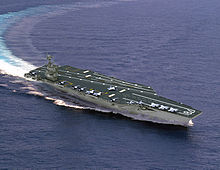 Artist's impression of the US Gerald R. Ford-class aircraft carrier
The current US fleet of Nimitz-class and USS Enterprise carriers are to be followed into service (and in some cases replaced) by the Gerald R. Ford-class. It is expected that the ships will be more automated in an effort to reduce the amount of funding required to maintain and operate its supercarriers. The main new features are implementation of Electromagnetic Aircraft Launch System (EMALS) (which replace the old steam catapults) and unmanned aerial vehicles.
With the decommissioning of the USS Kitty Hawk in May 2009, the U.S. fleet comprises 11 supercarriers. The House Armed Services Seapower subcommittee on 24 July 2007, recommended seven or maybe eight new carriers (one every four years). However, the debate has deepened over budgeting for the $12–14.5 billion (plus $12 billion for development and research) for the 100,000 ton Gerald Ford-class carrier (estimated service 2015) compared to the smaller $2 billion 45,000 ton America-class amphibious assault ships able to deploy squadrons of F-35B.[41]
See also
- History of the aircraft carrier
- Modern US Navy carrier air operations
- Project Habakkuk
- Seadrome
- Mobile offshore base
- Hull classification symbol
- Unsinkable aircraft carrier
Other types of aircraft carriers
- Anti-submarine warfare carrier
- Helicopter carrier
- Amphibious assault ship
- Seaplane tender
- Balloon carrier
- Airborne aircraft carrier
- Submarine aircraft carrier
- Flight deck cruiser
Related lists
- List of aircraft carriers
- List of aircraft carriers by country
- List of aircraft carriers by configuration
- List of aircraft carriers in service
- List of sunken aircraft carriers
- Timeline for aircraft carrier service
- List of amphibious warfare ships
- Number of warships in service worldwide
References
- Notes
- ^ "China aircraft carrier confirmed by general". BBC News. 2011-06-08. http://www.bbc.co.uk/news/world-asia-pacific-13692558. Retrieved 2011-06-09.
- ^ Wakamiya is "credited with conducting the first successful carrier air raid in history"Source:GlobalSecurity.org
- ^ "Sabre et pinceau", Christian Polak, p. 92.
- ^ "IJN Wakamiya Aircraft Carrier". globalsecurity.org. http://www.globalsecurity.org/military/world/japan/wakamiya-av.htm. Retrieved 2011-06-09.
- ^ Geoffrey Till, "Adopting the Aircraft Carrier: The British, Japanese, and American Case Studies" in Murray, Williamson; Millet, Allan R, eds (1996). Military Innovation in the Interwar Period. New York: Cambridge University Press. p. 194. ISBN 0-521-63760-0.
- ^ Lekic, Slobodan, Associated Press, "Aircraft carriers gain clout in naval power", Yahoo! News, 8 May 2011, retrieved 9 May 2011.
- ^ "The US Navy Aircraft Carriers". Navy.mil. http://www.navy.mil/navydata/ships/carriers/powerhouse/powerhouse.asp. Retrieved 30 January 2009.
- ^ Naval Air: Where There Were None, Now There Is One
- ^ Carpenter & Wiencek, Asian Security Handbook 2000, p. 302
- ^ "House and Senate Armed Services Committees agree FY 2010 Navy shipbuilding authorization". defpro.com, 10 October 2009.
- ^ Minemura, Kenji (17 December 2010). "Beijing admits it is building an aircraft carrier". Asahi Shimbun. Japan. Archived from the original on 17 December 2010. http://www.webcitation.org/5v35O99uQ. Retrieved 17 December 2010.
- ^ China Working to Counter US Naval Power in the Pacific
- ^ Chinas First Aircraft Carrier Launched
- ^ Marine Nationale - Renewing the assets
- ^ Sage, Adam (21 June 2008). "President Sarkozy ditches Franco-British carrier project". The Times (UK). http://business.timesonline.co.uk/tol/business/industry_sectors/engineering/article4183255.ece. Retrieved 30 January 2009.
- ^ a b c "Indian Aircraft Carrier (Project-71)". Indian Navy [Bharatiya Nau Sena]. Bharat Rakshak. http://www.bharat-rakshak.com/NAVY/Ships/Future/185-Indian-Aircraft-Carrier.html. Retrieved 11 September 2009.
- ^ a b c "Russian aircraft carrier ready in 2012 if India pays $2 bln more". RIA Novosti. 2008-11-13. http://en.rian.ru/russia/20081113/118299115.html. Retrieved 2011-06-09.
- ^ a b "First indigenous aircraft carrier to be launched next year: Navy chief". India Today. 2009-12-02. http://indiatoday.intoday.in/site/Story/73256/Top%20Stories/First+indigenous+aircraft+carrier+to+be+launched+next+year:+Navy+chief.html. Retrieved 2011-06-09.
- ^ "Article on India's indigenously built aircraft carrier". China Daily. 12 April 2005. http://www2.chinadaily.com.cn/english/doc/2005-04/12/content_433517.htm. Retrieved 30 January 2009.
- ^ "Russia to test aircraft carrier for India's navy in 2011". RIA Novosti. 2008-06-03. http://en.rian.ru/russia/20080603/109132065.html. Retrieved 2011-06-09.
- ^ Gorshkov: Medvedev on his way, Centre okays price renegotiation
- ^ http://www.defencetalk.com/news/publish/navy/Indian_Navy_Stunned_By_Latest_Russian_Demand_For_Gorschkov120017208.php[dead link]
- ^ "India, Russia end stalemate over Gorshkov price deal", The Times of India
- ^ India, Russia end stalemate over Gorshkov's price deal
- ^ Japan to Build New Helicopter Destroyer – Naval Technology
- ^ Demetriou, Danielle (23 November 2009). "Japan to build fleet's biggest helicopter destroyer to fend off China". The Daily Telegraph (London). http://www.telegraph.co.uk/news/worldnews/asia/japan/6635212/Japan-to-build-fleets-biggest-helicopter-destroyer-to-fend-off-China.html.
- ^ "Russia to Build New Aircraft Carrier". http://kommersant.com/p-10807/r_500/aircraft_carrier/. Retrieved 23 June 2007.
- ^ a b Lenta. Ru newssiteGoogle translation to English 23 June 2007
- ^ Lenta. Ru newssite Google translation to English 4 July 2006
- ^ RIA Novosti. 27 July 2008. "Russia to have 5–6 aircraft carriers in Northern, Pacific Fleets".
- ^ RIA Novosti. 4 April 2008. "Russia to have 5–6 aircraft carriers by 2060—Navy commander".
- ^ "Russia to build nuclear-powered 60,000-ton aircraft carrier", Russia , RIA Novosti
- ^ SpaceDaily, SPACEwar, "Russia halts aircraft carriers building", UPI, 10 December 2010
- ^ Danichev, Alexey. "Russian aircraft carrier blueprint to be ready by yearend – Navy chief." RIA Novosti, 2 August 2010.
- ^ RIA NOVOSTI, "Russia to build Nuclear Aircraft Carrier by 2023" 30 June 2011.
- ^ BarentsObserver.com, "Russia to Build Two Aircraft Carriers" 3 November 2011.
- ^ "Queen Elizabeth class Future Aircraft Carrier CVF (002)." Pike, J. GlobalSecurity.org.
- ^ "UK , £3.2bn giant carrier deals signed". BBC News. 3 July 2008. http://news.bbc.co.uk/1/hi/uk/7486683.stm. Retrieved 30 January 2009.
- ^ Carriers to enter service late
- ^ Facts and Figures : Queen Elizabeth Class, Royal Navy]
- ^ Kreisher, Otto (October 2007). "Seven New Carriers (Maybe)". Air Force Magazine (Air Force Association) 90 (10): 68–71. ISSN 0730-6784. http://www.airforce-magazine.com/MagazineArchive/Pages/2007/October%202007/1007carriers.aspx. Retrieved 2 October 2007.
- Bibliography
- Ader, Clement, "Military Aviation", 1909, Edited and translated by Lee Kennett, Air University Press, Maxwell Air Force Base Alabama, 2003, ISBN 978-1-58566-118-3
- Francillon, René J, Tonkin Gulf Yacht Club US Carrier Operations off Vietnam, (1988) ISBN 978-0-87021-696-1
- Friedman, Norman, U.S. Aircraft Carriers: an Illustrated Design History, Naval Institute Press, 1983. ISBN 978-0-87021-739-5. Contains many detailed ship plans.
- Nordeen, Lon, Air Warfare in the Missile Age, (1985) ISBN 978-1-58834-083-2
- Polak, Christian (2005) (in French, Japanese). Sabre et Pinceau: Par d'autres Français au Japon. 1872–1960. Hiroshi Ueki (植木 浩), Philippe Pons, foreword; 筆と刀・日本の中のもうひとつのフランス (1872–1960). éd. L'Harmattan.
- Sturtivant, Ray (1990). British Naval Aviation, The Fleet Air Arm, 1917–1990. London: Arm & Armour Press. ISBN 0-85368-938-5.
External links
- Future Aircraft Carrier: UK. Armed Forces International
- Aircraft carriers of the USN
- Info about flight deck crew, arresting cables, catapults
- How Stuff Works—Aircraft Carriers
- Haze Gray & Underway, World Aircraft Carrier Lists comprehensive and detailed listings of all the world's aircraft carriers and seaplane tenders from 1913–2001, with photo gallery.
- Ships That Mother Seaplanes: craft of the "hush-hush" fleet may play a part in first trans-Atlantic flight. Popular Science monthly, February 1919, page 80, on Google Books.
Categories:- Aircraft carriers
- Ship types








Wikimedia Foundation. 2010.
