

- Mare Nostrum
-
For other uses, see Mare Nostrum (disambiguation).
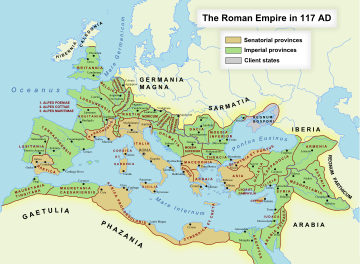 The Roman Empire at its farthest extent in AD 117
Mare Nostrum (Latin for "Our Sea") was a Roman name for the Mediterranean Sea. In the years following the unification of Italy in 1861, the term was revived by Italian nationalists who believed that Italy was the successor state to the Roman Empire.[1]
Contents
Roman usage
The term mare nostrum originally was used by Romans to refer to the Mediterranean Sea, following their conquest of Sicily, Sardinia and Corsica during the Punic Wars with Carthage. By 30 BC, Roman domination extended from the Iberian Peninsula to Egypt, and mare nostrum began to be used in the context of the whole Mediterranean Sea.[2] Other names were also employed, including Mare Internum ("The Internal Sea"); however, they did not include Mediterraneum Mare, which was a late Latin creation only attested to well after the Fall of Rome.[3]
Italian nationalist usage
The rise of Italian nationalism during the "Scramble for Africa" of the 1880s led to calls for the establishment of an Italian colonial empire. The phrase was first revived by the Italian poet Gabriele d'Annunzio.[citation needed]
Even if the coast of Tripoli were a desert, even if it would not support one peasant or one Italian business firm, we still need to take it to avoid being suffocated in mare nostrum.—Emilio Lupi, [1]Fascist usage
The term was again used by Benito Mussolini for use in fascist propaganda, in a similar manner to Adolf Hitler's lebensraum. Mussolini wanted to re-establish the greatness of the Roman Empire and believed that Italy was the most powerful of the Mediterranean countries after World War I.[4] He declared that "the twentieth century will be a century of Italian power" and created one of the most powerful navies of the world in order to control the Mediterranean Sea.[5][6]
When Italy entered World War II, she was already a major Mediterranean power, controlling the north and south shores of the central basin. The fall of France removed the main threat from the west, while the invasion of Albania, and later Greece and Egypt, sought to extend Axis control to the east.
Mussolini dreamed of creating a Greater Italia in his "Mare Nostrum" and promoted the fascist project—to be realized in a future peace conference after the anticipated Axis victory—of an enlarged Italian Empire, stretching from the Mediterranean shores of Egypt to the Indian Ocean shores of Somalia and eastern Kenya. He referred to making the Mediterranean Sea "an Italian lake." This aim, however, was challenged throughout the campaign by the Allied navies at sea and the Allied armies and resistance movements on land. For example, Greece had easily been incorporated into the Roman Empire, but the new Greek state proved to be too powerful for Italian conquest, and Greece remained independent until German forces arrived to assist the Italian invasion. Despite periods of Axis ascendancy during the Battle of the Mediterranean it was never realized, and ended altogether with the final Italian defeat of September 1943.
See also
References
Bibliography
- Lowe, C.J. (2002). Italian Foreign Policy 1870-1940. Routledge. ISBN 0415273722.
- Tellegen-Couperus, Olga (1993). Short History of Roman Law. Routledge. ISBN 0415072514.
Notes
- ^ a b Lowe (2002), p.34
- ^ Couperus (1993), p.32
- ^ Online Etymology Dictionary. "Mediterranean". Accessed 29 Aug 2011.
- ^ Anthony Rhodes, Propaganda: The art of persuasion: World War II, p70 1976, Chelsea House Publishers, New York
- ^ Fleming, Thomas. The New Dealers' War. Perseus Books,2001
- ^ Italian naval operations in the Mediteranian, such as the Battle of Cape Matapan, are included in the Battle of the Mediterranean
Categories:- History of the Mediterranean
- Former Italian colonies
- Italian fascism
- Ancient Roman geography

Wikimedia Foundation. 2010.
