

- Italian American
Infobox Ethnic group
group = Italian American "Italoamericani"
popplace = Found in the Northeast,Florida ,Illinois ,Michigan ,Ohio ,Chicago , and the West Coast Heavily concentrated in New York,New Jersey ,Connecticut ,Rhode Island ,Philadelphia ,San Francisco ,Pittsburgh ,Boston , andMiami .
caption = Notable Italian Americans:Rudy Giuliani ·Nancy Pelosi ·Fiorello La Guardia Sylvester Stallone ·Madonna Ciccone·Martin Scorsese Lee Iacocca ·Samuel Alito
poptime = 17,829,184 6.0% of the US population (2006)cite web |url=http://factfinder.census.gov/servlet/IPTable?_bm=y&-reg=ACS_2006_EST_G00_S0201:543;ACS_2006_EST_G00_S0201PR:543;ACS_2006_EST_G00_S0201T:543;ACS_2006_EST_G00_S0201TPR:543&-qr_name=ACS_2006_EST_G00_S0201&-qr_name=ACS_2006_EST_G00_S0201PR&-qr_name=ACS_2006_EST_G00_S0201T&-qr_name=ACS_2006_EST_G00_S0201TPR&-ds_name=ACS_2006_EST_G00_&-TABLE_NAMEX=&-ci_type=A&-redoLog=true&-charIterations=047&-geo_id=01000US&-geo_id=NBSP&-format=&-_lang=en|coauthors=United States Census Bureau|title=US demographic census|accessdate=2008-04-15]
langs =American English ·Italian·Sicilian·Neapolitan, otherItalian dialects and languages of Italian historical minorities
rels =Roman Catholic ,Protestant , Jewish,Waldensians
related =An Italian American is an American of Italian descent and/or dual citizenship. The phrase refers to someone born in the United States or who has immigrated to the United States and is of Italian heritage.
History
The Italian
Giovanni da Verrazzano was the first European explorer to passNew York Harbor . Other Italians played an important role in early United States history, asFilippo Mazzei , an important Italian physician and a promoter of liberty, close friend ofThomas Jefferson . He acted as an agent to purchase arms for Virginia during the American Revolutionary War. Throughout the 1800s, Italians arrived in the US in small numbers, though most immigration from Italy occurred in the 20th century between 1880 and 1960. Most Italian Americans came fromSouthern Italy ,Naples at first, andSicily , many as ruralpeasants with very little education. Smaller but significant numbers came from the northern regions ofLiguria andVeneto . From 1890 to 1900, 655,888 immigrants arrived in the United States, of which two-thirds were men. The main reasons for Italian immigration were the poor economic conditions in Italy during this period, particularly in the southern regions. In the United States, Italians settled in and dominated specific neighborhoods (often called "Little Italy ") where they could interact with one another, establish a familiar cultural presence, and find favorite foods. Many Italian immigrants arrived with very little cash or cultural capital (that is, they were not educated) and generally performed manual labor. Their neighborhoods were typicallyslums with overcrowded tenements and poorsanitation .Tuberculosis was rampant. Italian immigration peaked from 1900 until 1914, whenWorld War I made such intercontinental movement impossible. In many cases, the Italian immigrants were subjected to severe anti-Catholic, anti-immigrant discrimination and even violence such aslynching . [cite book | last = Gambino | first = Richard | title = Vendetta: A true story of the worst lynching in America, the mass murder of Italian-Americans in New Orleans in 1891, the vicious motivations behind it, and the tragic repercussions that linger to this day. | publisher = Doubleday | date = 1977 | isbn = 0-385-12273-X] By 1978, 5.3 million Italians had immigrated to the United States; two million arrived between 1900 and 1914. About a third of these immigrants intended to stay only briefly, in order to make money and return to Italy, and were commonly referred to as "Birds of Passage." While one in four did return home, the rest either decided to stay or were prevented from returning by the war. Over time—through attributes such as goal-setting, close-knit families, adaptability, frugality, education, and hard work—the descendants of Italian immigrants have generally realized theAmerican dream and have likewise attested it.Internment during World War II
The internment of Italian Americans during World War II has often been overshadowed by the Japanese American experience. Recently, however, books such as "Una storia segreta" (ISBN 1-890771-40-6) by Lawrence DiStasi and "Uncivil Liberties" (ISBN 1-58112-754-5) by Stephen Fox have been published, and movies, such as [http://www.prisonersamongus.com Prisoners Among Us] have been made. These efforts reveal that during World War II, roughly 600,000 Italians were required to carry identity cards that labeled them "resident aliens." Some 10,000 people in war zones on the West Coast were required to move inland, while hundreds of others were held in military camps for up to two years. Lawrence DiStasi claims that these wartime restrictions and internments contributed more than anything else to the loss of spoken Italian in the United States. After Italy declared war on the U.S., many Italian language papers and schools were forced, almost overnight, to close by the U.S. Government because of their past support for an enemy government.
Involvement in World War II
During World War II, many Italian Americans joined the U.S. armed forces to fight the
Axis Powers ; many women also enlisted. An estimated 1.2 million Italian Americans served in the armed forces during World War II; this represented 7.5% of the 16 million total who served. Italian American service assistance was pivotal during theAllied invasion of Sicily , where United States government troops worked with locals, including Mafiosi, to secure and fortify the newly-acquired foothold in Europe. Numerous texts document the delicate relations the United States government established with Italian American organized crime figures in the U.S. and the manner in which these were used to help ensure a successful landing. It is rumored that evenLucky Luciano helped smooth relations between the two communities during World War II.Demographics
Numbers
In the 2000 U.S. Census, Italian Americans constituted the fifth largest ancestry group in America with about 15.6 million people (5.6% of the total U.S. population). [PDF| [http://www.census.gov/prod/2004pubs/c2kbr-35.pdf Brittingham, Angela, and G. Patricia De La Cruz. Ancestry: 2000. Washington, D.C.: U.S. Dept. of Commerce, Economics and Statistics Administration, U.S. Census Bureau, 2004.] |468 KiB ]
Sicilian American s are a subset of numerous Americans of regional Italian ancestries. As of 2006, the Italian-American population climbed to 17.8 million persons constituting 6 percent of the population.Politics
[

Sons of Italy , which is the largest Italian American fraternal organization in the United States.] In the 1930s, Italian Americans voted heavily Democratic; since the 1960s, they have split about evenly between the Democratic (37%) and the Republican (36%) parties [ [http://www.i-italy.org/645/niaf-two-days-italian-american-affairs NIAF. Two Days of Italian/American Affairs] ] . The U.S. Congress includes Italian Americans who are regarded as leaders in both the Republican and Democratic parties. The highest ranking Italian American politician is currentlyNancy Pelosi (D-CA) who became the first woman and Italian AmericanSpeaker of the United States House of Representatives , and former RepublicanNew York City mayorRudy Giuliani was a candidate for the U.S. presidency in the 2008 election, as wasColorado Congressman Tom Tancredo .Geraldine Ferraro was also a vice-presidential candidate in 1984. Two of the nine U.S. Supreme Court justices--Antonin Scalia andSamuel Alito --are Italian-Americans, appointed by Republican Presidents. [Scalia was appointed byRonald Reagan ; Alito, byGeorge W. Bush .]Business and Economy
Italian-Americans have served an important role in the economy of the United States, and have founded companies of great national importance, such as Bank of America (by
Amadeo Giannini in 1904), and companies that have contributed to the local culture and character of U.S. cities, such as Petrini's Markets (founded by Frank Petrini in 1935), among many others. Italian-Americans have also made important contributions to the growth of the U.S. economy through their business expertise, such as the management of theChrysler Corporation byLee Iacocca , and the creative innovations ofMartin Scorsese for film companies such asColumbia Pictures andWarner Brothers .Culture
Many Italian Americans still retain aspects of their
culture . This includes Italian food, drink, art, annual Italian American feasts, and a strong commitment to extended family. Italian Americans influenced popular music in the 1940s and as recently in the 1970s, one of their major contributions to American culture. In movies that deal with cultural issues, Italian American words and lingo are sometimes spoken by the characters. Although most will not speak Italian fluently, a dialect of sorts has arisen among Italian Americans, particularly in the urban Northeast, often popularized in film and television.Among the most characteristic and popular of Italian American cultural contributions has been their feasts. Throughout the United States, wherever one may find an "Italian neighborhood" (often referred to as 'Little Italy'), one can find festive celebrations such as the well known
Feast of San Gennaro inNew York City , the unique Our Lady of Mount Carmel "Giglio" Feast in the Williamsburg section of Brooklyn, New York, Italian feasts involve elaborate displays of devotion to God andpatron saint s. Perhaps the most widely known is St. Joseph's feast day on March 19th. These feasts are much more than simply isolated events within the year. They express a "typically Italian" approach to life and are taken very seriously by the communities who prepare them. Feast ("Festa" in Italian) is an umbrella term for the various secular and religious, indoor and outdoor activities surrounding a religious holiday. Typically, Italian feasts consist of festive communal meals, religious services, games of chance and skill and elaborate outdoor processions consisting of statues resplendent in jewels and donations. This merriment usually takes place over the course of several days, and is communally prepared by a church community or a religious organization over the course of several months.Currently, there are more than 300 Italian feasts celebrated throughout the United States. These feasts are visited each year by millions of Americans from various backgrounds who come together to enjoy Italian delicacies such as Zeppole and sausage sandwiches. Though in past, and still unto this day, much of Italian American culture is centered around music and food, in recent years, a large and growing group of Italian American authors are having success publishing and selling books in America.
Some of the authors who have written about everyday, hardworking Italians are Pietro DiDonato [http://www.ihrc.umn.edu/research/vitrage/all/da/ihrc541.html] , Lawrence Ferlinghetti [http://www.citylights.com/ferlinghetti/] , Dana Gioia [http://www.danagioia.net/] , Executive Director of the National Endowment for the Arts; Daniela Gioseffi [http://www.gioseffi.com/] , Winner of the John Ciardi Award for Lifetime Achievement in Poetry, and
Helen Barolini , author of "The Dream Book", a collection of Italian American women's writings. Both women are American Book Award Winners [http://www.bookweb.org/news/awards/1293.html] and pioneers of Italian American writing, as is poet, Maria Mazziotti Gillan [http://www.italianamericanwriters.com/Gillan.html] . These women have authored many books depicting Italian American women in a new light. They, along with several other poets and writers, can be found at Italian American Writers [http://www.ItalianAmericanWriters.com/] .Among the scholars who have led the Renaissance in Italian American literature are professors Richard Gambino, Anthony Julian Tamburri, Paolo Giordano, and Fred Gardaphe. The latter three founded Bordighera Press, Inc. and edited "From the Margin, An Anthology of Italian American Writing," Purdue University Press. These men along with professors like novelist and accomplished critic, Dr. Josephine Gattuso-Hendin of New York University, have taught Italian American studies far and wide, at such institutions as The City University of New York, John D. Calandra Institute [http://www.qcpages.qc.cuny.edu/calandra/] , Queens College (CUNY), and The State University of New York at Stonybrook, as well as Brooklyn College, where Dr. Robert Viscusi, founded the Italian American Writers Association [http://www.iawa.net/] , and is an author and American Book Award winner, himself.
As a result of the efforts of magazines like "VIA: Voices in Italian Americana", and "Italian Americana", and many authors old and young, too numerous to mention, as well as early immigrant, pioneer writers like poet, Emanuel Carnevali, "Furnished Rooms," and novelist, Pietro DiDonato, author of "Christ in Concrete " --Italian Americans are beginning to read more of their own writers. A growing number of books featuring ordinary, hardworking Italians--having nothing to do with criminality--are published yearly to confront the cruel television and Hollywood stereotyping of this ethnic group. (See "Stereotypes," below.) Famed authors like Don DeLillo, Gilbert Sorrentino, Lawrence Ferlinghetti, Gay Talese, John Fante Tina DeRosa, Kim Addonizio, Daniela Gioseffi, Dana Gioia, to name a mere few who have broken through to main stream American literature and publishing, are changing the image of Italians in America with their books, stories, poems and essays far too numerous to site. Many of these authors' books and writings are easily found on the internet and on Italian American Writers [http://www.italianamericanwriters.com/] as well as in bibliographies online at Stonybrook University's Italian American Studies Dept. in New York [http://www.italianstudies.org/iam/Gesualdi.htm] or at The Italian American Writers Association website [http://www.iawa.net/database.htm] . The cultural face of Italian Americana is widening and changing daily to combat stereotyping by American movies and television.
Religion
Most immigrants had been Catholics in Italy. Observers have noted that they often became more devoutly Catholic in the United States, since their faith was a distinctive characteristic in the U.S.; devout Italian Americans often identified themselves as "Catholics" when talking to coworkers or neighbors. In spite of the Catholic dominance among the immigrants, it can be noted that the Italian religious minorities——such as
Waldensians ,Greek Catholics ,Greek Orthodox andItalian Jews ——also took part in the Italian immigration to America.In some Italian American communities,
Saint Joseph's Day (March 19 ) is marked by celebrations and parades.Columbus Day is also widely celebrated, as are the feasts of some regional Italianpatron saint s, most notably St. Januarius (San Gennaro) (September 19 ) (especially by those claiming Neapolitan heritage), andSanta Rosalia (September 4 ) by immigrants fromSicily . The immigrants from Potenza, Italy celebrate the Saint Rocco's day (August 16) feast at the Potenza Lodge inDenver, Colorado the 3rd weekend of August. San Rocco is the patron saint ofPotenza as is San Gerardo. Many still celebrate the Christmas season with aFeast of the seven fishes . InCleveland, Ohio , theFeast of Assumption is celebrated in Cleveland's Little Italy onAugust 15 . On this feast day, people will pin money onBlessed Virgin Mary statue as symbol of prosperity. The statue is paraded through Little Italy to Holy Rosary Parish. For almost 25 years, Cleveland Catholic Bishop Anthony Pilla would join in the parade and mass due to his Italian heritage. Pilla resigned in April 2006, but he still celebrates.While most Italian-American families have a Catholic background, there are various groups of Italian-American Christians who have chosen to practice Protestant Christianity for various reasons. In many cases, families may have decided to worship regularly at a local non-Catholic parish with which they and their community identify, but keep with the Catholic tradition in schooling their children at Catholic parochial or private schools, as well as fully participating in Catholic worship when attending Catholic churches for whatever reason. In some cases, there are individuals and families who have become resentful or disenchanted with the Catholic religion, and completely leave the Church, no longer considering themselves as being a part of the Catholic traditions in any way. Many joined the Episcopal Church because of disagreement with local Catholic Church leadership while still retaining much of the liturgical form. Many converted to Evangelical Christianity because they did not agree with the ritualistic nature of the Catholic religion, as well as their belief that Catholics have an incorrect interpretation of certain doctrines concerning the Magisterium, the Virgin Mary, the Saints, and the doctrine of Transubstantiation.
There are many ex-Catholic Italian-American members of mainline liberal Protestant churches, such as the
United Church of Christ , most of whom left the Catholic Church because they thought it to be too doctrinally conservative. There are also a significant number of ex-Catholic Italian-American converts to theUnitarian Universalist Church. [ [http://www.saintanthonyhackensack.org/history.html] ]Fiorello La Guardia was an Episcopalian (on his father's side; his mother was from the small but significant community ofItalian Jews ). Frank Santora is an ex-Catholic Italian-American pastor of Faith Church, a large Evangelicalmegachurch inNew Milford, Connecticut . [cite web |url=http://www.faithchurchct.com/about/ |title=Contact; A LITTLE ABOUT US... |accessdate=2008-05-23] There is a small charismatic denomination, called the Christian Church of North America, which is rooted in the Italian Pentecostal Movement that came out of Chicago in the early 1900s. It should also be noted that the first group of Italian immigrants to Trenton converted to the Baptist denomination. In the early 1900s, a number of Protestant denominations and missionaries worked in urban Italian American neighborhoods of the Northeast.Max Lucado ——bestselling author, alumnus of [http://www.acu.edu/admissions/ac_and_me/max_lucado.html Abilene Christian University] , and preacher inChurches of Christ ——is a prominent example of an Italian-American in non-Catholic ministry.Education
According to 2000 Census data, Italian Americans have a greater high school graduation rate than the national average, and a greater than or equal rate of advanced degrees compared to the national average. Italian Americans throughout the United States are well represented in a wide variety of occupations and professions, from skilled trades, to the arts, to engineering, science, mathematics, law, and medicine, and include numerous
Nobel prize winners. [http://www.italiansrus.com/articles/nobelprizes.htm]Italian language in the United States
According to the PDF| [http://www.osia.org/public/pdf/Italian_Lang_Study_2003.pdf Sons of Italy News Bureau] |339 KiB , from 1998 to 2002 the enrollment in college
Italian language courses grew by 30%, faster than the enrollment rates for French and German. Italian is the fourth most commonly taught foreign language in U.S. colleges and universities behind Spanish, French, and German. According to the U.S. 2000 Census, Italian is the fifth (seventh overall) most spoken language in the United States (tied with Vietnamese) with over 1 million speakers. [PDF| [http://www.census.gov/prod/2003pubs/c2kbr-29.pdf Language Use and English-Speaking Ability: 2000] |481 KiB ]As a result of the large wave of Italian immigration to the United States in the late 19th and early 20th centuries, the Italian language was once widely spoken in much of the U.S., especially in northeastern and Great Lakes area cities like Rochester,
Chicago ,Cleveland , andMilwaukee , as well asSan Francisco ,Saint Louis andNew Orleans . Italian-language newspapers exist in many American cities, especiallyNew York City , and Italian-language movie theatres existed in the U.S. as late as the 1950s.Today, Prizes like The Bordighera Annual Poetry Prize [http://www.ItalianAmericanWriters.com/prize.html/] founded by Daniela Gioseffi, Pietro Mastrandrea and Alfredo di Palchi with support from the Sonia Rraiziss-Giop Foundation, and Bordighera Press, [http://www.bordigherapress.org/] which publishes the winners in bilingual editions, have helped to encourage writers of the diaspora to write and read in Italian. Chelsea Books in New York City and Gradiva Press on Long Island have published many bilingual books also due to the efforts of bilingual writers of the diaspora like Paolo Valesio [http://www.columbia.edu/cu/italian/fac-bios/valesio/faculty.html] , Alfredo de Palchi [http://www.italianamericanwriters.com/dePalchi.html] , Luigi Fontanella. Dr. Luigi Bonaffini [http://userhome.brooklyn.cuny.edu/bonaffini/DP/index.html] of The City University of New York, publisher of "The Journal of Italian Translation" at Brooklyn College, has fostered Italian dialectic poetry throughout his homeland and the USA. Joseph Tusiani of New York and New York University [http://siba3.unile.it/ctle/tusiani/biography.htm] , a highly distinguised linguist and prize winning poet born in Italy, paved the way for Italian works of literature in English and has published many bilingual books and Italian classics for the American audience, among them the first complete works of Michaelangelo's poems in English to be published in the United States. All of this literary endeavor has helped to foster the Italian language, along with the Italian opera, of course, in the United States. Many of these authors and their bilingual books are located throughout the internet.
Author Lawrence Distasi [http://books.google.com] argues that the loss of spoken Italian among the Italian American population can be tied to U.S. government pressures during
World War II . During World War II, in various parts of the country, the U.S. government displayed signs that read, "Don't Speak the Enemy's Language." Such signs designated the languages of theAxis powers , German, Japanese, and Italian, as "enemy languages". Shortly after the Axis powers declared war on the U.S., many Italian, Japanese and German citizens were interned. Among the Italian Americans, those who spoke Italian, who had never taken out citizenship papers, and who belonged to groups that praisedBenito Mussolini , were most likely to become candidates for internment. Distasi claims that many Italian language schools closed down in theSan Francisco Bay Area within a week of the U.S. declaration of war on the Axis powers. Such closures were inevitable since most of the teachers in Italian languages were interned.Despite the pressures of the US government during World War II, now more than ever, children of Italian heritage, especially paternal heritage, are given Italian names, and raised in traditional Italian ways. The Italian language is still spoken and studied by those of Italian American descent, and it can be heard in various American communities, especially among older Italian Americans. During the late 20th and early 21st centuries, interest in Italian language and culture has surged among Italian Americans. Today's Italian American youth no longer take for granted the impressive contributions Italians and Italian Americans have made to
Western civilization , especially in the areas of fine art, music, science, philosophy, law, medicine, education, literature, architecture, and cuisine.There is, however, a dilemma for Italian Americans who consider re-learning the language of their ancestors. The formal "Italian" that is taught in colleges and universities is generally not the "Italian" with which Italian Americans are acquainted. Over eighty percent of Italian Americans are of Southern Italian origin, and the languages spoken by their families who arrived between 1880-1920 were dialects like Neapolitan and Sicilian, with perhaps some degree of influence from Standard Italian. Because the Italian of Italian Americans comes from a time just after the unification of the state, their language is in many ways anachronistic and demonstrates what the dialects of
Southern Italy used to be at the time. Because of this, Italian Americans studying Italian are often learning a language that does not include all of the words and phrases they may have learned from family.The situation is even more pronounced among Italian Americans whose ancestors came to the
United States fromNorthern Italy . Italian Americans variously ofEmilia-Romagna , Lombardian, Genoese, Marchigiano, Piedmontese, Venetian and other Northern Italian heritage are even further away linguistically from the languages of their ancestors through the contemporary standard Italian language.Fact|date=August 2008tereotypes
History
In the 1890-1920 period Italian Americans were often stereotyped as being "violent" and "controlled by the
Mafia ". [http://www.niaf.org/research/report_zogby.asp] In the 1920s, many Americans used theSacco and Vanzetti trial, in which two Italian anarchists were wrongly sentenced to death, to denounce Italian immigrants as anarchists and criminals. During the 1800s and early 20th century, Italian Americans were one of the most likely groups to be lynched. In 1891, eleven Italian immigrants inNew Orleans were lynched due to their ethnicity and suspicion of being involved in the Mafia (see:David Hennessy ). This was the largest mass lynching in US history. [ [http://www.ngbiwm.com/Exhibits/lynching.htm National Great Blacks in Wax Museaum - Italian Lynching] ]Present
To this day, Italian Americans are frequently associated with
organized crime , andNew York in the minds of many Americans, largely due to pervasive media stereotyping, a number of popular gangster movies (such as "The Godfather " and "Goodfellas ") and television series such as "The Sopranos ". AZogby International survey revealed that 78 percent of teenagers 13 to 18 associated Italian Americans with either criminal activity or blue-collar work. A survey by the [http://www.worldcat.org/search?q=au%3AResponse+Analysis+Corporation.&qt=hot_author Response Analysis Corporation] reported that 74 percent of adult Americans believe most Italian Americans have "some connection" toorganized crime . [See alsoAnti-Italianism as well as the2006 November 13 "AdWeek" [http://www.osia.org/public/pdf/Adweek.pdf article by Dona de Sanctis] .]However, the
National Italian American Foundation , the National American Italian Association and other Italian American organizations have asserted that theMafia in the United States have never numbered more than a few thousand individuals, and that it is unfair to associate such a small minority with the general population of Italian Americans.Communities
States known for their high concentrations of Italian Americans include
New York ,New Jersey ,Connecticut ,Pennsylvania ,Rhode Island ,Massachusetts ,Michigan ,Maryland ,Illinois ,California ,Ohio ,Florida , andLouisiana . Among major cities across the country,New York City ,Philadelphia ,Chicago ,Boston ,Pittsburgh ,Miami , andSan Francisco have America's seven largest Italian communities.tate totals
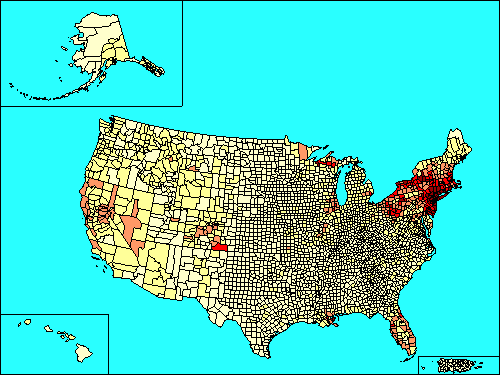 thumb|right|300px|Distribution of Italian Americans according to the 2000 census
Numbers
#
New York 3,254,298
#New Jersey 1,590,225
#Pennsylvania 1,547,470
#California 1,149,351
#Florida 1,147,946
#Massachusetts 918,838
#Illinois 739,284
#Ohio 720,847
#Connecticut 652,016
#Michigan 484,486
#Texas approx. 363,354
#Louisiana approx. 195,561 [See, "e.g.",Independence, Louisiana . In 2008 Italian-AmericanSteve Scalise was elected to represent the surrounding First Congressional District of Louisiana.]
#Rhode Island approx. 189,134Percentage
#
Rhode Island 19.7%
#Connecticut 18.6%
#New Jersey 17.9%
#New York 14.4%
#Massachusetts 14.5%
#Pennsylvania 13.0%US communities with high percentages of people of Italian ancestry
The top 50 US communities with the highest percentage of people claiming Italian ancestry are: [cite web |url=http://www.epodunk.com/ancestry/Italian.html |title=Ancestry Map of Italian Communities |publisher=Epodunk.com |accessdate=2008-08-18]
#
Johnston, Rhode Island 46.70%
#Hammonton, New Jersey 45.90%
# Frankfort, New York (village ) 44.70%
#East Haven, Connecticut 43.10%
#Roseto, Pennsylvania 41.80%
#Franklin Square, New York 40.00%
#North Massapequa, New York 38.90%
# Frankfort, New York (town ) 38.50%
#Totowa, New Jersey 37.70%
#Lowellville, Ohio 37.40%
# Fairfield Township (Essex County), New Jersey 37.20%
#North Providence, Rhode Island 36.60%
#Thornwood, New York 36.50%
#South Hackensack, New Jersey 36.30%
#Hawthorne, New York 36.20%
# Nutley Township, New Jersey 36.00%
#Jessup, Pennsylvania 35.90%
#Revere, Massachusetts 35.70%
# East Hanover Township, New Jersey 35.60%
#Harrison, New York (both the town and village) andDeer Park, New York 34.90%
#West Paterson, New Jersey 34.30%
#Valhalla, New York 34.20%
# Lyndhurst Township, New Jersey 33.80%
#North Haven, Connecticut 33.70%
#Staten Island, New York ,Buena, New Jersey andOld Forge, Pennsylvania 33.50%
#Saugus, Massachusetts 33.20%
#North Branford, Connecticut 33.00%
#Garden City South, New York 32.90%
#Lyncourt, New York 32.80%
#Massapequa Park, New York 32.20%
#Roseland, New Jersey 32.00%
#Follansbee, West Virginia 31.80%
#Pittston Township, Pennsylvania 31.40%
#Dunmore, Pennsylvania andBethpage, New York 31.30%
# Taylor Township (Lawrence County), Pennsylvania andCarlstadt, New Jersey 31.20%
#Shrub Oak, New York 31.10%
#Lake Grove, New York ,Wood-Ridge, New Jersey andLindenhurst, New York 30.90%
#Hasbrouck Heights, New Jersey 30.80%
#Bohemia, New York ,Selden, New York andIndependence, Louisiana 30.70%
#West Long Branch, New Jersey ,Holbrook, New York andIsland Park, New York 30.50%
#Cranston, Rhode Island 30.40%
#Holtsville, New York ,Malverne, New York ,Milton, New York ,Massapequa, New York andSouth Farmingdale, New York 30.20%
#Mechanicville, New York ,West Babylon, New York ,Netcong, New Jersey ,Eastchester, New York ,Gibbstown, New Jersey andRonkonkoma, New York 30.10%
#Tuckahoe, New York 30.00%
#North Great River, New York ,Newfield, New Jersey ,Seaford, New York and Saddle Brook Township, New Jersey 29.80%
#Islip Terrace, New York , Cedar Grove Township (Essex County), New Jersey,Plainedge, New York ,Farmingville, New York andMount Morris, New York 29.70%
#Mahopac, New York ,Orange, Connecticut andNesconset, New York 29.60%
# Greenfield Township, Illinois 29.50%
#Hauppauge, New York ,Shirley, New York andLodi, New Jersey 29.40%
#Carmel, New York and Greenwich Township (Gloucester County), New Jersey 29.30%U.S. communities with the most residents born in Italy
Top 101 U.S. communities with the most residents born in Italy are: [cite web |url=http://www.city-data.com/top2/h54.html |title=Top 101 cities with the most residents born in Italy (population 500+) |publisher=city-data.com |accessdate=2008-08-18]
#
Norridge, IL 7.4%
# West Paterson, NJ 6.8%
#Highwood, IL 6.7%
# North Lynbrook, NY 6.4%
# Franklin Square, NY 5.6%
#Glen Cove, NY 5.0%
#Harwood Heights, IL 4.9%
#Raritan, NJ 4.9%
# Totowa, NJ 4.8%
# Inwood, NY 4.8%
# Harrison, NY 4.8%
# Gates-North Gates, NY 4.7%
# Garden City South, NY 4.5%
# Thornwood, NY 4.5%
#Kenilworth, NJ 4.4%
# Hawthorne, NY 4.3%
# Tuckahoe, NY 4.3%
#Westbury, NY 4.3%
#Schiller Park, IL 4.2%
# Eastchester, NY 4.2%
#Glen Head, NY 4.2%
# Oakville, CT 4.0%
# Carlstadt, NJ 4.0%
#Moonachie, NJ 4.0%
#Wethersfield, CT 3.9%
#Cliffside Park, NJ 3.7%
#Hopewell Junction, NY 3.6%
#Anthony, TX 3.6%
#Mamaroneck, NY 3.6%
#East Rutherford, NJ 3.6%
# Revere, MA 3.5%
#Terra Mar, FL 3.5%
#North Haledon, NJ 3.4%
#Gates, NY 3.3%
#Chesterland, OH 3.2%
#Elmwood Park, IL 3.2%
#Little Ferry, NJ 3.2%
#Fairview, NJ 3.1%
# Lodi, NJ 3.1%
#Medford, MA 3.0%
#Kensington, CT 3.0%
#Locust Valley, NY 3.0%
#Cedar Glen Lakes, NJ 3.0%
#Dover Beaches South, NJ 3.0%
#Hawthorne, NJ 3.0%
#New Hyde Park, NY 2.9%
#Mount Kisco, NY 2.9%
#Rocky Hill, CT 2.9%
#Addison, IL 2.9%
#Englewood Cliffs, NJ 2.9%
#Watertown, CT 2.9%
#Lyndhurst, NJ 2.8%
#Elmwood Park, NJ 2.8%
# Island Park, NY 2.8%
# West Long Branch, NJ 2.8%
#Hewlett, NY 2.8%
#Pleasantville, NY 2.8%
# Malverne, NY 2.8%
# Marlboro, NY 2.8%
# Mahopac, NY 2.7%
#Belleville, NJ 2.7%
#Garfield, NJ 2.7%
#Westerly, RI 2.7%
#Elmsford, NY 2.7%
# Barnum Island, NY 2.6%
#North Castle, NY 2.6%
#Glendora, NJ 2.6%
#Highland Heights, OH 2.5%
#Ridgefield, NJ 2.5%
#Coraopolis, PA 2.5%
#Armonk, NY 2.5%
#Mission Bay, FL 2.5%
# Gardiner, NY 2.5%
#Everett, MA 2.5%
#Pelham, NY 2.5%
# Lyncourt, NY 2.5%
# Hasbrouck Heights, NJ 2.4%
# Verplanck, NY 2.4%
# Manhasset Hills, NY 2.4%
#Broomall, PA 2.4%
#Elmont, NY 2.4%
#Ambler, PA 2.4%
# Frankfort, NY (village ) 2.4%
#Bedford, NY 2.4%
# Valhalla, NY 2.4%
# Pelham Manor, NY 2.4%
# North New Hyde Park, NY 2.4%
#Manhasset, NY 2.4%
#Mount Pleasant, NY 2.4%
# Galeville, NY 2.3%
# Baxter Estates, NY 2.3%
#Estates of Fort Lauderdale, FL 2.3%
#Berlin, CT 2.3%
#Little Falls, NJ 2.3%
# Flower Hill, NY 2.3%
# Bay Park, NY 2.3%
# Netcong, NJ 2.3%
#Peck, MI 2.2%
#Skippack, PA 2.2%
#Lauderdale-by-the-Sea, FL 2.2%
#Derby, CT 2.2%References and notes
* Baily, Samuel L. "Immigrants in the Lands of Promise : Italians in Buenos Aires and New York City, 1870-1914" (1999) Online in ACLA History E-book Project
* [http://www.questia.com/PM.qst?a=o&d=26365447 Bona, Mary Jo. "Claiming a Tradition: Italian American Women Writers" (1999)]
* Diggins, John P. "Mussolini and m: The View from America" (1972)
* D'Agostino, Peter R. "Rome in America: Transnational Catholic Ideology from the Risorgimento to m" (2004).
* Delicato, Armando, "Italians in Detroit", ARCADIA PUB (SC), 2005, ISBN 0738539856
* Gans, Herbert J. "Urban Villagers" (1982)
* [http://www.questia.com/PM.qst?a=o&d=104280928 Guglielmo, Thomas A. "White on Arrival: Italians, Race, Color, and Power in Chicago, 1890-1945" (2003)]
* [http://www.questia.com/PM.qst?a=o&d=9287553 Gardaphe, Fred L. "Italian Signs, American Streets: The Evolution of Italian American Narrative" (1996)]
* Giordano, Paolo A. and Anthony Julian Tamburri, eds. "Beyond the Margin: Essays on Italian Americana" (1998).
* [http://www.questia.com/PM.qst?a=o&d=59087669 Hobbie, Margaret. "Italian American Material Culture: A Directory of Collections, Sites, and Festivals in the United States and Canada" (1992)]
* Juliani, Richard N. "The Social Organization of Immigration: The Italians in Philadelphia" (1980) [http://www.amazon.com/dp/0405134304/]
* Juliani, Richard N. "Building Little Italy: Philadelphia's Italians before Mass Migration" (1998) [http://www.psupress.org/books/titles/0-271-01731-7.html]
* Juliani, Richard N. "Priest, Parish, and People: Saving the Faith in Philadelphia's Little Italy" (2007) [http://www3.undpress.nd.edu/exec/dispatch.php?s=title,P01107]
* [http://www.questia.com/PM.qst?a=o&d=103874809 Lagumina, Salvatore J. et al eds. "The Italian American Experience: An Encyclopedia" (2000)]
* Stefano Luconi. "The Italian-American Vote in Providence, R.I., 1916-1948" 2005
* Nelli, Humbert S. "The Business of Crime: Italians and Syndicate Crime in the United States" (1981)
* Nelli, Humbert S. "Italians in Chicago, 1880-1930: A Study in Ethnic Mobility" (2005).
* Prendergast, William B. "The Catholic Voter in American Politics: The Passing of the Democratic Monolith" (1999)
* Smith, Tom. The Crescent City Lynchings: The Murder of Chief Hennessy, the New Orleans "Mafia" Trials, and the Parish Prison Mob (2007) [http://www.crescentcitylynchings.com/work1.htm]
* Sterba, Christopher M. "Good Americans: Italian and Jewish Immigrants During the First World" (2003)
* Tamburri, Anthony Julian. "A Semiotic of Ethnicity: In (Re)cognition of the Italian/American Writer" (1998).
* Tamburri, Anthony Julian, Paolo A. Giordano, Fred L. Gardaphé, eds. "From the Margin: Writings in Italian Americana" (2000, 2nd ed.)
* Whyte, William Foote. "Street Corner Society: The Social Structure of an Italian Slum" (1993).
*
* Fox, Stephen, "The unknown internment: an oral history of the relocation of Italian Americans during World War II", (Boston: Twayne Publishers, 1990). ISBN 0-8057-9108-6.ee also
*cite web| last=Barbagallo|first=Tricia|url=http://www.archives.nysed.gov/apt/magazine/MagSummer05FeatureArticle_000.pdf|title=Black Beach: The Mucklands of Canastota, New York|date=
June 01 ,2005 |accessdate=2008-06-04
*European American
*Hyphenated American
*Immigration to the United States
*Italian-American cuisine
*Italian diaspora
*Italy-USA Foundation
*List of Italian Americans
*National Italian American Foundation
*Order Sons of Italy in America
*Sicilian-American
*Utah Italians External links
*en icon [http://qcpages.qc.edu/calandra/ John D. Calandra Italian American Institute, City University of New York]
*en icon and it icon [http://www.i-Italy.org i-italy.org: The Italian/American Digital Project]
*en icon and it icon [http://www.i-Italy.us i-italy.us: The Italian/American Social Network]
*en icon [http://www.h-net.org/~itam/ H-ItAm daily discussion email group moderated by scholars]
*en icon [http://www.italianacademy.columbia.edu/ The Italian Academy for Advanced Studies in America]
*en icon [http://www.niaf.org/ National Italian American Foundation]
*en icon [http://www.noiaw.org/ National Organization of Italian American Women]
*en icon [http://www.sonsofitaly.com/ Sons of Italy in America]
*en icon [http://www.italianamericanwriters.com Italian American Writers: A Growing Online Archive]
*en icon [http://www.italianrap.com/italam/masterfr.html Towards a New Italian American Identity]
*en iconit icon [http://www.italiausa.org/ Italy-USA Foundation]
*en icon [http://www.italyculturemonth.org/ Italian Heritage & Culture Month Committee of New York]
*en iconit icon [http://www.iacelanguage.org/ Italian American Committee on Education]
* [http://www.italyrevisited.org/ Italy Revisited (photo archives)]Useful links for Italians in USA
*en icon [http://www.ItalianAmericanHistory.com Italian American History]
*en icon [http://www.esteri.it/eng/index.asp Ministry for Foreign Affairs]
*it icon PDF| [http://www.esteri.it/doc/voto.pdf How to vote Abroad] |1.24 MiB
*it icon PDF| [http://www.esteri.it/doc/FAQ_voto.pdf How to vote Abroad FAQs] |26.1 KiB
*en icon [http://www.italianamericanwriters.com Italian American Writers: A Growing Online Archive]
*en icon [http://www.italianamericanpress.com The Italian American Press]
*it icon [http://www.americaoggi.info America Oggi, an Italian-language daily published in the US]
*it iconen icon [http://www.lideamagazine.com/ L'Idea Magazine] A Magazine for the Italians in USA
*it iconen icon [http://www.italianamericana.com Italian Americana: The voice of leading cultural, intellectual and literary Italian Americans]
Wikimedia Foundation. 2010.
