

- Neopaganism in the United Kingdom
-

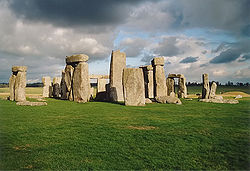
 A group of English neo-druids
An estimated 40,000 (0.1%) to 250,000 (0.4%) people make up the Neo-pagan movement in the United Kingdom, which includes a variety of paths and traditions such as Neo-Druidism, Germanic Neopaganism, and Wicca, accounting for roughly a quarter of Neo-pagans worldwide. According to the 2001 April UK Census, there is an estimated 32,000 Pagans, and 7,000 Wiccans in Wales and England.[1]
Contents
Demographics
A study conducted by Ronald Hutton compared a number of different sources (including membership lists of major organisations within the United Kingdom, major events attendance, subscriptions to magazines, etc.), and used standard models for calculating likely numbers of Pagans within the United Kingdom. This estimate accounted for multiple membership overlaps as well as the number of adherents represented by each attendee of a Neo-pagan gathering. Hutton estimated that there are 250,000 Neo-pagan adherents in the United Kingdom, roughly equivalent to the national Hindu community.[2]
A smaller number is suggested by the results of the 2001 Census, in which a question about religious affiliation was asked for the first time. Respondents were able to write in an affiliation not covered by the check-list of common religions, and a total of 42,262 people from England, Scotland, and Wales declared themselves to be Pagans by this method (or 23% of the 179,000 adherents of "other religions" in the results). These figures were not released as a matter of course by the Office of National Statistics, but were released after an application filed by the Pagan Federation (Scottish branch).[3] With a population of around 59 million, this gives a rough proportion of 7 Pagans per 10,000 inhabitants of the United Kingdom, fewer than the so-called Jedi religion, whose campaign made them the largest of the religions after the Big Six.[4]
The UK Census figures do not allow an accurate breakdown of traditions within the Pagan heading, as a campaign by the Pagan Federation before the census encouraged Wiccans, Heathens, Druids and others all to use the same write-in term 'Pagan' in order to maximise the numbers reported.
Research conducted by Dr Leo Ruickbie found that most Neo-pagans were located in South-east England.[5]
Organisations
Neo-pagan organisations in the UK:
- Pagan Federation (since 1971)
- Pagan Dawn
- Quest Conference
- Odinic Rite (since 1973)
- Unitarian Earth Spirit Network (since 1990)
- Neo-druidism in Britain
References
- ^ Office for National Statistics (11 October 2004). "National Statistics Online: Religious Populations". http://www.statistics.gov.uk/cci/nugget.asp?id=954. Retrieved 4 April 2010.
- ^ Hutton (2001)
- ^ Pagan Federation, Scotland (25 March 2004). "The Pagan Federation in Scotland - Census Results". http://www.scottishpf.org/census.html. Retrieved 4 April 2010.
- ^ Office for National Statistics (13 February 2003). "National Statistics Office: 390,000 Jedis There Are". http://www.statistics.gov.uk/CCI/nugget.asp?ID=297&Pos=&ColRank=2&Rank=1000. Retrieved 4 April 2010.
- ^ Ruickbie, Leo (2004). Witchcraft Out of the Shadows. Robert Hale. p. 170. ISBN 0709075677.
- ^ Khouri, Andrew (2010-06-21). "Thousands celebrate solstice". MSNBC. http://www.msnbc.msn.com/id/37821183/. Retrieved 2010-10-03.
- Hutton, Ronald (2001). The Triumph of the Moon: A History of Modern Pagan Witchcraft. ISBN 0-19-285449-6.
See also
- Neopaganism in the United States
- Religion in the United Kingdom
- New Age travellers
- British Traditional Wicca
Contemporary Paganism Movements SyncreticAdonism · Christianity · Church of All Worlds · Church of Aphrodite · Feraferia · Neo-Druidism · Neoshamanism · Neo-völkisch movements · Technopaganism · Thelema · Unitarian Universalist · WiccaEthnicApproaches By region German-speaking Europe · Greece · Hungary · Ireland · Latin Europe · Scandinavia · Slavic Europe · UK · USARelated Categories:- Paganism in the United Kingdom
- Neopaganism
- Religion in the United Kingdom


Wikimedia Foundation. 2010.
