

- Coosan languages
-
Coosan Kusan Ethnicity: Coos people Geographic
distribution:Oregon Linguistic classification: Oregon Coast Penutian ? - Coosan
Subdivisions: Hanis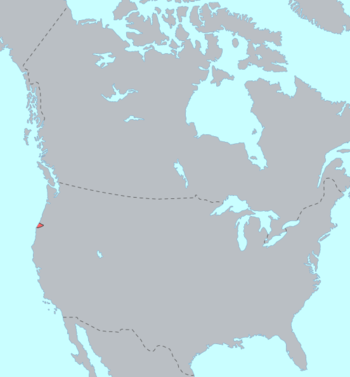
Pre-contact distribution of Coosan languagesThe Coosan (also Coos or Kusan) language family consists of two languages spoken along the southern Oregon coast. Both languages are now extinct.
Classification
- Hanis
- Miluk (aka Lower Coquille)
Melville Jacobs (1939) says that the languages are as close as Dutch and German. They share more than half of their vocabulary, though this is not always obvious, and grammatical differences cause the two languages to look quite different.
The origin of the name Coos is uncertain: one idea is that it is derived from a Hanis stem gus- meaning 'south' as in gusimídži·č 'southward'; another idea is that it is derived from a southwestern Oregon Athabaskan word ku·s meaning 'bay'.
In 1916 Edward Sapir suggested that the Coosan languages are part of a larger Oregon Penutian genetic grouping. This is currently being investigated. See Oregon Coast Penutian languages.
References
- Campbell, Lyle. (1997). American Indian languages: The historical linguistics of Native America. New York: Oxford University Press. ISBN 0-19-509427-1.
- Frachtenberg, Leo J. (1914). Lower Umpqua texts and notes on the Kusan dialect. California University contributions to anthropology (Vol. 4, pp. 141–150). (Reprinted 1969, New York: AMS Press).
- Atlas of languages of intercultural communication in the Pacific, Asia, and the Americas
- Mithun, Marianne. (1999). The languages of Native North America. Cambridge: Cambridge University Press. ISBN 0-521-23228-7 (hbk); ISBN 0-521-29875-X.
- Whereat, Don. (1992). (Personal communication in Mithun 1999).
External links
- Confederated Tribes of Coos, Lower Umpqua, and Siuslaw homepage
- Languages of Oregon - Coos
- Coos, Lower Umpqua & Siuslaw Tribes profile
Categories:

Wikimedia Foundation. 2010.
