

- Finno-Ugric languages
-
Finno-Ugric Geographic
distribution:Eastern and Northern Europe, North Asia Linguistic classification: Uralic - Finno-Ugric
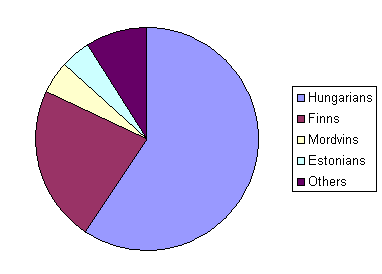
Subdivisions: ISO 639-2 and 639-5: fiu  Pie chart showing the percentage of specific nations speaking languages of the Finno-Ugric family
Finno-Ugric (
 /ˌfɪnoʊˈjuːɡrɪk/ or /ˌfɪnoʊˈuːɡrɪk/),[1] Finno-Ugrian or Fenno-Ugric is a traditional group of languages in the Uralic language family that comprises the Finno-Permic and Ugric language families.
Linguistic roots common to both branches of the traditional Finno-Ugric language tree (Finno-Permic and Ugric) are extremely distant. About 200 words with common roots in all main Finno-Ugric languages have been identified by philologists including 55 about fishing, 15 are about reindeer; and 3 are about commerce. According to philologist Mall Hellam there's only one mutual sentence: “the living fish swims in water.” (Finnish: Elävä kala ui veden alla), (Estonian: Elav kala ujub vee all), (Hungarian: az élő hal vízben úszik). [2]
The term Finno-Ugric languages, which originally represented the entire language-family proposal[citation needed], is sometimes used as a synonym for the more recent term Uralic, including the Samoyedic branch, as commonly happens when a language family is expanded with further discoveries.[3]
Contents
Status
The validity of Finno-Ugric as a genetic grouping is under challenge,[4] with some feeling that the Finno-Permic languages are as distinct from the Ugric languages as they are from the Samoyedic languages spoken in Siberia, or even that none of the Finno-Ugric, Finno-Permic, or Ugric branches have been established. Received opinion has been that the eastmost (and last discovered) Samoyed had separated first and the branching into Ugric and Finno-Permic took place later, but this reconstruction does not have strong support in the linguistic data. In the past, and occasionally today as well, the term Finno-Ugric was used for the entire Uralic language family.
Origins
Attempts at reconstructing a Proto-Finno-Ugric protolanguage—that is, a common ancestor of all Uralic languages except for the Samoyedic languages—are largely indistinguishable from Proto-Uralic, suggesting that Finno-Ugric may not be a historical grouping but a geographical one, with Samoyedic being distinct due to lexical borrowing rather than actually being historically divergent. It has been suggested that the area where Proto-Finno-Ugric was spoken reached between the Baltic Sea and the Ural mountains.[5]
Traditionally, the main set of evidence for the genetic proposal of Proto-Finno-Ugric has come from vocabulary. A large amount of vocabulary (e.g., the numerals "one", "three", "four" and "six") is only reconstructed up to the level of Proto-Finno-Ugric level, while only words with a Samoyedic equivalent have been reconstructed for Proto-Uralic. This methodology has been criticised, as for the most part no coherent explanation has been presented for the origin of Samoyedic vocabulary (though it does include a number of old loanwords from Proto-Indo-European or its immediate successors), and vocabulary divergences between the Samoyedic group and the rest of Uralic could be due to mechanisms of replacement such as language contact. Proponents of the traditional binary division note, however, that the invocation of extensive contact influence on vocabulary is at odds with the grammatical conservatism of Samoyedic.
The consonant *š (voiceless postalveolar fricative, [ʃ]) has not been conclusively shown to occur in the traditional Proto-Uralic lexicon, but it is attested in some of the Proto-Finno-Ugric material. Another feature attested in the Finno-Ugric vocabulary is that *i now behaves as a neutral vowel with respect to front-back vowel harmony, and thus there are roots such as *niva- "to remove the hair from hides".[6]
Regular sound changes proposed for this stage are few and remain open to interpretation. Sammallahti (1988)[6] proposes five, following Janhunen's (1981) reconstruction of Proto-Finno-Permic:
- Compensatory lengthening: development of long vowels from the cluster of vowel plus a particular syllable-final element, of unknown quality, symbolized by *x
- Raising of short *o to *u in open syllables before a subsequent *i
- E.g. *lomi > *lumi "snow" (> Finnish lumi, Hungarian archaic lom "frost", etc.)
- Shortening of long vowels in closed syllables and before a subsequent open vowel *a, *ä, predating the raising of *ää and *ee
- E.g. *ńäxl+mä > *ńäälmä > *ńälmä "tongue" (> Northern Sami njalbmi, Hungarian nyelv, etc.)
Sammallahti (1988) further reconstructs sound changes *oo, *ee > *a, *ä (merging with original *a, *ä) for the development from Proto-Finno-Ugric to Proto-Ugric. Similar sound laws are required for other languages as well. Thus, the origin and raising of long vowels may actually belong at a later stage,[7] and the development from Proto-Uralic to Proto-Ugric can be summarized as simple loss of *x. (The proposed original vowel length only surfaces consistently in the Baltic-Finnic languages.) The proposed raising of *o has been interpreted instead as a lowering *u > *o in Samoyedic (PU *lumi > Proto-Samoyedic *jom).[7]
Janhunen (200X, 2007)[8] notes a number of derivational innovations in Proto-Finno-Ugric, including *ńoma "hare" > *ńoma-la and *pexli "side" > *peel-ka > *pelka "thumb", though involving Proto-Uralic derivational elements.
Structural features
See also: Typology of Uralic languagesAll Finno-Ugric languages share structural features and basic vocabulary which find their origins in the hypothetical Proto-Finno-Ugric language. Around 200 basic words in this language have been suggested, including word stems for concepts related to humans such as names for relatives and body parts. This common vocabulary includes, according to Lyle Campbell, at least 55 words related to fishing, 33 related to hunting and eating animals, 12 related to reindeer, 17 related to plant foods, 31 related to technology, 26 related to building, 11 related to clothing, 18 related to climate, 4 related to society, 11 related to religion, and 3 related to commerce.
Typologically, most Finno-Ugric languages are agglutinative languages, which share common features like inflection by adding suffixes (instead of prepositions as in English) and syntactic coordination of suffixes. Furthermore, Finno-Ugric languages lack grammatical gender and thus use one pronoun for both he and she; for example, hän in Finnish, tämä in Votic, tema in Estonian, ő in Hungarian.
According to Robert Austerlitz[citation needed], Proto-Finno-Ugric had about seven cases; nominative, accusative, genitive, locative, allative, ablative, and adverbial.
In many Finno-Ugric languages possessive adjectives and possessive pronouns, such as my and your, are rarely used. Speakers suggest possession via declension. In those that have developed further towards fusional languages, the genitive of the personal pronoun is used to express possession. Examples: Estonian mu koer 'my dog', colloquial Finnish mun koira, Northern Sami mu beana 'my dog' (literally 'dog of me') or beatnagan 'my dog' (literally 'dog-my'). In others, a pronominal suffix is used, optionally together with the genitive case of a pronoun: thus book Finnish (minun) koirani, 'my dog' (literally 'I-gen. dog-my'), from koira "dog". Similarly, Hungarian, lacking possessive pronouns in their own right, uses possessive noun suffixes, optionally together with pronouns; cf. 'the dog' = a kutya vs. 'my dog' = az én kutyám (literally, 'the I dog-my') or simply a kutyám (literally, 'the dog-my'). Hungarian, however, does have independent possessive pronouns; for example, enyém 'mine', tiéd 'yours', etc. These are also declined; for example, nom. enyém, acc. enyémet, dat. enyémnek, etc.
Classification disputes
The relation of the Finno-Permic and the Ugric groups is adjudged remote by some scholars. On the other hand, with a projected time depth of only 3 or 4 thousand years, the traditionally accepted Finno-Ugric grouping would be far younger than many major families such as Indo-European or Semitic, and would be about the same age as, for instance, the Eastern subfamily of Nilotic. But the grouping is far from transparent or securely established. The absence of early records is a major obstacle. As for the Finno-Ugric Urheimat, most of what has been said about it is speculation.
Some linguists criticizing the Finno-Ugric genetic proposal[9] also question the validity of the entire Uralic family, instead proposing a Ural–Altaic, within which they believe Finno-Permic may be as distant from Ugric as from Turkic. However, this approach has been rejected by nearly all other specialists in Uralic linguistics. For refutations, see e.g. Aikio 2003; Bakró-Nagy 2003, 2005; De Smit 2003; Georg 2003; Kallio 2004; Laakso 2004; Saarikivi 2004.
Common vocabulary
This is a sample of cognates in basic vocabulary across Uralic, illustrating the sound laws (based on the Encyclopædia Britannica and Hakkinen 1979). In general two cognates do not have the same meaning; they merely have the same origin. Thus, the English word in each row should be regarded as an approximation of the original meaning, not a translation of the other words. A sentence that includes only cognate words in Finno-Ugric languages is "The living fish swims in water" (although it is not mutually intelligible).[10]
English Finnish Estonian Northern Sami Inari Sami Mari Komi Khanty Hungarian Finno-Ugric reconstruction heart sydän, sydäm- süda, südam- – – šüm śələm səm szív *śüδä(-mɜ) (*śiδä(-mɜ)) lap syli süli salla, sala solla šəl sɨl jöl öl *süle (*sile) vein suoni soon suotna, suona suona šön sən jan ín 'sinew' *se̮e̮ne go mennä, men- minna, min- mannat moonnađ mije- mun- mən- menni, megy *mene- fish kala kala guolli, guoli kyeli kol kul hal hal *kala hand käsi, käte-
gen. käden, part. kättäkäsi, kät-
gen. käe, part. kättgiehta, gieđa kieta kit ki köt kéz *käte eye silmä silm čalbmi, čalmmi čalme šinča śin sem szem *śilmä ice jää jää jiekŋa, jieŋa jiena ij ji jöŋk jég *jäŋe louse täi täi dihkki tikke tij toj tögtəm tetű *täje (Orthographical notes: The hacek denotes postalveolar articulation ('š' [ʃ]), while the acute denotes a secondary palatal articulation ('ś' [sʲ]). The Finnish letter 'y' and the letter 'ü' in other languages represent a high close rounded vowel [y]. The letter 'đ' in the Sami languages and 'δ' in reconstructions represent a voiced dental fricative [ð]. The Sami 'č' is a voiceless postalveolar affricate [t͡ʃ].)
Numbers
The numbers from 1 to 10 in several Finno-Ugric languages. Forms in italic do not descend from the reconstructed forms.
Number Baltic Finnic Samic Mordvinic Mari Permic Ugric Proto-
Finno-
UgricFinnish Estonian Võro Livonian Northern Sami Inari Sami Erzya Moksha Meadow Mari Komi Mansi Khanty Hungarian 1 yksi
gen. yhden, part. yhtäüks
gen. ühe, part. üht(e)ütś ikš okta ohta vejke fkä ikte ətik äkwa ĭt egy[11] *ükte 2 kaksi
gen. kahden, part. kahtakaks
gen. kahe, part. kaht(e)katś kakš guokte kyeh´ti kavto kaftə kokət kɨk kityg kät kettő/két *kakta 3 kolme kolm kolm kuolm golbma kulma kolmo kolmə kumət kuim hurum koləm három, harm- *kolme 4 neljä neli nelli nēļa njeallje nelji ńiľe nilä nələt nəľ nila ńelä négy *neljä 5 viisi viis viiś vīž vihtta vitta veƭe vetä wizət vit ät wet öt *viite 6 kuusi kuus kuuś kūž guhtta kutta koto kotə kuðət kvajt hot kut hat *kuute 7 seitsemän seitse säidse seis čieža čiččam śiśem sisäm šəmət sizim sat hét N/A 8 kahdeksan kaheksa katõsa kōdõks gávcci käävci kavkso kafksə kandaš(e) kəkjamɨs ńololow nyolc N/A 9 yhdeksän üheksa ütesä īdõks ovcci oovce vejkse veçksə indeš(e) əkmɨs ontolow kilenc N/A 10 kymmenen kümme kümme kim logi love kemeń keməń lu das low loŋət tíz *luke The number '2' descends in Ugric from a front-vocalic variant *kektä.
The numbers '9' and '8' in Finnic thru Mari are considered to be derived from the numbers '1' and '2' as '10–1' and '10–2'. One reconstruction is *yk+teksa and *kak+teksa respectively, where *teksa cf. deka is an Indo-European loan; notice that the difference between /t/ and /d/ is not phonemic, unlike in Indo-European. Another analysis is *ykt-e-ksa, *kakt-e-ksa, with *e being the negative verb.
Finno-Ugric Swadesh lists
100-word Swadesh lists for certain Finno-Ugric languages can be compared and contrasted at the Rosetta Project website: Finnish, Estonian, Hungarian, Erzya.
Peoples
Main article: Finno-Ugric peoplesThe Finno-Ugric peoples is a presumed historic group of those peoples who currently speak Finno-Ugric languages. Like the speakers of Indo-European languages, Finno-Ugric peoples include multiple races.
The four largest ethnicities speaking Finno-Ugric languages are the Hungarians (15 million), Finns (6–7 million), Estonians (1.1 million), and Mordvins (0.85 million). Three (Hungarians, Finns, and Estonians) inhabit independent nation-states, Hungary, Finland, and Estonia, while the Mordvins have an autonomous Mordovian Republic within Russia. The traditional area of the indigenous Sami people is in Northern Fenno-Scandinavia and the Kola Peninsula in Northwest Russia and is known as Sápmi. Some other Finno-Ugric peoples have autonomous republics in Russia: Karelians (Republic of Karelia), Komi (Komi Republic), Udmurts (Udmurt Republic), Mari (Mari El Republic), and Mordvins (Moksha and Erzya; Republic of Mordovia). Khanty and Mansi peoples live in Khanty-Mansi Autonomous Okrug of Russia, while Komi-Permyaks live in Komi-Permyak Okrug, which formerly was an autonomous okrug of Russia, but today is a territory with special status within Perm Krai.
Population genetics
The linguistic reconstruction of the Finno-Ugric language family has led to the postulation that the ancient Proto–Finno-Ugric people were ethnically related, and that even the modern Finno-Ugric-speaking peoples are ethnically related.[12] Such hypotheses are based on the assumption that heredity can be traced through linguistic relatedness,[13] but this premise is rarely accepted by the modern scientific community: It has not been shown that any contemporary group originated from one single ancient people, barring the earliest humans. Like perhaps all populations, individual groups of Finno-Ugric speakers have a diverse array of cultural, environmental, and genetic influences. However, modern genetic studies have shown that the Y-chromosome haplogroup N3, and sometimes N2, having branched from haplogroup N, which, itself, probably spread north, then west and east from Northern China about 12,000–14,000 years before present from father haplogroup NO (haplogroup O being the most common Y-chromosome haplogroup in Southeast Asia), is almost specific, though certainly not restricted, to Uralic or Finno-Ugric speaking populations, especially as high frequency or primary paternal haplogroup.[14][15]
Some of the ethnicities speaking Finno-Ugric languages are:
(Baltic Finnic)
("Volgaic")
- Sami (Lapps)
(Permic)
(Ugric)
See also
- Finnic peoples
- Ugric peoples
- Volga Finns
- Comb Ceramic culture
- Uralic languages
- Uralo-Siberian languages
- Old Hungarian script
- Old Permic script
References
- ^ Collins English Dictionary – Complete & Unabridged 10th Edition 2009
- ^ "The Finno-Ugrics The dying fish swims in water". The Economist. 2005.
- ^ Tommola, Hannu (2010). "Finnish among the Finno-Ugrian languages". Mood in the Languages of Europe. John Benjamins Publishing Company. p. 155. ISBN 9027205876. http://books.google.com/books?id=o3L8oKcbZtoC&pg=PA511&dq.
- ^ Salminen, Tapani (2002): Problems in the taxonomy of the Uralic languages in the light of modern comparative studies; the clade has also been abandoned by Ethnologue.
- ^ Campbell, Lyle (2004). Historical linguistics: an introduction. MIT Press. p. 405. ISBN 0262532670. http://books.google.com/books?id=EjXrrOJhex8C&pg=PA405&dq.
- ^ a b Sammallahti, Pekka (1988). "Historical Phonology of the Uralic languages". In Denis, Sinor. The Uralic languages – Description, history and foreign influences. BRILL. pp. 478–554. ISBN 9789004077416. http://books.google.com/books?id=TM2NQ78dP2wC&pg=PA492.
- ^ a b Häkkinen, Jaakko 2009: Kantauralin ajoitus ja paikannus: perustelut puntarissa. – Suomalais-Ugrilaisen Seuran Aikakauskirja 92. http://www.sgr.fi/susa/92/hakkinen.pdf
- ^ Janhunen, Juha (2007), "The primary laryngeal in Uralic and beyond" (pdf), Suomalais-Ugrilaisen Seuran toimituksia 253, ISSN 0355-0230, http://www.sgr.fi/sust/sust253/sust253_janhunen.pdf, retrieved 2010-05-05
- ^ especially Angela Marcantonio
- ^ http://itre.cis.upenn.edu/~myl/languagelog/archives/002729.html
- ^ According to Zaich, Gábor (2006) (in hu). Etimológiai szótár. p. 167. ISBN 963 7094 01 6., the Hungarian word for "one" is an internal development, i.e. it is not related to the Proto-Finno-Ugric *ükte
- ^ http://books.google.com/books?id=7rmgP02a_mkC&pg=PR7&ots=BX_ZloC9mA&dq=proff+Hungarian&sig=tg85J7fSIQSnBEMkfYH1g_ujmHY
- ^ Where do Finnish come from?
- ^ European Journal of Human Genetics – Abstract of article: A counter-clockwise northern route of the Y-chromosome haplogroup N from Southeast Asia towards Europe
- ^ http://www.journals.uchicago.edu/AJHG/journal/issues/v74n4/40783/40783.web.pdf?erFrom=-1818203271335085617Guest
Further reading
- Aikio, Ante (2003). Angela Marcantonio, The Uralic Language Family: Facts, Myths and Statistics. (Book review.) In: Word – Journal of the International Linguistic Association 3/2003: 401–412.
- Bakró-Nagy Marianne 2003. Az írástudók felelőssége. Angela Marcantonio, The Uralic Language Family. Facts, myths and statistics. In: Nyelvtudományi Közlemények 100: 44–62. (Downloadable: [2])
- Bakró-Nagy Marianne 2005. The responsibility of literati. Angela Marcantonio, The Uralic Language Family. Facts, myths and statistics. In: Lingua 115: 1053–1062. (Downloadable: [3])
- Benkő, Loránd: Etymologisches Wörterbuch des Ungarischen (Etymological Dictionary of Hungarian). Budapest: Akadémiai Kiadó, 1992–1997., ISBN 963-05-6227-8.
- Collinder, Björn: Fenno-Ugric Vocabulary. Uppsala, 1955, ISBN 3-87118-187-0.
- Campbell, Lyle: Historical Linguistics: An Introduction. Edinburgh University Press 1998.
- Csepregi Márta (ed.): Finnugor kalauz (Finno-Ugric Guide). Budapest: Panoráma, 1998., ISBN 963-243-862-0.
- De Smit, Merlijn 2003: A. Marcantonio: The Uralic language family. Facts, myths and statistics (review). In: Linguistica Uralica 2003, 57-67.
- Encyclopædia Britannica 15th ed.: Languages of the World: Uralic languages. Chicago, 1990.
- Georg, Stefan 2003. Rezension: A. Marcantonio: The Uralic Language Family. Facts, Myths and Statistics. In: Finnisch-Ugrische Mitteilungen Band 26/27.
- Häkkinen, Kaisa: Suomalais-ugrilaisten kielten etymologisen tutkimuksen asemasta ja ongelmista (About the situation and problems of the etymological research of the Finno-Ugric languages) (1979), in Nykysuomen rakenne ja kehitys (Structure and development of modern Finnish) volume 2, (NRJK 2) Pieksämäki 1984, ISBN 951-717-360-1.
- Kallio, Petri 2004. (Review:) The Uralic Language Family: Facts, Myths, and Statistics (Angela Marcantonio). In: Anthropological Linguistics Vol. 46, no. 4: 486-489.
- Laakso, Johanna: Karhunkieli. Pyyhkäisyjä suomalais-ugrilaisten kielten tutkimukseen (A Bear Tongue. Views on the Research of the Finno-Ugric Languages). Helsinki: SKS, 1999.
- Laakso, Johanna (ed.): Uralilaiset kansat (Uralic Peoples). Porvoo–Helsinki–Juva: WSOY, 1992, ISBN 951-0-16485-2.
- Laakso, Johanna 2004. Sprachwissenschaftliche Spiegelfechterei (Angela Marcantonio: The Uralic language family. Facts, myths and statistics). In: Finnisch-ugrische Forschungen 58: 296-307.
- Marcantonio, Angela: What Is the Linguistic Evidence to Support the Uralic Theory or Theories? – In Linguistica Uralica 40, 1, pp 40–45, 2004.
- Marcantonio, Angela: The Uralic Language Family: Facts, Myths and Statistics. 2003.
- Marcantonio, Angela, Pirjo Nummenaho, and Michela Salvagni: The "Ugric–Turkic Battle": A Critical Review. In Linguistica Uralica 37, 2, pp 81–102, 2001. Online version.
- Saarikivi, Janne 2004. Review of: Angela Marcantonio. Uralic Language Family: Facts, Myths and Statistics. In: Journal of Linguistics 1/2004. p. 187-191.
- Sammallahti, Pekka, Matti Morottaja: Säämi–suoma–säämi škovlasänikirje (Inari Sami – Finnish – Inari Sami School Dictionary). Helsset/Helsinki: Ruovttueatnan gielaid dutkanguovddaš/Kotimaisten kielten tutkimuskeskus, 1983, ISBN 951-9475-36-2.
- Sammallahti, Pekka: Sámi–suoma–sámi sátnegirji (Northern Sami – Finnish – Northern Sami Dictionary). Ohcejohka/Utsjoki: Girjegiisá, 1993, ISBN 951-8939-28-4.
- Sinor, Denis (ed.): Studies in Finno-Ugric Linguistics: In Honor of Alo Raun (Indiana University Uralic and Altaic Series: Volume 131). Indiana Univ Research, 1977, ISBN 0-933070-00-4.
- Vikør, Lars S. (ed.): Fenno-Ugric. In: The Nordic Languages. Their Status and Interrelations. Novus Press, pp. 62–74, 1993.
- Wiik, Kalevi: Eurooppalaisten juuret, Atena Kustannus Oy. Finland, 2002.
- Языки народов СССР III. Финно-угорские и самодийские языки (Languages of the Peoples in the USSR III. Finno-Ugric and Samoyedic Languages). Москва (Moscow): Наука (Nauka), 1966. (Russian)
- A magyar szókészlet finnugor elemei. Etimológiai szótár (The Hungarian Vocabulary of Finno-Ugric Origin. Etymological Dictionary). Budapest: Akadémiai Kiadó, 1967–1978.
External links
- Some Finno-Ugrian links A more comprehensive link collection
- Swadesh lists for the Finno-Ugric languages (from Wiktionary's Swadesh-list appendix)
- FAQ about Finno-Ugrian Languages
- Linguistic Shadow-Boxing Johanna Laakso's book review of Angela Marcantonio's "The Uralic language family. Facts, myths and statistics"
- Uralic Linguistics Vs. Voodoo Science! A collection of links about the "new paradigm" debate by Merlijn de Smit
- Numbers in Asian languages Counting to ten in a variety of languages
- Ugri.info Finno-Ugric peoples infobase
- Finno-Ugric Electronic Library by the Finno-Ugric Information Center in Syktyvkar, Komi Republic Interface in Russian and English, texts in Mari, Komi, Udmurt, Erzya and Moksha languages.
- The Finno-Ugrics: The dying fish swims in water The Economist, December 20, 2005
- "Ethnic origins of Finno-Ugric nations and modern Finno-Ugric nationalism in the Russian Federation" by Konstantin Zamyatin
Uralic languages Finnic Sami Miscellanea Permic Ugric Samoyedic Italics indicate extinct languagesCategories:

Wikimedia Foundation. 2010.
