

- Emo
-
This article is about the style of music. For other uses, see Emo (disambiguation).
Emo Stylistic origins Hardcore punk, indie rock Cultural origins Mid-1980s Washington, D.C. Typical instruments Vocals, guitar, bass guitar, drum kit Mainstream popularity Early 2000s–present Subgenres Screamo Regional scenes Washington, D.C. · Midwestern and Central United States · New Jersey and Long Island Other topics List of emo artists · timeline of alternative rock Emo (
 /ˈiːmoʊ/) is a style of rock music characterized by melodic musicianship and expressive, often confessional lyrics. It originated in the mid-1980s hardcore punk movement of Washington, D.C., where it was known as "emotional hardcore" or "emocore" and pioneered by bands such as Rites of Spring and Embrace. As the style was echoed by contemporary American punk rock bands, its sound and meaning shifted and changed, blending with pop punk and indie rock and encapsulated in the early 1990s by groups such as Jawbreaker and Sunny Day Real Estate. By the mid 1990s numerous emo acts emerged from the Midwestern and Central United States, and several independent record labels began to specialize in the style.
Emo broke into mainstream culture in the early 2000s with the platinum-selling success of Jimmy Eat World and Dashboard Confessional and the emergence of the subgenre "screamo". In recent years the term "emo" has been applied by critics and journalists to a variety of artists, including multiplatinum acts and groups with disparate styles and sounds.
In addition to music, "emo" is often used more generally to signify a particular relationship between fans and artists, and to describe related aspects of fashion, culture, and behavior.
Contents
History
Origins: 1980s
Emo emerged from the hardcore punk scene of early-1980s Washington, D.C., both as a reaction to the increased violence within the scene and as an extension of the personal politics espoused by Ian MacKaye of Minor Threat, who had turned the focus of the music from the community back towards the individual.[1][2] Minor Threat fan Guy Picciotto formed Rites of Spring in 1984, breaking free of hardcore's self-imposed boundaries in favor of melodic guitars, varied rhythms, and deeply personal, impassioned lyrics.[3] Many of the band's themes would become familiar tropes in later generations of emo music, including nostalgia, romantic bitterness, and poetic desperation.[4] Their performances became public emotional purges where audience members would sometimes weep.[5] MacKaye became a huge Rites of Spring fan, recording their only album and serving as their roadie on tour, and soon formed a new band of his own called Embrace which explored similar themes of self-searching and emotional release.[6] Similar bands soon followed in connection with the "Revolution Summer" of 1985, a deliberate attempt by members of the Washington, D.C. scene to break from the rigid constraints of hardcore in favor of a renewed spirit of creativity.[2] Bands such as Gray Matter, Beefeater, Fire Party, Dag Nasty, Lunchmeat, and Kingface were connected to this movement.[2][6]
The exact origins of the term "emo" are uncertain, but date back to at least 1985. According to Andy Greenwald, author of Nothing Feels Good: Punk Rock, Teenagers, and Emo, "The origins of the term 'emo' are shrouded in mystery [...] but it first came into common practice in 1985. If Minor Threat was hardcore, then Rites of Spring, with its altered focus, was emotional hardcore or emocore."[6] Michael Azerrad, author of Our Band Could Be Your Life, also traces the word's origins to this time: "The style was soon dubbed 'emo-core,' a term everyone involved bitterly detested, although the term and the approach thrived for at least another fifteen years, spawning countless bands."[7] MacKaye also traces it to 1985, attributing it to an article in Thrasher magazine referring to Embrace and other Washington, D.C. bands as "emo-core", which he called "the stupidest fucking thing I’ve ever heard in my entire life."[8] Other accounts attribute the term to an audience member at an Embrace show, who yelled that the band was "emocore" as an insult.[9][10] Others contend that MacKaye coined the term when he used it self-mockingly in a magazine, or that it originated with Rites of Spring.[10] The Oxford English Dictionary, however, dates the earliest usage of "emo-core" to 1992 and "emo" to 1993, with "emo" first appearing in print media in New Musical Express in 1995.[11][12]
The "emocore" label quickly spread around the Washington, D.C. punk scene and became attached to many of the bands associated with MacKaye's Dischord Records label.[9] Although many of these bands simultaneously rejected the term, it stuck nonetheless. Scene veteran Jenny Toomey has recalled that "The only people who used it at first were the ones that were jealous over how big and fanatical a scene it was. [Rites of Spring] existed well before the term did and they hated it. But there was this weird moment, like when people started calling music 'grunge,' where you were using the term even though you hated it."[13]
The Washington, D.C. emo scene lasted only a few years. By 1986 most of the major bands of the movement—including Rites of Spring, Embrace, Gray Matter, and Beefeater—had broken up.[14] Even so, the ideas and aesthetics originating from the scene spread quickly across the country via a network of homemade zines, vinyl records, and hearsay.[15] According to Greenwald, the Washington, D.C. scene laid the groundwork for all subsequent incarnations of emo:
What had happened in D.C. in the mid-eighties—the shift from anger to action, from extroverted rage to internal turmoil, from an individualized mass to a mass of individuals—was in many ways a test case for the transformation of the national punk scene over the next two decades. The imagery, the power of the music, the way people responded to it, and the way the bands burned out instead of fading away—all have their origins in those first few performances by Rites of Spring. The roots of emo were laid, however unintentionally, by fifty or so people in the nation's capital. And in some ways, it was never as good and surely never as pure again. Certainly, the Washington scene was the only time "emocore" had any consensus definition as a genre.[16]
MacKaye and Piccioto, along with Rites of Spring drummer Brendan Canty, went on to form the highly influential Fugazi who, despite sometimes being connected with the term "emo", are not commonly recognized as an emo band.[17]
Reinvention: early 1990s
 Sunny Day Real Estate in 2009.
As the ideals of the Washington, D.C. emo movement spread across the United States, many bands in numerous local scenes began to emulate the sound as a way to marry the intensity of hardcore with the complex emotions associated with growing older.[18] The style combined the fatalism, theatricality, and outsiderness of The Smiths with the uncompromising and dramatic worldview of hardcore.[18] Although the bands were numerous and the locales varied, the aesthetics of emocore in the late 1980s remained more or less the same: "over-the-top lyrics about feelings wedded to dramatic but decidedly punk music."[18] However, in the early 1990s, several new bands reinvented the emo style and carried its core characteristic, the intimacy between bands and fans, into the new decade.[19] Chief among these were Jawbreaker and Sunny Day Real Estate, both of whom fostered cult followings, recontextualized the word "emo", and brought it a step closer to the mainstream.[19] According to Andy Greenwald:
Sunny Day Real Estate was emo's head and Jawbreaker its busted gut—the two overlapped in the heart, then broke up before they made it big. Each had a lasting impact on the world of independent music. The bands shared little else but fans, and yet somehow the combination of the two lays down a fairly effective blueprint for everything that was labeled emo for the next decade.[19]
In the wake of the 1991 success of Nirvana's Nevermind, underground music and subcultures in the United States became big business. New distribution networks emerged, touring routes were codified, and regional and independent acts were able to access the national stage.[19] Teenagers across the country declared themselves fans of independent music, and being punk became mainstream.[19] In this new musical climate, the aesthetics of emo expanded into the mainstream and altered the way the music was perceived: "Punk rock no-nos like the cult of personality and artistic abstraction suddenly become de rigueur", says Greenwald. "If one definition of emo has always been music that felt like a secret, Jawbreaker and Sunny Day Real Estate were cast in the rolls of the biggest gossips of all, reigning as the largest influences on every emo band that came after them."[20]
Jawbreaker has been referred to as "the Rosetta Stone of contemporary emo".[20] Emerging from the San Francisco punk rock scene of the late 1980s and early 1990s, their songwriting combined the heft of hardcore with pop punk sensibilities and the tortured artistry of mid-1980s emocore.[20] Singer/guitarist Blake Schwarzenbach focused his lyrics on topics that were personal, immediate, and lived, often lifting them directly from his journal.[22] Though they were often obscure and cloaked in metaphors, their specificity to Schwarzenbach's own concerns gave the words a bitterness and frustration that made them universal and magnetic to audiences.[23] Schwarzenbach became emo's first idol as listeners related to the singer more than the songs themselves.[23] Jawbreaker's 1994 album 24 Hour Revenge Therapy became their most-loved amongst fans and is a touchstone of mid-1990s emo.[24] The band signed to major label Geffen Records and toured with Nirvana and Green Day, but their 1995 album Dear You sold poorly and they broke up soon after, with Schwarzenbach later forming Jets to Brazil.[25] Their influence lived on, however, through later successful emo and pop punk bands openly indebted to Jawbreaker's sound.[26]
Sunny Day Real Estate formed in Seattle during the height of the early-1990s grunge boom.[28] In contrast to Jawbreaker, its members were accomplished musicians with high-quality gear, lofty musical ambitions, intricate songwriting, and a sweeping, epic sound.[28] Frontman Jeremy Enigk sang desperately, in a falsetto register, about losing himself and subsuming himself in something greater, often using haphazard lyrics and made-up words.[29] The band's debut album Diary (1994) was over-the-top and romantic, and the music video for "Seven" received airplay on MTV.[30] The band's ambitious sound challenged other bands to reach further with their own music in sentiment, instrumentation, and metaphor, and represented a generational shift between grunge and emo.[27] Other emo-leaning punk bands soon followed suit, and the word "emo" began to shift from being vague and undefined to referring to a specific type of emotionally overbearing music that was romantic but distanced from the political nature of punk rock.[31] Sunny Day Real Estate fell apart after Diary, as Enigk became a born-again Christian and launched a solo career while the other members drifted into new projects such as the Foo Fighters. They released three more albums through a series of breakups and occasional reunions, but are remembered primarily for the promise of their debut and the shift it engendered in the tastes of underground rock fans.[32]
Underground popularity: mid 1990s
In the mid-1990s the American punk and indie rock movements, which had been largely underground since the early 1980s, became part of mainstream culture. After Nirvana's success, major record labels capitalized on the popularity of alternative rock and other underground music by signing numerous independent bands and spending large amounts of capital promoting them.[33] In 1994, the same year that Jawbreaker's 24 Hour Revenge Therapy and Sunny Day Real Estate's Diary were released, pop punk acts Green Day and The Offspring had mutiplatinum successes with their respective albums Dookie and Smash. In the wake of the underground going mainstream, over the next several years emo as a genre retreated, reformed, and morphed into a national subculture, then eventually something more.[33] Drawing inspiration from bands like Jawbreaker, Drive Like Jehu, and Fugazi, the new sound of emo was a mixture of hardcore's passion and indie rock's intelligence, bearing the anthemic power of punk rock and its do-it-yourself work ethic but with smoother songs, sloppier melodies, and yearning vocals.[34] Many of the new emo bands originated from the Midwestern and Central United States, such as Braid from Champaign-Urbana, Illinois, Christie Front Drive from Denver, Colorado, Mineral from Austin, Texas, Jimmy Eat World from Mesa, Arizona, The Get Up Kids from Kansas City, Missouri, and The Promise Ring from Milwaukee, Wisconsin.[35] According to Andy Greenwald, "This was the period when emo earned many, if not all, of the stereotypes that have lasted to this day: boy-driven, glasses-wearing, overly sensitive, overly brainy, chiming-guitar-driven college music."[34]
On the east coast, New York City-based Texas Is the Reason bridged the gap between indie rock and emo in their brief three-year lifespan by melding the melodies of Sunny Day Real Estate to churning punk musicianship and singing directly to the listener.[36] In New Jersey, Lifetime gained a reputation as a melodic hardcore act, playing shows in fans' basements.[37] Their 1995 album Hello Bastards on rising independent label Jade Tree Records fused hardcore with emo's tunefulness, turning its back on cynicism and irony in favor of love songs.[37] The album sold tens of thousands of copies[38] and the band inspired a number of later New Jersey and Long Island emo acts such as Brand New, Glassjaw, Midtown,[39] The Movielife, My Chemical Romance,[39] Saves the Day,[39][40] Senses Fail,[39] Taking Back Sunday,[38][39] and Thursday.[39][41]
The Promise Ring were one of the premier bands of the new emo style. Their music took a slower, smoother, pop punk approach to hardcore riffs, blending them with singer Davey von Bohlen's goofy, picturesque lyrics delivered with a froggy croon and pronounced lisp, and they played shows in basements and VFW halls[42] Jade Tree released their debut 30° Everywhere in 1996 and it sold tens of thousands of copies, a blockbuster by independent standards.[43] Greenwald describes the effect of the album as "like being hit in the head with cotton candy."[44] Other bands such as Karate, The Van Pelt, Joan of Arc, and The Shyness Clinic incorporated elements of post-rock and noise rock into the emo sound.[45] The common lyrical thread between these bands was "applying big questions to small scenarios."[45]
A cornerstone of mid-1990s emo was Weezer's 1996 album Pinkerton.[47] Following the success of their mutiplatinum debut, Pinkerton turned from their power pop sound to a much darker, more abrasive character.[48][49] Frontman Rivers Cuomo's songs were obsessed with messy, manipulative sex and his own insecurities of dealing with celebrity.[49] A critical and commercial failure,[49][50] it was ranked by Rolling Stone as the second-worst album of the year.[51] Cuomo retreated from the public eye,[49] later referring to the album as "hideous" and "a hugely painful mistake".[52] However, Pinkerton found enduring appeal with teenagers just discovering alternative rock, who were drawn to its confessional lyrics and themes of rejection and came to believe that it was directed at them.[46] Sales grew steadily as word of the album passed between fans, over online messageboards, and via Napster.[46] "Although no one was paying attention", says Greenwald, "perhaps because no one was paying attention—Pinkerton became the most important emo album of the decade."[46] When Weezer returned in 2000, however, they did so with a decidedly pop sound. Cuomo refused to play songs from Pinkerton, dismissing it as "ugly" and "embarrassing".[53] Nevertheless, the album held its appeal and eventually achieved both high sales and critical praise, and is noted for introducing emo to larger and more mainstream audiences.[54]
The emo aesthetic of the mid-1990s was embodied in Mineral, whose albums The Power of Failing (1997) and EndSerenading (1998) encapsulated the emo tropes of somber music accompanied by a shy narrator singing seriously about mundane problems.[55] Greenwald calls their song "If I Could" "the ultimate expression of mid-nineties emo. The song's short synopsis—she is beautiful, I am weak, dumb, and shy; I am alone but am surprisingly poetic when left alone—sums up everything that emo's adherents admired and its detractors detested."[55] Another significant band of the era was Braid, whose 1998 album Frame and Canvas and B-side song "Forever Got Shorter" blurred the lines between band and listener, as the group was a mirror-image of its own audience in passion and sentiment and sang in the voice of their fans.[56]
Though the emo style of the mid-1990s had thousands of young fans, it never broke into the national consciousness.[58] A few bands were offered contracts with major record labels, but most broke up before they could capitalize on the opportunity.[59] Jimmy Eat World signed to Capitol Records in 1995 and built a following among the emo community with their album Static Prevails, but did not break into the mainstream despite their major-label association as their music was mostly lost amongst the popular ska movement of the period.[60] The Promise Ring were the most commercially successful emo band of the time, with sales of their 1997 album Nothing Feels Good topping out in the mid-five figures.[58] Greenwald calls the album "the pinnacle of its generation of emo: a convergence of pop and punk, of resignation and celebration, of the lure of girlfriends and the pull of friends, bandmates, and the road."[61] He refers to mid-1990s emo as "the last subculture made of vinyl and paper instead of plastic and megabytes."[62]
Independent success: late 1990s and early 2000s
Beginning in the late 1990s emo had a surge of popularity in the realm of independent music, as a number of notable acts and record labels experienced successes that would lay the foundation for the style's later mainstream breakthrough. As emo gained a larger fanbase the music business began see its marketing potential, and as big business entered the picture many of the acts previously associated with the term intentionally distanced themselves from it:
As the '90s wore to a close, the music that was being labeled emo was making a connection with a larger and larger group of people. the aspects of it that were the most contagious—the sensitivity, hooks, and average-guy appeal—were also the easiest to latch onto, replicate, and mass market. As with any phenomenon—exactly like what happened with Sunny Day [Real Estate]—when business enters into a high-stakes, highly personal sphere, things tend to go awry very quickly [...] As fans threatened to storm the emo bandwagon, the groups couldn't jump off of it fast enough. The popularity and bankability of the word—if not the music—transformed an affiliation with the mid-nineties version of emo into an albatross.[63]
In 1997 Deep Elm Records launched a series of compilation albums entitled The Emo Diaries, which continued until 2007 with eleven installments.[64] Featuring mostly unreleased music from unsigned bands, the series included acts such as Jimmy Eat World, Further Seems Forever, Samiam, and The Movielife.[64] The diversity of bands and musical styles made the case for emo as more of a shared aesthetic than a genre, and the series helped to codify the term "emo" and spread it throughout the community of underground music.[63]
Jimmy Eat World's 1999 album Clarity was one of the most significant emo albums of the late 1990s and became a touchstone for later emo bands.[67] Writing in 2003, Andy Greenwald called it "one of the most fiercely beloved rock 'n' roll records of the last decade. It is name-checked by every single contemporary emo band as their favorite album, as a mind-bending milemarker that proved that punk rock could be tuneful, emotional, wide-ranging, and ambitious."[67] However, despite warm critical reception and promotion of the single "Lucky Denver Mint" in the Drew Barrymore comedy film Never Been Kissed, Clarity was commercially unsuccessful in a musical climate dominated by teen pop, and the band left major label Capitol Records the following year.[65][66] Nevertheless, the album gained steady popularity via word-of-mouth and was treasured by fans, eventually selling over 70,000 copies.[68] Jimmy Eat World self-financed the recording of their next album Bleed American (2001) before signing to Dreamworks Records. The album sold 30,000 copies in its first week and went gold shortly after. In 2002 it went platinum as emo broke into the mainstream.[69]
Drive-Thru Records, founded in 1996, steadily built up a roster of primarily pop punk bands with emo characteristics such as Midtown, The Starting Line, The Movielife, and Something Corporate.[70] Drive-Thru's partnership with major label MCA enabled their brand of emo-inflected pop to reach wider audiences.[71] The label's biggest early success was New Found Glory,[71] whose 2000 eponymous album reached No. 107 on the Billboard 200[72] with the single "Hit or Miss" reaching No. 15 on Modern Rock Tracks.[73] Drive-Thru's unabashedly populist and capitalist approach to music allowed its bands' albums and merchandise to sell heavily through popular outlets such as Hot Topic:[74]
In a world where cars are advertised as punk, Green Day members are platinum rock stars, and getting pierced and tatted up is as natural as a sweet-sixteen party, everyone is free to come up with their own definition of punk—and everyone is ready to embrace it. Emo had always connected with young people—it had just never aggressively marketed itself to them.[75]
Independent label Vagrant Records was behind several successful emo acts of the late 1990s and early 2000s. The Get Up Kids had sold over 15,000 copies of their debut album Four Minute Mile (1997) before signing to Vagrant, who promoted the band aggressively and put them on tours opening for big-name acts like Green Day and Weezer.[76] Their 1999 album Something to Write Home About was an independent success, reaching No. 31 on Billboard's Top Heatseekers chart.[77] Vagrant signed and released albums by a number of other emo and emo-related acts over the next two years, including The Anniversary, Reggie and the Full Effect, The New Amsterdams, Alkaline Trio, Saves the Day, Dashboard Confessional, Hey Mercedes, and Hot Rod Circuit.[78] Saves the Day had built a large following on the east coast and sold almost 50,000 copies of their second album Through Being Cool (1999)[40] before signing to Vagrant and releasing Stay What You Are (2001), which sold 15,000 copies in its first week,[79] reached No. 100 on the Billboard 200,[80] and went on to sell over 200,000 copies.[81] In the summer of 2001 Vagrant organized a national tour featuring every band on the label, sponsored by corporations such as Microsoft and Coca-Cola. This populist approach and the use of the internet as a marketing tool helped Vagrant become one of the country's most successful independent labels and also helped to popularize the term "emo".[82] According Greenwald, "More than any other event, it was Vagrant America that defined emo to masses—mainly because it had the gumption to hit the road and bring it to them."[79]
Mainstream popularity: 2000s
Emo broke into the mainstream media in the summer of 2002 with a number of notable events:[84] Jimmy Eat World's Bleed American album went platinum on the strength of "The Middle", which reached No. 1 on Billboard's Modern Rock Tracks chart.[84][85][86] Dashboard Confessional reached No. 22 on the same chart with "Screaming Infidelities"[87] from their Vagrant Records debut The Places You Have Come to Fear the Most, which was No. 5 on Independent Albums,[83] and became the first non-platinum-selling artist to record an episode of MTV Unplugged[84] (the resultant live album itself was a No. 1 Independent Album in 2003 and quickly went platinum).[83][88] New Found Glory's album Sticks and Stones debuted at No. 4 on the Billboard 200.[84][89] Saves the Day toured with Green Day, Blink-182, and Weezer, playing large arenas such as Madison Square Garden,[90] and by the end of the year had performed on Late Night with Conan O'Brien, appeared on the cover of Alternative Press, and had music videos for "At Your Funeral" and "Freakish" in heavy rotation on MTV2.[79][81] Articles on Vagrant Records were published in Time and Newsweek,[91] while the word "emo" began appearing on numerous magazine covers and became a catchall term for any music outside of mainstream pop.[92] Andy Greenwald attributes emo's sudden explosion into the mainstream to media outlets looking for the "next big thing" in the wake of the September 11 attacks:
The media business, so desperate for its self-obsessed, post-9/11 predictions of a return to austerity and the death of irony to come true, had found its next big thing. But it was barely a "thing," because no one had heard of it, and those who had couldn't define it. Despite the fact that the hedonistic, materialistic hip-hop of Nelly was still dominating the charts, magazine readers in the summer of '02 were informed that the nation was deep in an introverted healing process, and the way it was healing was by wearing thick black glasses and vintage striped shirts. Emo, we were told, would heal us all through fashion.[93]
In the wake of this success, many emo bands were signed to major record labels and the style became a marketable product.[94] Dreamworks Records senior A&R representative Luke Wood remarked that "The industry really does look at emo as the new raprock, or the new grunge. I don't think that anyone is listening to the music that's being made—they're thinking of how they're going to take advantage of the sound's popularity at retail."[95] The depoliticized nature of emo, coupled with its catchy music and accessible themes, gave it a broad appeal to young mainstream audiences.[96]
At the same time, a darker, more aggressive offshoot of emo gained popularity. New Jersey–based Thursday signed a multi-million-dollar, multialbum contract with Island Def Jam on the strength of their 2001 album Full Collapse, which reached No. 178 on the Billboard 200.[97] Their music differed from the prominent emo bands of the time in that it was more politicized and lacked dominant pop hooks and anthems, drawing influence from more maudlin bands such as The Smiths, Joy Division, and The Cure. However, the band's accessibility, openness, basement-show roots, and touring alongside bands like Saves the Day made them part of the emo movement.[98]
Offshoots
Screamo
Main article: ScreamoThe term "screamo" was initially applied to a more aggressive offshoot of emo that developed in San Diego in 1991, which used short songs that grafted "spastic intensity to willfully experimental dissonance and dynamics."[99] Screamo is a particularly dissonant style of emo influenced by hardcore punk [100] and uses typical rock instrumentation, but is noted for its brief compositions, chaotic execution, and screaming vocals. The genre is "generally based in the aggressive side of the overarching punk-revival scene."[100] The style began in 1991, in San Diego, at the Ché Café,[101] with groups such as Heroin, Antioch Arrow,[102] Angel Hair, Mohinder, Swing Kids, and Portraits of Past.[103] These groups were influenced by Washington D.C. post-hardcore (particularly Fugazi and Nation of Ulysses),[99] straight edge, the Chicago group Articles of Faith, hardcore punk band Die Kreuzen[104] and post-punk, such as Joy Division[105] and Bauhaus.[99]
Some bands that formed in the United States during the late 1990s and remained active throughout the 2000s, such as Thursday, Thrice, and Poison the Well made screamo much more popular. Many of these bands took influence from the likes of Refused and At the Drive-In.[100] By the mid-2000s, the over-saturation of the screamo scene caused many bands to purposefully expand past the genre’s trademarks and incorporate more experimental elements.[100] Even bands that weren’t necessarily screamo would often use the style's characteristic guttural vocal style.[100] Derek Miller, guitarist for the post-hardcore band Poison the Well, claimed that the term screamo "describes a thousand different genres."[106] According to Jeff Mitchell of Iowa State Daily, "there is no set definition of what screamo sounds like but screaming over once deafeningly loud rocking noise and suddenly quiet, melodic guitar lines is a theme commonly affiliated with the genre."[107] Juan Gabe, vocalist for the band Comadre, alleged that the term "has been kind of tainted in a way, especially in the States."[108]
Emo pop
"Emo pop," also called "emo pop punk,"[109] emerged as an offshoot from emo that also embraces pop music influences, such as more concise songs and hook filled choruses. Allmusic describes the style as blending "youthful angst" with "slick production" and mainstream appeal, using "high-pitched melodies, rhythmic guitars, and lyrics concerning adolescence, relationships, and heartbreak."[110] Britain's The Guardian described the style as a cross between "saccharine boy-band pop" and emo.[111] Modern emo pop bands have toned down extremities in loud/soft variations to provide a more widespread appeal.[109]
As emo became more successful in the mid-1990s due to the rise of grunge,[109] emo pop was developed by bands such as The Wrens, which pioneered a form of emo-pop on 1996's Secaucus, [112] and Weezer, which in 1996 released the definitive emo pop album Pinkerton.[113] Other bands which put out emo pop releases in the 90s included Sense Field,[114] Jejune,[114] Alkaline Trio,[115] and The Get Up Kids.[114][116] As emo became commercially successful in the early 2000s, the emo pop movement was birthed by Jimmy Eat World's 2001 release Bleed American and the success of that album's single "The Middle".[110] Genre pioneers Weezer and The Wrens both saw great success in this new movement, the former with its release The Green Album[110] and the latter with Meadowlands, which "reinvented punk-pop for the new generation".[112][117] As the genre coalesced, the record label Fueled by Ramen became a center of the movement, releasing platinum selling albums from bands like Fall Out Boy, Panic! at the Disco, and Paramore.[110] Two main regional scenes developed; in Florida the scene was created by the label Fueled by Ramen and the band Dashboard Confessional, and in the Midwest emo-pop was promoted by Pete Wentz, whose band Fall Out Boy rose to the front of the style in the mid-2000s.[110][118][119] In 2008, the band Cash Cash released Take It to the Floor, which Allmusic stated could be "the definitive statement of airheaded, glittery, and content-free emo-pop.[120] Allmusic further stated that with this release "the transformation of emo from the expression of intensely felt, ripped-from-the-throat feelings played by bands directly influenced by post-punk and hardcore to mall-friendly Day-Glo pop played by kids who look about as authentic as the "punks" on an old episode of Quincy did back in the '70s was made pretty much complete with the release of Cash Cash's Take It to the Floor album."[120]
Fashion and stereotype
Today emo is commonly tied to both music and fashion as well as the emo subculture.[121] Usually among teens, the term "emo" is stereotyped with wearing slim-fit jeans, sometimes in bright colors, and tight t-shirts (usually short-sleeved) which often bear the names of emo bands. Studded belts and black wristbands are common accessories in emo fashion. Some males also wear thick, black horn-rimmed glasses.[122][123][124]
The emo fashion is also recognized for its hairstyles. Popular looks include long side-swept bangs, sometimes covering one or both eyes. Also popular is hair that is straightened and dyed black. Bright colors, such as blue, pink, red, or bleached blond, are also typical as highlights in emo hairstyles. Short, choppy layers of hair are also common. This fashion has at times been characterized as a fad.[125] In the early 2000s, emo fashion was associated with a clean cut look,[126] but as the style spread to younger teenagers, the style has become darker, with long bangs and emphasis on the color black replacing sweater vests.
Emo has been associated with a stereotype that includes being particularly emotional, sensitive, shy, introverted, or angst-ridden.[127][128][129] It has also been associated with depression, self-injury, and suicide.[130][131]
Criticism and controversy
Gender bias
Emo has been criticized for its androcentrism.[132] Andy Greenwald notes that there are very few women in emo bands, and that even those few do not typically have an active voice in the songs' subject matter: "Though emo—and to a certain degree, punk—has always been a typically male province, the monotony of the labels' gender perspective can be overwhelming."[133] The triumph of the "lonely boy's aesthetic" in emo, coupled with the style's popularity, has led to a litany of one-sided songs in which males vent their fury at the women who have wronged them:[133] Some emo bands' lyrics disguise violent anti-women sentiments in a veneer of pop music.[134] However, despite emo's frequent portrayal of women as powerless victims, fans of the style are from both genders, and some acts have even greater popularity with women than with men.[135] One explanation for this is that the unifying appeal of emo, its expression of emotional devastation, can be appreciated equally by both sexes regardless of the songs' specific subjects.[136]
Backlash
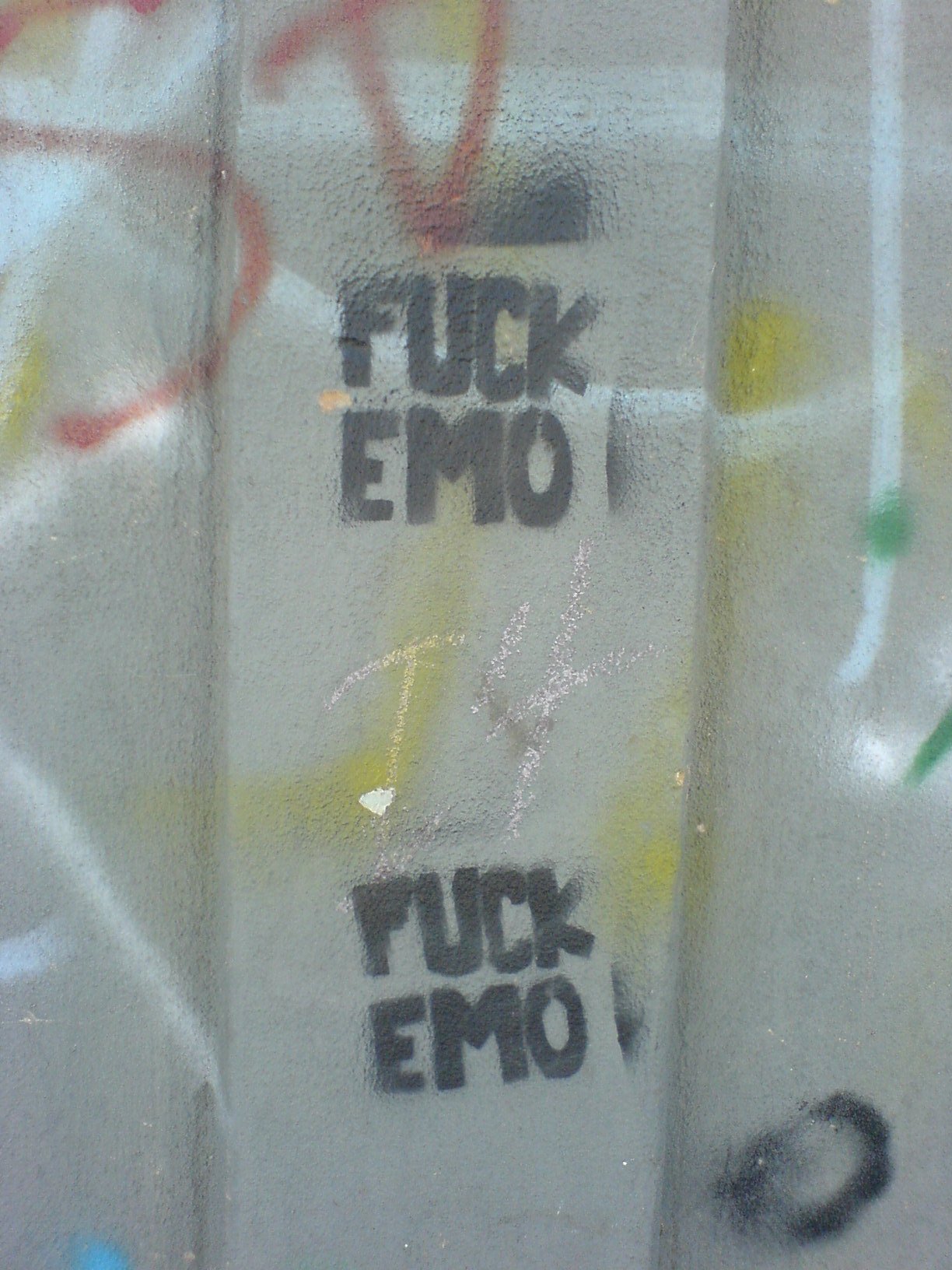
 "Fuck Emo" graffiti on a wall in Mexico.
The genre emo inspired a backlash movement in response to its rapid growth. Several bands considered to be "emo" rejected the label for the social stigma and controversy surrounding it.[137][138][139][140] Warped Tour founder Kevin Lyman stated that there was a "real backlash" among bands on the tour towards emo groups, but he dismissed the hostility as "juvenile" in nature.[141] The movement grew with intensity over time. Time reported in 2008 that "anti-emo" groups attacked teenagers in Mexico City, Querétaro, and Tijuana.[142][143] In Russia, a law was presented at the Duma to regulate emo websites and forbid emo style at schools and government buildings, for fears of emo being a "dangerous teen trend" promoting anti-social behaviour, depression, social withdrawal and even suicide.[144][145] In May 2010 in Saudi Arabia, the religious police in the city of Dammam arrested 10 emo girls for allegedly offensive un-Islamic behaviour and dress.[146]
Suicide
Emo music has been blamed for the suicide by hanging of teenager Hannah Bond by both the coroner at the inquest into her death and her mother, Heather Bond, after it was claimed that emo music glamorized suicide and her apparent obsession with My Chemical Romance was said to be linked to her suicide. The inquest heard that she was part of an Internet "emo cult" [147] and her Bebo page contained an image of an 'emo girl' with bloody wrists.[148] It also heard that she had discussed the "glamour" of hanging online[147] and had explained to her parents that her self harming was an "emo initiation ceremony".[148] Heather Bond criticised emo fashion, saying: "There are 'emo' websites that show pink teddies hanging themselves." After the verdict was reported in NME, fans of emo music contacted the magazine to defend against accusations that it promotes self harm and suicide.[149]
References
- ^ a b Greenwald, Andy (2003). Nothing Feels Good: Punk Rock, Teenagers, and Emo. New York: St. Martin's Griffin. p. 12. ISBN 031230863.
- ^ a b c Blush, Steven (2001). American Hardcore: A Tribal History. New York: Feral House. p. 157. ISBN 0-922925-71-7.
- ^ Greenwald, p. 12.
- ^ Greenwald, pp. 12–13.
- ^ Greenwald, p. 13.
- ^ a b c Greenwald, p. 14.
- ^ Azerrad, Michael (2001). Our Band Could Be Your Life: Scenes from the American Indie Underground 1981–1991. New York: Little, Brown and Company. p. 380. ISBN 0316787531.
- ^ Khanna, Vish (February 2007). "Timeline: Ian MacKaye - Out of Step". Exclaim.ca. http://exclaim.ca/articles/timeline.aspx?csid1=107. Retrieved 2009-04-19.
- ^ a b DePasquale, Ron. "Embrace: Biography". Allmusic. http://www.allmusic.com/artist/p12874. Retrieved 2009-04-21.
- ^ a b Popkin, Helen (2006-03-26). "What Exactly Is 'Emo,' Anyway?". MSNBC.com. MSNBC. http://www.msnbc.msn.com/id/11720603/. Retrieved 2009-04-21.
- ^ "emo-core, n". Oxford English Dictionary. Oxford University Press. http://dictionary.oed.com/cgi/entry/00341634?query_type=word&queryword=emo-core&first=1&max_to_show=10&single=1&sort_type=alpha. Retrieved 2009-04-18.
- ^ "emo, n". Oxford English Dictionary. Oxford University Press. http://dictionary.oed.com/cgi/entry/00341633?single=1&query_type=word&queryword=emo&first=1&max_to_show=10. Retrieved 2009-04-18.
- ^ Greenwald, pp. 14–15.
- ^ Greenwald, p. 15.
- ^ Greenwald, pp. 15–17.
- ^ Greenwald, pp. 15–16.
- ^ Greenwald, pp. 17–18. "Fugazi is one of the best and most influential groups of the last thirty years—and yet, despite some opinion to the contrary, they are not an emo band. Fugazi's fan base is too varied, too diffuse—its themes likewise. Fugazi is a living blueprint for a truly committed, punk/DIY artistic life once both the rage and the tears have faded. Making the group, perhaps, an emo doctoral program, but not emo. People have their preconceived ideas crushed by Fugazi, they don't have crushes on its members."
- ^ a b c Greenwald, p. 18.
- ^ a b c d e Greenwald, p. 19.
- ^ a b c Greenwald, p. 20.
- ^ Greenwald, p. 23.
- ^ Greenwald, p. 21.
- ^ a b Greenwald, pp. 21–22.
- ^ Greenwald, pp. 24–25. "24 Hour Revenge Therapy is arguably Jawbreaker's best album, but it is also far and away its most loved".
- ^ Greenwald, pp. 25–26.
- ^ Greenwald, p. 26.
- ^ a b Greenwald, pp. 29–31.
- ^ a b Greenwald, p. 28.
- ^ Greenwald, pp. 28–29.
- ^ Greenwald, p. 30.
- ^ Greenwald, pp. 31–32.
- ^ Greenwald, p. 32. ""[I]n many ways Sunny Day's brilliance was its zeitgeist-seizing debut, physically forcing a regime change in the hearts and minds of fans of underground rock."
- ^ a b Greenwald, p. 33.
- ^ a b Greenwald, pp. 34–35.
- ^ Greenwald, p. 34.
- ^ a b Greenwald, pp. 38–39.
- ^ a b Greenwald, pp. 121–122.
- ^ a b Greenwald, p. 122.
- ^ a b c d e f Rashbaum, Alyssa (2006-03-24). "A Lifetime of Rock". Spin. http://www.spin.com/articles/lifetime-rock. Retrieved 2009-03-28.
- ^ a b Greenwald, p. 80.
- ^ Greenwald, p. 152.
- ^ Greenwald, pp. 35–36.
- ^ Greenwald, p. 36.
- ^ Greenwald, p. 37.
- ^ a b Greenwald, p. 40.
- ^ a b c d Greenwald, p. 51.
- ^ Edwards, Gavin (2001-12-09). "Review: Pinkerton". Rolling Stone. http://www.rollingstone.com/artists/weezer/albums/album/301487/review/6635729/pinkerton. Retrieved 2009-03-23.
- ^ Erlewine, Stephen. "Allmusic: Pinkerton: Overview". Allmusic. http://www.allmusic.com/album/r241030. Retrieved 2007-09-21.
- ^ a b c d Greenwald, p. 50.
- ^ Luerssen, John D. (2004). Rivers' Edge: The Weezer Story. Toronto: ECW Press. p. 206. ISBN 1-55022-619-3.
- ^ Luerssen, p. 137.
- ^ Luerssen, p. 348.
- ^ Greenwald, p. 52.
- ^ Montgomery, James (2004-10-25). "The Argument: Weezer Are the Most Important Band of the Last 10 Years". MTV. http://www.mtv.com/bands/w/weezer/news_feature_102504/. Retrieved 2009-03-23.
- ^ a b c Greenwald, p. 41.
- ^ Greenwald, pp. 46–48.
- ^ Greenwald, pp. 42-44.
- ^ a b Greenwald, p. 42.
- ^ Greenwald, pp. 45–46.
- ^ Greenwald, pp. 99–101.
- ^ Greenwald, p. 44.
- ^ Greenwald, 48.
- ^ a b Greenwald, p. 119.
- ^ a b "The Emo Diaries". Deep Elm Records. http://www.deepelm.com/bands/index_emo.html#anchor1. Retrieved 2009-03-27.
- ^ a b Greenwald, pp. 103–104.
- ^ a b Vanderhoff, Mark. "Review: Clarity". Allmusic. http://www.allmusic.com/album/r396600. Retrieved 2009-03-26.
- ^ a b Greenwald, p. 101.
- ^ Greenwald, pp. 102–205.
- ^ Greenwald, pp. 104–108.
- ^ Greenwald, pp. 126–132.
- ^ a b Greenwald, p. 127.
- ^ "Artist Chart History - New Found Glory: Albums". Billboard charts. http://www.billboard.com/bbcom/retrieve_chart_history.do?model.chartFormatGroupName=Albums&model.vnuArtistId=351721&model.vnuAlbumId=1209750. Retrieved 2009-03-31.
- ^ "Artist Chart History - New Found Glory: Singles". Billboard charts. http://www.billboard.com/bbcom/retrieve_chart_history.do?model.chartFormatGroupName=Singles&model.vnuArtistId=351721&model.vnuAlbumId=1209750. Retrieved 2009-03-31.
- ^ Greenwald, pp. 127–129.
- ^ Greenwald, p. 70.
- ^ Greenwald, pp. 77–78.
- ^ "Heatseekers: Something to Write Home About". Billboard charts. http://www.billboard.com/bbcom/esearch/chart_display.jsp?cfi=294&cfgn=Albums&cfn=Heatseekers&ci=3035794&cdi=7505634&cid=10%2F23%2F1999. Retrieved 2009-03-25.[dead link]
- ^ Greenwald, p. 79.
- ^ a b c Greenwald, p. 81.
- ^ "Artist Chart History - Saves the Day". Billboard charts. http://www.billboard.com/bbcom/retrieve_chart_history.do?model.chartFormatGroupName=Albums&model.vnuArtistId=281258&model.vnuAlbumId=814700. Retrieved 2009-03-26.
- ^ a b Wilson, MacKenzie. "Saves the Day Biography". Allmusic. http://www.allmusic.com/artist/p311722. Retrieved 2009-03-26.
- ^ Greenwald, pp. 81–88.
- ^ a b c "Dashboard Confessional albums chart history". Billboard charts. http://www.billboard.com/bbcom/retrieve_chart_history.do?model.chartFormatGroupName=Albums&model.vnuArtistId=419236&model.vnuAlbumId=1082909. Retrieved 2009-03-23.
- ^ a b c d e Greenwald, p. 68.
- ^ a b "Jimmy Eat World singles chart history". Billboard charts. http://www.billboard.com/bbcom/retrieve_chart_history.do?model.vnuArtistId=147715&model.vnuAlbumId=1085063. Retrieved 2009-03-23.
- ^ Greenwald, p. 94.
- ^ "Dashboard Confessional singles chart history". Billboard charts. http://www.billboard.com/bbcom/retrieve_chart_history.do?model.vnuArtistId=419236&model.vnuAlbumId=1082909. Retrieved 2009-03-23.
- ^ "Artist Biography - Dashboard Confessional". Billboard. http://www.billboard.com/bbcom/bio/index.jsp?pid=419236&aid=1082909. Retrieved 2009-03-23.
- ^ "New Found Glory albums chart history". Billboard charts. http://www.billboard.com/bbcom/retrieve_chart_history.do?model.chartFormatGroupName=Albums&model.vnuArtistId=351721&model.vnuAlbumId=1209750. Retrieved 2009-03-23.
- ^ Greenwald, p. 67.
- ^ Greenwald, p. 88.
- ^ Greenwald, pp. 68–69.
- ^ Greenwald, p. 69.
- ^ Greenwald, pp. 140–141.
- ^ Greenwald, p. 142.
- ^ Greenwald, p. 146.
- ^ Greenwald, pp. 149–150.
- ^ Greewald, pp. 153–155.
- ^ a b c Jason Heller, "Feast of Reason". Denver Westword, June 20, 2002. [1] Access date: June 15, 2008
- ^ a b c d e Explore style: Screamo at Allmusic Music Guide
- ^ "A Day with the Locust", L.A. Weekly, September 18, 2003 [2] Access date: June 19, 2008
- ^ Local Cut, Q&A with Aaron Montaigne. [3] May 14, 2008. Access date: June 11, 2008.
- ^ Ebullition Catalog, Portraits of Past discography. [4] Access date: August 9, 2008.
- ^ "Blood Runs Deep: 23 A hat". Alternative Press. 2008-07-07. p. 126.
- ^ Swing Kids covered "Warsaw"; Justin Pearson discusses Joy Division's influence in an interview on Skatepunk.net, [5] Access date: June 13, 2008
- ^ "Screamo". Jimdero.com. http://www.jimdero.com/OtherWritings/OtherScreamoGW.htm. Retrieved 2011-07-30.
- ^ Mitchell, Jeff (July 26, 2001). "A Screamin' Scene". Iowa State Daily. http://www.iowastatedaily.com/article_7c9f7210-850e-5905-af02-9bcdb2b07f3e.html. Retrieved September 11, 2010.
- ^ info@yellowisthenewpink.com. "Jan, "Yellow is the new pink", 18-04-07". Yellowisthenewpink.com. http://yellowisthenewpink.com/articles_detail.php?idno=21. Retrieved 2011-07-30.
- ^ a b c Grehan, Keith (25 January 2011). "An Emotional Farewell?". Trinity News. WordPress. http://trinitynews.ie/wordpress/archives/2368. Retrieved 11 June 2011.
- ^ a b c d e "Explore: Emo-Pop". Allmusic. Rovi Corporation. http://allmusic.com/explore/style/emo-pop-d13770. Retrieved 10 June 2011.
- ^ Lester, Paul (8 December 2008). "New band of the day - No 445: Metro Station". The Guardian. http://www.guardian.co.uk/music/2008/dec/08/new-band-metro-station. Retrieved 10 June 2011. "They peddle "emo-pop", a sort of cross between saccharine boy-band pop and whatever it is that bands like Panic! at the Disco and Fall Out Boy do – emo, let's be frank."
- ^ a b Piero Scaruffi (2010). "The History of Rock Music: 1990-1999". http://www.scaruffi.com/history/cpt515.pdf.
- ^ SPIN Mobile (23 February 2011). "Weezer Reveal 'Pinkerton' Reissue Details". Spin Magazine. http://m.spin.com/entry/view/id/1/pn/all/p/0/?KSID=44d36181b28adf4a07ea253efa89940a. Retrieved 11 June 2011.
- ^ a b c Kieper, Nicole (October 2001). "Sense Field: Tonight and Forever - Nettwerk America". CMJ New Music Monthly. CMJ Network. http://books.google.com/books?id=rCoEAAAAMBAJ&pg=PA103&lpg=PA103&dq=%22emo+pop%22+techniques&source=bl&ots=i4UzABKAc8&sig=mzxcOhZAGV1bSnOXKGS3yNFaGdM&hl=en&ei=_EnyTfi8JozUgQeWnbjCCw&sa=X&oi=book_result&ct=result&resnum=7&ved=0CDcQ6AEwBjgU#v=onepage&q&f=false. Retrieved 10 June 2011.
- ^ Piero Scaruffi (2003). "The History of Rock Music. Alkaline Trio: biography, discography, reviews, links". The History of Rock Music. Piero Scaruffi. http://www.scaruffi.com/vol7/alkaline.html. Retrieved 11 June 2011.
- ^ Butler, Blake; Vladimir Bogdanov, Chris Woodstra, Stephen Thomas Erlewine (2002). "Four Minute Mile". All music guide to rock: the definitive guide to rock, pop, and soul. Hal Leonard Corporation. p. 462. http://books.google.com/books?id=1-pH4i3jXvAC&pg=PA462&lpg=PA462&dq=%22emo+pop%22+techniques&source=bl&ots=XIcUKOxXNR&sig=xEPVvZZU06X1AoUWJmfQpoIh2K8&hl=en&ei=_EnyTfi8JozUgQeWnbjCCw&sa=X&oi=book_result&ct=result&resnum=3&ved=0CCkQ6AEwAjgU#v=onepage&q&f=false. Retrieved 10 June 2011.
- ^ Piero Scaruffi. "Wrens: biography, discography, reviews, links". The History of Rock Music. Piero Scaruffi. http://www.scaruffi.com/vol5/wrens.html. Retrieved 10 June 2011.
- ^ Loftus, Johnny. "Fall Out Boy". Allmusic. Rovi Corporation. http://www.allmusic.com/artist/fall-out-boy-p533936. Retrieved 10 June 2011.
- ^ Futterman, Erica. "Fall Out Boy Biography". Rolling Stone Magazine. http://www.rollingstone.com/music/artists/fall-out-boy/biography. Retrieved 10 June 2011.
- ^ a b Sendra, Tim. "Take It to the Floor". Allmusic. Rovi Corporation. http://allmusic.com/album/take-it-to-the-floor-r1471616/review. Retrieved 11 June 2011.
- ^ "Emo Culture - Why The Long Fringe?". Nightline (3news): Event occurs at 1:17–1:22. 2006-07-05. http://www.3news.co.nz/TVShows/Nightline/Archive/tabid/227/articleID/10701/cat/17/Default.aspx#video.
- ^ "Knot Magazine – "In Defense of Emo"". Knotmag.com. http://www.knotmag.com/?article=885. Retrieved 2011-07-30.
- ^ Incendiary Magazine – "EMO: What Is It?"
- ^ "Label it. .. emo". gURL. iVillage Inc. http://www.gurl.com/findout/label/pages/0,,673303,00.html. Retrieved 2007-03-11.
- ^ Poretta, JP (2007-03-03). "Cheer up Emo Kid, It's a Brand New Day". The Fairfield Mirror. http://media.www.fairfieldmirror.com/media/storage/paper148/news/2007/03/08/Entertainment/Cheer.Up.Emo.Kid.Its.A.Brand.New.Day-2762635.shtml. Retrieved 2007-03-08.
- ^ "Geek chic look is clean cut". The.honoluluadvertiser.com. 2002-01-08. http://the.honoluluadvertiser.com/article/2002/Jan/08/il/il01a.html. Retrieved 2011-07-30.
- ^ La Gorce, Tammy (2007-08-14). "Finding Emo". The New York Times. http://www.nytimes.com/2005/08/14/nyregion/nyregionspecial2/14njCOVER.html?pagewanted=1. Retrieved 2007-10-20.
- ^ Bunning, Shane (2006-06-08). "The attack of the clones: an emo-lution in the fashion industry". Newspace, University of Queensland, School of Journalism and Communication.. http://www.newspace.uq.edu.au/modules.php?op=modload&name=News&file=article&sid=288. Retrieved 2007-10-20.
- ^ Stiernberg, Bonnie (2007-03-13). "What is emo?". The Daily illini. http://media.www.dailyillini.com/media/storage/paper736/news/2007/03/13/Diversions/What-Is.Emo-2773568.shtml. Retrieved 2007-10-20.
- ^ Sands, Sarah (August 16, 2006). "EMO cult warning for parents". The Daily Mail. http://www.dailymail.co.uk/pages/live/articles/news/news.html?in_article_id=400953&in_page_id=1770. Retrieved 2007-03-11.
- ^ Walsh, Jeremy (2007-10-18). "Bayside takes Manhattan". Queens Time Ledger. Archived from the original on 2007-10-21. http://web.archive.org/web/20071021003108/http://timesledger.com/site/news.cfm?newsid=18931360&BRD=2676&PAG=461&dept_id=542408&rfi=6. Retrieved 2007-10-20.
- ^ Greenwald, pp. 133–134.
- ^ a b Greenwald, p. 133.
- ^ Greenwald, p. 135.
- ^ Greenwald, pp. 137–138.
- ^ Greenwald, p. 139.
- ^ Allmusic ((( Panic at the Disco > Biography )))
- ^ "Panic! At The Disco declare emo "Bullshit!" The band reject "weak" stereotype". NME. 2006-10-18. http://www.nme.com/news/nme/24758. Retrieved 2008-08-10.
- ^ Brett Sowerby (2007-09-20). "My Chemical Romance talks to The 'Campus". "The Maine Campus". Archived from the original on 2008-06-17. http://web.archive.org/web/20080617220116/http://media.www.mainecampus.com/media/storage/paper322/news/2007/09/20/Style/My.Chemical.Romance.Talks.To.The.campus-2979744.shtml. Retrieved 2008-08-10.
- ^ "Pretty. Odd. : Panic at the Disco : Review". Rolling Stone. http://www.rollingstone.com/reviews/album/19381916/review/19517114/pretty_odd. Retrieved 2011-07-30.
- ^ Matt Diehl (2007). My So-Called Punk. Macmillan. p. 83. ISBN 9780312337810. http://books.google.com/?id=fyXcnhLCZPoC&pg=PT94&dq=emo+music.
- ^ Grillo, Ioan. "Mexico's Emo-Bashing Problem." Time. Thursday March 27, 2008. Retrieved on May 12, 2009.
- ^ "Anti-EMO Attacks in Tijuana". Thedailyswarm.com. 2008-03-29. http://www.thedailyswarm.com/swarm/mexican-emo-war-spreads-border-incidents-juarez-and-tijuana/. Retrieved 2011-07-30.
- ^ "Emo to be made illegal in Russia? New laws planned to stop 'dangerous teen trends'". NME. 2008-07-23. http://www.nme.com/news/my-chemical-romance/38392. Retrieved 2008-09-29.
- ^ Sean Michaels (2008-07-21). "Russia wages war on emo kids". The Guardian. http://www.guardian.co.uk/music/2008/jul/22/russian.emo. Retrieved 2008-09-29.
- ^ ""Saudi 'emo' girls busted by religious cops: report"". Breitbart.com. 2010-05-22. http://www.breitbart.com/article.php?id=CNG.818e03363d37aed733b8e1d6484580c4.8f1&show_article=1. Retrieved 2011-07-30.
- ^ a b Clench, James (2008-05-08). "Suicide of Hannah, the secret 'emo'". The Sun. http://www.thesun.co.uk/sol/homepage/news/article1138968.ece.
- ^ a b "Emo music attacked over teen suicide". NME. 2008-05-08. http://www.nme.com/news/various-artists/36468.
- ^ "Emo fans defend their music against suicide claims". NME. 2008-05-08. http://www.nme.com/news/my-chemical-romance/36480.
Further reading
- Andersen, Mark (2001). Dance of Days, Two Decades of Punk in the Nation's Capitol. Soft Skull Press. ISBN 1-887128-49-2.
External links
 Media related to Emo at Wikimedia Commons
Emo Other topics See also The Emo PortalHardcore punk Styles Christian hardcore · Crossover thrash · Crust punk · D-beat · Deathcore · Digital hardcore · Electronicore · Emo · Grindcore · Hatecore · Melodic hardcore · Metalcore · Nardcore · Nintendocore · Oi! · Post-hardcore · Powerviolence · Punk metal · Queercore · Rapcore · Screamo · Skate punk · Sludge metal · Street punk · Taqwacore · Thrashcore · UK 82 · Youth crewRegional scenes Argentina · Australia · Brazil · Canada · Italy · Greece · Japan · Scandinavia · Yugoslavia
United States: Boston · California · Chicago · Detroit · Minneapolis · New Jersey · New York · Washington, DCOther topics See also: The punk music portalCategories:- Emo
- Hardcore punk
- Music of Washington, D.C.
- Musical subcultures
- Punk genres
- Subcultures
- Words coined in the 1980s
- 2000s in music



Wikimedia Foundation. 2010.
