

- Amniotic band syndrome
-
Amniotic band syndrome Classification and external resources ICD-10 P02.8 ICD-9 762.8 OMIM 217100 DiseasesDB 32457 MedlinePlus 001579 eMedicine orthoped/561 MeSH D000652 Amniotic band syndrome (also known as "ADAM complex,"[1] "Amniotic band sequence,"[1] "Congenital constriction bands,"[1] and "Pseudoainhum"[1]) is a congenital disorder caused by entrapment of fetal parts (usually a limb or digits) in fibrous amniotic bands while in utero.
Contents
Epidemiology
Amniotic banding affects approximately 1 in 1,200 live births. It is also believed to be the cause of 178 in 10,000 miscarriages. Up to 50% of cases have other congenital anomalies including cleft lip, cleft palate, and clubfoot deformity. Hand and finger anomalies occur in up to 80%.
Features
The constriction of appendages by amniotic bands may result in:
- Constriction rings around the digits, arms and legs
- Swelling of the extremities distal to the point of constriction (congenital lymphedema)
- Amputation of digits, arms and legs (congenital amputation)
A strong relationship between ABS and clubfoot exists. A 31.5% of associated clubfoot deformity and ABS can be correlated with 20% occurring bilaterally. Other abnormalities found with ABS include: clubhands, cleft lip, and/or cleft palate, and hemangioma.
Natural history
To explain the cause of ABS, there are two main theories.
The amniotic band theory is that ABS occurs due to a partial rupture of the amniotic sac. This rupture involves only the amnion; the chorion remains intact. Fibrous bands of the ruptured amnion float in the amniotic fluid and can encircle and trap some part of the fetus. Later, as the fetus grows but the bands do not, the bands become constricting. This constriction reduces blood circulation, hence causes congenital abnormalities. In some cases a complete "natural" amputation of a digit(s) or limb may occur before birth or the digit(s) or limbs may be necrotic (dead) and require surgical amputation following birth.
The vascular disruption theory: Because the constricting mechanism of the amniotic band theory does not explain the high incidence of cleft palate and other forms of cleft defects occurring together with ABS, this co-occurrence suggests an "intrinsic" defect of the blood circulation.
Diagnosis

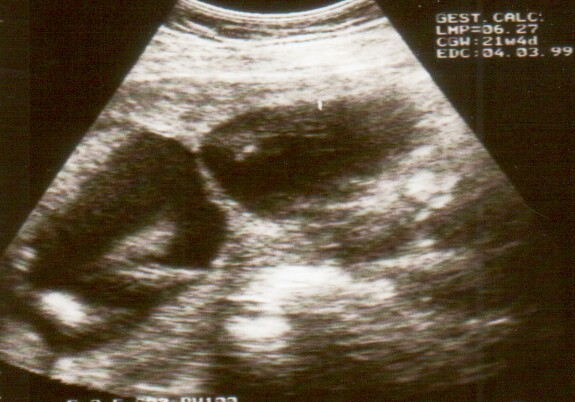
Amniotic band syndrome is often difficult to detect before birth as the individual strands are small and hard to see on ultrasound. Often the bands are detected indirectly because of the constrictions and swelling upon limbs, digits, etc. Misdiagnosis is also common, so if there are any signs of amniotic bands, further detailed ultrasound tests should be done to assess the severity. 3D ultrasound and MRI can be used for more detailed and accurate diagnosis of bands and the resulting damage/danger to the fetus.
Treatment
Treatment usually occurs after birth and where plastic and reconstructive surgery is considered to treat the resulting deformity.[2] Plastic surgery ranges from simple to complex depending on the extent of the deformity. Physical and occupational therapy may be needed long term.
In rare cases, if diagnosed in utero, fetal surgery may be considered to save a limb which is in danger of amputation or other deformity. This typically would not be attempted if neither vital organs nor the umbilical cord are affected. This operation has been able to be successfully performed on fetuses as young as 22 weeks.[3] The surgery took place at Melbourne's Monash Medical Centre in Australia and is believed to be the earliest surgery of its type, as surgeons usually hold off on operating until a mother is at least 28 weeks gestation.[4] There are also several facilities in the United States that have performed successful amniotic band release surgery.
Prognosis
The prognosis depends on the location and severity of the constricting bands. Every case is different and multiple bands may be entangled around the fetus.
Bands which wrap around fingers and toes can result in syndactyly or amputations of the digits. In other instances, bands can wrap around limbs causing restriction of movement resulting in clubbed feet. In more severe cases, the bands can constrict the limb causing decreased blood supply and amputation. Amniotic bands can also sometimes attach to the face or neck causing deformities such as cleft lip and palate. If the bands become wrapped around the head or umbilical cord it can be life threatening for the fetus.
The number of cases of miscarriage that can be contributed to ABS is unknown, although it has been reported that it may be the cause of 178 in 10,000 miscarriages.
Prevention
Amniotic band syndrome is considered an accidental event and it does not appear to be genetic or hereditary, so the likelihood of it occurring in another pregnancy is remote. The cause of amnion tearing is unknown and as such there are no known preventative measures.
See also
References
- ^ a b c d Rapini, Ronald P.; Bolognia, Jean L.; Jorizzo, Joseph L. (2007). Dermatology: 2-Volume Set. St. Louis: Mosby. ISBN 1-4160-2999-0.
- ^ Gabos PG (2006). "Modified technique for the surgical treatment of congenital constriction bands of the arms and legs of infants and children". Orthopedics 29 (5): 401–4. PMID 16729738.
- ^ "Surgeons save unborn baby's legs". News Online (Australian Broadcasting Corporation). 2008-06-08. http://www.abc.net.au/news/stories/2008/06/08/2268374.htm.
- ^ [1]
- Walter JH, Goss LR, Lazzara AT (1998). "Amniotic band syndrome". The Journal of foot and ankle surgery : official publication of the American College of Foot and Ankle Surgeons 37 (4): 325–33. PMID 9710786.
- Light TR, Ogden JA (1993). "Congenital constriction band syndrome. Pathophysiology and treatment". The Yale journal of biology and medicine 66 (3): 143–55. PMC 2588858. PMID 8209551. http://www.pubmedcentral.nih.gov/articlerender.fcgi?tool=pmcentrez&artid=2588858.
External links
- amnioticbandsyndrome.com - Information, Photos, Personal Stories of ABS, Online Community
- UCSF Fetal Treatment Center: Amniotic Band Syndrome
- SuperHands Kids and Heroes Support Group for parents of kids with upper limb differences
- Cincinnati Children's Hospital Fetal Care Center resources- one of the locations that has performed amniotic band release surgery
- Support and information for families dealing with fetal syndromes such as amniotic band syndrome
- Monica - a case study of a young woman born with amniotic band syndrome
Certain conditions originating in the perinatal period / fetal disease (P, 760–779) Maternal factors and
complications of pregnancy,
labour and deliveryLength of gestation
and fetal growthSmall for gestational age/Large for gestational age · Preterm birth/Postmature birth · Intrauterine growth restrictionBirth trauma By system Vitamin K deficiency (Haemorrhagic disease of the newborn)HDN (ABO • Anti-Kell • Rh c • Rh D • Rh E) · Hydrops fetalis · Hyperbilirubinemia (Kernicterus, Neonatal jaundice)Integument and
temperature regulationErythema toxicum · Sclerema neonatorumInfectious Other Categories:- Pathology of pregnancy, childbirth and the puerperium
- Cutaneous congenital anomalies
- Genetic disorders with OMIM but no gene
Wikimedia Foundation. 2010.
