

- Overseas departments and territories of France
-
"Overseas territories of France" redirects here. For the Euro-constituency, see Overseas Territories of France (European Parliament constituency).
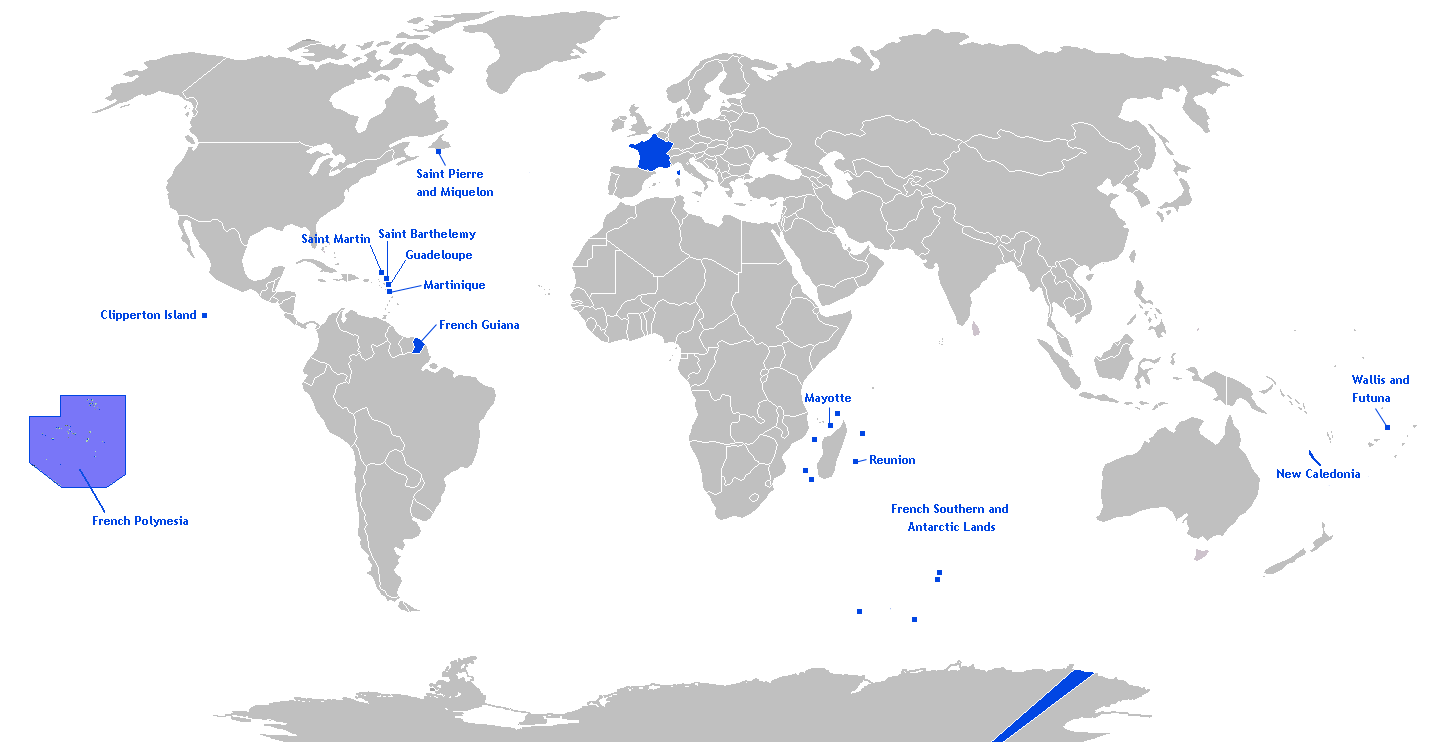
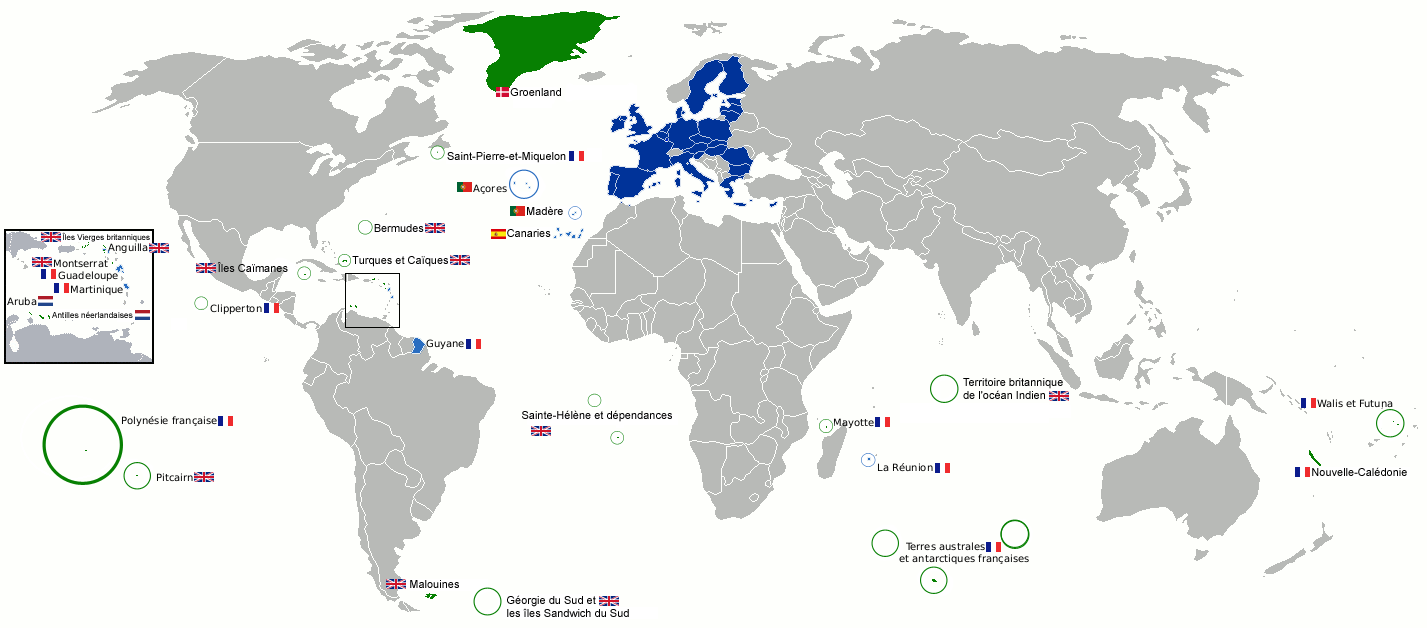
 French overseas departments, territories and claims on Antarctica

This article is part of the series on
Administrative divisions of France(incl. overseas regions)
(incl. overseas departments)
Urban communities
Agglomeration communities
Commune communities
Syndicates of New AgglomerationOthers in Overseas FranceOverseas collectivities
Sui generis collectivity
Overseas country
Overseas territory
Clipperton Island Jack of the Minister of Overseas France
The French Overseas Departments and Territories (French: départements et territoires d'outre-mer, colloquially referred to as the DOM-TOM [dɔmtɔm][1]) consist broadly of French-administered territories outside of the European continent. These territories have varying legal status and different levels of autonomy, although all have representation in the Parliament of France (except those with no permanent inhabitants), and consequently the right to vote in elections to the European Parliament. The French Overseas Departments and Territories include island territories in the Atlantic, Pacific and Indian oceans, French Guiana on the South American coast, and several periantarctic islands as well as a claim in Antarctica. 2,685,705 people lived in the French Overseas Departments and Territories in January 2011.[2]
From a legal and administrative standpoint, departments are very different from territories: according to the French constitution, French laws and regulations generally apply (civil code, penal code, administrative law, social laws, tax laws etc.), in departments as in the mainland. However, specific laws and regulations can be adapted to their specific situation. In territories, the principle is the opposite: territories are governed by autonomy statutes that allow them to make their own laws, except for some specific areas (like defense, international relations, international trade and currency, courts and administrative law), as provided in the autonomy statute, that are reserved to the central government and its local appointee.
Each inhabited French territory, metropolitan or overseas, is represented in both the French National Assembly and the French Senate (which make up the French Parliament). The overseas departments and territories are governed by local elected assemblies and by the French Parliament and French Government (where a cabinet member, the Minister of Overseas France, is in charge of issues related to the overseas departments and territories).
Contents
Varying constitutional statuses
Overseas departments and regions
- Guadeloupe (since 1946)
- Martinique (since 1946)
- French Guiana (since 1946)
- Réunion (since 1946)
- Mayotte (since 2011) 1976–2003: sui generis overseas territory; 2001–2003: with the designation departmental community; 2003–2011: Overseas community. In the 2009 Mahoran status referendum, Mahorans voted to become an overseas department in 2011, which occurred on March 31, 2011.
Overseas collectivities
This category was created with the constitutional reform on 28 March 2003. Each collectivity has its own statutory laws.
- French Polynesia (1946–2003: overseas territory, since 2003: overseas collectivity) Its new status of 2004 gives it the particular designation of overseas country (French: pays d'outre-mer), but the Constitutional Council of France judged that it was just a designation, not a particular status.
- Saint Pierre and Miquelon (1976–85: overseas department, 1985–2003: sui generis overseas territory, since 2003: overseas collectivity) Saint Pierre et Miquelon is still called collectivité territoriale de Saint-Pierre-et-Miquelon).
- Wallis and Futuna (1961–2003: overseas territory, since 2003: overseas collectivity). It is still commonly referred to as a territoire (Territoire des îles Wallis et Futuna).
- St. Martin: In 2003 the populations of St. Martin and St. Barthélemy voted in favour of secession from Guadeloupe in order to form separate overseas collectivities of France.[3] On February 7, 2007, the French Parliament passed a bill granting COM status to both jurisdictions.[4] The new status took effect on 22 February 2007 when the law was published in the Journal Officiel.[5] They remain part of the European Union, as explicitly stated in the Treaty of Lisbon.[6]
- St. Barthélemy (see the comments immediately above)
 The lands making up the French Republic, shown at the same geographic scale.
Special collectivity
- New Caledonia was an overseas territory beginning in 1946, but as a result of the 1998 Nouméa Accord, it gained a special status (statut particulier or statut original) in 1999. A New Caledonian citizenship was established, and a gradual transfer of power from the French state to New Caledonia itself was begun, to last from fifteen to twenty years.[7]
Overseas territories
- French Southern and Antarctic Lands (French: Terres Australes et Antarctiques Françaises; overseas territory of France since 1956). According to law 2007-224 of February 21, 2007, the Scattered Islands constitute the 5th district of TAAF. It is currently the only overseas territory.
Overseas country
The status of overseas country (French: Pays d'outre-mer), projected for French Pacific dependencies, was finally never created. The 2004 status of French Polynesia gives it this designation, but also recalls that it belongs to the category of overseas communities. The Constitutional Council of France confirmed that the designation of overseas country had no legal consequences. Since New Caledonia's status has no name and since its parliament can make local laws, it is sometimes incorrectly termed an overseas country.
Minor territories
- Clipperton Island (French: Île de Clipperton or Île de la Passion) (Spanish: Isla de la Pasión) is a nine-square-kilometre remote coral atoll located 1,280 kilometers south-west of Acapulco, Mexico, in the Pacific Ocean. It is held as state private property under the direct authority of the French government, administered by the Minister of Overseas France.
Political representation in the French Parliament
With 2,685,705 inhabitants in 2011, the French overseas departments and territories account for 4.1% of the population of the French Republic.[2] They enjoy a corresponding representation in the two chambers of the French Parliament.
Representation in the National Assembly
In the 13th Legislature (2007–2012), the French overseas departments and territories are represented by 22 deputies in the French National Assembly, accounting for 3.8% of the 577 deputies in the National Assembly:
- Réunion: 5 deputies
- Guadeloupe: 4 deputies
- Martinique: 4 deputies
- French Guiana: 2 deputies
- French Polynesia: 2 deputies
- New Caledonia: 2 deputies
- Mayotte: 1 deputy
- Saint Pierre and Miquelon: 1 deputy
- Wallis and Futuna: 1 deputy
- Saint Barthélemy: still represented by the deputy of Guadeloupe's 4th constituency, does not have its own deputy yet
- Saint Martin: still represented by the deputy of Guadeloupe's 4th constituency, does not have its own deputy yet
Representation in the Senate
Since September 2008, the French overseas departments and territories are represented by 19 senators in the French Senate, accounting for 5.5% of the 343 senators in the Senate:
- Guadeloupe: 3 senators
- Réunion: 3 senators
- French Guiana: 2 senators
- French Polynesia: 2 senators
- Martinique: 2 senators
- Mayotte: 2 senators
- New Caledonia: 1 senator
- Saint Barthélemy: 1 senator
- Saint Martin: 1 senator
- Saint Pierre and Miquelon: 1 senator
- Wallis and Futuna: 1 senator
List of French Overseas Territories
Inhabited departments and collectivities
The 11 French Overseas Territories are :
Flag Name Capital Population Land area (km2) Status Location Notes 
French Guiana Cayenne 229,000 (Jan. 2009)[8] 83,534 Overseas department / region South America 
French Polynesia Papeete 264,000 (Jan. 2009)[9] 4,167 Overseas collectivity South Pacific Ocean 
Guadeloupe Basse-Terre 404,000 (Jan. 2009)[8] 1,628 Overseas department / region Antilles 
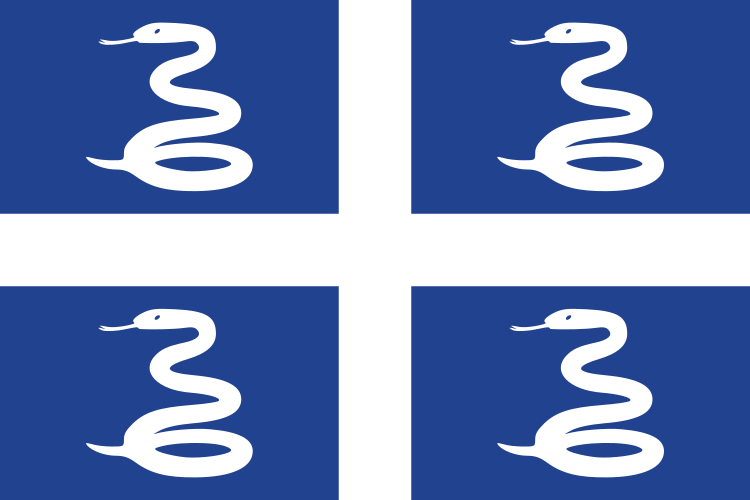
Martinique Fort-de-France 402,000 (Jan. 2009)[8] 1,128 Overseas department / region Antilles 
Mayotte Mamoudzou 186,452 (July 2007)[10] 374 Overseas department / region Africa
(Mozambique Channel)Voted on March 29, 2009 in favour of attaining overseas department / region status. That status became effective on March 31st, 2011.
Also claimed by Comoros
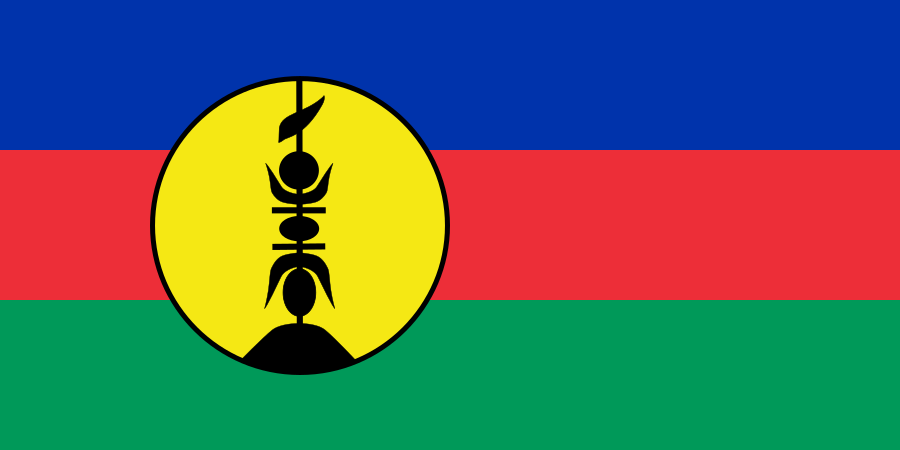
New Caledonia Nouméa 244,410 (Jan. 2008)[11] 18,575 Sui generis collectivity South Pacific Ocean Referendum for independence to occur sometime during the period of 2014 to 2019. 
Réunion Saint-Denis 817,000 (Jan. 2009)[8] 2,512 Overseas department / region Africa
(Indian Ocean)
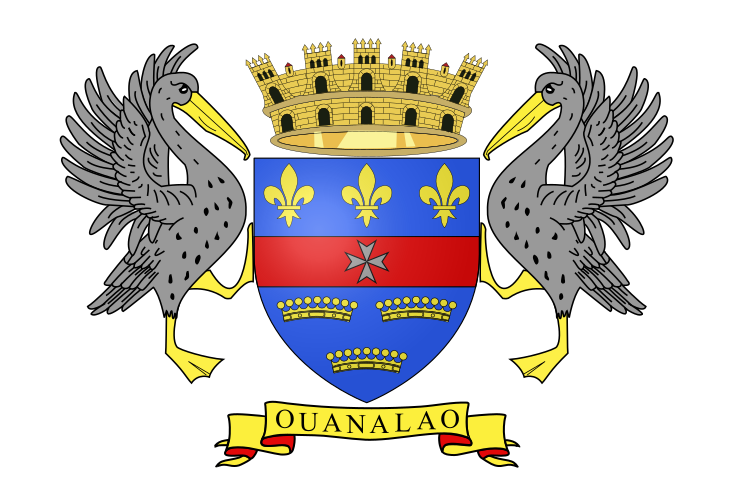
Saint Barthélemy Gustavia 8,450 (Jan. 2007)[12] 21 Overseas collectivity Antilles Detached from Guadeloupe on 22 February 2007. Saint Martin Marigot 35,925 (Jan. 2007)[12] 53 Overseas collectivity Antilles Detached from Guadeloupe on 22 February 2007. 
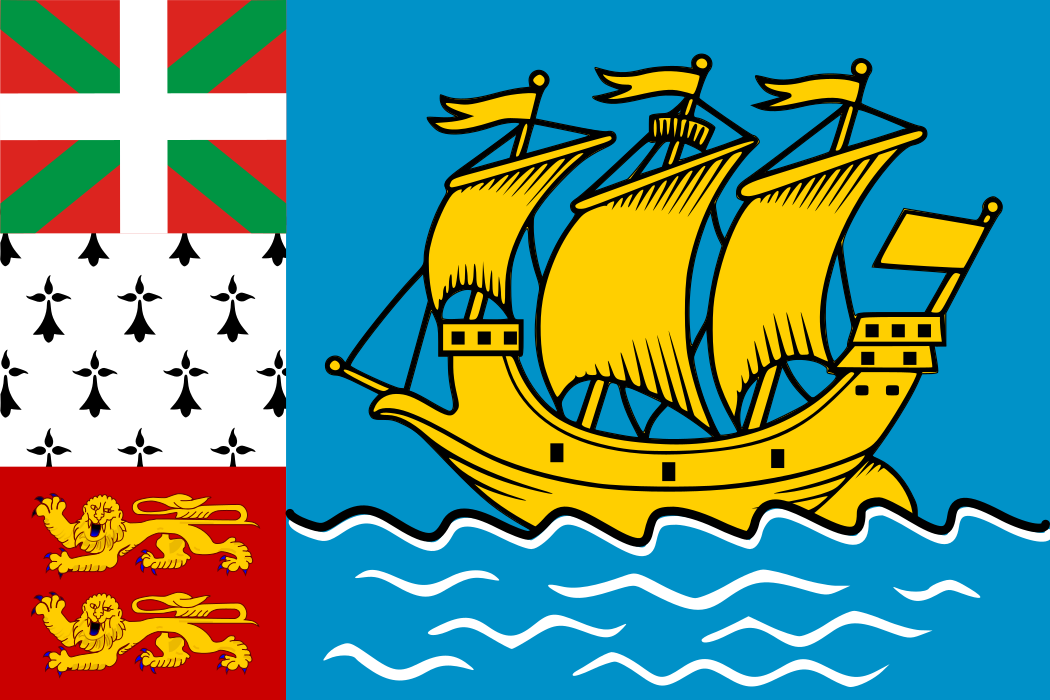
Saint Pierre and Miquelon Saint-Pierre 6,099 (Jan. 2007)[12] 242 Overseas collectivity Southeast of Canada 
Wallis and Futuna Mata-Utu 13,484 (Jul. 2008)[13] 274 Overseas collectivity South Pacific Ocean Overall Summary Status Population (Jan. 2011)[2] Land area (km2) Overseas Departments / Regions 1,890,705 91,847 Overseas Collectivities & New Caledonia 795,000 23,632 Total 2,685,705 120,049 Uninhabited lands
(Lands generally uninhabited, except by researchers in scientific stations)
Flag Name Capital Land area (km2) Status Location Notes 
Banc du Geyser - 1 TAAF district Africa
(Mozambique Channel)Claimed by Madagascar and Comoros Bassas da India - 1 TAAF district Africa
(Mozambique Channel)Claimed by Madagascar Clipperton - 7 French state private property West of Mexico Claimed by Mexico Crozet Islands Alfred Faure 352 TAAF district South Indian Ocean Europa - 28 TAAF district Africa
(Mozambique Channel)Claimed by Madagascar Glorioso Islands - 5 TAAF district Indian Ocean Claimed by Comoros, Madagascar and Seychelles Juan de Nova - 5 TAAF district Africa
(Mozambique Channel)Claimed by Madagascar Kerguelen Islands Port-aux-Français 7,215 TAAF district South Indian Ocean Saint-Paul Island and
Amsterdam IslandMartin-de-Viviès 66 TAAF district Indian Ocean Tromelin Island - 1 TAAF district Indian Ocean Claimed by Mauritius Antarctica
Flag Name Capital Land area (km2) Status Location Notes Adélie Land Dumont d'Urville Station 432,000 TAAF district Antarctica Under terms of Antarctic Treaty System Largest cities in overseas France
Ranked by population in the urban area:
- Pointe-à-Pitre–Les Abymes (Guadeloupe): 178,631 inhabitants (in 2008)
- Saint-Denis (Réunion): 175,053 (in 2008)
- Fort-de-France (Martinique): 171,628 (in 2008)
- Nouméa (New Caledonia): 163,723 (in 2009)
- Saint-Pierre (Réunion): 148,273 (in 2008)
- Papeete (French Polynesia): 131,695 (in 2007)
- Saint-Paul (Réunion): 103,008 (in 2008)
- Cayenne (French Guiana): 102,089 (in 2008)
See also
- French colonial empire
- Administrative divisions of France
- Government of France
- List of islands administered by France in the Indian and Pacific oceans
- Communes in France
- Outremer
- Metropolitan France
- Organisation internationale de la Francophonie
- List of French possessions and colony
References
- ^ About.com, Definition of les DOM-TOM
- ^ a b c INSEE, Government of France. "Bilan démographique 2010". http://www.insee.fr/fr/themes/document.asp?ref_id=ip1332#inter1. Retrieved 2011-01-21. (French)
- ^ "French Caribbean voters reject change". Caribbean Net News. 2003-12-09. http://www.caribbeannetnews.com/2003/12/09/voters.htm. Retrieved 2007-02-09. "However voters on the two tiny French dependencies of Saint-Barthélemy and Saint-Martin, which have been administratively attached to Guadeloupe, approved the referendum and are set to acquire the new status of "overseas collectivity"."
- ^ Magras, Bruno (2007-02-16). "Letter of Information from the Mayor to the residents and non-residents, to the French and to the foreigners, of Saint Barthelemy" (PDF). St. Barth Weekly. p. 2. http://www.st-barths.com/jsb/pdf_files/weekly108.pdf. Retrieved 2007-02-18. "On February 7 of this year, the French Parliament adopted the law granting Saint-Barthélemy the Statute of an Overseas Collectivity."
- ^ "Saint-Barth To Become An Overseas Collectivity" (PDF). St. Barth Weekly. 2007-02-09. p. 2. http://www.st-barths.com/jsb/pdf_files/weekly107.pdf. Retrieved 2007-02-09.
- ^ "Treaty of Lisbon, Article 2, points 287 and 293". http://eur-lex.europa.eu/LexUriServ/LexUriServ.do?uri=OJ:C:2007:306:0042:0133:EN:PDF. Retrieved 2008-01-31.
- ^ "Nouvelle-Calédonie", Le Petit Larousse (2010), Paris, page 1559.
- ^ a b c d INSEE, Government of France. "Population des régions au 1er janvier". http://www.insee.fr/fr/themes/tableau.asp?reg_id=99&ref_id=CMRSOS02137. Retrieved 2010-01-30. (French)
- ^ Institut Statistique de Polynésie Française (ISPF). "Enquêtes & Répertoires > Etat Civil". http://www.ispf.pf/ISPF/EnqRep/EtatCivil.aspx. Retrieved 2009-09-14.
- ^ (French) INSEE, Government of France. "INSEE Infos No 32" (PDF). http://www.insee.fr/fr/insee_regions/reunion/zoom/mayotte/publications/inseeinfos/pdf/insee%20infos%20n32.pdf. Retrieved 2007-12-02.
- ^ (French) Institut de la statistique et des études économiques de Nouvelle-Calédonie (ISEE). "CHIFFRES CLÉS - Démographie" (PDF). http://www.isee.nc/chiffresc/chiffresc.html#d%C3%A9mographie. Retrieved 2009-01-13.
- ^ a b c INSEE, Government of France. "Populations légales 2007 pour les départements et les collectivités d'outre-mer". http://www.insee.fr/fr/ppp/bases-de-donnees/recensement/populations-legales/france-departements.asp?annee=2007. Retrieved 2010-01-30. (French)
- ^ INSEE, Government of France. "Les populations des circonscriptions du Territoire des îles Wallis et Futuna". http://www.insee.fr/fr/themes/detail.asp?ref_id=poplegalescom&page=recensement/poplegalescom/popcircwallisetfutuna.htm. Retrieved 2009-01-13. (French)
- Robert Aldrich and John Connell, France's Overseas Frontier, Cambridge University Press, 1992
Further reading
- Frédéric Monera, L'idée de République et la jurisprudence du Conseil constitutionnel - Paris : L.G.D.J., 2004 [1] [2];
External links
- Official site
- past and current developments of France's overseas administrative divisions like pays d'outre-mer (French language)
 Overseas departments and territories of France
Inhabited areas 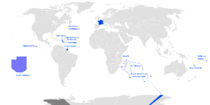 Special status
Uninhabited areas Pacific Ocean French Southern and
Antarctic LandsBanc du Geyser4 · Bassas da India4 · Europa Island4 · Glorioso Islands3, 4, 5 · Juan de Nova Island4 · Tromelin Island4, 51 Also known as overseas regions. 2 Claimed by Comoros. 3 Claimed by Madagascar. 4 Claimed by Seychelles. 5 Claimed by Mauritius. Dependencies of European Union states 
Denmark 
France United Kingdom Anguilla · Bermuda · British Antarctic Territory · British Indian Ocean Territory · British Virgin Islands · Cayman Islands · Falkland Islands · Gibraltar · Montserrat · Pitcairn Islands · Saint Helena, Ascension and Tristan da Cunha · South Georgia and the South Sandwich Islands · Turks and Caicos IslandsCategories:- Overseas departments, collectivities and territories of France
- Subdivisions of France







Wikimedia Foundation. 2010.
