

- Rib
-
This article is about the part of the skeleton. For other uses, see Rib (disambiguation).
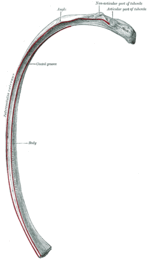 Single human rib-detail
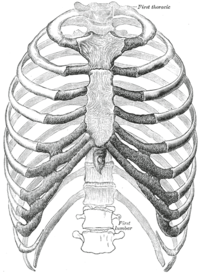 The human rib cage (Source: Gray's Anatomy of the Human Body, 20th ed. 1918)
In vertebrate anatomy, ribs (Latin: costae) are the long curved bones which form the rib cage. In most vertebrates, ribs surround the chest, enabling the lungs to expand and thus facilitate breathing by expanding the chest cavity. They serve to protect the lungs, heart, and other internal organs of the thorax. In some animals, especially snakes, ribs may provide support and protection for the entire body.
Contents
Human anatomy
Main article: Human rib cageHumans have 24 ribs (12 pairs). The first seven sets of ribs, known as "true ribs", are directly attached to the sternum through the costal cartilage. Rib 1 is unique and harder to distinguish from other ribs. It is a short, flat, C-shaped bone. The vertebral attachment can be found just below the neck and the majority of this bone can be found above the level of the clavicle. Ribs 2 through 7 have a more traditional appearance.[1] The following five sets are known as "false ribs", three of these sharing a common cartilaginous connection to the sternum, while the last two (eleventh and twelfth ribs) are termed floating ribs (costae fluitantes) or vertebral ribs. They are attached to the vertebrae only, and not to the sternum or cartilage coming off of the sternum. Some people are missing one of the two pairs of floating ribs, while others have a third pair. Rib removal is the surgical excision of ribs for therapeutic or cosmetic reasons.
In general, human ribs increase in length from ribs 1 through 7 and decrease in length again through rib 12. Along with this change in size, the ribs become progressively oblique (slanted) from ribs 1 through 9, then less slanted through rib 12.[1]
The ribcage is separated from the lower abdomen by the thoracic diaphragm which controls breathing. When the diaphragm contracts, the thoracic cavity is expanded, reducing intra-thoracic pressure and drawing air into the lungs. This happens through one of two actions (or a mix of the two): when the lower ribs the diaphragm connects to are stabilized by muscles and the central tendon is mobile, when the muscle contracts the central tendon is drawn down, compressing the cavity underneath and expanding the thoracic cavity downward. When the central tendon is stabilized and the lower ribs are mobile, a contraction of the diaphragm elevates the ribs, which works in conjunction with other muscles to expand the thoracic cavity upward.
In animals
 Skeleton of a dog showing the location of the ribs
 Ribcage of Myotis lucifugus (Little Brown Bat)
In fish, there are often two sets of ribs attached to the vertebral column. One set, the dorsal ribs, are found in the dividing septum between the upper and lower parts of the main muscle segments, projecting roughly sideways from the vertebral column. The second set, of ventral ribs arise from the vertebral column just below the dorsal ribs, and enclose the lower body, often joining at the tips. Not all species possess both types of rib, with the dorsal ribs being most commonly absent. Sharks, for example, have no dorsal ribs, and only very short ventral ribs, while lampreys have no ribs at all. In some teleosts, there may be additional rib-like bones within the muscle mass.[2]
Tetrapods, however, only ever have a single set of ribs which are probably homologous with the dorsal ribs of fishes. In the early tetrapods, every vertebra bore a pair of ribs, although those on the thoracic vertebrae are typically the longest. The sacral ribs were stout and short, since they formed part of the pelvis, connecting the backbone to the hip bones.[2]
In most subsequent forms, many of these early ribs have been lost, and in living amphibians and reptiles, there is great variation in rib structure and number. For example, turtles have only eight pairs of ribs, which are developed into a bony or cartilagenous carapace and plastron, while snakes have numerous ribs running along the full length of their trunk. Frogs typically have no ribs, aside from a sacral pair, which form part of the pelvis.[2]
In birds, ribs are present as distinct bones only on the thoracic region, although small fused ribs are present on the cervical vertebrae. The thoracic ribs of birds possess a wide projection to the rear; this uncinate process is an attachment for the shoulder muscles.[2]
Mammals usually also only have distinct ribs on the thoracic vertebra, although fixed cervical ribs are also present in monotremes. In marsupials and placental mammals, the cervical and lumbar ribs are found only as tiny remnants fused to the vertebrae, where they are referred to as transverse processes. In general, the structure and number of the true ribs in humans is similar to that in other mammals. Unlike reptiles, caudal ribs are never found in mammals.[2]
See also
 X-ray image of human chest, with ribs labelled
- Bone terminology
- Human rib cage
- Rib fracture
- Terms for anatomical location
- Ribs (food)
References
- Clinically Oriented Anatomy, 4th ed. Keith L. Moore and Robert F. Dalley. pp. 62–64
Human regional anatomy (TA A01.1) Head 
Neck Trunk Limbs Lower limb/
(see also leg)General anatomy: systems and organs, regional anatomy, planes and lines, superficial axial anatomy, superficial anatomy of limbs Categories:- Thorax
- Skeletal system


Wikimedia Foundation. 2010.
