

- United States Senate Committee on Armed Services
-
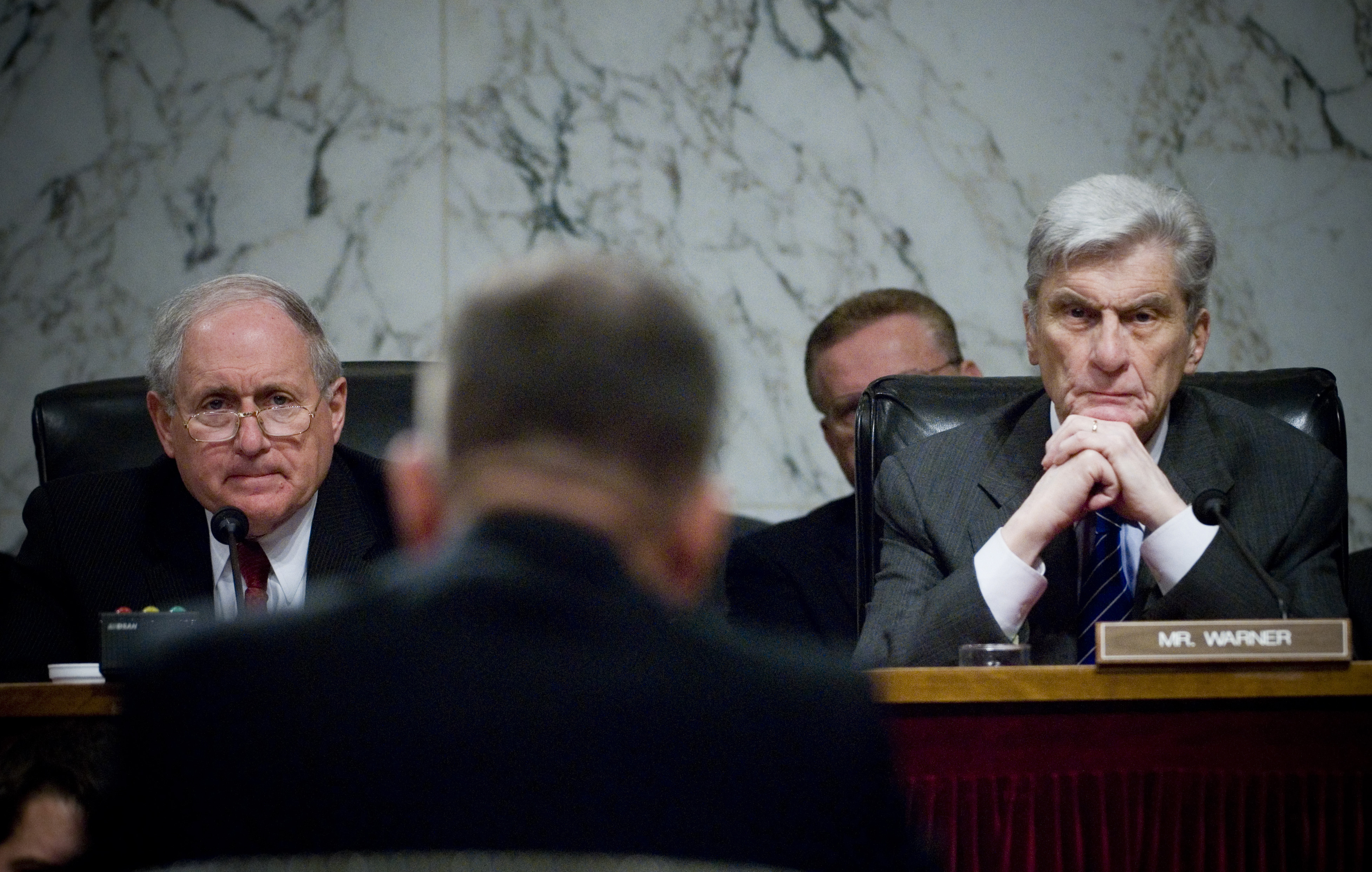
 Committee Chairman Carl Levin (D-MI) and former Chairman John Warner (R-VA) listen to Admiral Mike Mullen's confirmation hearing before the Armed Services Committee to become Chairman of the Joint Chiefs of Staff. The Armed Services Committee is the prime scene of discussion regarding U.S. Military in the Senate.
The Committee on Armed Services is a committee of the United States Senate empowered with legislative oversight of the nation's military, including the Department of Defense, military research and development, nuclear energy (as pertaining to national security), benefits for members of the military, the Selective Service System and other matters related to defense policy. The Armed Services Committee was created as a result of the Legislative Reorganization Act of 1946 following U.S. victory in the Second World War. It merged the responsibilities of the Committee on Naval Affairs (established in 1816) and the Committee on Military Affairs (also established in 1816). Considered one of the most powerful Senate committees, its broad mandate allowed it to report some of the most extensive and revolutionary legislation during the Cold War years, including the National Security Act of 1947. The committee is highly influential.
Contents
Jurisdiction
According to the Senate Rules Committee, all proposed legislation, messages, petitions, memorials, and other matters relating to the following subjects are referred to the Armed Services Committee[1]:
- Aeronautical and space activities pertaining to or primarily associated with the development of weapons systems or military operations.
- Common defense.
- Department of Defense, the Department of the Army, the Department of the Navy, and the Department of the Air Force, generally.
- Maintenance and operation of the Panama Canal, including administration, sanitation, and government of the Canal Zone.
- Military research and development.
- National security aspects of nuclear energy.
- Naval petroleum reserves, except those in Alaska.
- Pay, promotion, retirement, and other benefits and privileges of members of the Armed Forces, including overseas education of civilian and military dependents.
- Selective service system.
- Strategic and critical materials necessary for the common defense.
Members, 112th Congress
The Committee is chaired by Democrat Carl Levin of Michigan, and the Ranking Member is Republican John McCain of Arizona.
 In June 2009, Armed Services Committee senators Joe Lieberman, Carl Levin (chair), and John McCain, listen to Secretary of the Navy Ray Mabus deliver his opening remarks for the fiscal year 2010 budget request.
Majority Minority - Carl Levin, Michigan, Chairman
- Joseph Lieberman, Connecticut[2]
- Jack Reed, Rhode Island
- Daniel Akaka, Hawaii
- Ben Nelson, Nebraska
- Jim Webb, Virginia
- Claire McCaskill, Missouri
- Mark Udall, Colorado
- Kay Hagan, North Carolina
- Mark Begich, Alaska
- Joe Manchin, West Virginia
- Jeanne Shaheen, New Hampshire
- Kirsten Gillibrand, New York
- Richard Blumenthal, Connecticut
- John McCain, Arizona, Ranking Member
- James Inhofe, Oklahoma
- Jeff Sessions, Alabama
- Saxby Chambliss, Georgia
- Roger Wicker, Mississippi
- Scott Brown, Massachusetts
- Rob Portman, Ohio
- Kelly Ayotte, New Hampshire
- Susan Collins, Maine
- Lindsey Graham, South Carolina
- John Cornyn, Texas
- David Vitter, Louisiana
Source: 2011 Congressional Record, Vol. 157, Page S557
Subcommittees
Subcommittee Name Chair Ranking Member Airland Joe Lieberman (I-CT) Scott Brown (R-MA) Emerging Threats and Capabilities Bill Nelson (D-FL) Rob Portman (R-OH) Personnel Jim Webb (D-VA) Lindsey Graham (R-SC) Readiness and Management Support Claire McCaskill (D-MO) Kelly Ayotte (R-NH) SeaPower Jack Reed (D-RI) Roger Wicker (R-MS) Strategic Forces Ben Nelson (D-NE) Jeff Sessions (R-AL) Chairmen
Committee on Military Affairs, 1816-1947
Chairman Party State Years John Williams DR TN 1816–1817 George M. Troup DR GA 1817–1818 John Williams DR TN 1818–1823 Andrew Jackson DR TN 1823–1825 William Henry Harrison NR OH 1825–1828 Thomas Hart Benton D MO 1828–1841 William Preston W SC 1841–1842 John J. Crittenden W KY 1842–1845 Thomas Hart Benton D MO 1845–1849 Jefferson Davis D MS 1849–1851 James Shields D IL 1851–1855 John Weller D CA 1855–1857 Jefferson Davis D MS 1857–1861 Henry Wilson R MA 1861–1872 John A. Logan R IL 1872–1877 George E. Spencer R AL 1877–1879 Theodore Randolph D NJ 1879–1881 John A. Logan R IL 1881–1886 Joseph R. Hawley R CT 1887–1893 Edward Walthall D MS 1893–1895 Joseph R. Hawley R CT 1895–1905 Francis E. Warren R WY 1905–1911 Henry A. du Pont R DE 1911–1913 Joseph F. Johnston D AL 1913 George E. Chamberlain D OR 1913–1919 James W. Wadsworth, Jr. R NY 1919–1927 David A. Reed R PA 1927–1933 Morris Sheppard D TX 1933–1941 Robert R. Reynolds D NC 1941–1945 Elbert Thomas D UT 1945–1947 Chairman Party State Years Charles Tait R GA 1816–1818 Nathan Sanford R NY 1818–1819 James Pleasants R VA 1819–1823 James Lloyd F MA 1823–1825 Robert Y. Hayne D SC 1825–1832 George M. Dallas D PA 1832–1833 Samuel Southard W NJ 1833–1836 William C. Rives D VA 1836–1839 Reuel Williams D ME 1839–1841 Willie P. Mangum W NC 1841–1842 Richard H. Bayard W DE 1842–1845 John Fairfield D ME 1845–1847 David Levy Yulee D FL 1847–1851 William M. Gwin D CA 1851–1855 Stephen Mallory D FL 1855–1861 John P. Hale R NH 1861–1864 James Grimes R IA 1864–1870 Aaron Cragin R NH 1870–1877 Aaron A. Sargent R CA 1877–1879 John R. McPherson D NJ 1879–1881 James Donald Cameron R PA 1881–1893 John R. McPherson D NJ 1893–1895 James Donald Cameron R PA 1895–1897 Eugene Hale R ME 1897–1909 George C. Perkins R CA 1909–1913 Benjamin Tillman D SC 1913–1918 Claude A. Swanson D VA 1918–1919 Carroll S. Page R VT 1919–1923 Frederick Hale R ME 1923–1933 Park Trammell D FL 1933–1937 David I. Walsh D MA 1937–1947 Committee on Armed Services, 1947-present
Chairman Party State Years Chan Gurney Republican South Dakota 1947–1949 Millard E. Tydings Democratic Maryland 1949–1951 Richard B. Russell Democratic Georgia 1951–1953 Leverett Saltonstall Republican Massachusetts 1953–1955 Richard B. Russell Democratic Georgia 1955–1969 John C. Stennis Democratic Mississippi 1969–1981 John Tower Republican Texas 1981–1984 Barry Goldwater Republican Arizona 1985–1987 Sam Nunn Democratic Georgia 1987–1995 Strom Thurmond Republican South Carolina 1995–1999 John Warner Republican Virginia 1999–2001 Carl Levin Democratic Michigan 2001 John Warner Republican Virginia 2001 Carl Levin Democratic Michigan 2001–2003 John Warner Republican Virginia 2003–2007 Carl Levin Democratic Michigan 2007–present See also
Footnotes
External links
- United States Senate Armed Services Committee Website
- Department of Defense
- Armed Forces Retirement Home
- Selected Service System
- Four Torture Memos Released April 16, 2009, in response to FOIA suit by ACLU Senate Armed Services Committee Report on Torture released April 22, 2009.
- Senate Armed Services Committee member profiles at WhoRunsGov at The Washington Post
Leadership - Commander-in-chief: President of the United States
- Secretary of Defense
- Deputy Secretary of Defense
- Joint Chiefs of Staff (Chairman)
- United States Congress: Committees on Armed Services:
- Senate
- House
- Active duty four-star officers
- Highest ranking officers in history
- National Security Act of 1947
- Goldwater–Nichols Act
Organization BranchesReserve componentsStructure - United States Code
- The Pentagon
- Installations
- Budget
- Units:
- Logistics
- Media
Operations and history - Current deployments
- Conflicts
- Wars
- Timeline
- History:
- Colonial
- WWII
- Civil affairs
- African Americans
- Asian Americans
- Jewish Americans
- Sikh Americans
- Historiography:
- Art:
- A
- AF
Personnel TrainingOther- Oath:
- Creeds & Codes:
- Service numbers:
- A
- MC
- N
- AF
- CG
- Military Occupational Specialty/Rating/Air Force Specialty Code
- Pay
- Uniform Code of Military Justice
- Judge Advocate General's Corps
- Military Health System/TRICARE
- Separation
- Veterans Affairs
- Conscription
- Chiefs of Chaplains:
Equipment LandSeaAirOtherLegend: A = Army, MC = Marine Corps, N = Navy, AF = Air Force, CG = Coast Guard, PHS = Public Health Service, NOAA = National Oceanic and Atmospheric Administration, MSC = Military Sealift CommandCategories:- Committees of the United States Senate
- Military of the United States




Wikimedia Foundation. 2010.
