

- Battle of Kursk
-
- Battle of Kursk
- Operation Citadel
Part of the Eastern Front of World War II 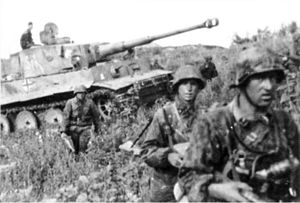
Panzergrenadiers with a Tiger I of the 2nd SS Panzergrenadier Division Das Reich advance through the southern Voronezh FrontDate German offensive phase: 5 – 20 July 1943
Soviet offensive phase: 12 July – 23 August 1943Location Kursk, Russian SFSR, Soviet Union Result Decisive Soviet victory[nb 1][nb 2] Belligerents  Germany
 Soviet Union
Commanders and leaders - Georgy Zhukov
- Konstantin Rokossovsky
- Nikolay Vatutin
- Aleksandr Vasilevsky
- Ivan Konev
Strength 780,900 men[3]
2,928 tanks[3]
9,966 guns and mortars[4]
2,110 aircraft[5][nb 3]1,910,361 men[6][page needed]
5,128 tanks[6][page needed]
25,013 guns and mortars[4]
2,792 aircraft[7][nb 4]Casualties and losses Operation Zitadelle:[nb 5]
54,182 men [nb 6]
323 destroyed[10] tanks and assault guns
159 aircraft[11]
~500 guns[12][page needed]
Battle of Kursk:[nb 7]
203,000 casualties[13]
720 destroyed tanks and assault guns[14]
681 aircraft[15]
guns unknownOperation Zitadelle:[nb 5]
177,847 men[16]
1,614[17] – 1,956[18] tanks and assault guns
459[17] – 1,961[18] aircraft
3,929 guns
Battle of Kursk:[nb 7]
863,303 casualties[nb 8]
6,064 tanks and assault guns[nb 9]
1,626[17] aircraft
5,244 guns[17]Naval warfare
Baltic Sea - Black Sea - Arctic - (Arctic Convoys - Rösselsprung - Wunderland)
1941
Barbarossa - (Białystok and Minsk - Smolensk - Uman - Leningrad - 1st Kiev - Sevastopol - Rostov - Moscow) - Finland - Chechnya
1942
Battles of Rzhev - (Toropets and Kholm - Demyansk - Velikiye Luki - Mars) - 2nd Kharkov - Case Blue - Stalingrad - (Uranus - Winter Storm)
1943
3rd Kharkov - Kursk - 2nd Smolensk - Lower Dnieper - 2nd Kiev
1944
Dnieper and Carpathian - Leningrad and Novgorod - Narva - Hube's Pocket - Crimea - Jassy-Kishinev - Karelia - Bagration - Lvov and Sandomierz - 2nd Jassy-Kishinev - Baltics - Debrecen - Petsamo and Kirkenes - Hungary
1945
Vistula and Oder - East Prussia - East Pomerania - Solstice - Silesia - Vienna - Berlin - Czechoslovakia - German capitulationBattle of Kursk The eastern front at the time of Operation Citadel. Orange areas show the destruction of an earlier Soviet breakthrough that ended with the Kharkov offensive operation. Green areas show German advances on Kursk.
The Battle of Kursk took place when German and Soviet forces confronted each other on the Eastern Front during World War II in the vicinity of the city of Kursk, (450 kilometres / 280 miles south of Moscow) in the Soviet Union in July and August 1943. It remains both the largest series of armored clashes, including the Battle of Prokhorovka, and the costliest single day of aerial warfare in history. It was the final strategic offensive the Germans were able to mount in the east. The resulting decisive Soviet victory gave the Red Army the strategic initiative for the rest of the war.
The Germans hoped to shorten their lines by eliminating the Kursk salient (also known as the Kursk bulge), created in the aftermath of their defeat at the Battle of Stalingrad. They envisioned pincers breaking through its northern and southern flanks to achieve a great encirclement of Red Army forces. The Soviets, however, had intelligence of the German Army's intentions. This and German delays to wait for new weapons, mainly Tiger and Panther tanks,[21][22] gave the Red Army time to construct a series of defense lines and gather large reserve forces for a strategic counterattack.[23]
Advised months in advance that the attack would fall on the neck of the Kursk salient, the Soviets designed a plan to slow, redirect, exhaust, and progressively wear down the powerful German panzer spearheads by forcing them to attack through a vast interconnected web of minefields, pre-sighted artillery fire zones, and concealed anti-tank strong points comprising eight progressively spaced defense lines 250 km deep—more than 10 times as deep as the Maginot Line—and featuring a greater than 1:1 ratio of anti-tank guns to attacking vehicles. By far the most extensive defensive works ever constructed, it proved to be more than three times the depth necessary to contain the furthest extent of the German attack.[24][page needed]
When the German forces had exhausted themselves against the defences, the Soviets responded with counter-offensives, which allowed the Red Army to retake Orel and Belgorod on 5 August and Kharkov on 23 August, and push the Germans back across a broad front.
Although the Red Army had had success in winter, this was the first successful strategic Soviet summer offensive of the war. The model strategic operation earned a place in war college curricula.[nb 10][25][page needed] The Battle of Kursk was the first battle in which a Blitzkrieg offensive had been defeated before it could break through enemy defenses and into its strategic depths.[26]
Contents
Background
In the winter of 1942–43 the Red Army conclusively won the Battle of Stalingrad. About 800,000 German and other Axis troops were lost, including the entire German Sixth Army, seriously depleting Axis strength in the east.
During the months of November, 1942 to February, 1943, the German position in southern Russia became critical. With the encirclement of the German 6th Army at Stalingrad, a huge hole opened up in their lines. Follow-up Soviet forces pushed west, threatening to isolate Army Group A in the Caucasus as well.
German Field Marshal Erich von Manstein was reduced to desperate measures. Divisions were scraped up by thinning nonthreatened sectors. Noncombat personnel were pressed into service, along with tanks in rear area workshops. Ad hoc units were formed which blunted the Soviet advance spearheads.
In due course, the SS Panzer Corps arrived from France, fresh and up to strength. Other mechanized units such as the 11th Panzer Division arrived from Army Group A, along with the 6th and 17th Panzer Divisions. By February 19, enough German armor was concentrated to launch a pincer-style counteroffensive against the overextended Russian forces, notably Armored Group Popov.
The ensuing attack left the front line running roughly from Leningrad in the north to Rostov in the south. In the middle lay a large 200 km (120 mi) wide and 150 km (90 mi) deep Soviet-held salient, or bulge centered round the town of Kursk between German forward positions near Orel in the north, and Kharkov in the south.
The temporary spring thaw now turned the countryside into a muddy quagmire and both sides settled down to plan their next move.
General Manstein initially believed the Kursk salient could be attacked by way of a double-envelopment offensive from the north and south, encircling the Russian troops within the bulge. But by June, with the Red Army fully aware of what was afoot and making ready for it, he opposed the operation, addressing Hitler personally. Manstein believed the German Army in Russia should conserve its manpower and go to the strategic defensive which could be accomplished by a retreat to the Dnieper River, building up the Panzer divisions and using them to deliver sharp counterblows.
Hitler remained uncertain, keeping the option open. He placed considerable faith in the Tiger and Panther tanks going into production. But whereas the Tiger had already proven itself in combat, the newer Panther had an untested quality. Still, Hitler pinned much of his hopes on the new design and delayed the prospective attack until 324 Panthers could be delivered by May 31, according to his armaments minister, Albert Speer.
At the top of the German High Command (OKH), Colonel General Kurt Zeitzler and others did not approve of Manstein's defensive strategy and instead turned their attention to the obvious bulge at Kursk. Two Red Army Fronts, the Voronezh and Central Fronts, occupied the ground in and around the salient and pinching it off would trap almost a fifth of the Red Army's manpower. It would also result in a much straighter and shorter line and recapture the strategically useful railway city of Kursk, located on the main north-south railway line from Rostov to Moscow.
In March, the plans crystallized. Walter Model's 9th Army would attack southwards from Orel while Hermann Hoth's 4th Panzer Army and Army Group Kempf under the overall command of Manstein would attack northwards from Belgorod. They planned to meet at Kursk, but if the offensive went well, they would have permission to continue forward on their own initiative, with a general plan to re-establish a new line at the Don River, several weeks' march to the east.
The German commanders favoring the attack were confident and guided by the facts that the distance to Kursk was short, the attacking forces strong, and the Wehrmacht's history was one of always shattering Soviet front lines where it chose to.
Contrary to his recent behavior, Hitler gave the OKH considerable control over the planning of the operation. Over the next few weeks, they continued to increase the scope of the forces attached to the front, stripping other areas of the German line of anything useful for deployment in the operation. They first set the attack for 4 May, but delayed in order to allow more time for new weapons to arrive from Germany. Hitler postponed the offensive several more times. On 5 May, the launch date became 12 June. Due to the potential threat of an Allied landing in Italy and delays in armor deliveries, Hitler set the launch date to 20 June. On 17 June, he further postponed it until 3 July, and then later to 5 July.[27][nb 11][28]
The concept behind the German offensive was the traditional (and for the Germans usually successful) double-envelopment, or Kesselschlacht (cauldron battle). The German Army had long favored such a Cannae-style method and the tools of Blitzkrieg made these types of tactics even more effective. Blitzkrieg depends upon a mass of armor concentrated at some weak point, followed by rapid breakthroughs where columns of tanks and mechanized infantry penetrate forward and then curve inward toward each other, trapping the enemy forces in between. Essential to such operations is control of the air space so that one's tanks are not subject to aerial bombardment, but those of the enemy are. Upon encirclement of a portion of the opposing force, defeat follows through disruption of command and supply rather than continuation of a pitched battle.
Such breakthroughs were easier to achieve by attacking in unexpected locations, as the Germans had done in the Ardennes in 1940, Kiev in 1941, and towards Stalingrad and the Caucasus in the summer of 1942.
The OKH plan for the attack on the Kursk salient, "Operation Citadel", violated one crucial principle of war: the element of surprise. As the Germans moved in more men and equipment, it became increasingly obvious what was happening.
A number of German commanders questioned the idea, notably Guderian, who asked Hitler:
"Was it really necessary to attack Kursk, and indeed in the east that year at all? Do you think anyone even knows where Kursk is? The entire world doesn't care if we capture Kursk or not. What is the reason that is forcing us to attack this year on Kursk, or even more, on the Eastern Front?"
Perhaps more surprisingly, Hitler replied:
"I know. The thought of it turns my stomach."[29][30]The German force numbered fifty divisions, including 17 Panzer and Panzergrenadier divisions. Among them were the elite Wehrmacht Großdeutschland Division as well as three battle-hardened Waffen-SS divisions; the 1st SS Panzergrenadier Division Leibstandarte SS Adolf Hitler, 2nd SS Panzergrenadier Division Das Reich and the 3rd SS Panzergrenadier Division Totenkopf, which were all grouped into the II SS Panzer Corps.
Soviet plans
 To the West! calls this Soviet poster, while a Soviet soldier destroys the German To the East! sign
The Red Army had also begun planning their summer offensives and had settled on a plan that mirrored that of the Germans. Attacks in front of Orel and Kharkov would flatten the line and potentially lead to a breakout near the Pripyat Marshes.
However, these ideas were abandoned as Moscow received warning of the German build-up through the Lucy spy ring in Switzerland. Additional information came from John Cairncross in the UK who forwarded decoded Lorenz cipher data from Bletchley Park.[31][32] Marshal Georgiy Zhukov had already predicted the site of the German attack as early as 8 April, recommending to Stavka (the Red Army General Staff) a defensive strategy. Anastas Mikoyan wrote in his memoirs that he was notified about the attack in general details by Stalin on 27 March.[33]
The pattern of the war up until this point had been one of German offensive success in spring and summer. Blitzkrieg had worked against all opponents, including the Red Army. On the other hand, Soviet forces had attacked with success only during the winter. Although Joseph Stalin and some Stavka officers were eager to strike first, the majority along with Zhukov advised a more cautious approach. In a letter to Stalin on April 8, 1943 he wrote:
I consider it inadvisable for our forces to go over to the offensive in the very first days of the campaign in order to forestall the enemy. It would be better to make the enemy exhaust himself against our defences, and knock out his tanks and then, bringing up fresh reserves, to go over to the general offensive which would finally finish off his main force.[34]
Hitler delayed the launching of his offensive which gave the Red Army two months in which to turn the salient into one of the most heavily defended areas in history. They evacuated most of their troops from the outer bulge leaving a crust of defending infantry there. But at the base of the bulge on both sides, two fronts, the Central on the north face and Voronezh in the south manned the lines, with Steppe Front in nearby reserve.
To meet the German attack, the Central and Voronezh fronts created several main lines of defense in their sectors. Protecting the infantry in each line were enormous mine belts and anti-tank ditches in front.
The preparation of the battlefield by Red Army military engineers was thorough. Reports indicate 503,993 anti-tank mines and 439,348 anti-personnel mines were laid. On average, 1,500 anti-tank and 1,700 anti-personnel mines were laid per kilometre of front. In the sectors eventually attacked, densities were never lower than 1,400 per kilometre and sometimes reached as high as 2,000 per kilometre.
Further supporting the Soviet infantry were 6,000 76.2mm anti-tank guns which were skillfully camouflaged. Gunners were instructed to concentrate their fire on the more vulnerable Panzer IV tanks which formed a majority of the Panzer division strength. The Russian howitzers, mortars and machinegun posts had as their mission to eliminate German infantry attempting to close in on the anti-tank guns. The density of artillery in the salient was unusual. There were more artillery regiments than infantry regiments. The Red Army was determined to grind down the advancing Panzer formations with artillery and anti-tank obstacles in order to slow, stop, and counterattack them.
Further buttressing the Russian infantry were independent armored brigades. Some of these tanks were dug into hull-down positions and used in a static role.
Waiting in reserve for the Germans if they should breach the Soviet lines was the Steppe Front consisting of 4th and 5th Guards, 27th, 53rd and 57th Armies, and the 5th Guards Tank Army.
The Russians massed some 1,300,000 men, 3,600 tanks, 20,000 artillery pieces, and 2,792 aircraft. This amounted to 26% of the total manpower of the Red Army, 26% of its mortars and artillery, 35% of its aircraft, and 46% of its tanks.[34] The Germans received reports of powerful Soviet concentrations in the Kursk area and delayed the offensive to allow for more Panther tanks to reach the front line.[35]
Many of the Soviet forces assigned to the defense of the salient were recent veterans of the Battle of Stalingrad. But the Red Army also added over one million new men in the first half of 1943. Hence the Red Army was comparatively stronger in 1943, while the German army was smaller.
 Red Army machine gun crew in action
Like the Germans, the Soviets employed numerous deceptions. Dummy positions were constructed. Mock aircraft were placed on false airfields and misleading radio traffic sent to confuse German intelligence. Camouflage for battlefield positions was excellent. Generally, the first warning German units received of the presence of Soviet guns was their own vehicles exploding.
State of the Red Air Force
In the early stages of the war, the Red Air Force, while numerically superior, suffered from an abundance of obsolete designs and insufficient training. Many Soviet pilots learned to fly as civilian members of air clubs set up by the Osoaviakhim.
By 1943, more formal training was introduced and modern aircraft such as the Yakovlev Yak-9 fighter, Petlyakov Pe-2 light bomber and Ilyushin Il-2 ground attack aircraft were available in large numbers.
Consequently, the Red Air Force had greatly improved by the Battle of Kursk, to the point where neither side gained ascendancy in the air.[citation needed] Both German and Russian armored columns suffered from bombing attacks.[citation needed]
Opposing forces
See also: Battle of Kursk order of battleWehrmacht
Order of battle: Army Group Center (Field Marshal Günther von Kluge) Army Commander Note Corps Commander Divisions 9th Army Walter Model XX Army Corps R. von Roman 45th, 72nd, 137th, & 251st Infantry Division XLVI Army Corps H. Zorn 7th, 31st, 102nd,& 258th Infantry Division XLI Army Corps J. Harpe 18th Panzer Division & 86th, & 292nd Infantry Division XLVII Panzer Corps J. Lemelsen 2nd, 9th & 20th Panzer Division & 6th Infantry Division XXIII Army Corps J. Frießner 216th, & 383rd Infantry Division & 78th Sturmdivision Army Reserve 4 & 12th Panzer Division & 10th Panzer Grenadier Division 2nd Panzer Army Erich-Heinrich Clößner XXXV Army Corps L. Rendulic 34th 56th 262nd & 299th Infantry Division LIII Army Corps F. Gollwitzer 208th, 211th & 293rd Infantry Division & 25th Panzer Grenadier Division LV Army Corps E. Jaschke 110th, 134th 296th & 339th Infantry Division Army reserve 112th Infantry Division Army Group Reserve 5th & 8th Panzer Division Order of battle: Army Group South (Field Marshal Erich von Manstein) Army Commander Note Corps Commander Divisions 4th Panzer Army Hermann Hoth LII Army Corps E. Ott 57th, 255th & 332nd Infantry Division XLVIII Panzer Corps Otto von Knobelsdorff 3rd & 11th Panzer Division & 167th Infantry Division und Panzer-Grenadier-Division Großdeutschland II SS Panzer Corps P. Hausser 1st, 2nd & 3rd SS-Panzer Grenadier Division Army Detachment Kempf Werner Kempf III Panzer Corps H. Breith 6th, 7th, & 19th Panzer Division & 168th Infantry Division Korps Raus E. Raus 106th & 320th Infantry Division XLII Army Corps F. Mattenklot 39th, 161st & 282nd Infantry Division Army Group Reserve XXIV. Tank corps 5th SS Panzergrenadier Division & 17th Panzer Division Red Army
Order of battle: Central Front (Army General Konstantin Rokossovsky) Army Commander Note Corps Division 13th Army N. Puchow 17th Guards Rifle Corps 6th, 70th & 75th Guards Rifle Division 18th Guards Rifle Corps 2nd, 3rd & 4th Airborne Guards Rifle Division 15th Rifle Corps 8. 74 & 148. Rifle Division 29th Rifle Corps 15th, 81st & 307th Rifle Division 48th Army P. Romanenko 42nd Rifle Corps 6th, 70th & 75th Guards Rifle Division 73rd Rifle Corps 2nd, 3rd & 4th Airborne Guards Rifle Division 60th Army I. Tschernjachowski 24th Rifle Corps 42nd, & 112th. Rifle Division 30. Rifle Corps 121st, 141st & 322nd Rifle Division Independent 55th Rifle Division 65th Army I. Tschernjachowski 18th Rifle Corps 69th, 149th & 246th Rifle Division 27th Rifle Corps 60th & 193rd Rifle Division Independent 37th Garde Rifle Division & 181st, 194th & 354th Rifle Division 70th Army I. Galanin 28th Rifle Corps 132nd, 211th & 280th Rifle Division Independent 102nd, 106th, 140th & 162nd Rifle Division 2nd Tank Army A. Rodin 3rd Tank Corps 16th Tank Corps Front Assets 9th Tank Corps 19th Tank Corps Order of battle: Voronezh Front (Army General Nikolai Vatutin) Army Commander Note Corps Divisions 6th Guards Army i. Tschistjakow 22nd Guards Rifle Corps 61st, 71st & 90th Guards Rifle Division 23rd Guards Rifle Corps 51st & 52nd Guards Rifle Division & 375th Rifle Division Independent 89th Guards Rifle Division 7th Guards Army M. Schumilow 24th Guards Rifle Corps 15th, 36th & 72nd Guards Rifle Division 25th Guards Rifle Corps 73rd, 78th & 81st Guards Rifle Division Independent 213th Rifle Division 40th Army K. Moskalenko 47th Rifle Corps 161st, 206th & 237th Rifle Division 52nd Rifle Corps 100th, 219th & 309th Rifle Division 69th Army W. Krutschenkin 48th Rifle Corps 107th, 183rd & 307th Rifle Division 49th Rifle Corps 111th & 270th Rifle Division 1st Guards Tank Army M. Katukov 6th Tank Corps 31st Tank Corps 3rd Mechanized Corps Front Assets 35th Guards Rifle Corps 92nd,93rd & 94th Guards Rifle Division Independent 2nd & 3rd Guards Tank Corps Order of battle: Steppe Front (Ivan Konev) Army Commander Note Corps Divisions 5th Guards Army A. Zhadov 32nd Guards Rifle Corps 13th % 66th Guards Rifle Division 6th Airborne Guards Rifle Division 33rd Guards Rifle Corps 95th & 97nd Guards Rifle Division & 9th Airborne Guards Rifle Division Independent 42nd Guards Rifle Division & 10th Tank Corps 5th Guards Tank Army P.Rotmistrov 5th Guards Rifle Corps 29th Tank Corps Strengths, as tallied by David M. Glantz and Karl-Heinz Frieser German offensive phase (Zitadelle) Men Tanks Guns Soviet Ratio German Soviet Ratio German Soviet Ratio German Frieser[nc 1] 1,426,352 2.8:1 518,271 4,938[nc 2] 2:1 2.465 31,415 4:1 7,417 Glantz[nc 3] 1,910,361 2.5:1 780,900 5,128 1.7:1 2,928 For their attack, the Wehrmacht used three armies and a large proportion of their tanks on the eastern front. The 9th Army in the north had 335,000 men (223,000 combat troops), the 4th Panzer Army had 223,907 men (149,271) and Army detachment Kempf had 100,000 men (66,000) for a grand total of 778,907 men (518,271).
The Red Army used two Fronts (Army groups) for the defence and one Front as a reserve. The Central and Voronezh Fronts fielded 12 armies. Central Front had 711,575 men (510,983 combat troops), Voronezh Front had 625,591 men (446,236) and Steppe Front had 573,195 men (449,133) for a grand total of 1,910,361 (1,426,352).
Strengths, as tallied by David M. Glantz and Karl-Heinz Frieser Soviet offensive phase Men Tanks Guns Soviet Ratio German Soviet Ratio German Soviet Ratio German Frieser[nd 1] 1,987,463 3.2:1 625,271 8,200 3:1 2,699[nd 2] 47,416 5:1 9,467 Glantz[nd 3] 2,500,000 2.7:1 940,900 7,360[nd 4] 2.3:1 3,253 When the Red Army launched their counteroffensive in the north, the German 2nd Panzer Army was attacked by two Soviet Fronts: Brijansk and West. The 107,000 men of the 2nd Panzer Army and some reinforcements in the south brought the Wehrmacht troops to approximately to 950,000 men (approximately 650,000 combat troops). The two Soviet Fronts brought the Red Army to 2,629,458 men (1,987,463 combat troops).
Sub-operations and nomenclature
 Battle of Kursk
For Wehrmacht's OKH, the Battle of Kursk was a part of the strategic Operation Citadel Offensive (German: Unternehmen Zitadelle).
For Soviet historians the series of operations conducted as part of the Summer–Autumn Campaign of 1943 (1 July – 31 December) include:[41][verification needed]
- Kursk Strategic Defensive Operation (5–23 July 1943)
- Orel-Kursk Defensive Operation (5–11 July)
- Belgorod-Kursk Defensive Operation (5–23 July)
- Denial air operations over the Kursk Bulge (5–23 July)
- Air superiority operations in Operation Kutuzov
- Orel Strategic Counter-Offensive Operation (codenamed Operation Kutuzov) (12 July – 18 August 1943)
- Volkhov-Orel Offensive Operation (12 July – 18 August)
- Kromy-Orel Offensive Operation (15 July – 18 August)
- Air superiority operations in Operation Rumyantsev
- Belgorod–Kharkov Counter-Offensive Offensive Operation (codenamed Operation Rumyantsev) (3–23 August 1943)
- Belgorod–Bogodukhov Offensive Operation (3–23 August)
- Belgorod–Khar'kov Offensive Operation (3–23 August)
- Battle of Prokhorovka (12 July 1943)
- Zmiyev Offensive Operation (12–23 August)
The exact definition of the operations varies. The Germans saw it only as the Operation Citadel offensive, while the Soviet and Russian historians continue today to combine Citadel and the subsequent Soviet counter-offensives, Operation Kutuzov and Operation Polkovodets Rumyantsev, as a single strategic event.
Preliminaries
Ground
 Waffen-SS soldiers assemble in preparation for the attack
It took four months before Hitler allowed Manstein to attack, by which time the Germans had added 90 Elefant Panzerjägers (the total number produced as such), all 79 flyable Henschel Hs 129 ground attack aircraft,[42] as well as 270 Tigers, late model Panzer Mark-IVs and even a number of captured T-34s.[43] In total, they assembled some 3,000 tanks and assault guns, 2,110 aircraft[5][nb 3] and 435,000 men. It formed one of the greatest concentrations of German fighting power ever put together. Even so, Hitler expressed doubts about its adequacy.[citation needed]
By this time, Allied action in Western Europe was beginning to have a significant impact on German military strength. Although actions in North Africa hardly constituted the Red Army's longed-for second front, the operation there did begin to tell on the Germans, and in the last quarter of 1942 and the first half of 1943, 40% of Luftwaffe losses occurred in the battles over Malta and Tunisia. German air superiority was no longer guaranteed. The Soviet Air Force outnumbered the Luftwaffe and was gaining in technological quality as well. Both air forces possessed very effective ground-attack aircraft types capable of destroying armor: the Soviet Ilyushin Il-2 Shturmovik and the German Junkers Ju 87G (Initially Ju 87D-3/5 with a pair of added Bordkanone 37 mm gunpods).[44][nb 12]
The start date for the offensive had been moved repeatedly as delays in preparation had forced the Germans to postpone the attack. Finally, on 1 July, the orders were issued to attack on 5 July. The following day, Marshal Aleksandr Vasilevsky warned the Front commanders (N. F. Vatutin, Konstantin Rokossovsky and I. S. Konev) that the long-awaited German offensive would begin sometime between 3 and 6 July. For months, the Soviets had been receiving detailed information on the planning of the offensive from the Red Orchestra spy ring (German: Rote Kapelle), and the "Lucy Group" espionage organization, whose sources allegedly included officers in Hermann Göring's aviation ministry and other parts of the Nazi administration.[46]
 Two Tiger tanks and a StuG with infantry
Preliminary fighting started on 4 July 1943 in the south, as 4th Panzer Army elected to try to take Soviet outposts prior to the main assault on 5 July, sacrificing tactical surprise. Nikolai Fyodorovich Vatutin, having received reports that the German offensive was imminent, ordered Voronezh Front to bombard German positions on the night of 4 July.[47]
In the afternoon Stuka dive bombers attacked the Soviet front lines on the north, and then returned to their airfields while the German artillery opened up to continue the pounding. Kempf's armored spearhead, the III Panzer Corps, then advanced on the Soviet positions around Zavidovka. At the same time, the Großdeutschland Division attacked Butovo in torrential rain and the 11th Panzer Division took the high ground around Butovo. To the west of Butovo the going proved tougher for Großdeutschland and the 3rd Panzer Division; they met stiff Soviet resistance and did not secure their objectives until midnight. The II SS Panzer Corps launched preliminary attacks to secure observation posts and again met with strong resistance, until assault troops equipped with flamethrowers cleared the bunkers and outposts.
At 02:30, the Red Army hit back with an artillery bombardment in the north and south. This barrage by over 3,000 guns and mortars expended about half of the artillery ammunition for the entire operation. The goal was to delay and disorganize the German attack. In the northern face, the Central Front artillery fired mostly against German artillery positions and managed to suppress 50 of the 100 German batteries they attacked, resulting in much weaker German artillery fire on the opening day of the attack. This bombardment disrupted German units and caused them to attack at different times on 5 July. In the south, the Red Army chose to fire largely against the German infantry and tanks in their assembly areas. This was partially successful in delaying the German attack but caused few casualties.
Main operations — the northern face
German onslaught
 Tiger I tanks spearhead the assault in the northern sector
The 9th Army's attack in the north fell far short of its objectives on 5 July. The attack sector had been correctly anticipated by the Red Army Central Front. Attacking on a 45 kilometre wide front, the Germans found themselves trapped in the huge defensive minefields and needed engineering units to come up and clear them under artillery fire. Although a few Goliath and Borgward remote-controlled engineering vehicles were available to clear lanes in the minefields, they were not generally successful. Even when the vehicles cleared mines, they had no on-board marking system to show following tanks where the cleared lanes were. Red Army units covered the minefields with small arms and artillery fire, delaying German engineers clearing manually; German losses were high.
For example, the German 653rd Heavy Panzerjäger Battalion began the attack with 49 "Ferdinand" (known in the West as "Elefant") heavy tank destroyers; 37 of them were lost in the minefields before 17:00 on 5 July. Although most of the lost vehicles were mobility kills rather than permanent losses, they were out of action until they could be repaired. They were also easier for Red Army artillery to knock out permanently. However, since the Germans were advancing, any repairable vehicles could be recovered, repaired, and put back into action. After the first day of attack, the German units penetrated 8 km deep into the Russian lines for the loss of 1,287 killed and missing and 5,921 wounded.[48]
The Germans noted a fundamental flaw in their armored vehicles, particularly the Elefant. Although excellent against any Soviet tank at long to medium range, they lacked secondary armament and were vulnerable to attacks from Soviet slit trenches, once they were separated from the heavy machine gun protection of the lighter tanks, vehicles and infantry. Guderian noted in his diary:
Once they had broken through into the enemy's infantry zone they literally had to go quail-shooting with cannons. They did not manage to neutralise, let alone destroy, the enemy's rifle and machine guns, so that our own infantry was unable to follow up behind them. By the time they reached the Soviet artillery they were on their own.[49]
On the second day, the Central Front under Rokossovsky started a counter-attack against the German 9th Army, particularly the XLVI Tank Corps. The Red Army attacked with the 2nd Tank Army and the XIX Tank Corps, but this operational counter-attack was launched too early.[48] Soviet tanks sustained heavy losses in their first combat with Tiger tanks of 505th Heavy Tank Battalion. The 107th and 164th Tank Brigade lost 69 tanks and the Soviet attack was stopped.[50] After the encounter with German Tigers, Rokossovsky decided to dig in most of his tanks and use them as static anti-tank guns.[51]
The next two days of the attack saw heavy fighting around the strong point of Ponyri (on the Orel–Kursk railway), which was one of the most fortified positions in the northern sector. Both sides saw this area as a vital point; a very intense battle took place. The German tanks were awaited by 70 antitank guns per km.[52] On 7 July the 86th and 292nd German Infantry Divisions attacked Ponyri and captured the town after intense house to house fighting. The Soviets counter-attacked and forced the German troops to withdraw temporarily; many counter-attacks by both sides followed and the town changed hands many times. Not before the evening of 8 July did the German units capture most of the town. The heavy Ferdinands were called into action to take Hill 253.5 and succeeded on 9 July. It developed into a battle of attrition with heavy casualties for both sides; Keegan called Ponyri "the new Douaumont".[53] German units were exhausted, while Russian reserves were committed.
Model decided to pause to rearrange his units.[54] On 10 July, he renewed his attack with additional air support, but his gains were minor. Fresh Soviet formations repelled German attacks and only limited penetrations were achieved; the diary of the 9th Army describes the heavy fighting as a "new type of mobile attrition battle".[nb 13] Model canceled the new attack.
The cancellation of the attack changed German plans; Model accepted that his forces did not have enough power to advance directly through the Soviet strongpoints. He decided to bypass the heights of Ol'chovatka and shift the schwerpunkt to XLVI Panzer Corps. He also decided to use the uncommitted 12th Panzer Division. For the first time in the northern sector, a heavy concentration of tanks was planned. Model's hesitation to use the concept of concentration, which is described as the decisive element of an armored attack,[55][page needed] led to a slow advance of the 9th Army. Because of the limited action of the tank units, only 63 tanks and assault guns were written off by 12 July.[56]
Soviet formations, including the 3rd Tank Army and the 11th Guards Army, attacked the German 2nd Panzer Army, positioned in the rear of 9th Army. The outnumbered 2nd Panzer Army had trouble with the Soviet attack. Soviet formations made a deep penetration and threatened German supply routes. With their advance on Orel the encirclement of the 9th Army was possible.[56][57]
The end of Zitadelle in the north
The 9th Army had to withdraw and used an opportunity created for them by the Luftwaffe. Their part in the offensive was over. Because the German armor was not concentrated and used with the same intensity as in the south, the German armor losses were comparatively light — 143 vehicles were total losses between 5 and 14 July.[58] Central Front losses were 526 tanks.[nb 14] This failed to keep up with the steady influx of new soldiers and matériel arriving for the Red Army. Few Red Army guns were captured and those Red Army units that retreated did so on orders. The German attack had nearly broken through the main Soviet defence zones but stalled. The Soviet counter-offensive compelled Model to withdraw or risk the destruction of both German Armies.[59]
Northern analysis
A number of factors explain the 9th Army's lack of progress, mainly the combination of Soviet defensive planning and German lack of concentration of force. German armor was committed piecemeal rather than in strength and often without sufficient infantry support.[60] Soviet defensive preparation was also a major factor. The Central Front under Marshal Rokossovsky had correctly anticipated the likely areas of German attack and had fortified those areas very heavily, holding other areas more thinly. The 13th Army, which bore the brunt of the German attack, was far stronger in men and anti-tank guns than the other Central Front units and held the strongest defensive positions in the salient.
Model's army had fewer tanks than Manstein had in the south and the German 9th Army committed major units piecemeal because Model was afraid of the Bryansk Front, which stood ready for counterattack to the north of his army. Model decided to place his most powerful corps, Gruppe Esebeck (2 Pz. Div and 10 Pz. Gren. Div), far behind the frontline to use it as "fire brigade" against a possible onslaught by the Bryansk Front. Model's decision not to use his Panzer divisions as a concentrated force can be seen as the most significant reason for the poor penetration of the northern pincer.[61] Finally, the 9th Army led with reinforced infantry divisions that were already in the line facing the Red Army, rather than attacking with uncommitted units.
Review of attack frontages and depth of German penetration clearly shows the success of the Red Army defensive tactics. While it began with a 45 km wide attack front on 5 July, the next day the German 9th Army's front was reduced to 40 km. This dropped to 15 km wide by 7 July and to only 2 km on 8–9 July. Each day, the depth of the German advance slowed: 5 km on the first day, 4 on the second, never more than 2 km each succeeding day. By 10 July the 9th Army had been stopped.[62]
Much of the Soviet defensive success is attributable to its method of fire control, known to the Germans as Pakfront. This relied upon a group of 10 or more anti-tank guns under a commander, which would fire at one target at a time. These positions were protected with heavy concentrations of mortar and machine gun nests, which were ordered to fire on German infantry only.[63]
Main operations — the southern face
German attack
 A Waffen-SS Tiger I engages enemy armor. The Tiger's advanced optics and accurate main gun allowed it to hit targets at long range.
Von Manstein's troops in the south were better equipped than Model's in the north. The 4th Panzer Army and Army Group Kempf had 1,377 tanks and assault guns while the 9th Army possessed 988 tanks and assault guns.[64] The 1,377 tanks included 102 Tiger I tanks and 200 Panthers.
The 4th Panzer Army (Hoth) attacked in two directions with the 48th Panzer Corps and the 2nd SS Panzer Corps. The flanks of the spearheads were protected by the 52nd Corps on the left and by Army Group Kempf on the right. The XLVIII Tank Corps was to be the lead spearhead so they were reinforced with 200 Panthers. Their opponent was the Voronezh Front.
At 04:00 the attack began; nearly all units advanced with good speed despite encountering well prepared defensive positions and minefields. Manstein's tanks were much more successful than their northern counterparts. The main reason for this was his better use of tanks in concentrated spearheads.[64] In the south the Red Army had not been able to pinpoint the German attack sectors; this forced them to spread out their defenses evenly. Three of the four armies of the Voronezh Front had about 10 antitank guns per kilometre of front, whereas in the Central Front, guns were distributed twice as heavily in the active sectors. The Voronezh Front made the decision to hold the tactical zone thinly, leaving a higher proportion of units in deeper positions than in the Central Front. The Voronezh Front was weaker than the Central Front, and it faced much stronger German forces.
 The crew of a PzKpfw III tank assigned to the 2nd SS Panzer Division Das Reich, resting after heavy fighting in the southern sector.
The new Panther tanks proved unreliable and failed to perform to expectations. When they moved to their assembly areas, 45 out of 200 new tanks experienced mechanical problems requiring repair.[65] When the remaining Panthers launched their attack, they immediately ran into a minefield and many were immobilised.
In the first two days the 2nd SS Panzer Corps penetrated 25 km into the Russian lines and took Jakovlevo. The 200 Panthers of the 48th Tank Corps to their left spent more time in the workshops than fighting the enemy. Army Group Kempf, which was to assist the 2nd SS Panzer Corps, was outnumbered[clarification needed] and had problems crossing the Donets River.
The steady progress of the German units forced the Russian leaders to commit some of their strategic reserves, as nearly all operational reserves were in action. The Steppe Front had been formed in the months leading up to the operation as a central reserve. As early as 6 July, Stavka decided to send the 2nd and 10th Tank Corps and the 5th Guards Tank Army to the southern sector; a day later, other formations got their marching orders. Vatutin planned an operational counterstrike against the German units but decided to cancel it after the failure of the northern counter-attack. Instead of seeking open battle against the German tanks, Vatutin let his tanks dig in, as Rokossovsky did in the north.[66] Zhukov protested against this use of the tanks but Vatutin's decision stood.
German officers reported that they were slowed down by the "silent tanks" (Schweigepanzer), because it cost much time to overcome these camouflaged "bases".[clarification needed][67] Despite the order to dig in many of their tanks, the Soviet units still had enough tanks to launch some counterattacks. On 7 July a German Tiger I commanded by SS Unterscharführer Franz Staudegger met a group of about 50 T-34s. In the ensuing battle, Staudegger knocked out 22 T-34s; he was the first Tiger commander to be awarded the first Knight's Cross.[68]
The Germans' advance was slowed. On the 9 July the first German units reached the Psel River. The next day the first infantry units crossed the Psel. By 10 July German units in the south had lost 166 tanks. Despite the deep defensive system and minefields, German tank losses were remarkably low.[69] The 11th of July was a successful day for German units; Army Group Kempf achieved a breakthrough and its 3rd Panzer Corps (6th, 7th and 19th Panzer Divisions) penetrated deep into Russian lines. The next night the 6th Panzer Division took a bridge over the Donets with a swift surprise attack.[70] The 3rd Panzer Corps then advanced to Prokhorovka from the south and the 2nd SS Panzer Corps from the west, almost trapping the Russian 69th Army. At this moment Manstein thought the final breakthrough was achieved and now free of the minefields, could operate freely and destroy the Russian armored reserves in the open.[71] The Russians, indeed, began moving their tank reserves toward the spearheads of Army Group South.
Prokhorovka
Main article: Battle of ProkhorovkaAccounts of this battle are controversial. The original Soviet account of a brave but reckless, although ultimately successful, massive Red Army assault on heavy German armor is now generally discounted; the most recent revisionist accounts suggest a Soviet debacle, with the Soviet charge on German armor being disrupted not by German tanks but because many T-34s fell into a Soviet anti-tank ditch.[72]
What is generally not disputed is that the Red Army did enough, at great cost, to stop a German breakthrough. In that sense Prokhorovka remains a crucial turning point of the battle and indeed of the Great Patriotic War: here the German army was stopped.
 Memorial on Prokhorovka Field
On the morning of 12 July, Hoth, determined to push for a breakthrough, collected reserves of the 4th Panzer Army and advanced on Prokhorovka. At the same time the 5th Guards Tank Army launched a series of attacks as part of multi-front counteroffensive in an attempt to catch the Germans off balance. The SS and Guards units collided west of Prokhorovka in country punctuated by farms, rolling hills and gullies.
In stifling heat, an eight-hour battle began. The German units had 494 tanks and self-propelled artillery pieces in the attack, 90% of them operational.[73] The German force found itself heavily outnumbered by the 5th Guards Tank Army, who, moving mainly at night, had brought 593 tanks and 37 self-propelled artillery pieces into position at Stary Oskol.[74] They had not yet been committed to battle, so they were fresh.
The Soviet 31st Guards Tank Corps and the 33rd Guards Rifle Corps fought the 3rd SS Totenkopf to a standstill by getting in close to the German armor and attacking the vulnerable sides of the Tigers. The 2nd SS was soon forced onto the defensive. Although the German formation held, it lost half its armor in a prolonged engagement. By the night of 11–12 July, the only success the Germans had to show for their losses was a captured bridgehead over the Donets river at Rzavets. The 1st SS Division Leibstandarte had been stopped by the Soviet 18th Tank Corps, while the 3rd Panzer Corps and 2nd SS Panzer Division were checked by the 2nd Guards Tank Corps and two other Soviet reserve corps.[75]
The air battle was also intense. Von Manstein had intended it to be the decisive blow against the Red Army forces to prevent a breakthrough to Oboyan and Kursk. Sturmoviks from 291 ShAD attacked the 2nd SS Panzer Division throughout the day, causing significant damage to German armored formations. Simultaneously, waves of Hs 129s and Ju 87s inflicted losses on the 69th Army and 5th Guards Army. Although Soviet tank losses are unknown, a report from the 29th Tank Corps reported "heavy losses in tanks through enemy aircraft and artillery". Losses were so heavy that the advance had to be halted and a switch to the defensive ordered.[76]
The Luftwaffe had complete air superiority over Prokhorovka, due to the VVS being concentrated over the flanks of the 4th Panzer Army.
The battle can best be described as a costly tactical loss but an operational draw for the Red Army. Neither the 5th Guards Tank Army nor the 2nd SS Panzer Corps accomplished their missions that day. After the battle was over, the Soviets held the area and were able to recover their disabled tanks and wounded crews.[77][78]
Tank losses in the battle have been a contentious subject. Red Army losses have been given from 200 to 822 tanks, but the records show about 300 complete losses and as many damaged. German losses have been reported to be as low as 80 and as high as several hundred. The Soviets claim the Germans lost 400 tanks in this battle and 3,500 soldiers killed,[79] but newer research suggest only about 500 lost men and much lower tank losses, with only a few tanks completely destroyed and about 40-80 damaged.[80][81][82][83] In any event, the losses of both the 2nd SS Panzer Corps and the 5th Guards Tank Army in what has been called the greatest tank battle of all time were not of the epic proportions sometimes attributed to the Prokorovka engagement.
The end of Zitadelle in the south
While the German offensive had been stopped in the north by 10 July, in the south the overall situation still hung in the balance, even after 12 July. German forces on the southern wing, exhausted and heavily depleted, had breached the first two defensive belts and believed that they were about to break through the last belt. In fact at least five more defensive zones awaited them, although they were not as strong as the initial belts, and some of them did not have troops deployed. Red Army defenders had been weakened, and major parts of their reserve forces had been committed. Still, the available uncommitted Red Army reserves were far larger than the few available German reserves.
On 16 July, German forces withdrew to their start line. Severely depleted, the Germans then had to face Operation Polkovodets Rumyantsev, an offensive launched to smash the German forces in the Belgorod–Kharkov area on 3 August. Belgorod fell on 5 August, and on 23 August, Kharkov fell, despite fierce resistance from German forces. With the capture of Kharkov, the Soviets considered the Battle of Kursk over.[84]
Southern analysis
The German forces made steady progress, but, as in the north, attack frontage width and penetration depth tended to drop as the attack proceeded. The trend was not as marked as in the north, however. A 30 km wide attack frontage on 5 July became 20 km wide by 7 July and 15 km by 9 July. Likewise, the depth of penetration dropped from 9 km on 5 July to 5 km on 8 July and 2–3 km each day thereafter until the attack was cancelled.
Red Army minefields and artillery were successful in delaying the German attack and inflicting losses. The ability of dug-in Red Army units to delay the Germans allowed their own reserves to be brought up into threatened sectors. Over 90,000 additional mines were laid during the operations by small mobile groups of engineers, generally working at night immediately in front of the expected German attack areas. There were no large-scale captures of prisoners nor any great loss of artillery, indicating that Soviet units were giving ground in good order.
German losses can be seen in the example of the Großdeutschland Division, which began the operation with 118 tanks. On 10 July, after five days of fighting, the division reported it had 3 Tigers, 6 Panthers, and 11 Pzkw-III and Pzkw-IV tanks operational. XLVIII Panzer Corps reported, overall, 38 Panthers operational with 131 awaiting repair, out of the 200 it started with on 5 July.
Hitler cancels the operation
On the night of 9–10 July, the Western Allies mounted an amphibious invasion of Sicily. Three days later, Hitler summoned Günther von Kluge and Erich von Manstein to his Wolfsschanze headquarters in East Prussia and declared his intention to "temporarily" call off Operation Zitadelle. Von Manstein attempted to dissuade him, arguing that Zitadelle was on the brink of victory: "on no account should we let go of the enemy until the mobile reserves which he had committed were decisively beaten". In an unusual reversal of their roles, Hitler gave von Manstein a few more days to continue the offensive, but on 17 July, he ordered a withdrawal and canceled the operation. He then ordered the entire SS Panzer Corps to be transferred to Italy.[85]
Hitler's decision to call off the operation at the height of the tactical battle has since been strongly criticized by German generals in their memoirs,[86] and by some historians.[87] For example, it has been pointed out that the SS Panzer Corps would have taken three months to be transferred to Sicily, and thus could not possibly have affected the outcome there, while its contribution to the Kursk operation was vital.[88][page needed]
Only one German division, the 1st SS Panzer Division Leibstandarte Adolf Hitler, departed for Italy, without their equipment. The remainder stayed to face the Red Army counteroffensive launched in the wake of the failed German offensive.
Reasons for the failure of Zitadelle
Historian Karl-Heinz Frieser points out these reasons for the failure of Operation Zitadelle:
- The Soviets had numerical superiority. Frieser points out that the biggest problem of the OKW was the shortage of infantry. The OKH had no operational reserve while the Red Army could field an entire front (Steppe Front) as reserve. That the Red Army had more tanks than the Wehrmacht had less influence on the outcome according to Frieser.[89][90][91]
- Repeated delays by Hitler gave the Red Army enough time to fortify the bulge around Kursk to an enormous fortress. High officers like Manstein and Zeitzler pushed for a fast attack to catch the Red Army unprepared and low on morale after the third battle of Kharkov. The overlap with the Allied invasion of Sicily made Hitler's date for the attack the "most adverse possible".[92]
Military historian and Soviet military expert David Glantz draws these conclusions:
- The German defeat at Kursk did not come about by the "often-exaggerated numerical superiority" of the Soviet armed forces. The principal factor at Kursk was the revolution in Soviet command, staff, operational and tactical techniques. The General Staff had learned lessons from previous battles and disseminated "war experience" based on "exhaustive" analysis of battles, operations and campaigns. These lessons were added to Soviet doctrine (Soviet deep battle), producing new procedures.[93] Glantz and House have asserted the tank strength was even, between 1:1 and 1.5:1 in the Soviets' favour.[94]
- The Soviets introduced new operational and tactical techniques, and had solved many of the problems of integrating arms and services into "a true combined arms operation". He emphasises "sophisticated understanding of intelligence, deception, and anti-tank defence". Similar improvements were made in the combined use of artillery, tanks, engineers, and infantry to break German defences on a narrow front. At Prokhorovka and in the Kutuzov operations, the Red Army gained experience with mobile armored formations and mechanized corps that became the hallmark of Soviet deep operations. These formations demonstrated their ability to match the best efforts of the German Panzer force. Operations still needed to be perfected to reduce huge casualties. Nevertheless, the German command recognised that at Kursk they faced an entirely new and more competent Red Army.[93][95]
- Defensive tactics had improved. Skillful use of anti-tank artillery in strong points and the use of separate tank brigades, tank regiments and self-propelled gun units to support them offered mobile defence support. These units participated in wearing down tactical attacks against enemy spearheads. The transitional year of 1943 was decisive for the Soviet war effort. Operational and tactical techniques tested and smoothed out in 1943 would be refined further and perfected in 1944 and 1945. "The elementary education the Red Army received in 1941–42 gave way to the secondary education of 1943. In 1944 and 1945 the Soviets would accomplish university-level and graduate study in the conduct of war".[96]
Military expert Steven Zaloga offers these insights about the Red Army at Kursk:
- The popular perception of Soviet victory "by numbers" was a myth created by German generals in their memoirs written in the 1950s. He rejects the caricature of the Red Army relying on mass rather than tactical skill, but accepts that at the tactical end (the platoon and company level), the Red Army was not particularly impressive and received significantly poorer training.[97] Zaloga points out that there were still many tactical lessons to be learned; however by 1943 the gap between Soviet and German tanker training had "narrowed greatly", and the Soviets were soon at a comparable level with the Germans.[98]
- The Soviets, in terms of operational art, were adept at using mobile tank formations.[98] Zaloga asserts that Soviet operational methods were superior, allowing Soviet field commanders to bluff, baffle and overwhelm their opponents.[99]
Historian Richard Overy makes the following interpretations:
- The quality of the two air forces were even. The Soviets had introduced air-to-ground communications, radar, a proper maintenance system, and depots for forward fuel reserves. This allowed aircraft to fly twenty missions in the heat of the battle (while the Luftwaffe suffered shortages).[100][101]
- The Soviets were not inferior in the quality of their tanks. Although the T-34 model (with its 76 mm main gun) was out-ranged by German Tiger I and Panther tanks, it was faster and more manoeuvrable than the Tiger and the latter had too many mechanical difficulties[102] at the Battle of Prokhorovka. To counter the Tiger tank, the Soviets used their tanks in a "hand-to-hand" combat role. Crews were ordered to close the range so that it would not become an issue.[103] According to Glantz and House the Soviet tanks pressed home their initial attacks despite significant German advantages: the range of the German tanks' 88mm gun, German air superiority, and attacking a well dug-in enemy while covering flat rolling terrain. Even so, the loss ratio was less than 2:1, 320 German and 400 Soviet AFVs.[26]
Soviet counterattacks
In the north: Operation Kutuzov
Main article: Operation KutuzovOperation Kutuzov was launched on 12 July against the southern wing of Army Group Centre. The counterattack was launched before the Germans had stopped their attack, so Operation Kutuzov had a bigger effect on the outcome of Zitadelle when compared to the southern counterattack, which was launched after the cancellation of Zitadelle.
The Bryansk Front (commanded by Markian Popov) and parts of the Western Front (commanded by Vasily Sokolovsky) attacked the largely undefended German north flank of the 2nd Panzer Army on 12 July. The 2nd Panzer Army was diminished as many tanks were transferred to other armies before Zitadelle. On 12 July the attacking forces numbered 487,111 combat troops supported by 1,401 tanks and 15,109 guns.[104] Three days later the second phase of Operation Kutuzov started with the attack of the German 9th Army by several Russian armies. The combined troops deployed for Kutuzov now numbered 1,286,049 men supported by 2,409 tanks and 26,379 guns.[105]
The operations of the Bryansk Front marked the beginning of the Russian summer offensive. The artillery barrage was heavy and the first German lines were overrun. German defensive lines were deeper than expected and many Russian spearheads were slowed and sustained heavy casualties,[106] but in some areas the Russian units achieved deep penetrations.[107] The Germans lacked reserves to block these penetrations, so the situation became very dangerous for the 2nd Panzer Army.[107] On 13 July Army Group Centre gave command of the 2nd Panzer Army to Model, who already commanded the German 9th Army. Model now was in control of all German units in the Orel area.
The situation for the Germans worsened as Russian breakthroughs threatened the entire 9th Army. Model sent nearly all of his Panzer units to aid the 2nd Panzer Army whose northern front was about to collapse, while the 4th Army in the north sent the 253rd Infantry Division. German units achieved a temporary stabilization of the front but meanwhile the 9th Army started to withdraw from the captured ground. Initially, the Russian Central Front followed hesitantly, but then started attacking in earnest with heavy air support.[107] On 18 July the 9th Army was at the same position as on 5 July, before the start of Zitadelle.
Russian tank formations failed to achieve an operational breakthrough despite their numerical superiority.[108] Red Army tank armies repeated their attacks against the same positions with the same methods and suffered heavy casualties in men and tanks. For example, the 4th Tank Army lost 84% of their T-34s and 46% of their light tanks within a few days.[109] After two weeks of fighting the 3rd Guards Tank Army had lost half of their 800 tanks.[109] The German armies conducted a fighting withdrawal to Hagen-Stellung.[110]
Organized by the Red Army, approximately 100,000 partisans supported the Russian operations.[111] German movements were hampered by partisans disrupting German supply routes, especially railway lines. On 3 August partisans launched a large operation against the German rear, the so called "Railway-war".
By shortening their line the Wehrmacht freed 19 divisions, which could be used elsewhere or held as reserves.[110] Nevertheless, the Soviets achieved a complete breakthrough. The Soviets massed a concentration of artillery and tanks on small narrow fronts and used sophisticated artillery techniques to defeat German fortified positions despite tenacious German defences. Operation Kutuzov "was a perfect example of the newly sophisticated Soviet way of war".[112] On 5 August the 3rd Guards Tank Army entered Orel and by 18 August, the Bryansk Front had reached the city Bryansk, "completely eliminating the German salient in the region".[112]
The battle was the bloodiest of the three major operations during the Battle of Kursk. The German overall losses were 86,064 men;[110] the Red Army lost 112,529 men and 317,361 were wounded.[113] The losses for the Red Army were particularly high for tanks and assault guns: 2,586 of them were written off during Kutuzov.[114] German tank losses are not available for this battle, but Heeresgruppe Mitte (Army Group Center) lost 343 during both Zitadelle and Kutuzov.[110]
Some of the Soviet commanders were displeased, complaining that an even greater victory might have been won. Marshal Rokossovsky said, "Instead of encircling the enemy, we only pushed them out of the bulge... The operation would have been different if we had used our force for two heavy punches which met at Bryansk". Zhukov held a similar opinion.[115] Stalin instead thought encirclement tactics could wait: "It is our task to push them from our territory. We can trap them when they are weaker".[115]
In the south: Operation Polkovodets Rumyantsev
Main article: Operation Polkovodets Rumyantsev Southern sector of the Battle of Kursk.
To the south the Red Army needed time to regroup after the losses sustained in July, and could not launch another offensive until 3 August, when Operation Polkovodets Rumyantsev commenced. Stavka planned Operation Rumyantsev as the major thrust of their summer offensive. The aim was to destroy Manstein's 4th Panzer Army and Army Group Kempf and later the southern wing of Heeresgruppe Süd (Army Group South). The German 1st Tank Army and newly formed 6th Army were to be trapped by an advance to the Black Sea.[116] The Russian Southern Front and the Southwestern Front attacked as early as 17 July.
The Voronezh Front and the Steppe Front deployed about 1,144,000 men[117] supported by 2,418 tanks[118] and 13,633 guns and rocket launchers[118] for the attack. At the start of "Rumyantsev" the Germans fielded only 237 tanks and assault guns. Manstein believed that the Soviets were incapable of launching an offensive in the southern sector, and dispatched his reserves (II SS Panzer Corps, XXIV Corps and XXXXVIII Panzer Corps) southward to deal with Soviet offensives aimed at the Dnieper and Mius Rivers. The Soviet operations in those regions were actually carefully planned diversion operations. The Soviet plan worked; German reserves were removed from the critical Kharkov axis (conforming to Maskirovka: military deception).[112] The tactical operations across the Mius were unsuccessful, but achieved their primary aim of diverting German forces further away from Kharkov, although by Soviet accounts, the Stavka had wished for more.[119]
For the Kharkov offensive the Red Army focused enormous firepower on a 30 km front. The 5th and 6th Guards Armies, two elements that had borne the brunt of the German offensive, and the Soviet 53rd Army took part. The artillery concentration was necessary to puncture the first five German defence lines between Kursk and Kharkov. The 1st Tank Army and 5th Guards Army, supported by two additional mobile corps, would act as a mobile operational unit to encircle Kharkov from the north and west. To the west, four separate tank corps would support the 27th and 40th Armies would make supporting attacks. To the east and south-east, the 69th and 7th Guards Armies, followed by the 57th Army of the Southwestern Front, would also support the attack.[120]
On 3 August the initial attack demonstrated the growing sophistication of Soviet tactical art. Heavy and long-range artillery bombarded German positions, supported by anti-tank shock groups, ready to repel counter attacks. The German defence was tenacious, and two tank armies had to enter the battle to secure a penetration. By 5 August the Soviets had broken deep into the German rear and captured Belgorod, advancing some 60 km into German lines. Each combined-arms army pressed the German defences from the north and east.[121]
German reserves were rushed from the Orel sector and north from the Donbas regions (where Soviet maskirovka operations had diverted them) and tried to break up Soviet attacks. The only success was achieved by the Grossdeutschland Panzergrenadier Division, which succeeded in delaying the 40th Army from 6–7 August. Four infantry divisions and seven Panzer and motorised divisions were assembled under the III Panzer Corps. Manstein tried to repeat the success of the Third Battle of Kharkov, where the Soviets had been over-extended and defeated. This time the Soviets were alert to the danger, and it was the German forces that were worn down.[122] On 12 August, units of the newly arrived 2nd SS Panzergrenadier Division Das Reich and 3rd SS Panzergrenadier Division Totenkopf started a counterattack against two Soviet Armies near Bogodukhov, 30 km northwest of Kharkov. The Waffen-SS units trapped and annihilated many Soviet units during the following maneuver battles. To assist the 6th Guards Army and the 1st Tank Army, the 5th Guards Tank Army joined the battles. All three Soviet armies suffered heavily and the tank armies lost more than 800 of their initial 1,112 tanks.[123][124] After the counterattack of the two German divisions, the Soviet tank armies were no longer capable of offensive actions.[124] The Soviet advance around Bogodukhov was stopped so the German units now tried to close the gap between Achtryrka and Krasnokutsk. The counterattack started on 18 August and on 20 August Totenkopf and Großdeutschland met behind the Soviet units.[123] Parts of two Soviet armies and two tank corps were trapped, but the trapped units heavily outnumbered the German units. Many Soviet units were able to break out while suffering heavy casualties.[123][125] After this setback the Soviet troops focused on Kharkov and captured it after heavy fighting on 23 August. The battle is usually referred to as the Fourth Battle of Kharkov by the Germans and the Belgorod–Kharkov offensive operation by the Soviets.[126]
Soviet casualties in the Belgorod–Kharkov sector during this operation were 71,611 killed and 183,955 wounded; 1,864 tanks and 423 artillery guns were lost.[113]
German losses were 10,000 killed and 20,000 wounded. German tank losses are estimated at least 8 times lower than Soviet tank losses of 1,864.[127]
Results
 The battlefield grave of Heinz Kühl, a German soldier. The Third Reich did not recover from the losses sustained at Kursk and found itself in a strategic retreat for the remainder of the campaign in the east.
The campaign was a decisive Soviet success. For the first time, a major German offensive had been stopped before achieving a breakthrough. The Germans, despite using more technologically advanced armor than in previous years, were unable to break through the in-depth defenses of the Red Army, and were surprised by the significant operational reserves of the Red Army. This was an outcome that few had predicted, and it changed the pattern of operations on the Eastern Front. The victory had not been cheap; the Red Army, although preventing the Germans from achieving their goals, lost considerably more men and matériel than the Wehrmacht.
With the failure of Zitadelle we have suffered a decisive defeat. The armoured formations, reformed and re-equipped with so much effort, had lost heavily in both men and equipment and would now be unemployable for a long time to come. It was problematical whether they could be rehabilitated in time to defend the Eastern Front... Needless to say the Russians exploited their victory to the full. There were to be no more periods of quiet on the Eastern Front. From now on, the enemy was in undisputed possession of the initiative.[128] — Heinz Guderian
 Prokhorovka Cathedral on the former battlefield commemorates the Red Army losses and victory.
From this point on, a new pattern emerged. The initiative had firmly passed to the Red Army, while the Germans spent the rest of the war reacting rather than attacking. A new front had opened in Italy, diverting some of Germany's resources and attention.[84] Both sides had their losses, but only the Soviets had the manpower and the industrial production to recover fully. The Germans never regained the initiative after Kursk and never again launched a major offensive in the East.
The loss convinced Hitler of the incompetence of his General Staff. His interference in military matters progressively increased, so that by the end of the war he was involved in tactical decisions. The German Army went from loss to loss as Hitler attempted personally to micromanage the day-to-day operations of what soon became a three-front war. The opposite was true for Stalin. After seeing Stavka's planning justified on the battlefield, he trusted his advisors more, and stepped back from operational planning, only rarely overruling military decisions. The Red Army gained more freedom and became more and more fluid as the war continued.
Casualties
German
According to German historian Karl-Heinz Frieser, who interpreted German archives, the Wehrmacht suffered 54,182 casualties in total during Operation Citadel (4–16 July). Of these 9,036 personnel were killed in action, another 1,960 were reported missing in action, and 43,159 wounded in action. The German 9th Army (under the command of Army Group Centre) suffered 23,345 casualties while Army Group South suffered 30,837 casualties.[9]
For Operation Polkovodets Rumyantsev Frieser states between 1–20 August, the Wehrmacht and Waffen SS units suffered 25,068 casualties, including 8,933 killed and missing. For Rumyantzev he estimated ~30,000 men lost with 10,000 killed and missing. For Operation Kutuzov Frieser gives 86,064 casualties with 14,215 killed, 11,300 missing and 60,549 wounded.[129] Total casualties for the Battle of Kursk were ~170,000 men.
According to Frieser, the Wehrmacht lost 252 tanks and assault guns during Operation Zitadelle (until 20 July). Army Group South admitted losses of 161 tanks and 14 assault guns by 16 July. The German Ninth Army reported the loss of 41 tanks and 17 assault guns up to and including the 14 July. Among these were ten Tiger tanks, 42 Panther and 19 "Ferdinand" or "Elefant" heavy tank destroyers. Other losses included 109 Panzer IVs, 38 Panzer IIIs, 3 flame tanks and 31 assault guns.[130]
The number of lost tanks for Zitadelle and the Soviet counter offensives is hard to establish. Frieser gives the number of 1,331 tanks destroyed for the entire Eastern Front for July and August. Frieser estimates the number of tanks destroyed during the Battle of Kursk as 760. Frieser explains that many of these tanks were beyond repair and abandoned.[129]
David Glantz gives a total of 49,822 casualties.[131] Glantz asserts German losses during the Soviet counter offensives are unavailable.[132]
Glantz estimates that 1,612 tanks and assault guns were knocked out and/or damaged, of which 323 were destroyed.[133] Tank losses from counterattacks are uncertain according to Glantz.
Aircraft losses, according to Frieser, totaled 524. For Zitadelle (5–20 July) 159 were lost, while 218 were destroyed during the Soviet Operation Kutuzov and a further 147 during Polkovodets Rumyantsev.[134]
According to Christer Bergström, the Generalquartiermeister der Luftwaffe reported 97 aircraft lost between 5–8 July (Fliegerkorps VIII 58 and Luftflotte 6 39). For the period 5–31 July, Generalquartiermeister der Luftwaffe gives figures of 681 lost from the two air fleets (335 for Fliegerkorps VIII and 346 for Luftflotte 6). Of this total 420 were written off; 192 from Fliegerkorps VIII and 229 from Luftflotte 6.[135]
According to Soviets claims the Red Army smashed thirty German divisions, inflicting the following casualties between 5 July and 23 August 1943: 500,000 dead, wounded, and captured soldiers; 1,500 tanks and 3,700 planes destroyed.[136][137]
Soviet
David Glantz quotes Grigoriy Krivosheyev as the most reliable source. According to Glantz' interpretation of Krivosheev's work, which interpreted Soviet archives, Soviet losses at Kursk during Citadel (known to the Soviets as the Kursk strategic defensive operation, 5–20 July) amounted to 177,874 casualties.[138] The Central Front suffered 15,336 killed and 18,561 sick or wounded for a total of 33,897 casualties. The Voronezh Front suffered 27,542 killed and 46,350 sick or wounded for a total of 73,892 casualties. The Steppe Front suffered 27,452 killed with 42,606 sick or wounded for a total of 70,085 casualties.[139]
Glantz estimates Soviet losses during Operation Kutuzov at 112,529 killed and 317,361 wounded for a total of 429,890 casualties;[133] the Western Front as losing 25,585 killed and 76,856 wounded and sick; the Bryansk Front suffered 39,173 killed and 123,234 wounded and sick. The Central Front lost 47,771 killed and 117,271 wounded and sick.[133] Total casualties for the "Battle of Kursk" were 863,303 men.
The Soviet losses during Operation Polkovodets Rumyantsev (3–23 August), according to Glantz and official Soviet sources, were 255,556 casualties, including 71,611 killed and 183,955 wounded. The Voronzeh Front lost 48,339 killed and 108,954 wounded for a total of 157,293 casualties. The Steppe Front lost 23,272 killed and 75,001 wounded for a total of 98,273 casualties.[133] Soviet material losses for Citadel (5–20 July) amounted to 2,586 tanks and Self-propelled artillery out of 3,925 committed to combat (well over 50 percent). Roughly, this was seven times the number of German losses. The number of losses in the Polkovodets Rumyantsev operation were also heavy. Glantz quotes Krivosheyev's numbers of 1,864 tanks and self-propelled artillery guns out of 2,439 engaged, well over 50 percent. The loss ratio was roughly 5:1 in favor of the Germans.[140]
Frieser also supports Krivosheyev's casualty figures for men and armor.[141]
According to Christer Bergström, Red Air Force losses amounted to 677 on the northern flank and 439 on the southern flank of the bulge during Citadel. In the north, 5–11 July, Soviet losses amounted to 430 destroyed aircraft. The 2nd Air Army suffered 433 casualties in total in the north during July 1943. Total losses for the 17th Air Army were 244 during the same period. Other unit casualties are uncertain. Bergström's research indicates total Soviet air losses were 1,104 between 12 July and 18 August, covering Operations Citadel and Kutuzov.[142]
Notes
- ^ With the final destruction of German forces at Kharkov, the Battle of Kursk came to an end. Having won the strategic initiative, the Red Army advanced along a 2,000 kilometres (1,200 mi) front.[1]
- ^ After Kursk, Germany could not even pretend to hold the strategic initiative in the East.[2]
- ^ a b figures from German archives. Bundesarchiv-Militararchiv, Freiburg; Luftfahrtmuseum, Hannover-Laatzen; WASt Deutsche Dienststelle, Berlin.
- ^ 1,030 of 2. VA, and 611 of 17 VA on the Southern flank, and 1,151 on the Northern sector,[8] figures from Russian archives; Russian aviation trust; Russian Central Military Archive TsAMO, Podolsk; Russian State Military Archive RGVA, Moscow; Monino Air Force Museum, Moscow
- ^ a b Operation Zitadelle means the time of the German attack from 4–16 July, Soviet losses are for the period of 5–23 July
- ^ 9,063 KIA 43,159 WIA 1,960MIA[9]
- ^ a b The whole Battle of Kursk means the time of the German attack and the two Soviet counterattacks from 4 July to 23 August.
- ^ kursk-defence: 177,847; orel-counter: 429,890; belgorod-counter: 255,566[19]
- ^ Kursk-defence; 1,614. Orel-counter; 2,568. Belgorod-counter; 1,864.[20]
- ^ When the week of combat around Kursk had ended, the perceived infallibility of Blitzkrieg was destroyed, along with the hopes of the German Army for victory or even stalemate in the east. Kursk announced to the world that for every offensive theory there is a suitable defensive one available to those who devote enough thought to develop it.
- ^ Source: German Nation Archive microfilm publication T78, Records of the German High Command (Oberkommando der Wehrmacht) Roll 343, Frames 6301178–180 confirms Hitler's teleprinter messages to Rommel about reinforcing southern Italy with armored forces destined to be used for Zitadelle.
- ^ The air operation is misunderstood in most accounts. The German Freya radar stations established in Belgorod and Kharkov in 1943 had only picked up Soviet formations approaching from Belgorod and were not responsible for the failure of the strike.[45]
- ^ KTB AOK9 9 July ( Daily war diary of the 9th Army)[54]
- ^ 651 knocked out tanks, 526 write offs, primary source: CAMO (Ministry of Defence of Russia)[56]
Citations
- ^ Taylor and Kulish 1974, p. 171.
- ^ Glantz & House 1995, p. 175.
- ^ a b Glantz & House 2004, p. 338.
- ^ a b Glantz & House 1995, p. 165.
- ^ a b Bergström 2007, pp. 123–125.
- ^ a b Glantz & House 2004.
- ^ Bergström 2007, pp. 127–128.
- ^ Bergström 2007, p. 21.
- ^ a b Frieser 2007, p. 154.
- ^ Glantz & House, p. 276.
- ^ Frieser 2007, p. 154. Luftflotte 6 45 losses Luftflotte 4 144 losses.
- ^ No numbers available; estimation by Frieser 2007
- ^ Zetterling/Frankson Kursk 1943 pages 117, 116, and endnote 18. For all participating armies in the Kursk area, there were 203,000 casualties for July and August.
- ^ Frieser 2007, p. 201. Exact numbers are unknown; the entire "ostfront" lost 1,331 tanks and assault guns for July and August, so the number of 720 is an estimation.
- ^ Bergström 2008, p. 120: Figures for 5–31 July, as given by the Generalquartiermeister der Luftwaffe.
- ^ Krivosheev Kursk
- ^ a b c d Krivosheev Kursk equipment
- ^ a b Frieser 2007, p. 150.
- ^ Krivosheev p.188-190
- ^ Krivosheev p. 370.
- ^ Dunn 1997, p. p. x.
- ^ Kasdorf, p. 16.
- ^ Glantz 1989, pp. 149–59.
- ^ Keegan 2006.
- ^ Glantz 1986.
- ^ a b Glantz & House 1995, p. 167.
- ^ Kulish & Taylor 1974, p. 170.
- ^ Mulligan 1987, p. 329.
- ^ Clark 1966, p. 275.
- ^ Clark 1966, p. 325.
- ^ http://www.innovationnewsdaily.com/tunny-code-breaker-nazi-secrets-2020/
- ^ http://www.colossus-computer.com/colossus1.html
- ^ "ВОЕННАЯ ЛИТЕРАТУРА -[ Мемуары ]- Микоян А.И. Так было". Militera.lib.ru. http://militera.lib.ru/memo/russian/mikoyan/04.html. Retrieved 2010-08-06.
- ^ a b V.M Kulish & A.J.P Taylor 1974, p. 168.
- ^ Clark 1966, p. 327.
- ^ a b Frieser 2007, p. 100.
- ^ a b Frieser 2007, p. 91.
- ^ Glantz p. 338.
- ^ Glantz & House 2004, p. 346.
- ^ Glantz p. 342.
- ^ Glantz (1990), pp. 82–113
- ^ Bergström 2007, pp. 124–125.
- ^ Töppel 2002, p. 33–34.
- ^ Bergström 2007, pp. 79–81; 102; 106; 114; 118.
- ^ Bergström 2007, pp. 26–27.
- ^ Mulligan 1987, pp. 236, 254.
- ^ Clark 1966, p. 329.
- ^ a b Frieser 2007, p. 108.
- ^ Clark 1966, p. 333.
- ^ Glantz p. 93.
- ^ Rokossovsky p. 266.
- ^ Piekalkiewice, Unternehmen Zitadelle, p. 154.
- ^ Keegan 2006, p. 72.
- ^ a b Frieser 2007, p. 110.
- ^ Guderian, Achtung-Panzer!
- ^ a b c Frieser 2007, p. 111.
- ^ Overy 1995, p. 205.
- ^ Restayn & Moller 2002, pp. 333–336.
- ^ Overy 1995, pp. 204–205.
- ^ Restayn & Moller 2002, p. 333.
- ^ Frieser 2007, p. 107.
- ^ Overy 1995, p. 204.
- ^ Clark 1966, pp. 331–332.
- ^ a b Frieser 2007, p. 112.
- ^ Frieser 2007, p. 113.
- ^ Glantz & House, p. 102.
- ^ Frieser 2007, p. 116.
- ^ Wendt p.18
- ^ Geheime Kommandosache
- ^ Frieser 2007, p. 118.
- ^ Manstein p. 500
- ^ Richard J. Evans, The Third Reich at War, London, Allen Lane, 2008, p. 488.
- ^ Frankson, p. 30.
- ^ Bergström 2007, p. 77.
- ^ Healy 1992, pp. 84–87.
- ^ Bergström 2007, pp. 79–80.
- ^ Clark 1966, p. 337.
- ^ Healy 1992, pp. 76–77.
- ^ "чпеообс мйфетбфхтб -[ чПЕООБС ЙУФПТЙС ]- уБНУПОПЧ б.н. лТБИ ЖБЫЙУФУЛПК БЗТЕУУЙЙ 1939–1945". Militera.lib.ru. http://militera.lib.ru/h/samsonov2/11.html. Retrieved 2010-08-06.
- ^ Bergström 2007, p. 81.
- ^ Dieter Brand Generalmajor a.D : "Vor 60 Jahren: Prochorowka (Teil II)"
- ^ Frieser pp. 130, 132.
- ^ Glantz 1999, p. 275.
- ^ a b Taylor & Kulish 1974, p. 171.
- ^ Clark 1966, pp. 337–38.
- ^ Manstein, Verlorene Siege p. 504.
- ^ Engelmann, Zitadelle p. 5.
- ^ Carell & Osers 1966–1971.
- ^ Frieser 2007, p. 149.
- ^ Krivosheev, p. 188–190.
- ^ Zetterling/Frankson p. 116, 117.
- ^ Magenheimer, die Militärstrategie Deutschlands 1940–1945 p.244
- ^ a b Glantz & House 1995, p. 176.
- ^ Glantz & House 1995, pp. 149–150.
- ^ Glantz 1991, pp. 132–133.
- ^ Glantz 1991, pp. 136–137.
- ^ Zagola 1989, p. 6.
- ^ a b Zagola 1989, p. 18.
- ^ Zagola 1989, p. 7.
- ^ Bergström 2007, pp. 48–49.
- ^ Overy 1995, p. 192.
- ^ Overy 1995, p. 207.
- ^ Overy 1995, pp. 207–209.
- ^ Koltunov, p. 80.
- ^ Koltunov, p. 82.
- ^ Rendulic, Die Schlacht von Orel, p. 134.
- ^ a b c Frieser 2007, p. 185.
- ^ Rotmistrov, The Role of Armoured Forces p. 173.
- ^ a b Sutov/Ramanicev, p. 277.
- ^ a b c d Frieser 2007, p. 188.
- ^ Frieser 2007, p. 187, according to Soviet numbers.
- ^ a b c Glantz & House 1995, p. 168.
- ^ a b Glantz & House 1995, p. 297.
- ^ Krivosheev, p. 278.
- ^ a b Zhukov p. 188.
- ^ Glantz & House p. 241.
- ^ Krivosheev. p. 190.
- ^ a b Koltunov p. 81.
- ^ Glantz & House 1995, p. 352.
- ^ Glantz & House 1995, pp. 168–169.
- ^ Glantz & House 1995, p. 169.
- ^ Glantz & House 1995, pp. 169–170.
- ^ a b c Frieser 2007, p. 196.
- ^ a b Glantz & House 2004, p. 249.
- ^ Glantz & House 2004, p. 251.
- ^ Glantz & House 1995, p. 70.
- ^ Frieser 2007, p. 199.
- ^ Bergström 2007, p. 121.
- ^ a b Frieser 2007, p. 202.
- ^ Frieser 2007, p. 151.
- ^ Glantz & Orenstein 1999, p. 338.
- ^ Glantz & Orenstein 1999, p. 345.
- ^ a b c d Glantz & Orenstein 1999, p. 276.
- ^ Frieser 2007, p. 204.
- ^ Bergström 2008, p. 120.
- ^ "Основные операции Советских Вооруженных Сил в ВОВ, начавшиеся в 1943 году". MilitaryMaps.narod.ru. http://militarymaps.narod.ru/oper_1943.html#14. Retrieved 2010-08-06.
- ^ Пигарев Ростислав Владимирович. "Курская Битва". Biograph-soldat.ru. http://www.biograph-soldat.ru/OPER/ARTICLES/021-kursk.htm. Retrieved 2010-08-06.
- ^ Glantz & Orenstein 1999, p. 274.
- ^ Glantz & Orenstein 1999, p. 275.
- ^ Glantz & Orenstein 1999, pp. 276–277.
- ^ Frieser 2007, pp. 150, 200 onward.
- ^ Bergström 2008, p. 121.
References
- Bergström, Christer (2007). Kursk — The Air Battle: July 1943. Hersham: Chervron/Ian Allen. ISBN 978-1-903223-88-8.
- Bergström, Christer (2008). Bagration to Berlin — The Final Air Battle in the East: 1941–1945. Burgess Hill: Chervron/Ian Allen. ISBN 978-1-903223-91-8.
- Carell, Paul; Osers, Ewald (1966–1971). Hitler's War on Russia: V1: Hitler Moves East, V2: Scorched Earth. Translated from the German Unternehmen Barbarossa. London: Corgi. ISBN 9780552086387.
- Clark, Alan (1966). Barbarossa: The Russian-German Conflict 1941–1945. New York: William Morrow. ISBN 0688042686. OCLC 40117106.
- Dunn, Walter (1997). Kursk: Hitler's Gamble, 1943. Westport, Conn: Greenwood Press. ISBN 978-0-275957-33-9.
- Frieser, Karl-Heinz; Klaus Schmider, Klaus Schönherr, Gerhard Schreiber, Kristián Ungváry, Bernd Wegner (2007) (in German). Das Deutsche Reich und der Zweite Weltkrieg – Vol. 8: Die Ostfront 1943/44 – Der Krieg im Osten und an den Nebenfronten. München: Deutsche Verlags-Anstalt München. ISBN 978-3-421-06235-2.
- Glantz, David M. & House, Jonathon (1995). When Titans Clashed: How the Red Army Stopped Hitler. Lawrence, Kan: University of Kansas Press. ISBN 9780700608997.
- Glantz, David M. & Orenstein, Harold S. (1999). The Battle for Kursk 1943: The Soviet General Staff Study. London; Portland, OR: Frank Cass. ISBN 0714649333.
- Glantz, David M. & House, Jonathan M. (2004). The Battle of Kursk. Lawrence, Kan: University Press of Kansas. ISBN 0700613358.
- Glantz, David M. (1990). The Role of Intelligence in Soviet Military Strategy in World War II. Novato, CA: Presidio Press. ISBN 0891413804.
- Glantz, David M. (1989). Soviet Military Deception in the Second World War. London: Routledge. ISBN 9780714633473.
- Glantz, David M. (September 1986). "Soviet Defensive Tactics at Kursk, July 1943". U.S. Army Command and General Staff College (Ft. Belvoir) Soviet Army Studies Office Combined Arms Center Combat Studies Institute (CSI Report No. 11). OCLC 320412485. http://www.cgsc.edu/carl/download/csipubs/glantz2.pdf.
- Healy, Mark (1992). Kursk 1943: Tide Turns in the East. London: Osprey Publishers. ISBN 978-1-855322-11-0.
- Kasdorf, Colonel Bruno (PDF). The Battle of Kursk – An Analysis of Strategic and Operational Principles. U.S. Army War College. http://www.theblackvault.com/documents/ADA377406.pdf.
- Keegan, John, ed (2006). Atlas of World War II. London: Collins. ISBN 0-00-721465-0.
- Krivosheev, Grigoriy (1997). Soviet Casualties and Combat Losses in the Twentieth Century. London: Greenhill Books. ISBN 1853672807.
- Krivosheev, Grigoriy. "Россия и СССР в войнах XX века: Потери вооруженных сил: Статистическое исследование [Russia and the USSR in the Wars of the 20th Century: Loss of Armed Forces: Statistical Study]" (in Russian). Olma Press. ISBN 9785224015153. http://www.soldat.ru/doc/casualties/book/. Google translation
- Manstein, Erich von (2000) (in German). Verlorene Siege. München: Monch. ISBN 3763752536.
- Mawdsley, Evan (2007). Thunder in the East: The Nazi-Soviet War, 1941–1945. London: Hodder Arnold. ISBN 0340613920.
- Mulligan, Timothy P. (1987). "Spies, Ciphers and 'Zitadelle': Intelligence and the Battle of Kursk, 1943" (PDF). Journal of Contemporary History 22 (2): 235–260. doi:10.1177/002200948702200203. http://jch.sagepub.com/cgi/content/citation/22/2/235.
- Newton, Stephen H. (2003). Kursk: The German View. Cambridge, Mass: Westview Press. ISBN 0306811502.
- Nipe, George (1996). Decision In the Ukraine, Summer 1943, II. SS and III. Panzerkorps. Winnipeg: J.J. Fedorowicz. ISBN 0921991355.
- Overy, Richard (1995). Why the Allies Won. New York City: Norton Press. ISBN 9780393039252.
- Restayn, Jean & Moller, N. (2002). Operation "Citadel", A Text and Photo Album, Volume 1: The South. Altona, Man: J.J. Fedorowicz Publishing. ISBN 0921991703.
- Restayn, Jean & Moller, N. (2006). Operation "Citadel", A Text and Photo Album, Volume 2: The North. Altona, Man: J.J. Fedorowicz Publishing. ISBN 092199172X.
- Robbins, David L. (2004). Last Citadel. London: Orion. ISBN 0752859250.
- Taylor, A.J.P & Kulish, V.M (1974). A History Of World War Two. London: Octopus Books. ISBN 0-70640-399-1.
- Töppel, Roman (2001) (MA Thesis). Die Offensive gegen Kursk 1943 – Legenden, Mythen, Propaganda. Dresden: Technical University.
- Zetterling, Niklas & Frankson, Anders (2000). Kursk 1943: A Statistical Analysis. Cass Series on the Soviet (Russian) Study of War. London: Routledge. ISBN 0714650528.
Further reading
- Healy, Mark. Zitadelle: The German Offensive Against the Kursk Salient 4–17 July 1943. Stroud: The History Press. ISBN 9780752457161.
- irbergui (YouTube id), German newsreels showing the Battle of Kursk, YouTube, Retrieved 2008-09-19
- Licari, Michael J. The Battle of Kursk: Myths and Reality, Mike Licari's Home Page, Retrieved 2008-09-19
- Licari, Michael J. A Review Essay: Books on the Battle of Kursk, Mike Licari's Home Page, Retrieved 2008-09-19
- Staff. Sixth Scale Battle
- Vázquez, Rodolfo Torres, rtvmodeler.com, Retrieved 2008-09-19
- Wilson, Alan Kursk – Raw Data to Download, 6 February 1999. —Information from the US Army KOSAVE II study on the southern face battle
- Wilson, Alan The Kursk Region, 5 July 1943 (map), 27 October 1999
World War II Participants Timeline Aspects GeneralWar crimes- German and Wehrmacht war crimes
- The Holocaust
- Italian war crimes
- Japanese war crimes
- Allied war crimes
- Soviet war crimes
- United States war crimes
- German military brothels
- Camp brothels
- Rape during the occupation of Japan
- Comfort women
- Rape of Nanking
- Rape during the occupation of Germany
- Nazi crimes against Soviet POWs
- Italian prisoners of war in the Soviet Union
- Japanese prisoners of war in the Soviet Union
- Japanese prisoners of war in World War II
- German prisoners of war in the Soviet Union
- Finnish prisoners of war in the Soviet Union
- Polish prisoners of war in the Soviet Union
- Romanian prisoners of war in the Soviet Union
- German prisoners of war in the United States
Categories:- 1943 in the Soviet Union
- Battles and operations of the Soviet–German War
- Battles involving the Soviet Union
- Battles of World War II involving Germany
- Conflicts in 1943
- Tank battles






Wikimedia Foundation. 2010.
