

- The History of the Decline and Fall of the Roman Empire
-
This article is about the book. For the historical event, see Decline of the Roman Empire. For publication details and chapter listings, see Outline of The History of the Decline and Fall of the Roman Empire.
The History of the Decline and Fall of the Roman Empire Author(s) Edward Gibbon Country England Language English Subject(s) history of the Roman Empire Publisher Strahan & Cadell, London. Publication date 1776–89 Media type print LC Classification DG311 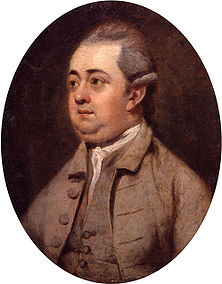 Edward Gibbon (1737–1794).
The History of the Decline and Fall of the Roman Empire is a non-fiction history book written by English historian Edward Gibbon and published in six volumes. Volume I was published in 1776, and went through six printings. Volumes II and III were published in 1781; volumes IV, V, VI in 1788–89. The original volumes were published in quarto sections, a common publishing practice of the time. The work covers the history of the Roman Empire, Europe, and the Catholic Church from 98 to 1590 and discusses the decline of the Roman Empire in the East and West. Because of its relative objectivity and heavy use of primary sources, at the time, its methodology became a model for later historians. This led to Gibbon being called the first "modern historian of ancient Rome."[1]
Contents
Thesis
Gibbon offers an explanation for why the Roman Empire fell, a task made difficult by a lack of comprehensive written sources, though he was not the only historian to tackle the subject.[2] Most of his ideas are directly taken from what few relevant records were available: those of the Roman moralists of the 4th and 5th centuries.[citation needed]
According to Gibbon, the Roman Empire succumbed to barbarian invasions in large part due to the gradual loss of civic virtue among its citizens.[3] They had become weak, outsourcing their duties to defend their Empire to barbarian mercenaries, who then became so numerous and ingrained that they were able to take over the Empire. Romans, he believed, had become effeminate, unwilling to live a tougher, "manly" military lifestyle. He further blames the degeneracy of the Roman army and the Praetorian guards. In addition, Gibbon argued that Christianity created a belief that a better life existed after death, which fostered an indifference to the present among Roman citizens, thus sapping their desire to sacrifice for the Empire. He also believed its comparative pacifism tended to hamper the traditional Roman martial spirit. Finally, like other Enlightenment thinkers, Gibbon held in contempt the Middle Ages as a priest-ridden, superstitious, dark age. It was not until his own age of reason and rational thought, it was believed, that human history could resume its progress.[citation needed]
Gibbon sees the primary catalyst of the empire's initial decay and eventual collapse in the Praetorian Guard, instituted as a special class of soldiers permanently encamped in a commanding position within Rome, a seed planted by Augustus at the establishment of the empire. As Gibbon calls them at the outset of Chapter V: The Praetorian bands, whose licentious fury was the first symptom and cause of the decline of the Roman empire... He cites repeated examples of this special force abusing its power with calamitous results, including numerous instances of imperial assassination and demands of ever-increasing pay.
Style
Gibbon writes with pessimism and detached use of irony.
Citations
Gibbon provides the reader with a glimpse of his thought process with extensive notes along the body of the text, a precursor to the modern use of footnotes. Gibbon's footnotes are famous for their idiosyncrasies and often, their humor. They provide an entertaining moral commentary on both ancient Rome and 18th-century Great Britain. This technique enabled Gibbon to compare ancient Rome to modern times. Gibbon's work advocates a rationalist and progressive view of history.
Gibbon's citations provide in-depth detail regarding his use of sources for his work, which included documents dating back to ancient Rome. The detail within his asides and his care in noting the importance of each document is a precursor to modern-day historical footnoting methodology.
The work is notable for its erratic but exhaustively documented notes and research. John Bury, following him 113 years later with his own "History of the Later Roman Empire," utilized much of the same research, and commended the depth and accuracy of Gibbon's work. It is notable that Bury, over a century after Gibbon, and Heather, over a century after Bury, both based much of their own work on Gibbon's factual research. Both found little to argue with his facts, though both disagreed with his theories, primarily on Christianity as a prime factor in the Empire's decline and fall. Unusual for the 18th century, Gibbon was notably not content with secondhand accounts when the primary sources were accessible, and used them so well that even today historians still cite his work as the definitive factual history of the western empire. "I have always endeavoured," Gibbon wrote, "to draw from the fountain-head; that my curiosity, as well as a sense of duty, has always urged me to study the originals; and that, if they have sometimes eluded my search, I have carefully marked the secondary evidence, on whose faith a passage or a fact were reduced to depend."[4] The Decline and Fall is a literary monument and a massive step forward in historical method.[5]
Controversy: chapters XV, XVI
Volume I was originally published in sections, as was common for large works at the time. The first two were well received and widely praised. The last quarto in Volume I, especially Chapters XV and XVI, were highly controversial, and Gibbon was attacked as a "paganist". Gibbon challenged Church history by estimating far smaller numbers of Christian martyrs than had been traditionally accepted. The Church's version of its early history had rarely been questioned before. For Gibbon, however, the Church writings were secondary sources, and he shunned them in favour of primary sources contemporary to the period he was chronicling. This is why Gibbon is referred to as the "first modern historian".
He compared the reigns of Diocletian (284–305), and Charles V (1519–1556) and the electorate of the Holy Roman Empire, making the argument that the two were remarkably dissimilar. Both emperors were plagued by continuous war and compelled to excessive taxation; both chose to abdicate as Emperors at roughly the same age; and both chose to lead a quiet life upon their retirement. However, Gibbon argues these similarities are only superficial and the underlying context and character of the two rulers is markedly different.
Criticism
Numerous tracts were published criticizing his work, and Gibbon was forced to defend his work in reply.[6] He left London to finish the following volumes in Lausanne, where he could work in solitude. Gibbon's remarks on Christianity aroused particularly vigorous attack. However, in the mid-twentieth century, at least one author claimed that "church historians allow the substantial justness of [Gibbon's] main positions."[7]
Christianity as a contributor to the fall and to stability
"As the happiness of a future life is the great object of religion, we may hear without surprise or scandal that the introduction, or at least the abuse of Christianity, had some influence on the decline and fall of the Roman empire. The clergy successfully preached the doctrines of patience and pusillanimity; the active virtues of society were discouraged; and the last remains of military spirit were buried in the cloister: a large portion of public and private wealth was consecrated to the specious demands of charity and devotion; and the soldiers' pay was lavished on the useless multitudes of both sexes who could only plead the merits of abstinence and chastity. Faith, zeal, curiosity, and more earthly passions of malice and ambition, kindled the flame of theological discord; the church, and even the state, were distracted by religious factions, whose conflicts were sometimes bloody and always implacable; the attention of the emperors was diverted from camps to synods; the Roman world was oppressed by a new species of tyranny; and the persecuted sects became the secret enemies of their country. Yet party-spirit, however pernicious or absurd, is a principle of union as well as of dissension. The bishops, from eighteen hundred pulpits, inculcated the duty of passive obedience to a lawful and orthodox sovereign; their frequent assemblies and perpetual correspondence maintained the communion of distant churches; and the benevolent temper of the Gospel was strengthened, though confirmed, by the spiritual alliance of the Catholics. The sacred indolence of the monks was devoutly embraced by a servile and effeminate age; but if superstition had not afforded a decent retreat, the same vices would have tempted the unworthy Romans to desert, from baser motives, the standard of the republic. Religious precepts are easily obeyed which indulge and sanctify the natural inclinations of their votaries; but the pure and genuine influence of Christianity may be traced in its beneficial, though imperfect, effects on the barbarian proselytes of the North. If the decline of the Roman empire was hastened by the conversion of Constantine, his victorious religion broke the violence of the fall, and mollified the ferocious temper of the conquerors." (chap. 39).
Historians such as David S. Potter and Fergus Millar dispute claims that the Empire fell as a result of a kind of lethargy towards current affairs brought on by Constantine's adoption of Christianity as the official state religion. They claim that such a view is "vague" and has little real evidence to support it. Others such as J.B. Bury, who wrote a history of the later Empire, claimed there is "no evidence" to support Gibbon's claims of Christian apathy towards the Empire:
"It has often been alleged that Christianity in its political effects was a disintegrating force and tended to weaken the power of Rome to resist her enemies. It is difficult to see that it had any such tendency, so long as the Church itself was united. Theological heresies were indeed to prove a disintegrating force in the East in the seventh century, when differences in doctrine which had alienated the Christians in Egypt and Syria from the government of Constantinople facilitated the conquests of the Saracens. But after the defeat of Arianism, there was no such vital or deep-reaching division in the West, and the effect of Christianity was to unite, not to sever, to check, rather than to emphasise, national or sectional feeling. In the political calculations of Constantine it was probably this ideal of unity, as a counterpoise to the centrifugal tendencies which had been clearly revealed in the third century, that was the great recommendation of the religion which he raised to power. Nor is there the least reason to suppose that Christian teaching had the practical effect of making men less loyal to the Empire or less ready to defend it. The Christians were as pugnacious as the pagans. Some might read Augustine's City of God with edification, but probably very few interpreted its theory with such strict practical logic as to be indifferent to the safety of the Empire. Hardly the author himself, though this has been disputed."[8]
Today, historians tend to analyze economic and military factors in the decline of Rome.[9]
Furthermore, Gibbon has been criticized for his portrayal of Paganism as tolerant and Christianity as intolerant. In an article that appeared 1996 in the journal Past & Present, H.A. Drake challenges an understanding of religious persecution in ancient Rome, which he considers to be the "conceptual scheme" that was used by historians to deal with the topic for the last 200 years, and whose most eminent representative is Gibbon. Gibbon had written:
- "The various modes of worship which prevailed in the Roman world were all considered by the people as equally true; by the philosophers as equally false; and by the magistrate as equally useful".
Drake counters:
- "With such deft strokes, Gibbon enters into a conspiracy with his readers: unlike the credulous masses, he and we are cosmopolitans who know the uses of religion as an instrument of social control. So doing, Gibbon skirts a serious problem: for three centuries prior to Constantine, the tolerant pagans who people the Decline and Fall were the authors of several major persecutions, in which Christians were the victims. ...Gibbon covered this embarrassing hole in his argument with an elegant demur. Rather than deny the obvious, he adroitly masked the question by transforming his Roman magistrates into models of Enlightenment rulers — reluctant persecutors, too sophisticated to be themselves religious zealots."
Misinterpretation of Byzantium
Others such as John Julius Norwich, despite their admiration for his furthering of historical methodology, consider Gibbon's hostile views on the Byzantine Empire flawed and blame him somewhat for the lack of interest shown in the subject throughout the 19th and early 20th centuries.[10] This view might well be admitted by Gibbon himself: "But it is not my intention to expatiate with the same minuteness on the whole series of the Byzantine history."[11] However one recent scholar of Byzantium says, "For Gibbon and Lebeau were genuine historians — and Gibbon a very great one — and their works, in spite of factual inadequacy, rank high for their presentation of their material."[12]
Gibbon's reflections
Although he published other books, Gibbon devoted much of his life to this one work (1772–1789). His autobiography Memoirs of My Life and Writings is devoted largely to his reflections on how the book virtually became his life. He compared the publication of each succeeding volume to a newborn child.[13]
Maps
Beginning with the fourth edition of Volume 1, issued in quarto in 1781 along with the first edition of Volumes 2 and 3, the Decline and Fall included three original fold out maps. The larger ones, a matched pair, both measuring 17X19", were titled, respectively, “A Map of the Eastern Part of the Roman Empire” and “A Map of the Western Part of the Roman Empire.” Both were drawn by Thomas Kitchin (1718-1784); were dated January 1781; and referred to the publisher of the Decline and Fall, Strahan and Cadell. There is considerable overlap in coverage. The smaller of the three maps is 10X8" and was likewise labeled under the title “A Map of the Parts of Europe and Asia adjacent to Constantinople.” These maps were clearly customized for the Decline and Fall; they do not appear in Kitchin's General Atlas or World Atlas. The maps together with the 1781 text bridge the fall of the Western Empire and the rise of the Eastern Empire; the text of Volume 2 begins with an extended description of Constantinople; the corresponding map was inserted at page 22.
Geography was of great importance to Gibbon; the History is thick with little known place names, many but not all of which appear on his maps. To aid readers, numerous places are designated with both the ancient and 18th century names. Despite their importance, Gibbon’s maps appear in few later editions of the Decline and Fall by other publishers, perhaps for reasons of cost and reproducibility of foldouts. (Quartos are large by modern standards.) There is no explicit mention of the maps in the text, the Prefaces or the Advertisement. The maps were omitted from the standard 20th century editions of the Decline and Fall by Bury and Womersley.
Many of the maps in Kitchin's Atlases were expressly based on those of Jean Baptist Bourguignon d’Anville (1697 – 1782), who was Gibbon’s chief geographic reference. d’Anville’s Atlas General was published in 1771. It included a matched pair of Empire maps comparable to Gibbon’s but with greater detail. They were titled "Orbis Romani Pars Orientalis" and "Orbis Romani Pars Occidentalis." These and other maps by d'Anville identify many places referred to by Gibbon in the text but not noted on the Decline and Fall maps. Gibbon's injunction in Chapter 50, note 2, applies to the entire work: "d’Anville’s Maps … should lie before the reader."
Editions
Gibbon continued to revise and change his work even after publication. The complexities of the problem are addressed in Womersley's introduction and appendices to his complete edition.
- In-print complete editions
- J.B. Bury, ed., 7 volumes (London: Methuen, 1909–1914), currently reprinted (New York: AMS Press, 1974). Until Womersley, this was the essential edition, but now nearing age 100, the historical analysis/commentary is dated. [ISBN 0-404-02820-9].
- Hugh Trevor-Roper, ed., 6 volumes (New York: Everyman's Library, 1993–1994). from the Bury text and with Gibbon's own notes, but without Bury's, many of which are superseded by more recent research. [ISBN 0-679-42308-7 (vols. 1–3); ISBN 0-679-43593-X (vols. 4–6)].
- David Womersley, ed., 3 volumes. hardback-(London: Allen Lane, 1994); paperback-(New York: Penguin Books, 2005;1994). The current essential edition[citation needed], the most faithful to Gibbon's original text[citation needed]. The ancient Greek quotations are not as accurate as in Bury, but an otherwise excellent work with complete footnotes and bibliographical information for Gibbon's cryptic footnote notations[citation needed]. Includes the original index, and the Vindication (1779) which Gibbon wrote in response to attacks on his caustic portrayal of Christianity. The 2005 print includes minor revisions and a new chronology. [ISBN 0-7139-9124-0 (3360 p.); ISBN 0-14-043393-7 (v.1, 1232 p.); ISBN 0-14-043394-5 (v.2, 1024 p.); ISBN 0-14-043395-3 (v.3, 1360 p.)]
- In-print abridgements
- David Womersley, ed., 1 volume (New York: Penguin Books, 2000). Includes all footnotes and eleven of the original seventy-one chapters. [ISBN 0-14-043764-9, 848 p.]
- Hans-Friedrich Mueller, ed., one volume abridgment (New York: Random House, 2003). Includes excerpts from all seventy-one chapters. It eliminates footnotes, geographic surveys, details of battle formations, long narratives of military campaigns, ethnographies and genealogies, but retains the narrative from start to finish. Based on the Rev. H.H. [Dean] Milman edition of 1845 (see also Gutenberg etext edition). [ISBN 0-375-75811-9, (trade paper, 1312 p.); ISBN 0-345-47884-3 (mass market paper, 1536 p.)]
Legacy
Variations on the series title (including using "Rise and Fall" in place of "Decline and Fall") have been used by other writers:
- An Inquiry into the Permanent Causes of the Decline and Fall of Powerful and Wealthy Nations. Designed To Shew How The Prosperity Of The British Empire May Be Prolonged. 2nd edition, 1807. 1805, William Playfair
- The Rise and Fall of the Confederate Government (1868), Jefferson Davis
- Decline and Fall (1928), Evelyn Waugh
- The Decline and Fall of Practically Everybody (1950), by the satirist Will Cuppy
- The Rise and Fall of the Third Reich (1959), William Shirer
- The Rise and Fall of Adolf Hitler (1961), William Shirer
- The Decline and Fall of the Roman Church (1983), Malachi Martin
- Decline and Fall of the Freudian Empire (1986), Hans Eysenck
- The Decline and Fall of Roman Britain (2000), Neil Faulkner
- The Decline and Fall of the Catholic Church in America (2003), David Carlin
- The Decline and Fall of the British Empire (2007), Piers Brandon
- Decline and Fall of the American Republic (2010), Bruce Ackerman
and the music album:
- Arthur (Or the Decline and Fall of the British Empire) (1969), The Kinks
- The Rise And Fall of Ziggie Stardust, David Bowie
and the films:
- The Fall of the Roman Empire (1964)
- The Decline of Western Civilization (1981), Penelope Spheeris
- The Decline of the American Empire (1986), Denys Arcand
The title and author are also cited in Noel Coward's comedic poem "I Went to a Marvellous Party".[14] And in the poem "The Foundation of Science Fiction Success", Isaac Asimov acknowledged that his Foundation series—an epic tale of the fall and rebuilding of a galactic empire—was written "with a tiny bit of cribbin' / from the works of Edward Gibbon".
See also
- Edward Gibbon
- Decline of the Roman Empire
- Outline of The History of the Decline and Fall of the Roman Empire
Notes
- ^ David Potter, A Companion To The Roman Empire. (Malden, Mass.: Blackwell Pub., 2006), p. 100.
- ^ see for example Henri Pirenne's (1862–1935) famous thesis published in the early 20th century. As for sources more recent than the ancients, Gibbon certainly drew on Montesquieu's short essay, Considérations sur les causes de la grandeur des Romains et de leur décadence, and on previous work published by Bossuet (1627-1704) in his Histoire universelle à Monseigneur le dauphin (1763). see Pocock, EEG. for Bousset, pp. 65, 145; for Montesquieu, pp. 85–88, 114, 223.
- ^ J.G.A. Pocock, "Between Machiavelli and Hume: Gibbon as Civic Humanist and Philosophical Historian," Daedulus 105,3(1976), 153–169; and in Further reading: Pocock, EEG, 303–304; FDF, 304–306.
- ^ Preface to Gibbon's Volume the Fourth in David Womersley ed., Edward Gibbon - The History of the Decline and Fall of the Roman Empire, vol. 2 (New York: Penguin Books, 1994), p. 520.
- ^ In the early 20th century, biographer Sir Leslie Stephen ["Gibbon, Edward (1737–1794)," Dictionary of National Biography, vol. 7, (Oxford, 1921), 1134] summarized The History's reputation as a work of unmatched erudition, a degree of professional esteem which remains as strong today as it was then:
The criticisms upon his book...are nearly unanimous. In accuracy, thoroughness, lucidity, and comprehensive grasp of a vast subject, the History is unsurpassable. It is the one English history which may be regarded as definitive. ...Whatever its shortcomings, the book is artistically imposing as well as historically unimpeachable as a vast panorama of a great period.
- ^ Gibbon, A Vindication of Some Passages in the Fifteenth and Sixteenth chapters of the History Of the Decline and Fall of the Roman Empire. online.
- ^ The New Schaff-Herzog Encyclopedia of Religious Knowledge, vol. IV, eds. S.M. Jackson, et al. (Grand Rapids, Mich.: Baker Book House, 1952), 483–484. online.
- ^ J.B. Bury, History of the Later Roman Empire, from Arcadius to Irene (395 A. D. to 800 A. D.). (London and New York: Macmillan and Co., 1889), 319–320.
- ^ Ramsay MacMullen, Corruption and the Decline of Rome. (New Haven: Yale Univ. Press, 1988); Thomas S. Burns, Barbarians Within the Gates of Rome: Study of Roman Military Policy and the Barbarians, ca. 375–425 AD. (Bloomington: Indiana Univ. Press, 1995).
- ^ John Julius Norwich, Byzantium (New York: Knopf, 1989); Byzantium: the apogee (London and New York: Viking Press, 1991).
- ^ Preface of 1782 online.
- ^ Georgije Ostrogorski History of the Byzantine State (1986) p 5 online
- ^ Patricia B. Craddock, Edward Gibbon, Luminous Historian. (Baltimore: Johns Hopkins Univ. Press, 1989), 249–266.
- ^ Link to notes on the poem here [1]. Excerpt: "If you have any mind at all, Gibbon's divine Decline and Fall, Seems pretty flimsy, No more than a whimsy... ."
Further reading
- Brownley, Martine W. "Appearance and Reality in Gibbon's History," Journal of the History of Ideas 38,4(1977), 651–666.
- Brownley, Martine W. "Gibbon's Artistic and Historical Scope in the Decline and Fall," Journal of the History of Ideas 42,4(1981), 629–642.
- Cosgrove, Peter. Impartial Stranger: History and Intertextuality in Gibbon's Decline and Fall of the Roman Empire (Newark: Associated University Presses, 1999); [ISBN 0-87413-658-X].
- Craddock, Patricia. "Historical Discovery and Literary Invention in Gibbon's 'Decline and Fall'," Modern Philology 85,4(May 1988), 569–587.
- Drake, H.A., "Lambs into Lions: explaining early Christian intolerance," Past and Present 153(1996), 3–36. Oxford Journals
- Furet, Francois. "Civilization and Barbarism in Gibbon's History," Daedalus 105,3(1976), 209–216.
- Gay, Peter. Style in History (New York: Basic Books, 1974); [ISBN 0-465-08304-8].
- Ghosh, Peter R. "Gibbon's Dark Ages: Some Remarks on the Genesis of the Decline and Fall," Journal of Roman Studies 73(1983), 1–23.
- Homer-Dixon, Thomas "The Upside of Down: Catastrophe, Creativity and the Renewal of Civilization", 2007 [ISBN 978-0-676-97723-3] Chapter 3 pp. 57–60
- Kelly, Christopher. "A Grand Tour: Reading Gibbon's 'Decline and Fall'," Greece & Rome 2nd ser., 44,1 (Apr. 1997), 39–58.
- Momigliano, Arnaldo. "Eighteenth-Century Prelude to Mr. Gibbon," in Pierre Ducrey et al., eds., Gibbon et Rome à la lumière de l'historiographie moderne (Geneva: Librairie Droz, 1977).
- Momigliano, Arnaldo. "Gibbon from an Italian Point of View," in G.W. Bowersock et al., eds., Edward Gibbon and the Decline and Fall of the Roman Empire (Cambridge: Harvard Univ. Press, 1977).
- Momigliano, Arnaldo. "Declines and Falls," American Scholar 49(Winter 1979), 37–51.
- Momigliano, Arnaldo. "After Gibbon's Decline and Fall," in Kurt Weitzmann, ed. Age of Spirituality : a symposium (Princeton: 1980); [ISBN 0-89142-039-8].
- Pocock, J.G.A. Barbarism and Religion, 4 vols. all Cambridge Univ. Press.
- vol. 1, The Enlightenments of Edward Gibbon, 1737–1764, 1999 [hb: ISBN 0-521-63345-1]. cited as "Pocock, EEG";
- vol. 2, Narratives of Civil Government, 1999 [hb: ISBN 0-521-64002-4];
- vol. 3, The First Decline and Fall, 2003 [pb: ISBN 0-521-82445-1]. cited as "Pocock, FDF."
- vol. 4, Barbarians, Savages and Empires, 2005 [hb: ISBN 0-521-85625-6].
- The Work of J.G.A. Pocock: Edward Gibbon section.
- Trevor-Roper, H.R. "Gibbon and the Publication of The Decline and Fall of the Roman Empire, 1776–1976," Journal of Law and Economics 19,3 (Oct. 1976), 489–505.
- Womersley, David. The Transformation of 'The Decline and Fall of the Roman Empire' (Cambridge: 1988).
- Womersley, David, ed. Religious Scepticism: Contemporary Responses to Gibbon (Bristol, England: Thoemmes Press, 1997).
- Wootton, David. "Narrative, Irony, and Faith in Gibbon's Decline and Fall," History and Theory 33,4 (Dec., 1994), 77–105.
External links
- The History of the Decline and Fall of the Roman Empire author record at Project Gutenberg. Based on the Rev. H.H. Milman edition of 1845.
- The History of the Decline and Fall of the Roman Empire from the Online Library of Liberty. The J. B. Bury edition, in 12 volumes.
- Memoirs of My Life and Writings at Project Gutenberg
- The History of the Decline and Fall of the Roman Empire, Google Book Search (pdf version)
- a text at CCEL
- EdwardGibbonStudies.com: Web Center for Edward Gibbon Studies
- DeclineandFallResources.com: Maps, Translations, Illustrations[unreliable source]
Categories:- 1776 books
- 1781 books
- 1788 books
- English non-fiction literature
- Theories of history
- History books about ancient Rome
- Non-Islamic Islam studies literature
- Gothic Wars books
- Books about civilizations
- Books critical of Christianity
- 18th-century history books

Wikimedia Foundation. 2010.
