

- Counties of Norway
-
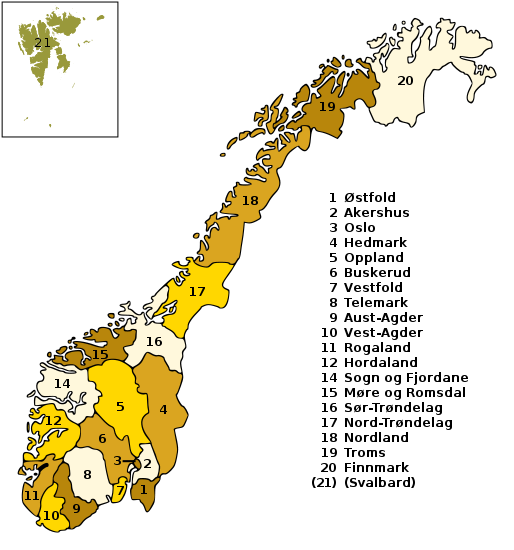
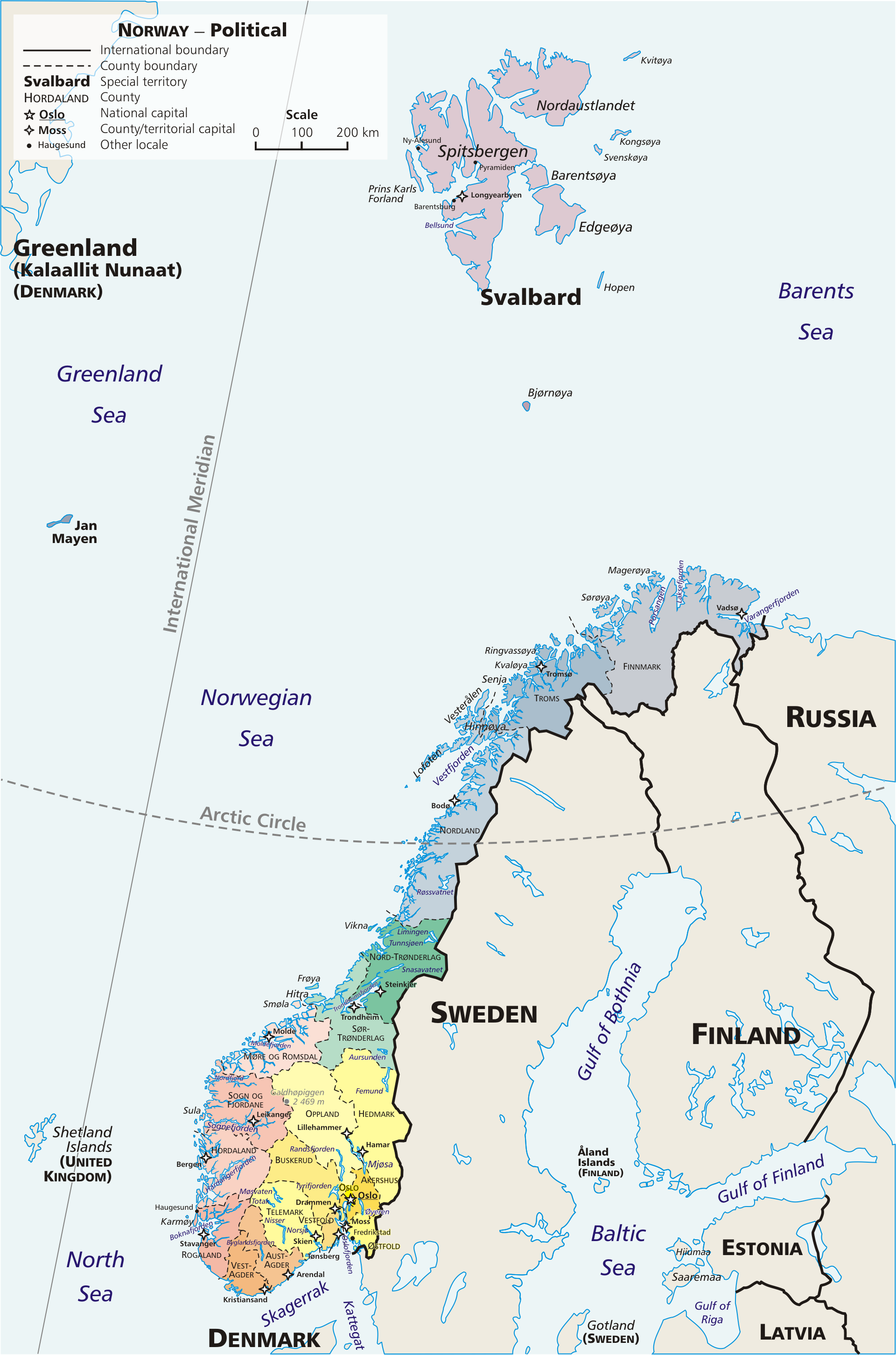
 A geopolitical map of Norway, exhibiting its 19 first-order subnational divisions (fylker or "counties") with Svalbard and Jan Mayen
Norway 
This article is part of the series:
Politics and government of
NorwayMonarchyGovernmentParliamentLocal Gov'tForeign policy
Norway is divided into 19 administrative regions, called counties (singular Norwegian: fylke, plural Norwegian: fylker (Bokmål) / fylke (Nynorsk); until 1918 known as amt, pl. amter / amt). The counties form the primary first-level subdivisions of Norway and are further divided into 430 municipalities (kommune, pl. kommuner / kommunar). The capital Oslo is considered as both a county and a municipality.
There is some political disagreement on whether counties are a practical, economical or even necessary level of administration. See politics of Norway for more information.
Contents
List of counties
Below is a list of the Norwegian counties as they have been since 1919, with their current administrative centres. Note that the counties are administered both by appointees of the national government and to a lesser extent by their own elected bodies. The county numbers are from the official numbering system ISO 3166-2:NO, which follows the coastline from the Swedish border in the southeast to the Russian border in the northeast. The number 13 was dropped from the system when the city of Bergen (county no. 13) was merged into Hordaland (county no. 12) in 1972.
ISO-code Arms County (Fylke) Administrative centre 01 
Østfold Sarpsborg 02 
Akershus Oslo 03 
Oslo City of Oslo 04 
Hedmark Hamar 05 
Oppland Lillehammer 06 
Buskerud Drammen 07 
Vestfold Tønsberg 08 
Telemark Skien 09 
Aust-Agder Arendal 10 
Vest-Agder Kristiansand 11 
Rogaland Stavanger 12 
Hordaland Bergen 13 
Sogn og Fjordane Leikanger 14 
Møre og Romsdal Molde 15 
Sør-Trøndelag Trondheim 16 
Nord-Trøndelag Steinkjer 17 
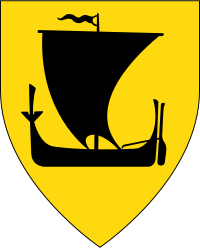
Nordland Bodø 18 
Troms Tromsø 19 
Finnmark Vadsø Map
History
Fylke
From the consolidation to a single kingdom, Norway was divided into a number of geographic regions that had its own legislative assembly or Thing, such as Gulating (Western Norway) and Frostating (Trøndelag). The second-order subdivision of these regions was into fylker, such as Egdafylke and Hordafylke. In 1914, the historical term fylke was brought into use again to replace the term amt introduced during the union with Denmark. Current day counties (fylker) often, but not necessarily, correspond to the historical areas.
Fylke in the 10th to 13th century
Counties (folkland) under the Borgarting, located in Viken with the seat at Sarpsborg:[1]
Counties (first three fylke, last two bilandskap) under the Eidsivating, located in Oplandene with the seat at Eidsvoll:[1]
- Raumafylke
- Heinafylke
- Hadafylke
- Gudbrandsdal
- Østerdal
Counties under the Gulating, located in Vestlandet with the seat at Gulen:[2]
- Sunnmærafylke
- Firdafylke
- Sygnafylke
- Valdres and Hallingdal
- Hordafylke
- Rygjafylke
- Setesdalen
- Egdafylke
Counties under the Frostating, located in Trøndelag with the seat at Frosta:
- Eynafylke
- Sparbyggjafylke
- Verdælafylke
- Skeynafylke
- Orkdælafylke
- Gauldælafylke
- Stjordælafylke
- Strindafylke
- Naumdælafylke
- Nordmærafylke
- Romsdælafylke
Counties not attached to a thing:
- Jamtaland
- Herjedalen
- Håløygjafylke
Finnmark (including northern Troms), the Faroe Islands, the Orkney Islands, Shetland, the Hebrides, Isle of Man, Iceland and Greenland were Norwegian skattland ("tax countries"), and did not belong to any known counties or assembly areas.
Syssel
Syssel in 1300
From the end of the 12th century, Norway was divided into several syssel. The head of the various syssel was the syslemann, who represented the king locally. The following shows a reconstruction of the different syssel in Norway c. 1300, including sub-syssel where these seem established.[3]
- Elvesysle
- Ranrike
- Borgarsysle (two parts)
- Romerike (two parts, "northern" and "southern")
- Hedmark (two parts, "northern" and "southern")
- Østerdalen
- "north of Åmot"
- "south of Åmot"
- Gudbrandsdalen
- "north of Ruste"
- "south of Ruste"
- Hadeland (later Ringerike, two parts, "northern" and "outer")
- Valdres and Hallingdal (two parts)
- Numedal and Telemark?
- Tverrdalane and Modum?
- Oslosysle (northern lut and western lut)
- Tønsbergsysle
- Skiensysle
- Eastern part (later Nedenes)
- Robyggjelag
- Agder Midtsysla
- Lista
- Rygjafylke
- "north of the fjord"
- "south of the fjord"
- Hordaland (Nordhordland? and Sunnhordland?)
- Hardanger
- Voss
- Sogn (two parts?)
- Sunnfjord
- Nordfjord
- Sunnmøre
- Romsdal
- Nordmøre?
- Nordmørafylke
Len
From 1308, the term len (plural len) in Norway signified an administrative region roughly equivalent to today's counties. The historic len was an important administrative entity during the period of Dano-Norwegian unification after their amalgamation as one state, which lasted for the period 1536[4]–1814.
At the beginning of the 16th century the political divisions were variable, but consistently included four main len and approximately 30 smaller sub-regions with varying connections to a main len. Up to 1660 the four principal len were headquartered at the major fortresses Bohus Fortress, Akershus Fortress, Bergenhus Fortress and the fortified city of Trondheim.[5] The sub-regions corresponded to the church districts for the Lutheran church in Norway.
Len in 1536
- Båhus len (later termed Bohuslän after Denmark-Norway ceded it to Sweden by the Treaty of Roskilde in 1658)
- Akershus len
- Trondheim len
- Bergenhus len (which included Northern Norway)
These four principal len were in the 1530s divided into approximately 30 smaller regions. From that point forward through the beginning of the 17th century the number of subsidiary len was reduced, while the composition of the principal len became more stable.[6]
Len in 1660
From 1660 Norway had nine principal len comprising 17 subsidiary len:
- Akershus len
- Tunsberg len
- Bratsberg len
- Agdesiden len
- Stavanger len
- Bergenhus len
- Trondheim len
- Nordlandene len
- Vardøhus len
Len written as län continues to be used as the administrative equivalent of county in Sweden to this day. Each len was governed by a lenman.[7]
Amt
With the royal decree of February 19, 1662, each len was designated an amt (plural amt) and the lenmann was titled amtmann, from German Amt (office), reflecting the bias of the Danish court of that period.[8]
Amt in 1671
After 1671 Norway was divided into four principal amt or stiftsamt and there were nine subordinate amt:
- Akershus amt
- Smålenene amt
- Brunla amt
- Agdesiden amt
- Bratsberg amt
- Stavanger amt
- Bergenhus amt
- Halsnøy klostergods
- Hardanger amt
- Nordlandene amt
- Trondheim amt
- Romsdalen amt
- Vardøhus amt
Amt in 1730
From 1730 Norway had the following amt:
- Vardøhus amt
- Tromsø amt
- Nordlands amt
- Nordre Trondhjems amt
- Søndre Trondhjems amt
- Romsdalen amt
- Nordre Bergenhus amt
- Søndre Bergenhus amt
- Stavanger amt
- Lister og Mandals amt
- Nedenes amt
- Bratsberg amt
- Buskerud amt
- Oplandenes amt
- Hedemarkens amt
- Akershus amt
- Smaalenenes amt
At this time there were also two counties (grevskap) controlled by actual counts, together forming what is now Vestfold county:
- Laurvigen county
- Jarlsberg county
Amt in 1760
In 1760 Norway had the following stiftamt and amt:[9]
- Akershus stiftamt
- Opplands amt
- Akershus amt
- Smålenenes amt
- Laurvigen county
- Jarlsberg county
- Bratsberg amt (eastern half)
- Agdesiden stiftamt
- Bratsberg amt (western half)
- Nedenes amt
- Lister and Mandal amt
- Stavanger amt
- Bergenhus stiftamt
- Romsdal amt (southern half)
- Trondheim stiftamt
- Romsdal amt (northern half)
- Nordlands amt
- Vardøhus amt
Fylke
From 1919 each amt was renamed a fylke (plural fylker) (county) and the amtmann was now titled fylkesmann (county governor).
See also
- Ranked list of Norwegian counties
- Municipalities of Norway
- Regions of Norway
- Traditional districts of Norway
- Metropolitan regions of Norway
- Subdivisions of the Nordic countries
- Lists of County Governors of Norway
Counties of Norway Akershus · Aust-Agder · Buskerud · Finnmark · Hedmark · Hordaland · Møre og Romsdal · Nordland · Nord-Trøndelag · Oppland · Oslo · Østfold · Rogaland · Sogn og Fjordane · Sør-Trøndelag · Telemark · Troms · Vest-Agder · Vestfold

First-level administrative divisions in Europe Sovereign
statesAlbania · Andorra · Armenia2 · Austria · Azerbaijan3 · Belarus · Belgium · Bosnia and Herzegovina · Bulgaria · Croatia · Cyprus2 · Czech Republic · Denmark · Estonia · Finland · France1 · Georgia3 · Germany · Greece · Hungary · Iceland · Ireland · Italy · Kazakhstan2 · Latvia · Liechtenstein · Lithuania · Luxembourg · Republic of Macedonia · Malta · Moldova · Monaco · Montenegro · Netherlands · Norway · Poland · Portugal · Romania · Russia1 · San Marino · Serbia · Slovakia · Slovenia · Spain · Sweden · Switzerland · Turkey1 · Ukraine · United Kingdom
States with limited
recognitionAbkhazia3 · Kosovo · Northern Cyprus2 · South Ossetia3
1 Has part of its territory outside Europe. 2 Considered European for cultural, political and historical reasons but is geographically in West Asia. 3 Partially or entirely in Asia, depending on the definition of the border.References
Footnotes
- ^ a b "Lagting og lagsogn frem til 1797". Borgarting lagmannsrett. http://www.domstol.no/DAtemplates/Article.aspx?id=10162&epslanguage=NO.
- ^ "Frå lagting til allting". Gulatinget. http://www.gulatinget.no/Default.aspx?tabid=6304.
- ^ Danielsen (et al.), 1991, p. 77
- ^ Christian III, king of Denmark-Norway, carried out the Protestant Reformation in Norway in 1536.
- ^ Kavli, Guthorm (1987). Norges festninger. Universitetsforlaget. ISBN 82-00-18430-7.
- ^ Len on Norwegian Wiki site
- ^ Jesperson, Leon (Ed.) (2000). A Revolution from Above? The Power State of 16th and 17th Century Scandinavia. Odense University Press. ISBN 87-7838-407-9.
- ^ Amt at Norwegian Wiki site
- ^ Danielsen (et al.), 1991, p. 153
Bibliography
- Danielsen, Rolf; Dyrvik, Ståle; Grønlie, Tore; Helle, Knut; Hovland, Edgar (1991 (2007)). Grunntrekk i norsk historie (1 ed.). Oslo: Universitetsforlaget. ISBN 978-82-00-21273-7.
External links
Categories:- Counties of Norway
- Subdivisions of Norway
- Lists of country subdivisions
- Country subdivisions of Europe
- First-level administrative country subdivisions
- Norway-related lists






Wikimedia Foundation. 2010.
