

- Communion (Christian)
-
This article is about interpersonal bonds in Christianity. For the Christian rite reenacting the Last Supper, see Eucharist.
 An ecumenical youth service
The term communion is derived from Latin communio (sharing in common).[1] The corresponding term in Greek is κοινωνία, which is often translated as "fellowship". In Christianity, the basic meaning of the term communion is an especially close relationship of Christians, as individuals or as a Church, with God and with other Christians. This basic meaning of the word, found in many passages of the New Testament as well as in secular Greek, predates its other, more specific, Christian uses.
Contents
Classical Greek
The Greek word κοινωνία (koinonia) was in use before the advent of Christianity. In Ancient Greek, it could apply to a business partnership, to fellowship of life in marriage, to a spiritual relationship with a god such as Zeus, to comradely fellowship between friends, to a community or society.[2]
New Testament
In the Bible, the Greek term κοινωνία (koinonia) is an exclusively New Testament term, appearing nowhere in the ancient Greek translation of the Old Testament known as the Septuagint. As a noun, or in its adjectival or verbal forms, it is found in 43 verses of the New Testament. In addition, the noun is found in some manuscripts (used for producing the English translation known as the King James Version, but not for more recent translations) in Ephesians 3:9.
In the New Testament, the word is applied, according to the context, to communion, sharing or fellowship with:
- the divine nature (2 Peter 1:4), God (1 John 1:6), the Trinity (1 John 1:3), Jesus, Son of God (1 Corinthians 1:9), his sufferings (Philippians 3:10; 1 Peter 4:13), his future glory (1 Peter 5:1), the Holy Spirit (2 Corinthians 13:14; Philippians 2:1)
- the blood and the body of Christ (1 Corinthians 10:16), pagan sacrifices and gods (1 Corinthians 10:18-20)
- fellow Christians, their sufferings and the faith (Acts 2:42; Galatians 2:9; 1 John 1:3, 1:7; Hebrews 10:33; Revelation 1:9; Philemon 1:6, 1:17)
- a source of spiritual favours (Romans 11:17), the gospel (1 Corinthians 9:23), light and darkness (2 Corinthians 6:14)
- others' sufferings and consolation (2 Corinthians 1:7; Philippians 4:14), their evangelizing work (Philippians 1:5), their graces or privileges (Romans 15:27; Philippians 1:7), their material needs, to remedy which assistance is given (Romans 12:13, 15:26-27; 2 Corinthians 8:4, 9:13; Galatians 6:6; Philippians 4:15; 1 Timothy 6:18; Hebrews 13:16)
- the evil deeds of others (Matthew 23:30; Ephesians 5:11; 1 Timothy 5:22; 2 John 1:11; Revelation 18:4)
- the bodily human nature all have in common (Hebrews 2:14)
- a work partnership, secular or religious (Luke 5:10; 2 Corinthians 8:23)
Of these usages, Bromiley's International Standard Bible Encyclopedia selects as especially significant the following meanings:
- I. Common life in general (only in Acts 2:42)
- II. Communion between particular groups, the most remarkable instance of which was that between Jews and Gentiles
- III. Communion in the Body and Blood of Christ
- IV. Sharing in divine revelation and with God himself (1 John 1:1-7).[3]
Derived meanings in Christianity
By metonymy, the term is used of a group of Christian Churches that have this close relationship of communion with each other. An example is the Anglican Communion.
If the relationship between the Churches is complete, involving fulness of "those bonds of communion - faith, sacraments and pastoral governance - that permit the Faithful to receive the life of grace within the Church",[1] it is called full communion. However, the term "full communion" is frequently used in a broader sense, to refer instead to a relationship between Christian Churches that are not united, but have only entered into an arrangement whereby members of each Church have certain rights within the other.
If a Church recognizes that another Church, with which it lacks bonds of pastoral governance, shares with it some of the beliefs and essential practices of Christianity, it may speak of "partial communion" between it and the other Church.
The communion of saints is the relationship that, according to the belief of Christians, exists between them as people made holy by their link with Christ. This relationship is generally understood to extend not only to those still in earthly life, but also to those who have gone past death to be "at home with the Lord" (2 Corinthians 5:8). Since the word rendered in English as "saints" can mean not only "holy people" but also "holy things", the term communion of saints also applies to the sharing by members of the Church in the holy things of faith, sacraments (especially the Eucharist), and the other spiritual graces and gifts that they have in common.
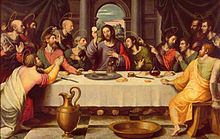
In a special way the term communion is applied to sharing in the Eucharist by partaking of the consecrated bread and wine, an action seen as entering into a particularly close relationship with Christ. Sometimes the term is applied not only to this partaking but to the whole of the rite or to the consecrated elements. For further information, see the article Eucharist.
See also
References
External links
- Fellowship as defined in the New Testament
- Broken but Never Divided: An Orthodox Perspective
- Congregation for the Doctrine of the Faith, Letter to the Bishops of the Catholic Church on some aspects of the Church understood as communion
Bibliography
- NAS Exhaustive Concordance of the Bible with Hebrew-Aramaic and Greek Dictionaries. The Lockman Foundation. 1981, 1998.
- Bromiley, Geoffrey W. (1979). The International Standard Bible Encyclopedia. Grand Rapids, Michigan: William B. Eerdmans Publishing Co..
- Robert Porter Lynch; Ninon Prozonic (2006). "How the Greeks created the First Golden Age of Innovation" (Word document). pp. 14. http://www.enginesofinnovation.com/html/publications.html. Retrieved 2007-04-08.
- Richards, Lawrence O. (1985). Expository Dictionary of Bible Words. Grand Rapids, Michigan: Zondervan Corporation.
- Thayer, Joseph H. (1885). Greek-English Lexicon of the New Testament. Grand Rapids, Michigan: Zondervan Publishing House.
- Verna Lewis-Elgidely Koinonia in the Three Great Abrahamic Faiths: Acclaiming the Mystery and Diversity of Faiths Cloverdale Books (2007) ISBN 978-1-929569-37-3
Categories:- Christian group structuring
- Christian terms


Wikimedia Foundation. 2010.
