

- Mikoyan-Gurevich MiG-15
-
MiG-15
MiG-15UTI
Single-seat MiG 15 of the Polish Air Force in Museum Uzbrojenia in Poznań Role Fighter Manufacturer Mikoyan-Gurevich First flight 30 December 1947 Introduction 1949 Status Trainers in service Primary users Soviet Air Force
PLA Air Force
Korean People's Air Force
41 othersNumber built ~12,000 + ~6,000 in license Developed into Mikoyan-Gurevich MiG-17 The Mikoyan-Gurevich MiG-15 (Russian: Микоян и Гуревич МиГ-15) was a jet fighter developed for the USSR by Artem Mikoyan and Mikhail Gurevich. The MiG-15 was one of the first successful swept-wing jet fighters, and it achieved fame in the skies over Korea, where early in the war, it outclassed all straight-winged enemy fighters in daylight. The MiG-15 also served as the starting point for development of the more advanced MiG-17 which was still an effective threat to supersonic American fighters over North Vietnam in the 1960s. The MiG-15 is believed to have been the most widely produced jet aircraft ever made, with over 12,000 built. Licensed foreign production perhaps raised the total to over 18,000.[1] The MiG-15 is often mentioned along with the North American F-86 Sabre in lists of the best fighter aircraft of the Korean War and in comparison with fighters of other eras.[2]
NATO and USAF reporting names were as follows:
- MiG-15: NATO reporting name "Fagot",[3] USAF/DoD reporting name "Type 14".[4]
Contents
Design and development
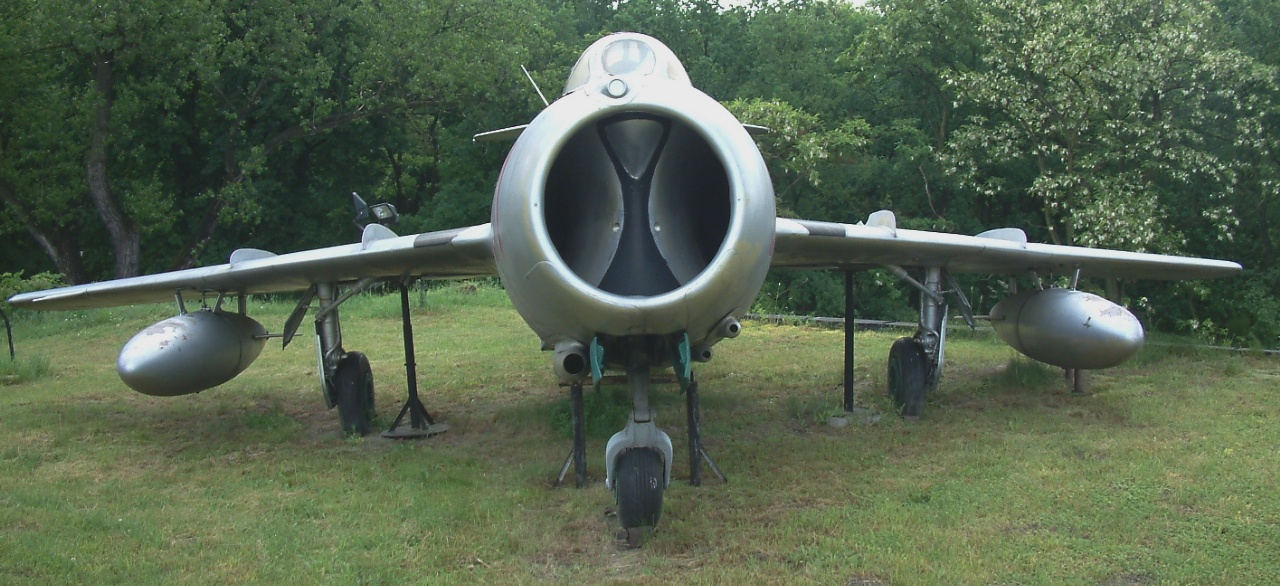
 Front view of a MiG-15
Most early jets were designed like piston-engined fighters with straight wings, limiting their high speed performance. German research during World War II had shown swept wings would perform better at transonic speeds, and Soviet aircraft designers were quick to take advantage of this information. There are claims[by whom?] of Artem Mikoyan and Mikhail Gurevich (lead designers of the "MiG" bureau) being heavily influenced by the Focke-Wulf Ta 183. The abortive late-war German jet had swept wings and bore a resemblance to the later MiG-15, but the two aircraft are different in structure and general design. The Soviets did seize plans and prototypes for the Ta-183, but the majority of Focke-Wulf engineers (in particular, Hans Multhopp, who led the Ta-183 development team) were captured by Western armies; therefore, it could be argued that the MiG-15 design team drew some limited inspiration from the Ta-183, but there is insufficient evidence to prove it was heavily influenced. Currently, many sources claim that the MiG-15 is an original design benefiting from German research, but conceived, designed, engineered, and produced by the Soviets.[6][page needed]
The unusual MiG-8 Utka experimental canard aircraft, built right at the conclusion of World War II by the MiG design bureau, is said[by whom?] to have also been a major influence in the use of swept wings on later Mikoyan designs.
By 1946, Soviet designers were to power them. Soviet aviation minister Mikhail Khrunichev and aircraft designer A. S. Yakovlev suggested to Premier Joseph Stalin the USSR buy advanced jet engines from the British. Stalin is said to have replied, "What fool will sell us his secrets?"[6]
However, he gave his consent to the proposal and Mikoyan, engine designer Vladimir Klimov, and others travelled to the United Kingdom to request the engines. To Stalin's amazement, the British Labour government and its pro-Soviet Minister of Trade, Sir Stafford Cripps, were perfectly willing to provide technical information and a license to manufacture the Rolls-Royce Nene. This engine was reverse-engineered and produced as the Klimov RD-45, subsequently incorporated into the MiG-15.[6] Rolls-Royce later attempted to claim £207 million in license fees, without success.[citation needed]
 MiG-15bis at Monino Aircraft Museum
In the interim, on 15 April 1947, the Council of Ministers issued decree #493–192, which ordered the Mikoyan OKB to build two prototypes for a new jet fighter. As the decree called for a first flight as soon as December, designers at OKB-155 fell back on an earlier troublesome design, the MiG-9. The MiG-9 suffered from an unreliable engine and control problems; the first would be solved by the excellent new Klimov engine, and to solve the second, the designers began experimenting with swept wings and redesigning the tail. The resulting prototypes were designated as I-310.[citation needed]The I-310 was a clean, swept-wing fighter with 35° sweep in wings and tail, and exceptional performance, with a top speed of over 1,040 km/h (650 mph). Its primary competitor was the similar Lavochkin La-168. After evaluation, the MiG design was chosen for production. Designated MiG-15, the first production example flew on 31 December 1948. It entered Soviet Air Force service in 1949, and would subsequently receive the NATO reporting name "Fagot." Early production examples had a tendency to roll to the left or to the right due to manufacturing variances, so aerodynamic trimmers called "nozhi" (knives) were fitted to correct the problem, the knives being adjusted by ground crews until the aircraft flew correctly.[6]
 Polish Air Force MiG-15UTI
An improved variant, the MiG-15bis ("second"), entered service in early 1950 with a Klimov VK-1 engine, an improved version of the RD-45/Nene, plus minor improvements and upgrades.[6] Visible differences were a headlight in the air intake separator and horizontal upper edge airbrakes. The 23 mm cannons were placed more closely together in their undercarriage. Some "bis" aircraft also adopted under-wing hardpoints for unguided rocket launchers or 50–250 kg (110–551 lb) bombs. Fighter-bomber modifications were dubbed "IB", "SD-21", and "SD-5". About 150 aircraft were upgraded to SD-21 specification during 1953–1954. An unknown number of aircraft were modified to "IB" specification in the late 1950s.
The MiG-15 arguably had sufficient power to dive at supersonic speeds, but could not do so because it did not have an "all-flying" tail. As a result, the pilot's ability to control the aircraft deteriorated significantly as it approached Mach 1. Later MiGs would incorporate all-flying tails.
The MiG-15 was originally intended to intercept American bombers like the B-29. It was even evaluated in mock air-to-air combat trials with a captured U.S. B-29, as well as the later Soviet B-29 copy, the Tu-4 "Bull". To ensure the destruction of such large bombers, the MiG-15 carried cannons: two 23 mm with 80 rounds per gun and a single 37 mm with 40 rounds. These weapons provided tremendous punch in the interceptor role, but their limited rate of fire and relatively low velocity made it more difficult to score hits against small and maneuverable enemy jet fighters in air-to-air combat. The 23 mm and 37 mm also had radically different ballistics, and some United Nations pilots in Korea had the unnerving experience of 23 mm shells passing over them while the 37 mm shells flew under. The cannons were fitted into a neat pack that could be winched down out of the bottom of the nose for servicing and reloading, in principle allowing a pre-prepared pack to be switched for rapid turnaround. (Some sources mistakenly claim the pack was added in later models.)[6]
A variety of MiG-15 variants were built, but the most common was the MiG-15UTI (NATO reporting name "Midget") two-seat trainer.[citation needed] Because Mikoyan-Gurevich never mass-produced the transition training versions of the later MiG-17 or MiG-19, the MiG-15UTI remained the sole Warsaw Pact advanced jet trainer well into the 1970s, the primary training role being fulfilled exclusively by Czechoslovak Aero L-29 Delfin and the L-39 Albatros jet trainers (save for Poland, which used their indigenous TS-11 Iskra jets). While China produced two-seat trainer versions of the later MiG-17 and MiG-19, the Soviets felt that the MiG-15UTI was sufficient for their needs and did not produce their own trainer versions of those aircraft.[citation needed]
Operational history
The MiG-15 was widely exported, with the People's Republic of China receiving MiG-15bis models in 1950. Chinese MiG-15s took part in the first jet-versus-jet dogfights during the Korean War. The swept-wing MiG-15 quickly proved superior to the first-generation, straight-wing jets of western air forces such as the F-80 and British Gloster Meteor, as well as piston-engined P-51 Mustangs and F4U Corsairs with the MiG-15 of First Lieutenant Semyon Fiodorovich Jominich scoring the first jet-vs-jet victory in history when he bagged the F-80C of Frank Van Sickle, who died in the encounter (the USAF credits the loss to the action of the North Korean flak).[7][unreliable source?] Only the F-86 Sabre, with its highly trained pilots, was a match for the MiG.
Its baptism of fire occurred during the last phases of the Chinese Civil War (1946–49). During the first months of 1950, the aviation of Nationalist China attacked from Taiwan the communist position in continental China, especially Shanghai. Mao Zedong requested the military assistance of the USSR, and the 50th IAD (Истребительная Авиадивизия, ИАД; Istrebitelnaya Aviadiviziya; Fighter Aviation Division) equipped with the MiG-15bis was deployed south of the People's Republic of China. On 28 April 1950, Captain Kalinikov shot down a P-38 of the Kuomintang, scoring the first aerial victory of the MiG-15. Another followed on 11 May, when Captain Ilya Ivanovich Schinkarenko downed the B-24 Liberator of Li Chao Hua, commander of the 8th Air Group of the nationalist Air Force.
The Korean War (1950–1953)
See also: MiG Alley No's MiG-15 on display at the National Museum of the United States Air Force.
When the ongoing Korean War escalated with the North Korean offensive of 25 June 1950, the Northern Air Force was equipped with World War II-vintage Soviet prop-driven fighters, including 93 Il-10s and 79 Yak-9Ps.[8] The North Korean Air Force had roughly 93 Il-10s, 79 Yak-9Ps, and 40–50 assorted transport/liaison/trainer aircraft".[9] The vast numerical and technical superiority of the USAF, led by advanced jets such as Lockheed F-80 Shooting Star and Republic F-84 Thunderjet fighters, quickly brought air superiority, thus laying North Korea's cities bare to the destructive power of USAF B-29 bombers which, together with Navy and Marine aircraft, roamed the skies largely unopposed for a time.
The decision to introduce the MiG-15 not only closed the jet fighter gap, its performance leapfrogged all of the opposing straight-winged jets. The MiG-15 proved very effective in its designed role against formations of B-29 heavy bombers, shooting down numerous bombers. In a match-up with the F-86, the results were not as clear-cut though Americans claimed that the F-86 had the advantage in combat kills. The Soviet 64th IAK (Fighter Aviation Corps) claimed 1,106 UN aircraft destroyed in the Korean War, compared to Allied records that 142 Allied aircraft were downed by the Soviet MiG-15 pilots. Western experts do acknowledge many Soviet pilots earned bigger individual scores than their American counterparts due to a number of factors, though overall figures of NATO were probably overstated.[10]
For many years, the participation of Soviet aircrews in the Korean War was widely suspected by the United Nations forces, but consistently denied by the Soviet Union. With the end of the Cold War, however, Soviet pilots who participated in the conflict have begun to reveal their role.[11] Soviet aircraft were adorned with North Korean or Chinese markings and pilots wore either North Korean uniforms or civilian clothes to disguise their origins. For radio communication, they were given cards with common Korean words for various flying terms spelled out phonetically in Cyrillic characters.[11] These subterfuges did not long survive the stresses of air-to-air combat, however, and pilots routinely communicated (cursed) in Russian. Soviet pilots were prevented from flying over areas in which they might be captured, which would indicate that the Soviet Union was officially a combatant in the war.
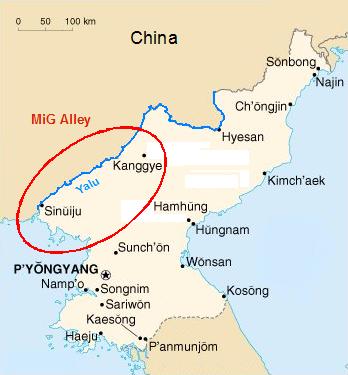
The USSR never acknowledged that its pilots ever flew over Korea during the Cold War. Americans who intercepted radio traffic during combat confirmed hearing Russian voices, but only the Communist Chinese and North Korean combatants took responsibility for the flying. Until the publishing of recent books by Red Chinese and Soviet authors, such as Zhang Xiaoming, Leonid Krylov, Yuriy Tepsurkaev and Igor Seydov, little was known of the actual pilots. The Americans recognized the techniques of their opponents whom they called "honchos",[10] and dubbed "MiG Alley" the site of numerous dogfights in the northwestern portion of North Korea where the Yalu River empties into the Yellow Sea.
 Map showing the general location of "MiG Alley."
The Soviets were training Red Chinese MiG-15 pilots when Communist China entered the war in support of North Korea. By October, the Soviet Union had agreed to provide air regiments of state-of-the-art Soviet-designed and -built MiG-15 fighters, along with the trained crews to fly them. Simultaneously, the Kremlin agreed to supply the Red Chinese and North Koreans with their own MiG-15s, as well as train their pilots. On 1 November 1950, eight MiG-15s intercepted about 15 F-51D Mustangs of the United States Air Force (USAF) and First Lieutenant Fiodor V. Chizh shot down the F-51D of Aaron Abercombrie in his MiG-15, killing the American pilot. Three MiG-15s of the same unit intercepted 10 F-80 Shooting Stars, and the MiG-15 of First Lieutenant Semyon Fiodorovich Jominich scored the first jet-vs-jet victory in history when he downed the F-80C of Frank Van Sickle, who would also perish (USAF credits both losses to the action of the North Korean flak).[7] However on 9 November, the Soviet MiG-15 pilots suffered their first loss when Lieutenant Commander William T. Amen off the aircraft carrier USS Philippine Sea shot down and killed Captain Mikhail F. Grachev while flying a Grumman F9F Panther.[12]
The Soviet air units claimed to have shot down 29 American aircraft through the rest of the month: 11 F-80s, seven B-29s and nine F-51s.[7] 23 out of these 29 claims match with acknowledged losses, but US sources assert that most of them were either operational or due to AAA, admitting only four B-29s (a downed B-29, plus two B-29s and a RB-29 which crash-landed or were damaged beyond repair). US historians agree that the MiG-15 gained aerial superiority over northwestern Korea.[7]
To counter the unexpected turn of events, three squadrons of the F-86 Sabre, America's only operational jet with swept wings were quickly rushed to the Far East in December.[13] On 17 December 1950, Lieutenant Colonel Bruce H. Hinton forced Major Yakov Nikanorovich Yefromeyenko to eject from his burning MiG.[7] In the following days both sides traded punches, with Captain Nikolay Yefremovich Vorovyov shooting down the F-86A of Captain Lawrence V. Bach in his MiG-15bis on 22 December 1950.[7] Both sides exaggerated their claims of aerial victories that month; the Sabre fliers claimed eight MiGs, and the Soviets claimed to have shot down 12 F-86s. The actual losses were three MiGs and at least four Sabres.
Those first encounters established the main features of the aerial battles of the next two and a half years. The MiG-15 and MiG-15bis had a higher ceiling than all the versions of the Sabre – 15,500 m (50,900 ft) versus 14,936 m (49,003 ft) of the F-86F – and accelerated faster than F-86A/E/Fs due to their better thrust-to-weight ratio – 1,005 km/h (624 mph) versus 972 km/h (604 mph) of the F-86F. The MiG-15's 2,800 m (9,200 ft) per minute climbing rate was also greater than the 2,200 m (7,200 ft) per minute of the F-86A and -E (the F-86F matched the MiG-15s rate). A better turn radius above 10,000 m (33,000 ft) further distinguished the MiG-15, as did more powerful weaponry – one 37 mm N-37 cannon and two 23 mm NR-23 cannons, versus the inferior hitting power of the six 12.7 mm (.50 in) machine guns of the Sabre. But the MiG was slower at low altitude – 935 km/h (581 mph) in the MiG-15bis configuration as opposed to the 1,107 km/h (688 mph) of the F-86F. The Soviet World War II-era ASP-1N gyroscopic gunsight was less sophisticated than the accurate A-1CM and A4 radar ranging sights of the F-86E and -F. All Sabres turned tighter below the 8,000 m (26,000 ft) altitude.[14]
Thus if the MiG-15 forced the Sabre to fight in the vertical plane, or in the horizontal one above 10,000 m (33,000 ft), it gained a significant advantage. Furthermore, a MiG-15 could easily escape from a Sabre by climbing to its ceiling, knowing that the F-86 could not follow him. Below 8,000 m (26,247 ft) however, the Sabre had a slight advantage over the MiG in most aspects excluding climb rate, especially if the Soviet pilot made the mistake of fighting in the horizontal plane.
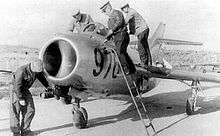 Soviet groundcrew prepare a MiG-15bis from Antung airbase,China, mid-1952
The main mission of the MiG-15 was not only to dogfight against the F-86 however, but to counter the USAF Boeing B-29 Superfortress bombers. This mission was assigned to the elite of the Soviet Air Force (VVS), in April 1951 to the 324th IAD of Colonel Ivan Kozhedub, the World War II Allied "Ace of Aces", and later to the 303rd IAD of General Georgiy A. Lobov, who arrived to Korea in June of that same year.[7]
A total of 44 MiG-15s achieved victories in that mission on 12 April 1951 when they intercepted a large formation of 48 Superfortresses, 18 Sabres, 54 F-84 Thunderjets and 24 F-80 Shooting Stars heading towards the bridge linking North Korea and Red China over the Yalu river in Uiju. When the ensuing battle was finished, the experienced Soviet fliers had shot down or damaged beyond repair ten B-29As, one F-86A and three F-80Cs with the loss of only one MiG.[7]
US strategic bombers returned the week of 22–27 October to neutralize the North Korean aerodromes of Namsi, Taechon and Saamchan, taking further losses to the MiG-15. On 23 October 1951, 56 MiG-15bis intercepted nine Superfortresses escorted by 34 F-86s and 55 F-84Es. In spite of their numerical inferiority, the Soviet airmen shot down or damaged beyond repair eight B-29As and two F-84Es, losing only one MiG in return and leading Americans to call that day "Black Tuesday".[citation needed] The most successful Soviet pilots that day were Lieutenant Colonel Aleksandr P. Smorchkov and 1st Lieutenant Dmitriy A. Samoylov. The former shot down a Superfortress on each of 22, 23 and 24 October.[7] Samoylov added two F-86As to his scoreboard on 24 October 1951,[15][16] and on October 27 shot down two more aircraft: a B-29A and an F-84E.[15][17] These losses among the heavy bombers forced the Far East Air Force's High Command to cancel the precision daylight attacks of the B-29s, and only undertake radar-directed night raids.[18]
During the period from November 1950 to January 1952, no less than 40 Soviet MiG-15 pilots were credited as aces, with five or more victories. Soviet combat records show that the first pilot to claim his fifth aerial victory was Captain Stepan Ivanovich Naumenko on 24 December 1950.[12][19] The honor falls to Captain Sergei Kramarenko, when on 29 July 1951, he scored his actual fifth victory.[20] Approximately 16 out of those 40 pilots actually became aces, the most successful being Major Nikolay Sutyagin, credited with 22 victories, 13 of which confirmed by US; Colonel Yevgeny Pepelyaev with 19 claims, 15 confirmed victories; and Major Lev Shchukin – 17 credited, 11 verified.[21]
 Soviet MiG-15 aces during the Korean War. From left to right: Aleksandr Smorchkov (12 victories), Nikolay Ivanov (6 kills), Semyon Fedorets (8), Yevgeny Pepelyayev (19) and Sergey Kramarenko (13)
- 10 February 1952: Major George Andrew Davis, Jr., an ace credited with 14 victories, 10 confirmed by Communist sources, was shot down and killed. The assailant's identity was disputed between 1st Lieutenant Mikhail Akimovich Averin and Zhang Jihui.[22][23][24][25]
- 4 July 1952: A few seconds after shooting down 1st Lieutenant M. I. Kosynkin, future ace Captain Clifford H. Jolley was forced to eject out of his crippled F-86E after being caught by surprise by MiG-15bis pilot 1st Lieutenant Vasily Romanovich Krutkikh.[16][22]
At least two Soviet fliers became aces during that period: Majors Arkadiy S. Boytsov and Vladimir N. Zabelin, with six and nine victories respectively.[22]
New and better trained PVO divisions would replace the 97th and 190th in July and August 1952, and if they could not take aerial superiority away from the Americans, then they certainly neutralized it between September 1952 and July 1953. Again, the figures of victories and losses in the air are still debated by historians of the USA and Russia, but on at least three occasions, Soviet MiG-15 aces gained the upper hand against Sabre aces:
- 7 April 1953: The 10-kill ace Captain Harold E. Fischer was shot down over Manchuria shortly after causing damage to a Chinese and a Soviet MIG over Dapu airbase in Manchuria. The attackers identity was disputed between 1st Lieutenant Grigoriy Nesterovich Berelidze and Han Dechai.[26][27]
- 12 April 1953: Captain Semyon Alekseyevich Fedorets, a Soviet ace with eight victories, shot down the F-86E of Norman E. Green, but shortly afterward was attacked by the future top American ace of the Korean War, Captain Joseph C. McConnell. In the ensuing dogfight, they shot each other down, ejecting and being rescued safely.[22]
- 20 July 1953: During a raid deep into Manchuria, and after shooting down two Chinese MiGs, Majors Thomas M. Sellers and Stephen L. Bettinger (the second an ace with five kills) tried to catch by surprise two Soviet MiG-15s that were landing in Dapu. The Soviet fliers skillfully forced the Americans to overshoot, reversed direction and shot both down: Captain Boris N. Siskov forced Bettinger to bail out and his wingman 1st Lieutenant Vladimir I. Klimov killed Major Sellers. This was Siskov's fifth victory, making him the last ace of the Korean War. Those were also the last Sabres downed by Soviet fliers in the war.[16][26][28]
The MiG-15 threat forced the FEAF to cancel the B-29 daylight raids in favor of night radar-guided missions from November 1951 onwards. Initially this presented a threat to Communist defenses, as their only specialized night-fighting unit was equipped with the prop-driven Lavochkin La-11, inadequate for the task of intercepting the B-29. Part of the regiment was re-equipped with the MiG-15bis, and another night-fighting unit joined the fray, causing American heavy bombers to suffer losses again. Between 21:50 and 22:30 on 10 June 1952 four MiG-15bis attacked Superfortresses over Sonchon and Kwaksan. Lieutenant Colonel Mikhail Ivanovich Studilin damaged a B-29A beyond repair, forcing it to make an emergency landing at Kimpo Air Base.[7] A few minutes later, Major Anatoly Karelin added two more Superfortresses to his tally.[7] Studilin and Karelin's wingmen, Major L. A. Boykovets and 1st Lieutenant Zhahmany Ihsangalyev, also damaged one B-29 each. Anatoly Karelin eventually became an ace with six kills (all B-29s at night).[29] In the aftermath of these battles, B-29 night sorties were cancelled for two months. Originally conceived to shoot down rather than escort bombers, both of America's state-of-art jet night fighters – the F-94 Starfire and the F3D Skyknight – were committed to protect the Superfortresses against MiGs.
The MiG-15 was less effective in getting past the Marine Corps ground-based two-seat F3D Skyknight night fighters assigned to escort B-29s after the F-94 Starfires proved ineffective. What the squat planes lacked in sheer performance, they made up with the advantage of a search radar which enabled the Skyknight to see its targets clearly while the MiG-15's directions to find bomber formations were of little use in seeing escorting fighters. On the night of 2–3 November 1952, a Skyknight with pilot Major William Stratton and radar operator Hans Hoagland damaged the MiG-15 of Captain V. D. Vishnyak. Five days later, Oliver R. Davis with radar operator D.F. "Ding" Fessler downed a MiG-15bis; the pilot, Lieutenant Ivan P. Kovalyov, ejected safely. Skyknights claimed five MiG kills with no losses of their own,[30] and no B-29s escorted by them were lost to enemy fighters.[31] However, the duel was not one-sided: on the night of 16 January 1953, an F3D almost did fall to a MiG, when the Skyknight of Captain George Cross and Master Sergeant J. A. Piekutowski suffered serious damage in an attack by a Soviet MiG-15bis; with difficulty, the Skyknight returned to Kunsan Air Base.[32] Three and a half months later, on the night of 29 May 1953, Chinese MiG-15 pilot Hou Shujun of the PLA Air Force shot down over Anju a F3D-2; Capt. James B. Brown and Sgt. James V. Harrell still remain missing in action.[17][33]
In a Royal Navy Sea Fury flying from a light fleet carrier [34] FAA pilot Lieutenant Peter "Hoagy" Carmichael downed a MiG-15 on August 8, 1952, in air-to-air combat. The Sea Fury would be one of the few prop-driven fighter aircraft to shoot down a jet fighter. On September 10, 1952, Captain Jesse G. Folmar shot down a MiG-15 with an F4U Corsair, but was himself downed by another MiG.[35]
The figures given by the Soviet sources indicate that the MiG-15s of the 64th IAK (the fighter corp which included all the divisions that rotated through the conflict) performed 60,450 daylight combat sorties and 2,779 night ones, engaged the enemy in 1,683 daylight aerial battles and 107 at night, claiming to have shot down 1,097 UN aircraft over Korea, including 647 F-86s, 185 F-84s, 118 F-80s, 28 F-51s, 11 F-94s, 65 B-29s, 26 Gloster Meteors and 17 aircraft of different types.[26]
The Soviet VVS and PVO were the primary users of the MiG-15 during the war, but not the only ones; it was also used by the People's Air Forces of China and North Korea (known as the United Air Army). Excluding a brief episode in January 1951, the Chinese Air Force did not see action until 25 September 1951, when 16 MiG-15s engaged Sabres, with pilot Li Yongtai claiming a victory but losing a MiG and its pilot.[36] The North Korean unit equipped with the MiG-15 got into action a year later, in September 1952. From then until the end of the war, the United Air Army claimed to have shot down 211 F-86s, 72 F-84s and F-80s, and 47 other aircraft of various types, losing 116 Chinese airmen and 231 aircraft: 224 MiG-15s, three La-11s and four Tupolev Tu-2s.[37] Several pilots were credited with five or more enemy aircraft, such as Zhao Baotong with seven victories, Wang Hai with nine kills, and both Kan Yon Duk and Kim Di San with five victories.
Defection
 MiG-15 delivered by the defecting North Korean pilot No Kum-Sok to the US Air Force
Eager to obtain an intact MiG for testing, the United States created Operation Moolah which offered a reward of US$100,000 and political asylum to any pilot who would defect with his MiG-15.[38] Franciszek Jarecki, a pilot of the Polish Air Force, defected from Soviet-controlled Poland in a MiG-15 on the morning of March 5, 1953, allowing Western air experts to examine the aircraft for the first time.[39] Jarecki flew from Słupsk to the field airport at Rønne on the Danish island of Bornholm. The whole trip took him only a few minutes. There, specialists from the USA, called by Danish authorities, thoroughly checked the plane. According to international regulations, they returned it by ship to Poland a few weeks later. Jarecki also received a $50,000 reward for being the first to present a MiG-15 to the Americans and became a US citizen.[N 1]
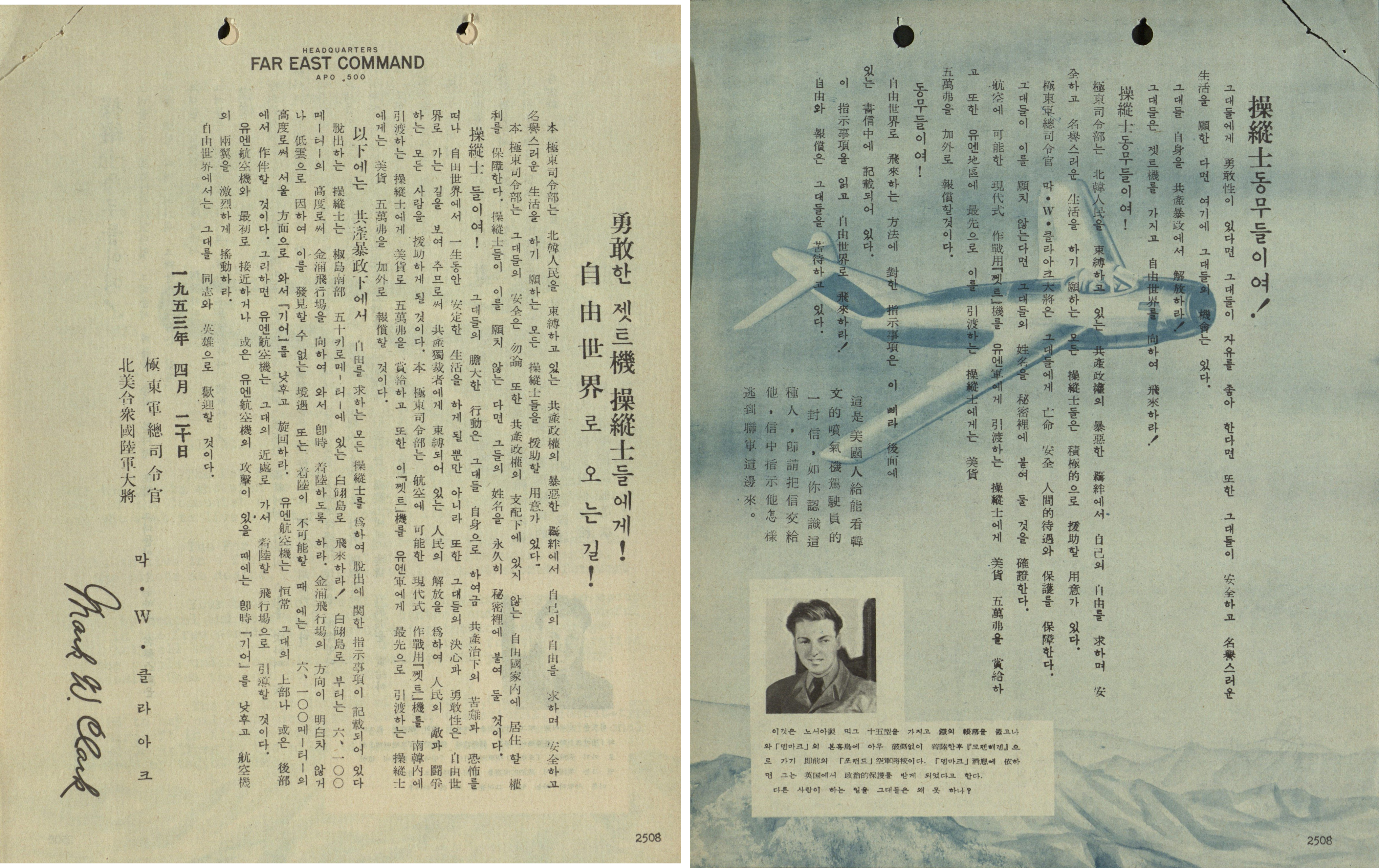
 A propaganda leaflet promising a $100,000 reward to the first North Korean pilot to deliver a jet fighter to UN forces.
Others eventually followed his example, such as the North Korean pilot Lieutenant No Kum-Sok, who claimed to be unaware of the reward US$100,000 when he landed at Kimpo Air Base on 21 September 1953.[41] This MiG-15 was minutely inspected and was test flown by several test pilots including Chuck Yeager. Yeager reported in his autobiography the MiG-15 had dangerous handling faults and claimed that during a visit to the USSR, Soviet pilots were incredulous he had dived in it, this supposedly being very hazardous.[42] When this story got back to the Soviet pilots Yeager claimed to have talked to, they angrily denounced it. In fact, although the MiG-15 did have some handling quirks and could, in principle, exceed flight limits in a dive, its airbrakes opened automatically at the red line limit, preventing it from going out of control.[6] Lieutenant No's aircraft is now on display at the National Museum of the United States Air Force near Dayton, Ohio.
The Cold War
During the 1950s the MiG-15s of the USSR and their Warsaw Pact allies on many occasions, intercepted aircraft of the NATO air forces performing reconnaissance near or inside their territory; such incidents sometimes ending with aircraft of one side or the other being shot down. The known incidents where the MiG-15 was involved include:
- 16 December 1950: An RB-29 of USAF is downed over Primore (Sea of Japan) by two MiG-15 pilots, Captain Stepan A. Bajaev and 1st Lieutenant N. Kotov.
- 19 November 1951: MiG-15bis pilot, 1st Lieutenant A. A. Kalugin forces a USAF C-47 that had penetrated Hungarian airspace to land at the airbase at Pápa.
- 13 June 1952: two naval MiG-15s flown by Captain Oleg Piotrovich Fedotov and 1st Lieutenant Ivan Petrovich Proskurin shot down a RB-29A near Valentin Bay, over the Sea of Japan – all 12 crewmembers perished (their bodies were not recovered).
- 13 June 1952, Catalina affair: A Soviet MiG-15 flown by Captain Osinskiy shot down a DC-3 reconnaissance plane of the Swedish Air Force piloted by Alvar Almeberg near Ventspils over the Baltic Sea. Its three crewmembers perished. Out of two Swedish military Catalina flying boats that conducted subsequent search and rescue for the downed DC-3, one was also shot down by a MiG-15, but this time with no loss of life.
- 7 August 1952: Two MiG-15 pilots, 1st Lieutenants Zeryakov and Lesnov shot down a USAF RB-29 over the Kurile islands – all the crew of nine died (the remains of one of them, Captain John R. Durnham, was returned to the United States in 1993).
- 18 November 1952: four MiG-15bis engaged four F9F-2 Panther off the aircraft carrier USS Princeton near Vladivostok. One MiG-15 pilot, Captain Dmitriy Belyakov, managed to seriously damage Lieutenant Junior Grade David M. Rowlands's F9F-2, but seconds later he and 1st Lieutenant Vandalov were downed by Elmer Royce Williams and John Davidson Middleton; neither Soviet pilot was found.
- 10 March 1953: Two MiG-15bis of the Czechoslovak Air Force intercepted two F-84Gs over Czechoslovak airspace, and Jaroslav Šrámek shot down one of them; the F-84 crashed in Bavarian territory. US pilot bailed out safely.
- 12 March 1953: Seven airmen were killed when the Royal Air Force Avro Lincoln they were flying in, was shot down by a Soviet Air Force MiG-15 in the Berlin air corridor, near Boizenburg, 20 miles NE of Lüneburg.
- 29 July 1953: Two MiG-15bis intercepted a RB-50G near Gamov, in the Sea of Japan, and instructed them to land at their home base. The RB-50 gunners opened fire and hit the MiG of 1st Lieutenant Aleksandr D. Rybakov. Rybakov and his wingman 1st Lieutenant Yuriy M. Yablonskiy then shot down the RB-50. One of the crewmembers (John E. Roche) was rescued alive, and corpses of other three were recovered. The remaining 13 crew members became missing-in-action.
- 17 April 1955: The MiG-15 pilots Korotkov and Sazhin shot down an RB-47E north of the Kamchatka peninsula – all three crewmembers perished.
- 27 June 1955: El Al Flight 402 was shot down by two Bulgarian MiG-15 aircraft after penetrating Bulgarian airspace. All 58 passengers and crew perished in the attack.[43][44][45]
Suez Canal Crisis (1956)
Egypt bought a handful of MiG-15bis and MiG-17 fighters in 1955 from Czechoslovakia with the sponsorship and support of the USSR, just in time to participate in the Suez Canal Crisis. During the air combat against the Israeli Air Force the Egyptian MiG-15bis's managed to shoot down only three Israeli aircraft : a Piper Cub and a Meteor F.8 on 30 October 1956, and a Dassault Ouragan on 1 November which then performed a belly landing — this last victory was scored by the Egyptian pilot Faruq el-Gazzavi.[46]
Other events
Throughout the 1950s[citation needed] MiG-15s of China's People's Liberation Army Air Force (PLAAF) frequently engaged Republic of China (ROC) and U.S. aircraft in combat; in 1958 a ROC F-86 fighter achieved the first air-to-air kill with an AIM-9 Sidewinder air-to-air missile against a PLAAF MiG-15.[47]
The first Soviet cosmonaut Yuri Gagarin was killed in a crash during a March 1968 training flight in a MiG-15UTI due to poor visibility and miscommunication with ground control.[48]
MiG-17
The more advanced MiG-17 was very similar in appearance, but addressed many of the limitations of the MiG-15. It introduced a new swept wing with a "compound sweep" configuration: a 45° angle near the fuselage, and a 42° angle for the outboard part of the wings. The first prototype was flown in 1950 before the end of the Korean war. Later versions introduced radar, afterburning engines and missiles. Although it was obsolete as a subsonic type by 1965, a small force of MiG-17PFs rose to challenge attackers at the Thanh Hoa Bridge, downing or damaging beyond repair F-105 Thunderchief and F-8 Crusader supersonic fighters. Although Vietnam later flew newer supersonic MiG-19s and MiG-21s, the MiG-17 remained effective, soldiering on until the end of the conflict. It was the MiG-15 derivative which first led to new dogfight tactics and training (including the use of the A-4 Skyhawk as MiG-17 simulator) to regain the advantage American F-86s had enjoyed against MiG-15s over the skies of Korea. The MiG-19 was a further development which initially was a MiG-17 fitted with an even sharper wing and tail sweepback, though the final product would bear little resemblance to the original MiG-15 beyond the nose and cockpit.
Production
 SB Lim-2 of the Polish Air Force
The USSR built around 12,000 MiG-15s in all variants. It was also built under license in Czechoslovakia (as the S-102 and S-103) and Poland (as the Lim-1 and Lim-2, and two-seat SB Lim-1 and SB Lim-2).
In the early 1950s, the Soviet Union delivered hundreds of MiG-15s to China, where they received the designation J-2. The Soviets also sent almost a thousand MiG-15 engineers and specialists to China, where they assisted China's Shenyang Aircraft Factory in building the MiG-15UTI trainer (designated JJ-2). China never produced a single-seat fighter version, only the two-seat JJ-2.[49]
The designation "J-4" is unclear; some sources claim Western observers mistakenly labelled China's MiG-15bis a "J-4", while the PLAAF never used the "J-4" designation. Others claim "J-4" is used for MiG-17F, while "J-5" is used for MiG-17PF.[50] Another source claims the PLAAF used "J-4" for Soviet-built MiG-17A, which were quickly replaced by license-built MiG-17Fs (J-5s).[51] What is certain, is that the service lives of the J-2 and J-4 in the PLAAF were short, as they were quickly replaced by the more capable J-5 and J-6.[citation needed]
Variants
 Egyptian Air Force MiG-15UTI
- I-310: Prototype.
- MiG-15: First production version.
- MiG-15P: Single-seat all-weather interceptor version of the MiG-15bis.
- MiG-15SB: Single-seat fighter bomber version.
- MiG-15SP-5: Two-seat all-weather interceptor version of the MiG-15UTI.
- MiG-15T: Target-towing version.
- MiG-15bis: Improved single-seat fighter version.
- MiG-15bisR: Single-seat reconnaissance version.
- MiG-15bisS: Single-seat escort fighter version.
- MiG-15bisT: Single-seat target-towing version.
- MiG-15UTI: Two-seat dual-control jet trainer.
- J-2: (Jianjiji – fighter) Chinese designation of USSR production MiG-15bis single-seat fighter.[52]
- JJ-2: (Jianjiji Jiaolianji – fighter trainer) Chinese production of MiG-15UTI two-seat jet trainers. Exported as Shenyang FT-2.[52]
- BA-5: un-manned target drone conversions of J-2 fighters.[52]
- Lim-1: MiG-15 jet fighters built under license in Poland.
- Lim-1A: Polish-built reconnaissance version of the MiG-15 with AFA-21 camera.
- Lim-2: MiG-15bis built under license in Poland, with Lis-2 (licensed VK-1) engines.
- Lim-2R: Polish-built reconnaissance version of MiG-15bis with a place for a camera in the front part of the canopy.
- SB Lim-1: Polish Lim-1 converted to equivalent of MiG-15UTI jet trainers, with RD-45 jet engines.
- SB Lim-2: Polish Lim-2 or SBLim-1 converted to jet trainers with Lis-1 (VK-1) jet engines.
- SBLim-2A or -2Art: Polish-built two-seat reconnaissance version, for correcting artillery.
- S-102: MiG-15 jet fighters built under license in Czechoslovakia, with M05 (licenced RD-45) Motorlet/Walter engines.
- S-103: MiG-15bis jet fighters built under license in Czechoslovakia with M06 (licenced VK-1) Motorlet/Walter engines.
- CS-102: MiG-15UTI jet trainers built under license in Czechoslovakia.
- Raduga KS-1 Komet: An air-launched anti-shipping cruise missile.
Operators
 Former operators of the MiG-15
 Afghanistan
- Afghan Air Force. 42, including 38 MiG-15UTI, were delivered to the Royal Afghan Air Force from 1951, serving through 1979.[53]
 Albania
- Albanian Air Force. 80 or more have served with the Albanian Air Force since 1955, including Soviet, Czechoslovak and Chinese-built examples. The initial allotment of 10 MiG-15 fighters delivered in 1955 was followed by 24 MiG-15UTI trainers from that year on. These were supplemented by Czechoslovak Avia CS-102 trainers, with four being acquired. Further fighter deliveries comprised 26 MiG-15bis examples. Once Albania switched to Chinese support, deliveries of 24 F-2 fighters and 15 FT-2 trainers commenced from 1965. These aircraft remained in service through the late 1990s.[54]
 Algeria
- Algerian Air Force
 Angola
- People's Air and Air Defence Force of Angola
 Bulgaria
- Bulgarian Air Force
 Burkina Faso
 Cambodia
- Cambodian Air Force
 People's Republic of China
- People's Liberation Army Air Force
- People's Liberation Army Navy Air Force
Imported 654 Mig-15 fighters from October 1950 to 1951. The last 18 Mig-15 fighters retired in 1980. Imported 1460 Mig-15bis fighters from 1952 to 1955. The Mig-15bis retired in 1986. Imported 357 Mig-15UTI trainers from 1951 to 1958. China also refitted some Mig-15 and Mig-15bis fighters to trandem trainers. Mig-15UTI retired in 1986.
 Republic of the Congo
- Congolese Air Force
 Cuba
Cuba- Cuban Air Force
 Czechoslovakia
- Czechoslovak Air Force
 East Germany
- East German Air Force
 Egypt
Egypt- Egyptian Air Force
 Finland
- Finnish Air Force. Only operated the MiG-15UTI.
 Guinea
 Guinea-Bissau
 Hungary
- Hungarian Air Force
 Indonesia
- Indonesian Air Force. Acquired its MiG-15s in 1961. Used MiG-15UTI and other MiG-15 as trainers during the preparation of Operation Trikora in 1962 in Western New Guinea (now Papua and West Papua). The aircraft were grounded in 1969 and removed from service in 1970.
 Iraq
Iraq- Iraqi Air Force
 Libya
Libya- Libyan Air Force
 Madagascar
 Mali
Mali Mongolia
- Mongolian Air Force. deliveried and operated 4 MiG-15UTI as a trainer in 1970 .
 Morocco
- Royal Moroccan Air Force
 Mozambique
 Nigeria
- Nigerian Air Force operated MiG-15UTI as a trainer.
 North Korea
- North Korean Air Force. Still operates MiG-15UTI as a trainer.
 North Vietnam
- Vietnam People's Air Force
 North Yemen
 Pakistan
- Pakistan Air Force
 Poland
 Romania
- Romanian Air Force. Operated a total of 514 MiG-15, MiG-15bis, MiG-15 UTI, S-102 and CS-102 from 1952 until 1992
 Somalia
- Somali Air Corps
 South Yemen
- South Yemen Air Force
 Soviet Union
- Soviet Air Force
- Soviet Anti-Air Defence
 Sri Lanka
- Sri Lanka Air Force
 Sudan
Sudan- Sudanese Air Force
 Syrian Arab Republic
- Syrian Air Force
 Tanzania
- Tanzanian Air Force
 Uganda
- Ugandan Air Force
 United States
- United States Air Force. In the 1980s, the United States purchased a number of Shenyang J-4s along with Shenyang J-5s from China via the Combat Core Certification Professionals Company; these aircraft were employed in a "mobile threat test" program at Kirtland Air Force Base, operated by the 4477th "Red Hats" Test and Evaluation Squadron of the United States Air Force.
 Viet Nam
- Vietnam People's Air Force
 Yemen
Yemen- Yemen Air Force
Survivors
Many MiG-15s are on display through the world. In addition, they are becoming increasingly common as private sport planes and warbirds. According to the FAA, there are 43 privately owned MiG-15s in the US, including Chinese and Polish derivatives/manufacture.[55]
Australia
- Air Combat Australia utilised 2 MiG-15's for adventure flights from 1997, when they originated the adventure flight industry, to 2005 when they upgraded to 4 L-39C Albatros'.
Cuba
- A MiG-15UTI of the FAR (Fuerza Aérea Revolucionaria) is displayed at the Museo del Aire.
Romania
UK
- A Polish-built MiG-15 is displayed in North Korean colours at the Fleet Air Arm Museum.
- An S-102 in Czechoslovakian colours is displayed at the National Museum of Flight, East Fortune, Edinburgh.
USA
- MiG-15 (c/n 2015357) is on display at the National Museum of the United States Air Force in Dayton, Ohio. This is the aircraft flown to Kimpo Air Base in South Korea on 21 September 1953 by a defecting North Korean pilot who was given a reward of $100,000 (see above). The aircraft was flight-tested on Okinawa and then brought to the U.S. to be returned to its "rightful owners" (believed to be the Soviet Union, which denied participating in the Korean War).[38] When this offer was ignored it was transferred to the United States Air Force Museum in November 1957.[56] It is on display in the Museum's Modern Flight gallery.
Specifications (MiG-15bis)
 MiG-15UTI
 MiG-15 Drawing
General characteristics
- Crew: MiG-15bis=1, MiG-15UTI=2
- Length: 10.11 m (33 ft 2 in)
- Wingspan: 10.08 m (33 ft 1 in)
- Height: 3.70 m (12 ft 2 in)
- Wing area: 20.6 m² (221.74 ft²)
- Airfoil: TsAGI S-10 / TsAGI SR-3
- Empty weight: 3,580 kg (7,900 lb)
- Loaded weight: 4,960 kg (10,935 lb)
- Max takeoff weight: 6,105 kg (13,460 lb)
- Fuel capacity: 1,400 L (364 US gal)
- Powerplant: 1 × Klimov VK-1 turbojet, 26.5 kN (5,950 lbf)
Performance
- Maximum speed: 1,075 km/h (668 mph)
- Cruise speed: 840 km/h (520 mph)
- Range: 1,200 km, 1,975 km with external tanks (745 mi / 1,225 mi)
- Service ceiling: 15,500 m (50,850 ft)
- Rate of climb: 50 m/s (9,840 ft/min)
- Wing loading: 240.8 kg/m² (49.3 lb/ft²)
- Thrust/weight: 0.54
Armament
- 2x NR-23 23mm cannons in lower left fuselage (80 rounds per gun, 160 rounds total)
- 1x Nudelman N-37 37 mm cannon in lower right fuselage (40 rounds total)
- 2x 100 kg (220 lb) bombs, drop tanks, or unguided rockets on 2 underwing hardpoints.
See also
- Related development
- Aircraft of comparable role, configuration and era
- Dassault Ouragan
- Dassault Mystere
- Focke-Wulf Ta 183
- FMA IAe 33 Pulqui II
- Hawker Hunter
- Lavochkin La-15
- North American F-86 Sabre
- Republic F-84 Thunderjet
- Saab 29 Tunnan
- Related lists
- List of military aircraft of the Soviet Union and the CIS
- List of fighter aircraft
References
- Notes
- Citations
- ^ "Mikoyan-Gurevich MiG-15 (Ji-2) Fagot B." Smithsonian National Air and Space Museum. Retrieved: 27 August 2011.
- ^ Minnesota Air National Guard Museum." mnangmuseum.org. Retrieved: 12 September 2010.
- ^ a b Designations
- ^ a b c "Designation systems." designation-systems.net. Retrieved: 9 October 2009.
- ^ Listings
- ^ a b c d e f g Gordon, Yefim. Mikoyan-Gurevich MiG-15. Leicester, UK: Midland Publishing, 2001. ISBN 1-85780-105-9.
- ^ a b c d e f g h i j k Krylov, Leonid and Yuriy Tepsurkaev. Soviet MiG-15 Aces of the Korean War", Chapter 1. Korean War Resources (KORWALD). Retrieved: 11 March 2009.
- ^ "Historic Battles." historic-battles.com. Retrieved: 12 September 2010.
- ^ "Korean Air Force." korean-war.com. Retrieved: 12 September 2010.
- ^ a b Zampini, Diego. "Russian [sic-Soviet] Aces over Korea Mikoyan-Gurevich MiG-15 Fagot pilots". Acepilots.com, 2008. Retrieved: 10 March 2009.
- ^ a b Zaloga 1991
- ^ a b Krylov and Tepsurkaev 2009
- ^ "Sabre: The F-86 in Korea." findarticles.com. Retrieved: 12 September 2010.
- ^ Thompson and McLaren 2002, Chapter 10.
- ^ a b Seydov, Igor. "Dmitriy Samoylov", Mir Aviatsiya, 1–2003, pp. 30–36.
- ^ a b c Thompson and McLaren 2002, Appendix B.
- ^ a b KORWALD Retrieved: 12 September 2010.
- ^ Davis 2001, p. 91.
- ^ Krylov and Tepsurkaev 2008, Chapter 1.
- ^ Zampini, Diego. "Red Stars over North Korea". Flieger Revue Xtra 22, November 2008.
- ^ Zampini, Diego. "Red Stars over North Korea". Flieger Revue Xtra 22, November 2008
- ^ a b c d Seydov, Igor and Askold German. "Krasnye Dyaboly na 38-oy Parallel." Moskow: EKSMO, 1998.
- ^ Zampini, Diego. "Red Stars over North Korea", Flieger Revue Xtra 23, December 2008
- ^ Dorr et al 1995, Chapter 3.
- ^ Zhang 2003, pp 167–168.
- ^ a b c Krylov and Tepsurkaev 2008, Chapter 6.
- ^ Zhang 2003, pp 192, 265.
- ^ Zampini, Diego. "Red Stars over North Korea", Flieger Revue Xtra 23, November 2008
- ^ Krylov and Tepsurkaev 2008, Appendixes.
- ^ Grossnick, Roy A. and William J. Armstrong. United States Naval Aviation, 1910–1995. Annapolis, Maryland: Naval Historical Center, 1997. ISBN 0-16-049124-X.
- ^ Gobel, Greg. "The Douglas F3D Skyknight." Vectorsite, 1 August 2008. Retrieved: 2 May 2009.
- ^ Dorr et al 1995, p. 71.
- ^ Zhang 2002, pp. 194–195.
- ^ "Sea Fury History". Unlimited Air Racing. Retrieved: 9 March 2007.
- ^ Flight Journal Aug 2002 Corsairs to the rescue
- ^ Zhang 2002, Chapter 7.
- ^ Zhang 2002, Chapter 9.
- ^ a b Friedman, Herbert A. Operation Moolah: The Plot to Steal a MiG-15.
- ^ Albury, Chuck. "Escape from Red Poland." St. Petersburg Times, 5 March 1967. Retrieved: 14 July 2010.
- ^ Mehta, Coleman Armstrong. "A Rat Hole to be Watched? CIA Analyses of the Tito-Stalin Split, 1948–1950." lib.ncsu.edu. Retrieved: 22 November 2010.
- ^ Kum-Sok and Osterholm 1996
- ^ Yeager and Janos 1986, p. 208.
- ^ Magnus, Allan. "Shootdowns of the Cold War Era Air Aces, 28 July 2002. Retrieved: 14 July 2010.
- ^ Kotlobovsky, Alexander. "Goryachoe Nebo Kholodnoy Voyny" ("The Hot Sky of the Cold War" (Russian)) airforce.ru, 2005. Retrieved: 14 July 2010.
- ^ Lednicer, David. "Aircraft Downed During the Cold War and Thereafter." silent-warriors.com, 8 November 2005. Retrieved: 14 July 2010.
- ^ Nicolle 1996
- ^ "AAM-N-7/GAR-8/AIM-9 Sidewinder."Raytheon (Philco/General Electric)." designation-systems.net. Retrieved: 12 September 2010.
- ^ Doran 1998, pp. 210–229.
- ^ "China." globalsecurity.org. Retrieved: 12 September 2010.
- ^ [1]
- ^ "Background." airtoaircombat.com. Retrieved: 12 September 2010.
- ^ a b c Gordon,Yefim and Dmitry Komissarov. Chinese Aircraft. Manchester: Hikoki Publications, 2008. ISBN 978-1902 109046.
- ^ Afghanistan (AFG), World Air Forces – Historical Listings
- ^ "Albania (ALB), World Air Forces – Historical Listings." worldairforces.com. Retrieved: 12 September 2010.
- ^ "FAA Register: MiG-15." FAA. Retrieved: 17 May 2011.
- ^ United States Air Force Museum 1975, p. 57.
- Bibliography
- Belyakov, R.A. and J. Marmain. MiG: Fifty Years of Secret Aircraft Design. Annapolis, Maryland: US Naval Institute Press, 1993. ISBN 978-1-55750-566-8.
- Butowski, Piotr (with Jay Miller). OKB MiG: A History of the Design Bureau and its Aircraft. Earl Shilton, Leicester, UK: Midland Counties Publications, 1991. ISBN 0-904597-80-6.
- Davis, Larry. 4th Fighter Wing in the Korean War. Atglen, Pennsylvania: Schiffer Publishing, 2001. ISBN 978-0-7643-1315-8.
- Davis, Larry. MiG Alley Air to Air Combat over Korea. Warren, Michigan: Squadron/Signal Publications Inc., 1978. ISBN 0-89747-081-8.
- Doran, Jamie and Piers Bizony. Starman: The Truth Behind the Legend of Yuri Gagarin. London: Bloomsbury Publishing plc, 1998. ISBN 0-7475-3688-0.
- Dorr, Robert F., Jon Lake and Warren Thompson. Korean War Aces(Aircraft of the Aces). London: Osprey Publishing, 1995. ISBN 978-1-85532-501-2.
- Gordon, Yefim and Peter Davison. Mikoyan Gurevich MiG-15 Fagot (WarbirdTech Volume 40). North Branch, Minnesota: Speciality Press, 2005. ISBN 1-58007-081-7.
- Gordon, Yefim and Vladimir Rigmant. Warbird History: MiG-15 – Design, Development, and Korean War Combat History. St. Paul, Minnesota: Motorbooks, 1993. ISBN 978-0-87938-793-8.
- Gordon, Yefim et al. MiG-15 Fagot, all variants (bilingual Czech/English). Prague 10-Strašnice: MARK I Ltd., 1997. ISBN 80-900708-6-8.
- Gordon,Yefim & Komissarov, Dmitry. Chinese Aircraft. Hikoki Publications. Manchester. 2008. ISBN 9 781902 109046
- Gunston, Bill. The Osprey Encyclopedia of Russian Aircraft: 1875–1995. London: Osprey Aerospace, 1996.
- Higham, Robin, John T. Greenwood and Von Hardesty. Russian Aviation and Air Power in the Twentieth Century. London: Frank Cass, 1998. ISBN 978-0714643809.
- Karnas, Dariusz. Mikojan Gurievitch MiG-15. Sandomierz, Poland/Redbourn, UK: Mushroom Model Publications, 2004. ISBN 978-8389450050.
- Krylov, Leonid and Yuriy Tepsurkaev. "Combat Episodes of the Korean War". Mir Aviatsiya (Translation to English language by Stephen L. Sewell), 1–97, pp. 38–44. Retrieved: 29 March 2009.
- Krylov, Leonid and Yuriy Tepsurkaev. Soviet MiG-15 Aces of the Korean War. Botley, Oxford, UK: Osprey Publications, 2008. ISBN 1-84603-299-7.
- Kum-Suk, No and Roger J. Osterholm. A MiG-15 to Freedom. Jefferson, North Carolina: McFarland & Co. Publishers, 1996. ISBN 0-7864-0210-5.
- Mesko, Jim. Air War over Korea. Carrollton, Texas: Squadron/Signal Publications Inc., 2000. ISBN 0-89747-415-5.
- Nicolle, David. Phoenix over the Nile: A History of Egyptian Air Power 1932–1994 (Smithsonian History of Aviation & Spaceflight). Washington, D.C.: Smithsonian, 1996. ISBN 1-56098-626-3.
- Seydov, Igor and Askold German. Krasnye Dyaboly na 38-oy Parallel. EKSMO, Russia. 1998
- Stapfer, Hans-Heiri. MiG-15 Fagot Walk Around (Walk Around 40). Carrollton, Texas: Squadron/Signal Publications Inc., 2006. ISBN 0-89747-495-3.
- Stapfer, Hans-Heiri. MiG-15 in action (Aircraft number 116). Carrollton, Texas: Squadron/Signal Publications Inc., 1991. ISBN 0-89747-264-0.
- Sweetman, Bill and Bill Gunston. Soviet Air Power: An Illustrated Encyclopedia of the Warsaw Pact Air Forces Today. London: Salamander Books, 1978. ISBN 0-517-24948-0.
- Thompson, Warren E. and David R. McLaren. MiG Alley: Sabres vs. MiGs over Korea. North Branch, Minnesota: Specialty Press, 2002. ISBN 978-1-58007-058-4.
- United States Air Force Museum Guidebook. Wright-Patterson AFB, Ohio: Air Force Museum Foundation, 1975.
- Werrell, Kenneth. Sabres Over MiG Alley: The F-86 and the Battle for Air Superiority in Korea. Annapolis, Maryland: U.S. Naval Institute Press, 2005. ISBN 978-1-59114-933-0.
- Wilson, Stewart. Legends of the Air 1: F-86 Sabre, MiG-15 and Hawker Hunter. London: Aerospace Publications Pty Ltd., 2003. ISBN 1-875671-12-9.
- Yeager, Chuck and Leo Janos. Yeager: An Autobiography. New York: Bantam Books, 1986. ISBN 0-553-25674-2.
- Zaloga, Steven J. "The Russians in MiG Alley: Their part in the Korean War." Air Force Magazine, Volume 74, Issue 2, February 1991.
- Zhang, Xiaoming. Red Wings over the Yalu: China, the Soviet Union, and the Air War in Korea (Texas A&M University Military History Series). College Station, Texas: Texas A&M University, 2002. ISBN 978-1-58544-201-0.
External links
- Noland,David. Fighter Planes: MiG-15. The Air Power of the Evil Empire
- The Mikoyan MIG-15 at Greg Goebel's AIR VECTORS
- Warbird Alley: MiG-15 page- Information about privately owned MiG-15s
- MiG-15 in Korea
- MiG-15 Fagot at Global Security.org
- MiG-15 Fagot at Global Aircraft
- MiG-15 Fagot at FAS
- MiG-15 versus F-86
- Cuban MiG-15
- We Flew the Mig, US propaganda movie on the merits of the plane, at Google Video
- Mig Alley USA, Aviation Classics, Ltd Reno, Nevada
Mikoyan and Gurevich (MiG) aircraft Fighters/Interceptors Attack Reconnaissance Trainers Experimental Lists relating to aviation General Aircraft (manufacturers) · Aircraft engines (manufacturers) · Airlines (defunct) · Airports · Civil authorities · Museums · Registration prefixes · Rotorcraft (manufacturers) · TimelineMilitary Accidents/incidents Records Categories:- Military aircraft of the Korean War
- Mikoyan aircraft
- Soviet fighter aircraft 1940–1949
- Soviet military trainer aircraft 1940–1949
- 1949 introductions




































Wikimedia Foundation. 2010.
