

- Cutting (plant)
-
"Rooting" redirects here. For the Android OS concept, see Rooting (Android OS).
 Plant cuttings can be taken by cutting a stem of a plant, or a single leaf.
Plant cutting, also known as striking or cloning, is a technique for vegetatively (asexually) propagating plants in which a piece of the source plant containing at least one stem cell is placed in a suitable medium such as moist soil, potting mix, coir or rock wool. The cutting produces new roots, stems, or both, and thus becomes a new plant independent of the parent.
Contents
Technique
Typically, striking is a simple process in which a small amount of the parent plant is removed. This removed piece, called the cutting, is then encouraged to grow as an independent plant.
Since most plant cuttings will have no root system of their own, they are likely to die from dehydration if the proper conditions are not met. To have a reasonable chance of success, the cutting should have:
- a moist medium. The medium cannot, however, be too wet lest the cutting rot. A number of media are used in this process, including but not limited to soil, perlite, vermiculite, coir, rock wool, expanded clay, and even water given the right conditions.
- a humid environment (this generally means placing the cuttings under a plastic sheet or in another confined space where the air can be kept moist)
- partial shade (to prevent the cutting from drying out)
If the plant is unlikely to grow, even with the above conditions met, you can administer a rooting hormone to "encourage" the plant to grow and mature.
After cuttings are placed in the medium, they are watered thoroughly with a fine mist, such as from a nozzle sprayer or a spray mister bottle. After the initial watering, the medium is allowed to almost dry out before misting again, with the aim to keep the soil moist but not wet and waterlogged. A fine mist is used to avoid disturbing plants.
In addition, the cutting needs to be taken correctly; this means:
- at the right time; in temperate countries, stem cuttings of young wood need to be taken in spring, of hardened wood they need to be taken in winter
- with the right size and amount of foliage; length of stem cuttings of soft wood for example need to be between 5-15 cm and of hard wood between 20-25 cm. Also, two thirds of the foliage of soft wood stem cuttings should be removed. For hard wood stem cuttings, complete foliage removal is necessary.
Though not essential, several compounds may be used to promote the formation of roots through the signaling activity of plant hormone auxins, and is helpful with especially hard plant species. Among the commonly used chemicals is indole-3-butyric acid (IBA) used as a powder, liquid solution or gel. This compound is applied either to the cut tip of the cutting or as a foliar spray. Rooting hormone can be manufactured naturally - one method is to soak the yellow-tipped shoots of a weeping willow tree in water, or to prepare a tea from the bark of a willow tree. When using the shoots or bark, they should be soaked for 24 hours prior to using.[1] Honey, though it does not contain any plant hormones, can also make an effective rooting substance.
Some plants form roots much more easily. Most succulent cuttings can be left on a table and small roots will form, and some other plants can form roots from having their cuttings placed in a cup of water.
Types of cuttings
Many vegetative parts of a plant can be used. The most common methods are:-
- Stem cuttings, in which a piece of stem is part buried in the soil, including at least one leaf node. The cutting is able to produce new roots, usually at the node.
- Root cuttings, in which a section of root is buried just below the soil surface, and produces new shoots
- Scion cuttings, which are dormant ligneous woody twigs.[2]
- Eye cuttings, which are pieces of foliated or defoliated stalks with one or more eyes.[3]
- Leaf cuttings, in which a leaf is placed on moist soil. These have to develop both new stems and new roots. Some leaves will produce one plant at the base of the leaf. In some species, multiple new plants can be produced at many places on one leaf, and these can be induced by cutting the leaf veins.
Although some species, such as willow, blackberry and pelargoniums can be grown simply by placing a cutting into moist ground, the majority of species require more attention. Most species require humid, warm, partially shaded conditions to strike, thus requiring the approach above to be followed. Particularly difficult species may need cool air above and warm soil. In addition, with many more difficult cuttings, one should use the type of cutting that has the most chance of success with that particular plant species.[4]
Providing the right soil
Depending on the type of soil being used, several additives may need adding to create good soil for cuttings. These additions may include:
- chalk; to increase the pH-value of the soil; a pH of 6-6,5 is to be maintained
- organic substance/humus; to increase nutrient load; keep to a bare minimum though
- sand or gravel; to increase the soil's water permeability
For example with plain potting soil, a third of the container should be filled with sand, to make suitable soil for cuttings.
Providing the right humidity
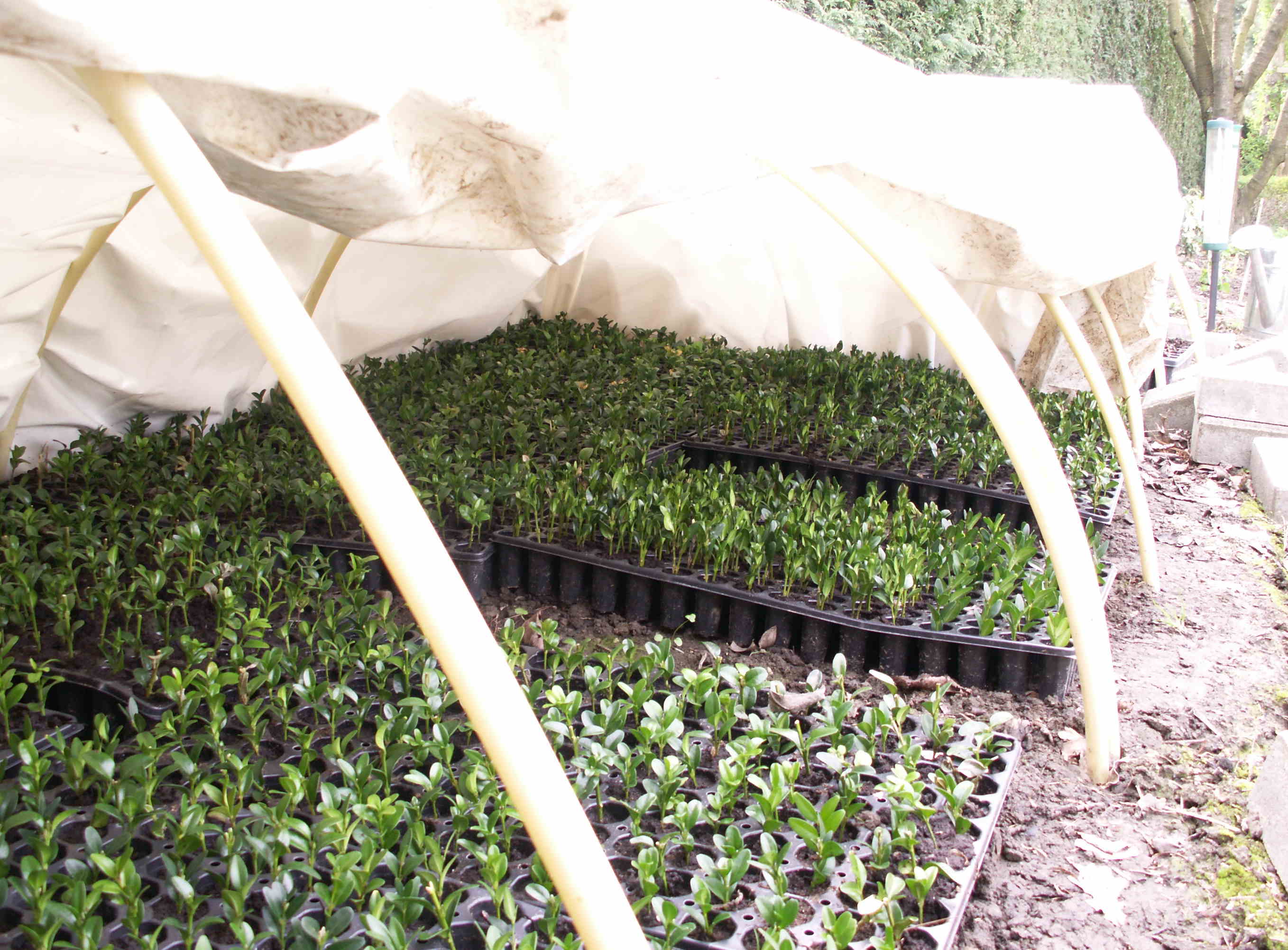
 A white plastic greenhouse, used to keep the cuttings humid
Although several options can be used here, usually semi-white plastic is used to cover the cuttings. The soil below and from the cuttings themselves is kept moist, and should be aerated once in a while to prevent formation of molds.
Stem cuttings or truncheons
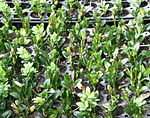 Softwood stemcuttings of Buxus sempervirens
In temperate countries, stem cuttings may be taken of soft (green or semi-ripe) wood and hard wood which has specific differences in practice. Stem cuttings of soft wood is taken in spring, while from hard wood, they are taken in winter. Also, of soft wood the upper branches are taken (with a length of 5-15 cm) and with hard wood, the lower branches are taken instead (with a length of 20-25 cm). Finally, soft wood cuttings are planted above ground and hard wood cuttings are totally submerged with soil. With hard wood cuttings, several cuttings are also bound together (to a bushel).
See also
References
- ^ "How to make your own rooting hormone". Pioneerthinking.com. 2005-11-02. http://www.pioneerthinking.com/mp_rootinghormone.html. Retrieved 2010-02-21.
- ^ "Scion cuttings description". Rooting-hormones.com. 2009-02-01. http://www.rooting-hormones.com/cuttype.htm. Retrieved 2010-02-21.
- ^ "Eye cuttings description". Rooting-hormones.com. 2009-02-01. http://www.rooting-hormones.com/cuttype.htm. Retrieved 2010-02-21.
- ^ "Certain plant species having more success with certain types of cuttings". Healthrecipes.com. http://www.healthrecipes.com/plant_cuttings.htm. Retrieved 2010-02-21.
External links
Categories:- Horticulture and gardening
- Plant reproduction



Wikimedia Foundation. 2010.
