

- Organ (anatomy)
-
For the musical instrument, see Organ (music).
In biology, an organ (Latin: organum, "instrument, tool", from Greek ὄργανον, organon, "organ, instrument, tool"[1]) is a collection of tissues joined in structural unit to serve a common function. [2]
Usually there is a main tissue (parenchyma) and sporadic tissues (stroma). The main tissue is the one that is unique for the specific organ. For example, main tissue in the heart is the myocardium, while sporadic are the nerves, blood, connective etc.. Functionally related organs often cooperate to form whole organ systems. Organs exist in all higher biological organisms, in particular they are not restricted to animals, but can also be identified in plants. An example of this is the bladder. In single-cell organisms like bacteria, the functional analogues of organs are called organelles.
A hollow organ is a visceral organ that is a hollow tube or pouch (as the stomach or intestine) or that includes a cavity (as of the heart or urinary bladder).[3]
Contents
Organ systems
Main article: Biological systemTwo or more organs working together in the execution of a specific body function form an Organ System (Biological System or Body System). The functions of organ systems often share significant overlap. For instance, the nervous and endocrine system both operate via a shared organ, the hypothalamus. For this reason, the two systems are combined and studied as the neuroendocrine system. The same is true for the musculoskeletal system the relationship between the muscular and skeletal systems.
Plants
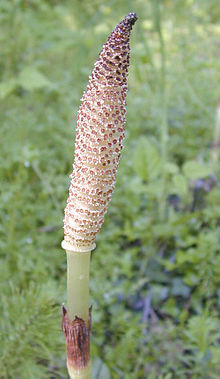 Strobilus of Equisetum telmateia.
Organs of plants can be divided into vegetative and reproductive. Vegetative plant organs are root, stem, and leaf. The reproductive organs are variable. In angiosperms, they are represented with the flower, seed and fruit. In conifers, the organ that bears the reproductive structures is called a cone. In other divisions of plants, the reproductive organs are called strobili (in Lycopodiophyta) or simply gametophores (in mosses).
The vegetative organs are essential for maintaining the life of a plant. While there can be 11 organ systems in animals, there are far fewer in plants, where some perform the vital functions, such as photosynthesis, while the reproductive organs are essential in reproduction. However, if there is asexual vegetative reproduction, the vegetative organs are those that create the new generation of plants (see clonal colony).
The three main organ systems in vascular plants are the root, shoot and reproductive systems.
Animals
The organ level of organisation in animals can be first detected in flatworms and the more advanced phyla. The less-advanced taxons (like Placozoa, Porifera and Radiata) do not show consolidation of their tissues into organs.
List of mammalian organ systems
There are eleven major organ systems found in mammals.
Mammals such as humans have a variety of organ systems. These specific systems are also widely studied in human anatomy.
- Circulatory system: pumping and channeling blood to and from the body and lungs with heart, blood and blood vessels.
- Digestive system: digestion and processing food with salivary glands, esophagus, stomach, liver, gallbladder, pancreas, intestines, colon, rectum and anus.
- Endocrine system: communication within the body using hormones made by endocrine glands such as the hypothalamus, pituitary or pituitary gland, pineal body or pineal gland, thyroid, parathyroids and adrenals, i.e., adrenal glands.
- Excretory system: kidneys, ureters, bladder and urethra involved in fluid balance, electrolyte balance and excretion of urine.
- Integumentary system: skin, hair and nails.
- Lymphatic system: structures involved in the transfer of lymph between tissues and the blood stream, the lymph and the nodes and vessels that transport it including the Immune system: defending against disease-causing agents with leukocytes, tonsils, adenoids, thymus and spleen.
- Muscular system: movement with muscles.
- Nervous system: collecting, transferring and processing information with brain, spinal cord, peripheral nerves and nerves.
- Reproductive system: the sex organs, such as ovaries, fallopian tubes, uterus, vagina, mammary glands, testes, vas deferens, seminal vesicles, prostate and penis.
- Respiratory system: the organs used for breathing, the pharynx, larynx, trachea, bronchi, lungs and diaphragm.
- Skeletal system: structural support and protection with bones, cartilage, ligaments and tendons.
See also
- Cloning
- Fascia
- Organ transplant
- Organelles, analogous sub-cellular structures
References
- ^ Organon, Henry George Liddell, Robert Scott, A Greek-English Lexicon, at Perseus project
- ^ Widmaier EP, Raff H, and Strang KT (2003) Vander's Human Physiology. 11th Ed. McGraw-Hill. ISBN 987-0-07-304962-5.
- ^ Dictionary.com > hollow organ Citing: Merriam-Webster's Medical Dictionary, 2002
External links
Human systems and organs TA 2–4:
MSBone (Carpus · Collar bone (clavicle) · Thigh bone (femur) · Fibula · Humerus · Mandible · Metacarpus · Metatarsus · Ossicles · Patella · Phalanges · Radius · Skull (cranium) · Tarsus · Tibia · Ulna · Rib · Vertebra · Pelvis · Sternum) · CartilageTA 5–11:
splanchnic/
viscusmostly
Thoracicmostly
AbdominopelvicDigestive system+
adnexaMouth (Salivary gland, Tongue) · upper GI (Oropharynx, Laryngopharynx, Esophagus, Stomach) · lower GI (Small intestine, Appendix, Colon, Rectum, Anus) · accessory (Liver, Biliary tract, Pancreas)TA 12–16 Blood
(Non-TA)General anatomy: systems and organs, regional anatomy, planes and lines, superficial axial anatomy, superficial anatomy of limbsBiosphere > Ecosystem > Community (Biocoenosis) > Population > Organism > Organ system > Organ > Tissue > Cell > Organelle > Molecule (Macromolecule · Biomolecule) > AtomCategories:- Organ systems
- Organs


Wikimedia Foundation. 2010.
